
Encyclopedia
"The Star-Spangled Banner" is the national anthem of the
United States of America, with lyrics written in 1814 by
Francis Scott Key. Key, a 35-year-old lawyer and amateur poet, wrote them as a poem after witnessing the bombardment of
Fort McHenry in
Baltimore,
Maryland, by
British ships in
Chesapeake Bay during the
War of 1812.
Set to the tune of "To Anacreon in Heaven," a popular British drinking-song, it became well-known as an American patriotic song. With a range of one and a half octaves, it is known for being notoriously difficult to sing. It was recognized for official use by the
United States Navy and the
White House , and was made the national anthem by a
Congressional resolution on 3 March 1931. Although the song has four stanzas, only the first is commonly sung today.
History
Early history
On September 3, 1814, Key and John S. Skinner of Baltimore, Maryland, an American prisoner-exchange agent, set sail from Baltimore aboard the
sloop HMS
Minden flying a
flag of truce on a mission approved by U.S. President
James Madison. Their goal was to secure the release of Dr. William Beanes, the elderly and popular town physician of Upper Marlboro, a friend of Key's who had been captured in his home. He was being accused of aiding in getting British soldiers arrested. Key and Skinner boarded the British flagship, HMS
Tonnant, on 7 September and spoke with General Robert Ross and Admiral Alexander Cochrane over dinner, while they discussed war plans. At first, Ross and Cochrane refused to release Beanes, but relented after Key and Skinner showed them letters written by wounded British prisoners praising Beanes and other Americans for their kind treatment.
Because Key and Michle Skinner had heard details of the plans for the attack on Baltimore, they were held captive until after the battle, first aboard HMS
Surprise, and later back on
Minden, after which some British gunboats attempted to slip past the fort and effect a landing in a cove to the west of it, but they were turned away by gunners at nearby Fort Covington, the city's last line of defense. During the rainy night, Key had witnessed the bombardment and observed that the fort's smaller "storm flag" continued to fly, but once the shelling had stopped, he would not know how the battle had turned out until dawn. By then, the storm flag had been lowered, and a larger flag had been raised.
Key was inspired by the American victory and the sight of the large
American flag flying triumphantly above the fort. This flag, with fifteen stars and fifteen stripes, is today on display in the
National Museum of American History, a treasure of the
Smithsonian Institution. It was restored in 1914 by Amelia Fowler, and again in 1998 as part of an ongoing conservation program.
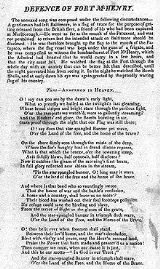
Aboard the ship the next day, Key wrote a poem on the back of a letter he had kept in his pocket. At twilight on 16 September, he and Skinner were released in Baltimore. He finished the poem at the Indian Queen Hotel, where he was staying, and he entitled it "Defence of Fort McHenry."
Key gave the poem to his brother-in-law, Judge Joseph H. Nicholson, who recognized that the words fit the tune of the popular melody "To Anacreon in Heaven," which dated from the mid-1760s, when it had been composed, in
London, by John Stafford Smith. Nicholson took the poem to a printer in Baltimore, who anonymously printed
broadside copies of it—the song's first known printing—on 17 September; of these, two known copies survive.
On 20 September, both the
Baltimore Patriot and
The American printed the song, with the note "Tune: Anacreon in Heaven." The song quickly became popular, with seventeen newspapers from
Georgia to
New Hampshire printing it. Soon after, Thomas Carr of the Carr Music Store in Baltimore published the words and music together under the title "The Star-Spangled Banner." The song's popularity grew even larger, and its first public performance took place in October, when Baltimore actor Ferdinand Durang sang it at Captain McCauley's tavern.
The song gained popularity throughout the
nineteenth century and bands played it during public events, such as July 4 celebrations. On 27 July 1889, Secretary of the Navy
Benjamin F. Tracy signed General Order #374, making "The Star-Spangled Banner" the official tune to be played at the raising of the flag.
In 1913, Percy Moran painted a picture of Francis Scott Key reaching out toward the flag.
In 1916,
Woodrow Wilson ordered that "The Star-Spangled Banner" be played at military and other appropriate occasions. Although the playing of the song two years later during the
seventh-inning stretch of the 1918 World Series is often noted as the first instance that the Anthem was played at a baseball game, evidence shows that the "Star Spangled-Banner" was performed as early as 1897 at Opening Day ceremonies in Philadelphia and then more regularly at the Polo Grounds in New York beginning in 1898. Today, the anthem is performed before the first pitch at every game.
On 3 November 1929, Robert Ripley drew a panel in his syndicated cartoon,
Believe it or Not! is a franchise which deals in bizarre events and items so strange and un...
, saying, "Believe It or Not, America has no national anthem." In 1931,
John Philip Sousa published his opinion in favor, stating that "it is the spirit of the music that inspires" as much as it is Key's "soulstirring" words. By a law signed on 3 March 1931 by President
Herbert Hoover, "The Star-Spangled Banner" was adopted as the national anthem of the United States.
Modern history
A famous instrumental interpretation is
Jimi Hendrix's guitar solo at the first
Woodstock Festival. It became a late-1960s emblem. Whitney Houston's rendition at
Super Bowl XXV is often considered one of the best performances of the song.
When sung in public , verses after the first are almost always omitted, and few Americans know their words.
Isaac Asimov's short story "No Refuge Could Save" made light of this: a foreign spy was identified when it was found he knew every stanza, the joke being that no "real" American would know the whole text. It is also sometimes said humorously that the last two words of the national anthem are "PLAY BALL!" since that phrase is shouted by
baseball umpires after the anthem is played before games.
In March 2005, the government-sponsored The National Anthem Project was launched after a
Harris Interactive poll showed many adults knew neither the lyrics nor the history of the anthem. While some view this project as a form of wartime
propaganda, some music teachers say it will offer benefits for music education by bringing new attention to their efforts.
Satire
From
Kurt Vonnegut's
Breakfast of Champions is a 1973 [i] novel by the American author Kurt Vonnegut [i] ...
:
- Listen:
- Trout and Hoover were citizens of the United States of America, a country which was called America for short. This was their national anthem, which was pure , like so much they were expected to take seriously:
- [the first stanza of the anthem follows]
- There were one quadrillion nations in the Universe, but the nation Dwayne Hoover and Kilgore Trout belonged to was the only one with a national anthem which was gibberish sprinkled with question marks.
- [...]
- The undippable flag was a beauty, and the anthem and the vacant motto might not have mattered much, if it weren´t for this: a lot of citizens were so ignored and cheated and insulted that they thought they might be in the wrong country, or even on the wrong planet, that some terrible mistake had been made. It might have comforted them some if their anthem and their motto had mentioned fairness or brotherhood or hope or happiness, had somehow welcomed them to the society and its real estate.
Lyrics
Translations
The anthem has also been translated into other languages. In 1861, it was translated into German. It has been translated into Yiddish by Jewish immigrants , and into
French by
Acadians of
Louisiana . The third verse of the anthem has also been translated into
Latin. It has been translated into Samoan; here are the last four lines of the first verse:
- O roketi mumu fa'aafi, o pomu ma fana ma aloi afi
- E fa'amaonia i le po atoa, le fu'a o lo'o tu maninoa.
- Aue! ia tumau le fe'ilafi mai, ma agiagia pea
- I eleele o sa'olotoga, ma nofoaga o le au totoa..
Nuestro Himno
A
Spanish-language version, "Nuestro Himno," was released on 28 April 2006, just days before nationwide demonstrations about immigration-law reform. This version was created as a show of support for Latino and
Hispanic immigrants in the United States as a response to a proposed crackdown on illegal immigration. Similar to the English version of the
Canadian national anthem, which was set to the tune of the French version but is not related to the text thereof, this song, or
himno, is merely inspired by and is only an approximate—not a word-for-word—translation of stanzas selected from Key's poem. No claim is made that it is the Spanish-language version of the United States' national anthem. Public reaction was widely divided, and it drew this response from
President George W. Bush: "I think people who want to be a citizen of this country ought to learn English and they ought to learn to sing the national anthem in English."
"Nuestro Himno" is not the first Spanish-language version of the "The Star-Spangled Banner" to have been published. The
United States Department of State's shows other Spanish-language versions of it, including "Himno nacional—La Bandera de Estrellas," copyrighted in 1919.
Another multilingual version was released on May 16, 2006. Performing as Voices United for America, ten singers sing the song in
Italian, Spanish,
Swedish,
Bulgarian,
German,
Arabic,
Japanese,
Tagalog,
Korean, and English. The song was recorded to raise awareness of House Resolution 793, which states that the National Anthem should be sung only in English.
Performances
The song is notoriously difficult for nonprofessionals to sing, because its range is wide: an octave and a half.
Garrison Keillor has frequently campaigned for the performance of the anthem in the original key,
G major—which can, in fact, be managed by most average singers without difficulty. Humorist Richard Armour referred to the song's difficulty in his book
It All Started With Columbus:
- In an attempt to take Baltimore, the British
...
attacked
Fort McHenry, which protected the harbor. Bombs were soon bursting in air, rockets were glaring, and all in all it was a moment of great historical interest. During the bombardment, a young lawyer named Francis Scott Key wrote "The Star-Spangled Banner", and when, by the dawn's early light, the British heard it sung, they fled in terror!
Professional singers have been known to forget the words—which is one reason the song is so often prerecorded and lip-synched. This situation was lampooned in the comedy film The Naked Gun, as its star
Leslie Nielsen, undercover as opera singer Enrico Palazzo at a baseball game, made mincemeat of the lyrics. The prerecording of the anthem has become standard practice at some ballparks , due also in part to the poor acoustics at such venues. Since the 1970s, it has been a tradition at
Baltimore Orioles games for fans to accent the line of "Oh, say does that Star-Spangled Banner yet wave" in the "The Star Spangled Banner" by yelling "O!"
Musical references
The tune has been referenced in many other musical compositions.
- The city of Philadelphia commissioned Richard Wagner to write a piece in honor of the centenary of U.S. independence. His American Centennial March uses a recurring allusion to "The Star-Spangled Banner" in its main theme.
- The nineteenth-century American composer Louis Moreau Gottschalk incorporated both "The Star-Spangled Banner" and "Yankee Doodle" in his piano composition The Union.
- Giacomo Puccini controversially used the opening phrases of "The Star-Spangled Banner" as a theme for the character of Pinkerton in his opera Madama Butterfly.
- The last of Leopold Godowsky's set of thirty piano pieces titled Triakontameron is "Requiem : Epilogue", which concludes with a full-blown romantic arrangement of the anthem. The opening strains of the anthem appear prominently in first portion of Edwin E. Bagley's National Emblem March.
- The paraphrase of the first stanza is used in the score of American Panorama by Daniele Amfitheatrof.
- The title tune of the 1960s musical Hair
...
contains the line "O, say, can you see my eyes? If you can, then my hair's too short!"
- Jimi Hendrix performed "The Star-Spangled Banner" at the Woodstock Festival on August 18, 1969.
- The opera Nixon in China by John Coolidge Adams seems to quote "The Star-Spangled Banner" upon the arrival of President Nixon's plane.
Media
References
External links
- —free easy piano arrangement of "The Star-Spangled Banner / Anacreon in Heaven"
- City Pages, July 4, 2001