

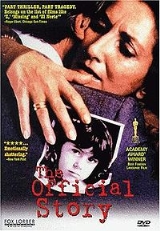
The Official Story

Encyclopedia
The Official Story is a 1985
Argentine
drama film
directed by Luis Puenzo
, and written by Puenzo and Aída Bortnik
. It stars Norma Aleandro
, Héctor Alterio, and Chunchuna Villafañe
, among others. In the United Kingdom
, it was released as The Official Version.
The film is about an upper middle class
couple in Buenos Aires
with an adopted child
. The mother comes to realize that her daughter may be the child of a desaparecido, a victim of the forced disappearance
s that occurred during Argentina's Dirty War
in the 1970s.
Among several other international awards, it won the Oscar for Best Foreign Language Film at the 58th Academy Awards
, being the first Latin America
n film to achieve it.
. It begins five years after Alicia (Norma Aleandro), a History
high school teacher and, Roberto (Héctor Alterio), a wealthy businessman and lawyer with close ties to the military junta
, had adopted a baby girl named Gaby (Analia Castro).
Alicia starts wondering about the real parents of Gaby, a topic her husband has told her to forget as it was a condition of the adoption. Yet, he knows the story of his daughter's adoption. While hard to believe, Alicia, as other members of the Argentine middle class, is not aware of how much killing and suffering has gone on in the country, until her students begin to complain that the "government approved" History books given to them were written by the regime's "assassins".
After Ana (Chunchuna Villafañe
), Alicia's long time friend, returns from her exile
in Europe, Alicia begins to do some serious political and personal research on her own. Ana had been tortured by ultra-right paramilitary forces loyal to the brutal Argentine regime for having lived with a so-called subversive man.
Alicia learns the identity of Gaby's grandmother, Sara (Chela Ruiz), who reveals the identity of the girl's disappeared parents. She finds out that her husband played a major role in the regime's repression and participated in intensive dealings with foreign business representatives. At a family dinner, Roberto has an intense political argument with his anarchist father and brother, where he espouses the political point of view of the ruling conservative military elite, and his father and brother argue from the side of social justice
.
The film suggests that Sara may not actually be Gaby's real grandmother, and briefly explores the fact that Gaby's true family may never be known. This juxtaposition of fact and emotion are meant to evoke the mood of hope and hopelessness in reaction to a war environment.
The film ends with a confrontation between Alicia and her husband. He wants her to forget about the past and look to the future. Upon his arrival, Roberto is told that Gaby is not home. In response to his inquiry, Alicia responds: "how does it feel not knowing where your child is?". Although she tells him that Gaby is at his mother's house, he becomes enraged and assaults her, but is interrupted by the telephone ringing. He answers it, and starts talking to Gaby. Alicia gets her purse to leave, indicating that she no longer can live with him.
The audience is left to wonder if Alicia will return Gaby to her real family or leave her with Roberto. However, the final shot of the film shows Gaby sitting in a wicker rocking chair at her adopted grandparents' house, singing a nursery rhyme. This clearly parallels the story Alicia tells earlier in the story about sitting in a rocking chair at her grandmother's house, waiting for her parents, not knowing that they had died in a car accident.
 The film is based on the real political events that took place in Argentina after Jorge Rafael Videla
's reactionary military junta
assumed power on March 24, 1976. During the junta's rule, the parliament was suspended; unions, political parties and provincial governments were banned; and, in what became known as the Dirty War
, between 9,000 and 30,000 people deemed left-wing "subversives" disappeared from society.
Like many progressive actors and others in the country, the lead actress in the film, Norma Aleandro, was forced into exile during this time. She traveled to Uruguay
first and Spain
later. She returned after the fall of the military government in 1983. Aleandro once said, "Alicia's personal search is also my nation's search for the truth about our history. The film is positive in the way it demonstrates that she can change her life despite all she is losing."
The Official Story can be considered alongside a group of other films that were the first to be made in Argentina after the downfall in 1983 of the last Argentine dictator, General Galtieri
, and his autocratic regime. These films deal frankly with the repression, the torture, and the disappearances during Argentina's Dirty War in the 1970s and early 1980s; they include Funny Dirty Little War (1983) and Night of the Pencils
(1986). A second group of films, which includes Verónico Cruz
(1988) uses metaphor and hints at wider socio-political issues.
The film was entirely shot in the city of Buenos Aires, Argentina
, including the Plaza de Mayo
where the Mothers of the Plaza de Mayo congregated in the late 1970s with signs and pictures of desaparecidos who were subjected to forced disappearance by the Argentine military in the Dirty War
. The Mothers of the Plaza de Mayo continue to protest every Thursday afternoon at 3:30 pm in the Plaza de Mayo
in Buenos Aires.
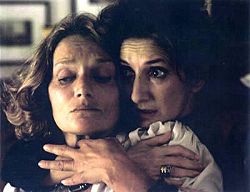 The film won many awards when first released and, as such, the drama was widely well received in the 1980s. Walter Goodman, film critic for The New York Times
, believes the film was well balanced, and wrote, "Mr. Puenzo's film is unwaveringly committed to human rights, yet it imposes no ideology or doctrine. The further miracle is that this is the 39-year-old director's first feature film."
Critic Roger Ebert
lauded the film in his film review, writing, "The Official Story is part polemic, part thriller, part tragedy. It belongs on the list with films like Z
, Missing
and El Norte
, which examine the human aspects of political unrest. It is a movie that asks some very hard questions ... Alicia is played in the movie by Norma Aleandro, whose performance won the best actress award at this year's Cannes Film Festival
. It is a performance that will be hard to forget, particularly since so much of it is internal. Some of the key moments in the film come as we watch Aleandro and realize what must be taking place inside her mind, and inside her conscience. Most political films play outside the countries that they are about; "The Official Story" is now actually playing in Argentina, where it must be almost unbearably painful for some of the members of its audiences. It was almost as painful for me."
Film critics Frederic and Mary Ann Brussat, of the website Spirituality and Practice, were painfully touched by the story they viewed. They write, "The Official Story is a wrenching and painful drama that crystallizes the horror and the obscenity of political activities that annihilate family solidarity in the name of ideology...The Official Story packs a shattering visceral punch."
Critic Ken Hanke of the North Carolina
Mountain Xpress
finds fault with the story, which he felt at times played out like a soap opera, but argues that it is still close to being a textbook example of how to use a personal story to tell and illuminate a much larger view. He believes that Alicia's political awakening is what gives the film "its strength and its resonance."
A few critics were dismissive of the story Puenzo tells. For example, The Chicago Reader
Dave Kehr thought "Puenzo's methods are so crudely manipulative ... that the film quickly uses up the credit of its good intentions."
, the Cannes Film Festival
, and the Mar del Plata Film Festival
.
Nominations
1985 in film
-Events:* 3 December - Roger Moore steps down from the role of James Bond after twelve years and seven films. He is replaced by Timothy Dalton.* The Academy Award for Best Picture was won by Out Of Africa, while the highest grossing film was Back to the Future.* Bliss wins AFI Award for best Movie...
Argentine
Argentina
Argentina , officially the Argentine Republic , is the second largest country in South America by land area, after Brazil. It is constituted as a federation of 23 provinces and an autonomous city, Buenos Aires...
drama film
Drama film
A drama film is a film genre that depends mostly on in-depth development of realistic characters dealing with emotional themes. Dramatic themes such as alcoholism, drug addiction, infidelity, moral dilemmas, racial prejudice, religious intolerance, poverty, class divisions, violence against women...
directed by Luis Puenzo
Luis Puenzo
Luis Adalberto Puenzo is an Argentine film director, producer and screenplay writer.He works mainly in the cinema of Argentina, but has also worked in the United States.-Biography:...
, and written by Puenzo and Aída Bortnik
Aída Bortnik
Aída Bortnik is an Argentine screenwriter, nominated for an Academy Award for her work in the film La historia oficial .- Career :...
. It stars Norma Aleandro
Norma Aleandro
Norma Aleandro Robledo is an Argentine actress and screenwriter, born in Buenos Aires to Pedro Aleandro and María Luisa Robledo, both actors. Her sister, María Vaner, was a famous actress in Argentina.- Life and career :...
, Héctor Alterio, and Chunchuna Villafañe
Chunchuna Villafañe
Elva 'Chunchuna' Villafañe is an Argentine film and television actress, born in Buenos Aires, Argentina.She has appeared in film and television since the year 1971.Her most well-known role is as Ana in La historia oficial ....
, among others. In the United Kingdom
United Kingdom
The United Kingdom of Great Britain and Northern IrelandIn the United Kingdom and Dependencies, other languages have been officially recognised as legitimate autochthonous languages under the European Charter for Regional or Minority Languages...
, it was released as The Official Version.
The film is about an upper middle class
Upper middle class
The upper middle class is a sociological concept referring to the social group constituted by higher-status members of the middle class. This is in contrast to the term "lower middle class", which is used for the group at the opposite end of the middle class stratum, and to the broader term "middle...
couple in Buenos Aires
Buenos Aires
Buenos Aires is the capital and largest city of Argentina, and the second-largest metropolitan area in South America, after São Paulo. It is located on the western shore of the estuary of the Río de la Plata, on the southeastern coast of the South American continent...
with an adopted child
Adoption
Adoption is a process whereby a person assumes the parenting for another and, in so doing, permanently transfers all rights and responsibilities from the original parent or parents...
. The mother comes to realize that her daughter may be the child of a desaparecido, a victim of the forced disappearance
Forced disappearance
In international human rights law, a forced disappearance occurs when a person is secretly abducted or imprisoned by a state or political organization or by a third party with the authorization, support, or acquiescence of a state or political organization, followed by a refusal to acknowledge the...
s that occurred during Argentina's Dirty War
Dirty War
The Dirty War was a period of state-sponsored violence in Argentina from 1976 until 1983. Victims of the violence included several thousand left-wing activists, including trade unionists, students, journalists, Marxists, Peronist guerrillas and alleged sympathizers, either proved or suspected...
in the 1970s.
Among several other international awards, it won the Oscar for Best Foreign Language Film at the 58th Academy Awards
58th Academy Awards
The 58th Academy Awards, honoring the best in film for 1985, were held on March 24, 1986 at the Dorothy Chandler Pavilion in Los Angeles, California. They were hosted by Alan Alda, Jane Fonda and Robin Williams. The ceremony was watched by 38.93 million viewers, tying the 78th Academy Awards as...
, being the first Latin America
Latin America
Latin America is a region of the Americas where Romance languages – particularly Spanish and Portuguese, and variably French – are primarily spoken. Latin America has an area of approximately 21,069,500 km² , almost 3.9% of the Earth's surface or 14.1% of its land surface area...
n film to achieve it.
Plot
The film looks upon a married couple torn apart by the campaign of killings and torture that sent thousands of accused political leftists to unmarked graves in the mid 1970s during the period known as the Dirty WarDirty War
The Dirty War was a period of state-sponsored violence in Argentina from 1976 until 1983. Victims of the violence included several thousand left-wing activists, including trade unionists, students, journalists, Marxists, Peronist guerrillas and alleged sympathizers, either proved or suspected...
. It begins five years after Alicia (Norma Aleandro), a History
History
History is the discovery, collection, organization, and presentation of information about past events. History can also mean the period of time after writing was invented. Scholars who write about history are called historians...
high school teacher and, Roberto (Héctor Alterio), a wealthy businessman and lawyer with close ties to the military junta
National Reorganization Process
The National Reorganization Process was the name used by its leaders for the military government that ruled Argentina from 1976 to 1983. In Argentina it is often known simply as la última junta militar or la última dictadura , because several of them existed throughout its history.The Argentine...
, had adopted a baby girl named Gaby (Analia Castro).
Alicia starts wondering about the real parents of Gaby, a topic her husband has told her to forget as it was a condition of the adoption. Yet, he knows the story of his daughter's adoption. While hard to believe, Alicia, as other members of the Argentine middle class, is not aware of how much killing and suffering has gone on in the country, until her students begin to complain that the "government approved" History books given to them were written by the regime's "assassins".
After Ana (Chunchuna Villafañe
Chunchuna Villafañe
Elva 'Chunchuna' Villafañe is an Argentine film and television actress, born in Buenos Aires, Argentina.She has appeared in film and television since the year 1971.Her most well-known role is as Ana in La historia oficial ....
), Alicia's long time friend, returns from her exile
Exile
Exile means to be away from one's home , while either being explicitly refused permission to return and/or being threatened with imprisonment or death upon return...
in Europe, Alicia begins to do some serious political and personal research on her own. Ana had been tortured by ultra-right paramilitary forces loyal to the brutal Argentine regime for having lived with a so-called subversive man.
Alicia learns the identity of Gaby's grandmother, Sara (Chela Ruiz), who reveals the identity of the girl's disappeared parents. She finds out that her husband played a major role in the regime's repression and participated in intensive dealings with foreign business representatives. At a family dinner, Roberto has an intense political argument with his anarchist father and brother, where he espouses the political point of view of the ruling conservative military elite, and his father and brother argue from the side of social justice
Social justice
Social justice generally refers to the idea of creating a society or institution that is based on the principles of equality and solidarity, that understands and values human rights, and that recognizes the dignity of every human being. The term and modern concept of "social justice" was coined by...
.
The film suggests that Sara may not actually be Gaby's real grandmother, and briefly explores the fact that Gaby's true family may never be known. This juxtaposition of fact and emotion are meant to evoke the mood of hope and hopelessness in reaction to a war environment.
The film ends with a confrontation between Alicia and her husband. He wants her to forget about the past and look to the future. Upon his arrival, Roberto is told that Gaby is not home. In response to his inquiry, Alicia responds: "how does it feel not knowing where your child is?". Although she tells him that Gaby is at his mother's house, he becomes enraged and assaults her, but is interrupted by the telephone ringing. He answers it, and starts talking to Gaby. Alicia gets her purse to leave, indicating that she no longer can live with him.
The audience is left to wonder if Alicia will return Gaby to her real family or leave her with Roberto. However, the final shot of the film shows Gaby sitting in a wicker rocking chair at her adopted grandparents' house, singing a nursery rhyme. This clearly parallels the story Alicia tells earlier in the story about sitting in a rocking chair at her grandmother's house, waiting for her parents, not knowing that they had died in a car accident.
Cast
- Héctor Alterio as Roberto Ibáñez
- Norma AleandroNorma AleandroNorma Aleandro Robledo is an Argentine actress and screenwriter, born in Buenos Aires to Pedro Aleandro and María Luisa Robledo, both actors. Her sister, María Vaner, was a famous actress in Argentina.- Life and career :...
as Alicia Marnet de Ibáñez - Chunchuna VillafañeChunchuna VillafañeElva 'Chunchuna' Villafañe is an Argentine film and television actress, born in Buenos Aires, Argentina.She has appeared in film and television since the year 1971.Her most well-known role is as Ana in La historia oficial ....
as Ana - Hugo Arana as Enrique
- Guillermo Battaglia as José
- Chela Ruiz as Sara
- Patricio ContrerasPatricio ContrerasPatricio Contreras is a well-known Chilean-Argentine film actor.-Life and work:Contreras was born in Santiago, Chile in 1947 and emigrated to neighboring Argentina following the 1973 coup d'état against left-wing President Salvador Allende, of whom Contreras was a vocal supporter...
as Benítez - María Luisa Robledo as Nata
- Aníbal Morixe as Miller
- Jorge Petraglia as Macci
- Analía Castro as Gaby
- Daniel Lago as Dante
- Augusto Larreta as General
Background
Jorge Rafael Videla
Jorge Rafael Videla Redondo is a former senior commander in the Argentine Army who was the de facto President of Argentina from 1976 to 1981. He came to power in a coup d'état that deposed Isabel Martínez de Perón...
's reactionary military junta
Military junta
A junta or military junta is a government led by a committee of military leaders. The term derives from the Spanish language junta meaning committee, specifically a board of directors...
assumed power on March 24, 1976. During the junta's rule, the parliament was suspended; unions, political parties and provincial governments were banned; and, in what became known as the Dirty War
Dirty War
The Dirty War was a period of state-sponsored violence in Argentina from 1976 until 1983. Victims of the violence included several thousand left-wing activists, including trade unionists, students, journalists, Marxists, Peronist guerrillas and alleged sympathizers, either proved or suspected...
, between 9,000 and 30,000 people deemed left-wing "subversives" disappeared from society.
Like many progressive actors and others in the country, the lead actress in the film, Norma Aleandro, was forced into exile during this time. She traveled to Uruguay
Uruguay
Uruguay ,officially the Oriental Republic of Uruguay,sometimes the Eastern Republic of Uruguay; ) is a country in the southeastern part of South America. It is home to some 3.5 million people, of whom 1.8 million live in the capital Montevideo and its metropolitan area...
first and Spain
Spain
Spain , officially the Kingdom of Spain languages]] under the European Charter for Regional or Minority Languages. In each of these, Spain's official name is as follows:;;;;;;), is a country and member state of the European Union located in southwestern Europe on the Iberian Peninsula...
later. She returned after the fall of the military government in 1983. Aleandro once said, "Alicia's personal search is also my nation's search for the truth about our history. The film is positive in the way it demonstrates that she can change her life despite all she is losing."
The Official Story can be considered alongside a group of other films that were the first to be made in Argentina after the downfall in 1983 of the last Argentine dictator, General Galtieri
Leopoldo Galtieri
Leopoldo Fortunato Galtieri Castelli was an Argentine general and President of Argentina from December 22, 1981 to June 18, 1982, during the last military dictatorship . The death squad Intelligence Battalion 601 directly reported to him...
, and his autocratic regime. These films deal frankly with the repression, the torture, and the disappearances during Argentina's Dirty War in the 1970s and early 1980s; they include Funny Dirty Little War (1983) and Night of the Pencils
Night of the Pencils (film)
Night of the Pencils is an Argentine drama film directed by Héctor Olivera and written by Olivera and Daniel Kon. It is based on the non-fiction book by María Seoane and Héctor Ruiz Núñez....
(1986). A second group of films, which includes Verónico Cruz
Verónico Cruz (film)
Verónico Cruz is a 1988 Argentine and British drama film. The motion picture is directed by Miguel Pereira, his first, and written by Pereira and Eduardo Leiva Muller. The movie was produced by Julio Lencina and Sasha Menocki and features Juan José Camero, Gonzalo Morales, among others...
(1988) uses metaphor and hints at wider socio-political issues.
Production
At first, director Puenzo, fearing for his safety, intended to shoot the film in secret, using hidden 16mm cameras. But the junta government fell right about the time the screenplay was completed.The film was entirely shot in the city of Buenos Aires, Argentina
Buenos Aires
Buenos Aires is the capital and largest city of Argentina, and the second-largest metropolitan area in South America, after São Paulo. It is located on the western shore of the estuary of the Río de la Plata, on the southeastern coast of the South American continent...
, including the Plaza de Mayo
Plaza de Mayo
The Plaza de Mayo is the main square in downtown Buenos Aires, Argentina. It is flanked by Hipólito Yrigoyen, Balcarce, Rivadavia and Bolívar streets....
where the Mothers of the Plaza de Mayo congregated in the late 1970s with signs and pictures of desaparecidos who were subjected to forced disappearance by the Argentine military in the Dirty War
Dirty War
The Dirty War was a period of state-sponsored violence in Argentina from 1976 until 1983. Victims of the violence included several thousand left-wing activists, including trade unionists, students, journalists, Marxists, Peronist guerrillas and alleged sympathizers, either proved or suspected...
. The Mothers of the Plaza de Mayo continue to protest every Thursday afternoon at 3:30 pm in the Plaza de Mayo
Plaza de Mayo
The Plaza de Mayo is the main square in downtown Buenos Aires, Argentina. It is flanked by Hipólito Yrigoyen, Balcarce, Rivadavia and Bolívar streets....
in Buenos Aires.
Critical reception
The New York Times
The New York Times is an American daily newspaper founded and continuously published in New York City since 1851. The New York Times has won 106 Pulitzer Prizes, the most of any news organization...
, believes the film was well balanced, and wrote, "Mr. Puenzo's film is unwaveringly committed to human rights, yet it imposes no ideology or doctrine. The further miracle is that this is the 39-year-old director's first feature film."
Critic Roger Ebert
Roger Ebert
Roger Joseph Ebert is an American film critic and screenwriter. He is the first film critic to win a Pulitzer Prize for Criticism.Ebert is known for his film review column and for the television programs Sneak Previews, At the Movies with Gene Siskel and Roger Ebert, and Siskel and Ebert and The...
lauded the film in his film review, writing, "The Official Story is part polemic, part thriller, part tragedy. It belongs on the list with films like Z
Z (film)
Z is a 1969 French language political thriller directed by Costa Gavras, with a screenplay by Gavras and Jorge Semprún, based on the 1966 novel of the same name by Vassilis Vassilikos. The film presents a thinly fictionalized account of the events surrounding the assassination of democratic Greek...
, Missing
Missing (film)
Missing is a 1982 American drama film directed by Costa Gavras, and starring Jack Lemmon, Sissy Spacek, Melanie Mayron, John Shea, Charles Cioffi and Janice Rule...
and El Norte
El Norte (film)
El Norte is an American and British film, directed by Gregory Nava. The screenplay was written by Nava and Anna Thomas. The movie was first presented at the Telluride Film Festival in 1983, and its wide release was in January 1984....
, which examine the human aspects of political unrest. It is a movie that asks some very hard questions ... Alicia is played in the movie by Norma Aleandro, whose performance won the best actress award at this year's Cannes Film Festival
1985 Cannes Film Festival
-Jury:*Miloš Forman *Claude Imbert *Edwin Zbonek *Francis Veber *Jorge Amado *Mauro Bolognini *Michel Perez *Mo Rothmann *Néstor Almendros *Sarah Miles...
. It is a performance that will be hard to forget, particularly since so much of it is internal. Some of the key moments in the film come as we watch Aleandro and realize what must be taking place inside her mind, and inside her conscience. Most political films play outside the countries that they are about; "The Official Story" is now actually playing in Argentina, where it must be almost unbearably painful for some of the members of its audiences. It was almost as painful for me."
Film critics Frederic and Mary Ann Brussat, of the website Spirituality and Practice, were painfully touched by the story they viewed. They write, "The Official Story is a wrenching and painful drama that crystallizes the horror and the obscenity of political activities that annihilate family solidarity in the name of ideology...The Official Story packs a shattering visceral punch."
Critic Ken Hanke of the North Carolina
North Carolina
North Carolina is a state located in the southeastern United States. The state borders South Carolina and Georgia to the south, Tennessee to the west and Virginia to the north. North Carolina contains 100 counties. Its capital is Raleigh, and its largest city is Charlotte...
Mountain Xpress
Mountain Xpress
The Mountain Xpress is a free alternative newspaper covering news, arts, local politics, and events in Asheville and western North Carolina. Published each Wednesday in print and online, it has a print circulation of about 29,000...
finds fault with the story, which he felt at times played out like a soap opera, but argues that it is still close to being a textbook example of how to use a personal story to tell and illuminate a much larger view. He believes that Alicia's political awakening is what gives the film "its strength and its resonance."
A few critics were dismissive of the story Puenzo tells. For example, The Chicago Reader
The Chicago Reader
The Chicago Reader is an American alternative weekly newspaper in Chicago, Illinois, noted for its literary style of journalism and coverage of the arts, particularly film and theater. It was founded in 1971 by a group of friends from Carleton College...
Dave Kehr thought "Puenzo's methods are so crudely manipulative ... that the film quickly uses up the credit of its good intentions."
Distribution
The Official Story first opened in Argentina on April 3, 1985. It has also been featured at various film festivals including the Toronto Film Festival, the Berlin International Film FestivalBerlin International Film Festival
The Berlin International Film Festival , also called the Berlinale, is one of the world's leading film festivals and most reputable media events. It is held in Berlin, Germany. Founded in West Berlin in 1951, the festival has been celebrated annually in February since 1978...
, the Cannes Film Festival
1985 Cannes Film Festival
-Jury:*Miloš Forman *Claude Imbert *Edwin Zbonek *Francis Veber *Jorge Amado *Mauro Bolognini *Michel Perez *Mo Rothmann *Néstor Almendros *Sarah Miles...
, and the Mar del Plata Film Festival
Mar del Plata Film Festival
The Mar del Plata International Film Festival is an international film festival that takes place every November in the city of Mar del Plata, Argentina...
.
Awards
Wins- Academy AwardsAcademy Award for Best Foreign Language FilmThe Academy Award for Best Foreign Language Film is one of the Academy Awards of Merit, popularly known as the Oscars, handed out annually by the U.S.-based Academy of Motion Picture Arts and Sciences...
: Oscar; Best Foreign Film; 1985. - Los Angeles Film Critics Association Awards: LAFCA Award Best Foreign Film; (tied with RanRan (film)is a 1985 Japanese-French jidaigeki film written and directed by Akira Kurosawa. The film starred Tatsuya Nakadai as Hidetora Ichimonji, an aging Sengoku-era warlord who decides to abdicate as ruler in favor of his three sons. It also stars Mieko Harada as the wife of Ichimonji's eldest son...
); 1985. - New York Film Critics Circle AwardsNew York Film Critics Circle AwardsNew York Film Critics' Circle Awards are given annually to honor excellence in cinema worldwide by an organization of film reviewers from New York City-based publications. It is considered one of the most important precursors to the Academy Awards....
: NYFCC Award Best Actress; Norma Aleandro; 1985. - Toronto International Film FestivalToronto International Film FestivalThe Toronto International Film Festival is a publicly-attended film festival held each September in Toronto, Ontario, Canada. In 2010, 339 films from 59 countries were screened at 32 screens in downtown Toronto venues...
: People's Choice Award, Luis Puenzo, 1985. - Premios ACE: Premio ACE Cinema; Best Actress, Norma Aleandro; Cinema - Best Director, Luis Puenzo; Cinema - Best Film; 1986.
- Golden Globes: Best Foreign Language Film; 1986.
- Argentinian Film Critics Association Awards: Silver Condor; Best Actress, Norma Aleandro; Best Cinematography, Félix Monti; Best Director, Luis Puenzo; Best Editing, Juan Carlos Macías; Best Film; Best New Actress, Analía Castro; Best Original Screenplay, Aída Bortnik and Luis Puenzo; Best Supporting Actor, Patricio Contreras; Best Supporting Actress, Chela Ruiz; 1986.
- Berlin International Film FestivalBerlin International Film FestivalThe Berlin International Film Festival , also called the Berlinale, is one of the world's leading film festivals and most reputable media events. It is held in Berlin, Germany. Founded in West Berlin in 1951, the festival has been celebrated annually in February since 1978...
: Interfilm Award, Otto Dibelius Film Award, Luis Puenzo, (tied with Un Complicato intrigo di donne, vicoli e delitti); 1986. - Cannes Film Festival1985 Cannes Film Festival-Jury:*Miloš Forman *Claude Imbert *Edwin Zbonek *Francis Veber *Jorge Amado *Mauro Bolognini *Michel Perez *Mo Rothmann *Néstor Almendros *Sarah Miles...
: Best ActressBest Actress Award (Cannes Film Festival)The Best Actress Award is an award presented at the Cannes Film Festival. It is chosen by the jury from the 'official section' of films at the festival. It was first awarded in 1946.-Award Winners:-External links:* * ....
, Norma Aleandro; Prize of the Ecumenical Jury, Luis Puenzo; 1985. - Kansas City Film Critics Circle AwardsKansas City Film Critics CircleThe Kansas City Film Critics Circle is a group of media film critics in the Kansas City metropolitan area. James Loutzenhiser, a local psychiatrist and film buff, who died in November 2001, founded the group in 1967...
: KCFCC Award Best Foreign Film; 1986. - David di Donatello Awards: David Best Foreign Actress, Norma Aleandro; 1987.
Nominations
- Academy Awards: Best Writing, Screenplay Written Directly for the Screen; 1985.
- Cannes Film Festival: Golden Palm, Luis Puenzo; 1985.
- Sant Jordi Awards: Sant Jordi Award; Best Foreign Actress, Norma Aleandro; 1987.
See also
- Maria Eugenia SampalloMaria Eugenia SampalloMaria Eugenia Sampallo is an Argentinian known for being the first person to take a couple who illegally adopted her as a baby to court for kidnapping her when her parents disappeared along with thousands of others in a military purge of radicals, dissidents and leftist sympathizers, known as the...
- The Lost Steps (2001)
- Captive (2005)
External links
- La historia oficial at the cinenacional.comCinenacional.comCinenacional.com is a web portal and web-based database about Argentine cinema.The site provides a vast array of information, including: films, television programs, directors, actors, cinematographers, film editors, production designers, and other production professions in Argentina...
- La historia oficial 20th Anniversary in Argentina
- The Official Story trailer at You Tube