


The Nine Muses

Encyclopedia
- "The Nine Muses" may also refer to nine letters written by AeschinesAeschinesAeschines was a Greek statesman and one of the ten Attic orators.-Life:Although it is known he was born in Athens, the records regarding his parentage and early life are conflicting; but it seems probable that his parents, though poor, were respectable. Aeschines' father was Atrometus, an...
.
John Dryden
John Dryden was an influential English poet, literary critic, translator, and playwright who dominated the literary life of Restoration England to such a point that the period came to be known in literary circles as the Age of Dryden.Walter Scott called him "Glorious John." He was made Poet...
, Esq. (London: Richard Basset, 1700) was an elegiac
Elegiac
Elegiac refers either to those compositions that are like elegies or to a specific poetic meter used in Classical elegies. The Classical elegiac meter has two lines, making it a couplet: a line of dactylic hexameter, followed by a line of dactylic pentameter...
volume of poetry
Poetry
Poetry is a form of literary art in which language is used for its aesthetic and evocative qualities in addition to, or in lieu of, its apparent meaning...
published pseudonymously
Pen name
A pen name, nom de plume, or literary double, is a pseudonym adopted by an author. A pen name may be used to make the author's name more distinctive, to disguise his or her gender, to distance an author from some or all of his or her works, to protect the author from retribution for his or her...
. The contributors were English women writers, each of whom signed their poems with the names of Muse
Muse
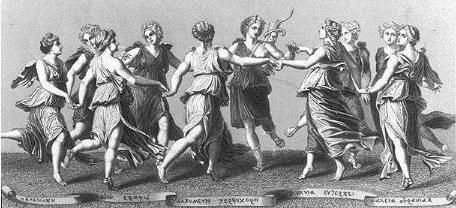
The Muses in Greek mythology, poetry, and literature, are the goddesses who inspire the creation of literature and the arts. They were considered the source of the knowledge, related orally for centuries in the ancient culture, that was contained in poetic lyrics and myths...
s. The collection was edited by Delarivier Manley
Delarivier Manley
Delarivier Manley was an English novelist of amatory fiction, playwright, and political pamphleteer...
(who wrote as "Melpomene
Melpomene
Melpomene , initially the Muse of Singing, she then became the Muse of Tragedy, for which she is best known now. Her name was derived from the Greek verb melpô or melpomai meaning "to celebrate with dance and song." She is often represented with a tragic mask and wearing the cothurnus, boots...
" and "Thalia") and includes pieces by Susanna Centlivre
Susanna Centlivre
Susanna Centlivre born Susanna Freeman, also known professionally as Susanna Carroll, was an English poet, actress and one of the premier dramatists of the 18th century. During her long career at Theatre Royal, Drury Lane, she became known as the Second Woman of the English Stage after Aphra Behn...
("perhaps," according to Blain et al.), Sarah Fyge Egerton
Sarah Fyge Egerton
Sarah Fyge Egerton was a female poet who wrote in the late seventeenth and early eighteenth centuries. She was one of six children born to Mary Beacham and Thomas Fyge...
("Erato
Erato
In Greek mythology, Erato is one of the Greek Muses. The name would mean "desired" or "lovely", if derived from the same root as Eros, as Apollonius of Rhodes playfully suggested in the invocation to Erato that begins Book III of his Argonautica....
", "Euterpe
Euterpe
In Greek mythology, Euterpe + τέρπειν terpein ) was one of the Muses, the daughters of Mnemosyne, fathered by Zeus. Called the "Giver of delight", when later poets assigned roles to each of the Muses, she was the muse of music. In late Classical times she was named muse of lyric poetry and...
", and "Terpsichore
Terpsichore
In Greek mythology, Terpsichore "delight of dancing" was one of the nine Muses, ruling over dance and the dramatic chorus. She lends her name to the word "terpsichorean" which means "of or relating to dance". She is usually depicted sitting down, holding a lyre, accompanying the dancers' choirs...
"), Mary Pix
Mary Pix
Mary Pix was an English novelist and playwright. Church records indicate that she lived in London, marrying George Pix, a merchant tailor from Hawkhurst, Kent in 1684. Baptismal records reveal that she had two sons, George and William...
("Clio
Clio
thumb|Clio—detail from [[The Art of Painting|The Allegory of Painting]] by [[Johannes Vermeer]]In Greek mythology, Clio or Kleio, is the muse of history. Like all the muses, she is a daughter of Zeus and Mnemosyne...
"), Catherine Trotter ("Calliope
Calliope
In Greek mythology, Calliope was the muse of epic poetry, daughter of Zeus and Mnemosyne, and is now best known as Homer's muse, the inspiration for the Odyssey and the Iliad....
"), and Sarah Piers
Sarah Piers
Sarah, Lady Piers was a literary patron, political commentator, and a poet.Her father was originally of Roydon in Yorkshire. She was the daughter of Matthew Roydon and wife of Sir George Piers , a Kentish army captain and Clerk of the Privy Seal. She had two sons, one of whom died in childhood...
("Urania
Urania
Urania was, in Greek mythology, the muse of astronomy. Some accounts list her as the mother of the musician Linus. She is usually depicted with a globe in her left hand. She is able to foretell the future by the arrangement of the stars...
"). The poet writing as "Polimnia" (Of Rhetorick) has not been identified; her initials are "Mrs. D. E."