
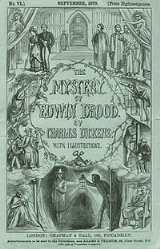
The Mystery of Edwin Drood is the final novel by
Charles DickensCharles John Huffam Dickens was an English novelist, generally considered the greatest of the Victorian period. Dickens enjoyed a wider popularity and fame than had any previous author during his lifetime, and he remains popular, having been responsible for some of English literature's most iconic...
. The novel was left
unfinishedAn unfinished work is creative work that has not been finished. Its creator may have chosen never to finish it or may have been prevented from doing so by circumstances outside of their control such as death. Such pieces are often the subject of speculation as to what the finished piece would have...
at the time of Dickens' death, and his intended ending for it remains unknown. Though the novel is named after the character Edwin Drood, the story focuses on Drood's uncle, choirmaster John Jasper, who is in love with his pupil, Rosa Bud. Miss Bud is Drood's fiancée who has also caught the eye of the high-spirited and hot-tempered Neville Landless, who comes from Ceylon with his twin sister, Helena. Landless and Drood take an instant dislike to one another. Drood later disappears under mysterious circumstances. Dickens died before he could finish the mystery.
The story is set in Cloisterham, a lightly fictionalised Rochester, and feelingly evokes the atmosphere of the town as much as its streets and buildings.
Summary
The novel begins as John Jasper leaves a London
opium denAn opium den was an establishment where opium was sold and smoked. Opium dens were prevalent in many parts of the world in the 19th century, most notably China, Southeast Asia, North America and France...
. The next evening, Edwin Drood visits Jasper, who is the choirmaster at Cloisterham Cathedral. Edwin confides that he has misgivings about his betrothal to Rosa Bud. The next day, Edwin visits Rosa at the Nuns' House, the boarding school where she lives. They quarrel good-naturedly, which they apparently do frequently during his visits. Meanwhile, having an interest in the cathedral cemetery, Jasper seeks the company of Durdles, a man who knows more about the cemetery than anyone else.
Neville Landless and his twin sister Helena are sent to Cloisterham for their education. Neville will study with the
minor canonA Minor Canon is a member of staff on the establishment of a cathedral or a collegiate church. Minor Canons are clergy and take part in the daily services but are not part of the formal Chapter. They are generally more junior clergy, who in a parish church would be serving a curacy....
, Rev. Mr Crisparkle; Helena will live at the Nuns' House with Rosa. Neville confides to Rev. Mr Crisparkle that he had hated his cruel stepfather, while Rosa confides to Helena that she loathes and fears her music-master, Jasper. Neville is immediately smitten with Rosa and is indignant that Edwin prizes his betrothal lightly. Edwin provokes him and he reacts violently, giving Jasper the opportunity to spread rumours about Neville's reputation of having a violent temper. Rev. Mr Crisparkle tries to reconcile Edwin and Neville, who agrees to apologize to Edwin if the former will forgive him. It is arranged that they will dine together for this purpose on
Christmas EveChristmas Eve refers to the evening or entire day preceding Christmas Day, a widely celebrated festival commemorating the birth of Jesus of Nazareth that takes place on December 25...
at Jasper's home.
Rosa's guardian, Mr. Grewgious, tells her that she has a substantial inheritance from her father. When she asks whether there would be any forfeiture if she did not marry Edwin, he replies that there would be none on either side. Back at his office in London, Mr. Grewgious gives Edwin a ring which Rosa's father had given to her mother, with the proviso that Edwin must either give the ring to Rosa as a sign of his irrevocable commitment to her, or return it to Mr. Grewgious. Mr. Bazzard, Mr. Grewgious's clerk, witnesses this transaction.
Next day, Rosa and Edwin amicably agree to end their betrothal.
They decide to ask Mr. Grewgious to break the news to Jasper, and Edwin intends to return the ring to Mr. Grewgious. Meanwhile, Durdles takes Jasper into the cathedral
cryptIn architecture, a crypt is a stone chamber or vault beneath the floor of a burial vault possibly containing sarcophagi, coffins or relics....
. On the way there Durdles points out a mound of quicklime. Jasper provides a bottle of wine to Durdles. The wine is mysteriously potent, and Durdles soon loses consciousness; while unconscious he dreams that Jasper goes off by himself in the crypt. As they return from the crypt, they encounter a boy called Deputy, and Jasper, thinking he was spying on them, takes him by the throat, but seeing that this will strangle him, lets him go.
On Christmas Eve, Neville buys himself a heavy walking stick; he plans to spend his
ChristmasChristmas or Christmas Day is an annual holiday generally celebrated on December 25 by billions of people around the world. It is a Christian feast that commemorates the birth of Jesus Christ, liturgically closing the Advent season and initiating the season of Christmastide, which lasts twelve days...
break hiking around the countryside. Meanwhile, Edwin visits a jeweller in order to repair his pocket watch; it is mentioned that the only pieces of jewellery that he wears are the watch and chain and a shirt pin. By chance he meets a woman, who is an opium user from London. She asks Drood's Christian name, and he replies that it is 'Edwin'; she says he is fortunate it is not 'Ned,' for 'Ned' is in great danger. He thinks nothing of this, for the only person who calls him 'Ned' is Jasper. Meanwhile, Jasper buys himself a black scarf of strong silk, which is not seen again during the course of the novel. The reconciliation dinner is successful, and at midnight, Drood and Neville Landless leave together to go down to the river and look at a wind storm that rages that night.
The next morning Edwin is missing, and Jasper spreads suspicion that Neville has killed him. Neville leaves early in the morning for his hike; the townspeople overtake him and bring him back to the city. Rev. Mr Crisparkle keeps Neville out of jail by taking responsibility for him: he will produce him anytime his presence is required. That night Jasper is grief stricken when Mr. Grewgious informs him that Edwin and Rosa had ended their betrothal; he reacts more strongly to this news than to the prospect that Edwin was dead. The next morning Rev. Mr Crisparkle goes to the river
weirA weir is a small overflow dam used to alter the flow characteristics of a river or stream. In most cases weirs take the form of a barrier across the river that causes water to pool behind the structure , but allows water to flow over the top...
and finds Edwin's watch and chain and his shirt pin; no other trace of him is found.
A half year later, Neville is living in London near Mr. Grewgious's office. Mr. Tartar introduces himself and offers to share his garden with Landless; Mr. Tartar's chambers are adjacent to Neville's above a common courtyard. A stranger, who calls himself Dick Datchery, arrives in Cloisterham. He rents a room below Jasper and observes the comings and goings in the area. On his way to the lodging the first time, Mr. Datchery asks directions from Deputy. But Deputy will not go near there for fear that Jasper will choke him again.
Jasper visits Rosa at the Nuns' House and professes his love for her. She rejects him, but he persists; he says that if she gives him no hope, he will destroy Neville, the brother of her dear friend Helena. In fear of Jasper, Rosa goes to Mr. Grewgious in London.
The next day Rev. Mr Crisparkle follows Rosa to London. When he is with Mr. Grewgious and Rosa, Mr. Tartar calls and asks if he remembers him. Rev. Crisparkle does remember him, as the one who years before saved him from drowning. They do not dare let Rosa contact Neville and Helena directly for fear that Jasper may be watching Neville, but Mr. Tartar allows Rosa to visit his chambers in order to contact Helena above the courtyard. Mr. Grewgious arranges for Rosa to rent a place from Mrs. Billickin and arranges for Miss Twinkleton to live with her there so that she can live there respectably.
Jasper visits the London opium den again for the first time since Edwin's disappearance. When he leaves at dawn, the woman who runs the opium den follows him. She vows to herself that she will not lose his trail again as she did after his last visit. This time she follows him all the way to his home in Cloisterham; outside she meets Mr. Datchery, who tells her Jasper's name and that he will sing the next morning in the cathedral service. On inquiry Datchery learns she is called "Princess Puffer." The next morning she attends the service and shakes her fists at Jasper from behind a pillar.
Dickens's death leaves the rest of the story unknown. However, he did provide his own summary of the story as planned in a letter to his friend and biographer John Forster:
His first fancy for the tale was expressed in a letter in the middle of
July. "What should you think of the idea of a story beginning in this
way?--Two people, boy and girl, or very young, going apart from one
another, pledged to be married after many years—at the end of the book.
The interest to arise out of the tracing of their separate ways, and the
impossibility of telling what will be done with that impending fate."
This was laid aside; but it left a marked trace on the story as
afterwards designed, in the position of Edwin Drood and his betrothed.
I first heard of the later design in a letter dated "Friday the 6th of
August 1869", in which after speaking, with the usual unstinted praise
he bestowed always on what moved him in others, of a little tale he had
received for his journal, he spoke of the change that had occurred
to him for the new tale by himself. "I laid aside the fancy I told you
of, and have a very curious and new idea for my new story. Not a
communicable idea (or the interest of the book would be gone), but a
very strong one, though difficult to work." The story, I learnt
immediately afterward, was to be that of the murder of a nephew by his
uncle; the originality of which was to consist in the review of the
murderer's career by himself at the close, when its temptations were to
be dwelt upon as if, not he the culprit, but some other man, were the
tempted. The last chapters were to be written in the condemned cell, to
which his wickedness, all elaborately elicited from him as if told of
another, had brought him. Discovery by the murderer of the utter
needlessness of the murder for its object, was to follow hard upon
commission of the deed; but all discovery of the murderer was to be
baffled till towards the close, when, by means of a gold ring which had
resisted the corrosive effects of the lime into which he had thrown the
body, not only the person murdered was to be identified but the locality
of the crime and the man who committed it. So much was told to me
before any of the book was written; and it will be recollected that the
ring, taken by Drood to be given to his betrothed only if their
engagement went on, was brought away with him from their last
interview. Rosa was to marry Tartar, and Crisparkle the sister of
Landless, who was himself, I think, to have perished in assisting Tartar
finally to unmask and seize the murderer.
Characters
- Edwin Drood – an orphan. When he comes of age, he plans to marry Rosa Bud and go to Egypt, doing engineering with the firm where his father had been a partner.
- Rosa Bud – an orphan and Edwin Drood's fiancée. Their betrothal was arranged by their fathers.
- John Jasper – the choirmaster of Cloisterham Cathedral, Edwin Drood's uncle and guardian, and Rosa Bud's music master. He secretly loves Rosa. He visits an opium den in London.
- Neville and Helena Landless – twin orphans. They are from Ceylon, but it is not clear to what extent they are Ceylonese. In their childhood they were mistreated and deprived. Neville is immediately smitten by Rosa Bud. He is more proud than is good for him, and his integrity prevents him from making an insincere apology to Drood. Helena and Rosa become dear friends.
- Rev. Septimus Crisparkle – minor canon
A Minor Canon is a member of staff on the establishment of a cathedral or a collegiate church. Minor Canons are clergy and take part in the daily services but are not part of the formal Chapter. They are generally more junior clergy, who in a parish church would be serving a curacy....
of Cloisterham Cathedral and Neville Landless's mentor.
- Mr. (Hiram) Grewgious – a London lawyer and Rosa Bud's guardian. He was a friend of her parents.
- Mr. Bazzard – Mr. Grewgious's clerk. He is absent from that post when Datchery is in Cloisterham. He has written a play.
- (Stony) Durdles – a stonemason. He knows more than anyone else about the Cloisterham Cathedral cemetery.
- Deputy – a small boy. "Deputy" is not his name but rather a handle he uses for anonymity. If he catches Durdles out after 10 pm, he throws rocks at him until he goes home. Durdles pays him a halfpenny for doing so.
- Dick Datchery – a stranger who takes lodging in Cloisterham for a month or two.
- Princess Puffer – a haggard woman who runs a London opium den frequented by Jasper. She is unnamed in most of the book. "Princess Puffer" is the handle by which Deputy knows her.
- Mr. (Thomas) Sapsea – a comically conceited auctioneer. By the time of Drood's disappearance he has become Mayor of Cloisterham.
- Mr. Tope – the verger
A verger is a person, usually a layman, who assists in the ordering of religious services, particularly in Anglican churches.-History:...
of Cloisterham Cathedral.
- Mrs. Tope – the verger's wife. She cooks for Jasper and rents lodging to Datchery.
- Miss Twinkleton – the mistress of the Nuns' House, the boarding school where Rosa lives.
- Mrs. Tisher – Miss Twinkleton's assistant at the Nuns' House.
- Mrs. Crisparkle – Rev. Crisparkle's widowed mother.
- Mr. Honeythunder – a bullying London philanthropist. He is Neville and Helena Landless's guardian.
- Mr. Tartar – a retired naval officer. He resigned his commission in his late twenties when an uncle left him some property, but he lives in London, being unaccustomed to the space of a large estate.
- Mrs. Billickin – a widowed distant cousin of Mr. Bazzard. She rents lodging in London to Rosa and Miss Twinkleton.
The murderer
Although the killer is not revealed, it is generally believed that John Jasper, Edwin's uncle, is the murderer. There are three reasons:
- John Forster had the plot described to him by Dickens: "The story...was to be that of the murder of a nephew by his uncle."
- Luke Fildes, who illustrated the story, said that Dickens had told him, when they were discussing an illustration, "I must have the double necktie! It is necessary, for Jasper strangles Edwin Drood with it."
- Dickens' son Charles stated that his father had told him unequivocally that Jasper was the murderer.
The book gives other hints:
- It describes a nightly scene in which Jasper goes secretly with Durdles to the graveyard. Jasper sees quicklime, at that time believed to hasten the decomposition of bodies.
- A day before he disappears, Edwin talks with Princess Puffer in the graveyard. She tells him "Ned" is in great danger. Later it turns out she has been following John Jasper from London, and he told her something in his state of intoxication. Furthermore, Jasper is the only one who refers to Edwin Drood as "Ned".
- On the day Edwin is reported missing, Jasper is informed by Grewgious, Rosa's guardian, that she and Edwin had broken off their engagement. Jasper collapses in a state of shock: could it be because of a murder that was unnecessary?
- Rosa Bud has always been afraid of John Jasper, and at a warm day in the afternoon, half a year after Edwin's disappearance, he tells her his love for her might be enough to get even his beloved nephew out of the way.
- Princess Puffer tries to follow Jasper, she suspects him of something because of what he said during his opium intoxication. Jasper says to Puffer at the end of the book: "Suppose you had something in your mind; something you were going to do... Should you do it in your fancy, when you were lying here doing this?... I did it over and over again. I have done it hundreds of thousands of times in this room." Is Mr Jasper here referring to the murder of Edwin? And maybe he told by accident what he was talking about in his sleep?
- The very first hint (Mr. Jasper being concerned about what he may say while in an opium stupor) occurs in the first pages when Mr. Jasper listens to other opium users and says "unintelligible!". Puffer says after his last opium trip of the book to him, when he sleeps: "'Unintelligible' I heard you say, of two more than me. But don't ye be too sure always; don't ye be too sure, beauty!"
- And then a strange last fact. On the day of the disappearance of Edwin, Jasper was in a great state of mind. He was outstanding in the choir, with great self command, and his temperament was remarkably positive all day. Is this because he knew the day he had been waiting for had finally come?
Dick Datchery
Datchery appears some time after Edwin's disappearance and keeps a close eye on Jasper. There are hints that he is in disguise and this theme has been taken up in adaptations of the story which try to solve the mystery: in the 1935 movie production of the story, starring
Claude RainsClaude Rains was an English stage and film actor whose career spanned 66 years. He was known for many roles in Hollywood films, among them the title role in The Invisible Man , a corrupt senator in Mr. Smith Goes to Washington , Mr...
as Jasper, Datchery is Neville Landless in disguise. A
BBCThe British Broadcasting Corporation is a British public service broadcaster. Its headquarters is at Broadcasting House in the City of Westminster, London. It is the largest broadcaster in the world, with about 23,000 staff...
radio drama of 1990, starring
Ian HolmSir Ian Holm, CBE is an English actor known for his stage work and for many film roles. He received the 1967 Tony Award for Best Featured Actor for his performance as Lenny in The Homecoming and the 1998 Laurence Olivier Award for Best Actor for his performance in the title role of King Lear...
as Jasper, had Datchery as an actor who investigates mysteries between performances.
There are plenty of proposals on the identity of Datchery:
Some readers believe Dick Datchery is Helena Landless. A hint for this is that at the beginning of the book Neville Landless tells Mr Crisparkle Helena used to dress up like a boy. Dick Datchery appears in Cloisterham almost at the same time Helena leaves. As Datchery lives very close to Jasper, it might be a move of Helena to find out more about the suspect Jasper, who accuses her own brother of the disappearance.
On the other hand, Helena goes to Neville and meets Rosa in London frequently before Rosa moves to the apartment of Mrs. Billickin. Although Dickens does not give many suggestions about the nature of the presence of Datchery during his stay in Cloisterham, it seems he is ever present and not "disappearing" for more than one day. We are told of Datchery's first meal in Cloisterham, which consists of a fried sole, a veal cutlet, and a pint of sherry, which some people feel would show a side of Helena's character hitherto unsuspected.
Others suggest that Datchery is Mr Grewgious, who, like Helena, would be suspicious of Mr. Jasper.
Another contender for Mr. Datchery is Mr. Bazzard, who is absent from London during Datchery's stay in Cloisterham.
Other strong candidates are Neville Landless and Edwin Drood himself.
A strong argument can be made for Tartar. He & Bazzard are the only two characters unfamiliar with Cloisterham, and both are absent from London while Datchery is in Cloisterham. As Rosa's future husband it would be incredibly unusual for Dickens to not assign a major role for him. Even his name suggests that he is Datchery, 'tar' being slang for sailor. The doubling suggests that he is two men in one. Datchery is described at one point as walking with his hands clasped behind him--"as the wont of such buffers is", a walking stance frequently associated with naval officers pacing a quarter-deck. Frequently there are similar expressions used to describe both characters. Tartar is described as "being an idle man", an echo of Datchery's "idle buffer living on his means." The characters also share a similar manner of speech & both are described as having a whimsical humour.
Continuations
Supplying a conclusion to
The Mystery of Edwin Drood has occupied writers from the time of Dickens's death to the present day.
The first three attempts to complete the story were undertaken by Americans. The first, by
Robert Henry NewellRobert Henry Newell was a popular 19th century American humorist.During the U.S. Civil War, Newell wrote a series of satirical articles using the pseudonym Orpheus C. Kerr, commenting on the war and contemporary society...
, published under the pen name Orpheus C. Kerr in 1870, was as much a parody as a continuation, transplanting the story to the United States. It is a "burlesque" farce rather than a serious attempt to continue in the spirit of the original story.
The second ending was written by Henry Morford, a New York journalist. He travelled to Rochester with his wife and published the ending serially during his stay in England from 1871–1872. In this ending, Edwin Drood survives Jasper's murder attempt. Datchery is Bazzard in disguise, but Helena disguises herself as well to overhear Jasper's mumbling under the influence of opium.
The third attempt was perhaps the most unusual. In 1873, a young
VermontVermont is a state in the New England region of the northeastern United States of America. The state ranks 43rd in land area, , and 45th in total area. Its population according to the 2010 census, 630,337, is the second smallest in the country, larger only than Wyoming. It is the only New England...
printer, Thomas James, published a version which he claimed had been literally 'ghost-written' by him channelling Dickens' spirit. A sensation was created, with several critics, including
Arthur Conan DoyleSir Arthur Ignatius Conan Doyle DL was a Scottish physician and writer, most noted for his stories about the detective Sherlock Holmes, generally considered a milestone in the field of crime fiction, and for the adventures of Professor Challenger...
, a spiritualist himself, praising this version, calling it similar in style to Dickens' work and for several decades the 'James version' of
Edwin Drood was common in America. Other
Drood scholars disagree. John C. Walters "dismiss[ed it] with contempt", stating that the work "is self-condemned by its futility, illiteracy, and hideous American mannerisms; the mystery itself becomes a nightmare, and the solution only deepens the obscurity."
Another notable attempt was
John Jasper's Secret: Sequel to Charles Dicken's Mystery of Edwin Drood, by Charles Dickens Jr. and
Wilkie CollinsWilliam Wilkie Collins was an English novelist, playwright, and author of short stories. He was very popular during the Victorian era and wrote 30 novels, more than 60 short stories, 14 plays, and over 100 non-fiction pieces...
.
Two of the most recent of the posthumous collaborations are
The Mystery of Edwin Drood by
Leon GarfieldLeon Garfield was a British writer of fiction. He is best known for his historical novels for children, though he also wrote for adults...
(1980) and
The Decoding of Edwin Drood (1980) by Charles Forsyte. There was also a humorous continuation by the Italian duo
Fruttero & LucentiniFruttero & Lucentini was the usual way for Carlo Fruttero and Franco Lucentini to sign their joint work, including novels, short stories, articles, anthologies...
entitled
The D CaseThe D Case is the title of a novel about The Mystery of Edwin Drood, an unfinished work by Charles Dickens, of which is also a piece of humorous literary critique...
.
The Trial of John Jasper
In January 1914, John Jasper (played by Frederick T. Harry) stood trial for the murder of Edwin Drood in London. The "trial" was organised by the
Dickens FellowshipThe Dickens Fellowship was founded in 1902, and is an international association of people from all walks of life who share an interest in the life and works of Victorian era novelist Charles Dickens....
.
G. K. ChestertonGilbert Keith Chesterton, KC*SG was an English writer. His prolific and diverse output included philosophy, ontology, poetry, plays, journalism, public lectures and debates, literary and art criticism, biography, Christian apologetics, and fiction, including fantasy and detective fiction....
, best known for the
Father BrownFather Brown is a fictional character created by English novelist G. K. Chesterton, who stars in 52 short stories, later compiled in five books. Chesterton based the character on Father John O'Connor , a parish priest in Bradford who was involved in Chesterton's conversion to Catholicism in 1922...
mystery stories, was the judge while
George Bernard ShawGeorge Bernard Shaw was an Irish playwright and a co-founder of the London School of Economics. Although his first profitable writing was music and literary criticism, in which capacity he wrote many highly articulate pieces of journalism, his main talent was for drama, and he wrote more than 60...
was the foreman of the jury, made up of other authors. J. Cuming Walters, author of
The Complete Edwin Drood, led the prosecution, while
Cecil ChestertonCecil Edward Chesterton was an English journalist and political commentator, known particularly for his role as editor of The New Witness from 1912 to 1916, and in relation to its coverage of the Marconi scandal....
acted for the defence.
Proceedings were very light-hearted with Shaw in particular making wisecracks at the expense of others present. For instance, Shaw claimed that if the prosecution thought that producing evidence would influence the jury then "he little knows his functions".
The jury returned a verdict of
manslaughterManslaughter is a legal term for the killing of a human being, in a manner considered by law as less culpable than murder. The distinction between murder and manslaughter is said to have first been made by the Ancient Athenian lawmaker Dracon in the 7th century BC.The law generally differentiates...
, Shaw stating that it was a compromise on the grounds that there was not enough evidence to convict Jasper but that they did not want to run the risk of being murdered in their beds. Both sides protested and demanded that the jury be discharged. Shaw claimed that the jury would be only too pleased to be discharged. Chesterton ruled that the mystery of Edwin Drood was insoluble and fined everyone, except himself, for contempt of court.
Original publication
The Mystery of Edwin Drood was scheduled to be published in twelve instalments (shorter than Dickens's usual twenty) from April 1870 to March 1871, each costing one
shillingThe shilling is a unit of currency used in some current and former British Commonwealth countries. The word shilling comes from scilling, an accounting term that dates back to Anglo-Saxon times where it was deemed to be the value of a cow in Kent or a sheep elsewhere. The word is thought to derive...
and illustrated by
Luke FildesSir Samuel Luke Fildes RA was an English painter and illustrator born at Liverpool and trained in the South Kensington and Royal Academy schools....
. Only six of the instalments were completed before Dickens's death in 1870. It was therefore approximately half finished.
- I – April 1870 (chapters 1–4)
- II – May 1870 (chapters 5–9)
- III – June 1870 (chapters 10–12)
- IV – July 1870 (chapters 13–16)
- V – August 1870 (chapters 17–20)
- VI – September 1870 (chapters 21–23)
Planned instalments never published:
- VII – October 1870
- VIII – November 1870
- IX – December 1870
- X – January 1871
- XI – February 1871
- XII – March 1871
Films
To date, there have been four film adaptations of
The Mystery of Edwin Drood. The first two were silent pictures released in 1909 and 1914. They are unavailable to the general
publicWorks are in the public domain if the intellectual property rights have expired, if the intellectual property rights are forfeited, or if they are not covered by intellectual property rights at all...
and have been little-seen since they were released. These were followed by:
- The Mystery of Edwin Drood
The Mystery of Edwin Drood was the third film adaptation and first sound film version of Charles Dickens's unfinished novel of the same name. It starred Claude Rains in the role of the villainous John Jasper...
(1935) released by Universal PicturesUniversal Pictures , a subsidiary of NBCUniversal, is one of the six major movie studios....
and directedA film director is a person who directs the actors and film crew in filmmaking. They control a film's artistic and dramatic nathan roach, while guiding the technical crew and actors.-Responsibilities:...
by Stuart Walker, starring Claude RainsClaude Rains was an English stage and film actor whose career spanned 66 years. He was known for many roles in Hollywood films, among them the title role in The Invisible Man , a corrupt senator in Mr. Smith Goes to Washington , Mr...
, Douglass MontgomeryRobert Douglass Montgomery was an American film actor.-Career:Son of a jeweler, he used the stage name of Douglass Montgomery when he first acted on stage in New York. He appeared as a ruggedly handsome fair-haired man, often slightly naive. He started his career in Hollywood, often playing the...
, Heather Angel, Valerie HobsonValerie Hobson was a British actress who appeared in a number of British films during the 1940s and 1950s...
, and David MannersDavid Manners was a Canadian - American film actor.Born Rauff de Ryther Daun Acklom in Halifax, Nova Scotia, Manners came to Hollywood at the beginning of the talking films revolution after studying acting with Eva Le Gallienne, and acting on stage with Helen Hayes...
.
- The Mystery of Edwin Drood
The Mystery of Edwin Drood is a 1993 film, the fourth film adaptation of the Charles Dickens unfinished novel of the same title.-Cast:* Robert Powell as John Jasper* Jonathan Phillips as Edwin Drood* Peter Pacey as Septimus Crisparkle...
(1993) starring Robert PowellRobert Powell is an English television and film actor, probably most famous for his title role in Jesus of Nazareth and as the fictional secret agent Richard Hannay...
as "John Jasper".
Television
A two-part drama, adapted with an original ending by Gwyneth Hughes and directed by
Diarmuid LawrenceDiarmuid Lawrence is a British television director.Born in Westcliff-on-Sea in Essex, Lawrence began his career in 1978 as a production assistant on the BBC television drama Pennies from Heaven...
, will air on BBC Two on 1 January and 2 January 2012 and on PBS on 15 April 2012.
Matthew RhysMatthew Rhys Evans , known professionally as Matthew Rhys, is a Welsh actor, best known as Kevin Walker on the U.S. ABC family drama Brothers & Sisters, and as Dylan Thomas in The Edge of Love.-Early life:...
stars as John Jasper,
Tamzin MerchantTamzin Merchant is an English actress. She is known for her role as Georgiana Darcy in Pride & Prejudice and for her role as the ill-fated Queen Catherine Howard in The Tudors.-Career:...
plays Rosa Bud, and Freddie Fox plays Edwin Drood. Other cast members include
Alun ArmstrongAlun Armstrong is a prolific British character actor. Armstrong grew up in County Durham in North East England. He first became interested in acting through Shakespeare productions at his grammar school. Since his career began in the early 1970s, he has played, in his words, "the full spectrum of...
as Hiram Grewgious;
David DawsonDavid Dawson is a British actor. He has appeared on television in The Road to Coronation Street and Luther and on stage in Comedians, Posh and Luise Miller.-Early life:...
as Bazzard;
Rory KinnearRory Kinnear is an award-winning English actor who has worked with the Royal Shakespeare Company and the Royal National Theatre.-Early life:...
as Reverend Septimus Crisparkle;
Julia McKenzieJulia McKenzie is an English actress, singer, and theatre director. She is best-known for her performance in Fresh Fields, but to current television audiences, she is best known for her role as Miss Marple in Agatha Christie's Marple...
as the Reverend's mother, Mrs Crisparkle;
Sacha DhawanSacha Dhawan is an English actor. He has performed on stage, film, television and radio. Dhawan was born in Bramhall, Stockport, Greater Manchester.-Career:...
as Neville Landless; Amber Rose Revah as Helena Landless;
Ron CookRon Cook is an English actor who has been active in the theatre, film and television since the 1970s. He is from South Shields, Co Durham, England and is a graduate of Rose Bruford College.- Stage appearances :...
as Durdles; and
Ian McNeiceIan McNeice is a prolific English screen, stage, and television character actor.-Early life:McNeice was born in Basingstoke in Hampshire. McNeice's acting training started at the Taunton School in Somerset, followed by two years at the Salisbury Playhouse...
as Mayor Sapsea.
Radio
On 5 and 12 January 1953, the
Suspense-Production background:One of the premier drama programs of the Golden Age of Radio, was subtitled "radio's outstanding theater of thrills" and focused on suspense thriller-type scripts, usually featuring leading Hollywood actors of the era...
radio program aired a two-part adaptation of
The Mystery of Edwin Drood. It depicts John Jasper (played by
Herbert MarshallHerbert Marshall , born Herbert Brough Falcon Marshall, was an English actor.His parents were Percy F. Marshall and Ethel May Turner. He graduated from St. Mary's College in Old Harlow, Essex and worked for a time as an accounting clerk...
) as the killer, tricked into giving himself away.
Theatre
Almost immediately following Charles Dickens's death, playwrights and theatre companies have mounted versions of
The Mystery of Edwin Drood with varying degrees of popularity, success, and faithfulness to the original work.
The first modern major theatrical adaptation was a
musical comedyMusical theatre is a form of theatre combining songs, spoken dialogue, acting, and dance. The emotional content of the piece – humor, pathos, love, anger – as well as the story itself, is communicated through the words, music, movement and technical aspects of the entertainment as an...
with book, music, and lyrics by
Rupert HolmesRupert Holmes is an American-British composer, singer-songwriter, musician and author of plays, novels and stories. He is best known for his number one pop hit "Escape " and the song "Him", which reached the number 6 position on the Hot 100 U.S. pop chart in 1980...
. The production, originally known by the full name of
The Mystery of Edwin Drood, but re-titled halfway through its original run to simply
Drood, was first produced in 1985 by the
New York Shakespeare FestivalNew York Shakespeare Festival is the previous name of the New York City theatrical producing organization now known as the Public Theater. The Festival produced shows at the Delacorte Theater in Central Park, as part of its free Shakespeare in the Park series, at the Public Theatre near Astor Place...
, and then transferred to
BroadwayBroadway theatre, commonly called simply Broadway, refers to theatrical performances presented in one of the 40 professional theatres with 500 or more seats located in the Theatre District centered along Broadway, and in Lincoln Center, in Manhattan in New York City...
, where it ran for 608 performances (and 24 previews). It won five 1986
TonysThe Antoinette Perry Award for Excellence in Theatre, more commonly known as a Tony Award, recognizes achievement in live Broadway theatre. The awards are presented by the American Theatre Wing and The Broadway League at an annual ceremony in New York City. The awards are given for Broadway...
, including Best Musical, as well as
Drama DeskThe Drama Desk Awards, which are given annually in a number of categories, are the only major New York theater honors for which productions on Broadway, Off-Broadway, Off-Off-Broadway compete against each other in the same category...
and
EdgarThe Edgar Allan Poe Awards , named after Edgar Allan Poe, are presented every year by the Mystery Writers of America...
awards. The musical has since played successfully in numerous regional and amateur productions.
Because Dickens's book was left unfinished, the musical hinges upon a novel idea: the audience decides by vote which of the characters is the murderer. The musical's suspect pool includes John Jasper, Neville Landless, Rosa Bud, Helena Landless, Rev. Crisparkle, Princess Puffer, and Mr. Bazzard. Adding further interactivity, the audience also chooses one male and one female character to develop a romance together: Holmes wrote brief alternate endings for every possible voting outcome, even the most unlikely.
Pop culture references
- Edwin Drood is the name of a fictional band from the TV series Jonathan Creek
Jonathan Creek is a British mystery series produced by the BBC and written by David Renwick. Primarily a crime drama, the show is also peppered with broadly comic touches...
.
- Edwin Drood is the name of the protagonist in the novel The Man With The Golden Torc by Simon R Green
- The 1999 novel Disgrace by J. M. Coetzee references Edwin Drood as the novel that Lucy reads before the crime on her farm.
- A 2005 episode of the television series Doctor Who
The new first series of British science fiction series Doctor Who began on 26 March 2005 with the episode "Rose", which marked the end of the programme's 16-year absence from episodic television following its cancellation in 1989, and aired its finale episode "The Parting of the Ways" on 18 June 2005...
, "The Unquiet Dead"The Unquiet Dead" is an episode in the British science-fiction television series Doctor Who that was first broadcast on 9 April 2005 and is the first episode of the revival to be set in the past. In Victorian Cardiff, the dead are walking, and creatures made of gas are on the loose...
", shows a fictional Charles Dickens, set the Christmas before his death, overcoming a skepticismSkepticism has many definitions, but generally refers to any questioning attitude towards knowledge, facts, or opinions/beliefs stated as facts, or doubt regarding claims that are taken for granted elsewhere...
of the supernaturalThe supernatural or is that which is not subject to the laws of nature, or more figuratively, that which is said to exist above and beyond nature...
and being inspired to write about the gaseous creatures that he fought with the Ninth DoctorThe Ninth Doctor is the ninth incarnation of the protagonist of the long-running BBC television science-fiction series Doctor Who. He is played by Christopher Eccleston....
and Rose TylerRose Marion Tyler is a fictional character portrayed by Billie Piper in the long-running British science fiction television series Doctor Who, and was created by series producer Russell T Davies...
, suggesting that his last novel will be completed as The Mystery of Edwin Drood and the Blue Elementals, with Edwin's killer being "not of this earth" but blue creatures that were inspired by the Gelth.
- The 2009 novel Drood
Drood is a 2009 novel written by Dan Simmons. It is a fictionalized account of the last five years of Charles Dickens' life told from the view point of Dickens' friend and fellow author Wilkie Collins. The title comes from Dickens' unfinished novel, The Mystery of Edwin Drood...
by Dan SimmonsDan Simmons is an American author most widely known for his Hugo Award-winning science fiction series, known as the Hyperion Cantos, and for his Locus-winning Ilium/Olympos cycle....
is a fictionalized account of the last five years of Dickens's life and the writing of and inspirations for the novel.
- The 2009 novel The Last Dickens by Matthew Pearl
Matthew Pearl is an American novelist and educator. His novels include The Dante Club, The Poe Shadow and The Last Dickens and have been published in more than 40 countries.-Biography:...
is a fictionalized account of events after Dickens' death related to his unfinished novel.
- In 2011, Unthank Books published a version of "The Mystery of Edwin Drood" with an interpreted ending by Sir David Maddden.
External links
- The Mystery of Edwin Drood at Internet Archive
The Internet Archive is a non-profit digital library with the stated mission of "universal access to all knowledge". It offers permanent storage and access to collections of digitized materials, including websites, music, moving images, and nearly 3 million public domain books. The Internet Archive...
.
- The Mystery of Edwin Drood – Searchable HTML version.
- The Mystery of Edwin Drood – Free audio book from Librivox.
- The Mystery of Edwin Drood – An analysis explaining Edwin Drood's themes and allusions, and offering a solution to its mysteries.
- About Edwin Drood, via Internet Archive
The Internet Archive is a non-profit digital library with the stated mission of "universal access to all knowledge". It offers permanent storage and access to collections of digitized materials, including websites, music, moving images, and nearly 3 million public domain books. The Internet Archive...
. A collection of 19th and early 20th century books exploring the mysteries and offering solutions.