
Home      Discussion      Topics      Dictionary      Almanac
Signup       Login
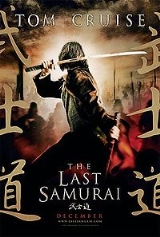
The Last Samurai

The Last Samurai

Overview
The Last Samurai is a 2003 drama film
Drama film
A drama film is a film genre that depends mostly on in-depth development of realistic characters dealing with emotional themes. Dramatic themes such as alcoholism, drug addiction, racial prejudice, religious intolerance, poverty, crime and corruption put the characters in conflict with themselves,...

/war film
War film
War films are a film genre concerned with warfare, usually about naval, air or land battles, sometimes focusing instead on prisoners of war, covert operations, military training or other related subjects. At times war films focus on daily military or civilian life in wartime without depicting battles...

 directed and co-produced by Edward Zwick
Edward Zwick
Edward M. Zwick is an American filmmaker and film producer noted for his sprawling war films. He has been described as a "throwback to an earlier era, an extremely cerebral director whose movies consistently feature fully rounded characters, difficult moral issues, and plots that thrive on the...

, who also co-wrote the screenplay
Screenplay
A screenplay or script is a written work that is made especially for a film or television program. Screenplays can be original works or adaptations from existing pieces of writing. A play for television is known as a teleplay.- Format and style :...

 based on a story by John Logan
John Logan (writer)
John David Logan is an American screenwriter and film producer.-Personal life:Logan was born in San Diego, growing up in California and New Jersey before moving to Chicago to attend Northwestern University, where he graduated in 1983. His parents immigrated to the US from Northern Ireland. The...

.

This film was inspired by a project developed by writer and director Vincent Ward
Vincent Ward
Vincent Ward, ONZM is a film director and screenwriter.-Biography:Vincent Ward was awarded an Order of New Zealand Merit in 2007 for his contribution to film making. He was born in Greytown, New Zealand. He was trained as an artist at the University of Canterbury. Ward began writing and directing...

. Ward became executive producer on the film – working in development on it for nearly four years and after approaching several directors (Coppola, Weir), he interested Edward Zwick. The film went ahead with Zwick and was shot in Ward’s native New Zealand
New Zealand
New Zealand is an island country in the south-western Pacific Ocean comprising two main landmasses , and numerous smaller islands, most notably Stewart Island/Rakiura and the Chatham Islands. The indigenous Māori named New Zealand Aotearoa, commonly translated as The Land of the Long White Cloud...

.

The film stars Tom Cruise
Tom Cruise
Thomas Cruise Mapother IV , better known by his screen name of Tom Cruise, is an American actor and film producer. Forbes magazine ranked him as the world's most powerful celebrity in 2006. He has been nominated for three Academy Awards and won three Golden Globe Awards...

 (who also co-produced) in the role of American soldier Nathan Algren whose personal and emotional conflicts bring him into contact with samurai
Samurai
is the term for the military nobility of pre-industrial Japan. According to translator William Scott Wilson: "In Chinese, the character 侍 was originally a verb meaning to wait upon or accompany a person in the upper ranks of society, and this is also true of the original term in Japanese, saburau...

 in the wake of the Meiji Restoration
Meiji Restoration
The , also known as the Meiji Ishin, Revolution or Renewal, was a chain of events that led to enormous changes in Japan's political and social structure...

 in the Empire of Japan
Empire of Japan
The Empire of Japan was a Japanese political entity that existed during the period from the...

 in 1876 and 1877.
Discussion
Ask a question about 'The Last Samurai'
Start a new discussion about 'The Last Samurai'
Answer questions from other users
Full Discussion Forum
 
Quotations

There is some comfort in the emptiness of the sea, no past, no future.

My thanks, on behalf of those who died in the name of better mechanical amusements and commercial opportunities.

[to the Silent Samurai] I know why you don't talk. You're angry. You're angry because they make you wear a dress.

[speaking with the Silent Samurai, after being beaten to the ground by Uijo] I just realized, I've been remiss. Forgive me, I forgot to thank you for looking out for me yesterday. That is your job, correct? Protecting me. Well done 'Bob.' You don't mind if I call you Bob, do you? I knew a Bob once; God, he was ugly as a mule. Are you a ladies man, Bob?

[kneeling in front of Emperor] If you believe me to be your enemy, command me, and I will gladly take my life.

[narrating] Winter, 1877. What does it mean to be Samurai? To devote yourself utterly to a set of moral principles. To seek a stillness of your mind. And to master the way of the sword.

[narrating] Spring, 1877. This marks the longest I've stayed in one place since I left the farm at 17. There is so much here I will never understand. I've never been a church going man, and what I've seen on the field of battle has led me to question God's purpose. But there is indeed something spiritual in this place. And though it may forever be obscure to me, I cannot but be aware of its power. I do know that it is here that I've known my first untroubled sleep in many years.

From the moment they wake, they devote themselves to the perfection of whatever they pursue.

I do not presume to understand the course of my life.

Many of our customs seem strange to you. And the same is true of yours. For example, not to introduce yourself is considered extremely rude, even among enemies.

Encyclopedia
The Last Samurai is a 2003 drama film
Drama film
A drama film is a film genre that depends mostly on in-depth development of realistic characters dealing with emotional themes. Dramatic themes such as alcoholism, drug addiction, racial prejudice, religious intolerance, poverty, crime and corruption put the characters in conflict with themselves,...

/war film
War film
War films are a film genre concerned with warfare, usually about naval, air or land battles, sometimes focusing instead on prisoners of war, covert operations, military training or other related subjects. At times war films focus on daily military or civilian life in wartime without depicting battles...

 directed and co-produced by Edward Zwick
Edward Zwick
Edward M. Zwick is an American filmmaker and film producer noted for his sprawling war films. He has been described as a "throwback to an earlier era, an extremely cerebral director whose movies consistently feature fully rounded characters, difficult moral issues, and plots that thrive on the...

, who also co-wrote the screenplay
Screenplay
A screenplay or script is a written work that is made especially for a film or television program. Screenplays can be original works or adaptations from existing pieces of writing. A play for television is known as a teleplay.- Format and style :...

 based on a story by John Logan
John Logan (writer)
John David Logan is an American screenwriter and film producer.-Personal life:Logan was born in San Diego, growing up in California and New Jersey before moving to Chicago to attend Northwestern University, where he graduated in 1983. His parents immigrated to the US from Northern Ireland. The...

.

This film was inspired by a project developed by writer and director Vincent Ward
Vincent Ward
Vincent Ward, ONZM is a film director and screenwriter.-Biography:Vincent Ward was awarded an Order of New Zealand Merit in 2007 for his contribution to film making. He was born in Greytown, New Zealand. He was trained as an artist at the University of Canterbury. Ward began writing and directing...

. Ward became executive producer on the film – working in development on it for nearly four years and after approaching several directors (Coppola, Weir), he interested Edward Zwick. The film went ahead with Zwick and was shot in Ward’s native New Zealand
New Zealand
New Zealand is an island country in the south-western Pacific Ocean comprising two main landmasses , and numerous smaller islands, most notably Stewart Island/Rakiura and the Chatham Islands. The indigenous Māori named New Zealand Aotearoa, commonly translated as The Land of the Long White Cloud...

.

The film stars Tom Cruise
Tom Cruise
Thomas Cruise Mapother IV , better known by his screen name of Tom Cruise, is an American actor and film producer. Forbes magazine ranked him as the world's most powerful celebrity in 2006. He has been nominated for three Academy Awards and won three Golden Globe Awards...

 (who also co-produced) in the role of American soldier Nathan Algren whose personal and emotional conflicts bring him into contact with samurai
Samurai
is the term for the military nobility of pre-industrial Japan. According to translator William Scott Wilson: "In Chinese, the character 侍 was originally a verb meaning to wait upon or accompany a person in the upper ranks of society, and this is also true of the original term in Japanese, saburau...

 in the wake of the Meiji Restoration
Meiji Restoration
The , also known as the Meiji Ishin, Revolution or Renewal, was a chain of events that led to enormous changes in Japan's political and social structure...

 in the Empire of Japan
Empire of Japan
The Empire of Japan was a Japanese political entity that existed during the period from the...

 in 1876 and 1877. Other actors include Ken Watanabe
Ken Watanabe
is a Japanese stage, film, and television actor. To English-speaking audiences he is known for playing tragic hero characters, such as General Tadamichi Kuribayashi in Letters from Iwo Jima and Lord Katsumoto in The Last Samurai, for which he was nominated for the Academy Award for Best Supporting...

, Hiroyuki Sanada
Hiroyuki Sanada
is a Japanese actor.-Early life:Sanada was born in Tokyo, Japan. He began training with Sonny Chiba's Japan Action Club. Originally aiming to be an action star, he developed good all-round martial arts ability...

, Timothy Spall
Timothy Spall
Timothy Leonard Spall OBE is a BAFTA award-nominated English actor and occasional presenter.-Early life:Spall, third of four sons, was born in Battersea, London; his father, Joe, was a postal worker, and his mother, Sylvia, a hairdresser...

, Billy Connolly
Billy Connolly
Billy Connolly, CBE is a Scottish comedian, musician, presenter and actor. He is sometimes known, especially in his native Scotland, by the nickname The Big Yin...

, Tony Goldwyn
Tony Goldwyn
Anthony Howard "Tony" Goldwyn is an American actor and director. He portrayed the villain Carl Bruner in Ghost, Kendall Dobbs in Designing Women and the voice of the title character of the Disney animated Tarzan and Kingdom Hearts.-Personal life:Goldwyn was born in Los Angeles, California, the...

 and Shin Koyamada
Shin Koyamada
, born on March 10, 1982 in Okayama, Japan is a Japanese and American film actor, producer, philanthropist, and martial artist. Shin has been in Los Angeles, United States since the year 2000. He speaks fluent Japanese and English....

.

The film's plot is based on the 1877 Satsuma Rebellion
Satsuma Rebellion
The , was a revolt of Satsuma ex-samurai against the Meiji government from January 29, 1877 to September 24,1877, 9 years into the Meiji Era. It was the last, and the most serious, of a series of armed uprisings against the new government.-Background:...

 led by Saigō Takamori
Saigo Takamori
was one of the most influential samurai in Japanese history, living during the late Edo Period and early Meiji Era. He has been dubbed the last true samurai. History Channel The Samurai, video documentary -Early life:...

, and also on the story of Jules Brunet
Jules Brunet
Jules Brunet was a French officer who played an active role in Mexico and Japan, and later became a General and Chief of Staff of the French Army in 1898....

, a French army
French Army
The French Army, officially the Armée de Terre , is the land-based component of the French Armed Forces and its largest. As of 2008, the army employs 133,947 regular soldiers and 24 000+ civilians...

 captain who fought alongside Enomoto Takeaki
Enomoto Takeaki
Viscount was a Japanese Navy admiral faithful to the Tokugawa Shogunate who fought against the new Meiji government until the end of the Boshin War, but later served in the government as one of the founders of the Imperial Japanese Navy.-Early life:...

 in the earlier Boshin War
Boshin War
The was a civil war in Japan, fought from 1868 to 1869 between forces of the ruling Tokugawa shogunate and those seeking to return political power to the imperial court....

. The historical roles of the United Kingdom
United Kingdom of Great Britain and Ireland
The United Kingdom of Great Britain and Ireland was the formal name and the state form of the United Kingdom from 1 January 1801 until 12 April 1927...

, the Netherlands
Netherlands
The Netherlands is a country in Northwestern Europe, constituting the major portion of the Kingdom of the Netherlands. It is a parliamentary democratic constitutional monarchy. The Netherlands borders the North Sea to the north and west, Belgium to the south, and Germany to the east...

 and France
French Third Republic
The French Third Republic was the republican government of France between the end of the Second French Empire in 1870 and the Vichy Regime after the invasion of France by the German...

 in Japanese westernization
Westernization
Westernisation or occidentalisation is a process whereby societies come under or adopt the Western culture in such matters as industry, technology, law, politics, economics, lifestyle, diet, language, alphabet, religion, philosophy, valuesindustry, technology, law, politics, economics, lifestyle,...

 are largely attributed to the United States in the film. These details, characters in the film and the real story are simplified for plot purposes; the film does not seek to duplicate history.

The Last Samurai was well received upon release, with a North American box office
Box office
A box office is a place where tickets are sold to the public for admission to a venue. Patrons may perform the transaction at a countertop, through an unblocked hole through a wall, or at a wicket...

 of $456 million. In addition it was nominated for several awards, including the Academy Awards
Academy Awards
The Academy Awards, popularly known as the Oscars, are presented annually by the American Academy of Motion Picture Arts and Sciences to recognize excellence of professionals in the film industry, including directors, actors, and writers. The formal ceremony at which the awards are presented is...

, the Golden Globes and the National Board of Review.

Plot


1876. Captain Nathan Algren (Tom Cruise
Tom Cruise
Thomas Cruise Mapother IV , better known by his screen name of Tom Cruise, is an American actor and film producer. Forbes magazine ranked him as the world's most powerful celebrity in 2006. He has been nominated for three Academy Awards and won three Golden Globe Awards...

) is a disenchanted Ex-United States Army
United States Army
The United States Army is the branch of the United States Military responsible for land-based military operations. It is the largest and oldest established branch of the U.S. military and is one of seven uniformed services...

 captain
Captain (Land)
The army rank of Captain is an officer rank historically corresponding to command of a company of soldiers. The rank is also used by some air forces and marine forces. Today a captain is typically the commander, or second in command, of a company or squadron...

 and an alcoholic, traumatized by his past transgressions against Native American
Native Americans in the United States
Native Americans in the United States is the phrase that describes indigenous peoples from North America now encompassed by the continental United States, including parts of Alaska and the island state of Hawaii. They comprise a large number of distinct tribes, states, and ethnic groups, many of...

s during the Indian Wars. In the years following his army service, Algren makes his living by relating war stories to gun show
Gun show
A gun show is a temporary exhibition or gathering where guns, gun parts, gun accessories, ammunition, and gun literature, as well as knives, jerky, militaria, and miscellaneous collectibles are legally displayed, bought, sold, and discussed. Gun shows also often include exhibitions related to...

 audiences, an experience which further hampers his mental state. Fed up with Algren's perpetual drunkenness, his employer fires him, forcing Algren to accept an invitation by his former commanding officer Lieutenant Colonel Bagley (Tony Goldwyn
Tony Goldwyn
Anthony Howard "Tony" Goldwyn is an American actor and director. He portrayed the villain Carl Bruner in Ghost, Kendall Dobbs in Designing Women and the voice of the title character of the Disney animated Tarzan and Kingdom Hearts.-Personal life:Goldwyn was born in Los Angeles, California, the...

), whom Algren hates and blames for his waking nightmares. Bagley approaches him with an offer on behalf of a Japanese businessman, Mr. Omura (Masato Harada
Masato Harada
Masato Harada is a Japanese film director, critic, and sometimes an actor; he is best known to Western audiences as Omura in The Last Samurai and as Mr Mita in Fearless...

), to help the new Meiji Restoration
Meiji Restoration
The , also known as the Meiji Ishin, Revolution or Renewal, was a chain of events that led to enormous changes in Japan's political and social structure...

 government train the new Western
Western world
The Western world, also known as the West and the Occident , is a term that can have multiple meanings depending on its context...

-style Imperial Japanese Army
Imperial Japanese Army
The Imperial Japanese Army , or literally Army of the Empire of Greater Japan was the official ground based armed force of Imperial Japan from 1867 to 1945...

. Assisting them are Algren's old army colleague Zeb Gant (Billy Connolly
Billy Connolly
Billy Connolly, CBE is a Scottish comedian, musician, presenter and actor. He is sometimes known, especially in his native Scotland, by the nickname The Big Yin...

) and Simon Graham (Timothy Spall
Timothy Spall
Timothy Leonard Spall OBE is a BAFTA award-nominated English actor and occasional presenter.-Early life:Spall, third of four sons, was born in Battersea, London; his father, Joe, was a postal worker, and his mother, Sylvia, a hairdresser...

), a cynical British translator with a deep-seated interest in the Samurai.

Under the command of Bagley, Algren trains a conscripted
Conscription
Conscription is a general term for involuntary labor demanded by an established authority. It is most often used in the specific sense of requiring citizens to serve in the armed forces...

 army of peasants in handling a rifle. Before they can be adequately trained, Algren is ordered to take them into battle against a group of samurai rebels led by Katsumoto (Ken Watanabe
Ken Watanabe
is a Japanese stage, film, and television actor. To English-speaking audiences he is known for playing tragic hero characters, such as General Tadamichi Kuribayashi in Letters from Iwo Jima and Lord Katsumoto in The Last Samurai, for which he was nominated for the Academy Award for Best Supporting...

) to protect Omura's investment in a new railway. During the battle, the samurai swarm the wholly-unprepared army, killing Gant and forcing Bagley to withdraw from the field. Algren was able to cut down dozens of samurai using his experience as a cavalry trooper with the sabre and revolver until he was knocked off his horse. But he refused to give in and manages to fend off several samurai with a broken spear embroidered with a flag depicting a white tiger. The flag on the spear reminds Katsumoto of a vision he experienced during meditation, of a white tiger fighting off his attackers. Katsumoto's brother-in-law, the red-masked samurai Hirotaro, prepares to deliver a killing blow to the fallen Algren; however, Algren refuses to yield and picks up a spear, fatally stabbing Hirotaro through the neck. Believing what he has witnessed to be an omen
Omen
An omen is a phenomenon that is believed to foretell the future, often signifying the advent of change. Omens may be considered "good" or "bad", but the term is more often used in a foreboding sense, as with the word "ominous".-In ancient Rome:Ancient Roman religion employed two distinct types of...

, Katsumoto takes Algren prisoner and spares his life. Algren is taken to an isolated village, where he gradually recovers inside a house belonging to Hirotaro's family, including his widow Taka, her two sons, and Katsumoto's son, Nobutada (Shin Koyamada
Shin Koyamada
, born on March 10, 1982 in Okayama, Japan is a Japanese and American film actor, producer, philanthropist, and martial artist. Shin has been in Los Angeles, United States since the year 2000. He speaks fluent Japanese and English....

).

Over time, Algren overcomes his alcoholism and sharpens his mind through practice of bushido
Bushido
, meaning "Way of the Warrior", is a Japanese code of conduct and a way of the samurai life, loosely analogous to the concept of chivalry. It originates from the samurai moral code and stresses frugality, loyalty, martial arts mastery, and honor unto death. Born of two main influences, the violent...

, the way of the samurai. He confides to his journal that he has never felt so entirely at peace than he has among Katsumoto and his people. Despite lingering fidelity to Hirotaro, Taka develops romantic feelings for Algren, particularly when she notices his budding fatherly relationship toward her children. Algren studies swordsmanship under skilled swordmaster Ujio and becomes fluent in Japanese by conversing with the local residents; in doing so, he earns their respect. One night, as the people watch a comic play, a group of ninja
Ninja
A was a covert agent or mercenary of feudal Japan specializing in unorthodox arts of war. The functions of the ninja included espionage, sabotage, infiltration, assassination, as well as open combat in certain situations. The underhanded tactics of the ninja were contrasted with the samurai, who...

 assassins attack the village. Algren wins the respect and admiration of the samurai by coming to Katsumoto's aid, and the Samurai succeeding in defeating the ninjas, but at the cost of many losses. Though Katsumoto does not confirm it, Algren deduces that the attack was ordered by Omura.

With the arrival of spring, Algren is taken back to Tokyo. There he learns that the army, under Bagley's command, is now better organized and outfitted with howitzer
Howitzer
A howitzer is a type of artillery piece that is characterized by a relatively short barrel and the use of comparatively small explosive charges to propel projectiles at relatively high trajectories, with a steep angle of descent...

s and Gatling gun
Gatling gun
The Gatling gun was one of the most well known rapid-fire weapons to be used in the 1860s by the Union forces of the American Civil War, following the 1851 invention of the mitrailleuse by the Belgian Army....

s acquired from the United States. Omura offers to place Algren in command of the army if he agrees to crush the samurai rebellion, but Algren declines. In private, Omura orders his men to kill Algren if he attempts to warn Katsumoto of their intentions. At the same time, Katsumoto offers his counsel to the young Emperor, to whom he was once a teacher. He learns that the Emperor's hold upon the throne is much weaker than he thought, and that he is essentially a puppet of Omura. When Katsumoto refuses to observe new laws that forbid samurai to publicly carry swords, he is arrested and confined to his quarters in Tokyo. Anticipating an assasination attempt on Katsumoto, Algren heads directly for his quarters but is ambushed by Omura's men; Algren narrowly escapes death through judicious use of martial arts he learned in Katsumoto's camp. With the assistance of Graham and Nobutada, Algren frees Katsumoto from custody. During their flight, Nobutada is mortally wounded and stays behind in order to aid his father's escape; Algren looks on as Nobutada is gunned down by his pursuers.

Katsumoto is still mourning the loss of his son when he receives word that a large Imperial Army unit, commanded by Omura and Bagley, is marching out to engage the samurai. A counter-force of samurai, numbering only 500, is rallied. Algren makes a reference to the Battle of Thermopylae
Battle of Thermopylae
The Battle of Thermopylae took place over three days during the second Persian invasion of Greece. It took place simultaneously with the naval battle at Artemisium, in August or September 480 BC, at the pass of Thermopylae . It was fought between an alliance of Greek city-states, led by Sparta,...

 in which a small army fought against a much larger opposing force by using the terrain to their advantage; Katsumoto surmises that a similar tactic would reduce the effectiveness of their enemy's artillery. On the eve of battle, Algren is presented with a katana
Katana
A Japanese sword, or , is one of the traditional bladed weapons of Japan. These are categorised in several types according to size and method of manufacture...

 of his own. Taka also gifts him with her dead husband's armor, and they kiss just before Algren leaves.

When the Imperial Army confronts the samurai's rebel forces, the samurai fall back to higher ground, preventing the Imperials from using their superior firepower. As expected, Omura immediately orders the infantry to pursue the samurai into a trap, setting fires to cut off their escape routes. The samurai then unleash volleys of arrows on the infantrymen. Drawing their swords, the samurai, Algren and Katsumoto amongst them, charge the confused and wounded infantrymen. A second wave of Imperial infantry follows behind, as does the samurai cavalry, and a savage melee ensues that leaves many dead on both sides before the Imperial soldiers retreat.

Realizing that fresh Imperial forces are coming and that defeat is inevitable should a second battle occur, the surviving samurai resolve to make a final mounted charge. They attack, but are cut to pieces by Japanese cannons and then by another unit of infantrymen. During the battle, Bagley shoots Katsumoto; before he can finish off the samurai, Algren throws his sword at Bagley, killing him. On approaching the Imperial rear line, and progressing far enough to scare Omura, the samurai are suddenly cut down by a row of Gatling guns. Overcome by the sight of the dying samurai, an Imperial lieutenant originally trained by Algren orders the Gatling guns to cease fire, against Omura's wishes. Katsumoto, observing bushido
Bushido
, meaning "Way of the Warrior", is a Japanese code of conduct and a way of the samurai life, loosely analogous to the concept of chivalry. It originates from the samurai moral code and stresses frugality, loyalty, martial arts mastery, and honor unto death. Born of two main influences, the violent...

, asks Algren to assist
Kaishakunin
A kaishakunin is an appointed second whose duty is to behead one who has committed seppuku, Japanese ritual suicide, at the moment of agony...

 him in performing seppuku
Seppuku
is a form of Japanese ritual suicide by disembowelment. Seppuku was originally reserved only for samurai. Part of the samurai honor code, seppuku was used voluntarily by samurai to die with honor rather than fall into the hands of their enemies, as a form of capital punishment for samurai who have...

; Algren obeys, ending Katsumoto's life. The Imperial troops show their respect by bowing before the fallen samurai.

Later, as American ambassadors prepare to have the Emperor sign a treaty that would give the US exclusive rights to sell firearms to the Japanese government, Algren offers Katsumoto's sword as a present to the Emperor. The Emperor understands the message and tells the American ambassador that his treaty deal is not in the best interests of Japan. Omura objects, and the Emperor – realizing that he need not be ruled by Omura – confiscates his estates and fortunes. The Emperor then offers him Katsumoto's sword to commit seppuku if the dishonor is too great to bear. Omura merely lowers his head and walks away.

The movie ends and the viewer realizes that the narrator who had previously told the story is Simon Graham. Algren then returns to the samurai village and to Taka. Graham philosophically concludes Algren found a measure of peace "that we all seek, and few of us ever find."

Cast

  • Tom Cruise
    Tom Cruise
    Thomas Cruise Mapother IV , better known by his screen name of Tom Cruise, is an American actor and film producer. Forbes magazine ranked him as the world's most powerful celebrity in 2006. He has been nominated for three Academy Awards and won three Golden Globe Awards...

     as Captain
    Captain (Land)
    The army rank of Captain is an officer rank historically corresponding to command of a company of soldiers. The rank is also used by some air forces and marine forces. Today a captain is typically the commander, or second in command, of a company or squadron...

     Nathan Algren, a Civil War
    American Civil War
    The American Civil War , also known as the War Between the States and several other names, was a civil war in the United States of America. Eleven Southern slave states declared their secession from the United States and formed the Confederate States of America...

     and Indian Wars
    Indian Wars
    Indian Wars is the name used in the United States to describe a series of conflicts between the colonial or federal government and the native people of North America....

     veteran
    Veteran
    A war veteran is a person who has or is serving in the armed forces, or a person who has had long service or experience in an occupation or office....

     haunted by the massacre
    Battle of Washita River
    The Battle of Washita River occurred on November 27, 1868 when Lt. Col. George Armstrong Custer’s 7th U.S. Cavalry attacked Black Kettle’s Cheyenne camp on the Washita River .-Background:...

     of Native American
    Native Americans in the United States
    Native Americans in the United States is the phrase that describes indigenous peoples from North America now encompassed by the continental United States, including parts of Alaska and the island state of Hawaii. They comprise a large number of distinct tribes, states, and ethnic groups, many of...

     civilians at the Washita River. Algren was born in the United Kingdom
    United Kingdom
    The United Kingdom of Great Britain and Northern Ireland is a sovereign state located off the northwestern coast of continental Europe. It is an island country, spanning an archipelago including Great Britain, the northeastern part of Ireland, and many small islands...

     but is a naturalized American. Following a dismissal from his job, he agrees to help the new Meiji Restoration
    Meiji Restoration
    The , also known as the Meiji Ishin, Revolution or Renewal, was a chain of events that led to enormous changes in Japan's political and social structure...

     government train its first Western
    Western world
    The Western world, also known as the West and the Occident , is a term that can have multiple meanings depending on its context...

    -style conscript
    Conscription
    Conscription is a general term for involuntary labor demanded by an established authority. It is most often used in the specific sense of requiring citizens to serve in the armed forces...

     army
    Army
    An army An army An army (from Latin armata "armed (things)" via Old French armée, "armed" (feminine), in the broadest sense, is the land-based Military of a nation. It may also include other branches of the military such as the air force via means of aviation corps...

     for a hefty sum. During the army's first battle he is captured by the samurai
    Samurai
    is the term for the military nobility of pre-industrial Japan. According to translator William Scott Wilson: "In Chinese, the character 侍 was originally a verb meaning to wait upon or accompany a person in the upper ranks of society, and this is also true of the original term in Japanese, saburau...

     Katsumoto and taken to the village of Katsumoto's son, where he soon becomes intrigued with the way of the samurai and decides to join them in their cause. His journal entries reveal his impressions about traditional Japanese culture, which almost immediately evolves to admiration.
  • Ken Watanabe
    Ken Watanabe
    is a Japanese stage, film, and television actor. To English-speaking audiences he is known for playing tragic hero characters, such as General Tadamichi Kuribayashi in Letters from Iwo Jima and Lord Katsumoto in The Last Samurai, for which he was nominated for the Academy Award for Best Supporting...

     as samurai
    Samurai
    is the term for the military nobility of pre-industrial Japan. According to translator William Scott Wilson: "In Chinese, the character 侍 was originally a verb meaning to wait upon or accompany a person in the upper ranks of society, and this is also true of the original term in Japanese, saburau...

     Lord Katsumoto, a warrior-poet who was once Emperor Meiji's most trusted teacher. He is displeased with Mr. Omura's bureaucratic reform policies which leads him into organizing a revolt against the Imperial Army. Katsumoto is based on real life samurai Saigō Takamori
    Saigo Takamori
    was one of the most influential samurai in Japanese history, living during the late Edo Period and early Meiji Era. He has been dubbed the last true samurai. History Channel The Samurai, video documentary -Early life:...

    .
  • Shin Koyamada
    Shin Koyamada
    , born on March 10, 1982 in Okayama, Japan is a Japanese and American film actor, producer, philanthropist, and martial artist. Shin has been in Los Angeles, United States since the year 2000. He speaks fluent Japanese and English....

     as Nobutada, Katsumoto's son who is lord of the village that the Samurai are encamped in and befriends Algren. Katsumoto, the leader samurai, advises Nobutada to teach Algren in the Japanese way – Japanese culture and Japanese language.
  • Tony Goldwyn
    Tony Goldwyn
    Anthony Howard "Tony" Goldwyn is an American actor and director. He portrayed the villain Carl Bruner in Ghost, Kendall Dobbs in Designing Women and the voice of the title character of the Disney animated Tarzan and Kingdom Hearts.-Personal life:Goldwyn was born in Los Angeles, California, the...

     as Lieutenant Colonel Bagley, Capt. Algren's commanding officer in the 7th Cavalry Regiment, who was to train the Imperial Army. Algren dislikes Bagley for his role in the Washita River massacre
    Battle of Washita River
    The Battle of Washita River occurred on November 27, 1868 when Lt. Col. George Armstrong Custer’s 7th U.S. Cavalry attacked Black Kettle’s Cheyenne camp on the Washita River .-Background:...

     of the Native Americans that Algren cannot get over. His facial hair is very similar to the way Custer wore his and is intended to evoke that image. Bagley is killed by Algren in the climactic battle When Algren throws his sword into his chest.
  • Masato Harada
    Masato Harada
    Masato Harada is a Japanese film director, critic, and sometimes an actor; he is best known to Western audiences as Omura in The Last Samurai and as Mr Mita in Fearless...

     as Omura, an industrialist and pro-reform politician who dislikes the old samurai and shogun
    Shogun
    is a military rank and historical title for Hereditary Commanders in Chief of the Armed Forces of Japan. The modern rank is equivalent to a Generalissimo...

     related lifestyle and the main antagonist of the film. He quickly imports westernization
    Westernization
    Westernisation or occidentalisation is a process whereby societies come under or adopt the Western culture in such matters as industry, technology, law, politics, economics, lifestyle, diet, language, alphabet, religion, philosophy, valuesindustry, technology, law, politics, economics, lifestyle,...

     and modernization
    Modernization
    Modernization is a concept used in sociology and politics. It is the view that a standard, teleological evolutionary pattern, as described in the social evolutionism theories, exists as a template for all nations and peoples...

     while making money for himself through his railroads. Coming from a merchant family that was like many repressed during the days of Samurai rule and cause for his extreme dislike for their nobility, he assumes a great deal of power during the Meiji Restoration and takes advantages of Meiji's youth to become his chief advisor (wielding power similar to those of the Shoguns). His image is designed to evoke the image of Okubo Toshimichi
    Okubo Toshimichi
    , was a Japanese statesman, a samurai of Satsuma, and one of the three great nobles who led the Meiji Restoration. He is regarded as one of the main founders of modern Japan.-Early life:...

    , a leading reformer during the Meiji Restoration. Masato Harada noted that he was deeply interested in joining the film after witnessing the construction of Emperor Meiji's conference room on sound stage
    Sound stage
    A sound stage is a soundproof, hangar-like structure, building or room, used for the production of theatrical motion pictures and television shows, usually inside a movie studio....

     19 (where Humphrey Bogart
    Humphrey Bogart
    Humphrey DeForest Bogart was an American actor.After trying various jobs, Bogart began acting in 1921 and became a regular in Broadway productions in the 1920s and 1930s. When the stock market crash of 1929 reduced the demand for plays, Bogart turned to film...

     had once acted) at Warner Brothers studios.
  • Shichinosuke Nakamura as Emperor Meiji
    Emperor Meiji
    The or Meiji the Great was the 122nd emperor of Japan according to the traditional order of succession, reigning from 3 February 1867 until his death....

    . Credited with the implementation of the 1868 Meiji Restoration, the Emperor is eager to import Western ideas and practices to modernize and empower Japan to become a strong nation. His appearance bears a strong resemblance to Emperor Meiji during that 1860's rather than during the 1870s, when The Last Samurai takes place.
  • Hiroyuki Sanada
    Hiroyuki Sanada
    is a Japanese actor.-Early life:Sanada was born in Tokyo, Japan. He began training with Sonny Chiba's Japan Action Club. Originally aiming to be an action star, he developed good all-round martial arts ability...

     as Ujio, one of the most dedicated, loyal and fierce samurai under Katsumoto. He teaches Algren the art of Samurai sword fighting, none too gently but eventually grows to respect him. He is one of the remaining samurai to die in the final charge in the last battle.
  • Timothy Spall
    Timothy Spall
    Timothy Leonard Spall OBE is a BAFTA award-nominated English actor and occasional presenter.-Early life:Spall, third of four sons, was born in Battersea, London; his father, Joe, was a postal worker, and his mother, Sylvia, a hairdresser...

     as Simon Graham, a British interpreter for Captain Algren and his non-English speaking soldiers. Initially portrayed as a typical practical-minded Englishman, he later comes to understand the Samurai cause. This character is shown to have some resemblances also to the real-world Corfiote
    Corfiot Italians
    Corfiot Italians are a population from the Greek island of Corfu with ethnic and linguistic ties to the Republic of Venice. Their name was specifically established by Niccolò Tommaseo during the Italian Risorgimento...

     photographer Felice Beato
    Felice Beato
    Felice Beato , sometimes known as Felix Beato, was a Corfiote photographer. He was one of the first photographers to take pictures in East Asia and one of the first war photographers. He is noted for his genre works, portraits, and views and panoramas of the architecture and landscapes of Asia and...

    .
  • Seizo Fukumoto
    Seizo Fukumoto
    is a Japanese actor.Born February 3, 1943, he entered acting at age 15 in Kyoto, the capital of Japanese cinema. A specialist in film and television jidaigeki set in the Edo period, he most often plays a ronin, but in his hundreds of appearances he has taken nearly every role. His forte is...

     as the Silent Samurai, an elderly man assigned to follow Algren (who later calls the samurai "Bob") as he travels through the village. Ultimately, the Samurai saves Algren's life (and speaking for the first and only time, "Algren-san!") by taking a fatal bullet for him. He bears a marked resemblance to Kyuzo from Seven Samurai.
  • Koyuki Kato
    Koyuki
    better known as is a Japanese model and actress.Koyuki was born in Zama, Kanagawa-ken. She started her modeling career in 1995 and has since starred in various Japanese dramas, TV and magazine ad campaigns and films. She frequently appears in Japanese print and television marketing campaigns for...

     as Taka, Katsumoto's sister and the wife of the red-masked Samurai Hirotaro, whom Nathan Algren kills earlier.
  • Billy Connolly
    Billy Connolly
    Billy Connolly, CBE is a Scottish comedian, musician, presenter and actor. He is sometimes known, especially in his native Scotland, by the nickname The Big Yin...

     as Sergeant Zebulon Gant, an ex-soldier who served with and is loyal to Algren, talked him into coming to Japan. He, along with Algren, train the imperial army before confronting the samurais. He is later killed in the opening battle by Hirotaro (Taka's husband).
  • Shun Sugata
    Shun Sugata
    ' is a Japanese character actor from Yamanashi Prefecture. He is most known for portraying villainous characters.-Films:*Abunai Deka *Baka Yaro! 2: Shiawase ni naritai...

     as Nakao, a tall jujutsu and naginata-skilled samurai, who takes part in Katsumoto's rescue, and is later killed in the final battle.

Production


Filming took place in New Zealand, with Japanese cast members and an American Production crew. Views of Mount Fuji
Mount Fuji
is the highest mountain in Japan at . Along with Mount Tate and Mount Haku, it is one of Japan's "Three Holy Mountains" . An active volcano that last erupted in 1707–08, Mount Fuji is just west of Tokyo, and can be seen on a clear day...

 were superimposed using CGI
Computer-generated imagery
Computer-generated imagery is the application of the field of computer graphics or, more specifically, 3D computer graphics to special effects in films, television programs, commercials, simulators and simulation generally, and printed media...

 of Mount Fuji as seen from Yokohama. Several of the village scenes were shot on the Warner Brothers Studios backlot
Backlot
A backlot is an area behind or adjoining a movie studio with space to build or with permanent exterior sets for outdoor scenes in motion picture and/or television productions....

 in Burbank, California.

Reception


The film received an enthusiastic reception among the moviegoing public in Japan, with box office receipts higher in that country than in the USA. Critical reception in Japan was generally positive. Tomomi Katsuta of The Mainichi Shinbun thought that the film was "a vast improvement over previous American attempts to portray Japan", noting that director Zwick "had researched Japanese history, cast well-known Japanese actors and consulted dialogue coaches to make sure he didn't confuse the casual and formal categories of Japanese speech." However, Katsuta still found fault with the film's idealistic, "storybook" portrayal of the samurai, stating that "Our image of samurai are that they were more corrupt." As such, he said, the noble samurai leader Katsumoto "set (his) teeth on edge." The Japanese premiere was held at Roppongi Hills
Roppongi Hills
is one of Japan's largest integrated property developments, located in the Roppongi district of Minato, Tokyo.Constructed by building tycoon Minoru Mori, the mega-complex incorporates office space, apartments, shops, restaurants, cafés, movie theaters, a museum, a hotel, a major TV studio, an...

 multiplex in Tokyo on November 1, 2003. The entire cast was present; they signed autographs, provided interviews and appeared on stage to speak to fans. Many of the cast members expressed the desire for audiences to learn and respect the important values of the samurai, and to have a greater appreciation of Japanese culture and custom.

Reviews were also positive in the United States, though less so than in Japan, with numerous unflattering comparisons to Kevin Costner
Kevin Costner
Kevin Michael Costner is an American actor, musician, producer, and director. He has been nominated for three BAFTA Awards, won two Oscars and a Golden Globe Award. Costner's roles include Lt. John J...

's film Dances with Wolves
Dances with Wolves
Dances with Wolves is a 1990 epic film based on the book of the same name which tells the story of a Civil War-era United States Army lieutenant who travels to the American frontier to find a military post...

. Motoko Rich of The New York Times observed that the film has opened up a debate, "particularly among Asian-Americans and Japanese," about whether the film and others like it were "racist, naïve, well-intentioned, accurate – or all of the above."

The movie was nominated for four Academy Awards, including Best Supporting Actor for Ken Watanabe
Ken Watanabe
is a Japanese stage, film, and television actor. To English-speaking audiences he is known for playing tragic hero characters, such as General Tadamichi Kuribayashi in Letters from Iwo Jima and Lord Katsumoto in The Last Samurai, for which he was nominated for the Academy Award for Best Supporting...

, and three Golden Globes, Best Supporting Actor for Watanabe, Best Actor - Drama for Tom Cruise
Tom Cruise
Thomas Cruise Mapother IV , better known by his screen name of Tom Cruise, is an American actor and film producer. Forbes magazine ranked him as the world's most powerful celebrity in 2006. He has been nominated for three Academy Awards and won three Golden Globe Awards...

 and Best Score for Hans Zimmer
Hans Zimmer
Hans Florian Zimmer is a German composer and producer, best known for his film scores. He has composed music for over 100 films, including Hollywood blockbusters such as the Pirates of the Caribbean series, Gladiator, The Lion King and The Dark Knight.Zimmer spent the early part of his career in...

. Awards won by the film include Best Director by the National Board of Review, Outstanding Supporting Visual Effects at the Visual Effects Society Awards, Outstanding Foreign Language Film
Japan Academy Prize for Outstanding Foreign Language Film
Every year since its inception, the Japanese Academy has recognized an outstanding foreign film. The year that any given film is nominated is not based on the film's domestic release date but rather on the date it is released in Japan. As delays of over four months are not uncommon, many films...

 at the Japan Academy Prize, four Golden Satellite Awards, and Best Fire Stunt at the Taurus World Stunt Awards
Taurus World Stunt Awards
The Taurus World Stunt Awards is a yearly award ceremony that honors stunt performers in movies. It is held each year in Los Angeles.- Categories :*Best Fight*Best Fire Stunt*Best High Work*Best Work with a Vehicle*Best Overall Stunt by a Stunt Woman...

.

Soundtrack


Composed by Hans Zimmer
Hans Zimmer
Hans Florian Zimmer is a German composer and producer, best known for his film scores. He has composed music for over 100 films, including Hollywood blockbusters such as the Pirates of the Caribbean series, Gladiator, The Lion King and The Dark Knight.Zimmer spent the early part of his career in...

, the score for The Last Samurai makes use of traditional Japanese instrumentation and compositional techniques, as well as the Western equivalent. The Taiko
Taiko
means "drum" in Japanese . Outside Japan, the word is often used to refer to any of the various Japanese drums and to the relatively recent art-form of ensemble taiko drumming .-Types of taiko:Japanese taiko drums have been developed into a wide...

 drum features prominently in the action cues. Vocal shouts and chants are featured in the "Red Warrior" cue. The score was nominated for several awards, including a Golden Globe for Best Original Score, and won an ASCAP award.

Track listing

  • "A Way of Life"– 8:03
  • "Spectres in the Fog"– 4:07
  • "Taken"– 3:36
  • "A Hard Teacher"– 5:44
  • "To Know My Enemy"– 4:48
  • "Idyll's End"– 6:40
  • "Safe Passage"– 4:56
  • "Ronin"– 1:53
  • "Red Warrior"– 3:56
  • "The Way of the Sword"– 7:59
  • "A Small Measure of Peace"– 7:59

Historical background


The Last Samurai combines real but disconnected historical situations, rather distant in time, into a single narrative. It also replaces the key Western actors of the period (especially the French) by American ones. Finally, it portrays a radical conflict between ancient and modern fighting methods, but in reality all sides of the conflict (the Satsuma Rebellion
Satsuma Rebellion
The , was a revolt of Satsuma ex-samurai against the Meiji government from January 29, 1877 to September 24,1877, 9 years into the Meiji Era. It was the last, and the most serious, of a series of armed uprisings against the new government.-Background:...

, and before it the Boshin War
Boshin War
The was a civil war in Japan, fought from 1868 to 1869 between forces of the ruling Tokugawa shogunate and those seeking to return political power to the imperial court....

) adopted modern equipment to various degrees. Indeed, firearms had been in use centuries earlier in Japan and played an important part in the civil wars that created the Tokugawa
Tokugawa
Tokugawa may refer to:*Tokugawa clan, a powerful family of Japan*Tokugawa shogunate, a feudal regime of Japan*Tokugawa period, aka Edo period, an era in Japanese history-See also:*Tokugawa...

 Shogunate, but were later rejected as dishonorable and by the early 19th century the gunsmith's art had fallen into disuse. Many thematic, and visual elements of the film parallel the films of Akira Kurosawa, specifically Seven Samurai.

Military modernization and Western involvement


The kind of military modernization described in The Last Samurai was already largely achieved by the time of the Boshin War
Boshin War
The was a civil war in Japan, fought from 1868 to 1869 between forces of the ruling Tokugawa shogunate and those seeking to return political power to the imperial court....

 ten years before, in 1868. At that time, forces favourable to the Shogun
Shogun
is a military rank and historical title for Hereditary Commanders in Chief of the Armed Forces of Japan. The modern rank is equivalent to a Generalissimo...

 were modernized and trained by the French Military Mission to Japan (1867)
French Military Mission to Japan (1867)
The 1867-1868 French Military Mission to Japan was the first Western military mission to Japan. The mission was formed by Napoléon III, following a request of the Japanese Shogunate in the person of its emissary to Europe, Shibata Takenaka ....

, and a modern fleet of steam warships had already been constituted (Eight steam warships, Kaiten
Japanese warship Kaiten
The Japanese warship was a warship of the troops loyal to the Shogun during the Boshin War in Japan in 1868. She was armed with 13 cannons, had a complement of 153 men, a displacement of 710 tons, an engine of 400 hp generating a speed of 12 knots. Her length was 68.4 meters, width was 10.6 meters...

, Banryū
Japanese warship Banryu
The Japanese warship was a ship of the Bakufu Navy, and subsequently belonged to the troops loyal to the Shogun during the Boshin War in Japan in 1868. Banryū was originally built in England as a schooner, where she had been named Emperor. She had a length of 41.8 meters, a breadth of 5.45 meters,...

, Chiyodagata
Japanese gunboat Chiyodagata
was a gunboat of the Tokugawa Navy, and Japan's first domestically-built steam warship...

, Chōgei
Japanese warship Chogei
was a transportation ship belonging to the troops faithful to the Shogun during Japan's Boshin War.Chōgei was originally built in England. After the end of the Boshin War, she was used to transport the wounded rebels to Tokyo....

, Kaiyō Maru
Japanese battleship Kaiyo Maru
Kaiyō Maru was one of Japan's first modern warships, powered by both sails and steam. She was ordered in the Netherlands in 1863 by the Bakufu, the government of the Shogun, the Nederlandsche Handel-Maatschappij acting as agents. The ship was built at the yard of Cornelis Gips and Sons in...

, Kanrin Maru
Japanese warship Kanrin Maru
Kanrin Maru was Japan's first sail and screw-driven steam corvette . She was ordered in 1853 from the Netherlands, the only Western country with which Japan had diplomatic relations throughout its period of sakoku , by the Shogun's government, the Bakufu...

, Mikaho
Japanese warship Mikaho
was as small steam transportation warship belonging to the Navy of the Bakufu around 1860.Vice Admiral Enomoto Takeaki, vice-commander of the Navy, refusing to remit his fleet to the new government and left Shinagawa on August 20th, 1868, with four steam warships and four steam transports was as...

 and Shinsoku
Japanese warship Shinsoku
was a Japanese warship belonging the troops loyal to the Shogun during the Boshin War.She was originally built in the United States of America, where she was named Meteo....

 formed the core of the Bakufu Navy in 1868). The Western fiefs of Satsuma and Chōshū were also already highly modernized, supported by British
United Kingdom
The United Kingdom of Great Britain and Northern Ireland is a sovereign state located off the northwestern coast of continental Europe. It is an island country, spanning an archipelago including Great Britain, the northeastern part of Ireland, and many small islands...

 interests and expertise. Even the appearance of Gatling gun
Gatling gun
The Gatling gun was one of the most well known rapid-fire weapons to be used in the 1860s by the Union forces of the American Civil War, following the 1851 invention of the mitrailleuse by the Belgian Army....

s in Japan goes back to that time (the Gatling guns were invented in 1861, and deployed during the 1868-1869 Boshin War by both sides, at the Battle of Hokuetsu
Battle of Hokuetsu
The was a battle of the Boshin War of the Meiji restoration, which occurred in 1868 in the northwestern part of Japan, in the area of modern Niigata Prefecture.-Background:...

 and the Naval Battle of Miyako
Naval Battle of Miyako
The was a naval action during the Boshin War on 1869-05-06 .-Preparations:After the remnants of the Bakufu army loyal to the former Tokugawa shogunate refused to surrender to the new Meiji government in the Battle of Ueno and Battle of Aizu, they fled north to occupy the island of Hokkaidō and...

). Modernization had already advanced at a fast pace during the Bakumatsu period, many years before the installation of the Meiji Emperor
Emperor Meiji
The or Meiji the Great was the 122nd emperor of Japan according to the traditional order of succession, reigning from 3 February 1867 until his death....

.

Although Commodore Perry
Matthew Perry (naval officer)
Matthew Calbraith Perry was the Commodore of the U.S. Navy who compelled the opening of Japan to the West with the Convention of Kanagawa in 1854.-Early life and naval career:...

 is credited with opening Japan to foreign contacts in 1854, American involvement in Japan was minimal thereafter. In-depth interaction, mainly commercial in nature, only started from 1859 with the Harris Treaty, and from 1861 American influence waned due to the demands of the American Civil War
American Civil War
The American Civil War , also known as the War Between the States and several other names, was a civil war in the United States of America. Eleven Southern slave states declared their secession from the United States and formed the Confederate States of America...

 (1861-1865). The main powers involved with the modernization of Japan up to the 1868 Meiji Restoration
Meiji Restoration
The , also known as the Meiji Ishin, Revolution or Renewal, was a chain of events that led to enormous changes in Japan's political and social structure...

 were the Netherlands
Netherlands
The Netherlands is a country in Northwestern Europe, constituting the major portion of the Kingdom of the Netherlands. It is a parliamentary democratic constitutional monarchy. The Netherlands borders the North Sea to the north and west, Belgium to the south, and Germany to the east...

 (initiation of a modern navy with the Nagasaki Naval Training Center
Nagasaki Naval Training Center
The was a naval training institute, between 1855 when it was established by the government of the Shogun, until 1859, when it was transferred to Tsukiji in Tokyo....

 and the supply of Japan's first modern ships, the Kankō Maru
Kanko Maru
-History:Following the forced opening of Japan by Commodore Matthew Perry in 1854, Japan decided to order modern ships from the Dutch, their sole Western trading partners in the previous 200 years of Seclusion, or "Sakoku". The ships were ordered from Janus Henricus Donker Curtius, head of the...

and the Kanrin Maru
Japanese warship Kanrin Maru
Kanrin Maru was Japan's first sail and screw-driven steam corvette . She was ordered in 1853 from the Netherlands, the only Western country with which Japan had diplomatic relations throughout its period of sakoku , by the Shogun's government, the Bakufu...

), France (Construction of the arsenal of Yokosuka by Léonce Verny
Léonce Verny
François Léonce Verny, was a French officer and naval engineer who directed the construction of the Yokosuka Naval Arsenal in Japan, as well as many related modern infrastructure projects from 1865 to 1876, thus helping jump-start Japan's modernization.-Early life:Léonce Verny was born in Pont...

, the 1867 French Military Mission), and Great Britain (in supplying modern equipment, especially ships, to a variety of domains, and in training the Navy with the Tracey Mission
Tracey Mission
The Tracey Mission was a Naval mission of the Royal Navy sent to Japan in 1867-1868. The mission had been requested by the Shogunate in order to help develop its Navy, and more specifically to organize and superintend the Naval school at Tsukiji, Tokyo....

).

Meiji restoration


Following the Meiji restoration in 1868, the early Imperial Japanese Army
Imperial Japanese Army
The Imperial Japanese Army , or literally Army of the Empire of Greater Japan was the official ground based armed force of Imperial Japan from 1867 to 1945...

 was essentially developed with the assistance of French advisors again, through the second French Military Mission to Japan (1872-1880)
French Military Mission to Japan (1872-1880)
The 1872-1880 French Military Mission to Japan was the second French military mission to that country. It followed the first French Military Mission to Japan , which had ended with the Boshin War and the establishment of the rule of Emperor Meiji....

. An army of conscripts, mostly peasants replacing the former samurai class, was put in place with French assistance for the first time in March 1873. These troops were further modernized and their officers trained in military academies set up by the French, and would intervene against former samurai in the Satsuma rebellion in 1877. The Haitorei edict
Haitorei Edict
The was an edict issued by the Meiji government of Japan on March 28, 1876 which prohibited people, with the exception of the military and law enforcement officials, from carrying weapons in public. Violators would have their swords confiscated....

 in 1876 all but banned carrying swords and guns on streets.

The Satsuma rebellion


The Satsuma Rebellion
Satsuma Rebellion
The , was a revolt of Satsuma ex-samurai against the Meiji government from January 29, 1877 to September 24,1877, 9 years into the Meiji Era. It was the last, and the most serious, of a series of armed uprisings against the new government.-Background:...

, the historical event described in The Last Samurai, was even more one-sided than in the movie, although the military techniques employed by each side were less contrasted. It occurred in 1877, ten years after the Boshin War, and ten years after the establishment of the Imperial Japanese army
Imperial Japanese Army
The Imperial Japanese Army , or literally Army of the Empire of Greater Japan was the official ground based armed force of Imperial Japan from 1867 to 1945...

. The Imperial troops sent a huge force of 300,000 soldiers under Kawamura Sumiyoshi
Kawamura Sumiyoshi
Count , was an admiral in the Imperial Japanese Navy. Kawamura's wife Haru was the aunt of Saigō Takamori.- Biography :A native of Satsuma, Kawamura studied navigation at Tokugawa bakufu naval school at Nagasaki. In 1868, he joined his Satsuma clansmen, and fought on the imperial side in the Boshin...

, modern in all aspects of warfare, using howitzers and observations balloons, to the island of Kyūshū to fight Saigō Takamori
Saigo Takamori
was one of the most influential samurai in Japanese history, living during the late Edo Period and early Meiji Era. He has been dubbed the last true samurai. History Channel The Samurai, video documentary -Early life:...

.

Saigō Takamori's rebels numbered around 40,000 in total, until they dwindled to about 400 at the final stand
Last stand
Last stand is a loose military term used to describe a body of troops holding a defensive position in the face of overwhelming odds where the plurality of soldiers is killed...

 at the Battle of Shiroyama
Battle of Shiroyama
The took place on 24 September 1877, in Kagoshima, Japan. It was the final battle of the Satsuma Rebellion.-Summary:Following defeat at the Siege of Kumamoto Castle and in other battles in central Kyūshū, the surviving remnants of the samurai forces loyal to Saigō Takamori fled back to Satsuma,...

. Although they fought for the preservation of the caste of the samurai, and officers often wore samurai cuirasses, they did not neglect Western military methods: they used guns and cannons, and all contemporary depictions of Saigō Takamori represent him wearing the uniform of a Western general. At the end of the conflict, running out of material and ammunition, they had to fall back to close-quarter tactics and the use of swords, bows and arrows. In a parallel to the movie, they also fought for a more virtuous form of government (their slogan was "新政厚徳", "New government, High morality").

In contrast to the Boshin War, no Westerners are recorded to have fought on either side of the Satsuma rebellion. Specifically, Saigō Takamori did not fight side-by-side with foreign soldiers during the Satsuma Rebellion. During the Boshin War, Saigō may have been supported by British and American military advisors, but the only documented case of foreigners actually fighting for a Japanese cause was that of the French soldiers supporting Enomoto Takeaki
Enomoto Takeaki
Viscount was a Japanese Navy admiral faithful to the Tokugawa Shogunate who fought against the new Meiji government until the end of the Boshin War, but later served in the government as one of the founders of the Imperial Japanese Navy.-Early life:...

.

Although the Katsumoto character is based on Saigo Takamori, the last battle in the film is based not on his last stand but on another battle in which a group of disgruntled retainers attacked the new Imperial Army with no firearms or western weapons that took place at roughly the same time.

Further foreign assistance


A third French Military Mission to Japan (1884-1889)
French Military Mission to Japan (1884-1889)
The 1884 French Military Mission to Japan was the third French military mission to that country and consisted of 5 men.It followed two earlier missions, the first French Military Mission to Japan , and the second French Military Mission to Japan , which had a considerable role in shaping the new...

 was later sent. However, due to the German
Germany
Germany , officially the Federal Republic of Germany , is a country in Central Europe. It is bordered to the north by the North Sea, Denmark, and the Baltic Sea; to the east by Poland and the Czech Republic; to the south by Austria and Switzerland; and to the west by France, Luxembourg, Belgium,...

 victory in the Franco-Prussian War
Franco-Prussian War
The Franco-Prussian War or Franco-German War, often referred to in France as the 1870 War was a conflict between France and Prussia. Prussia was aided by the North German Confederation, of which it was a member, and the South German states of Baden, Württemberg and Bavaria...

, the Japanese government also relied on Prussia
Prussia
Prussia was a historic state originating out of the Duchy of Prussia and the Margraviate of Brandenburg. For centuries this state had substantial influence on German and European history...

 as a model for their army, and hired two German military advisors (Major Jakob Meckel
Jakob Meckel
Klemens Wilhelm Jacob Meckel was a general in the Prussian army and foreign advisor to the government of Meiji period Japan.Meckel was born in Cologne, Rhine Province...

 and Captain von Blankenbourg) for the training of the Japanese General Staff from 1886 to 1889. Other known foreign military consultants were the Italian Major Pompeo Grillo, who worked at the Osaka
Osaka
is a city in Japan, located at the mouth of the Yodo River on Osaka Bay, in the Kansai region of the main island of Honshū.Osaka is a City in Japan and also is designated city under the Local Autonomy Law and the capital city of Osaka Prefecture...

 foundry from 1884 to 1888, followed by Major Quaratezi from 1889 to 1890, and the Dutch
Netherlands
The Netherlands is a country in Northwestern Europe, constituting the major portion of the Kingdom of the Netherlands. It is a parliamentary democratic constitutional monarchy. The Netherlands borders the North Sea to the north and west, Belgium to the south, and Germany to the east...

 Captain Schermbeck
Schermbeck
Schermbeck is a municipality in the district of Wesel, in North Rhine-Westphalia, Germany.- Geography :Schermbeck is situated near the river Lippe, approx. 20 km east of Wesel, and 8 km north-west of Dorsten. It's maximum dilatation from north to south is about 12,90 km, from west...

, who worked on improving coastal defenses from 1883 to 1886.

Japan did not use foreign military advisors anymore between 1889 and 1918, until again a fourth French Military Mission to Japan (1918-1919)
French Military Mission to Japan (1918-1919)
The French Airforce Mission to Japan , was the first foreign military mission to Japan since the 1890s.During the early 20th century, Japan realized it was inexperienced in newer military areas, such as aviation and naval aviation...

, headed by Commandant Jacques-Paul Faure, was requested to assist in the development of the nascent Japanese airforce.

Westerners fighting alongside Japanese


Historically, the only major case of foreigners taking an active role in a Japanese civil war is that of the French military advisers under Jules Brunet
Jules Brunet
Jules Brunet was a French officer who played an active role in Mexico and Japan, and later became a General and Chief of Staff of the French Army in 1898....

 (initially members of the 1867 French Military Mission), who joined the forces favourable to the Shogun under Enomoto Takeaki
Enomoto Takeaki
Viscount was a Japanese Navy admiral faithful to the Tokugawa Shogunate who fought against the new Meiji government until the end of the Boshin War, but later served in the government as one of the founders of the Imperial Japanese Navy.-Early life:...

, during the Boshin war
Boshin War
The was a civil war in Japan, fought from 1868 to 1869 between forces of the ruling Tokugawa shogunate and those seeking to return political power to the imperial court....

. They were deeply involved in the military organization of the Shogunate's forces, and fought (several of them were heavily wounded) almost to the end of the conflict. A few days before surrender, when the situation had become desperate, they left on the French frigate
Frigate
A frigate is a warship. The term has been used for warships of many sizes and roles over the past few centuries.In the 17th century, the term was used for any warship built for speed and manoeuvrability, the description often used being "frigate-built"...

 Coëtlogon which had been waiting at anchor in Hakodate. Some of these French officers did wear the samurai attire (such as the French Naval officer Eugène Collache
Eugène Collache
Eugène Collache was an officer of the French Navy in the 19th century. Based on the ship Minerva of the French Oriental Fleet, he deserted when the ship was anchored at Yokohama harbour, with his friend Henri Nicol to rally other French officers, led by Jules Brunet, who had embraced the cause of...

), although most officers in the armies of the Bakufu, as well as of course their French colleagues, wore French military uniforms.

The Japanese in the late 19th century did hire foreign advisers to modernize their army, but they were mostly French, not American. Ken Watanabe's character was based on the real Saigō Takamori
Saigo Takamori
was one of the most influential samurai in Japanese history, living during the late Edo Period and early Meiji Era. He has been dubbed the last true samurai. History Channel The Samurai, video documentary -Early life:...

 whose exact style of death is unknown. The accounts of his subordinates claim either that he uprighted himself and committed seppuku after his injury or that he requested that a comrade assist his suicide. In debate, some scholars have suggested that neither is the case, and that Saigō may have gone into shock following his wound, losing his ability to speak. Several comrades upon seeing him in this state, would have severed his head, assisting him in the warrior's suicide
Suicide
Suicide is the intentional killing of one's self. Many dictionaries also note the metaphorical sense of "willful destruction of one's self-interest"...

 they knew he would have wished. Later, they would have said that he committed seppuku
Seppuku
is a form of Japanese ritual suicide by disembowelment. Seppuku was originally reserved only for samurai. Part of the samurai honor code, seppuku was used voluntarily by samurai to die with honor rather than fall into the hands of their enemies, as a form of capital punishment for samurai who have...

 in order to preserve his status as a true samurai
Samurai
is the term for the military nobility of pre-industrial Japan. According to translator William Scott Wilson: "In Chinese, the character 侍 was originally a verb meaning to wait upon or accompany a person in the upper ranks of society, and this is also true of the original term in Japanese, saburau...

.

Additional inspiration


A historical American figure whose life story is somewhat mirrored by the Tom Cruise's character is Henry Andres Burgevine
Henry Andres Burgevine
Henry Andres Burgevine was an American sailor of French ancestry, mercenary and soldier of fortune, who became famous for his military victories for Imperial China during the Taiping Rebellion...

, though his involvement was in China's Taiping Rebellion
Taiping Rebellion
The Taiping Rebellion was a large-scale revolt in China from 1850 to 1864, during the Qing Dynasty, by an army led by heterodox Christian convert Hong Xiuquan...

.

Another possible inspiration of the movie is the life of William Adams
William Adams (sailor)
William Adams , also known in Japanese as Anjin-sama and Miura Anjin , was an English navigator who travelled to Japan and is believed to be the first Briton ever to reach that country...

, the first westerner given the rank of Samurai
Samurai
is the term for the military nobility of pre-industrial Japan. According to translator William Scott Wilson: "In Chinese, the character 侍 was originally a verb meaning to wait upon or accompany a person in the upper ranks of society, and this is also true of the original term in Japanese, saburau...

. William Adams, a ship captain who was shipwrecked in Japan in 1600, developed a unique friendship with Tokugawa Ieyasu
Tokugawa Ieyasu
...

, the founder of the Tokugawa Shogunate
Tokugawa shogunate
The Tokugawa shogunate, also known as the and the , was a feudal regime of Japan established by Tokugawa Ieyasu and ruled by the shoguns of the Tokugawa family. This period is known as the Edo period and gets its name from the capital city, Edo, which now is called Tokyo...

, the military government that ruled Japan from 1603 to 1868. Coming from different and unknown cultures, the exchange of information and knowledge was a key highlight to the relationship between Adams and Tokugawa. Shogun
Shogun (novel)
Shōgun is a 1975 novel by James Clavell. It is the first novel in the author's Asian Saga. It is set in feudal Japan in the year 1600 some months before the critical battle of Sekigahara, and gives an account of the rise of the daimyo "Toranaga" to the Shogunate, seen through the eyes of an...

, a 1975 novel by James Clavell, is a fictionalised account of Adams' exploits.

See also

  • O-yatoi gaikokujin
    O-yatoi gaikokujin
    The oyatoi gaikokujin -- sometimes rendered o-yatoi gaikokujin in romaji, were foreign advisors hired by the Japanese government for their specialized knowledge to assist in the modernization of Japan at the end of the Bakufu and during the Meiji Era...

  • Samurai
    Samurai
    is the term for the military nobility of pre-industrial Japan. According to translator William Scott Wilson: "In Chinese, the character 侍 was originally a verb meaning to wait upon or accompany a person in the upper ranks of society, and this is also true of the original term in Japanese, saburau...

  • Ōmura Masujirō
    Omura Masujiro
    was a Japanese military leader and theorist in Bakumatsu period Japan. He is regarded as the “Father of the Modern Japanese Army.”- Early Life and Education :...

  • French Military Mission to Japan (1867)
    French Military Mission to Japan (1867)
    The 1867-1868 French Military Mission to Japan was the first Western military mission to Japan. The mission was formed by Napoléon III, following a request of the Japanese Shogunate in the person of its emissary to Europe, Shibata Takenaka ....

  • Mark Rappaport (creature effects artist)
    Mark Rappaport (creature effects artist)
    Mark Rappaport is an American special effects/makeup artist.His main body of work is with special effects in a wide variety of films from science fiction to horror, to comedy and theater. Mark has created hyper-realistic animatronic animals including the horse used by Tom Cruise in The Last...


External links