


The Kingston Trio

Encyclopedia
The Kingston Trio is an American folk
and pop music
group that helped launch the folk revival
of the late 1950s to late 1960s. The group started as a San Francisco Bay Area nightclub act with an original lineup of Dave Guard
, Bob Shane
, and Nick Reynolds
. It rose to international popularity, fueled by unprecedented sales of 33⅓ rpm long-playing record albums
(LPs), and helped to alter the direction of popular music in the U.S.
The Kingston Trio was one of the most prominent bands of the era's pop-folk boom that started in 1958 with the release of their first album
and its hit recording of "Tom Dooley
", which sold over three million copies as a single. The Trio released nineteen albums that made Billboard
's Top 100, fourteen of which ranked in the top 10, and five of which hit the number 1 spot. Four of the group's LPs charted among the Top 10 selling albums for five weeks in November and December 1959, a record unmatched for more than 50 years, and the group still ranks after half a century in the all-time lists of many of Billboard's cumulative charts, including those for most weeks with a number 1 album, most total weeks charting an album, most number 1 albums, most consecutive number 1 albums, and most top ten albums.
Music historian Richie Unterberger
characterized their impact as "phenomenal popularity", and the Kingston Trio's massive record sales in its early days made acoustic folk music commercially viable, paving the way for singer-songwriter, folk rock
, and Americana
artists who followed in their wake.
(Donald David Guard, October 19, 1934 – March 22, 1991) and Bob Shane
(born Robert Castle Schoen, February 1, 1934) had been friends since junior high school at the Punahou School
in Honolulu
, Hawaii where both had learned to play ukulele
in required music classes. They had developed an interest in and admiration for native Hawaiian slack key guitarists like Gabby Pahinui
. While in Punahou's secondary school, Shane taught first himself and then Guard the rudiments of the six-string guitar, and the two began performing at parties and in school shows doing an eclectic mix of Tahitian, Hawaiian, and calypso
songs.
After graduating from high school in 1952, Guard enrolled at Stanford University
in Palo Alto, California while Shane matriculated at nearby Menlo College
. At Menlo, Shane became friends with Nick Reynolds
(Nicholas Wells Reynolds, July 27, 1933 – October 1, 2008), a native San Diegan with an extensive knowledge of folk and calypso songs—in part from his guitar-playing father, a career officer in the U.S. Navy. Reynolds was also able to create and sing tenor
harmonies, a skill derived in part from family singalongs, and could play both guitar and bongo and conga drums. Shane and Reynolds performed at fraternity parties and luau
s for a time, and eventually Shane introduced Reynolds to Guard. The three began performing at campus and neighborhood hangouts, sometimes as a trio but with an aggregation of friends that could swell their ranks to as many as six or seven, according to Reynolds. They usually billed themselves under the name of "Dave Guard and the Calypsonians". None of the three at that time had any serious aspirations to enter professional show business, however, and Shane returned to Hawaii following his graduation in late 1956 to work in the family sporting goods business.
Still in the Bay Area, Guard and Reynolds had organized themselves somewhat more formally into an entity named "The Kingston Quartet" with friends bassist Joe Gannon
and vocalist Barbara Bogue, though as before they were often joined in their performances by other friends. At one engagement at Redwood City's Cracked Pot beer garden, they met a young San Francisco publicist named Frank Werber, who had heard of them from a local entertainment reporter. Werber liked the group's raw energy but did not consider them refined enough to want to represent them as an agent or manager at that point, though he left his telephone number with Guard. Some weeks later (and following a brief period in which Reynolds was temporarily replaced in the quartet by Don MacArthur), Guard and Reynolds invited Werber to a performance of the group at the Italian Village Restaurant in San Francisco, where Werber was so impressed by the group's progress that he agreed to manage them provided they replace Gannon, in whose professional potential Werber had no faith. Bogue left with Gannon, and Guard, Reynolds, and Werber invited Shane to rejoin the now more formally organized band. Shane, who had been performing part-time as a solo act at night in Honolulu, readily assented and returned to the mainland in early March 1957.
The four drew up a contract as equal partners in Werber's office in San Francisco, deciding first on the name "Kingston Trio" because it evoked, through its association with Kingston
, Jamaica, the calypso music popular at the time, and second on the uniform of three-quarter-length sleeved vertically striped shirts that the group hoped would help their target audience of college students to identify with them.
The first major professional break for the Kingston Trio came in late June 1957 when comedienne Phyllis Diller
canceled a week-long engagement at a small San Francisco club called The Purple Onion
. When Werber convinced the club's owner to give the untested Trio a chance, Guard sent out five hundred postcards to everyone that the three musicians knew in the Bay Area and Werber plastered the city with handbills announcing the engagement. When the crowds came, the Trio had been well prepared by months of work, and they achieved such local popularity that the initial week's engagement stretched to six months. Werber built upon this initial success, booking a national club tour in early 1958 for the Trio that included engagements at such prominent night spots as Mr. Kelly's in Chicago, the Village Vanguard
in New York, Storyville
in Boston, and finally a return to San Francisco and its showcase nightclub, the Hungry i
, in June of that year.
At the same time, Werber was attempting to leverage the Trio's popularity as a club act into a recording contract. Both Dot Records
and Liberty Records
expressed some interest, but each proposed to record the Trio on 45rpm (revolutions per minute) singles only, whereas Werber and the Trio members both felt that 33⅓ rpm albums had more potential for the kind of music that the group was doing. Through Jimmy Saphier, agent for Bob Hope
who had seen and liked the group at The Purple Onion, Werber contacted Capitol Records
, who dispatched one of its top producers Voyle Gilmore
to San Francisco to evaluate the Trio's commercial potential. On Gilmore's strong recommendation, Capitol signed the Kingston Trio to an exclusive seven-year deal.
The group's first album, Capitol T996 The Kingston Trio
, was recorded over a three day period in February 1958 and released in June the same year just as the Trio was beginning its engagement at the Hungry i. Gilmore had made two important supervisory decisions as producer—first, to add the same kind of "bottom" to the Trio's sound that he had heard in live performance and consequently recruiting Purple Onion house bassist Buzz Wheeler to play on the album, and second to record the group's songs without the secondary orchestral accompaniment that was nearly universal (even for folk-styled records) at the time. The song selections on the first album reflected the repertoire that the musicians had been working on for two years—re-imagined traditional songs inspired by The Weavers
like "Santy Anno" and "Bay of Mexico," calypso-flavored tunes reminiscent of the hugely popular Harry Belafonte
recordings of the time such as "Banua" and "Sloop John B
", and a mix of both foreign language and contemporary songwriter numbers, including Terry Gilkyson
's "Fast Freight" and "Scotch and Soda
", whose authorship remains unknown as of 2011.
The album sold moderately well—including on-site sales at the Hungry i during the Kingston Trio's engagement there through the summer—but it was DJ Paul Colburn at station KLUB in Salt Lake City whose enthusiasm for a single cut on the record spurred the next development in the group's history. Colburn began playing "Tom Dooley
" extensively on his show, prompting a rush of album sales in the Salt Lake area by fans who wanted to listen to the song, as yet unavailable as a single record. Colburn called other DJs around the country urging them to do the same, and national response to the song was so strong that a reluctant Capitol Records finally released the tune as a 45rpm single on August 8, 1958; it reached the number 1 spot on the Billboard chart by late November, sold a million copies by Christmas, and was awarded a gold record on January 21, 1959. "Tom Dooley" also spurred the debut album to a number 1 position on the charts and helped the band earn a second gold record for the LP, which remained charted on Billboard's weekly reports for 195 weeks.
The success of the album and the single earned the Kingston Trio a Grammy award
for Best Country & Western Performance
for "Tom Dooley" at the awards' inaugural ceremony in 1959. At the time, no folk music category existed in the Grammy's scheme. The next year, largely as a result of The Kingston Trio
and "Tom Dooley", the National Academy of Recording Arts and Sciences
instituted a folk category and the Trio won the first Grammy Award for Best Ethnic or Traditional Folk Recording
for its second studio album At Large
.
This was the beginning of a remarkable three-year run for the Trio in which their first five studio albums achieved number 1 chart status and were awarded gold records. By 1961, the group had sold more than eight million records, earning in excess of US$
25 million for Capitol, roughly US$180 million in 2011 dollars. The Kingston Trio was responsible for 15 per cent of Capitol's total sales when Capitol also recorded among many other popular artists Frank Sinatra
and Nat "King" Cole. Both Sinatra and Cole were also producing high-charting profitable albums. One indication of the Kingston Trio's popularity during this era was that for five consecutive weeks in November and December 1959, four Kingston Trio albums ranked in the top ten of Billboards Top LPs chart, an accomplishment unmatched by any artist before or since. The Trio also charted several single records during this time, made numerous television appearances, and played upwards of 200 engagements per year.
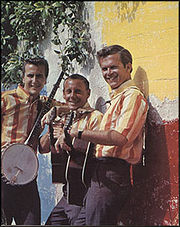 Despite the Kingston Trio's nearly unprecedented success in record sales, by early 1961 a rift developed and deepened between Guard on one side and Shane and Reynolds on the other. Guard had been referred to in the press and on the albums' liner notes as the "acknowledged leader" of the group, a description never wholly endorsed by Shane and Reynolds, who felt themselves equal contributors to the group's repertoire and success. Guard wanted Shane and Reynolds to follow his lead and learn more of the technical aspects of music and to redirect the group's song selections, in part because of the withering criticism that the group had been getting from more traditional folk performers for the Trio's smoother and more commercial versions of folk songs and for the money-making copyrights that the Kingston group had secured for their arrangements of public domain
songs. Shane and Reynolds felt that the formula for song selection and performance that they had painstakingly developed and rehearsed still served them well.
Furthermore, over $100,000 appeared to be missing from the Trio's publishing royalties (an accounting error eventually rectified) and that created an additional irritant to both sides: to Guard because he regarded it as inexcusable carelessness and to Shane and Reynolds because it highlighted what they perceived as Guard's propensity to claim individual copyright for some of the group's songs, including "Tom Dooley
" (though Guard eventually lost a suit over copyright for that number to Alan Lomax
, Frank Warner, and Frank Proffitt
) and "Scotch and Soda
".
The situation became intolerable for all concerned, and Dave Guard resigned from the Kingston Trio in April 1961, though pledging to fulfill group commitments through November of that year. Shane, Reynolds, and Werber bought out Guard's interest in the partnership for $300,000 to be paid over a number of years and moved to replace him immediately. The remaining Trio partners settled quickly on John Stewart, a 21-year-old member of the Cumberland Three, one of the myriad of groups that sprang up hoping to imitate the Kingston Trio's success. Stewart was already well-acquainted with Reynolds and Shane, having sold two of his early songwriting efforts to the Trio, and he was a proficient guitarist, banjoist, and singer who seemed to the partners to be perfectly positioned to replace Guard. Stewart began rehearsing and recording with the group nearly immediately, commencing public appearances with the Trio in September 1961.
According to Shane, "We did nearly as well with John as we did with Dave." Six of the group's next seven albums between 1961 and 1963 continued to place in Billboard's Top Ten and several of the group's most successful singles, including "Where Have All the Flowers Gone?
" and "Greenback Dollar", charted as well.
Beginning in 1964, however, the Kingston Trio's dominance in record sales and popularity began to wane, due partly to the number and popularity of the aforementioned imitators in the pop-folk world but also to the rise of other major commercial folk groups like Peter, Paul and Mary
whose music had a decidedly more political bent than the Trio's. In addition, the British Invasion
spearheaded by The Beatles
, who were signed by Capitol just as the Trio's seven-year contract was running out, depressed sales of acoustic folk albums significantly, and Capitol did not make a serious effort to re-sign the group. Werber secured a generous signing bonus from Decca Records
, and the last four albums of the Kingston Trio's first decade were released by that label. Without the production facilities of Capitol, however, and the expertise of Voyle Gilmore and engineer Pete Abbott, the Decca releases lacked the aural brilliance of the Capitol albums, and none of the four sold especially well.
By 1966, Reynolds had grown weary of touring and Stewart wanted to strike out on his own as a singer-songwriter, so the three musicians and Werber developed an exit strategy of playing as many dates as possible for a year with an endpoint determined to be a final two-week engagement at the Hungry i in June 1967. The group followed this strategy successfully, and on June 17, 1967, the Kingston Trio ceased to be an actively performing band.
, Oregon and pursued interests in ranching, business, and race cars for the next twenty years. Stewart commenced a long and distinguished career as a singer-songwriter, composing hit songs like "Daydream Believer
" for The Monkees
and "Runaway Train" for Rosanne Cash
. He recorded more than 40 albums of his own, most notably the landmark California Bloodlines
, and found chart success in the top forty
with "Midnight Wind", "Lost Her in the Sun", and "Gold", the latter reaching number 5 in 1979.
Bob Shane decided to stay in entertainment, and he experimented with solo work. He recorded several singles, including a well-received but under-marketed version of the song "Honey
" that later became a million-seller for Bobby Goldsboro
, and with different configurations with other folk-oriented performers. Though finances were not an immediate concern—the Kingston Trio partners Werber, Shane and Reynolds still owned an office building, a restaurant, other commercial real estate, and a variety of other lucrative investments—Shane wanted to return to a group environment and in 1969 secured permission from his partners to use the mutually-owned group name for another band, with Reynolds and Werber insisting only that Shane's group be musically as accomplished as its predecessors and that Shane append "new" to the band's title.
Shane agreed and organized two troupes under the name of "The New Kingston Trio". The first consisted of guitarist Pat Horine and banjoist Jim Connor in addition to Shane and lasted from 1969 to 1973, the second including guitarist Roger Gambill and banjoist Bill Zorn from 1973 until 1976. Shane tried to create a repertoire for these groups that included both the older and expected Kingston Trio standards like "Tom Dooley" and "M.T.A." but that would also feature more contemporary songs as well, including country and novelty tunes. The attempt did not meet with any significant success. The only full-length album released by either group was The World Needs a Melody
in 1973 (though 25 years later FolkEra Records issued The Lost Masters 1969-1972, a compilation of previously unreleased tracks from the Shane-Horine-Connor years), and its sales were negligible. Though both troupes of the New Kingston Trio made a limited number of other recordings and several television appearances, neither generated very much interest from fans or the public at large.
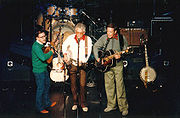 In 1976, Bill Zorn left the New Kingston Trio to work as a solo performer and record producer in London. Shane and Gambill replaced him with George Grove, a professionally-trained singer and instrumentalist from North Carolina who had been working in Nashville as a studio musician.
The same year, Shane secured from Werber and Reynolds the unencumbered rights to use the band's original name of the Kingston Trio without the appended "new" in exchange for relinquishing his interest in the still-profitable corporation, whose holdings included copyrights and licensing rights to many of the original Trio's songs. Since 1976, the various troupes headed and owned by Shane have performed and recorded simply as the Kingston Trio.
The Shane-Gambill-Grove Kingston Trio existed from 1976 through 1985, when Gambill died unexpectedly from a heart ailment at the age of 45. The nine years of this configuration was to that point the longest period of time that any three musicians had worked together as the Kingston Trio, and the group released two albums of largely original material.
It was during this period as well that PBS producers JoAnne Young and Paul Surratt approached Shane and the other principals of the original group with the idea of arranging a reunion concert that would be taped and used as a fundraiser for the network. Agreement was reached, and on November 7, 1981, Dave Guard, Nick Reynolds, and John Stewart joined the Shane-Gambill-Grove Trio and guest performers Mary Travers
of Peter, Paul and Mary
, Tom Smothers
of the Smothers Brothers
, and Lindsey Buckingham
of Fleetwood Mac
at the Magic Mountain
amusement park north of Los Angeles for a show billed as "The Kingston Trio And Friends Reunion." The different configurations of the Trio took turns performing sets of the group's best-known songs with all the artists joining onstage for a finale.
More than twenty years had passed since Dave Guard had left the group, but residual tension surfaced between Guard and Shane in an article in the Wall Street Journal that appeared in March 1982 following the national broadcast of the taped show. Guard implicitly disparaged Shane's current group, and Shane asserted a distaste for performing again with Guard, who had spent the intervening decades living and performing in Australia, touring sporadically as a soloist, and writing about and teaching music. Despite the unpleasantness, Shane and Guard reconciled to a large degree (even to the point of planning a possible reunion tour) prior to Guard's death at age 56 from lymphoma nine years later in March 1991.
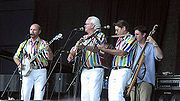 Following the 1985 death of Roger Gambill, Kingston Trio personnel changed several times, though Shane and Grove remained constants. Bob Haworth, a veteran folk performer who had worked as a member of The Brothers Four
for many years initially replaced Gambill from 1985 through 1988 and again from 1999 through 2005. In 1988, original member Nick Reynolds rejoined the band until his final retirement in 1999. When heart disease forced Bob Shane's retirement from touring in March 2004, he was replaced by former New Kingston Trio member Bill Zorn. A year later, following Haworth's departure, Grove and Zorn were joined by Rick Dougherty, who had performed for a time with Zorn as second-generation members of another popular folk group from the 1960s, The Limeliters
.
Both the Grove–Zorn–Haworth and Grove–Zorn–Dougherty troupes of the Kingston Trio have released original CDs and DVDs, and the latter configuration continues to tour extensively under the direction of the only surviving original member Bob Shane, now sole owner of the band. Capitol Records
, Decca Records
, Collector's Choice Music, and Folk Era Records have released and continue to release compilations of older albums as well as previously-unreleased tapes of both studio and live recordings from the Kingston Trio's first ten years.
magazine, a publication that combined articles on traditional folk music with political activism. Its editor Irwin Silber
referred to "the sallow slickness of the Kingston Trio" and in an article in the spring 1959 issue Ron Radosh
said that the Trio brought "good folk music to the level of the worst in Tin Pan Alley
music" and referred to them as "prostitutes of the art who gain their status as folk artists because they use guitars and banjos." Following the Trio's performance at the premier Newport Folk Festival
in 1959, folk music critic Mark Morris wrote "What connection these frenetic tinselly showmen have with a folk festival eludes me...except that it is mainly folk songs that they choose to vulgarize."
Frank Proffitt
, the Appalachian music
ian whose version of "Tom Dooley" the Trio re-arranged, watched their performance of his song on a television show and wrote in reaction, "They clowned and hipswung. Then they came out with 'This time tomorrow, reckon where I’ll be/If it hadn't a' been for Grayson/I'd a been in Tennessee.' I began to feel sorty sick. Like I’d lost a loved one. Tears came to my eyes. I went out and bawled on the ridge." Proffitt had learned the song from his father and his grandmother, who had known Tom Dula
and Laura Foster, the killer and the victim in the actual 1866 murder related in the song. Both Proffitt and fellow North Carolina musician Doc Watson
sang the older version of the tune, which had "a lively mocking tempo...that retained some of the ghastliness and moral squalor of an actual murder", according to folk historian Robert Cantwell, who also notes that the Kingston Trio's version of the song left out several verses from the traditional lyric. The slower, harmonized Trio version of the Dooley song and other traditional numbers struck Proffitt as a betrayal of "the strange mysterious workings which has made Tom Dooly live[sic]". As recently as 2006, folk traditionalist and influential banjo master Billy Faier
remarked "I hear and see very little respect for the folk genre" in their music and described the Trio's repertoire as "a mishmash of twisted arrangements that not only obscure the true beauty of the folk songs from which they derive, but give them a meaning they never had."
However, Trio members never claimed to be folksingers and were never comfortable with the label. The liner notes for the group's first album featured a quotation from Dave Guard asserting that "We are not folksingers in the accepted sense of the word." Guard later told journalist Richard Hadlock in Down Beat
magazine: "We are not students of folk music; the basic thing for us is honest and worthwhile songs that people can pick up and become involved in." Nick Reynolds added in the same article: "We don't collect old songs in the sense that the academic cats do... We get new tunes to look over every day. Each one of us has his ears open constantly to new material or old stuff that's good." Bob Shane remarked years later: "To call the Kingston Trio folksingers was kind of stupid in the first place. We never called ourselves folksingers... We did folk-oriented material, but we did it amid all kinds of other stuff. But they didn't know what to call us with our instruments, so Capitol Records called us folksingers and gave us credit for starting this whole boom."
Further, Peter Dreier points out that "the group deserves credit for helping to launch the folk boom that brought recognition to older folkies and radicals like Woody Guthrie and Pete Seeger, and for paving the way for newcomers like Joan Baez, Bob Dylan and Phil Ochs, who were well-known for their progressive political views and topical songs. By the time these younger folk singers arrived on the scene, the political climate had changed enough to provide a wide audience for protest music." The passage of time may well have made the controversy moot. Writing in the British daily The Guardian
, again in an obituary for Reynolds, Ken Hunt asserted that "The Kingston Trio helped to turn untold numbers of people on to folk music... they put the boom in folk boom. The Kingston Trio carried the torch overseas, most notably with their international hit of 1958, Tom Dooley. They were the greatest of the bands to emerge after the McCarthy-era blacklisting of folk musicians and breathed new air into the genre."
Discussing his earliest musical influences in a 2001 Rolling Stone interview, Bob Dylan
remembered:
Jac Holzman
, co-founder of the originally folk-based Elektra Records
, remarked that his formerly struggling company's new-found prosperity in the late 1950s resulted from "The Kingston Trio which has the ability to capture the interest of a large number of people who have never been conscious of folk music before. In this respect, the Kingston Trio has put us on the map."
Even some staunch traditionalists from both the urban and rural folk music communities had an affinity for the Kingstons' polished commercial versions of older songs. In her memoir And A Voice To Sing With, singer and activist Joan Baez
recalled that "Traveling across the country with my mother and sisters, we heard the commercial songs of the budding folk boom for the first time, the Kingston Trio's 'Tom Dooley' and 'Scotch and Soda.' Before I turned into a snob and learned to look down upon all commercial folk music as bastardized and unholy, I loved the Kingston Trio. When I became one of the leading practitioners of 'pure folk,' I still loved them..." Arthel "Doc" Watson
of North Carolina, one of the most respected and influential musicians performing traditional music, remarked, "I’ll tell you who pointed all our noses in the right direction, even the traditional performers. They got us interested in trying to put the good stuff out there—the Kingston Trio. They got me interested in it!"
, Lindsey Buckingham
of Fleetwood Mac
, Timothy B. Schmit
of The Eagles, pioneering folk-rock artist Gram Parsons
, Stephen Stills
and David Crosby
of Crosby, Stills, and Nash, The Beach Boys
' Al Jardine
, Big Brother and the Holding Company
founding member Peter Albin, Denny Doherty
of The Mamas and the Papas, banjo master Tony Trischka
, pop group ABBA
, Jefferson Airplane
founding members Marty Balin
and Paul Kantner
, Buffalo Springfield
founding member Richie Furay
, Byrds co-founder Gene Clark
, roots musician and master mandolin player David Grisman
, singer-songwriters Tom Paxton
,Harry Chapin
, Jimmy Buffett
, Tim Buckley
, Steve Goodman
(composer of "The City Of New Orleans
"), Steve Gillette
, and Michael Smith
(composer of "The Dutchman
"), folk-rock group We Five
co-founder Jerry Burgan, folk and rock musician Jerry Yester
, and progressive jazz vocal group Manhattan Transfer
among many others cite the Kingston Trio as a formative influence in their musical careers.
Satirist Tom Lehrer
has acknowledged the Trio's pioneering of college concerts, observing that before the Kingstons "there was no real concert circuit...The Kingston Trio started all that," and in Time magazine, critic Richard Corliss
asserted, "In my youth, they changed pop music, and me with it."
Grammy Hall of Fame Award
Grammy Lifetime Achievement Award
"
Vocal Group Hall of Fame
Hit Parade Hall of Fame
Library of Congress National Registry of Historically Significant Recordings
Billboard
Awards
Folk music
Folk music is an English term encompassing both traditional folk music and contemporary folk music. The term originated in the 19th century. Traditional folk music has been defined in several ways: as music transmitted by mouth, as music of the lower classes, and as music with unknown composers....
and pop music
Pop music
Pop music is usually understood to be commercially recorded music, often oriented toward a youth market, usually consisting of relatively short, simple songs utilizing technological innovations to produce new variations on existing themes.- Definitions :David Hatch and Stephen Millward define pop...
group that helped launch the folk revival
American folk music revival
The American folk music revival was a phenomenon in the United States that began during the 1940s and peaked in popularity in the mid-1960s. Its roots went earlier, and performers like Josh White, Burl Ives, Woody Guthrie, Lead Belly, Richard Dyer-Bennett, Oscar Brand, Jean Ritchie, John Jacob...
of the late 1950s to late 1960s. The group started as a San Francisco Bay Area nightclub act with an original lineup of Dave Guard
Dave Guard
Donald David "Dave" Guard was an American folk singer, songwriter, arranger and recording artist. Along with Nick Reynolds and Bob Shane, he was one of the founding members of The Kingston Trio.Guard was educated in Honolulu, Hawaii, at Punahou School in what was then the pre-statehood U.S....
, Bob Shane
Bob Shane
Bob Shane is an American singer and guitarist and, with Nick Reynolds' passing in October 2008, the only surviving founding member of The Kingston Trio. In that capacity, Shane became a seminal figure in the revival of folk and other acoustic music as a popular art form in the U.S...
, and Nick Reynolds
Nick Reynolds
Nick Reynolds was an American folk musician and recording artist. Reynolds was one of the founding members of The Kingston Trio, whose largely folk-based material captured international attention during the late fifties and early sixties.- Early life :Growing up in Coronado, California, his...
. It rose to international popularity, fueled by unprecedented sales of 33⅓ rpm long-playing record albums
LP album
The LP, or long-playing microgroove record, is a format for phonograph records, an analog sound storage medium. Introduced by Columbia Records in 1948, it was soon adopted as a new standard by the entire record industry...
(LPs), and helped to alter the direction of popular music in the U.S.
The Kingston Trio was one of the most prominent bands of the era's pop-folk boom that started in 1958 with the release of their first album
The Kingston Trio (album)
The Kingston Trio is The Kingston Trio's debut album, released in 1958 . It entered the album charts in late October 1958, where it resided for nearly four years, spending one week at #1 in early 1959...
and its hit recording of "Tom Dooley
Tom Dooley (song)
"Tom Dooley" is an old North Carolina folk song based on the 1866 murder of a woman named Laura Foster in Wilkes County, North Carolina. It is best known today because of a hit version recorded in 1958 by The Kingston Trio. This version was a multi-format hit, reaching #1 in Billboard, the...
", which sold over three million copies as a single. The Trio released nineteen albums that made Billboard
Billboard (magazine)
Billboard is a weekly American magazine devoted to the music industry, and is one of the oldest trade magazines in the world. It maintains several internationally recognized music charts that track the most popular songs and albums in various categories on a weekly basis...
's Top 100, fourteen of which ranked in the top 10, and five of which hit the number 1 spot. Four of the group's LPs charted among the Top 10 selling albums for five weeks in November and December 1959, a record unmatched for more than 50 years, and the group still ranks after half a century in the all-time lists of many of Billboard's cumulative charts, including those for most weeks with a number 1 album, most total weeks charting an album, most number 1 albums, most consecutive number 1 albums, and most top ten albums.
Music historian Richie Unterberger
Richie Unterberger
Richie Unterberger is a US author and journalist whose focus is popular music and travel writing.-Life and writing:Having worked as a DJ at WXPN in Philadelphia, he started reviewing records for Op magazine in 1983...
characterized their impact as "phenomenal popularity", and the Kingston Trio's massive record sales in its early days made acoustic folk music commercially viable, paving the way for singer-songwriter, folk rock
Folk rock
Folk rock is a musical genre combining elements of folk music and rock music. In its earliest and narrowest sense, the term referred to a genre that arose in the United States and the UK around the mid-1960s...
, and Americana
Americana (music)
Americana is an amalgam of roots musics formed by the confluence of the shared and varied traditions that make up the American musical ethos; specifically those sounds that are merged from folk, country, blues, rhythm and blues, rock and roll and other external influential styles...
artists who followed in their wake.
Formation, 1954–1957
Dave GuardDave Guard
Donald David "Dave" Guard was an American folk singer, songwriter, arranger and recording artist. Along with Nick Reynolds and Bob Shane, he was one of the founding members of The Kingston Trio.Guard was educated in Honolulu, Hawaii, at Punahou School in what was then the pre-statehood U.S....
(Donald David Guard, October 19, 1934 – March 22, 1991) and Bob Shane
Bob Shane
Bob Shane is an American singer and guitarist and, with Nick Reynolds' passing in October 2008, the only surviving founding member of The Kingston Trio. In that capacity, Shane became a seminal figure in the revival of folk and other acoustic music as a popular art form in the U.S...
(born Robert Castle Schoen, February 1, 1934) had been friends since junior high school at the Punahou School
Punahou School
Punahou School, once known as Oahu College, is a private, co-educational, college preparatory school located in Honolulu CDP, City and County of Honolulu in the U.S. State of Hawaii...
in Honolulu
Honolulu, Hawaii
Honolulu is the capital and the most populous city of the U.S. state of Hawaii. Honolulu is the southernmost major U.S. city. Although the name "Honolulu" refers to the urban area on the southeastern shore of the island of Oahu, the city and county government are consolidated as the City and...
, Hawaii where both had learned to play ukulele
Ukulele
The ukulele, ; from ; it is a subset of the guitar family of instruments, generally with four nylon or gut strings or four courses of strings....
in required music classes. They had developed an interest in and admiration for native Hawaiian slack key guitarists like Gabby Pahinui
Gabby Pahinui
Charles Philip "Gabby" or "Pops" Pahinui was a slack-key guitarist.Gabby was born Charles Kapono Kahahawaii Jr. and later hānai-ed into the Pahinui family as Charles Philip Pahinui and raised in the Kaka'ako area of Honolulu in the 1920s...
. While in Punahou's secondary school, Shane taught first himself and then Guard the rudiments of the six-string guitar, and the two began performing at parties and in school shows doing an eclectic mix of Tahitian, Hawaiian, and calypso
Calypso music
Calypso is a style of Afro-Caribbean music that originated in Trinidad and Tobago from African and European roots. The roots of the genre lay in the arrival of enslaved Africans, who, not being allowed to speak with each other, communicated through song...
songs.
After graduating from high school in 1952, Guard enrolled at Stanford University
Stanford University
The Leland Stanford Junior University, commonly referred to as Stanford University or Stanford, is a private research university on an campus located near Palo Alto, California. It is situated in the northwestern Santa Clara Valley on the San Francisco Peninsula, approximately northwest of San...
in Palo Alto, California while Shane matriculated at nearby Menlo College
Menlo College
Menlo College, often referred to as Menlo, is a private, four-year baccalaureate college specializing in business located in the Silicon Valley town of Atherton, California.-Campus:...
. At Menlo, Shane became friends with Nick Reynolds
Nick Reynolds
Nick Reynolds was an American folk musician and recording artist. Reynolds was one of the founding members of The Kingston Trio, whose largely folk-based material captured international attention during the late fifties and early sixties.- Early life :Growing up in Coronado, California, his...
(Nicholas Wells Reynolds, July 27, 1933 – October 1, 2008), a native San Diegan with an extensive knowledge of folk and calypso songs—in part from his guitar-playing father, a career officer in the U.S. Navy. Reynolds was also able to create and sing tenor
Tenor
The tenor is a type of male singing voice and is the highest male voice within the modal register. The typical tenor voice lies between C3, the C one octave below middle C, to the A above middle C in choral music, and up to high C in solo work. The low extreme for tenors is roughly B2...
harmonies, a skill derived in part from family singalongs, and could play both guitar and bongo and conga drums. Shane and Reynolds performed at fraternity parties and luau
Luau
A luau is a Hawaiian feast. It may feature food, such as poi, kalua pig, poke, lomi salmon, opihi, haupia, and beer; and entertainment, such as Hawaiian music and hula...
s for a time, and eventually Shane introduced Reynolds to Guard. The three began performing at campus and neighborhood hangouts, sometimes as a trio but with an aggregation of friends that could swell their ranks to as many as six or seven, according to Reynolds. They usually billed themselves under the name of "Dave Guard and the Calypsonians". None of the three at that time had any serious aspirations to enter professional show business, however, and Shane returned to Hawaii following his graduation in late 1956 to work in the family sporting goods business.
Still in the Bay Area, Guard and Reynolds had organized themselves somewhat more formally into an entity named "The Kingston Quartet" with friends bassist Joe Gannon
Joe Gannon
Joe Gannon is a Philadelphia native, recording producer, director, musical stage lighting and production designer. Gannon operated and managed Frank Zappa’s record company and produced records for CBS. He worked as road manager for Bill Cosby and staged Madonna's first film appearance...
and vocalist Barbara Bogue, though as before they were often joined in their performances by other friends. At one engagement at Redwood City's Cracked Pot beer garden, they met a young San Francisco publicist named Frank Werber, who had heard of them from a local entertainment reporter. Werber liked the group's raw energy but did not consider them refined enough to want to represent them as an agent or manager at that point, though he left his telephone number with Guard. Some weeks later (and following a brief period in which Reynolds was temporarily replaced in the quartet by Don MacArthur), Guard and Reynolds invited Werber to a performance of the group at the Italian Village Restaurant in San Francisco, where Werber was so impressed by the group's progress that he agreed to manage them provided they replace Gannon, in whose professional potential Werber had no faith. Bogue left with Gannon, and Guard, Reynolds, and Werber invited Shane to rejoin the now more formally organized band. Shane, who had been performing part-time as a solo act at night in Honolulu, readily assented and returned to the mainland in early March 1957.
The four drew up a contract as equal partners in Werber's office in San Francisco, deciding first on the name "Kingston Trio" because it evoked, through its association with Kingston
Kingston, Jamaica
Kingston is the capital and largest city of Jamaica, located on the southeastern coast of the island. It faces a natural harbour protected by the Palisadoes, a long sand spit which connects the town of Port Royal and the Norman Manley International Airport to the rest of the island...
, Jamaica, the calypso music popular at the time, and second on the uniform of three-quarter-length sleeved vertically striped shirts that the group hoped would help their target audience of college students to identify with them.
Era of peak success, 1957–61
Werber imposed a stern training regimen on Guard, Shane, and Reynolds, rehearsing them for six to eight hours a day for several months, sending them to prominent San Francisco vocal coach Judy Davis to help them learn to preserve their voices, and working on the group's carefully prepared but apparently spontaneous banter between songs. At the same time, the group was developing a varied and eclectic repertoire of calypso, folk, and foreign language songs, suggested by all three of the musicians though usually arranged by Guard with some harmonies created by Reynolds.The first major professional break for the Kingston Trio came in late June 1957 when comedienne Phyllis Diller
Phyllis Diller
Phyllis Diller is an American actress and comedian. She created a stage persona of a wild-haired, eccentrically dressed housewife who makes jokes about a husband named "Fang" while pretending to smoke from a long cigarette holder...
canceled a week-long engagement at a small San Francisco club called The Purple Onion
The Purple Onion
The Purple Onion is a celebrated cellar club in the North Beach area of San Francisco, California located at 140 Columbus Avenue...
. When Werber convinced the club's owner to give the untested Trio a chance, Guard sent out five hundred postcards to everyone that the three musicians knew in the Bay Area and Werber plastered the city with handbills announcing the engagement. When the crowds came, the Trio had been well prepared by months of work, and they achieved such local popularity that the initial week's engagement stretched to six months. Werber built upon this initial success, booking a national club tour in early 1958 for the Trio that included engagements at such prominent night spots as Mr. Kelly's in Chicago, the Village Vanguard
Village Vanguard
The Village Vanguard is a jazz club located at in Greenwich Village, New York City. The club was opened on February 22, 1935, by Max Gordon. At first, it also featured other forms of music such as folk music and beat poetry, but it switched to an all-jazz format in 1957.-History:Over 100 jazz...
in New York, Storyville
Storyville (nightclub)
Storyville was a Boston nightclub and music venue opened by Boston, Massachusetts native jazz promoter and producer George Wein during the 1940s. Ahead of its time, it was a magnet for music titans like Billy Holiday, Ella Fitzgerald, Sarah Vaughan, Duke Ellington, Louis Armstrong, Charlie Parker,...
in Boston, and finally a return to San Francisco and its showcase nightclub, the Hungry i
Hungry i
The hungry i was originally a nightclub in North Beach, San Francisco. It was launched by Eric "Big Daddy" Nord, who sold it to Enrico Banducci in 1950.-The name:How the club's name came about is something of a mystery...
, in June of that year.
At the same time, Werber was attempting to leverage the Trio's popularity as a club act into a recording contract. Both Dot Records
Dot Records
Dot Records was an American record label and company that was active between 1950 and 1977. It was founded by Randy Wood. In Gallatin, Tennessee, Wood had earlier started a mail order record shop, known for its radio ads on WLAC in Nashville and its R&B air personality Bill "Hoss" Allen...
and Liberty Records
Liberty Records
Liberty Records was a United States-based record label. It was started by chairman Simon Waronker in 1955 with Al Bennett as president and Theodore Keep as chief engineer. It was reactivated in 2001 in the United Kingdom and had two previous revivals.-1950s:...
expressed some interest, but each proposed to record the Trio on 45rpm (revolutions per minute) singles only, whereas Werber and the Trio members both felt that 33⅓ rpm albums had more potential for the kind of music that the group was doing. Through Jimmy Saphier, agent for Bob Hope
Bob Hope
Bob Hope, KBE, KCSG, KSS was a British-born American comedian and actor who appeared in vaudeville, on Broadway, and in radio, television and movies. He was also noted for his work with the US Armed Forces and his numerous USO shows entertaining American military personnel...
who had seen and liked the group at The Purple Onion, Werber contacted Capitol Records
Capitol Records
Capitol Records is a major United States based record label, formerly located in Los Angeles, but operating in New York City as part of Capitol Music Group. Its former headquarters building, the Capitol Tower, is a major landmark near the corner of Hollywood and Vine...
, who dispatched one of its top producers Voyle Gilmore
Voyle Gilmore
Voyle Gilmore was an American record producer and arranger. He was best known for his work with Frank Sinatra and The Kingston Trio on Capitol Records...
to San Francisco to evaluate the Trio's commercial potential. On Gilmore's strong recommendation, Capitol signed the Kingston Trio to an exclusive seven-year deal.
The group's first album, Capitol T996 The Kingston Trio
The Kingston Trio (album)
The Kingston Trio is The Kingston Trio's debut album, released in 1958 . It entered the album charts in late October 1958, where it resided for nearly four years, spending one week at #1 in early 1959...
, was recorded over a three day period in February 1958 and released in June the same year just as the Trio was beginning its engagement at the Hungry i. Gilmore had made two important supervisory decisions as producer—first, to add the same kind of "bottom" to the Trio's sound that he had heard in live performance and consequently recruiting Purple Onion house bassist Buzz Wheeler to play on the album, and second to record the group's songs without the secondary orchestral accompaniment that was nearly universal (even for folk-styled records) at the time. The song selections on the first album reflected the repertoire that the musicians had been working on for two years—re-imagined traditional songs inspired by The Weavers
The Weavers
The Weavers were an American folk music quartet based in the Greenwich Village area of New York City. They sang traditional folk songs from around the world, as well as blues, gospel music, children's songs, labor songs, and American ballads, and selling millions of records at the height of their...
like "Santy Anno" and "Bay of Mexico," calypso-flavored tunes reminiscent of the hugely popular Harry Belafonte
Harry Belafonte
Harold George "Harry" Belafonte, Jr. is an American singer, songwriter, actor and social activist. He was dubbed the "King of Calypso" for popularizing the Caribbean musical style with an international audience in the 1950s...
recordings of the time such as "Banua" and "Sloop John B
The John B. Sails
"The John B. Sails" is a folk song that first appeared in a 1917 American novel, Pieces of Eight, written by Richard Le Gallienne. The "secret" narrator of the story describes it as "one of the quaint Nassau ditties," the first verse and chorus of which are:-1950 to 1963:Among others, the song has...
", and a mix of both foreign language and contemporary songwriter numbers, including Terry Gilkyson
Terry Gilkyson
Hamilton H. Gilkyson III , better known as Terry Gilkyson, was an American folk singer, composer, and lyricist.-Biography:...
's "Fast Freight" and "Scotch and Soda
Scotch and Soda (song)
"Scotch and Soda" is a song recorded by The Kingston Trio in 1958 and first released on the album The Kingston Trio; it also appeared on the live album Once Upon a Time and on various compilations....
", whose authorship remains unknown as of 2011.
The album sold moderately well—including on-site sales at the Hungry i during the Kingston Trio's engagement there through the summer—but it was DJ Paul Colburn at station KLUB in Salt Lake City whose enthusiasm for a single cut on the record spurred the next development in the group's history. Colburn began playing "Tom Dooley
Tom Dooley (song)
"Tom Dooley" is an old North Carolina folk song based on the 1866 murder of a woman named Laura Foster in Wilkes County, North Carolina. It is best known today because of a hit version recorded in 1958 by The Kingston Trio. This version was a multi-format hit, reaching #1 in Billboard, the...
" extensively on his show, prompting a rush of album sales in the Salt Lake area by fans who wanted to listen to the song, as yet unavailable as a single record. Colburn called other DJs around the country urging them to do the same, and national response to the song was so strong that a reluctant Capitol Records finally released the tune as a 45rpm single on August 8, 1958; it reached the number 1 spot on the Billboard chart by late November, sold a million copies by Christmas, and was awarded a gold record on January 21, 1959. "Tom Dooley" also spurred the debut album to a number 1 position on the charts and helped the band earn a second gold record for the LP, which remained charted on Billboard's weekly reports for 195 weeks.
The success of the album and the single earned the Kingston Trio a Grammy award
Grammy Award
A Grammy Award — or Grammy — is an accolade by the National Academy of Recording Arts and Sciences of the United States to recognize outstanding achievement in the music industry...
for Best Country & Western Performance
Grammy Award for Best Country & Western Recording
The Grammy Award for Best Country & Western Recording was awarded from 1959 to 1968. From 1959 to 1961 the award was presented as the Grammy Award for Best Country & Western Performance...
for "Tom Dooley" at the awards' inaugural ceremony in 1959. At the time, no folk music category existed in the Grammy's scheme. The next year, largely as a result of The Kingston Trio
The Kingston Trio (album)
The Kingston Trio is The Kingston Trio's debut album, released in 1958 . It entered the album charts in late October 1958, where it resided for nearly four years, spending one week at #1 in early 1959...
and "Tom Dooley", the National Academy of Recording Arts and Sciences
National Academy of Recording Arts and Sciences
The National Academy of Recording Arts & Sciences, Inc., known variously as The Recording Academy or NARAS, is a U.S. organization of musicians, producers, recording engineers and other recording professionals dedicated to improving the quality of life and cultural condition for music and its...
instituted a folk category and the Trio won the first Grammy Award for Best Ethnic or Traditional Folk Recording
Grammy Award for Best Ethnic or Traditional Folk Recording
The Grammy Award for Best Ethnic or Traditional Folk Recording was awarded from 1960 to 1986. During this time the award had several minor name changes:*From 1960 to 1961 the award was known as Best Performance - Folk...
for its second studio album At Large
At Large
In reviewing At Large for Allmusic, music critic Bruce Eder wrote the album "shows in the far more complex sound achieved by the trio throughout this album, with voices and instruments more closely interwoven than on their earlier studio recordings and achieving control over their volume that, even...
.
This was the beginning of a remarkable three-year run for the Trio in which their first five studio albums achieved number 1 chart status and were awarded gold records. By 1961, the group had sold more than eight million records, earning in excess of US$
United States dollar
The United States dollar , also referred to as the American dollar, is the official currency of the United States of America. It is divided into 100 smaller units called cents or pennies....
25 million for Capitol, roughly US$180 million in 2011 dollars. The Kingston Trio was responsible for 15 per cent of Capitol's total sales when Capitol also recorded among many other popular artists Frank Sinatra
Frank Sinatra
Francis Albert "Frank" Sinatra was an American singer and actor.Beginning his musical career in the swing era with Harry James and Tommy Dorsey, Sinatra became an unprecedentedly successful solo artist in the early to mid-1940s, after being signed to Columbia Records in 1943. Being the idol of the...
and Nat "King" Cole. Both Sinatra and Cole were also producing high-charting profitable albums. One indication of the Kingston Trio's popularity during this era was that for five consecutive weeks in November and December 1959, four Kingston Trio albums ranked in the top ten of Billboards Top LPs chart, an accomplishment unmatched by any artist before or since. The Trio also charted several single records during this time, made numerous television appearances, and played upwards of 200 engagements per year.
Change and a second phase, 1961–67
Public domain
Works are in the public domain if the intellectual property rights have expired, if the intellectual property rights are forfeited, or if they are not covered by intellectual property rights at all...
songs. Shane and Reynolds felt that the formula for song selection and performance that they had painstakingly developed and rehearsed still served them well.
Furthermore, over $100,000 appeared to be missing from the Trio's publishing royalties (an accounting error eventually rectified) and that created an additional irritant to both sides: to Guard because he regarded it as inexcusable carelessness and to Shane and Reynolds because it highlighted what they perceived as Guard's propensity to claim individual copyright for some of the group's songs, including "Tom Dooley
Tom Dooley (song)
"Tom Dooley" is an old North Carolina folk song based on the 1866 murder of a woman named Laura Foster in Wilkes County, North Carolina. It is best known today because of a hit version recorded in 1958 by The Kingston Trio. This version was a multi-format hit, reaching #1 in Billboard, the...
" (though Guard eventually lost a suit over copyright for that number to Alan Lomax
Alan Lomax
Alan Lomax was an American folklorist and ethnomusicologist. He was one of the great field collectors of folk music of the 20th century, recording thousands of songs in the United States, Great Britain, Ireland, the Caribbean, Italy, and Spain.In his later career, Lomax advanced his theories of...
, Frank Warner, and Frank Proffitt
Frank Proffitt
Frank Proffitt was an Appalachian old time banjoist and performer at the 1963 Newport Folk Festival. He was a key figure in inspiring musicians of the 1960s and 1970s to play the banjo. He recorded the ballad "Tom Dooley", learned from his aunt Nancy Prather...
) and "Scotch and Soda
Scotch and Soda (song)
"Scotch and Soda" is a song recorded by The Kingston Trio in 1958 and first released on the album The Kingston Trio; it also appeared on the live album Once Upon a Time and on various compilations....
".
The situation became intolerable for all concerned, and Dave Guard resigned from the Kingston Trio in April 1961, though pledging to fulfill group commitments through November of that year. Shane, Reynolds, and Werber bought out Guard's interest in the partnership for $300,000 to be paid over a number of years and moved to replace him immediately. The remaining Trio partners settled quickly on John Stewart, a 21-year-old member of the Cumberland Three, one of the myriad of groups that sprang up hoping to imitate the Kingston Trio's success. Stewart was already well-acquainted with Reynolds and Shane, having sold two of his early songwriting efforts to the Trio, and he was a proficient guitarist, banjoist, and singer who seemed to the partners to be perfectly positioned to replace Guard. Stewart began rehearsing and recording with the group nearly immediately, commencing public appearances with the Trio in September 1961.
According to Shane, "We did nearly as well with John as we did with Dave." Six of the group's next seven albums between 1961 and 1963 continued to place in Billboard's Top Ten and several of the group's most successful singles, including "Where Have All the Flowers Gone?
Where Have All the Flowers Gone?
"Where Have All the Flowers Gone?" is a folk song. The first three verses were written by Pete Seeger in 1955, and published in Sing Out! magazine...
" and "Greenback Dollar", charted as well.
Beginning in 1964, however, the Kingston Trio's dominance in record sales and popularity began to wane, due partly to the number and popularity of the aforementioned imitators in the pop-folk world but also to the rise of other major commercial folk groups like Peter, Paul and Mary
Peter, Paul and Mary
Peter, Paul and Mary were an American folk-singing trio whose nearly 50-year career began with their rise to become a paradigm for 1960s folk music. The trio was composed of Peter Yarrow, Paul Stookey and Mary Travers...
whose music had a decidedly more political bent than the Trio's. In addition, the British Invasion
British Invasion
The British Invasion is a term used to describe the large number of rock and roll, beat, rock, and pop performers from the United Kingdom who became popular in the United States during the time period from 1964 through 1966.- Background :...
spearheaded by The Beatles
The Beatles
The Beatles were an English rock band, active throughout the 1960s and one of the most commercially successful and critically acclaimed acts in the history of popular music. Formed in Liverpool, by 1962 the group consisted of John Lennon , Paul McCartney , George Harrison and Ringo Starr...
, who were signed by Capitol just as the Trio's seven-year contract was running out, depressed sales of acoustic folk albums significantly, and Capitol did not make a serious effort to re-sign the group. Werber secured a generous signing bonus from Decca Records
Decca Records
Decca Records began as a British record label established in 1929 by Edward Lewis. Its U.S. label was established in late 1934; however, owing to World War II, the link with the British company was broken for several decades....
, and the last four albums of the Kingston Trio's first decade were released by that label. Without the production facilities of Capitol, however, and the expertise of Voyle Gilmore and engineer Pete Abbott, the Decca releases lacked the aural brilliance of the Capitol albums, and none of the four sold especially well.
By 1966, Reynolds had grown weary of touring and Stewart wanted to strike out on his own as a singer-songwriter, so the three musicians and Werber developed an exit strategy of playing as many dates as possible for a year with an endpoint determined to be a final two-week engagement at the Hungry i in June 1967. The group followed this strategy successfully, and on June 17, 1967, the Kingston Trio ceased to be an actively performing band.
Hiatus and the New Kingston Trio, 1967–1976
Following the Hungry i engagement, Reynolds moved to Port OrfordPort Orford, Oregon
Port Orford is a city in Curry County, Oregon, United States. It is on the southern Oregon Coast, at the northern end of what coastal Oregonians call the Banana Belt, because the weather from Port Orford south is noticeably warmer than the weather north of nearby Cape Blanco...
, Oregon and pursued interests in ranching, business, and race cars for the next twenty years. Stewart commenced a long and distinguished career as a singer-songwriter, composing hit songs like "Daydream Believer
Daydream Believer
"Daydream Believer" is a song composed by John Stewart shortly before he left the Kingston Trio. The song was originally recorded by The Monkees, with Davy Jones singing lead vocals. The single hit the number one spot on the U.S. Billboard Hot 100 chart in December 1967, remaining there for four...
" for The Monkees
The Monkees
The Monkees are an American pop rock group. Assembled in Los Angeles in 1966 by Robert "Bob" Rafelson and Bert Schneider for the American television series The Monkees, which aired from 1966 to 1968, the musical acting quartet was composed of Americans Micky Dolenz, Michael Nesmith and Peter Tork,...
and "Runaway Train" for Rosanne Cash
Rosanne Cash
Rosanne Cash is an American singer-songwriter and author. She is the eldest daughter of the late country music singer Johnny Cash and his first wife, Vivian Liberto Cash Distin....
. He recorded more than 40 albums of his own, most notably the landmark California Bloodlines
California Bloodlines
California Bloodlines is the second album by folk musician John Stewart, former member of the Kingston Trio. It was named by Rolling Stone as of one of the 200 best albums of all time....
, and found chart success in the top forty
Top Forty
The Top Forty or Top 40 is a music industry shorthand for the currently most-popular songs in a particular genre. When used without qualification, it typically refers to the best-selling or most frequently broadcast popular music songs of the previous week...
with "Midnight Wind", "Lost Her in the Sun", and "Gold", the latter reaching number 5 in 1979.
Bob Shane decided to stay in entertainment, and he experimented with solo work. He recorded several singles, including a well-received but under-marketed version of the song "Honey
Honey (Bobby Goldsboro song)
"Honey," also known as "Honey ," is a song written by Bobby Russell. He first produced it with former Kingston Trio member Bob Shane...
" that later became a million-seller for Bobby Goldsboro
Bobby Goldsboro
Bobby Goldsboro is an American country and pop singer-songwriter. He had a string of Pop and Country hits during the 1960s and 1970s, including his signature #1 classic "Honey," which sold well over one million copies in the United States.-Early life:Goldsboro was born in Marianna, Florida...
, and with different configurations with other folk-oriented performers. Though finances were not an immediate concern—the Kingston Trio partners Werber, Shane and Reynolds still owned an office building, a restaurant, other commercial real estate, and a variety of other lucrative investments—Shane wanted to return to a group environment and in 1969 secured permission from his partners to use the mutually-owned group name for another band, with Reynolds and Werber insisting only that Shane's group be musically as accomplished as its predecessors and that Shane append "new" to the band's title.
Shane agreed and organized two troupes under the name of "The New Kingston Trio". The first consisted of guitarist Pat Horine and banjoist Jim Connor in addition to Shane and lasted from 1969 to 1973, the second including guitarist Roger Gambill and banjoist Bill Zorn from 1973 until 1976. Shane tried to create a repertoire for these groups that included both the older and expected Kingston Trio standards like "Tom Dooley" and "M.T.A." but that would also feature more contemporary songs as well, including country and novelty tunes. The attempt did not meet with any significant success. The only full-length album released by either group was The World Needs a Melody
The World Needs a Melody
The World Needs a Melody is an album by The New Kingston Trio, released in 1973.-History:Two years before the release of Once Upon a Time in 1969, the Kingston Trio disbanded in 1967 following a two week farewell engagement at San Francisco's Hungry i, the nightclub at which they had started their...
in 1973 (though 25 years later FolkEra Records issued The Lost Masters 1969-1972, a compilation of previously unreleased tracks from the Shane-Horine-Connor years), and its sales were negligible. Though both troupes of the New Kingston Trio made a limited number of other recordings and several television appearances, neither generated very much interest from fans or the public at large.
The third phase, 1976–2011
The same year, Shane secured from Werber and Reynolds the unencumbered rights to use the band's original name of the Kingston Trio without the appended "new" in exchange for relinquishing his interest in the still-profitable corporation, whose holdings included copyrights and licensing rights to many of the original Trio's songs. Since 1976, the various troupes headed and owned by Shane have performed and recorded simply as the Kingston Trio.
The Shane-Gambill-Grove Kingston Trio existed from 1976 through 1985, when Gambill died unexpectedly from a heart ailment at the age of 45. The nine years of this configuration was to that point the longest period of time that any three musicians had worked together as the Kingston Trio, and the group released two albums of largely original material.
It was during this period as well that PBS producers JoAnne Young and Paul Surratt approached Shane and the other principals of the original group with the idea of arranging a reunion concert that would be taped and used as a fundraiser for the network. Agreement was reached, and on November 7, 1981, Dave Guard, Nick Reynolds, and John Stewart joined the Shane-Gambill-Grove Trio and guest performers Mary Travers
Mary Travers (singer)
Mary Allin Travers was an American singer-songwriter and member of the folk music group Peter, Paul and Mary, along with Peter Yarrow and Noel Stookey...
of Peter, Paul and Mary
Peter, Paul and Mary
Peter, Paul and Mary were an American folk-singing trio whose nearly 50-year career began with their rise to become a paradigm for 1960s folk music. The trio was composed of Peter Yarrow, Paul Stookey and Mary Travers...
, Tom Smothers
Tom Smothers
Tom Smothers is an American comedian, composer and musician, best known as half of the musical comedy team The Smothers Brothers, alongside his younger brother Dick.-Early life:...
of the Smothers Brothers
Smothers Brothers
The Smothers Brothers are Thomas and Richard , American singers, musicians, comedians and folk heroes. The brothers' trademark act was performing folk songs , which usually led to arguments between the siblings...
, and Lindsey Buckingham
Lindsey Buckingham
Lindsey Adams Buckingham is an American guitarist, singer, composer and producer, most notable for being the guitarist and male lead singer of the musical group Fleetwood Mac. Aside from his tenure with Fleetwood Mac, Buckingham has also released six solo albums and a live album...
of Fleetwood Mac
Fleetwood Mac
Fleetwood Mac are a British–American rock band formed in 1967 in London.The only original member present in the band is its eponymous drummer, Mick Fleetwood...
at the Magic Mountain
Six Flags Magic Mountain
Six Flags Magic Mountain is a theme park located in Valencia, California north of Los Angeles. It opened on Memorial Day weekend on May 30, 1971 as Magic Mountain, by the Newhall Land and Farming Company. In 1979, Six Flags purchased the park and added the name Six Flags to the park's title. In...
amusement park north of Los Angeles for a show billed as "The Kingston Trio And Friends Reunion." The different configurations of the Trio took turns performing sets of the group's best-known songs with all the artists joining onstage for a finale.
More than twenty years had passed since Dave Guard had left the group, but residual tension surfaced between Guard and Shane in an article in the Wall Street Journal that appeared in March 1982 following the national broadcast of the taped show. Guard implicitly disparaged Shane's current group, and Shane asserted a distaste for performing again with Guard, who had spent the intervening decades living and performing in Australia, touring sporadically as a soloist, and writing about and teaching music. Despite the unpleasantness, Shane and Guard reconciled to a large degree (even to the point of planning a possible reunion tour) prior to Guard's death at age 56 from lymphoma nine years later in March 1991.
The Brothers Four
The Brothers Four are an American folk singing group, founded in 1957 in Seattle, Washington, known for their 1960 hit song "Greenfields".-History:...
for many years initially replaced Gambill from 1985 through 1988 and again from 1999 through 2005. In 1988, original member Nick Reynolds rejoined the band until his final retirement in 1999. When heart disease forced Bob Shane's retirement from touring in March 2004, he was replaced by former New Kingston Trio member Bill Zorn. A year later, following Haworth's departure, Grove and Zorn were joined by Rick Dougherty, who had performed for a time with Zorn as second-generation members of another popular folk group from the 1960s, The Limeliters
The Limeliters
The Limeliters are an American folk music group, formed in July 1959 by Lou Gottlieb , Alex Hassilev , and Glenn Yarbrough . The group was active from 1959 until 1965, when they disbanded. After a hiatus of sixteen years Yarbrough, Hassilev, and Gottlieb reunited and began performing as...
.
Both the Grove–Zorn–Haworth and Grove–Zorn–Dougherty troupes of the Kingston Trio have released original CDs and DVDs, and the latter configuration continues to tour extensively under the direction of the only surviving original member Bob Shane, now sole owner of the band. Capitol Records
Capitol Records
Capitol Records is a major United States based record label, formerly located in Los Angeles, but operating in New York City as part of Capitol Music Group. Its former headquarters building, the Capitol Tower, is a major landmark near the corner of Hollywood and Vine...
, Decca Records
Decca Records
Decca Records began as a British record label established in 1929 by Edward Lewis. Its U.S. label was established in late 1934; however, owing to World War II, the link with the British company was broken for several decades....
, Collector's Choice Music, and Folk Era Records have released and continue to release compilations of older albums as well as previously-unreleased tapes of both studio and live recordings from the Kingston Trio's first ten years.
Initial criticism
Almost from its inception, the Kingston Trio found itself at odds with the traditional music community. Urban folk musicians of the time (to whom Bob Dylan referred in Rolling Stone as "the left-wing puritans that seemed to have a hold on the folk-music community") frequently associated folk music with leftist politics and were contemptuous of the Trio's deliberate political neutrality. Peter Dreier of Occidental College observed that "Purists often derided the Kingston Trio for watering down folk songs in order to make them commercially popular and for remaining on the political sidelines during the protest movements of the 1960s." A series of scathing articles appeared over several years in Sing Out!Sing Out!
Sing Out! is a quarterly journal of folk music and folk songs that has been published since May 1950.-Background:Sing Out! is the primary publication of the tax exempt, not-for-profit, educational corporation of the same name...
magazine, a publication that combined articles on traditional folk music with political activism. Its editor Irwin Silber
Irwin Silber
Irwin Silber was an American journalist, editor, publisher, and political activist.-Early years:Irwin Silber was born October 17, 1925 in New York City to ethnic Jewish parents....
referred to "the sallow slickness of the Kingston Trio" and in an article in the spring 1959 issue Ron Radosh
Ronald Radosh
Ronald Radosh is an American writer, professor, historian, former Marxist, and neoconservative. He is known for his work on the Cold War espionage case of Ethel and Julius Rosenberg and his advocacy of the state of Israel....
said that the Trio brought "good folk music to the level of the worst in Tin Pan Alley
Tin Pan Alley
Tin Pan Alley is the name given to the collection of New York City music publishers and songwriters who dominated the popular music of the United States in the late 19th century and early 20th century...
music" and referred to them as "prostitutes of the art who gain their status as folk artists because they use guitars and banjos." Following the Trio's performance at the premier Newport Folk Festival
Newport Folk Festival
The Newport Folk Festival is an American annual folk-oriented music festival in Newport, Rhode Island, which began in 1959 as a counterpart to the previously established Newport Jazz Festival...
in 1959, folk music critic Mark Morris wrote "What connection these frenetic tinselly showmen have with a folk festival eludes me...except that it is mainly folk songs that they choose to vulgarize."
Frank Proffitt
Frank Proffitt
Frank Proffitt was an Appalachian old time banjoist and performer at the 1963 Newport Folk Festival. He was a key figure in inspiring musicians of the 1960s and 1970s to play the banjo. He recorded the ballad "Tom Dooley", learned from his aunt Nancy Prather...
, the Appalachian music
Appalachian music
Appalachian music is the traditional music of the region of Appalachia in the Eastern United States. It is derived from various European and African influences, including English ballads, Irish and Scottish traditional music , religious hymns, and African-American blues...
ian whose version of "Tom Dooley" the Trio re-arranged, watched their performance of his song on a television show and wrote in reaction, "They clowned and hipswung. Then they came out with 'This time tomorrow, reckon where I’ll be/If it hadn't a' been for Grayson/I'd a been in Tennessee.' I began to feel sorty sick. Like I’d lost a loved one. Tears came to my eyes. I went out and bawled on the ridge." Proffitt had learned the song from his father and his grandmother, who had known Tom Dula
Tom Dula
Thomas C. Dula was a former Confederate soldier, who was tried, convicted, and hanged for the murder of his fiancée, Laura Foster. The trial and hanging received national publicity from newspapers such as The New York Times, thus turning Dula's story into a folk legend...
and Laura Foster, the killer and the victim in the actual 1866 murder related in the song. Both Proffitt and fellow North Carolina musician Doc Watson
Doc Watson
Arthel Lane "Doc" Watson is an American guitar player, songwriter and singer of bluegrass, folk, country, blues and gospel music. He has won seven Grammy awards as well as a Grammy Lifetime Achievement Award. Watson's flatpicking skills and knowledge of traditional American music are highly regarded...
sang the older version of the tune, which had "a lively mocking tempo...that retained some of the ghastliness and moral squalor of an actual murder", according to folk historian Robert Cantwell, who also notes that the Kingston Trio's version of the song left out several verses from the traditional lyric. The slower, harmonized Trio version of the Dooley song and other traditional numbers struck Proffitt as a betrayal of "the strange mysterious workings which has made Tom Dooly live[sic]". As recently as 2006, folk traditionalist and influential banjo master Billy Faier
Billy Faier
Billy Faier is an American banjo player. He, along with Pete Seeger, was one of the early exponents of the banjo during the mid-20th century American folk music revival....
remarked "I hear and see very little respect for the folk genre" in their music and described the Trio's repertoire as "a mishmash of twisted arrangements that not only obscure the true beauty of the folk songs from which they derive, but give them a meaning they never had."
However, Trio members never claimed to be folksingers and were never comfortable with the label. The liner notes for the group's first album featured a quotation from Dave Guard asserting that "We are not folksingers in the accepted sense of the word." Guard later told journalist Richard Hadlock in Down Beat
Down Beat
Down Beat is an American magazine devoted to "jazz, blues and beyond" to indicate its expansion beyond the jazz realm which it covered exclusively in previous years. The publication was established in 1934 in Chicago, Illinois...
magazine: "We are not students of folk music; the basic thing for us is honest and worthwhile songs that people can pick up and become involved in." Nick Reynolds added in the same article: "We don't collect old songs in the sense that the academic cats do... We get new tunes to look over every day. Each one of us has his ears open constantly to new material or old stuff that's good." Bob Shane remarked years later: "To call the Kingston Trio folksingers was kind of stupid in the first place. We never called ourselves folksingers... We did folk-oriented material, but we did it amid all kinds of other stuff. But they didn't know what to call us with our instruments, so Capitol Records called us folksingers and gave us credit for starting this whole boom."
21st-century perspectives
Over the years, the Kingston Trio expanded its song selection beyond the rearranged traditional numbers, calypso songs, and Broadway show tunes that had appeared on its first several albums. In an obituary for Nick Reynolds (d. October 1, 2008), Spencer Leigh wrote in Britain's Sunday Independent:
Looking at their repertoire now, it is apparent that the Kingston Trio was far more adventurous than is generally supposed. They introduced "It Was A Very Good Year" in 1961, later a standard for Frank Sinatra, and they were one of the first to spot the potential of English language versions of Jacques Brel's songs by recording "Seasons in the Sun" in 1963. They encouraged young songwriters including Hoyt Axton ("Greenback Dollar"), Rod McKuen ("Ally Ally Oxen Free", "The World I Used to Know") and Billy Edd Wheeler ("Reverend Mr Black"). Best of all, in 1962 they introduced listeners to one of the most poignant songs ever written, the anti-war ballad "Where Have All The Flowers Gone?" by Pete Seeger, formerly with the Weavers.
Further, Peter Dreier points out that "the group deserves credit for helping to launch the folk boom that brought recognition to older folkies and radicals like Woody Guthrie and Pete Seeger, and for paving the way for newcomers like Joan Baez, Bob Dylan and Phil Ochs, who were well-known for their progressive political views and topical songs. By the time these younger folk singers arrived on the scene, the political climate had changed enough to provide a wide audience for protest music." The passage of time may well have made the controversy moot. Writing in the British daily The Guardian
The Guardian
The Guardian, formerly known as The Manchester Guardian , is a British national daily newspaper in the Berliner format...
, again in an obituary for Reynolds, Ken Hunt asserted that "The Kingston Trio helped to turn untold numbers of people on to folk music... they put the boom in folk boom. The Kingston Trio carried the torch overseas, most notably with their international hit of 1958, Tom Dooley. They were the greatest of the bands to emerge after the McCarthy-era blacklisting of folk musicians and breathed new air into the genre."
On folk and pop music
The Kingston Trio's influence on the development of American popular music has been considerable. According to music critic Bruce Eder writing for Allmusic.com:
In the history of popular music, there are a relative handful of performers who have redefined the content of the music at critical points in history—people whose music left the landscape, and definition of popular music, altered completely. The Kingston Trio were one such group, transforming folk music into a hot commodity and creating a demand—where none had existed before—for young men (sometimes with women) strumming acoustic guitars and banjos and singing folk songs and folk-like novelty songs in harmony. On a purely commercial level, from 1957 until 1963, the Kingston Trio were the most vital and popular folk group in the world, and folk music was sufficiently popular as to make that a significant statement. Equally important, the original trio—Dave Guard, Nick Reynolds, and Bob Shane—in tandem with other, similar early acts such as the Limeliters, spearheaded a boom in the popularity of folk music that suddenly made the latter important to millions of listeners who previously had ignored it.
Discussing his earliest musical influences in a 2001 Rolling Stone interview, Bob Dylan
Bob Dylan
Bob Dylan is an American singer-songwriter, musician, poet, film director and painter. He has been a major and profoundly influential figure in popular music and culture for five decades. Much of his most celebrated work dates from the 1960s when he was an informal chronicler and a seemingly...
remembered:
There were other folk-music records, commercial folk-music records, like those by the Kingston Trio. I never really was an elitist. Personally, I liked the Kingston Trio. I could see the picture...the Kingston Trio were probably the best commercial group going, and they seemed to know what they were doing.
Jac Holzman
Jac Holzman
Jac Holzman was the founder, chief executive officer and head of both Elektra Records and Nonesuch Records.-Biography:He founded Elektra Records in his St. John's College dorm room in 1950 and Nonesuch Records in 1964...
, co-founder of the originally folk-based Elektra Records
Elektra Records
Elektra Records is an American record label owned by Warner Music Group. In 2004, it was consolidated into WMG's Atlantic Records Group. After five years of dormancy, the label was revived by Atlantic in 2009....
, remarked that his formerly struggling company's new-found prosperity in the late 1950s resulted from "The Kingston Trio which has the ability to capture the interest of a large number of people who have never been conscious of folk music before. In this respect, the Kingston Trio has put us on the map."
Even some staunch traditionalists from both the urban and rural folk music communities had an affinity for the Kingstons' polished commercial versions of older songs. In her memoir And A Voice To Sing With, singer and activist Joan Baez
Joan Baez
Joan Chandos Baez is an American folk singer, songwriter, musician and a prominent activist in the fields of human rights, peace and environmental justice....
recalled that "Traveling across the country with my mother and sisters, we heard the commercial songs of the budding folk boom for the first time, the Kingston Trio's 'Tom Dooley' and 'Scotch and Soda.' Before I turned into a snob and learned to look down upon all commercial folk music as bastardized and unholy, I loved the Kingston Trio. When I became one of the leading practitioners of 'pure folk,' I still loved them..." Arthel "Doc" Watson
Doc Watson
Arthel Lane "Doc" Watson is an American guitar player, songwriter and singer of bluegrass, folk, country, blues and gospel music. He has won seven Grammy awards as well as a Grammy Lifetime Achievement Award. Watson's flatpicking skills and knowledge of traditional American music are highly regarded...
of North Carolina, one of the most respected and influential musicians performing traditional music, remarked, "I’ll tell you who pointed all our noses in the right direction, even the traditional performers. They got us interested in trying to put the good stuff out there—the Kingston Trio. They got me interested in it!"
On musicians
Other artists including comedian, actor, and banjo player Steve MartinSteve Martin
Stephen Glenn "Steve" Martin is an American actor, comedian, writer, playwright, producer, musician and composer....
, Lindsey Buckingham
Lindsey Buckingham
Lindsey Adams Buckingham is an American guitarist, singer, composer and producer, most notable for being the guitarist and male lead singer of the musical group Fleetwood Mac. Aside from his tenure with Fleetwood Mac, Buckingham has also released six solo albums and a live album...
of Fleetwood Mac
Fleetwood Mac
Fleetwood Mac are a British–American rock band formed in 1967 in London.The only original member present in the band is its eponymous drummer, Mick Fleetwood...
, Timothy B. Schmit
Timothy B. Schmit
Timothy Bruce Schmit is an American musician and songwriter, best known for his work as bass guitar player and singer for Poco and the Eagles. Schmit has also worked for decades as a session musician and solo artist.-Early career:Raised in Sacramento, Schmit began playing in the folk music group...
of The Eagles, pioneering folk-rock artist Gram Parsons
Gram Parsons
Gram Parsons was an American singer, songwriter, guitarist and pianist. Parsons is best known for his work within the country genre; he also mixed blues, folk, and rock to create what he called "Cosmic American Music"...
, Stephen Stills
Stephen Stills
Stephen Arthur Stills is an American guitarist and singer/songwriter best known for his work with Buffalo Springfield and Crosby, Stills & Nash . He has performed on a professional level in several other bands as well as maintaining a solo career at the same time...
and David Crosby
David Crosby
David Van Cortlandt Crosby is an American guitarist, singer, and songwriter. In addition to his solo career, he was a founding member of three bands: The Byrds, Crosby, Stills & Nash , and CPR...
of Crosby, Stills, and Nash, The Beach Boys
The Beach Boys
The Beach Boys are an American rock band, formed in 1961 in Hawthorne, California. The group was initially composed of brothers Brian, Dennis and Carl Wilson, their cousin Mike Love, and friend Al Jardine. Managed by the Wilsons' father Murry, The Beach Boys signed to Capitol Records in 1962...
' Al Jardine
Al Jardine
Alan Charles "Al" Jardine is a founding member of top-selling American music group The Beach Boys, a guitarist and occasional lead vocalist. He was inducted into the Rock and Roll Hall of Fame in 1988.-Early life:...
, Big Brother and the Holding Company
Big Brother and the Holding Company
Big Brother and the Holding Company is an American rock band that formed in San Francisco in 1965 as part of the same psychedelic music scene that produced the Grateful Dead, Quicksilver Messenger Service and Jefferson Airplane. They are best known as the band that featured Janis Joplin as their...
founding member Peter Albin, Denny Doherty
Denny Doherty
Dennis Gerrard Stephen Doherty was a Canadian singer and songwriter. He was most widely known as a founding member of the 1960s musical group The Mamas & the Papas.-Early career:...
of The Mamas and the Papas, banjo master Tony Trischka
Tony Trischka
Tony Trischka is an American five-string banjo player.-Biography:Tony Trischka was born in Syracuse, New York, and graduated from Syracuse University with a B.A in Fine Arts, and was inspired to play the banjo in 1963, listening to the Kingston Trio's "Charlie and The MTA". Trischka was a...
, pop group ABBA
ABBA
ABBA was a Swedish pop group formed in Stockholm in 1970 which consisted of Anni-Frid Lyngstad, Björn Ulvaeus, Benny Andersson and Agnetha Fältskog...
, Jefferson Airplane
Jefferson Airplane
Jefferson Airplane was an American rock band formed in San Francisco in 1965. A pioneer of the psychedelic rock movement, Jefferson Airplane was the first band from the San Francisco scene to achieve mainstream commercial and critical success....
founding members Marty Balin
Marty Balin
Marty Balin is an American musician. He is best known as the founder and one of the lead singers of the psychedelic rock band Jefferson Airplane.-Early life:Martyn Buchwald was born in Cincinnati, Ohio...
and Paul Kantner
Paul Kantner
Paul Lorin Kantner is an American rock musician, known for co-founding the psychedelic rock band Jefferson Airplane and its spin-off band Jefferson Starship.- Overview :...
, Buffalo Springfield
Buffalo Springfield
Buffalo Springfield is a North American folk rock band renown both for its music and as a springboard for the careers of Neil Young, Stephen Stills, Richie Furay and Jim Messina. Among the first wave of North American bands to become popular in the wake of the British invasion, the group combined...
founding member Richie Furay
Richie Furay
Richie Furay is an American singer, songwriter, and Rock & Roll Hall of Fame member who is best known for forming the bands Buffalo Springfield with Stephen Stills, Neil Young, Bruce Palmer, and Dewey Martin, and Poco with Jim Messina, Rusty Young, George Grantham and Randy Meisner...
, Byrds co-founder Gene Clark
Gene Clark
Gene Clark, born Harold Eugene Clark was an American singer-songwriter, and one of the founding members of the folk-rock group The Byrds....
, roots musician and master mandolin player David Grisman
David Grisman
David Grisman is an American bluegrass/newgrass mandolinist and composer of acoustic music. In the early 1990s, he started the Acoustic Disc record label in an effort to preserve and spread acoustic or instrumental music.-Biography:Grisman grew up in Hackensack, New Jersey...
, singer-songwriters Tom Paxton
Tom Paxton
Thomas Richard Paxton is an American folk singer and singer-songwriter who has been writing, performing and recording music for over forty years...
,Harry Chapin
Harry Chapin
Harry Forster Chapin was an American singer-songwriter best known in particular for his folk rock songs including "Taxi", "W*O*L*D", and the number-one hit "Cat's in the Cradle". Chapin was also a dedicated humanitarian who fought to end world hunger; he was a key player in the creation of the...
, Jimmy Buffett
Jimmy Buffett
James William "Jimmy" Buffett is a singer-songwriter, author, entrepreneur, and film producer. He is best known for his music, which often portrays an "island escapism" lifestyle. Together with his Coral Reefer Band, Buffett's musical hits include "Margaritaville" , and "Come Monday"...
, Tim Buckley
Tim Buckley
Timothy Charles Buckley III was an American vocalist, and musician. His music and style changed considerably through the years; his first album was mostly folk oriented, but over time his music incorporated jazz, psychedelia, funk, soul, avant-garde and an evolving "voice as instrument," sound...
, Steve Goodman
Steve Goodman
Steve Goodman was an American folk music singer-songwriter from Chicago, Illinois. The writer of "City of New Orleans", made popular by Arlo Guthrie, Goodman won two Grammy Awards.-Personal life:...
(composer of "The City Of New Orleans
City of New Orleans (song)
"City of New Orleans" is a folk song written by Steve Goodman , describing a train ride from Chicago to New Orleans via the Illinois Central Railroad in bittersweet and nostalgic terms. Goodman got the idea while traveling on the eponymous train for a visit to his wife's family...
"), Steve Gillette
Steve Gillette And Cindy Mangsen
Since their marriage in 1989, Steve Gillette and Cindy Mangsen have been traveling, performing and recording together.Their album Live In Concert, recorded at The Ark in Ann Arbor in 1991, is available from their own company, Compass Rose Music. A second duet album, The Light Of The Day, was named...
, and Michael Smith
Michael Peter Smith
Michael Peter Smith is a Chicago, U.S.-based singer-songwriter. Rolling Stone Magazine once called him "The greatest songwriter in the English language"...
(composer of "The Dutchman
The Dutchman
"The Dutchman" is a song written by Michael Peter Smith in 1968 and popularized by Steve Goodman. At the time Smith wrote the song, he had never visited the Netherlands....
"), folk-rock group We Five
We Five
We Five was a 1960s folk rock musical group based in San Francisco, California. Their best-known hit was their 1965 remake of Ian and Sylvia's "You Were on My Mind", which reached #1 on the Cashbox chart, #3 on the Billboard Hot 100, and #1 on the Adult Contemporary chart...
co-founder Jerry Burgan, folk and rock musician Jerry Yester
Jerry Yester
Jerry Yester is an American folk rock musician, record producer, and arranger.Growing up in Burbank, California, Yester formed a duo with brother Jim Yester, the Yester Brothers, and starting playing folk clubs in Los Angeles in 1960...
, and progressive jazz vocal group Manhattan Transfer
The Manhattan Transfer
The Manhattan Transfer is an American vocal music group. There have been two manifestations of the group, with Tim Hauser being the only person to be part of both...
among many others cite the Kingston Trio as a formative influence in their musical careers.
On the music business
The C.F. Martin & Company guitar manufacturers has attributed the dramatic rise in demand for its instruments in the early 1960s in large part to the Kingston Trio's use of their guitars, featured prominently and without compensation on nearly all of their album covers. A Martin company press release in 2007 announcing a Kingston Trio commemorative model guitar stated that
...The Kingston Trio changed everything about popular music—and the entire acoustic guitar industry along with it...
It was the rise of The Kingston Trio that really established Martin as "America's Guitar"...The Kingston Trio wasn't just a musical group. It was a phenomenon, as influential in its time as The Beatles would become in theirs.
Satirist Tom Lehrer
Tom Lehrer
Thomas Andrew "Tom" Lehrer is an American singer-songwriter, satirist, pianist, mathematician and polymath. He has lectured on mathematics and musical theater...
has acknowledged the Trio's pioneering of college concerts, observing that before the Kingstons "there was no real concert circuit...The Kingston Trio started all that," and in Time magazine, critic Richard Corliss
Richard Corliss
Richard Nelson Corliss is a writer for Time magazine who focuses on movies, with the occasional article on music or sports. Corliss is the former editor-in-chief of Film Comment...
asserted, "In my youth, they changed pop music, and me with it."
Awards and honors
Grammy Awards- 1959 Best Country and Western RecordingGrammy Award for Best Country & Western RecordingThe Grammy Award for Best Country & Western Recording was awarded from 1959 to 1968. From 1959 to 1961 the award was presented as the Grammy Award for Best Country & Western Performance...
– "Tom DooleyTom Dooley (song)"Tom Dooley" is an old North Carolina folk song based on the 1866 murder of a woman named Laura Foster in Wilkes County, North Carolina. It is best known today because of a hit version recorded in 1958 by The Kingston Trio. This version was a multi-format hit, reaching #1 in Billboard, the...
" - 1960 Best Ethnic or Traditional Folk RecordingGrammy Award for Best Ethnic or Traditional Folk RecordingThe Grammy Award for Best Ethnic or Traditional Folk Recording was awarded from 1960 to 1986. During this time the award had several minor name changes:*From 1960 to 1961 the award was known as Best Performance - Folk...
–
At Large
In reviewing At Large for Allmusic, music critic Bruce Eder wrote the album "shows in the far more complex sound achieved by the trio throughout this album, with voices and instruments more closely interwoven than on their earlier studio recordings and achieving control over their volume that, even...
Grammy Hall of Fame Award
Grammy Hall of Fame Award
The Grammy Hall of Fame Award is a special Grammy award established in 1973 to honor recordings that are at least twenty-five years old and that have "qualitative or historical significance"...
- "Tom DooleyTom Dooley (song)"Tom Dooley" is an old North Carolina folk song based on the 1866 murder of a woman named Laura Foster in Wilkes County, North Carolina. It is best known today because of a hit version recorded in 1958 by The Kingston Trio. This version was a multi-format hit, reaching #1 in Billboard, the...
" 1998
Grammy Lifetime Achievement Award
Grammy Lifetime Achievement Award
The Grammy Lifetime Achievement Award is awarded by the Recording Academy to "performers who, during their lifetimes, have made creative contributions of outstanding artistic significance to the field of recording."...
"
- Awarded December, 2010
Vocal Group Hall of Fame
Vocal Group Hall of Fame
The Vocal Group Hall of Fame was organized to honor outstanding vocal groups throughout the world. It is headquartered in Sharon, Pennsylvania, United States. It includes a theater and a museum....
- Inducted in 2000
Hit Parade Hall of Fame
John Rook
John Harlan Rook is an American radio programmer known for his tenure at 50,000-watt ABC-owned WLS in Chicago; where in 1969, he was named "Radio's Man of the Year" by Variety as well as "Program Director of the Year" at the Gavin Report convention...
- Inducted in 2008
Library of Congress National Registry of Historically Significant Recordings
National Recording Registry
The National Recording Registry is a list of sound recordings that "are culturally, historically, or aesthetically important, and/or inform or reflect life in the United States." The registry was established by the National Recording Preservation Act of 2000, which created the National Recording...
- "Tom DooleyTom Dooley (song)"Tom Dooley" is an old North Carolina folk song based on the 1866 murder of a woman named Laura Foster in Wilkes County, North Carolina. It is best known today because of a hit version recorded in 1958 by The Kingston Trio. This version was a multi-format hit, reaching #1 in Billboard, the...
" 2008
Billboard
Billboard (magazine)
Billboard is a weekly American magazine devoted to the music industry, and is one of the oldest trade magazines in the world. It maintains several internationally recognized music charts that track the most popular songs and albums in various categories on a weekly basis...
Awards
- Best New Singing Group 1958
On Billboard
s album charts All rankings are from "American Album Chart Records 1955–2001"- Most Number 1 Albums: 5 for a Number 10 ranking
- Most Weeks Charting a Number 1 Album: 46 for a Number 5 ranking
- Most Weeks Charting an Album: 1,262 for a Number 10 ranking
- Most Top Ten Albums: 14 for a Number 9 ranking
- Most Consecutive Number 1 Albums: 4, tied for a Number 4 ranking
- Most Consecutive Top 40 Albums: 17, tied for a Number 6 ranking
- Most Total Weeks Albums Charted in One Year: 348 in 1961 for a Number 3 ranking; 284 in 1960 for a Number 6 ranking
- Most Weeks Charting An Album by Decade, 1960–69: 1089 for a Number 4 ranking
- Most Weeks With a Number 1 Album in a Calendar Year: 22 in 1960, tied for a Number 4 ranking; 18 in 1959, tied for a Number 7 ranking
- Most Consecutive Weeks at Number 1 Chart Position: 15, tied for a Number 8 ranking
External links
- The Kingston Trio Official Website
- The Kingston Trio Place – Comprehensive fan site including archived resources
- Folk U.S.A. – Archived vintage Kingston Trio audio and video clips.
- Digital Library Kingston Trio History and Nick Reynolds Interview (recorded 11.18.1967)http://www.library.unt.edu/resolveuid/4cc65566ba40054b35e4348f2eece755 for the Pop ChroniclesPop ChroniclesThe Pop Chronicles are two radio documentary series which together "may constitute the most complete audio history of 1940s-60s popular music." Both were produced by John Gilliland.-The Pop Chronicles of the 50s and 60s:...
.
Further reading
- Noble, Richard E. (2009) Number #1. Outskirts Press, Inc. ISBN 978-1-432738099
- Seeger, Pete. (2009) Where Have All The Flowers Gone? A Singalong Memoir. W.W. Norton and Co. ISBN 978-0393338614
- Weissman, Dick. (2005) Which Side Are You On? Continuum Press. ISBN 0-8264-16985
- Willens, Doris. (1988) Lonesome Traveler: The Life of Lee Hays. W.W. Norton and Co. ISBN 978-0803297470