

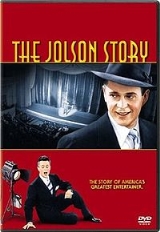
The Jolson Story

Encyclopedia
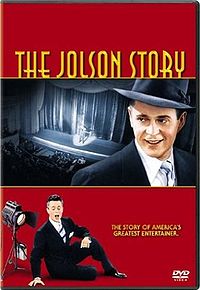
The Jolson Story is a 1946 musical biography which purports to tell the life story of singer Al Jolson
. It stars Larry Parks
as Jolson, Evelyn Keyes
as "Julie Benson" (approximating Jolson's wife, Ruby Keeler
), William Demarest
as his manager, Ludwig Donath
and Tamara Shayne
as his parents, and Scotty Beckett
as the young Jolson.
The Columbia Pictures
production was written by Sidney Buchman
(uncredited), Harry Chandlee, Stephen Longstreet
and Andrew Solt
. The dramatic scenes were directed by Alfred E. Green, with the musical sequences directed by Joseph H. Lewis.
performer Steve Martin (William Demarest
) offers to play a song for his audience, if they agree to sing along. Only one person does sing, a young boy named Asa Yoelson (Scotty Beckett
). Steve is bowled over by the boy's voice, but Asa realizes he should be singing at the synagogue with his father, Cantor Yoelson (Ludwig Donath
). Asa arrives late, and is later reprimanded by his strict father. Asa is reluctant to explain where he was, but Steve Martin visits the Yoelsons' home. He explains that he heard Asa sing at the burlesque house, and that he wants Asa to be part of his act. Papa Yoelson refuses to consider it.
Asa is determined to be in the act, and runs away to Baltimore, where he is taken to a home for boys. The kindly superintendent, Father McGee (Ernest Cossart
), finds Steve Martin and notifies Asa's parents. When they appear, Asa tells them that he will keep running away until they allow him to go into show business. Asa's mother (Tamara Shayne
) believes that it would be better to give Asa what he wants than have him running away all the time.
On stage, Asa gets bored with singing songs the same way all the time, and begins to improvise. When his voice suddenly breaks, he starts whistling instead, but is unhappy and wants to go home. Steve says that they can work on stage together - previously Asa has only stood in the audience. Asa changes his mind, and his name: he performs as Al Jolson (Larry Parks
).
At a show, blackface entertainer Tom Baron (Bill Goodwin
) passes out drunk, and Al goes on in his place. Two theatrical entrepreneurs, Oscar Hammerstein
(Edwin Maxwell
) and Lew Dockstader
(John Alexander
), are in the audience. Dockstader realizes that it was really Al who was on stage, and hires him join his minstrel show. One night, Jolson is out walking when he hears the new, exciting jazz music; he enjoys it so much that he forgets that he has a show that night. Dockstader fires him.
Al visits his parents, but does not stay long, because he receives a call from Tom Baron, who is now a theater manager. Baron invites Al to join his Broadway show. Al insists on choosing his own material, including his signature tune, "Mammy
", and he becomes so popular that he becomes the leading player and takes the show on tour.
At a Sunday night concert, Al meets an up-and-coming dancer named Julie Benson (Evelyn Keyes
). It is love at first sight for Al, and only a few hours after meeting her, he proposes to her. (Al Jolson was actually married four times. The character Julie Benson is modeled on his former wife Ruby Keeler
.) She agrees, although she does not love him yet. They marry during Al filming "The Jazz Singer", by which time Julie has fallen in love with him. But Julie is not as fond of show business as he is; she wants to quit and settle down. Al persuades her to continue with it, and they star in a film together, but eventually Julie can't stand any more. Al admits that he would rather have her than show business, and he finally quits. They move to the country.
Al refuses all job offers and absolutely will not sing, even for family and friends. But one night, they decide to celebrate the wedding anniversary of Al's parents. Papa Yoelson persuades him to sing for them, and then Tom Baron suggests they go to a nightclub and see an early floor show. Jolson is afraid of being recognized, but the crowd insists on a song. Although he tries to fob the crowd off, it is no use and he has to sing. Julie realizes he is happier than he has been in a long time, and decides to leave. She walks out of the picture, and out of his life, leaving Al to his first love: singing.
A successful sequel, Jolson Sings Again
, was released in 1949.
" number. Jolson is seen entirely in long shot; he performs on a theater runway.
Filming was already under way as a black-and-white feature when studio chief Harry Cohn
, impressed by the scenes already filmed, decided to start the project all over as a Technicolor
production.
 The film was a tremendous financial success, and won Academy Awards
for Best Music, Scoring of a Musical Picture
and Best Sound, Recording
(John Livadary), and was nominated for Best Actor in a Leading Role
(Larry Parks), Best Actor in a Supporting Role
(William Demarest), Best Cinematography, Color
and Best Film Editing
. The film was also entered into the 1947 Cannes Film Festival
.
Al Jolson
Al Jolson was an American singer, comedian and actor. In his heyday, he was dubbed "The World's Greatest Entertainer"....
. It stars Larry Parks
Larry Parks
Larry Parks was an American stage and movie actor. He was born Samuel Klausman Lawrence Parks. His career was virtually ended when he admitted to having once been a member of a Communist party cell, which led to his blacklisting by all Hollywood studios.-Background:Parks grew up in Joliet,...
as Jolson, Evelyn Keyes
Evelyn Keyes
Evelyn Louise Keyes was an American film actress. She is best-known for her role as Suellen O'Hara in the 1939 film Gone with the Wind.-Early life:...
as "Julie Benson" (approximating Jolson's wife, Ruby Keeler
Ruby Keeler
Ruby Keeler, born Ethel Hilda Keeler, was an actress, singer, and dancer most famous for her on-screen coupling with Dick Powell in a string of successful early musicals at Warner Brothers, particularly 42nd Street . From 1928 to 1940, she was married to singer Al Jolson...
), William Demarest
William Demarest
Carl William Demarest was an American character actor. He frequently played crusty but good-hearted roles.-Early life and career:...
as his manager, Ludwig Donath
Ludwig Donath
Ludwig Donath , was an Austrian actor who appeared in many American films.-Life:Donath graduated from Vienna's Academy of Dramatic Art and became a prominent actor on the stage in Berlin. When Hitler came to power in 1933, he returned to Vienna and was active there in theater and film and until the...
and Tamara Shayne
Tamara Shayne
Tamara Shayne was a Russian-born actress long resident in the United States....
as his parents, and Scotty Beckett
Scotty Beckett
Scott Hastings "Scotty" Beckett was an American child actor. He starred in the Our Gang and Rocky Jones, Space Ranger series.-Early career:...
as the young Jolson.
The Columbia Pictures
Columbia Pictures
Columbia Pictures Industries, Inc. is an American film production and distribution company. Columbia Pictures now forms part of the Columbia TriStar Motion Picture Group, owned by Sony Pictures Entertainment, a subsidiary of the Japanese conglomerate Sony. It is one of the leading film companies...
production was written by Sidney Buchman
Sidney Buchman
Sidney Robert Buchman was a screenwriter and producer who worked on 38 films from the late 1920s to the early 1970s. He is also sometimes credited as Sydney Buchman.-Career:...
(uncredited), Harry Chandlee, Stephen Longstreet
Stephen Longstreet
Stephen Longstreet was an American author.Born Chauncey Weiner on April 18th, 1907, known as Stephen Longstreet from 1939.Died February 20th, 2002....
and Andrew Solt
Andrew Solt
Andrew Solt is a producer, director, writer and documentary filmmaker. He has done numerous television specials and series for both broadcast and cable television and also movies. Solt owns the rights to the The Ed Sullivan Show library and has produced over 100 hours of new programming from the...
. The dramatic scenes were directed by Alfred E. Green, with the musical sequences directed by Joseph H. Lewis.
Plot
American burlesqueAmerican burlesque
American Burlesque is a genre of variety show. Derived from elements of Victorian burlesque, music hall and minstrel shows, burlesque shows in America became popular in the 1860s and evolved to feature ribald comedy and female striptease...
performer Steve Martin (William Demarest
William Demarest
Carl William Demarest was an American character actor. He frequently played crusty but good-hearted roles.-Early life and career:...
) offers to play a song for his audience, if they agree to sing along. Only one person does sing, a young boy named Asa Yoelson (Scotty Beckett
Scotty Beckett
Scott Hastings "Scotty" Beckett was an American child actor. He starred in the Our Gang and Rocky Jones, Space Ranger series.-Early career:...
). Steve is bowled over by the boy's voice, but Asa realizes he should be singing at the synagogue with his father, Cantor Yoelson (Ludwig Donath
Ludwig Donath
Ludwig Donath , was an Austrian actor who appeared in many American films.-Life:Donath graduated from Vienna's Academy of Dramatic Art and became a prominent actor on the stage in Berlin. When Hitler came to power in 1933, he returned to Vienna and was active there in theater and film and until the...
). Asa arrives late, and is later reprimanded by his strict father. Asa is reluctant to explain where he was, but Steve Martin visits the Yoelsons' home. He explains that he heard Asa sing at the burlesque house, and that he wants Asa to be part of his act. Papa Yoelson refuses to consider it.
Asa is determined to be in the act, and runs away to Baltimore, where he is taken to a home for boys. The kindly superintendent, Father McGee (Ernest Cossart
Ernest Cossart
Ernest Cossart was a British-born Hollywood actor. Born in Cheltenham, Gloucestershire, his real name was Emil von Holst. He was the brother of composer Gustav Holst. His daughter was the actress Valeria Cossart....
), finds Steve Martin and notifies Asa's parents. When they appear, Asa tells them that he will keep running away until they allow him to go into show business. Asa's mother (Tamara Shayne
Tamara Shayne
Tamara Shayne was a Russian-born actress long resident in the United States....
) believes that it would be better to give Asa what he wants than have him running away all the time.
On stage, Asa gets bored with singing songs the same way all the time, and begins to improvise. When his voice suddenly breaks, he starts whistling instead, but is unhappy and wants to go home. Steve says that they can work on stage together - previously Asa has only stood in the audience. Asa changes his mind, and his name: he performs as Al Jolson (Larry Parks
Larry Parks
Larry Parks was an American stage and movie actor. He was born Samuel Klausman Lawrence Parks. His career was virtually ended when he admitted to having once been a member of a Communist party cell, which led to his blacklisting by all Hollywood studios.-Background:Parks grew up in Joliet,...
).
At a show, blackface entertainer Tom Baron (Bill Goodwin
Bill Goodwin
Bill Goodwin was for many years the announcer and regular character of the Burns and Allen radio program, and subsequently The George Burns and Gracie Allen Show on television from 1950-51...
) passes out drunk, and Al goes on in his place. Two theatrical entrepreneurs, Oscar Hammerstein
Oscar Hammerstein I
Oscar Hammerstein I was a businessman, theater impresario and composer in New York City. His passion for opera led him to open several opera houses, and he rekindled opera's popularity in America...
(Edwin Maxwell
Edwin Maxwell
Edwin Maxwell was an Irish character actor in Hollywood movies of the 1930s and 1940s, frequently cast as shady businessmen and shysters, though often ones with a dignified bearing....
) and Lew Dockstader
Lew Dockstader
Lew Dockstader was a United States singer, comedian, and Vaudeville star, best known as a blackface minstrel show performer in the late 19th century and early years of the 20th century.Dockstader performed both as a solo act and leading a popular Minstrel troupe...
(John Alexander
John Alexander
-Arts and entertainment:* John Alexander , American stage and film actor* John Alexander II , Scottish film actor; see * John Alexander , British television director* John Alexander -Arts and entertainment:* John Alexander (actor) (1897–1982), American stage and film actor* John Alexander II...
), are in the audience. Dockstader realizes that it was really Al who was on stage, and hires him join his minstrel show. One night, Jolson is out walking when he hears the new, exciting jazz music; he enjoys it so much that he forgets that he has a show that night. Dockstader fires him.
Al visits his parents, but does not stay long, because he receives a call from Tom Baron, who is now a theater manager. Baron invites Al to join his Broadway show. Al insists on choosing his own material, including his signature tune, "Mammy
Mammy archetype
The mammy archetype is perhaps one of the best-known archetypes of African American women. She is often portrayed within a narrative framework or other imagery as a domestic servant of African descent, generally good-natured, often overweight, very dark skinned, middle aged, and loud...
", and he becomes so popular that he becomes the leading player and takes the show on tour.
At a Sunday night concert, Al meets an up-and-coming dancer named Julie Benson (Evelyn Keyes
Evelyn Keyes
Evelyn Louise Keyes was an American film actress. She is best-known for her role as Suellen O'Hara in the 1939 film Gone with the Wind.-Early life:...
). It is love at first sight for Al, and only a few hours after meeting her, he proposes to her. (Al Jolson was actually married four times. The character Julie Benson is modeled on his former wife Ruby Keeler
Ruby Keeler
Ruby Keeler, born Ethel Hilda Keeler, was an actress, singer, and dancer most famous for her on-screen coupling with Dick Powell in a string of successful early musicals at Warner Brothers, particularly 42nd Street . From 1928 to 1940, she was married to singer Al Jolson...
.) She agrees, although she does not love him yet. They marry during Al filming "The Jazz Singer", by which time Julie has fallen in love with him. But Julie is not as fond of show business as he is; she wants to quit and settle down. Al persuades her to continue with it, and they star in a film together, but eventually Julie can't stand any more. Al admits that he would rather have her than show business, and he finally quits. They move to the country.
Al refuses all job offers and absolutely will not sing, even for family and friends. But one night, they decide to celebrate the wedding anniversary of Al's parents. Papa Yoelson persuades him to sing for them, and then Tom Baron suggests they go to a nightclub and see an early floor show. Jolson is afraid of being recognized, but the crowd insists on a song. Although he tries to fob the crowd off, it is no use and he has to sing. Julie realizes he is happier than he has been in a long time, and decides to leave. She walks out of the picture, and out of his life, leaving Al to his first love: singing.
A successful sequel, Jolson Sings Again
Jolson Sings Again
Jolson Sings Again is the 1949 film sequel to The Jolson Story, both of which cover the life of singer Al Jolson.-Synopsis:In this follow-up to The Jolson Story, we pick up the singer's career just as he has returned to the stage after a premature retirement. But his wife has left him and the...
, was released in 1949.
Cast
- Larry ParksLarry ParksLarry Parks was an American stage and movie actor. He was born Samuel Klausman Lawrence Parks. His career was virtually ended when he admitted to having once been a member of a Communist party cell, which led to his blacklisting by all Hollywood studios.-Background:Parks grew up in Joliet,...
as Al Jolson - Evelyn KeyesEvelyn KeyesEvelyn Louise Keyes was an American film actress. She is best-known for her role as Suellen O'Hara in the 1939 film Gone with the Wind.-Early life:...
as Julie Benson - William DemarestWilliam DemarestCarl William Demarest was an American character actor. He frequently played crusty but good-hearted roles.-Early life and career:...
as Steve Martin - Bill GoodwinBill GoodwinBill Goodwin was for many years the announcer and regular character of the Burns and Allen radio program, and subsequently The George Burns and Gracie Allen Show on television from 1950-51...
as Tom Baron - Ludwig DonathLudwig DonathLudwig Donath , was an Austrian actor who appeared in many American films.-Life:Donath graduated from Vienna's Academy of Dramatic Art and became a prominent actor on the stage in Berlin. When Hitler came to power in 1933, he returned to Vienna and was active there in theater and film and until the...
as Cantor Yoelson - Scotty BeckettScotty BeckettScott Hastings "Scotty" Beckett was an American child actor. He starred in the Our Gang and Rocky Jones, Space Ranger series.-Early career:...
as Asa Yoelson / Al Jolson, as a boy - Tamara ShayneTamara ShayneTamara Shayne was a Russian-born actress long resident in the United States....
as Mrs. Yoelson - Jo-Carroll DennisonJo-Carroll DennisonJo-Carroll Dennison was a beauty queen and actress originally from Tyler, Texas.Dennison, a self-supported student at the Federal Institute in Tyler, Texas was lured into competing in the Miss Tyler pageant by the offer of a free swimsuit from Swartz Department Store...
as Ann Murray - John AlexanderJohn Alexander-Arts and entertainment:* John Alexander , American stage and film actor* John Alexander II , Scottish film actor; see * John Alexander , British television director* John Alexander -Arts and entertainment:* John Alexander (actor) (1897–1982), American stage and film actor* John Alexander II...
as Lew Dockstader - Ernest CossartErnest CossartErnest Cossart was a British-born Hollywood actor. Born in Cheltenham, Gloucestershire, his real name was Emil von Holst. He was the brother of composer Gustav Holst. His daughter was the actress Valeria Cossart....
as Father McGee - The Robert Mitchell Boy Choir as Church choir (as Mitchell 'Boychoir')
Plot Accuracy
Some of the plot details are fictionalized. There is no evidence that Jolson ever appeared as a child singer, and he was brought up by his sister (not his mother, who had died). Jolson actually had three managers, who were combined into the William Demarest character. Ruby Keeler refused to allow her name to be used, so the writers used an alias, Julie Benson. In addition, a theatrical billboard in the film tells that Jolson's musical "Big Boy" was in the third year of its run. In reality, the show had two runs, one of six weeks (Jan 7 - Mar 14, 1925, 56 performances) and one of 15 weeks (Aug 24 - Dec 1925, 120 performances).Production
Larry Parks' vocals were recorded by Al Jolson; Scotty Beckett's songs were recorded by Rudy Wissler. Al Jolson, determined to appear on screen somehow, persuaded the producer to film him instead of Larry Parks for the blackface "SwaneeSwanee (song)
"Swanee" is an American popular song written in 1919 by George Gershwin, with lyrics by Irving Caesar. It is most often associated with singer Al Jolson....
" number. Jolson is seen entirely in long shot; he performs on a theater runway.
Filming was already under way as a black-and-white feature when studio chief Harry Cohn
Harry Cohn
Harry Cohn was the American president and production director of Columbia Pictures.-Career:Cohn was born to a working-class German-Jewish family in New York City. In later years, he appears to have disparaged his heritage...
, impressed by the scenes already filmed, decided to start the project all over as a Technicolor
Technicolor
Technicolor is a color motion picture process invented in 1916 and improved over several decades.It was the second major process, after Britain's Kinemacolor, and the most widely used color process in Hollywood from 1922 to 1952...
production.
Awards
Academy Awards
An Academy Award, also known as an Oscar, is an accolade bestowed by the American Academy of Motion Picture Arts and Sciences to recognize excellence of professionals in the film industry, including directors, actors, and writers...
for Best Music, Scoring of a Musical Picture
Academy Award for Original Music Score
The Academy Award for Original Score is presented to the best substantial body of music in the form of dramatic underscoring written specifically for the film by the submitting composer.-Superlatives:...
and Best Sound, Recording
Academy Award for Sound
The Academy Award for Sound Mixing is an Academy Award that recognizes the finest or most euphonic sound mixing or recording, and is generally awarded to the production sound mixers and re-recording mixers of the winning film. Compare this award to the Academy Award for Sound Editing...
(John Livadary), and was nominated for Best Actor in a Leading Role
Academy Award for Best Actor
Performance by an Actor in a Leading Role is one of the Academy Awards of Merit presented annually by the Academy of Motion Picture Arts and Sciences to recognize an actor who has delivered an outstanding performance while working within the film industry...
(Larry Parks), Best Actor in a Supporting Role
Academy Award for Best Supporting Actor
Performance by an Actor in a Supporting Role is one of the Academy Awards of Merit presented annually by the Academy of Motion Picture Arts and Sciences to recognize an actor who has delivered an outstanding performance while working within the film industry. Since its inception, however, the...
(William Demarest), Best Cinematography, Color
Academy Award for Best Cinematography
The Academy Award for Best Cinematography is an Academy Award awarded each year to a cinematographer for work in one particular motion picture.-History:...
and Best Film Editing
Academy Award for Film Editing
The Academy Award for Film Editing is one of the annual awards of the Academy of Motion Picture Arts and Sciences. Nominations for this award are closely correlated with the Academy Award for Best Picture. Since 1981, every film selected as Best Picture has also been nominated for the Film Editing...
. The film was also entered into the 1947 Cannes Film Festival
1947 Cannes Film Festival
- Jury :The entire jury at this festival were French.*Georges Huisman *Raymond Borderie *Georges Carriere *Chosson *Joseph Dotti *Escoute *Jean Grémillon...
.
Quotations
- "I heard some music tonight. Something they call 'jazz.' The fellows just make it up as they go along. They pick it out of the air." (Jolson to Dockstader)
- "[I'm] trying to make songs out of music I picked up. Music nobody ever heard of before, but the only kind I want to sing." (Jolson, explaining what he's been doing)
- "That's an audience that never saw a live show. People in small towns who can afford a movie, where they can't afford anything else. Audience of millions. I'd be singing to every one of them at the same time. That's really something!" (Jolson, discussing the new talking picture)
- "Tonight, folks, I'm only going to sing two thousand songs. One to a customer." (Jolson)
- "Broadway? What a street! You know something, baby? It belongs to me. You know something else? If you want, I'll give it to you." (Jolson)
Songs in the Film
- Let Me Sing and I’m Happy
- Banks of the Wabash
- Ave Maria
- When You Were Sweet Sixteen
- After the Ball
- By the Light of the Silvery Moon
- Blue Bell
- Ma Blushin’ Rosie
- I Want a Girl
- My Mammy
- I’m Sitting on Top of the World
- You Made Me Love You
- Swanee
- Toot, Toot, Tootsie! (Goo’ Bye)
- The Spaniard That Blighted My Life
- April Showers
- California, Here I Come
- Liza (All the Clouds'll Roll Away)Liza (All the Clouds'll Roll Away)"Liza " is a song composed by George Gershwin with lyrics by Ira Gershwin and Gus Kahn. It was introduced in 1929 by Ruby Keeler in Florenz Ziegfeld's musical Show Girl. The stage performances were accompanied by the Duke Ellington Orchestra...
- There’s a Rainbow ’Round My Shoulder
- AvalonAvalon (Al Jolson song)"Avalon" is a 1920 popular song written by Al Jolson, Buddy DeSylva and Vincent Rose. It was introduced by Jolson and interpolated in the musicals Sinbad and Bombo. Jolson's recording rose to number two on the charts in 1921. The song was possibly written by Rose, but Jolson's popularity as a...
- She’s a Latin from Manhattan
- About, a Quarter to Nine
- Anniversary Song
- Waiting for the Robert E. Lee
- Rock-a-Bye Your Baby with a Dixie Melody