
All Topics  
The Hunchback of Notre Dame


   Email Print
   Bookmark   Link


The Hunchback of Notre Dame


The Hunchback of Notre Dame is an 1831 French novel written by Victor Hugo
Victor Hugo

Victor-Marie Hugo was a France poet, playwright, novelist, essayist, visual artist, statesman, human rights activist and exponent of the Romanticism movement in France....
. It is set in 1482 in Paris, in and around the cathedral of Notre Dame de Paris
Notre Dame de Paris

Notre Dame de Paris is a Gothic architecture cathedral on the eastern half of the ?le de la Cit? in the 4th arrondissement of Paris of Paris, France, with its main entrance to the west....
. The book tells the story of a poor Gypsy girl (La Esmeralda
Esmeralda (The Hunchback of Notre Dame)

La Esm?ralda is a fictional character in Victor Hugo's 1831 novel The Hunchback of Notre Dame . She is a French Roma people girl . She constantly attracts men with her seductive dances, and is rarely seen without her clever goat Djali....
) and a misshapen
Disfigurement

Disfigurement is the state of having one's appearance deeply and persistently harmed medically, as from a disease, birth defect, or wound.Disfigurement, whether caused by a benign or malignant condition, often leads to severe psychosocial problems such as negative body image; clinical depression; difficulties in one's social, sexual, and pr...
 bell-ringer (Quasimodo
Quasimodo

Quasimodo is a central character from French author Victor Hugo's 1831 novel Notre Dame de Paris. Against Hugo's wishes, most English translations of the work have renamed it The Hunchback of Notre Dame, making Quasimodo the title character....
) who was raised by the Archdeacon (Claude Frollo). The book was written as a statement to preserve the Notre Dame cathedral and not to 'modernize' it, as Hugo was thoroughly against this.

began to write Hunchback in 1829.


Discussion
Ask a question about 'The Hunchback of Notre Dame'
Start a new discussion about 'The Hunchback of Notre Dame'
Answer questions from other users
Full Discussion Forum


Recent Posts


Encyclopedia


The Hunchback of Notre Dame is an 1831 French novel written by Victor Hugo
Victor Hugo

Victor-Marie Hugo was a France poet, playwright, novelist, essayist, visual artist, statesman, human rights activist and exponent of the Romanticism movement in France....
. It is set in 1482 in Paris, in and around the cathedral of Notre Dame de Paris
Notre Dame de Paris

Notre Dame de Paris is a Gothic architecture cathedral on the eastern half of the ?le de la Cit? in the 4th arrondissement of Paris of Paris, France, with its main entrance to the west....
. The book tells the story of a poor Gypsy girl (La Esmeralda
Esmeralda (The Hunchback of Notre Dame)

La Esm?ralda is a fictional character in Victor Hugo's 1831 novel The Hunchback of Notre Dame . She is a French Roma people girl . She constantly attracts men with her seductive dances, and is rarely seen without her clever goat Djali....
) and a misshapen
Disfigurement

Disfigurement is the state of having one's appearance deeply and persistently harmed medically, as from a disease, birth defect, or wound.Disfigurement, whether caused by a benign or malignant condition, often leads to severe psychosocial problems such as negative body image; clinical depression; difficulties in one's social, sexual, and pr...
 bell-ringer (Quasimodo
Quasimodo

Quasimodo is a central character from French author Victor Hugo's 1831 novel Notre Dame de Paris. Against Hugo's wishes, most English translations of the work have renamed it The Hunchback of Notre Dame, making Quasimodo the title character....
) who was raised by the Archdeacon (Claude Frollo). The book was written as a statement to preserve the Notre Dame cathedral and not to 'modernize' it, as Hugo was thoroughly against this.

Plot introduction

Hugo began to write Hunchback in 1829. The agreement with his original publisher, Gosselin, was that the book would be finished that same year. However, Hugo was constantly delayed due to the demands of other projects. By the summer of 1830, Gosselin demanded the book to be completed by February 1831. And so beginning in September 1830, Hugo worked non-stop on the project; he bought a new bottle of ink, a woolen cloak, and cloistered himself in his room refusing to be bothered or to leave his house (except for nightly visits to the cathedral). The book was finished six months later.

Explanation of the novel's title

Hugo finished the book just as he was running out of ink. This tempted him to title the work What There Is in a Bottle of Ink. He eventually decided against it and called the book Notre-Dame de Paris. English translations of the book are often titled The Hunchback of Notre Dame, which have led some to believe that Quasimodo
Quasimodo

Quasimodo is a central character from French author Victor Hugo's 1831 novel Notre Dame de Paris. Against Hugo's wishes, most English translations of the work have renamed it The Hunchback of Notre Dame, making Quasimodo the title character....
 is the main character. Hugo never liked this title, preferring the original Notre-Dame de Paris. He gave this title because he considered the cathedral itself to be the main "character" of the story. The story takes place around and inside the church, and Hugo spent much time describing the building as well as decrying its abandonment after the abuse it suffered during the French Revolution
French Revolution

The French Revolution was a period of political and social upheaval and radical change in the history of France, during which the French governmental structure, previously an absolute monarchy with feudalism for the aristocracy and Roman Catholic Church clergy, underwent radical change to forms based on Age of Enlightenment principles of cit...
; during the Revolution, the church had been viewed as a symbol of the old regime and was pillaged and vandalized by angry mobs.

Plot

The story begins during the Renaissance
Renaissance

The Renaissance was a cultural movement that spanned roughly the 14th to the 17th century, beginning in Italy in the late Middle Ages and later spreading to the rest of Europe....
 in 1482, the day of the Festival of Fools in Paris. Quasimodo, the deformed bell ringer, is introduced by his crowning as Pope of Fools.

Esméralda, a beautiful 16-year-old gypsy with a kind and generous heart, captures the hearts of many men but especially those of Quasimodo and his adopted father, Claude Frollo. Frollo is torn between his lust and the rules of the church. He orders Quasimodo to get her. Quasimodo is caught and whipped and ordered to be tied down in the heat. Esméralda seeing his thirst, offers him water. It saves her, for she captures the heart of the hunchback.

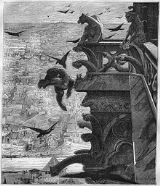
She is later accused of the murder of Phoebus, whom Frollo attempted to kill in jealousy, and is sentenced to death by hanging. Quasimodo saves her by bringing her to the cathedral under the law of sanctuary. Frollo rallies the truands (criminals of Paris) to charge the cathedral. The king, seeing the chaos, vetoes the law of sanctuary and commands his troops to take her out and kill her. When Quasimodo sees the truands, he assumes they are there to hurt Esméralda, so he drives them off. Frollo betrays Esméralda by handing her to the troops and watches while she is hanged. Quasimodo pushes him from Notre-Dame to his death. He then goes to where hanged dead bodies are thrown, lies next to her corpse and eventually dies of starvation. Two years later, excavationists find the skeletons of Esmeralda with broken neck and Quasimodo locked in an embrace.

Characters in The Hunchback of Notre Dame

  • Pierre Gringoire is a struggling poet. He mistakenly finds his way into the "Court of Miracles", the secret lair of the Gypsies. In order to preserve the secrecy, Gringoire must either be killed by hanging, or marry a Gypsy. Although Esméralda does not love him, and in fact believes him a coward rather than a true man (he, unlike Phoebus, failed in his attempt to rescue her from Quasimodo), she takes pity on his plight and marries him—although, much to his disappointment, she refuses to let him touch her.


  • Esméralda
    Esmeralda (The Hunchback of Notre Dame)

    La Esm?ralda is a fictional character in Victor Hugo's 1831 novel The Hunchback of Notre Dame . She is a French Roma people girl . She constantly attracts men with her seductive dances, and is rarely seen without her clever goat Djali....
     is a beautiful young barefoot Gypsy dancer, innocent, close to nature, and naturally compassionate and kind. She is the center of the human drama within the story. A popular focus of the citizens' attentions, she experiences their changeable attitudes, being first adored as an entertainer, then hated as a witch, before being lauded again for her dramatic rescue by Quasimodo; when the King finally decides to put her to death, he does so in the belief that the Parisian mob want her dead. She is loved by both Quasimodo and Claude Frollo, but falls in love with Captain Phoebus, who only wants to seduce her.


  • Djali is Esméralda's pet goat. She performs tricks such as writing the word "PHOEBUS" in moveable letter-blocks, and tapping the number of beats to indicate the month and hour of the day. These tricks delight the citizens at first, but later horrify them, causing them to believe Esméralda is a witch.


  • Quasimodo
    Quasimodo

    Quasimodo is a central character from French author Victor Hugo's 1831 novel Notre Dame de Paris. Against Hugo's wishes, most English translations of the work have renamed it The Hunchback of Notre Dame, making Quasimodo the title character....
     is the hunchback of Notre Dame. He lives in the bell tower of Notre Dame and rings the bells, which has made him deaf. When he was a hideous and abandoned baby, he was adopted by Claude Frollo. Quasimodo's life within the confines of the cathedral and his only two outlets—ringing the bells and his love and devotion for Frollo—are described. He ventures outside the Cathedral rarely, since people despise and shun him for his appearance. The notable occasions when he does leave include his taking part in the Feast of Fools—during which he is elected Fools'-Pope due to his perfect hideousness—and his subsequent attempt to kidnap Esméralda, his rescue of Esméralda from the gallows, his attempt to bring Phoebus to Esméralda, and his final abandonment of the cathedral at the end of the novel. It is revealed in the story that the baby Quasimodo was left by the gypsies in place of Esméralda, whom they abducted.


  • Claude Frollo is the Archdeacon of Notre Dame. Despite his celibacy vows as a priest, he finds himself madly in love with Esméralda. He nearly murders Phoebus in a jealous rage from seeing Phoebus with Esméralda. He is killed when Quasimodo pushes him off the cathedral. His dour attitude and his alchemical experiments scared and alienated him from the Parisians, who believed him a sorcerer, and so he lived without family, save for Quasimodo and his spoiled brother Jehan.


  • Jehan Frollo is Claude Frollo's over-indulged younger brother. He is a troublemaker and a student at the university. He is dependent on his brother for money, which he then proceeds to squander on alcohol. Quasimodo kills him during the attack on the cathedral.


  • Captain Phoebus de Chateaupers
    Captain Phoebus

    Captain Ph?bus de Ch?teaupers is a fictional character from The Hunchback of Notre Dame, an 1831 novel by Victor Hugo. He is the Captain of the King of France Archers....
     is the captain of the King's Archers. After he saves Esméralda from abduction, she becomes infatuated with him, and he himself is intrigued by her. He attempts to seduce her, but is interrupted in the attempt when Frollo tries to kill him. After recovering, Phoebus returns in shame to his fiancée, and for a time believes that Esméralda has been executed for witchcraft and his 'murder'. He later leads the archers in fighting off the gypsy attackers of Notre Dame, and searches the Cathedral and the city for Esméralda. After the events of the novel, he suffers the 'tragedy' of marriage to the beautiful but spiteful Fleur-de-Lys de Gondelaurier.


  • Fleur-de-Lys de Gondelaurier is a beautiful and wealthy socialite engaged to Phoebus. Phoebus's attentions to Esméralda make her insecure and jealous, and she and her friends respond by treating Esméralda with contempt and spite. Fleur-de-Lys later neglects to inform Phoebus that Esméralda has not been executed, which serves to deprive the pair of any further contact. Phoebus and Fleur-de-Lys marry at the end of the novel.


  • Sister Gudule, formerly named Paquette la Chantefleurie, is an anchorite, who lives in seclusion in an exposed cell in central Paris. She is tormented by the loss of her daughter Agnes, whom she believes to have been cannibalised by gypsies as a baby, and devotes her life to mourning her. Her long-lost daughter turns out to be Esméralda.


  • Louis XI is the King of France. Appears briefly when he is brought the news of the rioting at Notre Dame.


  • Tristan L'Hermite
    Tristan l'Hermite

    See also Fran?ois Tristan l'HermiteTristan l'Hermite was a France in the Middle Ages political and military figure of the late Middle Ages....
     is a friend of King Louis XI. He leads the band that goes to capture Esméralda.


  • Henriet Cousin is the city executioner.


  • Florian Barbedienne is the judge who sentences Quasimodo to be tortured. He is also deaf.


  • Jacques Charmolue gets Esméralda to falsely confess to killing Phoebus. He then has her executed.


  • Clopin Trouillefou is the King of Truands. He rallies the Court of Miracles to rescue Esmeralda from Notre Dame after the idea is suggested by Gringoire. He is eventually killed during the attack by the King's soldiers.


Major themes

As stated by many critics and scholars, the Cathedral of Notre Dame appears to be the main setting, which is almost elevated to the status of a character. Indeed, the original French title of the book,
Notre-Dame de Paris (the formal title of the Cathedral) shows that the cathedral (and not Quasimodo) is the subject of the story. The book portrays the Gothic
Gothic architecture

Gothic architecture is a style of architecture which flourished during the high and late Middle Ages. It evolved from Romanesque architecture and was succeeded by Renaissance architecture....
 era as one of extremes of architecture
Architecture

The term architecture can refer to a process, a profession or documentation.As a process, architecture is the activity of designing and construction buildings and other physical structures by a person or a computer, primarily to provide shelter....
, passion, and religion
Religion

A religion is an organized approach to human spirituality which usually encompasses a set of myth, symbols, beliefs and practices, often with a supernatural or transcendence quality, that give meaning to the practitioner's experiences of life through reference to a higher power or truth....
. Like many of his other works, Hugo is also very concerned with social justice, and his descriptions of religious fanaticism are also examined. Strikingly, Hugo shifts his focus between characters, and assigns the roles of hero and villain to different characters at different points in the novel.

Literary significance and reception

The enormous popularity of the book in France spurred the nascent historical preservation movement in that country and strongly encouraged Gothic revival architecture. Ultimately it led to major renovations at Notre-Dame in the 19th century led by Eugène Viollet-le-Duc
Eugène Viollet-le-Duc

Eug?ne Emmanuel Viollet-le-Duc was a French architect and theorist, famous for his "restorations" of medieval buildings. Born in Paris, he was as central a figure in the Gothic Revival in France as he was in the public discourse on "honesty" in architecture, which eventually transcended all revival styles, to inform the emerging spirit of M...
. Much of the cathedral's present appearance is a result of this renovation.

Allusions and references


Allusions to actual history, geography and current science

In
The Hunchback of Notre Dame, Victor Hugo makes frequent reference to the architecture of the Cathedral of Notre Dame in Paris.

He also mentions the invention of the printing press
Printing press

A printing press is a mechanical device for applying pressure to an inked surface resting upon a medium , thereby transferring an image. The mechanical systems involved were first assembled in Germany by the goldsmith Johannes Gutenberg around 1439, based on existing screw-presses used to press cloth, grapes etc., and possibly to print wood...
, when the bookmaker near the beginning of the work speaks of "the German pest."

Victor Hugo lived a few homes away from Victor of Aveyron
Victor of Aveyron

Victor of Aveyron was a feral child who apparently lived his entire childhood naked and alone in the woods before being found wandering the woods near Saint-Sernin-sur-Rance, France in 1797....
, the first well-documented feral child
Feral child

A feral child is a human child who has lived isolated from human contact from a very young age, and has no experience of human care, loving or social behavior, and, crucially, of human language....
, although the inspiration for Quasimodo's character is not directly linked to him.

Allusions in other works

The name
Quasimodo has become synonymous with "a courageous heart beneath a grotesque exterior."

Film, TV or theatrical adaptations

To date, all of the film and TV adaptations have strayed somewhat from the original plot, some going as far as to give it a happy ending.

The Hunchback of Notre Dame has had a number of film adaptations:
  • Esmeralda (1905 film)
    Esmeralda (1905 film)

    La Esm?ralda is a silent short film based on the novel The Hunchback of Notre Dame written by Victor Hugo and directed by the France director couple Alice Guy-Blach? and Victorin-Hippolyte Jasset ....
  • The Hunchback of Notre Dame (1911)
  • The Hunchback of Notre Dame (1923 film)
    The Hunchback of Notre Dame (1923 film)

    The 1923 in film film version of The Hunchback of Notre Dame, starring Lon Chaney, Sr. as Quasimodo and Patsy Ruth Miller as Esmeralda , and directed by Wallace Worsley, is the most famous adaptation of Victor Hugo's novel The Hunchback of Notre Dame....
  • The Hunchback of Notre Dame (1939 film)
    The Hunchback of Notre Dame (1939 film)

    The Hunchback of Notre Dame is a 1939 in film United States monochrome motion picture. It is considered by some reviewers to be the best of the many film versions of Victor Hugo's classic The Hunchback of Notre Dame, and perhaps the one that sticks closest to Hugo's plot and intention although the ending differs....
  • The Hunchback of Notre Dame (1956 film)
    The Hunchback of Notre Dame (1956 film)

    The Hunchback of Notre Dame is a 1956 in film France film version of Victor Hugo's novel popularly known as The Hunchback of Notre Dame....
  • The Hunchback of Notre Dame (1996 film)
    The Hunchback of Notre Dame (1996 film)

    The Hunchback of Notre Dame is an Academy Award-nominated, 1996 animated feature produced by Walt Disney Feature Animation and released to theaters on June 21, 1996 by Walt Disney Pictures....
  • The Hunchback (1997 film)
    The Hunchback (1997 film)

    The Hunchback is a film based on Victor Hugo's novel The Hunchback of Notre Dame. It stars Salma Hayek as Esmeralda and Mandy Patinkin as Quasimodo, The Hunchback of Notre Dame....


It has also appeared on TV numerous occasions:
  • The Hunchback of Notre Dame (1977)
  • The Hunchback of Notre Dame (1982 film)
    The Hunchback of Notre Dame (1982 film)

    The Hunchback of Notre Dame is a 1982 in film United Kingdom-United States television movie film starring Anthony Hopkins, Sir Derek Jacobi, Lesley-Anne Down, and Sir John Gielgud, based on the Victor Hugo novel....
  • The Hunchback of Notre Dame (1986)
  • Notre Dame de Paris (1999 musical TV version)
    Notre Dame de Paris (musical)

    Notre Dame de Paris is a France-Canada Musical theater which debuted on 16 September 1998 in Paris. It is based upon the novel The Hunchback of Notre Dame by the French novelist Victor Hugo....


Music:
  • The Hunchback of Notre Dame by Alec R. Costandinos
    Alec R. Costandinos

    Alec R. Costandinos, . His father was Armenian and his mother was Greek. He has long been considered one of the original catalysts of the France disco scene of the 70's....
     and the Syncophonic Orchestra from 1977, a lush orchestral disco 28 minute epic re-telling the tale of Quasimodo and Esmeralda.


Musical theatre:
  • Opera Esmeralda, by Arthur Goring Thomas
    Arthur Goring Thomas

    Arthur Goring Thomas was an England composer. He was the youngest son of Freeman Thomas and Amelia, daughter of Colonel Thomas Frederick.He was born at Ratton Park, Sussex, and educated at Haileybury College....
     (1883) based on the Victor Hugo
    Victor Hugo

    Victor-Marie Hugo was a France poet, playwright, novelist, essayist, visual artist, statesman, human rights activist and exponent of the Romanticism movement in France....
     novel.
  • Opera Esmeralda, by Dargomyzhsky (1847), also based on the same Victor Hugo
    Victor Hugo

    Victor-Marie Hugo was a France poet, playwright, novelist, essayist, visual artist, statesman, human rights activist and exponent of the Romanticism movement in France....
     novel.
  • The Hunchback of Notre Dame (1993), an Off Broadway musical
    Musical theatre

    Musical theatre is a form of theatre combining music, songs, spoken dialogue and dance. The emotional content of the piece ? humor, pathos, love, anger ? as well as the story itself, is communicated through the words, music, movement and technical aspects of the entertainment as an integrated whole....
     with music by Byron Janis
    Byron Janis

    Byron Janis is an United States pianist.He made several recordings for RCA Victor and Mercury Records, and occupies two volumes of the Philips Great Pianists series....
    , lyrics by Hal Hackady
    Hal Hackady

    Hal Hackady is an United States lyricist, librettist, and screenwriter.Hackady began his career writing television movie for early anthology series like General Electric Theater and Alfred Hitchcock Presents....
     and book by Anthony Scully
  • In 1999, "Notre Dame de Paris (musical)
    Notre Dame de Paris (musical)

    Notre Dame de Paris is a France-Canada Musical theater which debuted on 16 September 1998 in Paris. It is based upon the novel The Hunchback of Notre Dame by the French novelist Victor Hugo....
    " opened in Paris and became an instant success. It is considered the most successful adaptation of any novel except for "The Phantom of the Opera" and "Les Misérables." It was also adapted for the stage by Nicholas DeBaubien.
  • From 1999 to 2002, the Disney film was adapted into a darker, more Gothic musical production called Der Glöckner von Notre Dame
    Der Glöckner von Notre Dame

    Der Gl?ckner von Notre Dame is a musical theatre, with music by Alan Menken and lyrics by Stephen Schwartz. The musical opened at the Musical Theatre Berlin on June 5, 1999 in Berlin, Germany....
     (translated in English as The Bellringer of Notre Dame), re-written and directed by James Lapine
    James Lapine

    James Lapine is an American stage director and libretto.Lapine was born in Mansfield, Ohio, and is a graduate of Franklin and Marshall College....
     and produced by the Disney theatrical branch, in Berlin, Germany. A cast recording was also recorded in German. There has been discussion of an American revival of the musical.
  • A rock musical version was released in Seattle, Washington in 1998 titled "HUNCHBACK" with music and script by C. Rainey Lewis. A 2 Disc CD of the songs from the show could be found in a handful of internet stores like amazon.com
    Amazon.com

    Amazon.com, Inc. is an American electronic commerce company in Seattle, Washington. It is America's largest online retailer, with nearly three times the internet sales revenue of runner up Staples, Inc....
  • A musical version, scored by Dennis DeYoung
    Dennis DeYoung

    Dennis DeYoung is an American singer, songwriter, musician and Record producer best known for being a founding member of the rock band Styx , a tenure which lasted from 1970 to 1999....
    , will open in Chicago
    Chicago

    Chicago is the largest city in the U.S. state of Illinois and the Midwestern United States, as well as the List of United States cities by population city in the United States with more than 2.8 million residents....
     at the Bailiwick Reperatory in the summer of 2008


Ballet:

  • "The Hunchback of Notre Dame" 1998 Choreography and Direction Michael Pink. Original Music Score Philip Feeney. First performance in the United Kingdom. Currently in the repertoire of MIlwaukee Ballet, Boston Ballet, The Royal New Zealand Ballet, Atlanta Ballet and Colorado Ballet.


Radio:

  • The book was adapted and broadcast by BBC Radio 4 as its Classic Serial on 30 November and 7 December 2008, with deaf actor David Bower
    David Bower

    David Bower is a Wales actor, best known for his role as David in the hit romantic comedy Four Weddings and a Funeral. Born in Wrexham, North Wales, he is deaf and also works as a sign dancer and choreographer....
     playing Quasimodo.


Publication history

The Hunchback of Notre Dame is widely available in English language editions.
  • 1978, USA, Penguin Classics ISBN 0140443533, Pub date 26 October 1978, paperback
  • 2001, USA, Signet Classics ISBN 0451527887, Pub date 10 April 2001, paperback
  • 2002, USA, Modern Library Classics ISBN 0679642579, Pub date 8 October 2002
  • 2006, USA, Ann Arbor Media ISBN 1587264021, Pub date 14 July 2006, hard cover


Quotations

  • A description of Quasimodo upon his election as the fool's pope: "We shall not attempt to give the reader an idea of that tetrahedron nose-that horse-shoe mouth-that small left eye over-shadowed by a red bushy brow, while the right eye disappeared entirely under an enormous wart-of those straggling teeth with breaches here and there like the battlements of a fortress-of that horny lip, over which one of those teeth projected like the tusk of an elephant-of that forked chin-and, above all, of the expression diffused over the whole-that mixture of malice, astonishment, and melancholy. Let the reader, if he can, figure to himself this combination." (p. 62)
  • On the connection between architecture and culture: "When a man understands the art of seeing, he can trace the spirit of an age and the features of a king even in the knocker on a door." (p. 184)
  • Quasimodo's reaction to Esmeralda's gift of a drink of water while he is being heckled on the pillory: "Then from that eye, hitherto so dry and burning, was seen to roll a big tear, which fell slowly down that deformed visage so long contracted by despair. Perhaps it was the first that the unfortunate creature had ever shed." (p. 322)
  • Quasimodo, explaining why he won't enter Esmeralda's cell: "The owl goes not into the nest of the lark." (p. 502)
  • After Esmeralda's execution: "Quasimodo then lifted his eye to look upon the gypsy girl, whose body, suspended from the gibbet, he beheld quivering afar, under its white robes, in the last struggles of death; then again he dropped it upon the archdeacon, stretched a shapeless mass at the foot of the tower, and he said with a sob that heaved his deep breast to the bottom, 'Oh-all that I've ever loved!" (p. 678)


Bibliography

  • from the Victor Hugo Website


  • Pascal Tonazzi, Florilège de Notre-Dame de Paris (anthologie), Editions Arléa, Paris, 2007, ISBN 2869597959


External links

  • at the French
    French language

    French is a Romance language spoken around the world by around 80 million people as first language, by 190 million as second language, and by about another 200 million people as an acquired tongue, with significant speakers in 54 countries....
     Wikisource
    Wikisource

    Wikisource is an online library of free content source text, operated by the Wikimedia Foundation. Its aims are to harbour all forms of free text, in many languages....