
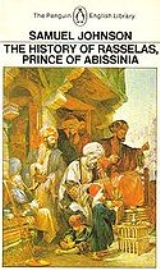
The History of Rasselas, Prince of Abissinia, often abbreviated to
Rasselas, is an
apologueAn apologue or apolog is a brief fable or allegorical story with pointed or exaggerated details, meant to serve as a pleasant vehicle for a moral doctrine or to convey a useful lesson without stating it explicitly. Unlike a fable, the moral is more important than the narrative details...
about happiness by
Samuel JohnsonSamuel Johnson , often referred to as Dr. Johnson, was an English author who made lasting contributions to English literature as a poet, essayist, moralist, literary critic, biographer, editor and lexicographer...
. The book's original working title was “The Choice of Life". He wrote the piece to help support his seriously ill mother with an intended completion date of January 22, 1759 (the eve of his mother's death). The book was first published in April 1759 in England. Johnson is believed to have received a total of £75 for the copyright. The first American edition followed in 1768. The title page of this edition carried a quotation, inserted by the publisher Robert Bell, from
La RochefoucauldLa Rochefoucauld can refer to:People:* Antoine de La Rochefoucauld* Count Antoine de La Rochefoucauld , 19th century Rosicrucian* François de La Rochefoucauld , French author...
: “The labour or Exercise of the Body, freeth Man from the Pains of the Mind; and this constitutes the Happiness of the Poor”.
Johnson was influenced by the vogue for exotic locations. He had translated A Voyage to Abyssinia by
Jeronimo LoboJerónimo Lobo was a Portuguese Jesuit missionary.He was born in Lisbon the third of at least five sons and six daughters to Francisco Lobo da Gama, the Governor of Cape Verde, and Dona Maria Brandão de Vasconcelos. He entered the Order of Jesus at the age of 14...
in 1735 and used it as the basis for what was described as a "philosophical romance". Ten years prior to writing Rasselas he published “
The Vanity of Human WishesThe Vanity of Human Wishes: The Tenth Satire of Juvenal Imitated is a poem by the English author Samuel Johnson. Written in 1749 , it was completed while Johnson was busy writing A Dictionary of the English Language and it was the first published work to include Johnson's name on the title page.As...
” in which he describes the inevitable defeat of worldly ambition. It was considered by early readers as a work of philosophical and practical importance and critics often remark on the difficulty of classifying Rasselas as a
novelA novel is a book of long narrative in literary prose. The genre has historical roots both in the fields of the medieval and early modern romance and in the tradition of the novella. The latter supplied the present generic term in the late 18th century....
. Johnson was a staunch opponent of slavery, revered by abolitionists, and Rasselas became a name adopted by emancipated slaves.
Overview
While the story is thematically similar to
CandideCandide, ou l'Optimisme is a French satire first published in 1759 by Voltaire, a philosopher of the Age of Enlightenment. The novella has been widely translated, with English versions titled Candide: or, All for the Best ; Candide: or, The Optimist ; and Candide: or, Optimism...
by
VoltaireFrançois-Marie Arouet , better known by the pen name Voltaire , was a French Enlightenment writer, historian and philosopher famous for his wit and for his advocacy of civil liberties, including freedom of religion, free trade and separation of church and state...
— both concern young men traveling in the company of honored teachers, encountering and examining human suffering in an attempt to determine the root of happiness — their root concerns are distinctly different. Voltaire was very directly satirizing the widely-read philosophical work by
Gottfried LeibnizGottfried Wilhelm Leibniz was a German philosopher and mathematician. He wrote in different languages, primarily in Latin , French and German ....
, particularly the Theodicee, in which Leibniz asserts that the world, no matter how we may perceive it, is necessarily the "best of all possible worlds", whereas the question Rasselas confronts most directly is whether or not humanity is essentially capable of attaining
happinessHappiness is a mental state of well-being characterized by positive emotions ranging from contentment to intense joy. A variety of biological, psychological, religious, and philosophical approaches have striven to define happiness and identify its sources....
. Writing as a devout
ChristianA Christian is a person who adheres to Christianity, an Abrahamic, monotheistic religion based on the life and teachings of Jesus of Nazareth as recorded in the Canonical gospels and the letters of the New Testament...
, Johnson makes through his characters no blanket attacks on the viability of a religious response to this question, as Voltaire does, and while the story is in places light and humorous, it is not a piece of
satireSatire is primarily a literary genre or form, although in practice it can also be found in the graphic and performing arts. In satire, vices, follies, abuses, and shortcomings are held up to ridicule, ideally with the intent of shaming individuals, and society itself, into improvement...
, as is Candide.
Plot
The plot is simple in the extreme. Rasselas, son of the King of Abyssinia (modern day
EthiopiaEthiopia , officially known as the Federal Democratic Republic of Ethiopia, is a country located in the Horn of Africa. It is the second-most populous nation in Africa, with over 82 million inhabitants, and the tenth-largest by area, occupying 1,100,000 km2...
), is shut up in a beautiful valley, “till the order of succession should call him to the throne.” He grows weary of the factitious entertainments of the place, and after much brooding escapes with his sister Nekayah, her attendant Pekuah and his poet-friend Imlac. They are to see the world and search for happiness, but after some sojourn in
EgyptEgypt , officially the Arab Republic of Egypt, Arabic: , is a country mainly in North Africa, with the Sinai Peninsula forming a land bridge in Southwest Asia. Egypt is thus a transcontinental country, and a major power in Africa, the Mediterranean Basin, the Middle East and the Muslim world...
, where they frequent various classes of society and undergo a few mild adventures, they perceive the futility of their search and abruptly return to Abyssinia.
Local color is almost nonexistent and episodic elements, e.g. the story of Imlac and that of the mad astronomer, abound. There is little of incident, no love-making, with few endeavors to charm the fancy, and with but slight recognition of the claims of sentiment.
Famous Quotations
One of the more famous quotations from this story is of the character Imlac:
Other famous quotations include:
"Be not too hasty...to trust or to admire, the teachers of morality: they discourse like angels, but they live like men."
"No man can say he is wretched by my persuasion."
"The truth is, that no mind is much employed upon the present: recollection and anticipation fill up almost all our moments."
"Few parents act in such a manner as much to enforce their maxims by the credit of their lives."
"A youth or maiden meeting by chance, or brought together by artifice, exchange glances, reciprocate civilities, go home, and dream of one another. Having little to divert attention, or diversify thought, they find themselves uneasy when they are apart, and therefore conclude they shall be happy together."
"Of the uncertainties of our present state, the most dreadful and alarming is the uncertain continuance of reason."
"Youth is delighted with applause, because it is considered as the earnest of some future good, and because the prospect of life is far extended."
"Do not suffer life to stagnate; it will grow muddy for want of motion: commit yourself again to the current of the world."
"What can be expected but disappointment and repentance from a choice made in the immaturity of youth, in the ardour of desire, without judgment, without forsight, without enquiry after conformity of opinions, similarity of manners, rectitude of judgment, or purity of sentiment."
"He that has much to do will do something wrong, and of that wrong must suffer the consequences; and, if it were possible that he should always act rightly, yet when such numbers are to judge of his conduct, the bad will censure and obstruct him by malevolence, and the good sometimes by mistake."
"We are long before we are convinced that happiness is never to be found, and each believes it possessed by others, to keep alive the hope of obtaining it for himself."
Influences
Irvin Ehrenpesis sees an aged Johnson's reflecting on lost youth in the character of Rasselas who is exiled from Happy Valley. Rasselas has also been viewed as a reflection of Johnson's melancholia projected on to the wider world, particularly at the time of his mother's death. Hester Piozzi saw in part Johnson in the character of Imlac who is rejected in his courtship by a class conscious social superior.
Thomas Keymer sees beyond the conventional
Roman à clefRoman à clef or roman à clé , French for "novel with a key", is a phrase used to describe a novel about real life, overlaid with a façade of fiction. The fictitious names in the novel represent real people, and the "key" is the relationship between the nonfiction and the fiction...
interpretations to call it a work that reflects the wider geo-political world in the year of publication (1759): the year in which “Britain became master of the world”. Rasselas is seen to express an hostility to the rising imperialism of his day and who rejects stereotypical “orientalist” viewpoints that justified
colonialismColonialism is the establishment, maintenance, acquisition and expansion of colonies in one territory by people from another territory. It is a process whereby the metropole claims sovereignty over the colony and the social structure, government, and economics of the colony are changed by...
. Johnson himself was regarded as a prophet who opposed imperialism, who described the
Anglo-French war for AmericaThe French and Indian War is the common American name for the war between Great Britain and France in North America from 1754 to 1763. In 1756, the war erupted into the world-wide conflict known as the Seven Years' War and thus came to be regarded as the North American theater of that war...
as a dispute between two thieves over the proceeds of a robbery.
Literature
Rasselas is mentioned numerous times in later notable literature.
- Jane Eyre
Jane Eyre is a novel by English writer Charlotte Brontë. It was published in London, England, in 1847 by Smith, Elder & Co. with the title Jane Eyre. An Autobiography under the pen name "Currer Bell." The first American edition was released the following year by Harper & Brothers of New York...
by Charlotte BrontëCharlotte Brontë was an English novelist and poet, the eldest of the three Brontë sisters who survived into adulthood, whose novels are English literature standards...
- Helen Burns reads it.
- Cranford
Cranford may refer to:*Cranford - a novel by Elizabeth Gaskell*Cranford - a BBC television adaptation of Cranford and other works by Elizabeth GaskellCranford may also refer to the following places:...
by Elizabeth GaskellElizabeth Cleghorn Gaskell, née Stevenson , often referred to simply as Mrs Gaskell, was a British novelist and short story writer during the Victorian era...
- Captain Brown (who is reading 'The Pickwick PapersThe Posthumous Papers of the Pickwick Club is the first novel by Charles Dickens. After the publication, the widow of the illustrator Robert Seymour claimed that the idea for the novel was originally her husband's; however, in his preface to the 1867 edition, Dickens strenuously denied any...
') denigrates Rasselas, thus offending Miss Jenkyns (who is a great admirer of Johnson).
- Rasselas is read by Hepzibah Pyncheon in Nathaniel Hawthorne
Nathaniel Hawthorne was an American novelist and short story writer.Nathaniel Hawthorne was born in 1804 in the city of Salem, Massachusetts to Nathaniel Hathorne and the former Elizabeth Clarke Manning. His ancestors include John Hathorne, a judge during the Salem Witch Trials...
's The House of the Seven GablesThe House of the Seven Gables is a 1668 colonial mansion in Salem, Massachusetts, USA. The house is now a non-profit museum, with an admission fee charged for tours, as well as an active settlement house with programs for children...
.
- Rasselas was read by Henry Stanley, the explorer, when he was a young man recently released from a Victorian workhouse, working as a school teacher in Wales. This is recorded in Tim Jeal's biography Stanley - The Impossible Life of Africa's Greatest Explorer.
- Little Women
Little Women is a novel by American author Louisa May Alcott . The book was written and set in the Alcott family home, Orchard House, in Concord, Massachusetts. It was published in two volumes in 1868 and 1869...
by Louisa May AlcottLouisa May Alcott was an American novelist. She is best known for the novel Little Women and its sequels Little Men and Jo's Boys. Little Women was set in the Alcott family home, Orchard House in Concord, Massachusetts, and published in 1868...
- the book is dropped on the floor by Jo March as she talks to Mr Laurence about his Grandson Laurie's prank.
- Middlemarch
Middlemarch: A Study of Provincial Life is a novel by George Eliot, the pen name of Mary Anne Evans, later Marian Evans. It is her seventh novel, begun in 1869 and then put aside during the final illness of Thornton Lewes, the son of her companion George Henry Lewes...
by George EliotMary Anne Evans , better known by her pen name George Eliot, was an English novelist, journalist and translator, and one of the leading writers of the Victorian era...
- the book is enjoyed by Lydgate as a child, along with Gulliver's TravelsTravels into Several Remote Nations of the World, in Four Parts. By Lemuel Gulliver, First a Surgeon, and then a Captain of Several Ships, better known simply as Gulliver's Travels , is a novel by Anglo-Irish writer and clergyman Jonathan Swift that is both a satire on human nature and a parody of...
, the dictionary, and the BibleThe Bible refers to any one of the collections of the primary religious texts of Judaism and Christianity. There is no common version of the Bible, as the individual books , their contents and their order vary among denominations...
.
- The Mountains of Rasselas by Thomas Pakenham - The title of Pakhenham's account of exploring Ethiopia to find the original royal mountaintop royal prisons alludes to Johnson's work. Pakenham explicitly mentions Johnson's work in this book.
- Sirak Heruy, son of Ethiopian intellectual Heruy Welde Sellase, translated Rasselas into Amharic
Amharic is a Semitic language spoken in Ethiopia. It is the second most-spoken Semitic language in the world, after Arabic, and the official working language of the Federal Democratic Republic of Ethiopia. Thus, it has official status and is used nationwide. Amharic is also the official or working...
, one of the major languages of Ethiopia. (Published in 1946/47.)
- "Mansfield Park
Mansfield Park may mean:* Mansfield Park by Jane Austen* Mansfield Park , based on the novel, directed by Patricia Rozema, starring Frances O'Connor, Embeth Davidtz, and Sheila Gish in 1999...
" by Jane AustenJane Austen was an English novelist whose works of romantic fiction, set among the landed gentry, earned her a place as one of the most widely read writers in English literature, her realism and biting social commentary cementing her historical importance among scholars and critics.Austen lived...
- Fanny Price refers to Dr. Johnson's celebrated judgment when she is comparing Mansfield Park and Portsmouth.
- "The Mill On The Floss
The Mill on the Floss is a novel by George Eliot , first published in three volumes in 1860 by William Blackwood. The first American edition was by Thomas Y...
" by George EliotMary Anne Evans , better known by her pen name George Eliot, was an English novelist, journalist and translator, and one of the leading writers of the Victorian era...
- Maggie reads it.
Locations
The community of Rasselas, Pennsylvania, located in
Elk CountyElk County is a county located in the U.S. state of Pennsylvania. As of the 2010 census, the population was 31,946.Elk County was created on April 18, 1843, from parts of Jefferson, Clearfield and McKean Counties, and is named for the Eastern elk that historically inhabited the region. Its county...
, was named after Rasselas Wilcox Brown, whose father, Isaac Brown, Jr., was fond of Johnson's story.
A Vale (or Valley) named after Rasselas is located in
TasmaniaTasmania is an Australian island and state. It is south of the continent, separated by Bass Strait. The state includes the island of Tasmania—the 26th largest island in the world—and the surrounding islands. The state has a population of 507,626 , of whom almost half reside in the greater Hobart...
within the
Franklin-Gordon Wild Rivers National ParkFranklin-Gordon Wild Rivers is a national park in Tasmania, Australia, 117 km west of Hobart. It is named after the two main river systems lying within the bounds of the park - the Franklin River and the Gordon River.- Location :...
Latitude (DMS): 42° 34' 60 S Longitude (DMS): 146° 19' 60 E
External links
- The History of Rasselas, Prince of Abissinia at Project Gutenberg
Project Gutenberg is a volunteer effort to digitize and archive cultural works, to "encourage the creation and distribution of eBooks". Founded in 1971 by Michael S. Hart, it is the oldest digital library. Most of the items in its collection are the full texts of public domain books...
- LibriVox audiorecording of Rasselas, Prince of Abyssinia by Samuel Johnson, read by Martin Geeson: http://www.archive.org/details/rasselas_prince_abyssinia_0909_librivox
Further reading
- John Robert Moore, "Rasselas and the Early Travelers to Ethiopia", Modern Language Quarterly, 1954 15(1), 36-41; DOI:10.1215/00267929-15-1-36