
All Topics  
The Grapes of Wrath

 
The Grapes of Wrath

   Email Print
   Bookmark   Link


The Grapes of Wrath


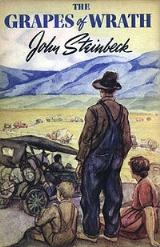
The Grapes of Wrath is a novel published in 1939 and written by John Steinbeck
John Steinbeck

John Ernst Steinbeck III was an American literature. He wrote the Pulitzer Prize-winning novel The Grapes of Wrath, published in 1939 and the novella Of Mice and Men, published in 1937....
, who was awarded the Pulitzer Prize
Pulitzer Prize

The Pulitzer Prize is an United States award regarded as the highest national honor in newspaper journalism, literary achievements and musical composition....
 and the Nobel Prize for Literature. It is frequently read in American high school and college literature classes. A celebrated Hollywood
Cinema of the United States

United States cinema has had a profound effect on cinema across the world since the early 20th century. Its history is sometimes separated into four main periods: the silent film era, Classical Hollywood cinema, New Hollywood, and the contemporary period ....
 film version
The Grapes of Wrath (film)

The Grapes of Wrath is a United States drama film directed by Academy Award Winner Best Director, John Ford. It was based on the Pulitzer Prize winning The Grapes of Wrath , written by John Steinbeck....
, starring Henry Fonda
Henry Fonda

Henry Jaynes Fonda was an United States Academy Awards-winning film and Stage actor, best known for his roles as plain-speaking idealists. Fonda's subtle, Naturalism acting style preceded by many years the popularization of method acting....
 and directed by John Ford
John Ford

John Ford was an United States film director of Ireland heritage famous for both his western such as Stagecoach and The Searchers and adaptations of such 20th-century American novels as The Grapes of Wrath ....
, was made in 1940
1940 in film

The year 1940 in film involved some significant events....
; however, the endings of the book and the movie differ greatly.

Steinbeck wrote The Grapes of Wrath at his home, 16250 Greenwood Lane, in what is now Monte Sereno, California
Monte Sereno, California

Monte Sereno is a city in Santa Clara County, California, California, USA. The population was 3,483 at the 2000 census. The city is located in the foothills of the Santa Cruz Mountains, about 10 miles southwest of San Jose, California and is immediately northwest of Los Gatos, California....
.


Discussion
Ask a question about 'The Grapes of Wrath'
Start a new discussion about 'The Grapes of Wrath'
Answer questions from other users
Full Discussion Forum


Recent Posts


Quotations


If you're in trouble or hurt or need—go to poor people. They're the only ones that'll help—the only ones.

And Ruthie whispered, Tha's grandpa, an' he's dead. Winfield nodded solemenly. he ain't breathin' at all. he's awful dead.

Tom grinned. It dont take no nerve to do somepin when there aint nothin else you can do.

To California or any place- every one a drum major leading a parade of hurts, marching with our bitterness. And some day- the armies of bitterness will all be going the same way. And they'll all walk together, and there'll be a dead terror from it.

Well,.

says Casy, "for anybody else it was a mistake, but if you think it was a sin - then it's a sin. A fell builds his own sins right up from the groun'."

In the souls of the people the grapes of wrath are filling and growing heavy, growing heavy for the vintage.


Encyclopedia


The Grapes of Wrath is a novel published in 1939 and written by John Steinbeck
John Steinbeck

John Ernst Steinbeck III was an American literature. He wrote the Pulitzer Prize-winning novel The Grapes of Wrath, published in 1939 and the novella Of Mice and Men, published in 1937....
, who was awarded the Pulitzer Prize
Pulitzer Prize

The Pulitzer Prize is an United States award regarded as the highest national honor in newspaper journalism, literary achievements and musical composition....
 and the Nobel Prize for Literature. It is frequently read in American high school and college literature classes. A celebrated Hollywood
Cinema of the United States

United States cinema has had a profound effect on cinema across the world since the early 20th century. Its history is sometimes separated into four main periods: the silent film era, Classical Hollywood cinema, New Hollywood, and the contemporary period ....
 film version
The Grapes of Wrath (film)

The Grapes of Wrath is a United States drama film directed by Academy Award Winner Best Director, John Ford. It was based on the Pulitzer Prize winning The Grapes of Wrath , written by John Steinbeck....
, starring Henry Fonda
Henry Fonda

Henry Jaynes Fonda was an United States Academy Awards-winning film and Stage actor, best known for his roles as plain-speaking idealists. Fonda's subtle, Naturalism acting style preceded by many years the popularization of method acting....
 and directed by John Ford
John Ford

John Ford was an United States film director of Ireland heritage famous for both his western such as Stagecoach and The Searchers and adaptations of such 20th-century American novels as The Grapes of Wrath ....
, was made in 1940
1940 in film

The year 1940 in film involved some significant events....
; however, the endings of the book and the movie differ greatly.

Steinbeck wrote The Grapes of Wrath at his home, 16250 Greenwood Lane, in what is now Monte Sereno, California
Monte Sereno, California

Monte Sereno is a city in Santa Clara County, California, California, USA. The population was 3,483 at the 2000 census. The city is located in the foothills of the Santa Cruz Mountains, about 10 miles southwest of San Jose, California and is immediately northwest of Los Gatos, California....
. Set during the Great Depression
Great Depression

File:International depression.pngThe Great Depression was a worldwide economic Recession starting in most places in 1929 and ending at different times in the 1930s or early 1940s for different countries....
, the novel
Novel

File:2009 stapelweise Neuerscheinungen im Buchladen.JPGA novel is today a long narrative in literary prose. The genre has historical roots both in the fields of the medieval and early modern Romance and in the tradition of the novella....
 focuses on a poor family of sharecroppers, the Joads, driven from their home by drought
Drought

A drought is an extended period of months or years when a region notes a deficiency in its water supply. Generally, this occurs when a region receives consistently below average precipitation ....
, economic hardship, and changes in the agriculture industry. In a nearly hopeless situation, they set out for California's Central Valley along with thousands of other "Okie
Okie

Okie is a term, dating from as early as 1907, originally denoting a resident or native of Oklahoma. It is derived from the name of the state, similar to Texan or Tex for someone from Texas, or Arkie or Arkansawyer for a native of Arkansas....
s" in search of land, jobs, and dignity.

Plot

The narrative begins just after Tom Joad is parole
Parole

Parole may have different meanings depending on the field and judiciary system. All of the meanings originated from the French language parole, meaning " word." Following its use in late-medieval Anglo-French chivalric practice, the term became associated with the release of prisoners based on prisoners giving their word of honor to abide...
d from prison for homicide
Homicide

Homicide refers to the act of killing another human being. It can also describe a person who has committed such an act, though this use is rare in modern English....
. On his journey home, he meets a now-former preacher, Jim Casy, whom he remembers from his childhood, and the two travel together. When they arrive at his childhood farm home, they find it deserted. Disconcerted and confused, he and Casy go to his Uncle John's home nearby where he finds his family loading a converted Hudson
Hudson Motor Car Company

The Hudson Motor Car Company made Hudson and other brand automobiles in Detroit, Michigan, from 1909 to 1954. In 1954, Hudson merged with Nash-Kelvinator Corporation to form American Motors Corporation....
 truck with what remains of their possessions; the crops were destroyed in the Dust Bowl
Dust Bowl

The Dust Bowl or the Dirty Thirties was a period of severe dust storms causing major ecological and agriculture damage to United States and Canada prairie lands from 1930 to 1936 ....
 and as a result, the family had to default on their loans. With their farm repossessed, the Joads seek solace in hope; hope inscribed on the handbills which are distributed everywhere in Oklahoma
Oklahoma

Oklahoma is a U.S. state and a sovereignty located in the South Central United States and Southern United States of the United States of America ....
, describing the beautiful and fruitful country of California
California

California is a U.S. state on the West Coast of the United States of the United States, along the Pacific Ocean. It is bordered by Oregon to the north, Nevada to the east, Arizona to the southeast, and to the south the Mexico state of Baja California....
 and high pay to be had in that state. The Joads, along with Jim Casy, are seduced by this advertising and invest everything they have into the journey. Although leaving Oklahoma would be breaking parole, Tom decides that it is a risk, albeit minimal, that he has to take.

While en route, they discover that all of the roads and the highways are saturated with other families who are also making the same trek, ensnared by the same promise. As the Joads continue on their journey and hear many stories from others, some coming from California, they are forced to confront the possibility that their prospects may not be what they hoped. This realization, supported by the deaths of Grandpa and Grandma and the departure of Noah (the eldest Joad son) and Connie (the husband of the pregnant Joad daughter, Rose of Sharon), is forced from their thoughts: they must go on because they have no choice--there is nothing remaining for them in Oklahoma.

Upon arrival, they find little hope of finding a decent wage, as there is an oversupply of labor and a lack of rights
Labor rights

Labor rights or workers' rights are a group of legal rights and claimed human rights having to do with labor relations between workers and their employers, usually obtained under labor and employment law....
, and the big corporate farmers are in collusion. The tragedy lies in the simplicity and impossibility of their dream: a house, a family, and a steady job. A gleam of hope is presented at Weedpatch, in one of the clean, utility-supplied camps operated by the Resettlement Administration
Resettlement Administration

The Resettlement Administration was a U.S. federal agency that, between April 1935 and December 1936, relocated struggling urban and rural families to communities planned by the federal government....
, a New Deal
New Deal

The New Deal was the name that United States President of the United States Franklin D. Roosevelt gave to a sequence of central economic planning and economic stimulus programs he initiated between 1933 and 1938 with the goal of giving aid to the unemployed, reform of business and financial practices, and recovery of the Economy of the Unite...
 agency that tried to help the migrants, but there is not enough money and space to care for all of the needy.

In response to the exploitation of laborers, the workers begin to join unions. The surviving members of the family unknowingly work as strikebreakers on an orchard involved in a strike that eventually turns violent, killing the preacher Casy and forcing Tom Joad to kill again and become a fugitive. He bids farewell to his mother, promising that no matter where he runs, he will be a tireless advocate for the oppressed. Rose of Sharon's baby is stillborn
Stillbirth

A stillbirth occurs when a fetus which has death in the uterus or during labor or childbirth, while exiting a woman's human body. The term is often used in distinction to live birth or miscarriage....
; however, Ma Joad remains steadfast and forces the family through the bereavement. In the end, Rose of Sharon commits the only act in the book that is not futile: she breast feeds
Breastfeeding

Breastfeeding is the feeding of an infant or young child with breast milk directly from human breasts rather than from a baby bottle or other container....
 a starving man, still trying to show hope in humanity after her own negative experience. This final act is said to illustrate the spontaneous mutual sharing that will lead to a new awareness of collective values.

Characters

  • Tom Joad — Protagonist of the story; the Joad family's second son, named for his father.
  • Ma Joad — matriarch. Practical and warm-spirited, she tries to hold the family together. Her given name is never learned; it is suggested that her maiden name was Hazlett.
  • Pa Joadpatriarch
    Patriarch

    Originally a patriarch was a man who exercised Autocracy authority as a pater familias over an extended family. The system of such rule of families by senior males is called patriarchy....
    , also named Tom. Hardworking sharecropper and family man.
  • Uncle John — Older brother of Pa Joad, feels responsible for the death of his young wife years before when he ignored her pleas for a doctor because he thought she just had a stomachache. He tries to repress "sins" such as drinking, then fulfills them with gross excesses like binge drinking.
  • Jim Casy — A preacher
    Preacher

    Preacher is a term the for someone who preaches sermons or gives homilies.Some believe a preacher is distinct from a theologian by focusing on the communication rather than the development of doctrine....
     who loses his faith after committing fornication with willing members of his church numerous times, and from his perception that religion has no solace or answer for the difficulties the people are experiencing. Christ figure, shares his initials with Jesus.
  • Al Joad — The second youngest son who cares mainly for cars and girls; looks up to Tom, but begins to find his own way. Over the book's course he gradually matures and learns responsibility.
  • Rose of Sharon Rivers ("Rosasharn") — Childish and dreamy teenage daughter who develops as the novel progresses to become a mature woman. She symbolizes regrowth when she helps the starving stranger (see also Roman Charity
    Roman Charity

    Roman Charity is the story of a daughter, Pero, who secretly breastfeeding her father, Cimon, after he is incarcerated and sentenced to death by starvation....
    , works of art based on the legend of a daughter as wet nurse
    Wet nurse

    A wet nurse is a woman who breastfeeding a baby that is not her own. These children may be known as milk-siblings and in some cultures share a special relationship....
     to a dying father). Pregnant in the beginning of the novel, she delivers a stillborn baby, probably as a result of malnutrition.
  • Connie Rivers — Rose of Sharon's husband. Young and naive, he is overwhelmed by the responsibilities of marriage and impending fatherhood, and abandons her shortly after arriving in California.
  • Noah Joad — The oldest son who is the first to willingly leave the family, choosing to stay by an idyllic river and survive by fishing. Injured at birth, described as "strange", he may have slight learning difficulties or autistic spectrum disorder.
  • Grampa (William) Joad — Tom's grandfather who expresses his strong desire to stay in Oklahoma. He is drugged to make him leave but dies shortly after of a stroke
    Stroke

    A stroke is the rapidly developing loss of brain function due to a disturbance in the blood supply to the brain. According to the National Stroke Association, a "stroke" occurs when a blood clot blocks and artery or a blood vessel breaks, interrupting blood flow to an area of the brain....
    . Symbolically, it is due to his spirit staying at the farm.
  • Granma Joad — The religious wife of Grandpa Joad, she seems to lose will to live (and consequently dies while crossing the desert) after her husband's death.
  • Ruthie Joad — One of the younger children.
  • Winfield Joad — A child. The youngest male in the family. He and Ruthie are close.
  • Ivy and Sairy Wilson — Kansas folks in a similar predicament, who help attend the death of Grandpa and subsequently share the travelling with the Joads as far as the California state line.
  • Mr. Wainwright — The father of Aggie Wainwright and husband of Mrs. Wainwright. Worries over his daughter who is sixteen and in his words "growed up".
  • Mrs. Wainwright — Mother to Aggie Wainwright and wife to Mr. Wainwright. She helps deliver Rose of Sharon's stillborn baby with Ma.
  • Aggie Wainwright — Sixteen years of age. Daughter to Mr. and Mrs. Wainwright. Intends on marrying Al. She has limited interactions with the other characters, but does speak with Ruthie and Winfield when Rose of Sharon goes into labor.


Development


Title

Steinbeck had unusual difficulty devising a title for his novel. "The Grapes of Wrath", suggested by his wife, Carol Steinbeck, was deemed more suitable than anything the author could come up with. The title is a reference to some lyrics from "The Battle Hymn of the Republic
The Battle Hymn of the Republic

"The Battle Hymn of the Republic" is an American Abolitionism song, written by Julia Ward Howe in November 1861 and first published in The Atlantic Monthly on 1 February 1862, that became popular during the American Civil War....
", by Julia Ward Howe
Julia Ward Howe

Julia Ward Howe was a prominent United States Abolitionism, activism, and poet most famous as the author of "The Battle Hymn of the Republic."...
:

Mine eyes have seen the glory of the coming of the Lord:
He is trampling out the vintage where the grapes of wrath are stored;
He hath loosed the fateful lightning of His terrible swift sword:
His truth is marching on.


These lyrics refer, in turn, to the biblical passage Revelation
Book of Revelation

The Book of Revelation, also called Revelation to John, Apocalypse of John , and Revelation of Jesus Christ is the last Biblical canon of the New Testament in the Christian Bible....
 14:19-20, an apocalyptic appeal to divine justice and deliverance from oppression in the final judgment.

And the angel thrust in his sickle into the earth, and gathered the vine of the earth, and cast it into the great winepress of the wrath of God. And the winepress was trodden without the city, and blood came out of the winepress, even unto the horse bridles, by the space of a thousand and six hundred furlongs.


As might be expected, the image invoked by the title serves as a crucial symbol in the development of both the plot and the novel's greater thematic concerns: From the terrible winepress of Dust Bowl
Dust Bowl

The Dust Bowl or the Dirty Thirties was a period of severe dust storms causing major ecological and agriculture damage to United States and Canada prairie lands from 1930 to 1936 ....
 oppression will come terrible wrath but also the deliverance of workers through their cooperation.

In popular culture


Adaptations


  • A film version
    The Grapes of Wrath (film)

    The Grapes of Wrath is a United States drama film directed by Academy Award Winner Best Director, John Ford. It was based on the Pulitzer Prize winning The Grapes of Wrath , written by John Steinbeck....
     was produced by Darryl F. Zanuck
    Darryl F. Zanuck

    Darryl Francis Zanuck was an Academy Award-winning Film producer, writer, actor, Film director, and studio executive who played a major part in the Hollywood studio system as one of its longest survivors ....
     in 1940
    1940 in film

    The year 1940 in film involved some significant events....
     and directed by John Ford
    John Ford

    John Ford was an United States film director of Ireland heritage famous for both his western such as Stagecoach and The Searchers and adaptations of such 20th-century American novels as The Grapes of Wrath ....
    . Ford won the Academy Award for Directing
    Academy Award for Directing

    The Academy Award for Achievement in Directing is one of the Academy Award presented by the Academy of Motion Picture Arts and Sciences to Film directors working in the film industry....
     and Jane Darwell
    Jane Darwell

    Jane Darwell was an Academy Awards-winning United States theater and film actor.Born Patti Woodard in Palmyra, Missouri, she originally intended to become a Circus performer; her father objected, however, and she compromised by becoming an actress....
     won the Academy Award for Best Supporting Actress
    Academy Award for Best Supporting Actress

    Performance by an Actress in a Supporting Role is one of the Academy Award presented annually by the Academy of Motion Picture Arts and Sciences to recognize an actor who has delivered an outstanding performance while working within the film industry....
    . The film was also nominated for several other awards: Academy Award for Best Picture
    Academy Award for Best Picture

    The Academy Award for Best Motion Picture is one of the Academy Award presented annually by the Academy of Motion Picture Arts and Sciences to artists working in the film industry....
    , Henry Fonda
    Henry Fonda

    Henry Jaynes Fonda was an United States Academy Awards-winning film and Stage actor, best known for his roles as plain-speaking idealists. Fonda's subtle, Naturalism acting style preceded by many years the popularization of method acting....
     for Best Actor, Robert L. Simpson for Best Film Editing, Edmund H. Hansen for Best Sound Recording, and Nunnally Johnson
    Nunnally Johnson

    Nunnally Hunter Johnson was an United States filmmaker who wrote, produced, and directed films.Johnson was born in Columbus, Georgia. He began his career as a journalist, writing for the Columbus Enquirer Sun, the Savannah Press, the Brooklyn Daily Eagle, and the New York Herald Tribune....
     for Best Screenplay Writing. It has been selected for preservation in the United States National Film Registry
    National Film Registry

    The National Film Registry is the registry of films selected by the United States National Film Preservation Board for preservation in the Library of Congress....
    .
  • The Steppenwolf Theatre Company
    Steppenwolf Theatre Company

    Steppenwolf Theatre Company is a Tony Award-winning Chicago theatre company founded in 1974 by Gary Sinise, Terry Kinney and Jeff Perry in the basement of a church in Highland Park, Illinois....
     produced a stage version of the book, adapted by Frank Galati
    Frank Galati

    Frank Galati is an American director, and actor. He is a member of Steppenwolf Theatre Company, an associate director at Goodman Theatre, and a professor of performance at Northwestern University....
    . Gary Sinise
    Gary Sinise

    Gary Alan Sinise is an United States actor and film director. During his career, Sinise has won an Emmy Award and a Golden Globe Award and was nominated for Palme d'Or and an Academy Award....
     played Tom Joad for its entire run of 188 performances on Broadway in 1990, and was shown on PBS the following year.
  • An opera based on the novel
    The Grapes of Wrath (opera)

    The Grapes of Wrath is an opera in three acts composed by Ricky Ian Gordon to a libretto by Michael Korie based on John Steinbeck?s 1939 The Grapes of Wrath....
     was co-produced by the Minnesota Opera
    Minnesota Opera

    The Minnesota Opera is a performance organization based in Minneapolis, Minnesota. It was founded in 1963, and is known for premiering such diverse works as Where the Wild Things Are by Maurice Sendak and Frankenstein by Libby Larsen....
     and Utah Symphony and Opera, with music by Ricky Ian Gordon
    Ricky Ian Gordon

    Ricky Ian Gordon is an American Musical theatre composer and lyricist....
     and libretto by Michael Korie
    Michael Korie

    Michael Korie is an United States Libretto and lyricist. Korie's works include Grey Gardens , Harvey Milk and The Grapes of Wrath ....
    . The world premiere performance of the opera was given in February 2007, to favorable local reviews.


Literature

  • Tom Joad appears as a background figure in the short story "Tom Joad" by Kim Newman
    Kim Newman

    Kim Newman is an English journalist, film critic, and fiction writer. Recurring interests visible in his work include film history and horror fiction?both of which he attributes to seeing Tod Browning's Dracula at the age of eleven?and alternate history ....
     and Eugene Byrne
    Eugene Byrne

    Eugene Byrne is an England freelance journalist and fiction writer.His novel ThigMOO, and the story it was based on, were nominated for the BSFA award....
    , in part of the short story collection Back in the USSA
    Back in the USSA

    Back in the USSA is a collection of 7 short stories by Eugene Byrne and Kim Newman, which was published in 1997 by Mark V. Ziesing Books. The stories are linked through their setting, an alternate history of the twentieth century in which the United States experienced a communist revolution in 1917 and became a communist superpower, wher...
    .


Music

  • In 1940, Woody Guthrie
    Woody Guthrie

    Woodrow Wilson "Woody" Guthrie is best known as an United States singer-songwriter and folk musician, whose musical legacy includes hundreds of political, Traditional music and children's songs, ballads and improvised works....
     recorded a ballad called "Tom Joad". This ballad, set to the tune of "John Hardy
    John Hardy (song)

    "John Hardy" is a traditional United States folk music based on the life of a railroad worker in West Virginia. The historical John Hardy killed a man during a craps game, was found guilty of murder in the first degree, and was hanged on January 19, 1894....
    ", summarizes the plot of the book and movie. It was so long that it had to be recorded in two parts. Woody wrote the song after seeing the movie, which he described as the "best cussed pitcher I ever seen".
  • The Grapes of Wrath
    The Grapes of Wrath (band)

    The Grapes of Wrath were a Canada folk rock band, who were one of Canada's most successful pop bands in the late 1980s and early 1990s before disbanding in 1992....
     was a popular Canadian alternative rock band from 1984 to 1994.
  • The English progressive rock
    Progressive rock

    Progressive rock is a form of rock music that evolved in the late 1960s and early 1970s as part of a "mostly British attempt to elevate rock music to new levels of artistic credibility." The term "art rock" is often used interchangeably with "progressive rock", but while there are crossovers between the two genres, they are not identical....
     band Camel
    Camel (band)

    Camel are an England progressive rock band formed in 1971. An important figure in the Canterbury scene, the group has been releasing studio and live recordings steadily, with considerable success, since their formation....
     recorded an album Dust and Dreams
    Dust And Dreams (album)

    Dust And Dreams is a Camel album, released in 1991. It's inspired by John Steinbeck's The Grapes of Wrath....
     (1991) inspired by The Grapes of Wrath.
  • On Pink Floyd
    Pink Floyd

    Pink Floyd are an English Rock music band who initially earned recognition for their psychedelic rock and space rock music, and later, as they evolved, for their progressive rock music....
    's 1987 album A Momentary Lapse of Reason
    A Momentary Lapse of Reason

    A Momentary Lapse of Reason is Pink Floyd's 1987 album, the band's first release after the departure of Roger Waters from the band in 1985. The album reached #3 on both the United States and United Kingdom charts....
    , the opening lines for the song "Sorrow
    Sorrow (Pink Floyd song)

    "Sorrow" is the final track from Pink Floyd's 1987 album, A Momentary Lapse of Reason although it was the seventh song from the album performed in the Momentary Lapse set of the 1987/88/89/90 tours....
    " are paraphrased from the beginning of a chapter in The Grapes of Wrath: "Sweet smell of a great sorrow lies over the land."
  • Kris Kristofferson
    Kris Kristofferson

    Kristoffer Kristian Kristofferson is an United States writer, singer-songwriter, actor, and musician. He is best known for hits such as "Me and Bobby McGee", "Sunday Mornin' Comin' Down", and "Help Me Make It Through the Night"....
    's 1981 single "Here Comes That Rainbow Again" is based on a scene from the book.
  • The Massachusetts metalcore band Killswitch Engage's 2004 album "The End of Heartache" consisted of the track, "Rose of Sharyn."
  • In 1995, Bruce Springsteen
    Bruce Springsteen

    Bruce Frederick Joseph Springsteen , nicknamed "The Boss", is an American songwriter, singer and musician. He has recorded and toured with the E Street Band....
     recorded his song "The Ghost of Tom Joad" on the album of the same name
    The Ghost of Tom Joad

    The Ghost of Tom Joad is the eleventh studio album by Bruce Springsteen, released in 1995 . The album was recorded and mixed at Thrill Hill during the spring and summer of 1995....
    . The lyric is set in contemporary times, but the third verse quotes Tom's famous "wherever there's a ..." lines. The song was later recorded by Rage Against The Machine
    Rage Against the Machine

    Rage Against the Machine is an American Rock music band, formed in Los Angeles, California in 1991. The band's lineup, unchanged since formation, consists of vocalist Zack de la Rocha, guitarist Tom Morello, bassist Tim Commerford, and drummer Brad Wilk....
    , José González
    José González

    Jos? Gonz?lez is a Sweden indie folk singer-songwriter of Argentine descent....
    's band Junip
    Junip

    Junip are a Swedish band featuring Jos? Gonz?lez, famous for his solo work. They released Black Refuge EP at the end of 2005, and although a full length album had been expected, it has not yet appeared....
    , and others. Springsteen has stated that he was first inspired by the John Ford film.


Television

  • In the Boy Meets World
    Boy Meets World

    Boy Meets World is an Television in the United States television sitcom that chronicles the events and everyday life lessons of Cory Matthews, who grows up from a young boy to a married man....
     episode "Me and Mr. Joad", Cory Matthews and Shawn Hunter lead their 7th grade class in a "strike" and class walkout inspired by the strike the workers did in the book.
  • An episode of television show South Park
    South Park

    South Park is an United Statesn animation situation comedy, notorious for its toilet humour, surrealism, and often black comedy, which satirizes Subject matter in South Park including religion, politics, violence, abuse, sexuality, and mental disorder....
    , entitled Over Logging
    Over Logging

    "Over Logging" is the sixth episode of the List of South Park Episodes#2008: Season 12 of the animated series South Park. It was originally telecast on April 16, 2008....
     parodied the novel, substituting a shortage of Internet access for a shortage of employment.


Critical reception

At the time of publication, Steinbeck's novel "was a phenomenon on the scale of a national event. It was publicly banned
Censorship

Censorship is the suppression of freedom of speech or deletion of communicative material which may be considered objectionable, harmful or sensitive, as determined by a censor....
 and burned
Book burning

Book burning is the practice of destroying, often ceremony, one or more copies of a book or other written material. In modern times, other forms of media, such as gramophone record, Video, and Compact disc have also been ceremoniously burned, torched, or shredded....
 by citizens, it was debated on national radio hook-ups
Talk radio

Talk radio is a radio format containing discussion about topical issues. Most shows are regularly hosted by a single individual, and often feature interviews with a number of different guests....
; but above all, it was read." Steinbeck scholar John Timmerman sums up the book's impact: "The Grapes of Wrath may well be the most thoroughly discussed novel - in criticism, reviews, and college classrooms - of twentieth century American literature
American literature

American literature refers to written or literature produced in the area of the United States and Colonial America. For more specific discussions of poetry and theater, see Poetry of the United States and Theater in the United States....
." Part of its impact stemmed from its passionate depiction of the plight of the poor, and in fact, many of Steinbeck's contemporaries attacked his social and political views. Bryan Cordyack writes, "Steinbeck was attacked as a propagandist
Propaganda

Propaganda is the dissemination of information aimed at influencing the opinions or behaviors of large numbers of people. As opposed to Objectivity providing information, propaganda in its most basic sense presents information in order to influence its audience....
 and a socialist
Socialism

Socialism refers to a broad set of economic theories of social organization advocating public or state ownership and administration of the means of production and distribution of goods, and a society characterized by equality for all individuals, with a fair or Egalitarianism method of compensation....
 from both the left and the right of the political spectrum. The most fervent of these attacks came from the Associated Farmers of California; they were displeased with the book's depiction of California farmers' attitudes and conduct toward the migrants. They denounced the book as a 'pack of lies' and labeled it 'communist
Communism

Communism is a socioeconomic structure and political ideology that promotes the establishment of an egalitarianism, classlessness, stateless society based on common ownership and control of the means of production and property in general....
 propaganda'." However, although Steinbeck was accused of exaggeration of the camp conditions to make a political point, in fact he had done the opposite, underplaying the conditions that he well knew were worse than the novel describes because he felt exact description would have gotten in the way of his story. Furthermore, there are several references to socialist politics and questions which appear in the John Ford film of 1940 which do not appear in the novel, which is less political in its terminology and interests.

Franklin D. Roosevelt

Franklin Delano Roosevelt , often referred to by his initials FDR, was the List of Presidents of the United States President of the United States....
 was an early advocate for addressing the plight of those featured in the book.

In 1962, the Nobel Prize
Nobel Prize

The Nobel Prize , established in the 1895 will of Swedish chemist Alfred Nobel; it was first awarded in Nobel Prize in Physics, Nobel Prize in Chemistry, Nobel Prize in Physiology or Medicine, Nobel Prize in Literature, and Nobel Peace Prize in 1901....
 committee cited Grapes of Wrath as a "great work" and as one of the committee's main reasons for granting Steinbeck the Nobel Prize for Literature.

Time Magazine included the novel in its TIME 100 Best English-language Novels from 1923 to 2005.

Bibliography

  • Gregory, James N. "Dust Bowl Legacies: the Okie Impact on California, 1939-1989." California History 1989 68(3): 74-85. Issn: 0162-2897
  • Saxton, Alexander. "In Dubious Battle: Looking Backward." Pacific Historical Review 2004 73(2): 249-262. Issn: 0030-8684 Fulltext: online at Swetswise, Ingenta, Ebsco
  • Sobchack, Vivian C. "The Grapes of Wrath (1940): Thematic Emphasis Through Visual Style." American Quarterly 1979 31(5): 596-615. Issn: 0003-0678 Fulltext: in Jstor. Discusses the visual style of John Ford's cinematic adaptation of the novel. Usually the movie is examined in terms of its literary roots or its social protest. But the imagery of the film reveals the important theme of the Joad family's coherence. The movie shows the family in closeups, cramped in small spaces on a cluttered screen, isolated from the land and their surroundings. Dim lighting helps abstract the Joad family from the reality of Dust Bowl migrants. The film's emotional and aesthetic power comes from its generalized quality attained through this visual style.
  • Windschuttle, Keith. The New Criterion, Vol. 20, No. 10, June 2002.
  • Zirakzadeh, Cyrus Ernesto. "John Steinbeck on the Political Capacities of Everyday Folk: Moms, Reds, and Ma Joad's Revolt." Polity 2004 36(4): 595-618. Issn: 0032-3497


External links

  • Study of "The Grapes of Wrath" on
  • : John Steinbeck's first-person account of the conditions he observed at a California squatter's camp.