

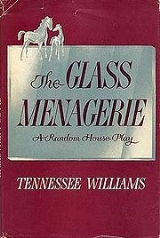
The Glass Menagerie

Encyclopedia
The Glass Menagerie is a four-character memory play by Tennessee Williams
. Williams worked on various drafts of the play prior to writing a version of it as a screenplay for MGM, to whom Williams was contracted. Initial ideas stemmed from one of his short stories, and the screenplay originally went under the name of 'The Gentleman Caller' (Williams envisioned Ethel Barrymore
and Judy Garland
for the roles that eventually became Amanda and Laura Wingfield although Louis B. Mayer
insisted on casting Greer Garson
as Laura).
The play premiered in Chicago in 1944. It was championed by Chicago critics Ashton Stevens
and Claudia Cassidy
whose enthusiasm helped build audiences so the producers could move the play to Broadway where it won the New York Drama Critics Circle Award in 1945. Laurette Taylor
originated the role of the all-too-loving mother, Amanda Wingfield, and many who witnessed it consider that performance to be an incomparable, defining moment for American acting. In the 2010 documentary Broadway: The Golden Age, by the Legends Who Were There
, Broadway
veterans nearly unanimously rank Taylor's performance as the most memorable of their entire lives. The Glass Menagerie was Williams's first successful play; he went on to become one of America's most highly regarded playwrights.
The play was reworked from one of Williams's short stories "Portrait of a Girl in Glass" (1943; published 1948). The story is also written from the point of view of narrator Tom Wingfield, and many of his soliloquies from The Glass Menagerie seem lifted straight from this original. Certain elements have clearly been omitted from the play, including the reasoning for Laura's fascination with Jim's freckles (linked to a book that she loved and often reread, Freckles by Gene Stratton-Porter
) . Generally the story contains the same plot as the play, with certain sections given more emphasis, and character details edited (for example, in the story, Jim nicknames Tom "Slim", instead of "Shakespeare").
The Glass Menagerie is accounted by many to be an autobiographical play about Williams's life, the characters and story mimicking his own more closely than any of his other works. Williams (whose real name is Thomas) would be Tom, his mother, Amanda, and his sickly and (supposedly) mentally ill sister Rose would be Laura (whose nickname in the play is "Blue Roses", a result of an unfortunate bout of Pleurosis as a high school student). It has been suggested as well that the character of Laura is based upon Williams himself, referencing his introvert nature and obsessive focus on one part of life (writing for Williams and glass animals in Laura's case).
Laura Wingfield: Amanda's daughter. She is slightly crippled and has an extra-sensitive mental condition.
Tom Wingfield: Amanda's son. He works in a warehouse but aspires to be a writer. He feels both obligated toward yet burdened by his family.
Jim O'Connor: A workmate of Tom's (a shipping clerk) and acquaintance of Laura's from high school (specifically named Soldan High School
), is also the physical representation of all Laura's desires and all Amanda's desires for her daughter. He is invited over to the Wingfields' house for dinner with the intent of being Laura's first gentleman caller. He seems like a dream come true for the Wingfields.
Mr. Wingfield: Amanda's absentee husband, represented by a large portrait on the set and frequently referred to by Amanda. He never appears in person during the play.
Amanda's husband abandoned the family long ago. Although a survivor and a pragmatist, Amanda yearns for the illusions and comforts she remembers from her days as a fêted Southern belle. She yearns especially for these things for her daughter Laura, a young adult with a crippled foot and tremulous insecurity about the outside world. Tom works in a warehouse, doing his best to support them. He chafes under the banality and boredom of everyday life and spends much of his spare time watching movies in cheap cinemas at all hours of the night. Amanda is obsessed with finding a suitor for Laura, who spends most of her time with her collection of little glass animals. Eventually Tom brings home an acquaintance from work named Jim, who Amanda hopes will be the long-awaited suitor for Laura. Laura realizes that Jim is the man she loved in high school and has thought of ever since. After a long evening in which Jim and Laura are left alone by candlelight in the living room, waiting for electricity to be restored, Jim reveals that he is already engaged to be married, and he leaves. During their long scene together, Jim and Laura have shared a quiet dance, and he accidentally brushes against the glass menagerie, knocking the glass unicorn to the floor and breaking its horn off ("Now it's just like the other horses," Laura says). When Amanda learns that Jim was engaged she assumes Tom knew and lashes out at him: ("That's right, now that you've had us make such fools of ourselves. The effort, the preparations, all the expense! The new floor lamp, the rug, the clothes for Laura! All for what? To entertain some other girl's fiancé! Go to the movies, go! Don't think about us, a mother deserted, an unmarried sister who's crippled and has no job! Don't let anything interfere with your selfish pleasure. Just go, go, go — to the movies !") At play's end, as Tom speaks, it becomes clear that Tom left home soon afterward and never returned. In Tom's final speech, as he watches his mother comforting Laura long ago, he bids farewell: "Oh, Laura, Laura, I tried to leave you behind me, but I am more faithful than I intended to be! I reach for a cigarette, I cross the street, I run into the movies or a bar, I buy a drink, I speak to the nearest stranger — anything that can blow your candles out! [LAURA bends over the candles.]- for nowadays the world is lit by lightning ! Blow out your candles, Laura — and so good-bye." Laura blows the candles out as the play ends.
on March 31, 1945 until June 29, 1946. It then moved to the Royale Theatre from July 1, 1946 until its closing on August 3, 1946. The show was directed by Eddie Dowling
and Margo Jones
. The cast for opening night was as follows:
in 1950, starring Gertrude Lawrence
, Jane Wyman
, Kirk Douglas
, Ann Tyrrell
and Arthur Kennedy
, and the second by Paul Newman
in 1987, starring Joanne Woodward
, John Malkovich
, Karen Allen
, and James Naughton
. Williams characterized the former, which had an implied happy ending grafted onto it, as was the style of American films from that era, as the worst adaptation of his work. Bosley Crowther
of the New York Times wrote, "As much as we hate to say so, Miss Lawrence's performance does not compare with the tender and radiant creation of the late Laurette Taylor
on the stage." It is not currently available on VHS or DVD.
There was a television adaptation by Anthony Harvey
, which was broadcast on ABC
on December 16, 1973, starring Katharine Hepburn
as Amanda, Sam Waterston
as Tom, Michael Moriarty
as Jim, and Joanna Miles
as Laura. (Tom's initial soliloquy, so striking onstage, is cut from this version; it opens with him walking alone in an alley, sitting on a rampart to read the newspaper and having his sister's and mother's voices conjure up the first domestic scene.) All four actors were nominated for Emmys, with Moriarty and Miles winning. An earlier television version, recorded on videotape
, and starring Shirley Booth
, was broadcast on December 8, 1966 as part of CBS
Playhouse. Hal Holbrook
played Tom and Pat Hingle
played the Gentleman Caller. Booth was nominated for an Emmy for her performance as Amanda.
There is a critically acclaimed Indian adaptation of the play, filmed in the Malayalam
language. The movie titled Akale (meaning At a Distance), released in 2004, is directed by Shyamaprasad
. The story is set in the southern Indian state of Kerala in the 1970s, in an Anglo-Indian/Latin Catholic household. The characters were renamed to fit the context better (the surname Wingfield was changed to D'Costa, reflecting the part-Portuguese heritage of the family — probably on the absent father's side, since the mother is Anglo-Indian), but the story remains essentially the same. Prithviraj Sukumaran
plays Neil D'Costa (Tom Wingfield in the play), Geethu Mohandas plays Rosemary D'Costa (Laura Wingfield), Sheela plays Margaret D'Costa (Amanda Wingfield), and Tom George plays Freddy Evans (Jim O'Connor). Sheela won the National Film Award for Best Supporting Actress, and Geethu Mohandas won the Kerala State Film Award for the best actress.
In 1997, Kiefer Sutherland
returned to his theatrical roots, starring with his mother (Canadian actress Shirley Douglas
) in a Canadian production of The Glass Menagerie at the Royal Alexandra Theatre in Toronto
.
Maureen Stapleton
, Jessica Tandy
, Julie Harris
(in New York) and Judith Ivey
and Harriet Harris (regionally) have all portrayed Amanda Wingfield.
"the summer before last." However, the Chicago World's Fair closed in 1934. Tom makes a couple of references to Guernica
in his soliloquies; the event happened in April 1937. The play is usually referenced as happening in spring of 1937. Jim must have remembered incorrectly. However, as the play is a memory play, Tom could be narrating in the spring of 1937 events that occurred in years previous to 1934.
When Amanda asks Jim to take the candelabra and wine glass out to Laura, she asks if he can manage both. In the original script Jim says, "Sure, I'm Superman." The Superman
character did not appear in comics until 1938's Action Comics #1. The phrase already existed from English translations of ubermensch
in works by Nietzsche, whom Williams often references in his plays. The line is altered in the Acting Edition to "Well, I can try."
in a short one-act entitled For Whom the Southern Belle Tolls, in which Laura is replaced by a wimpy hypochondriac son named Lawrence, and the "gentleman caller" becomes Ginny, a butch female factory worker with a hearing problem. Lawrence, instead of prizing a collection of glass figurines, here is obsessed with his collection of glass cocktail stirrers.
Ryan Landry and The Gold Dust Orphans
did a parody called The Plexiglass Menagerie, set in a FEMA trailer
in post-Katrina
New Orleans, with Landry playing Amanda in an all-male cast.
Tennessee Williams
Thomas Lanier "Tennessee" Williams III was an American writer who worked principally as a playwright in the American theater. He also wrote short stories, novels, poetry, essays, screenplays and a volume of memoirs...
. Williams worked on various drafts of the play prior to writing a version of it as a screenplay for MGM, to whom Williams was contracted. Initial ideas stemmed from one of his short stories, and the screenplay originally went under the name of 'The Gentleman Caller' (Williams envisioned Ethel Barrymore
Ethel Barrymore
Ethel Barrymore was an American actress and a member of the Barrymore family of actors.-Early life:Ethel Barrymore was born Ethel Mae Blythe in Philadelphia, Pennsylvania, the second child of the actors Maurice Barrymore and Georgiana Drew...
and Judy Garland
Judy Garland
Judy Garland was an American actress and singer. Through a career that spanned 45 of her 47 years and for her renowned contralto voice, she attained international stardom as an actress in musical and dramatic roles, as a recording artist and on the concert stage...
for the roles that eventually became Amanda and Laura Wingfield although Louis B. Mayer
Louis B. Mayer
Louis Burt Mayer born Lazar Meir was an American film producer. He is generally cited as the creator of the "star system" within Metro-Goldwyn-Mayer in its golden years. Known always as Louis B...
insisted on casting Greer Garson
Greer Garson
Greer Garson, CBE was a British-born actress who was very popular during World War II, being listed by the Motion Picture Herald as one of America's top ten box office draws in 1942, 1943, 1944, 1945, and 1946. As one of MGM's major stars of the 1940s, Garson received seven Academy Award...
as Laura).
The play premiered in Chicago in 1944. It was championed by Chicago critics Ashton Stevens
Ashton Stevens
Ashton P Stevens was an American drama critic. His newspaper column appeared in the San Francisco Examiner and later in the Chicago Herald-American...
and Claudia Cassidy
Claudia Cassidy
Claudia Cassidy , born in Shawneetown, Illinois, was a music, dance, and drama critic. She was so well-known for giving caustic reviews to what she considered bad performances that she earned the nickname "Acidy Cassidy." Her judgment, however, which was regarded as extremely controversial even in...
whose enthusiasm helped build audiences so the producers could move the play to Broadway where it won the New York Drama Critics Circle Award in 1945. Laurette Taylor
Laurette Taylor
Laurette Taylor was an American stage and silent film actress.-Personal life:Laurette Taylor was born in New York City of Irish extraction as Loretta Helen Cooney.-Personal life:...
originated the role of the all-too-loving mother, Amanda Wingfield, and many who witnessed it consider that performance to be an incomparable, defining moment for American acting. In the 2010 documentary Broadway: The Golden Age, by the Legends Who Were There
Broadway: The Golden Age, by the Legends Who Were There
Broadway: The Golden Age is a 2004 documentary by Rick McKay, telling the story of the "golden age" of Broadway by the oral history of the legendary actors of the 40s and 50s, incorporating rare lost footage of actual performances and never-before-seen personal home movies and photos.-The Cast:The...
, Broadway
Broadway theatre
Broadway theatre, commonly called simply Broadway, refers to theatrical performances presented in one of the 40 professional theatres with 500 or more seats located in the Theatre District centered along Broadway, and in Lincoln Center, in Manhattan in New York City...
veterans nearly unanimously rank Taylor's performance as the most memorable of their entire lives. The Glass Menagerie was Williams's first successful play; he went on to become one of America's most highly regarded playwrights.
The play was reworked from one of Williams's short stories "Portrait of a Girl in Glass" (1943; published 1948). The story is also written from the point of view of narrator Tom Wingfield, and many of his soliloquies from The Glass Menagerie seem lifted straight from this original. Certain elements have clearly been omitted from the play, including the reasoning for Laura's fascination with Jim's freckles (linked to a book that she loved and often reread, Freckles by Gene Stratton-Porter
Gene Stratton-Porter
Gene Stratton-Porter was an American author, amateur naturalist, wildlife photographer, and one of the earliest women to form a movie studio and production company. She wrote some best-selling novels and well-received columns in national magazines, such as McCalls...
) . Generally the story contains the same plot as the play, with certain sections given more emphasis, and character details edited (for example, in the story, Jim nicknames Tom "Slim", instead of "Shakespeare").
The Glass Menagerie is accounted by many to be an autobiographical play about Williams's life, the characters and story mimicking his own more closely than any of his other works. Williams (whose real name is Thomas) would be Tom, his mother, Amanda, and his sickly and (supposedly) mentally ill sister Rose would be Laura (whose nickname in the play is "Blue Roses", a result of an unfortunate bout of Pleurosis as a high school student). It has been suggested as well that the character of Laura is based upon Williams himself, referencing his introvert nature and obsessive focus on one part of life (writing for Williams and glass animals in Laura's case).
Characters
Amanda Wingfield: A woman abandoned by her husband some 16 years ago who is trying to raise her children under harsh financial conditions. Her devotion to her children has made her, as she admits at one point, to appear to be "hateful" towards them and she longs for the kind of Old South gentility and comforts which she remembers from her youth for her children. Once a Southern belle, she still clings to whatever powers of vivacity and charm she can muster.Laura Wingfield: Amanda's daughter. She is slightly crippled and has an extra-sensitive mental condition.
Tom Wingfield: Amanda's son. He works in a warehouse but aspires to be a writer. He feels both obligated toward yet burdened by his family.
Jim O'Connor: A workmate of Tom's (a shipping clerk) and acquaintance of Laura's from high school (specifically named Soldan High School
Soldan International Studies High School
Soldan International Studies High School is a public magnet high school in the Academy neighborhood of St. Louis, Missouri that is part of the St. Louis Public Schools. From its opening in 1909, Soldan was known for its wealthy and predominantly Jewish student population...
), is also the physical representation of all Laura's desires and all Amanda's desires for her daughter. He is invited over to the Wingfields' house for dinner with the intent of being Laura's first gentleman caller. He seems like a dream come true for the Wingfields.
Mr. Wingfield: Amanda's absentee husband, represented by a large portrait on the set and frequently referred to by Amanda. He never appears in person during the play.
Plot summary
The play is introduced to the audience by Tom as a memory play, based on his recollection of his mother Amanda and his sister Laura.Amanda's husband abandoned the family long ago. Although a survivor and a pragmatist, Amanda yearns for the illusions and comforts she remembers from her days as a fêted Southern belle. She yearns especially for these things for her daughter Laura, a young adult with a crippled foot and tremulous insecurity about the outside world. Tom works in a warehouse, doing his best to support them. He chafes under the banality and boredom of everyday life and spends much of his spare time watching movies in cheap cinemas at all hours of the night. Amanda is obsessed with finding a suitor for Laura, who spends most of her time with her collection of little glass animals. Eventually Tom brings home an acquaintance from work named Jim, who Amanda hopes will be the long-awaited suitor for Laura. Laura realizes that Jim is the man she loved in high school and has thought of ever since. After a long evening in which Jim and Laura are left alone by candlelight in the living room, waiting for electricity to be restored, Jim reveals that he is already engaged to be married, and he leaves. During their long scene together, Jim and Laura have shared a quiet dance, and he accidentally brushes against the glass menagerie, knocking the glass unicorn to the floor and breaking its horn off ("Now it's just like the other horses," Laura says). When Amanda learns that Jim was engaged she assumes Tom knew and lashes out at him: ("That's right, now that you've had us make such fools of ourselves. The effort, the preparations, all the expense! The new floor lamp, the rug, the clothes for Laura! All for what? To entertain some other girl's fiancé! Go to the movies, go! Don't think about us, a mother deserted, an unmarried sister who's crippled and has no job! Don't let anything interfere with your selfish pleasure. Just go, go, go — to the movies !") At play's end, as Tom speaks, it becomes clear that Tom left home soon afterward and never returned. In Tom's final speech, as he watches his mother comforting Laura long ago, he bids farewell: "Oh, Laura, Laura, I tried to leave you behind me, but I am more faithful than I intended to be! I reach for a cigarette, I cross the street, I run into the movies or a bar, I buy a drink, I speak to the nearest stranger — anything that can blow your candles out! [LAURA bends over the candles.]- for nowadays the world is lit by lightning ! Blow out your candles, Laura — and so good-bye." Laura blows the candles out as the play ends.
Original Broadway Cast
The Glass Menagerie opened in the Playhouse TheatrePlayhouse Theatre
The Playhouse Theatre is a West End theatre in the City of Westminster, located in Northumberland Avenue, near Trafalgar Square. The Theatre was built by F. H. Fowler and Hill with a seating capacity of 1,200. It was rebuilt in 1907 and still retains its original substage machinery...
on March 31, 1945 until June 29, 1946. It then moved to the Royale Theatre from July 1, 1946 until its closing on August 3, 1946. The show was directed by Eddie Dowling
Eddie Dowling
Eddie Dowling was an American actor, screenwriter, playwright, director, producer, songwriter and composer....
and Margo Jones
Margo Jones
Margo Jones was an influential American stage director and producer best known for launching the American regional theater movement and for introducing the theater-in-the-round concept in Dallas, Texas. In 1947, she established the first regional professional company when she opened Theatre ’47 in...
. The cast for opening night was as follows:
- Eddie DowlingEddie DowlingEddie Dowling was an American actor, screenwriter, playwright, director, producer, songwriter and composer....
as Tom Wingfield - Laurette TaylorLaurette TaylorLaurette Taylor was an American stage and silent film actress.-Personal life:Laurette Taylor was born in New York City of Irish extraction as Loretta Helen Cooney.-Personal life:...
as Amanda Wingfield - Julie HaydonJulie HaydonJulie Haydon was an American actress who performed on Broadway and in films.-Early career and films:Born Donella Donaldson in Oak Park, Illinois, Haydon began her acting career when she was 19, touring with Minnie Maddern Fiske in Mrs. Bumstead Leigh...
as Laura Wingfield - Anthony RossAnthony RossAnthony Ross was a Broadway stage, television and film actor.Born in New York City, he may be best remembered for being the first to play the character of "the Gentleman Caller" in the original 1944 production of Tennessee Williams' The Glass Menagerie.Ross appeared in 20th Century Fox films...
as Jim O'Connor
Film and television adaptations
At least two movie versions of The Glass Menagerie have been produced, the first directed by Irving RapperIrving Rapper
Irving Rapper was a British film director. His most successful body of work is 10 films he made while under contract with Warner Brothers....
in 1950, starring Gertrude Lawrence
Gertrude Lawrence
Gertrude Lawrence was an English actress, singer and musical comedy performer known for her stage appearances in the West End theatre district of London and on Broadway.-Early life:...
, Jane Wyman
Jane Wyman
Jane Wyman was an American singer, dancer, and character actress of film and television. She began her film career in the 1930s, and was a prolific performer for two decades...
, Kirk Douglas
Kirk Douglas
Kirk Douglas is an American stage and film actor, film producer and author. His popular films include Out of the Past , Champion , Ace in the Hole , The Bad and the Beautiful , Lust for Life , Paths of Glory , Gunfight at the O.K...
, Ann Tyrrell
Ann Tyrrell
Ann Tyrrell was an American actress who co-starred in both of the Ann Sothern CBS sitcoms Private Secretary and The Ann Sothern Show .-Career:...
and Arthur Kennedy
Arthur Kennedy (actor)
Arthur Kennedy was an American stage and film actor known for his versatility in supporting film roles and his ability to create "an exceptional honesty and naturalness on stage" especially in the original casts of Arthur Miller plays on Broadway.- Early life and education :Kennedy was born John...
, and the second by Paul Newman
Paul Newman
Paul Leonard Newman was an American actor, film director, entrepreneur, humanitarian, professional racing driver and auto racing enthusiast...
in 1987, starring Joanne Woodward
Joanne Woodward
Joanne Gignilliat Trimmier Woodward is an American actress, television and theatrical producer, and widow of Paul Newman...
, John Malkovich
John Malkovich
John Gavin Malkovich is an American actor, producer, director and fashion designer with his label Technobohemian. Over the last 25 years of his career, Malkovich has appeared in more than 70 motion pictures. For his roles in Places in the Heart and In the Line of Fire, he received Academy Award...
, Karen Allen
Karen Allen
Karen Jane Allen is an American actress best known for her role as Marion Ravenwood in Raiders of the Lost Ark and Indiana Jones and the Kingdom of the Crystal Skull...
, and James Naughton
James Naughton
James Naughton is an American director, theater, film and television actor.-Early life:Naughton was born in Middletown, Connecticut, the son of Rosemary and Joseph Naughton, both of whom were teachers He is the brother of actor David Naughton.-Career:Naughton graduated from Brown University and...
. Williams characterized the former, which had an implied happy ending grafted onto it, as was the style of American films from that era, as the worst adaptation of his work. Bosley Crowther
Bosley Crowther
Bosley Crowther was a journalist and author who was film critic for The New York Times for 27 years. His reviews and articles helped shape the careers of actors, directors and screenwriters, though his reviews, at times, were unnecessarily mean...
of the New York Times wrote, "As much as we hate to say so, Miss Lawrence's performance does not compare with the tender and radiant creation of the late Laurette Taylor
Laurette Taylor
Laurette Taylor was an American stage and silent film actress.-Personal life:Laurette Taylor was born in New York City of Irish extraction as Loretta Helen Cooney.-Personal life:...
on the stage." It is not currently available on VHS or DVD.
There was a television adaptation by Anthony Harvey
Anthony Harvey
Anthony Harvey is a British filmmaker who started his career in the 1950s as a film editor, and moved into directing in the mid 1960s. Harvey has fifteen film credits as an editor, and he has directed thirteen films...
, which was broadcast on ABC
American Broadcasting Company
The American Broadcasting Company is an American commercial broadcasting television network. Created in 1943 from the former NBC Blue radio network, ABC is owned by The Walt Disney Company and is part of Disney-ABC Television Group. Its first broadcast on television was in 1948...
on December 16, 1973, starring Katharine Hepburn
Katharine Hepburn
Katharine Houghton Hepburn was an American actress of film, stage, and television. In a career that spanned 62 years as a leading lady, she was best known for playing strong-willed, sophisticated women in both dramas and comedies...
as Amanda, Sam Waterston
Sam Waterston
Samuel Atkinson "Sam" Waterston is an American actor and occasional producer and director. Among other roles, he is noted for his Academy Award-nominated portrayal of Sydney Schanberg in 1984's The Killing Fields, and his Golden Globe- and Screen Actors Guild Award-winning portrayal of Jack McCoy...
as Tom, Michael Moriarty
Michael Moriarty
Michael Moriarty is an American-Canadian actor of stage and screen, and a jazz musician. He played Benjamin Stone for four seasons on the TV series Law & Order.-Early life:...
as Jim, and Joanna Miles
Joanna Miles
Joanna Miles is an American actress.Miles was born in Nice, France, the daughter of Jeanne Miles, an American painter, and Johannes Schiefer, a French painter art curator. She immigrated to the United States, and was naturalized a citizen, in 1941...
as Laura. (Tom's initial soliloquy, so striking onstage, is cut from this version; it opens with him walking alone in an alley, sitting on a rampart to read the newspaper and having his sister's and mother's voices conjure up the first domestic scene.) All four actors were nominated for Emmys, with Moriarty and Miles winning. An earlier television version, recorded on videotape
Videotape
A videotape is a recording of images and sounds on to magnetic tape as opposed to film stock or random access digital media. Videotapes are also used for storing scientific or medical data, such as the data produced by an electrocardiogram...
, and starring Shirley Booth
Shirley Booth
Shirley Booth was an American actress.Primarily a theatre actress, Booth's Broadway career began in 1925. Her most significant success was as Lola Delaney, in the drama Come Back, Little Sheba, for which she received a Tony Award in 1950...
, was broadcast on December 8, 1966 as part of CBS
CBS
CBS Broadcasting Inc. is a major US commercial broadcasting television network, which started as a radio network. The name is derived from the initials of the network's former name, Columbia Broadcasting System. The network is sometimes referred to as the "Eye Network" in reference to the shape of...
Playhouse. Hal Holbrook
Hal Holbrook
Harold Rowe "Hal" Holbrook, Jr. is an American actor. His television roles include Abraham Lincoln in the 1976 TV series Lincoln, Hays Stowe on The Bold Ones: The Senator and Capt. Lloyd Bucher on Pueblo. He is also known for his role in the 2007 film Into the Wild, for which he was nominated for...
played Tom and Pat Hingle
Pat Hingle
Martin Patterson "Pat" Hingle was an American actor.-Early life:Hingle was born Martin Patterson Hingle in Miami, Florida, the son of Marvin Louise , a schoolteacher and musician, and Clarence Martin Hingle, a building contractor. Hingle enlisted in the U.S. Navy in December 1941, dropping out of...
played the Gentleman Caller. Booth was nominated for an Emmy for her performance as Amanda.
There is a critically acclaimed Indian adaptation of the play, filmed in the Malayalam
Malayalam cinema
The Cinema of Kerala or Malayalam cinema refers to the film industry in the Indian state of Kerala, which makes films in the Malayalam language. Malayalam movies typically portray social or family issues and are considered more realistic than films from other parts of India. Malayalam cinema has...
language. The movie titled Akale (meaning At a Distance), released in 2004, is directed by Shyamaprasad
Shyamaprasad
Shyamaprasad is an Indian film director. Directing highly acclaimed and complex films such as Agnisakshi, Akale, Ore Kadal and Elektra, he has won several state, national and international film awards.-Biography:...
. The story is set in the southern Indian state of Kerala in the 1970s, in an Anglo-Indian/Latin Catholic household. The characters were renamed to fit the context better (the surname Wingfield was changed to D'Costa, reflecting the part-Portuguese heritage of the family — probably on the absent father's side, since the mother is Anglo-Indian), but the story remains essentially the same. Prithviraj Sukumaran
Prithviraj Sukumaran
Prithviraj Sukumaran credited mononymously as Prithviraj, is an Indian film actor and producer best known for his work in Malayalam cinema....
plays Neil D'Costa (Tom Wingfield in the play), Geethu Mohandas plays Rosemary D'Costa (Laura Wingfield), Sheela plays Margaret D'Costa (Amanda Wingfield), and Tom George plays Freddy Evans (Jim O'Connor). Sheela won the National Film Award for Best Supporting Actress, and Geethu Mohandas won the Kerala State Film Award for the best actress.
In 1997, Kiefer Sutherland
Kiefer Sutherland
Kiefer Sutherland is an English-born Canadian actor, producer and director, best known for his portrayal of Jack Bauer on the Fox thriller drama series 24 for which he has won an Emmy Award , a Golden Globe award , two Screen Actors Guild Awards and two Satellite...
returned to his theatrical roots, starring with his mother (Canadian actress Shirley Douglas
Shirley Douglas
Shirley Jean Douglas, OC is a Canadian television, film and stage actress and activist. Her acting career combined with her family name has made her recognisable in Canadian film, television and politics.-Personal life:...
) in a Canadian production of The Glass Menagerie at the Royal Alexandra Theatre in Toronto
Toronto
Toronto is the provincial capital of Ontario and the largest city in Canada. It is located in Southern Ontario on the northwestern shore of Lake Ontario. A relatively modern city, Toronto's history dates back to the late-18th century, when its land was first purchased by the British monarchy from...
.
Maureen Stapleton
Maureen Stapleton
Maureen Stapleton was an American actress in film, theater and television.-Early life:Stapleton was born Lois Maureen Stapleton in Troy, New York, the daughter of Irene and John P. Stapleton, and grew up in a strict Irish American Catholic family...
, Jessica Tandy
Jessica Tandy
Jessie Alice "Jessica" Tandy was an English-American stage and film actress.She first appeared on the London stage in 1926 at the age of 16, playing, among others, Katherine opposite Laurence Olivier's Henry V, and Cordelia opposite John Gielgud's King Lear. She also worked in British films...
, Julie Harris
Julie Harris
Julia Ann "Julie" Harris is an American stage, screen, and television actress. She has won five Tony Awards, three Emmy Awards and a Grammy Award, and was nominated for an Academy Award. In 1994, she was awarded the National Medal of Arts. She is a member of the American Theatre Hall of Fame...
(in New York) and Judith Ivey
Judith Ivey
Judith Lee Ivey is an American actress and director.-Personal life:Ivey was born in El Paso, Texas, the daughter of Dorothy Lee , a teacher, and Nathan Aldean Ivey, a college instructor and dean. She spent 1965-1968 in Dowagiac, Michigan, where she attended Union High School through tenth grade...
and Harriet Harris (regionally) have all portrayed Amanda Wingfield.
Mistakes
Jim O'Connor tells Laura that he went to the Chicago World's FairChicago World's Fair
Chicago World's Fair may refer to:*World's Columbian Exposition of 1893*Century of Progress Exposition of 1933...
"the summer before last." However, the Chicago World's Fair closed in 1934. Tom makes a couple of references to Guernica
Bombing of Guernica
The bombing of Guernica was an aerial attack on the Basque town of Guernica, Spain, causing widespread destruction and civilian deaths, during the Spanish Civil War...
in his soliloquies; the event happened in April 1937. The play is usually referenced as happening in spring of 1937. Jim must have remembered incorrectly. However, as the play is a memory play, Tom could be narrating in the spring of 1937 events that occurred in years previous to 1934.
When Amanda asks Jim to take the candelabra and wine glass out to Laura, she asks if he can manage both. In the original script Jim says, "Sure, I'm Superman." The Superman
Superman
Superman is a fictional comic book superhero appearing in publications by DC Comics, widely considered to be an American cultural icon. Created by American writer Jerry Siegel and Canadian-born American artist Joe Shuster in 1932 while both were living in Cleveland, Ohio, and sold to Detective...
character did not appear in comics until 1938's Action Comics #1. The phrase already existed from English translations of ubermensch
Übermensch
The Übermensch is a concept in the philosophy of Friedrich Nietzsche. Nietzsche posited the Übermensch as a goal for humanity to set for itself in his 1883 book Thus Spoke Zarathustra ....
in works by Nietzsche, whom Williams often references in his plays. The line is altered in the Acting Edition to "Well, I can try."
Parodies
The Glass Menagerie was parodied by Christopher DurangChristopher Durang
Christopher Ferdinand Durang is an American playwright known for works of outrageous and often absurd comedy. His work was especially popular in the 1980s.- Life :...
in a short one-act entitled For Whom the Southern Belle Tolls, in which Laura is replaced by a wimpy hypochondriac son named Lawrence, and the "gentleman caller" becomes Ginny, a butch female factory worker with a hearing problem. Lawrence, instead of prizing a collection of glass figurines, here is obsessed with his collection of glass cocktail stirrers.
Ryan Landry and The Gold Dust Orphans
The Gold Dust Orphans
The Gold Dust Orphans are a fringe theater company based in Boston and Provincetown, MA. It was founded in 1995 by writer/performer Ryan Landry, Scott Martino, Afrodite and Billy Hough...
did a parody called The Plexiglass Menagerie, set in a FEMA trailer
FEMA trailer
The term FEMA trailer,or FEMA travel trailer, is the name commonly given by the United States Government to many forms of temporary manufactured housing assigned to the victims of Hurricane Katrina, Hurricane Rita or other events, by the Federal Emergency Management Agency...
in post-Katrina
Hurricane Katrina
Hurricane Katrina of the 2005 Atlantic hurricane season was a powerful Atlantic hurricane. It is the costliest natural disaster, as well as one of the five deadliest hurricanes, in the history of the United States. Among recorded Atlantic hurricanes, it was the sixth strongest overall...
New Orleans, with Landry playing Amanda in an all-male cast.