

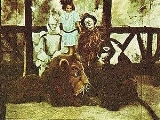
The Fairylogue and Radio-Plays

Encyclopedia
The Fairylogue and Radio-Plays was an early attempt to bring L. Frank Baum
's Oz books to the motion picture screen. It was a mixture of live
actor
s, hand-tinted magic lantern
slides, and film. Baum himself would appear as if he were giving a lecture, while he interacted with the characters (both on stage and on screen). Due to financial problems--the show cost more to make than sold-out houses could bring it--the show folded after two months of performances. It opened in Grand Rapids, Michigan
on September 24, 1908. It later moved to New York City
, where it reportedly closed December 16, 1908. It was scheduled to run through December 31, and ads for it continued to run in The New York Times
until then.
, in a process known as "Radio-Play", and were noted for being the most lifelike hand-tinted imagery of the time. Baum once claimed in an interview that a "Michael Radio" was a Frenchman who colored the films, though no evidence of such a person, even with the more proper French spelling "Michel", as second-hand reports unsurprisingly revise it, has been documented. It did not refer to the contemporary concept of radio
(or, for that matter, a radio play), but played on notions of the new and fantastic at the time, similar to the way "high-tech" or sometimes "cyber" would be used later in the century. The "Fairylogue" part of the title was to liken it to a travelogue
, which at the time was a very popular type of documentary film
entertainment.
, who had previously set a couple of Baum's songs in The Wizard of Oz
musical. It debuted four months before Camille Saint-Saëns
's score for The Assassination of the Duke of Guise
, and is therefore the earliest original film score to be documented.
, The Marvelous Land of Oz
, Ozma of Oz
and John Dough and the Cherub
, with intermission slides showing previews of Dorothy and the Wizard in Oz
, which was not sold in stores until near the end of the run. Francis Boggs
directed the Oz material and Otis Turner
directed John Dough and the Cherub. Baum, in a white suit, would step behind the screen and into the film, pulling his actors off to appear on stage with him. Surviving production stills depict a very large cast of Oz characters. Romola Remus
was the silver screen's first Dorothy. Will Morrison is credited with the role of Tip, but a William Gillespie
was interviewed in The Baum Bugle
about the role, and he introduced a discrepancy as to whether Ozma
was played by Maud Harrington as credited or Delilah Leitzell, as Gillespie remembers. Notably absent from this production is the Woggle-Bug, who was the title character of a failed musical
three years prior.
included a write-up of the show in a full-page article in a late 1909 issue, over a year after the show had come and gone, probably because they finally had space for it after it was no longer necessary but still of interest. When the production appeared in New York, the Times listing for it appeared along with the plays, not with the films, drawing attention to the fact that Baum, not to mention the rest of the cast, would be appearing live on stage with the films as a major, though far from the only, component.
The Fairylogue and Radio-Plays was produced by "The Radio-Play Company of America", John B. Shaw, Jr., general manager. The sets were designed and painted by E. Pollack. The costumes were designed by Fritz Schultz and Chicago Costuming Co.. Properties and papier-mâché
work by Charles van Duzen. Mechanical effects by Paul Dupont. Wigs by Hepner
. Shoes by Marshall Field & Co. Jewels loaned by C.D. Peacock.
The Selig Polyscope Company
was involved in the production of the films. This led to erroneous conclusions that The Wonderful Wizard of Oz
and its sequels were derived from the materials of this film, which was disproven with the discovery of that film, which bears little resemblance to the surviving materials of Fairylogue. Otis Turner is believed to be the director of both film versions of John Dough and the Cherub, both lost. It may be possible that they were one and the same film, but highly unlikely, as Fairylogue was most likely the singular print eventually discarded by the Baum family after its decomposition.
L. Frank Baum
Lyman Frank Baum was an American author of children's books, best known for writing The Wonderful Wizard of Oz...
's Oz books to the motion picture screen. It was a mixture of live
Theatre
Theatre is a collaborative form of fine art that uses live performers to present the experience of a real or imagined event before a live audience in a specific place. The performers may communicate this experience to the audience through combinations of gesture, speech, song, music or dance...
actor
Actor
An actor is a person who acts in a dramatic production and who works in film, television, theatre, or radio in that capacity...
s, hand-tinted magic lantern
Magic lantern
The magic lantern or Laterna Magica is an early type of image projector developed in the 17th century.-Operation:The magic lantern has a concave mirror in front of a light source that gathers light and projects it through a slide with an image scanned onto it. The light rays cross an aperture , and...
slides, and film. Baum himself would appear as if he were giving a lecture, while he interacted with the characters (both on stage and on screen). Due to financial problems--the show cost more to make than sold-out houses could bring it--the show folded after two months of performances. It opened in Grand Rapids, Michigan
Grand Rapids, Michigan
Grand Rapids is a city in the U.S. state of Michigan. The city is located on the Grand River about 40 miles east of Lake Michigan. As of the 2010 census, the city population was 188,040. In 2010, the Grand Rapids metropolitan area had a population of 774,160 and a combined statistical area, Grand...
on September 24, 1908. It later moved to New York City
New York City
New York is the most populous city in the United States and the center of the New York Metropolitan Area, one of the most populous metropolitan areas in the world. New York exerts a significant impact upon global commerce, finance, media, art, fashion, research, technology, education, and...
, where it reportedly closed December 16, 1908. It was scheduled to run through December 31, and ads for it continued to run in The New York Times
The New York Times
The New York Times is an American daily newspaper founded and continuously published in New York City since 1851. The New York Times has won 106 Pulitzer Prizes, the most of any news organization...
until then.
Michael Radio Color
The films were colored (credited as "illuminations") by Duval Frères of ParisParis
Paris is the capital and largest city in France, situated on the river Seine, in northern France, at the heart of the Île-de-France region...
, in a process known as "Radio-Play", and were noted for being the most lifelike hand-tinted imagery of the time. Baum once claimed in an interview that a "Michael Radio" was a Frenchman who colored the films, though no evidence of such a person, even with the more proper French spelling "Michel", as second-hand reports unsurprisingly revise it, has been documented. It did not refer to the contemporary concept of radio
Radio
Radio is the transmission of signals through free space by modulation of electromagnetic waves with frequencies below those of visible light. Electromagnetic radiation travels by means of oscillating electromagnetic fields that pass through the air and the vacuum of space...
(or, for that matter, a radio play), but played on notions of the new and fantastic at the time, similar to the way "high-tech" or sometimes "cyber" would be used later in the century. The "Fairylogue" part of the title was to liken it to a travelogue
Travel literature
Travel literature is travel writing of literary value. Travel literature typically records the experiences of an author touring a place for the pleasure of travel. An individual work is sometimes called a travelogue or itinerary. Travel literature may be cross-cultural or transnational in focus, or...
, which at the time was a very popular type of documentary film
Documentary film
Documentary films constitute a broad category of nonfictional motion pictures intended to document some aspect of reality, primarily for the purposes of instruction or maintaining a historical record...
entertainment.
Original film score
The production also included a full original score consisting of 27 cues by Nathaniel D. MannNathaniel D. Mann
Nathaniel D. Mann was an American composer best known for his work with L. Frank Baum. He composed at least two songs with Baum, "Different Ways of Making Love" and "It Happens Ev'ry Day," and another with John Slavin, "She Didn't Really Mind the Thing at All," for The Wizard of Oz stage musical...
, who had previously set a couple of Baum's songs in The Wizard of Oz
The Wizard of Oz (1902 stage play)
The Wizard of Oz was a 1902 musical extravaganza based on The Wonderful Wizard of Oz by L. Frank Baum, which was originally published in 1900...
musical. It debuted four months before Camille Saint-Saëns
Camille Saint-Saëns
Charles-Camille Saint-Saëns was a French Late-Romantic composer, organist, conductor, and pianist. He is known especially for The Carnival of the Animals, Danse macabre, Samson and Delilah, Piano Concerto No. 2, Cello Concerto No. 1, Havanaise, Introduction and Rondo Capriccioso, and his Symphony...
's score for The Assassination of the Duke of Guise
The Assassination of the Duke of Guise
The Assassination of the Duke of Guise is a French historical film directed by Charles Le Bargy and André Calmettes, adapted by Henri Lavedan, and featuring actors of the Comédie Française and prominent set designers...
, and is therefore the earliest original film score to be documented.
Adaptation
It was based on Baum's books The Wonderful Wizard of OzThe Wonderful Wizard of Oz
The Wonderful Wizard of Oz is a children's novel written by L. Frank Baum and illustrated by W. W. Denslow. Originally published by the George M. Hill Company in Chicago on May 17, 1900, it has since been reprinted numerous times, most often under the name The Wizard of Oz, which is the name of...
, The Marvelous Land of Oz
The Marvelous Land of Oz
The Marvelous Land of Oz: Being an Account of the Further Adventures of the Scarecrow and the Tin Woodman, commonly shortened to The Land of Oz, published on July 5, 1904, is the second of L. Frank Baum's books set in the Land of Oz, and the sequel to The Wonderful Wizard of Oz. This and the next...
, Ozma of Oz
Ozma of Oz
Ozma of Oz: A Record of Her Adventures with Dorothy Gale of Kansas, the Yellow Hen, the Scarecrow, the Tin Woodman, Tiktok, the Cowardly Lion and the Hungry Tiger; Besides Other Good People too Numerous to Mention Faithfully Recorded Herein published on July 30, 1907, was the third book of L....
and John Dough and the Cherub
John Dough and the Cherub
John Dough and the Cherub is a children's fantasy novel written by L. Frank Baum, about a living gingerbread man and his adventures.-The book:...
, with intermission slides showing previews of Dorothy and the Wizard in Oz
Dorothy and the Wizard in Oz
Dorothy and the Wizard in Oz: A Faithful Record of Their Amazing Adventures in an Underground World; and How with the Aid of Their Friends Zeb Hugson, Eureka the Kitten, and Jim the Cab-Horse, They Finally Reached the Wonderful Land of Oz is the fourth book set in the Land of Oz written by L....
, which was not sold in stores until near the end of the run. Francis Boggs
Francis Boggs
Francis W. Boggs was a stage actor and pioneer silent film director. He was one of the first to direct a film in Hollywood.-Biography:...
directed the Oz material and Otis Turner
Otis Turner
Otis Turner was an American director, screenwriter and producer. Between 1908 and 1917, he directed 133 motion pictures and wrote 40 scenarios.He was born in Fairfield, Indiana, and died in Los Angeles, California....
directed John Dough and the Cherub. Baum, in a white suit, would step behind the screen and into the film, pulling his actors off to appear on stage with him. Surviving production stills depict a very large cast of Oz characters. Romola Remus
Romola Remus
Romola Remus portrayed Dorothy Gale in the multimedia stage/film production, The Fairylogue and Radio-Plays, in which she worked directly with author L. Frank Baum. She was the first ever to play the role on film, though not the first to play it on stage...
was the silver screen's first Dorothy. Will Morrison is credited with the role of Tip, but a William Gillespie
William Gillespie (actor)
William Gillespie was a Scottish actor who started in Hollywood films from the silent era. Born in Aberdeen, he supported such comedians as Charlie Chaplin, Charley Chase and Laurel and Hardy, but was most prolific supporting Harold Lloyd in over 50 films.-Selected filmography:* The Cure * Easy...
was interviewed in The Baum Bugle
The Baum Bugle
The Baum Bugle: A Journal of Oz is the official journal of The International Wizard of Oz Club. The journal was founded in 1957, with its first issue released in June of that year . It publishes three times per year, with issues dated Spring, Autumn, and Winter; Issue No. 1 of Volume 50 appeared in...
about the role, and he introduced a discrepancy as to whether Ozma
Princess Ozma
Princess Ozma is a fictional character in the Land of Oz, created by L. Frank Baum. She appears in every book of the series except the first, The Wonderful Wizard of Oz .She is the rightful ruler of Oz, and L...
was played by Maud Harrington as credited or Delilah Leitzell, as Gillespie remembers. Notably absent from this production is the Woggle-Bug, who was the title character of a failed musical
The Woggle-Bug (musical)
The Woggle-Bug is a musical based on The Marvelous Land of Oz by L. Frank Baum, with book and lyrics by the author and music by Frederic Chapin that opened June 18, 1905 at the Garrick Theatre in Chicago under the direction of Frank Smithson, a Shubert Organization employee. The musical was a...
three years prior.
Cast
(listed in the order credited in the program)- L. Frank BaumL. Frank BaumLyman Frank Baum was an American author of children's books, best known for writing The Wonderful Wizard of Oz...
: The Wizard of Oz Man, who will present his very merry, whimsical and really wonderful Fairylogue and Radio-Plays - Frank Burns: His Majesty the ScarecrowScarecrow (Oz)The Scarecrow is a character in the fictional Land of Oz created by American author L. Frank Baum and illustrator William Wallace Denslow. In his first appearance, the Scarecrow reveals that he lacks a brain and desires above all else to have one. In reality, he is only two days old and merely...
- George E. Wilson: Nick Chopper, the Tin WoodmanTin WoodmanThe Tin Woodman, sometimes referred to as the Tin Man or the Tin Woodsman , is a character in the fictional Land of Oz created by American author L. Frank Baum...
- Wallace Illington: Tik-Tok, the Machine Man
- Bronson Ward, Jr.: Jack PumpkinheadJack PumpkinheadJack Pumpkinhead is a fictional character from the Oz book series by L. Frank Baum.-In Baum:Jack first appeared in The Marvelous Land of Oz. Jack's tall figure is made from tree limbs and jointed with wooden pegs...
, whose Brains are Seeds - Paul de Dupont: The Nome KingNome KingThe Nome King is a fictional character in L. Frank Baum's Oz books. Although the Wicked Witch of the West is the most famous of Oz's villains , the Nome King is the closest the book series has to a main antagonist.-In the novels:The character called the Nome King is originally named Roquat the Red...
, a Master of Enchantments - Will Morrison: Tip, a transformation, but a real boy
- Clarence Nearing: Prince Evring of Ev
- Sam 'Smiling' Jones:The Wizard (only a Humbug)Wizard (Oz)The Wizard of Oz, known during his reign as The Great and Powerful Oz, is the epithet of Oscar Zoroaster Phadrig Isaac Norman Henkel Emmannuel Ambroise Diggs, a fictional character in the Land of Oz, created by American author L...
- Joseph Schrode: The Cowardly LionCowardly LionThe Cowardly Lion is the main character in the fictional Land of Oz created by American author L. Frank Baum. He is a Lion, but he talks and interacts with humans....
- Burns Wantling: The Hungry TigerHungry TigerThe Hungry Tiger is a fictional character from The Oz books by L. Frank Baum.The Hungry Tiger is a massive beast who is friends with the Cowardly Lion. He is always hungry, no matter how much he eats, and longs to eat a "fat baby," though he never would because his conscience will not allow him to...
- The Yellow HenBillinaBillina is a character in the Oz books of L. Frank Baum.She is a yellow hen tossed overboard in a storm with Dorothy Gale in the novel Ozma of Oz, the third Oz book, and a sequel to L. Frank Baum's The Wonderful Wizard of Oz...
: Herself - TotoToto (dog)Toto is the name of a fictional dog in L. Frank Baum's Oz series of children's books, and works derived from them. The name is pronounced with a long "O", a homonym of "toe toe". The dog was originally a cairn terrier drawn by W.W. Denslow for the first edition of the Wizard of Oz...
, Dorothy's Dog: Himself - D.W. Clapperton: Sir RoosterRoosterA rooster, also known as a cockerel, cock or chanticleer, is a male chicken with the female being called a hen. Immature male chickens of less than a year's age are called cockerels...
, Visitor at the Emerald CityEmerald CityThe Emerald City is the fictional capital city of the Land of Oz in L. Frank Baum's Oz books, first described in The Wonderful Wizard of Oz... - Charles W. Smith: The HottentotKhoikhoiThe Khoikhoi or Khoi, in standardised Khoekhoe/Nama orthography spelled Khoekhoe, are a historical division of the Khoisan ethnic group, the native people of southwestern Africa, closely related to the Bushmen . They had lived in southern Africa since the 5th century AD...
, Visitor at the Emerald City - Daniel Heath: The BuccaneerBuccaneerThe buccaneers were privateers who attacked Spanish shipping in the Caribbean Sea during the late 17th century.The term buccaneer is now used generally as a synonym for pirate...
, Visitor at the Emerald City - Joe Finley: Hans Hoch, Visitor at the Emerald City
- Dudley Burton: A CourtierCourtierA courtier is a person who is often in attendance at the court of a king or other royal personage. Historically the court was the centre of government as well as the residence of the monarch, and social and political life were often completely mixed together...
, Visitor at the Emerald City - Samuel Woods: Madame Toussaud, Visitor at the Emerald City
- Romola RemusRomola RemusRomola Remus portrayed Dorothy Gale in the multimedia stage/film production, The Fairylogue and Radio-Plays, in which she worked directly with author L. Frank Baum. She was the first ever to play the role on film, though not the first to play it on stage...
: Dorothy GaleDorothy GaleDorothy Gale is the protagonist of many of the Oz novels by American author L. Frank Baum, and the best friend of Oz's ruler Princess Ozma. Dorothy first appears in Baum's classic children's novel The Wonderful Wizard of Oz and reappears in most of its sequels...
of KansasKansasKansas is a US state located in the Midwestern United States. It is named after the Kansas River which flows through it, which in turn was named after the Kansa Native American tribe, which inhabited the area. The tribe's name is often said to mean "people of the wind" or "people of the south... - Maud Harrington: Princess OzmaPrincess OzmaPrincess Ozma is a fictional character in the Land of Oz, created by L. Frank Baum. She appears in every book of the series except the first, The Wonderful Wizard of Oz .She is the rightful ruler of Oz, and L...
of Oz - Evelyn Judson: Glinda the Good, a Sorceress
- Josephine Brewster: MombiMombiMombi is a wicked old witch from L. Frank Baum Oz Books. She appears in the book The Marvelous Land of Oz and is alluded to in other works. Of all the wicked witches in L...
the Witch - Joseph Schrode: John DoughJohn DoughJohn Dough was a common name for a gingerbread man at the turn of the 20th century, though the best-remembered John Dough is the character created by L. Frank Baum in his 1906 novel, John Dough and the Cherub; the character also makes a cameo appearance in Baum's The Road to Oz...
, the Gingerbread ManGingerbread manA gingerbread man is a biscuit or cookie made of gingerbread, usually in the shape of a stylized human, commonly male as the name suggests, although making other shapes, especially seasonal themes and characters, is quite common as well.-History:... - Geo. Weatherbee: Mons. Grogande, the Baker who made him
- Frank Burns: The Rubber Bear, a Good Natured Thing
- George E. Wilson: The White Rabbit, Diffident, but not Shy
- Tommy Dean: Obo, Mifket who likes GingerbreadGingerbreadGingerbread is a term used to describe a variety of sweet food products, which can range from a soft, moist loaf cake to something close to a ginger biscuit. What they have in common are the predominant flavors of ginger and a tendency to use honey or molasses rather than just sugar...
- Lillian Swartz: Hogo, Mifket who likes Gingerbread
- Minnie Brown: Joko, Mifket who likes Gingerbread
- Daniel Heath: Tertius, an Islander
- Tom Persons: Hopkins, of the Village Fireworks Committee
- Grace Elder: Chick the Cherub, an Incubator Baby
- Annabel Jephson: The Island Princess
- Mrs. Bostwick: Mme. Grogand, the Baker's Wife
Production
The New York TimesThe New York Times
The New York Times is an American daily newspaper founded and continuously published in New York City since 1851. The New York Times has won 106 Pulitzer Prizes, the most of any news organization...
included a write-up of the show in a full-page article in a late 1909 issue, over a year after the show had come and gone, probably because they finally had space for it after it was no longer necessary but still of interest. When the production appeared in New York, the Times listing for it appeared along with the plays, not with the films, drawing attention to the fact that Baum, not to mention the rest of the cast, would be appearing live on stage with the films as a major, though far from the only, component.
The Fairylogue and Radio-Plays was produced by "The Radio-Play Company of America", John B. Shaw, Jr., general manager. The sets were designed and painted by E. Pollack. The costumes were designed by Fritz Schultz and Chicago Costuming Co.. Properties and papier-mâché
Papier-mâché
Papier-mâché , alternatively, paper-mache, is a composite material consisting of paper pieces or pulp, sometimes reinforced with textiles, bound with an adhesive, such as glue, starch, or wallpaper paste....
work by Charles van Duzen. Mechanical effects by Paul Dupont. Wigs by Hepner
Hepner
Hepner may refer to:* Jean Hepner , tennis player* Lee Hepner , orchestral conductor* Urmas Hepner , footballer-See also:* Hepner Hall* Hepner-Bailey Field at Adamson Stadium* Heppner...
. Shoes by Marshall Field & Co. Jewels loaned by C.D. Peacock.
The Selig Polyscope Company
Selig Polyscope Company
The Selig Polyscope Company was an American motion picture company founded in 1896 by William Selig in Chicago, Illinois. Selig Polyscope is noted for establishing Southern California's first permanent movie studio, in the historic Edendale district of Los Angeles...
was involved in the production of the films. This led to erroneous conclusions that The Wonderful Wizard of Oz
The Wonderful Wizard of Oz (1910 film)
The Wonderful Wizard of Oz is a 1910 silent fantasy film and the earliest surviving film version of L. Frank Baum's 1900 novel, made by the Selig Polyscope Company without Baum's direct input. It was created to fulfill a contractual obligation associated with Baum's personal bankruptcy caused by...
and its sequels were derived from the materials of this film, which was disproven with the discovery of that film, which bears little resemblance to the surviving materials of Fairylogue. Otis Turner is believed to be the director of both film versions of John Dough and the Cherub, both lost. It may be possible that they were one and the same film, but highly unlikely, as Fairylogue was most likely the singular print eventually discarded by the Baum family after its decomposition.