

The Elder Scrolls III: Morrowind

Encyclopedia
The Elder Scrolls III: Morrowind, often simply referred to as Morrowind, is a single-player computer role-playing game developed by Bethesda Game Studios, and published by Bethesda Softworks
and Ubisoft
. It is the third installment in The Elder Scrolls
series of games, following The Elder Scrolls II: Daggerfall
. It was released in North America in 2002 for Microsoft Windows
and the Xbox
. Well-received publicly and critically, with over four million sales and more than 60 awards (including Game of the Year
), The game spawned two expansion pack
s for the PC: Tribunal
and Bloodmoon
. Both were eventually repackaged into a full set containing all three, Morrowind: Game of the Year Edition, which shipped on October 30, 2003 for both PC and Xbox.
The main story takes place on Vvardenfell, an island in the Dunmer province of Morrowind, which lies in the empire of Tamriel and is far from the more civilized lands to the west and south that typified Daggerfall
and Arena
. The central quests concern the deity
Dagoth Ur, housed within the volcanic Red Mountain, who seeks to gain power and break Morrowind free from Imperial reign. Morrowind was designed with an open-ended free-form style of gameplay in mind, with less of an emphasis on the game's main plot than its predecessors. This choice received mixed reviews in the gaming press, though such feelings were tempered by reviewers' appreciation of Morrowind' s expansive and detailed game world.
Morrowind, like its predecessor Daggerfall, makes a distinction between "attributes" and "skills"; skills being those individual proficiencies in particular schools of battle or with particular armor classes, and attributes being broader proficiencies, such as "strength" and "endurance", which are either tied to important features unconnected to any skill, (viz. Health, evasion chance, etc.) or improve the efficiency of a wide variety of skills. Strength, for example, improves the damage of any physical blow dealt by the player character. Attributes, however, are improved only when the player levels up.
The player levels up their character by gaining levels in ten pre-determined skills, listed as 'major' and 'minor' skills. Each time the player levels up their character, they can select three attributes to augment as well. The player is better able to augment attributes related to their skill set, as each level gained in a particular skill adds to the multiplier by which the attribute is augmented.
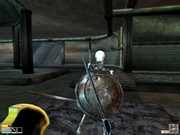 On a PC, the simplest melee attack, a chop, is performed with a left click. The slightly more complex slash and thrust attacks are performed by clicking in unison with tapping a directional key, though by turning on the "always use best attack" option, players can eliminate the moving element, freeing them to focus on the combat. A melee weapon's damage potential is rated for each of these attacks. Reviewers found little value in choosing between the three types of attacks for most weapons, and recommended the "always use best attack" option. Hidden arithmetic modifiers, applied to each combatant's skills, determines whether or not the attack hits. In the game's original release, the player was given no indication of the amount of health left in their enemies, and no indication of the strength of the player's attacks. Reviewers took the absence badly, wishing for more visible feedback. Bethesda eventually added enemy health bars in patch
1.1.0605, released one month after Morrowind' s initial publication.
series, attempts to establish a completely free-form world, with little constricting boundaries on the player's actions. From the beginning of the game, players are put in a world where they are left to roam, steal, quest and explore, without necessarily following the main quest. Lead Designer Ken Rolston
, asked prior to Morrowind' s release what he thought were the "core, untouchable design elements" of the Elder Scrolls series which "set them apart from other games", responded immediately: "Free-form experience." In Rolston's view, the game's central plot is a chance to introduce the player to a cross-current of conflicting factions, background themes, and to the characters of the game, rather than the primary focus of the player's experience. "Every TES game has to let you create the kind of character you want, and then do the things you want. We would never have a TES RPG force you to be a certain character or go down a certain path."
To allow for this behavior, Morrowind, in addition to creating an extensive main quest, provides detailed discursive quests for a variety of factions
, including various guilds, religious organizations and aristocratic houses, in addition to side-quests found by mere exploration. Even the main plot itself may be undertaken in a number of ways. There are, in the words of critic Craig Lindley, "a very specific set of central plot points within this main plot. But the plot points are partially ordered: seven high level tasks must be completed, but their constituent sub-tasks...can be accomplished in any order, and this is repeated for the sub-tasks involved in those sub-tasks." The choices the player makes in their performance of these tasks thus become methods of character interpretation; a set of dramatic tools establishing the player's newly created self-identity.
According to Gamasutra
's Matt Barton, some have argued that these changes put Morrowind closer in spirit to the original Dungeons & Dragons
tabletop game, where players take a more creative role in their play, and where players are left to decide for themselves the "right" action. This is a view paralleled by Rolston, who has stated that "The goal of every TES game is to create something that resembles a pen and paper RPG on the computer." The sheer number of quest possibilities, combined with what developer Ken Rolston identified as a lack of "narrative urgency", left many critics dissatisfied with the main plot. Ken Rolston later stated that the main quest might have been presented with greater force, in the style of the game's successor, The Elder Scrolls IV: Oblivion
, without losing the free-form design of the series, but such concerns were not addressed prior to Morrowind' s release.
After a storm and a strange vision in his dreams, the player begins fresh off a boat from a mainland prison in a town called Seyda Neen, freed by the string pulling of the current ruler of the Tamrielic Empire, Emperor Uriel Septim VII, with the task of meeting Caius Cosades, a member of the Blades, a secret group tasked with the protection of the Emperor and the Empire.
Cosades inducts the player into the Blades under orders of the Emperor, and sets the player on various quests to uncover the mysterious disappearances and revelations that the citizens of Vvardenfell have experienced, particularly the Sixth House and the Ashlander prophecies of the Nerevarine. It is later revealed that The Sixth House, and Dagoth Ur, has been directly influencing the people within their dreams, including attempts to invade the player's mind.
Prophecies from the nomadic people living in the Ashlands, The Ashlanders, predict that Nerevar's incarnate will fulfil a set of seven prophecies. The first two prophecies are that Nerevar will be born on a certain day to uncertain parents, and will be cured of Corprus disease. Fulfilling these, the player seeks to complete the third prophecy, a test to find the Moon-and-Star, the symbolic ring worn by Nerevar, which would instantly kill any other who tried to wear it. Once the player finds and equips the ring, he receives a vision from Azura, the ancient Daedric Prince of the Dawn and Dusk, who confirms that the player is Nerevar's incarnate. Nerevar completes the fourth and fifth trials, which are to rally the Great Houses and Ashlanders of Vvardenfell under one banner. After receiving the support and being declared "Hortator" of the Great Houses and "Nerevarine" of the nomadic Ashlander tribes, the player is officially, albeit reluctantly, called "Nerevarine" by the Tribunal Temple, who normally persecute anyone who claims to be the Nerevarine and sentences them to death.
Nerevar is invited to the palace of the poet God-King Vivec to discuss the assault on Dagoth Ur's stronghold in the heart of Red Mountain. Vivec presents the player with the artifact gauntlet Wraithguard, an ancient Dwemer artifact that can use the tools of 'Sunder' and 'Keening'. The ancient implements will destroy the fabled Heart of Lorkhan, but without having the Wraithguard equipped, it will deal a fatal blow to whoever wields it.
The player travels into Red Mountain to Dagoth Ur's citadel. After talking with Dagoth Ur, who attempts to sway the player to his side with the claim that he is merely following Nerevar's final orders, the player and Dagoth Ur fight. Besting Dagoth Ur, the player breaks the Heart of Lorkhan with Kagrenac's tools, destroying the source of Dagoth Ur's power and killing him in the process. Akulakhan's Chamber where Lorkhan's heart resides is destroyed, and in turn Red Mountain is cleared of blight and The Sixth House falls. Upon escaping from the chamber, Nerevar is congratulated by Azura, who appears before him to reward his efforts of fulfilling the prophecy.
After the Main Quest's completion, the game does not end. Vvardenfell is however affected in many different ways. The Blight Storms cease to plague the land, and the weak minded followers of the Sixth House are re-awakened, remembering nothing of their ordeal. The Dreamers who harassed Nerevar fall silent, and Nerevar becomes widely known as the savior of Vvardenfell. The quintessential consequence of defeating Dagoth Ur was the destruction of the Heart of Lorkhan. Due to their immortality linked to the heart, Vivec and the Tribunal become mortal again, leaving Vivec's future in question and up to the player to determine his fate. The loss of divinity among the Tribunal is the main concept for the game's expansion, "Tribunal". It has since been rumored that the hero pursued an expedition to the continent Akavir.
and Arena
. Along with graphical improvements
, one of the most obvious differences between Morrowind and the earlier games in the series is that Morrowind takes place in a much smaller area than the previous games. While Arena featured the entirety of Tamriel as an explorable area, and Daggerfall featured sizeable portions of two provinces of Tamriel, Hammerfell and High Rock, Morrowind includes only the "relatively small" island of Vvardenfell within the province of Morrowind. The change was a result of a conscious choice on the part of the developers to feature more detail and variety in the game. Whereas Daggerfall and Arena's dungeons were randomly generated, each area in Morrowind was specifically
detailed, and each item specifically placed. As a result, reviewers were generally impressed with the game-world's variety, as this maintained the perception of an "enormous" game-world. The game area expands to Mournhold on Morrowind's mainland in the Tribunal
expansion, and to the island of Solstheim to the northwest of Vvardenfell in the Bloodmoon
expansion.
Morrowind' s developers, rather than developing the common Medieval European
setting of fantasy
games, chose a more eclectic route, taking elements from Egypt
ian, early Japan
ese, and Middle East
ern cultures, with Middle Eastern architecture
cited in particular for its major influence on Balmora's Hlaalu architecture. Executive Producer Todd Howard felt that the use of Morrowind as a backdrop was integral in the development of the game's style. While admitting some elements of the partially medieval Imperial culture more typical of fantasy to retain familiarity with the earlier installments of the series, Morrowind' s dark elven setting "opened huge new avenues for creating cultures and sites that are not traditionally seen in a fantasy setting". The development team also gave particular credit to the Ridley Scott
film Gladiator
, high fantasy
, The Dark Crystal
, and Conan the Barbarian
as influences.
The game has over 300 books (not counting scrolls). One particular compilation of the text was 1,241 sheets of8.26 by 11.00 paper. PC Gamer
weighted the in-game text as equal to 6 standard-size novels. Many of these books provide long, serial stories, and provide hints as to the background and history of the game. One critic in particular, Phillip Scuderi, remembered Morrowind for its great literary richness. To him, the in-game literature and its integration within the game was Morrowind' s "most original and lasting contribution to the history of games", one that would place it beside Planescape: Torment
as one of the most important games of all time. Such themes are echoed in other responses to the game, such as that of RPGamer
's Joseph Witham, who found a story "discreet" in its progression, with a dungeon-crawling feel, standing alongside a "whole world of unique history" with books forming the greater part of the player's interaction with that world. Most of the books were reused in Oblivion.
The game has a great deal of geographic variety in climate, flora, and, to some extent, fauna as well. Beside that there is also some variety in politics and culture among the in-game population, combination of which adds to the uniqueness of different parts of the island. On top of that there is an archaeological aspect to the game, which gives a certain degree of depth to the story as well as the option for further exploration. Additionally, there are various kinds of limits in visibility such as fog and dust, which are countered with "clear day/night" effects that also enhance visibility to some extent.
The in-game exploration is chiefly based on walking and running; however, there are instances when swimming and sometimes flotation is involved. Transportation of other kind is limited to teleportation and fast traveling by the back of giant flea-like creatures named "Silt Striders".
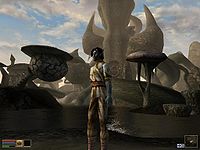 A third title in the Elder Scrolls series was first conceived during the development of Daggerfall, though it was originally to be set in the Summerset Isles and called Tribunal. Following the release of Daggerfall, it was set up around an SVGA version of XnGine
, which Bethesda later used in Battlespire
, and set in the province of Morrowind. The game was "much closer to Daggerfall in scope", encompassing the whole province of Morrowind, rather than the isle of Vvardenfell, and allowing the player to join all five Dunmer Great Houses. The blight was conceived as a dynamic force, progressively expanding and destroying cities in its wake. It was finally decided that the scope of the original design was too grand given the technology current at the time. According to Ken Rolston, something was said approximating "We’re not ready for it, we don’t want to jump into this and fail". The project was put on hold in 1997, as Bethesda went on to develop Redguard
and Battlespire, though the project remained in the back of the developers minds throughout this period.
The completion of Redguard in 1998 led to a return to the Morrowind project, as the developers felt a yearning in their audience to return to the classically epic forms of the earlier titles. Finding that the gaps between their own technical capacities and those of rival companies had grown in the interim, Bethesda sought to revitalize itself and return to the forefront of the industry, an effort spearheaded by project leader Todd Howard. The XnGine was scrapped and replaced with a Direct3D
powered engine, with transform and lighting capacity, 32-bit textures and skeletal animation. During their promotional campaign, Bethesda deliberately paralleled their screenshot releases with the announcement of NVIDIA
's GeForce 4, as "being indicative of the outstanding water effects the technology is capable of".
The scale of the game was much reduced from the earlier concept, focusing primarily on Dagoth Ur and a smaller area of land. It was decided that the game world would be populated using the methods the team had developed in Redguard; that is, the game objects would be crafted by hand, rather than generated using the random algorithmic methods of Arena and Daggerfall. By 2000, Morrowind was to be unequivocally a single-player game, with no chance of multiplayer extension. In the words of Pete Hines, Bethesda's Director of Marketing and PR: "No. Not on release, not three months after, no no no." The project, despite the reduced scale, became a massive investment. According to the team's reasoning's, the endeavor took "close to 100 man-years to create". To accomplish this feat, Bethesda tripled their staff and spent their first year of development on The Elder Scrolls Construction Set, allowing the game staff to easily balance the game and to modify it in small increments rather than large. According to project leader Todd Howard, the Construction Set came as the result of a communal yearning to develop a "role-playing operating system", capable of extension and modification, rather than a particular type of game. Despite the additional staff, designer Ken Rolston would later state that, compared to Oblivion, Morrowind had a small design team.
In May 2000, Bethesda set the first expected PC release date in late 2001. On May 5, 2001, Bethesda announced the development of an additional Morrowind release for Microsoft's Xbox. The project was, according to the same release, something that Bethesda had been working on with Microsoft since they had first known of the console. Morrowind had an impressive showing at E3 2001, demonstrating a beta build to the public. The same beta build was demonstrated to the staff of PC Gamer
for another preview, and was kept around the office as late as June 19 as the subject of later previews, while another test build was developed alongside. Later order forms, such as those by Electronics Boutique
, set the date in November. On October 10, 2001, GameSpot reported that Morrowind' s release date had been set back to March 2002. On October 12, a press release from Bethesda gave the date of "Spring 2002", confirming GameSpot's supposition of delay without agreeing on the more specific date of "March". Though no rationale behind the delay was given at the time, developer Pete Hines later attributed the delay to a need for game testing and balancing. Although the PC version of Morrowind had gone gold by April 23, 2002, and was released on May 1 in North America, the Xbox release was delayed further. On April 15, GameSpot suggested an Xbox release date sometime in May and a scheduled "going gold" date for the Xbox version in the first week of the same month. In contradiction of GameSpot's supposition, a June 4 Bethesda press release set June 7 as the Xbox release date.
On January 3, 2002, Bethesda announced that game publisher Ubisoft
would take control of the European distribution of Morrowind and eight other Bethesda games. Under Ubisoft's supervision, Morrowind' s European release took place in two stages. A "semi-localized" version of the game was released in May, containing a translated manual but leaving the game's text in untranslated English. A fully localized version of the game, with translated versions of both, was released in August. Ubisoft group brand manager Thomas Petersen described the difficulties of translating a "universe featuring more than a million words" as "quite a task".
In a break from standard industry practice, Bethesda decided to publish their strategy guide
in-house, rather than contracting it out to a third party publisher like BradyGames or Prima Games
. The decision resulted from a belief among Bethesda staff that they believed in and understood Morrowind more than any external agency, and deserved more royalties than were commonly rewarded. Bethesda hired Peter Olafson, a noted game journalist and friend of the company, and they began work on the guide in January 2002, four months prior to release. The resulting product, Morrowind Prophecies Strategy Guide, sold over 200,000 copies as of September 24, 2003. Although the royalties from most third-party game publishers approach 25% to 30% only infrequently, Bethesda managed a 70% profit margin on their own. In spite of this success, Bethesda decided to allow Prima Games to publish the "official" game guide for the release of The Elder Scrolls IV: Oblivion
.
' s soundtrack was composed by Jeremy Soule
, a video game composer whose previous soundtracks for Total Annihilation
and Icewind Dale
had earned some acclaim from the gaming press. In a Bethesda press release, Soule stated that the "epic quality" of the Elder Scrolls series was "particularly compatible with the grand, orchestral style of music" that Soule enjoys composing "the most". Outside Bethesda press releases, some have criticized Morrowind' s soundtrack. In their reviews of the game, both GameSpot and GameSpy criticized the length of the game's soundtrack and praised its general production quality. In the words of GameSpot's Greg Kasavin: "The very first time you boot up Morrowind, you'll be treated to a memorable, stirring theme filled with soaring strings and booming percussion. You'll proceed to hear it literally every five minutes or so during play." Soule was aware of the problem, and chose to create a soft and minimalist score so as not to wear out players' ears.
In a feature for Gamasutra, Scott B. Morton, although praising the music itself, declared that Morrowind' s soundtrack did not work effectively with the game's gameplay, accomplishing little as an emotional device. Morrowind' s soundtrack is ambient, with cues only for battle encounters. In Morton's view, the lack of variation, of response to the game's action, and of length—Morrowind' s soundtrack is only 30 minutes long—leaves players detached from the game world. Alexander Brandon, in another Gamasutra feature, praised Morrowind' s soundtrack for its innovative instrumentation. In Brandon's opinion, its use of orchestral elements in conjunction with synthesized ones, and the use of what Brandon termed "the 'Bolero
' approach", left the game's soundtrack feeling "incredibly dramatic". In February 2003, Morrowind was nominated for the category of "Outstanding Achievement in Original Music Composition" at the 6th Annual Academy of Interactive Arts & Sciences
's Interactive Achievement Awards, but lost to Medal of Honor: Frontline
.
Morrowind also contained a fair bit of voiced dialogue; an aspect somewhat better received by the gaming press. Of note is Lynda Carter
, television's Wonder Woman
, promoted by Bethesda for her role in voicing the Nordic race in the game. Morrowind' s race-specific voice acting received praise from some reviewers, though was met with disdain from others, who disliked the discord between a culturally inflected voice spoken in an alien dialect and the grammatically flawless dialogue printed in the dialogue boxes.
, the breadth and open-endedness of Morrowind is suggested to have contributed to the decline of single-player RPGs on home computers by leading customers to MMORPGs where they could have a similar experience.
In spite of this, reviewers generally felt that the drawbacks of the game were minor in comparison to its strengths. IGN concluded that "Morrowind isn't perfect and its system requirements are huge; but its accomplishments outweigh any reservations." GameSpot's review concluded with a similar summation. "Morrowind does have numerous drawbacks...But they're all generally minor enough that most anyone should be able to look past them...They'll otherwise find that Morrowind fulfills its many ambitious intentions. It's a beautiful-looking, sprawling, and completely open-ended game that allows you to play pretty much however you like".
The game environment of Morrowind was applauded as large and richly detailed, particularly for its real-time
weather effects, day/night cycle, and its great variety of plant and animal life. Xbox Nation commended the game for its "sheer scope", and credited that aspect as the game's "biggest selling point", though it criticized the slowdowns, travel times and questing complexities that resulted from it. In contrast to the "generic" nature of Daggerfall' s design, reviewers found Morrowind' s design spectacular, varied, and stunning. GameSpot stated that "Simply exploring Morrowind is possibly the best thing about it."
The mildly complex reciprocal skill system was generally praised, with some few exceptions. IGN, though finding the manual's description of the system unclear, found the classes well balanced and well designed for all play styles. GameSpot found the system clear and sensible. PC Gamer, by contrast, found the system unbalanced, with combat privileged over other features. Computer Gaming World
felt the system's privileging of combinations of single-handed combat weapons and shields over double-handed weapons unnecessarily exploitable, but appreciated the freedom offered by the broad skillset and action-dependent leveling. GameSpy gave strong commendation to the system, stating that "The advancement system makes so much sense that it makes other games, even games set in the D&D world such as Baldur's Gate, look silly by comparison". Morrowind's combat system was poorly received by the gaming press. GameSpot characterized it as one of the game's major weak points and GameSpy devoted the majority of their review's minor complaints to it. The system was disparaged for its simplicity and for its tendency to bore.
One element about Morrowind that received particular, and near-universal, criticism, was the game's journal system. In Morrowind, the player has a journal which is automatically updated with information from time to time following conversations with NPCs and important developments in the plot, each new entry following all those previous. Though IGN and GamePro
commended the general interface for its relative ease of use, the journal was almost universally reviled. The journal was found to quickly become a "muddled mess", "hundreds of pages long", without any useful method of organization by quest title or completion level. Computer Gaming World simply called the feature an "anal-retentive nightmare of confusion", and called it one of the game's two greatest shortcomings. However, Bethesda remedied the complaints to some extent in the subsequent expansion Tribunal. There, the journal was organized by quests and could be more easily navigated.
Despite being Bethesda's first major title to be produced for a console, Morrowind's Xbox release was well-received in the gaming press. The inability to use modifications on the Xbox was unhappily felt, as was non-native resolution, but the qualities of detail and open-endedness which had similarly graced the PC release made good the Xbox release's faults. Morrowind's Xbox release sold very well; it continued to rank among the top 10 sellers on the console one year after its initial release—a feat matched only by Halo: Combat Evolved
. In spite of its critical and commercial success, Morrowind did not win any end-of-year press awards for its Xbox release.
In 2010 IGN ranked Dagoth Ur 90th in "Top 100 Videogames Villains".
in reader polls, ranking 24% against Neverwinter's 34.9% popular support. It won IGN's RPG Vault's Game of the Year Award, IGN's PC Roleplaying Game of the Year Award in both its editorial and popular forms,
RPG Vault's Game of the Year Award 2002 and was IGN's reader's choice for Best Story. Morrowind lost GameSpot's RPG competition to Neverwinter Nights, and failed to win any other awards from the site. Morrowind, in addition to its nomination in music composition, was also nominated in the category of "Computer Role-Playing Game of the Year" at the 2003 Interactive Achievement Awards, but lost, again, to Neverwinter Nights. In September 2003, Morrowind received the dubious honour of ranking 21st on GameSpy's "25 Most Overrated Games" list, for its "buggy, repetitive, and dull gameplay".
 Bethesda Softworks, the developer
of Morrowind, offers gamer
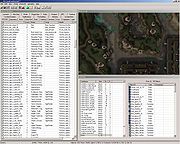
s the ability to recreate the world with a variety of mod making tools, such as The Elder Scrolls Construction Set, which allows the modder to create and edit different races, signs, abilities, and skills. Characters can be made as strong or as fast as the user wants, and allows the player to experience the game in a way that would not normally be possible within the game's mechanics.
Morrowind is well known for its ability to be changed by plugins (often referred to as modifications, or mods
for short) using the Elder Scrolls Construction Set, which comes with the PC version of the game. These plugins are usually easy to install and can change almost everything in the game. Plugins can include new creatures, weapons, armor, quests, people, playable species, Easter eggs, stores, player owned houses, cities, expand on the size of cities, and introduce new plotlines, or even entire landmasses with some or all of the above. Others create immensely powerful "god items" and place them in convenient locations. Still other mods change or enhance the graphical aspects of the game, such as lighting, 3D models, colors, and textures. There are also official mods made by Bethesda, such as "Siege at Firemoth", which can be found at the official site.
The choice to produce the expansion was primarily inspired by the success of Morrowind' s release, as well as a general feeling that Elder Scrolls series games are ongoing experiences that merit new things for their players to do. Development on the game began immediately after Morrowind shipped, giving the developers a mere five-month development cycle to release the game—a very fast cycle for the industry. The prior existence of the Construction Set, however, meant that the team "already had the tools in place to add content and features very quickly."
Interface improvements—specifically, an overhaul of Morrowind' s journal system—were among the key goals for Tribunal' s release. The new journal allowed the player to sort quests individually and by completion, reducing the confusion caused by the original's jumbling together of every quest into a single chronological stream. The game's reviewers took well to the change, although some criticized the incomplete implementation of the system, and others found the system continued to be "a bit unwieldy."
Reviews of Tribunal were generally positive, though to lesser amounts than was the case for Morrowind. Aggregate scoring sites Metacritic and Gamerankings both gave the game generally favourable scores: Metacritic, a score of 80; Game Rankings, a score of 82. Most critics commented on the greater linearity of the experience, combined with a reduction in the total size of the play area, giving the changes mixed reviews. GameSpot reported sullenly on the change: "it's somewhat surprising that the Tribunal expansion confines your adventures to the relatively small setting of the municipality Mournhold," and that, in light of this change, "Tribunal doesn't have many of the features that made Morrowind so appealing." IGN stated that although "you'll rarely lose sight of what you're doing or why," a fact that may make the game more "comprehensible" for some players, "the lack of interaction with the rest of the world is pretty depressing." RPGamer, by contrast, was unequivocally positive about the change: "Bethesda...neatly sidesteps two of the most difficult atmospheric flaws of Morrowind—the constant sense of emptiness, and the bland outdoor landscapes—by having the story take place entirely within the city of Mournhold...This smaller, tighter playing field ensures that every minor detail can and does get attention."
One of the key selling points of Bloodmoon was its reintegration of werewolves
; a feature that had been included in Daggerfall, but absent in Morrowind; a feature prominently advertised in previews prior to the game's release, in contrast to Morrowind' s vampirism
, which was almost an "Easter Egg
" in terms of how many players remained unfamiliar with the feature. Players become werewolves by catching the lycanthropic disease "Sanies Lupinus" and letting three days pass without attempting to cure it. Once the disease has been fully integrated, the player transforms every night, regardless of the lunar cycle. Being a werewolf provides ability increases, though their strength was reduced relative to the major bonuses offered by lycanthropy in Daggerfall. Some reviewers found the addition a welcome challenge, but others thought the addition frustrating and poorly implemented.
' s original release. Reviewers responded to the absence negatively. Nonetheless, reviews for the GOTY set were generally positive; more so than all previous releases. Metacritic gave the game a score of 89; Game Rankings, a 88. PC Gamer
re-released this version under their "PC Gamer Presents" line.
Bethesda Softworks
Bethesda Softworks, LLC, is an American video game company. A subsidiary of ZeniMax Media, the company was originally based in Bethesda, Maryland and eventually moved to their current location in Rockville, Maryland...
and Ubisoft
Ubisoft
Ubisoft Entertainment S.A. is a major French video game publisher and developer, with headquarters in Montreuil, France. The company has a worldwide presence with 25 studios in 17 countries and subsidiaries in 26 countries....
. It is the third installment in The Elder Scrolls
The Elder Scrolls
The Elder Scrolls is a role-playing video game series developed by Bethesda Game Studios and published by Bethesda Softworks.-History:...
series of games, following The Elder Scrolls II: Daggerfall
The Elder Scrolls II: Daggerfall
The Elder Scrolls II: Daggerfall is a first-person, traditional role-playing video game for MS-DOS developed by Bethesda Softworks and released in 1996. It is a sequel to the RPG The Elder Scrolls: Arena and the second installment in The Elder Scrolls series. On July 9, 2009, it was made available...
. It was released in North America in 2002 for Microsoft Windows
Microsoft Windows
Microsoft Windows is a series of operating systems produced by Microsoft.Microsoft introduced an operating environment named Windows on November 20, 1985 as an add-on to MS-DOS in response to the growing interest in graphical user interfaces . Microsoft Windows came to dominate the world's personal...
and the Xbox
Xbox
The Xbox is a sixth-generation video game console manufactured by Microsoft. It was released on November 15, 2001 in North America, February 22, 2002 in Japan, and March 14, 2002 in Australia and Europe and is the predecessor to the Xbox 360. It was Microsoft's first foray into the gaming console...
. Well-received publicly and critically, with over four million sales and more than 60 awards (including Game of the Year
Game of the Year
Game of the Year is a title awarded by various magazines, websites, and shows to a deserving game. Many are only for PC or console video games...
), The game spawned two expansion pack
Expansion pack
An expansion pack, expansion set, or supplement is an addition to an existing role-playing game, tabletop game or video game. These add-ons usually add new game areas, weapons, objects, and/or an extended storyline to a complete and already released game...
s for the PC: Tribunal
The Elder Scrolls III: Tribunal
The Elder Scrolls III: Tribunal is the first expansion for Bethesda Softworks' The Elder Scrolls III: Morrowind. It takes place in the temple/city of Mournhold, the capital of Morrowind, located in the larger city of Almalexia...
and Bloodmoon
The Elder Scrolls III: Bloodmoon
The Elder Scrolls III: Bloodmoon is the second expansion pack for Bethesda Softworks' The Elder Scrolls III: Morrowind. While it was originally released as an expansion set for Microsoft Windows, Bloodmoon is included within the Morrowind: Game of the Year edition for Xbox.Unlike the first...
. Both were eventually repackaged into a full set containing all three, Morrowind: Game of the Year Edition, which shipped on October 30, 2003 for both PC and Xbox.
The main story takes place on Vvardenfell, an island in the Dunmer province of Morrowind, which lies in the empire of Tamriel and is far from the more civilized lands to the west and south that typified Daggerfall
The Elder Scrolls II: Daggerfall
The Elder Scrolls II: Daggerfall is a first-person, traditional role-playing video game for MS-DOS developed by Bethesda Softworks and released in 1996. It is a sequel to the RPG The Elder Scrolls: Arena and the second installment in The Elder Scrolls series. On July 9, 2009, it was made available...
and Arena
The Elder Scrolls: Arena
The Elder Scrolls: Arena is the first game in the Elder Scrolls series. It is a first-person computer role-playing game for MS-DOS, developed by Bethesda Softworks and released in 1994...
. The central quests concern the deity
Deity
A deity is a recognized preternatural or supernatural immortal being, who may be thought of as holy, divine, or sacred, held in high regard, and respected by believers....
Dagoth Ur, housed within the volcanic Red Mountain, who seeks to gain power and break Morrowind free from Imperial reign. Morrowind was designed with an open-ended free-form style of gameplay in mind, with less of an emphasis on the game's main plot than its predecessors. This choice received mixed reviews in the gaming press, though such feelings were tempered by reviewers' appreciation of Morrowind
Character creation
Morrowind begins with the player's character, having been imprisoned, arriving in Morrowind by boat in order to be pardoned. This is a common introductory segment throughout the main installments of the series. A well-received tutorial depicting the prisoner's release moves the player through the process of character creation. The player is successively asked questions by a fellow prisoner, an officer, and a bureaucrat as the player is registered as a free citizen; choosing, in the process, the player character's name, race, gender, class, and birthsign. These affect the player's starting attributes, skills, and abilities. In a throwback to the Ultima series, the player has an opportunity to answer a series of moral questions to determine his class.Skill system
The player character's proficiency with a skill is increased either by practice, training or study. Practice involves performing the specific actions associated with a given skill, which gradually raises the character's proficiency in that skill. Raising weapon skills requires striking an enemy with the appropriate weapon; raising armor skills requires being struck while wearing the appropriate type of armor; etc. Training involves paying cash to NPCs in exchange for immediate proficiency increases in that skill. Study requires reading books found in the game, some of which will immediately raise a skill when read. Weaponry skills (viz. Short Blade, Long Blade, Axe, etc.) affect the character's chance to hit. Armor skills (viz. Heavy Armor, Light Armor, Unarmored, etc.) affect the defensive strength of the armor. Other skills (viz. Alchemy, Athletics and Security) affect proficiency at other actions such as potion-making, running, lockpicking, etc.Morrowind, like its predecessor Daggerfall, makes a distinction between "attributes" and "skills"; skills being those individual proficiencies in particular schools of battle or with particular armor classes, and attributes being broader proficiencies, such as "strength" and "endurance", which are either tied to important features unconnected to any skill, (viz. Health, evasion chance, etc.) or improve the efficiency of a wide variety of skills. Strength, for example, improves the damage of any physical blow dealt by the player character. Attributes, however, are improved only when the player levels up.
The player levels up their character by gaining levels in ten pre-determined skills, listed as 'major' and 'minor' skills. Each time the player levels up their character, they can select three attributes to augment as well. The player is better able to augment attributes related to their skill set, as each level gained in a particular skill adds to the multiplier by which the attribute is augmented.
Combat
Patch (computing)
A patch is a piece of software designed to fix problems with, or update a computer program or its supporting data. This includes fixing security vulnerabilities and other bugs, and improving the usability or performance...
1.1.0605, released one month after Morrowind
Free-form design
Morrowind, following the tradition established by its predecessors in The Elder ScrollsThe Elder Scrolls
The Elder Scrolls is a role-playing video game series developed by Bethesda Game Studios and published by Bethesda Softworks.-History:...
series, attempts to establish a completely free-form world, with little constricting boundaries on the player's actions. From the beginning of the game, players are put in a world where they are left to roam, steal, quest and explore, without necessarily following the main quest. Lead Designer Ken Rolston
Ken Rolston
Ken Rolston is an American computer game and board game designer best known for his work with West End Games and the hit computer game series The Elder Scrolls...
, asked prior to Morrowind
To allow for this behavior, Morrowind, in addition to creating an extensive main quest, provides detailed discursive quests for a variety of factions
Organizations of The Elder Scrolls
The organizations in The Elder Scrolls series are an element of play that The Elder Scrolls games have had in common since The Elder Scrolls II: Daggerfall...
, including various guilds, religious organizations and aristocratic houses, in addition to side-quests found by mere exploration. Even the main plot itself may be undertaken in a number of ways. There are, in the words of critic Craig Lindley, "a very specific set of central plot points within this main plot. But the plot points are partially ordered: seven high level tasks must be completed, but their constituent sub-tasks...can be accomplished in any order, and this is repeated for the sub-tasks involved in those sub-tasks." The choices the player makes in their performance of these tasks thus become methods of character interpretation; a set of dramatic tools establishing the player's newly created self-identity.
According to Gamasutra
Gamasutra
Gamasutra is a website founded in 1997 for video game developers. It is owned and operated by UBM TechWeb , a division of United Business Media, and acts as the online sister publication to the print magazine Game Developer...
's Matt Barton, some have argued that these changes put Morrowind closer in spirit to the original Dungeons & Dragons
Dungeons & Dragons
Dungeons & Dragons is a fantasy role-playing game originally designed by Gary Gygax and Dave Arneson, and first published in 1974 by Tactical Studies Rules, Inc. . The game has been published by Wizards of the Coast since 1997...
tabletop game, where players take a more creative role in their play, and where players are left to decide for themselves the "right" action. This is a view paralleled by Rolston, who has stated that "The goal of every TES game is to create something that resembles a pen and paper RPG on the computer." The sheer number of quest possibilities, combined with what developer Ken Rolston identified as a lack of "narrative urgency", left many critics dissatisfied with the main plot. Ken Rolston later stated that the main quest might have been presented with greater force, in the style of the game's successor, The Elder Scrolls IV: Oblivion
The Elder Scrolls IV: Oblivion
The Elder Scrolls IV: Oblivion is a single-player action role-playing video game developed by Bethesda Game Studios and published by Bethesda Softworks and the Take-Two Interactive subsidiary 2K Games...
, without losing the free-form design of the series, but such concerns were not addressed prior to Morrowind
Story
While Morrowind contains many quests and storylines, the central plot revolves around the reincarnation of the Chimer hero, Indoril Nerevar. The incarnate of Nerevar, referred to as "The Nerevarine", has been prophesied to oppose and defeat the rise of the malevolent deity Dagoth Ur and the remnants of his followers. These followers are encompassed in a forbidden faction named "The Sixth House", and are mainly located within the volcanic region of Red Mountain in the center of Vvardenfell, the island on which the game takes place. Dagoth Ur has used the Heart of Lorkhan, an artifact of great power, to make himself immortal and now seeks to drive the Imperial occupiers from Morrowind using his network of spies, as well as an enormous golem, powered by the Heart of Lorkhan, which Dagoth Ur had originally been tasked to guard.After a storm and a strange vision in his dreams, the player begins fresh off a boat from a mainland prison in a town called Seyda Neen, freed by the string pulling of the current ruler of the Tamrielic Empire, Emperor Uriel Septim VII, with the task of meeting Caius Cosades, a member of the Blades, a secret group tasked with the protection of the Emperor and the Empire.
Cosades inducts the player into the Blades under orders of the Emperor, and sets the player on various quests to uncover the mysterious disappearances and revelations that the citizens of Vvardenfell have experienced, particularly the Sixth House and the Ashlander prophecies of the Nerevarine. It is later revealed that The Sixth House, and Dagoth Ur, has been directly influencing the people within their dreams, including attempts to invade the player's mind.
Prophecies from the nomadic people living in the Ashlands, The Ashlanders, predict that Nerevar's incarnate will fulfil a set of seven prophecies. The first two prophecies are that Nerevar will be born on a certain day to uncertain parents, and will be cured of Corprus disease. Fulfilling these, the player seeks to complete the third prophecy, a test to find the Moon-and-Star, the symbolic ring worn by Nerevar, which would instantly kill any other who tried to wear it. Once the player finds and equips the ring, he receives a vision from Azura, the ancient Daedric Prince of the Dawn and Dusk, who confirms that the player is Nerevar's incarnate. Nerevar completes the fourth and fifth trials, which are to rally the Great Houses and Ashlanders of Vvardenfell under one banner. After receiving the support and being declared "Hortator" of the Great Houses and "Nerevarine" of the nomadic Ashlander tribes, the player is officially, albeit reluctantly, called "Nerevarine" by the Tribunal Temple, who normally persecute anyone who claims to be the Nerevarine and sentences them to death.
Nerevar is invited to the palace of the poet God-King Vivec to discuss the assault on Dagoth Ur's stronghold in the heart of Red Mountain. Vivec presents the player with the artifact gauntlet Wraithguard, an ancient Dwemer artifact that can use the tools of 'Sunder' and 'Keening'. The ancient implements will destroy the fabled Heart of Lorkhan, but without having the Wraithguard equipped, it will deal a fatal blow to whoever wields it.
The player travels into Red Mountain to Dagoth Ur's citadel. After talking with Dagoth Ur, who attempts to sway the player to his side with the claim that he is merely following Nerevar's final orders, the player and Dagoth Ur fight. Besting Dagoth Ur, the player breaks the Heart of Lorkhan with Kagrenac's tools, destroying the source of Dagoth Ur's power and killing him in the process. Akulakhan's Chamber where Lorkhan's heart resides is destroyed, and in turn Red Mountain is cleared of blight and The Sixth House falls. Upon escaping from the chamber, Nerevar is congratulated by Azura, who appears before him to reward his efforts of fulfilling the prophecy.
After the Main Quest's completion, the game does not end. Vvardenfell is however affected in many different ways. The Blight Storms cease to plague the land, and the weak minded followers of the Sixth House are re-awakened, remembering nothing of their ordeal. The Dreamers who harassed Nerevar fall silent, and Nerevar becomes widely known as the savior of Vvardenfell. The quintessential consequence of defeating Dagoth Ur was the destruction of the Heart of Lorkhan. Due to their immortality linked to the heart, Vivec and the Tribunal become mortal again, leaving Vivec's future in question and up to the player to determine his fate. The loss of divinity among the Tribunal is the main concept for the game's expansion, "Tribunal". It has since been rumored that the hero pursued an expedition to the continent Akavir.
Setting
Morrowind takes place on Vvardenfell, an island in the Dunmer province of Morrowind, far from the typically "European" lands to the west and south depicted in DaggerfallThe Elder Scrolls II: Daggerfall
The Elder Scrolls II: Daggerfall is a first-person, traditional role-playing video game for MS-DOS developed by Bethesda Softworks and released in 1996. It is a sequel to the RPG The Elder Scrolls: Arena and the second installment in The Elder Scrolls series. On July 9, 2009, it was made available...
and Arena
The Elder Scrolls: Arena
The Elder Scrolls: Arena is the first game in the Elder Scrolls series. It is a first-person computer role-playing game for MS-DOS, developed by Bethesda Softworks and released in 1994...
. Along with graphical improvements
Computer graphics
Computer graphics are graphics created using computers and, more generally, the representation and manipulation of image data by a computer with help from specialized software and hardware....
, one of the most obvious differences between Morrowind and the earlier games in the series is that Morrowind takes place in a much smaller area than the previous games. While Arena featured the entirety of Tamriel as an explorable area, and Daggerfall featured sizeable portions of two provinces of Tamriel, Hammerfell and High Rock, Morrowind includes only the "relatively small" island of Vvardenfell within the province of Morrowind. The change was a result of a conscious choice on the part of the developers to feature more detail and variety in the game. Whereas Daggerfall and Arena's dungeons were randomly generated, each area in Morrowind was specifically
detailed, and each item specifically placed. As a result, reviewers were generally impressed with the game-world's variety, as this maintained the perception of an "enormous" game-world. The game area expands to Mournhold on Morrowind's mainland in the Tribunal
The Elder Scrolls III: Tribunal
The Elder Scrolls III: Tribunal is the first expansion for Bethesda Softworks' The Elder Scrolls III: Morrowind. It takes place in the temple/city of Mournhold, the capital of Morrowind, located in the larger city of Almalexia...
expansion, and to the island of Solstheim to the northwest of Vvardenfell in the Bloodmoon
The Elder Scrolls III: Bloodmoon
The Elder Scrolls III: Bloodmoon is the second expansion pack for Bethesda Softworks' The Elder Scrolls III: Morrowind. While it was originally released as an expansion set for Microsoft Windows, Bloodmoon is included within the Morrowind: Game of the Year edition for Xbox.Unlike the first...
expansion.
Morrowind
Middle Ages
The Middle Ages is a periodization of European history from the 5th century to the 15th century. The Middle Ages follows the fall of the Western Roman Empire in 476 and precedes the Early Modern Era. It is the middle period of a three-period division of Western history: Classic, Medieval and Modern...
setting of fantasy
Fantasy
Fantasy is a genre of fiction that commonly uses magic and other supernatural phenomena as a primary element of plot, theme, or setting. Many works within the genre take place in imaginary worlds where magic is common...
games, chose a more eclectic route, taking elements from Egypt
Egypt
Egypt , officially the Arab Republic of Egypt, Arabic: , is a country mainly in North Africa, with the Sinai Peninsula forming a land bridge in Southwest Asia. Egypt is thus a transcontinental country, and a major power in Africa, the Mediterranean Basin, the Middle East and the Muslim world...
ian, early Japan
Japan
Japan is an island nation in East Asia. Located in the Pacific Ocean, it lies to the east of the Sea of Japan, China, North Korea, South Korea and Russia, stretching from the Sea of Okhotsk in the north to the East China Sea and Taiwan in the south...
ese, and Middle East
Middle East
The Middle East is a region that encompasses Western Asia and Northern Africa. It is often used as a synonym for Near East, in opposition to Far East...
ern cultures, with Middle Eastern architecture
Islamic architecture
Islamic architecture encompasses a wide range of both secular and religious styles from the foundation of Islam to the present day, influencing the design and construction of buildings and structures in Islamic culture....
cited in particular for its major influence on Balmora's Hlaalu architecture. Executive Producer Todd Howard felt that the use of Morrowind as a backdrop was integral in the development of the game's style. While admitting some elements of the partially medieval Imperial culture more typical of fantasy to retain familiarity with the earlier installments of the series, Morrowind
Ridley Scott
Sir Ridley Scott is an English film director and producer. His most famous films include The Duellists , Alien , Blade Runner , Legend , Thelma & Louise , G. I...
film Gladiator
Gladiator (2000 film)
Gladiator is a 2000 historical epic film directed by Ridley Scott, starring Russell Crowe, Joaquin Phoenix, Connie Nielsen, Ralf Möller, Oliver Reed, Djimon Hounsou, Derek Jacobi, John Shrapnel and Richard Harris. Crowe portrays the loyal Roman General Maximus Decimus Meridius, who is betrayed...
, high fantasy
High fantasy
High fantasy or epic fantasy is a subgenre of fantasy that is set in invented or parallel worlds. High fantasy was brought to fruition through the work of authors such as J. R. R. Tolkien and C. S. Lewis, whose major fantasy works were published in the 1950s...
, The Dark Crystal
The Dark Crystal
The Dark Crystal is a 1982 British-American fantasy film directed by Jim Henson and Frank Oz. Although marketed as a family film, it was notably darker than previous material created by them. The animatronics used in the film were considered groundbreaking. The primary concept artist was the...
, and Conan the Barbarian
Conan the Barbarian
Conan the Barbarian is a fictional sword and sorcery hero that originated in pulp fiction magazines and has since been adapted to books, comics, several films , television programs, video games, roleplaying games and other media...
as influences.
The game has over 300 books (not counting scrolls). One particular compilation of the text was 1,241 sheets of
PC Gamer
PC Gamer is a magazine founded in Britain in 1993 devoted to PC gaming and published monthly by Future Publishing. The magazine has several regional editions, with the UK and US editions becoming the best selling PC games magazines in their respective countries...
weighted the in-game text as equal to 6 standard-size novels. Many of these books provide long, serial stories, and provide hints as to the background and history of the game. One critic in particular, Phillip Scuderi, remembered Morrowind for its great literary richness. To him, the in-game literature and its integration within the game was Morrowind
Planescape: Torment
Planescape: Torment is a computer role-playing game developed for Windows by Black Isle Studios and released on December 12, 1999 by Interplay Entertainment. It takes place in Planescape, an Advanced Dungeons & Dragons fantasy campaign setting...
as one of the most important games of all time. Such themes are echoed in other responses to the game, such as that of RPGamer
RPGamer
RPGamer is a media and news website dedicated to covering computer and video game RPGs. Its coverage includes North American game news, European game news, Asian game news, gaming industry news, game reviews, game previews, hands-on game impressions, gaming conventions, game merchandise, release...
's Joseph Witham, who found a story "discreet" in its progression, with a dungeon-crawling feel, standing alongside a "whole world of unique history" with books forming the greater part of the player's interaction with that world. Most of the books were reused in Oblivion.
The game has a great deal of geographic variety in climate, flora, and, to some extent, fauna as well. Beside that there is also some variety in politics and culture among the in-game population, combination of which adds to the uniqueness of different parts of the island. On top of that there is an archaeological aspect to the game, which gives a certain degree of depth to the story as well as the option for further exploration. Additionally, there are various kinds of limits in visibility such as fog and dust, which are countered with "clear day/night" effects that also enhance visibility to some extent.
The in-game exploration is chiefly based on walking and running; however, there are instances when swimming and sometimes flotation is involved. Transportation of other kind is limited to teleportation and fast traveling by the back of giant flea-like creatures named "Silt Striders".
Development
XnGine
XnGine was a 3D engine developed by Bethesda Softworks.In 1997 support for higher resolutions was added and in 1998 it was made compatible with 3dfx graphics cards....
, which Bethesda later used in Battlespire
The Elder Scrolls Legends: Battlespire
An Elder Scrolls Legend: Battlespire is a 1997 first-person action computer role-playing game developed and published by Bethesda Softworks, set in the world of The Elder Scrolls....
, and set in the province of Morrowind. The game was "much closer to Daggerfall in scope", encompassing the whole province of Morrowind, rather than the isle of Vvardenfell, and allowing the player to join all five Dunmer Great Houses. The blight was conceived as a dynamic force, progressively expanding and destroying cities in its wake. It was finally decided that the scope of the original design was too grand given the technology current at the time. According to Ken Rolston, something was said approximating "We’re not ready for it, we don’t want to jump into this and fail". The project was put on hold in 1997, as Bethesda went on to develop Redguard
The Elder Scrolls Adventures: Redguard
The Elder Scrolls Adventures: Redguard is an action-adventure game developed and published by Bethesda Softworks with a third person style, set in the world of The Elder Scrolls. The game takes place in Tamriel in the year 864 of the Second Era, some 400 years prior to the events of Arena and the...
and Battlespire, though the project remained in the back of the developers minds throughout this period.
The completion of Redguard in 1998 led to a return to the Morrowind project, as the developers felt a yearning in their audience to return to the classically epic forms of the earlier titles. Finding that the gaps between their own technical capacities and those of rival companies had grown in the interim, Bethesda sought to revitalize itself and return to the forefront of the industry, an effort spearheaded by project leader Todd Howard. The XnGine was scrapped and replaced with a Direct3D
Direct3D
Direct3D is part of Microsoft's DirectX application programming interface . Direct3D is available for Microsoft Windows operating systems , and for other platforms through the open source software Wine. It is the base for the graphics API on the Xbox and Xbox 360 console systems...
powered engine, with transform and lighting capacity, 32-bit textures and skeletal animation. During their promotional campaign, Bethesda deliberately paralleled their screenshot releases with the announcement of NVIDIA
NVIDIA
Nvidia is an American global technology company based in Santa Clara, California. Nvidia is best known for its graphics processors . Nvidia and chief rival AMD Graphics Techonologies have dominated the high performance GPU market, pushing other manufacturers to smaller, niche roles...
's GeForce 4, as "being indicative of the outstanding water effects the technology is capable of".
The scale of the game was much reduced from the earlier concept, focusing primarily on Dagoth Ur and a smaller area of land. It was decided that the game world would be populated using the methods the team had developed in Redguard; that is, the game objects would be crafted by hand, rather than generated using the random algorithmic methods of Arena and Daggerfall. By 2000, Morrowind was to be unequivocally a single-player game, with no chance of multiplayer extension. In the words of Pete Hines, Bethesda's Director of Marketing and PR: "No. Not on release, not three months after, no no no." The project, despite the reduced scale, became a massive investment. According to the team's reasoning's, the endeavor took "close to 100 man-years to create". To accomplish this feat, Bethesda tripled their staff and spent their first year of development on The Elder Scrolls Construction Set, allowing the game staff to easily balance the game and to modify it in small increments rather than large. According to project leader Todd Howard, the Construction Set came as the result of a communal yearning to develop a "role-playing operating system", capable of extension and modification, rather than a particular type of game. Despite the additional staff, designer Ken Rolston would later state that, compared to Oblivion, Morrowind had a small design team.
In May 2000, Bethesda set the first expected PC release date in late 2001. On May 5, 2001, Bethesda announced the development of an additional Morrowind release for Microsoft's Xbox. The project was, according to the same release, something that Bethesda had been working on with Microsoft since they had first known of the console. Morrowind had an impressive showing at E3 2001, demonstrating a beta build to the public. The same beta build was demonstrated to the staff of PC Gamer
PC Gamer
PC Gamer is a magazine founded in Britain in 1993 devoted to PC gaming and published monthly by Future Publishing. The magazine has several regional editions, with the UK and US editions becoming the best selling PC games magazines in their respective countries...
for another preview, and was kept around the office as late as June 19 as the subject of later previews, while another test build was developed alongside. Later order forms, such as those by Electronics Boutique
Electronics Boutique
EB Games is an American computer and video games retailer. First established as an American company in 1977 by Emmanuel Baxter with a single electronics-focused location in the King of Prussia Mall near Philadelphia, the company has grown into an international corporation...
, set the date in November. On October 10, 2001, GameSpot reported that Morrowind
On January 3, 2002, Bethesda announced that game publisher Ubisoft
Ubisoft
Ubisoft Entertainment S.A. is a major French video game publisher and developer, with headquarters in Montreuil, France. The company has a worldwide presence with 25 studios in 17 countries and subsidiaries in 26 countries....
would take control of the European distribution of Morrowind and eight other Bethesda games. Under Ubisoft's supervision, Morrowind
In a break from standard industry practice, Bethesda decided to publish their strategy guide
Strategy guide
Strategy guides are instruction books that contain hints or complete solutions to specific video games. The line between strategy guides and walkthroughs is somewhat blurred, with the former often containing or being written around the latter. Strategy guides are often published in print, both in...
in-house, rather than contracting it out to a third party publisher like BradyGames or Prima Games
Prima Games
Prima Games, a division of Random House, is the largest publishing company of video game strategy guides in the United States. It is an imprint of the Random House Information Group, based in Roseville, California...
. The decision resulted from a belief among Bethesda staff that they believed in and understood Morrowind more than any external agency, and deserved more royalties than were commonly rewarded. Bethesda hired Peter Olafson, a noted game journalist and friend of the company, and they began work on the guide in January 2002, four months prior to release. The resulting product, Morrowind Prophecies Strategy Guide, sold over 200,000 copies as of September 24, 2003. Although the royalties from most third-party game publishers approach 25% to 30% only infrequently, Bethesda managed a 70% profit margin on their own. In spite of this success, Bethesda decided to allow Prima Games to publish the "official" game guide for the release of The Elder Scrolls IV: Oblivion
The Elder Scrolls IV: Oblivion
The Elder Scrolls IV: Oblivion is a single-player action role-playing video game developed by Bethesda Game Studios and published by Bethesda Softworks and the Take-Two Interactive subsidiary 2K Games...
.
Audio
MorrowindJeremy Soule
Jeremy Soule is an American composer of soundtracks for film, television and video games. He has won multiple awards and has been described as the "John Williams of video game music" and "a model of success" for Western composers. He has composed soundtracks for over 60 games and over a dozen...
, a video game composer whose previous soundtracks for Total Annihilation
Total Annihilation
Total Annihilation is a real-time strategy video game created by Cavedog Entertainment, a sub-division of Humongous Entertainment, and released on September 30, 1997 by GT Interactive for Microsoft Windows and Mac OS. It was the first RTS game to feature 3D units and terrain...
and Icewind Dale
Icewind Dale
Icewind Dale is a computer role-playing game developed for Windows by Black Isle Studios and published by Interplay Entertainment. Released on June 30, 2000, it takes place in the Dungeons & Dragons Forgotten Realms campaign setting, and is based on the Advanced Dungeons & Dragons 2nd edition...
had earned some acclaim from the gaming press. In a Bethesda press release, Soule stated that the "epic quality" of the Elder Scrolls series was "particularly compatible with the grand, orchestral style of music" that Soule enjoys composing "the most". Outside Bethesda press releases, some have criticized Morrowind
In a feature for Gamasutra, Scott B. Morton, although praising the music itself, declared that Morrowind
Boléro
Boléro is a one-movement orchestral piece by Maurice Ravel . Originally composed as a ballet commissioned by Russian ballerina Ida Rubinstein, the piece, which premiered in 1928, is Ravel's most famous musical composition....
' approach", left the game's soundtrack feeling "incredibly dramatic". In February 2003, Morrowind was nominated for the category of "Outstanding Achievement in Original Music Composition" at the 6th Annual Academy of Interactive Arts & Sciences
Academy of Interactive Arts & Sciences
The Academy of Interactive Arts & Sciences , founded in 1996, is a non-profit organization that promotes computer and video game entertainment with the annual D.I.C.E. Summit event, where its Interactive Achievement Awards ceremony has been held annually since 1998...
's Interactive Achievement Awards, but lost to Medal of Honor: Frontline
Medal of Honor: Frontline
-External links:*...
.
Morrowind also contained a fair bit of voiced dialogue; an aspect somewhat better received by the gaming press. Of note is Lynda Carter
Lynda Carter
Lynda Jean Carter is an American actress and singer, best known for being Miss World USA and as the star of the 1970s television series The New Original Wonder Woman and The New Adventures of Wonder Woman ....
, television's Wonder Woman
Wonder Woman (TV series)
Wonder Woman is an American television series based on the DC Comics comic book superhero of the same name. Starring Lynda Carter as Wonder Woman/Diana Prince and Lyle Waggoner as Steve Trevor, the show originally aired from 1975 to 1979....
, promoted by Bethesda for her role in voicing the Nordic race in the game. Morrowind
| The Elder Scrolls III: Morrowind Original Soundtrack (bundled with the Collector's Edition) |
|---|
Disc 1 (40:22)
|
Reception
Morrowind was well-received by critics, it was congratulated most frequently for its breadth of scope, the richness of its visuals, and the freedom it worked into its design. Alongside the compliments, however, came criticism that the game designers had overstretched themselves, leaving glitches in various spots, and made a game too taxing to be run on an average machine, with one reviewer calling it "a resource pig". In a retrospective by 1UP.com1UP.com
1UP.com is a video game website owned by IGN Entertainment, a division of News Corporation. Previously, the site was owned by Ziff Davis before being sold to UGO Entertainment in 2009....
, the breadth and open-endedness of Morrowind is suggested to have contributed to the decline of single-player RPGs on home computers by leading customers to MMORPGs where they could have a similar experience.
In spite of this, reviewers generally felt that the drawbacks of the game were minor in comparison to its strengths. IGN concluded that "Morrowind isn't perfect and its system requirements are huge; but its accomplishments outweigh any reservations." GameSpot's review concluded with a similar summation. "Morrowind does have numerous drawbacks...But they're all generally minor enough that most anyone should be able to look past them...They'll otherwise find that Morrowind fulfills its many ambitious intentions. It's a beautiful-looking, sprawling, and completely open-ended game that allows you to play pretty much however you like".
The game environment of Morrowind was applauded as large and richly detailed, particularly for its real-time
Real-time (media)
Real time within the media is a method of narratology wherein events are portrayed at the same rate that the audience experiences them. For example, if a movie told in real-time is two hours long, then the plot of that movie covers two hours of fictional time...
weather effects, day/night cycle, and its great variety of plant and animal life. Xbox Nation commended the game for its "sheer scope", and credited that aspect as the game's "biggest selling point", though it criticized the slowdowns, travel times and questing complexities that resulted from it. In contrast to the "generic" nature of Daggerfall
The mildly complex reciprocal skill system was generally praised, with some few exceptions. IGN, though finding the manual's description of the system unclear, found the classes well balanced and well designed for all play styles. GameSpot found the system clear and sensible. PC Gamer, by contrast, found the system unbalanced, with combat privileged over other features. Computer Gaming World
Computer Gaming World
Computer Gaming World was a computer game magazine founded in 1981 by Russell Sipe as a bimonthly publication. Early issues were typically 40-50 pages in length, written in a newsletter style, including submissions by game designers such as Joel Billings , Dan Bunten , and Chris Crawford...
felt the system's privileging of combinations of single-handed combat weapons and shields over double-handed weapons unnecessarily exploitable, but appreciated the freedom offered by the broad skillset and action-dependent leveling. GameSpy gave strong commendation to the system, stating that "The advancement system makes so much sense that it makes other games, even games set in the D&D world such as Baldur's Gate, look silly by comparison". Morrowind
One element about Morrowind that received particular, and near-universal, criticism, was the game's journal system. In Morrowind, the player has a journal which is automatically updated with information from time to time following conversations with NPCs and important developments in the plot, each new entry following all those previous. Though IGN and GamePro
GamePro
GamePro Media was a United States gaming media company publishing online and print content on the video game industry, video game hardware, and video game software developed for a video game console , a computer, and/or a mobile device . GamePro Media properties include GamePro magazine and...
commended the general interface for its relative ease of use, the journal was almost universally reviled. The journal was found to quickly become a "muddled mess", "hundreds of pages long", without any useful method of organization by quest title or completion level. Computer Gaming World simply called the feature an "anal-retentive nightmare of confusion", and called it one of the game's two greatest shortcomings. However, Bethesda remedied the complaints to some extent in the subsequent expansion Tribunal. There, the journal was organized by quests and could be more easily navigated.
Despite being Bethesda's first major title to be produced for a console, Morrowind
Halo: Combat Evolved
Halo: Combat Evolved, frequently referred to as Halo: CE, or Halo 1, is a first-person shooter video game developed by Bungie and published by Microsoft Game Studios. The first game of the Halo franchise, it was released on November 15, 2001 as a launch title for the Xbox gaming system, and is...
. In spite of its critical and commercial success, Morrowind did not win any end-of-year press awards for its Xbox release.
In 2010 IGN ranked Dagoth Ur 90th in "Top 100 Videogames Villains".
Awards
Morrowind won GameSpy's PC RPG of the Year Award, though it lost to Neverwinter NightsNeverwinter Nights
Neverwinter Nights , produced by BioWare and published by Infogrames , is a third-person perspective computer role-playing game that is based on third edition Dungeons & Dragons and Forgotten Realms rules. It was originally to be published by Interplay Entertainment, but the publisher's financial...
in reader polls, ranking 24% against Neverwinter's 34.9% popular support. It won IGN's RPG Vault's Game of the Year Award, IGN's PC Roleplaying Game of the Year Award in both its editorial and popular forms,
RPG Vault's Game of the Year Award 2002 and was IGN's reader's choice for Best Story. Morrowind lost GameSpot's RPG competition to Neverwinter Nights, and failed to win any other awards from the site. Morrowind, in addition to its nomination in music composition, was also nominated in the category of "Computer Role-Playing Game of the Year" at the 2003 Interactive Achievement Awards, but lost, again, to Neverwinter Nights. In September 2003, Morrowind received the dubious honour of ranking 21st on GameSpy's "25 Most Overrated Games" list, for its "buggy, repetitive, and dull gameplay".
Modification
Video game developer
A video game developer is a software developer that creates video games. A developer may specialize in a certain video game console, such as Nintendo's Wii, Microsoft's Xbox 360, Sony's PlayStation 3, or may develop for a variety of systems, including personal computers.Most developers also...
of Morrowind, offers gamer
Gamer
Historically, the term "gamer" usually referred to someone who played role-playing games and wargames. Since they became very popular, the term has included players of video games...
s the ability to recreate the world with a variety of mod making tools, such as The Elder Scrolls Construction Set, which allows the modder to create and edit different races, signs, abilities, and skills. Characters can be made as strong or as fast as the user wants, and allows the player to experience the game in a way that would not normally be possible within the game's mechanics.
Morrowind is well known for its ability to be changed by plugins (often referred to as modifications, or mods
Mod (computer gaming)
Mod or modification is a term generally applied to personal computer games , especially first-person shooters, role-playing games and real-time strategy games. Mods are made by the general public or a developer, and can be entirely new games in themselves, but mods are not standalone software and...
for short) using the Elder Scrolls Construction Set, which comes with the PC version of the game. These plugins are usually easy to install and can change almost everything in the game. Plugins can include new creatures, weapons, armor, quests, people, playable species, Easter eggs, stores, player owned houses, cities, expand on the size of cities, and introduce new plotlines, or even entire landmasses with some or all of the above. Others create immensely powerful "god items" and place them in convenient locations. Still other mods change or enhance the graphical aspects of the game, such as lighting, 3D models, colors, and textures. There are also official mods made by Bethesda, such as "Siege at Firemoth", which can be found at the official site.
The Elder Scrolls III: Tribunal
The Elder Scrolls III: Tribunal, announced on September 2, 2002 and scheduled for a PC-only release, went gold on November 1 and was released, with little fanfare, on November 6. Tribunal puts the player in the self-contained, walled city of Mournhold, the capital of the province of Morrowind; the new city is not connected to Morrowind's land mass, Vvardenfell, and the player must teleport to it. The storyline continues the story of the Tribunal deities.The choice to produce the expansion was primarily inspired by the success of Morrowind
Interface improvements—specifically, an overhaul of Morrowind
Reviews of Tribunal were generally positive, though to lesser amounts than was the case for Morrowind. Aggregate scoring sites Metacritic and Gamerankings both gave the game generally favourable scores: Metacritic, a score of 80; Game Rankings, a score of 82. Most critics commented on the greater linearity of the experience, combined with a reduction in the total size of the play area, giving the changes mixed reviews. GameSpot reported sullenly on the change: "it's somewhat surprising that the Tribunal expansion confines your adventures to the relatively small setting of the municipality Mournhold," and that, in light of this change, "Tribunal doesn't have many of the features that made Morrowind so appealing." IGN stated that although "you'll rarely lose sight of what you're doing or why," a fact that may make the game more "comprehensible" for some players, "the lack of interaction with the rest of the world is pretty depressing." RPGamer, by contrast, was unequivocally positive about the change: "Bethesda...neatly sidesteps two of the most difficult atmospheric flaws of Morrowind—the constant sense of emptiness, and the bland outdoor landscapes—by having the story take place entirely within the city of Mournhold...This smaller, tighter playing field ensures that every minor detail can and does get attention."
The Elder Scrolls III: Bloodmoon
The Elder Scrolls III: Bloodmoon, announced on February 14, 2003, and scheduled for release in May of the same year, went gold by May 23, and was released on June 6. Bethesda began work on the expansion immediately following the release of Tribunal in November 2002. Bloodmoon is a larger expansion than Tribunal, in terms of area covered and content created; it expands the game's main map to include the untamed island of Solstheim located to the northwest of Vvardenfell, a frigid northern tundra sprinkled with forests, and many new varieties of creatures, such as the short but tough rieklings. These additions marked a return to the "open-ended gameplay" and "free-form exploration" of the original, in contrast to the linearity and confinement of Tribunal. Reviews for Bloodmoon were, again, generally positive. Aggregate scoring sites Metacritic and Game Rankings both gave the game generally favorable scores: Metacritic, a score of 85; Gamerankings, a score of 83.One of the key selling points of Bloodmoon was its reintegration of werewolves
Werewolf
A werewolf, also known as a lycanthrope , is a mythological or folkloric human with the ability to shapeshift into a wolf or an anthropomorphic wolf-like creature, either purposely or after being placed under a curse...
; a feature that had been included in Daggerfall, but absent in Morrowind; a feature prominently advertised in previews prior to the game's release, in contrast to Morrowind
Vampire
Vampires are mythological or folkloric beings who subsist by feeding on the life essence of living creatures, regardless of whether they are undead or a living person...
, which was almost an "Easter Egg
Easter egg (media)
Image:Carl Oswald Rostosky - Zwei Kaninchen und ein Igel 1861.jpg|250px|thumb|right|Example of Easter egg hidden within imagerect 467 383 539 434 desc none...
" in terms of how many players remained unfamiliar with the feature. Players become werewolves by catching the lycanthropic disease "Sanies Lupinus" and letting three days pass without attempting to cure it. Once the disease has been fully integrated, the player transforms every night, regardless of the lunar cycle. Being a werewolf provides ability increases, though their strength was reduced relative to the major bonuses offered by lycanthropy in Daggerfall. Some reviewers found the addition a welcome challenge, but others thought the addition frustrating and poorly implemented.
The Elder Scrolls III: Morrowind Game of the Year Edition
The Elder Scrolls III: Morrowind Game of the Year Edition was announced May 12, 2003 and released October 30 of the same year. It compiled both the Tribunal and Bloodmoon expansions, along with patches available only for the PC release, and offered them up in one single package for both PC and Xbox platforms; something which, previously, Xbox owners had not had access to. Absent, however, from the Xbox version was the improved journal included in Bethesda's Bloodmoon and Tribunal releases, as well as the later patched editions of MorrowindPC Gamer
PC Gamer is a magazine founded in Britain in 1993 devoted to PC gaming and published monthly by Future Publishing. The magazine has several regional editions, with the UK and US editions becoming the best selling PC games magazines in their respective countries...
re-released this version under their "PC Gamer Presents" line.
See also
- The Elder Scrolls: ArenaThe Elder Scrolls: ArenaThe Elder Scrolls: Arena is the first game in the Elder Scrolls series. It is a first-person computer role-playing game for MS-DOS, developed by Bethesda Softworks and released in 1994...
- The Elder Scrolls II: DaggerfallThe Elder Scrolls II: DaggerfallThe Elder Scrolls II: Daggerfall is a first-person, traditional role-playing video game for MS-DOS developed by Bethesda Softworks and released in 1996. It is a sequel to the RPG The Elder Scrolls: Arena and the second installment in The Elder Scrolls series. On July 9, 2009, it was made available...
- The Elder Scrolls IV: OblivionThe Elder Scrolls IV: OblivionThe Elder Scrolls IV: Oblivion is a single-player action role-playing video game developed by Bethesda Game Studios and published by Bethesda Softworks and the Take-Two Interactive subsidiary 2K Games...
- The Elder Scrolls V: SkyrimThe Elder Scrolls V: SkyrimThe Elder Scrolls V: Skyrim is a role-playing video game developed by Bethesda Game Studios and published by Bethesda Softworks. It is the fifth installment in The Elder Scrolls action role-playing video game series, following The Elder Scrolls IV: Oblivion...
- Bethesda SoftworksBethesda SoftworksBethesda Softworks, LLC, is an American video game company. A subsidiary of ZeniMax Media, the company was originally based in Bethesda, Maryland and eventually moved to their current location in Rockville, Maryland...
External links
- The Elder Scrolls official site
- The Unofficial Elder Scrolls Pages — A wiki focusing on the Elder Scrolls series of games.