

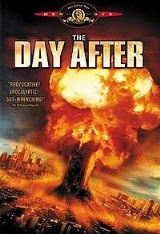
The Day After

Encyclopedia
The Day After is a 1983 American television movie
which aired on November 20, 1983, on the ABC
television network. It was seen by more than 100 million people during its initial broadcast.
The film portrays a fictional war between NATO forces and the Warsaw Pact
that rapidly escalates into a full scale nuclear exchange
between the United States
and the Soviet Union
. It focuses on the residents of Lawrence, Kansas
, and Kansas City, Missouri
, as well as several family farms situated next to nuclear missile silos.
The cast includes JoBeth Williams
, Steve Guttenberg
, John Cullum
, Jason Robards
and John Lithgow
. The film was written by Edward Hume
, produced by Robert Papazian and directed by Nicholas Meyer
. It was released on DVD
on May 18, 2004, with MGM
.
is shown to have commenced a military buildup in East Germany with the goal of intimidating the United States into withdrawing from West Berlin
. When the United States does not back down, Soviet armored divisions are sent to the border between West and East Germany.
During the late hours of Friday, September 15, news broadcasts report a "widespread rebellion among several divisions of the East German Army." As a result, the Soviets blockade
West Berlin. Tensions mount and the United States issues an ultimatum that the Soviets stand down from the blockade by 6:00 A.M. the next day, or it will be interpreted as an act of war. The Soviets refuse, and the President of the United States
puts all U.S. military forces around the world on a "stage 2 alert."
On Saturday, September 16, NATO forces in West Germany
invade East Germany through the Helmstedt checkpoint
to free Berlin
. The Soviets hold the Marienborn corridor and inflict heavy casualties on NATO troops. Two Soviet MiG-25s cross into West German airspace and bomb a NATO munitions storage facility, also striking a school and a hospital. A subsequent radio broadcast states that Moscow
is being evacuated. At this point, major U.S. cities begin mass evacuations as well. There soon follow unconfirmed reports that nuclear weapons were used in Wiesbaden
and Frankfurt
. Meanwhile, in the Persian Gulf
, naval warfare erupts, as radio reports tell of ship sinkings on both sides.
Eventually the Soviet Army
reaches the Rhine. Seeking to prevent Soviet forces from invading France
and causing the rest of Western Europe
to fall, NATO halts the Soviet advance by airbursting
three low-yield nuclear weapons over advancing Soviet troops. Soviet forces counter by launching a nuclear strike on NATO headquarters in Brussels
. In response, the United States Strategic Air Command
begins scrambling B-52
bombers.
After the initial nuclear exchange in Europe, the United States enacts its "launch on warning
" policy which will launch a full-scale nuclear attack on the Soviet Union if and when the United States receives indication that the Soviet Union is preparing to do the same.
The Soviet Air Force
then destroys a BMEWS
station in RAF Fylingdales
, England
and another at Beale Air Force Base
in California
. Meanwhile, on board the EC-135 Looking Glass aircraft, the order comes in from the President of the United States for a full nuclear strike against the Soviet Union. Almost simultaneously, an Air Force officer receives a report that a massive Soviet nuclear assault against the United States has been launched, stating "32 targets in track, with 10 impacting points." Another airman receives a report that over 300 Soviet ICBMs are inbound. It is deliberately unclear in the film whether the Soviet Union or the United States launches the main nuclear attack first.
The first salvo of the Soviet nuclear attack on the central United States (as shown from the point of view of the residents of Kansas
and western Missouri
) occurs at 3:38 PM Central Daylight Time when a large-yield nuclear weapon is air burst
at a high altitude over Kansas City, Missouri
, in order to generate an electromagnetic pulse
and disable any defensive weapons covering the nearby Minuteman III missile silos of Whiteman AFB. Thirty seconds later, incoming Soviet ICBMs begin to hit military and population targets, including Kansas City. Sedalia, Missouri
, all the way south to El Dorado Springs, Missouri
, is blanketed with ground burst
nuclear weapons. While there are no specifics given, it is strongly suggested in the film that America's cities, military, and industrial base are heavily damaged or destroyed. The aftermath depicts the central United States as a blackened wasteland of burned-out cities filled with radiation, burn, and blast victims. Eventually, the American President gives a radio address in which he declares that there is a ceasefire between the United States and the Soviet Union, which suffered similar damage.
Dr. Russell Oakes (Jason Robards
) lives in the upper-class Brookside neighborhood with his wife (Georgann Johnson) and works in a hospital in downtown Kansas City. He is scheduled to teach a hematology
class at the University of Kansas
hospital in nearby Lawrence, Kansas
, and is en route when he hears an alarming Emergency Broadcast System
alert on his car radio. He pulls off the crowded motorway, attempts to contact his wife, but gives up due to the incredibly long line at a phone booth. Oakes heads back home down I-70, the only eastbound motorist. The nuclear attack begins and Kansas City is gripped with panic as air raid sirens wail. Oakes' car is disabled by the electromagnetic pulse
, as is all electricity. Oakes is about thirty miles away from downtown when the missiles hit. His family, many colleagues and millions of others are killed. He walks ten miles to Lawrence and at the university hospital treats the wounded with Dr. Sam Hachiya (Calvin Jung
) and Nurse Bauer (JoBeth Williams
). Also at the university, science Professor Joe Huxley (John Lithgow
) and students use a Geiger counter
to monitor the level of nuclear fallout
outside. They build a makeshift radio to maintain contact with Dr. Oakes at the hospital, as well as to locate any other broadcasting survivors outside the city.
Billy McCoy (William Allen Young
) is an Airman First Class in the United States Air Force
stationed at Whiteman AFB near Kansas City who is called into duty during the DEFCON 2 alert. He is among the first to witness the initial missile launches signaling the start of a full-scale nuclear war. After it becomes clear that a Soviet counterstrike
is imminent, the unit panics; several Airmen stubbornly insist they stay on duty while the others, including McCoy, point out that it is futile. McCoy drives away in a truck to retrieve his wife and child in Sedalia, but it is disabled by the EMP blast. McCoy, realizing what has happened, flees the truck and finds an abandoned bunker, barely escaping the oncoming nuclear blast. After the attack, McCoy walks towards a town and finds an abandoned store, where he takes candy bars and other provisions while gunfire is heard in the distance. While standing in line for a drink of water from a well pump, McCoy befriends a man who is mute and shares his provisions. As they both begin to suffer the effects of radiation sickness
, they leave a refugee camp and head to the hospital at Lawrence, where McCoy ultimately succumbs to the disease.
Farmer Jim Dahlberg (John Cullum
) and his family live in rural Harrisonville, Missouri
, far outside of Kansas City but very close to a field of missile silos. While the family is preparing for the wedding of their eldest daughter, Denise, they are forced to prepare for the impending attack by converting their basement into a makeshift fallout shelter. As the missiles are launched, Dahlberg forcefully carries his wife Eve, who denied the severity of the escalating crisis and continued the wedding preparations, down to the basement from their bedroom. Eve collapses into a fit of hysteria
upon realizing a nuclear war has begun. While running to the shelter, the Dahlberg's son, Danny, stared directly at a nuclear explosion and was flash-blinded. University of Kansas student Stephen Klein (Steve Guttenberg
), hitchhiking home to Joplin, Missouri
, stumbles upon the farm and is taken in by the Dahlbergs. After several days in the basement, Denise, distraught over the situation and the unknown whereabouts of her fiance, Bruce, leaves the basement and runs outside. Klein goes after her and forces her back into the basement. In the weeks afterwards, Danny's condition deteriorates as does Denise's, who begins hemorrhaging while at a makeshift church service. Klein takes Danny and Denise to Lawrence for treatment. Dr. Hachiya attempts to treat Danny with no improvement, and Klein and Denise develop terminal radiation sickness. Dahlberg, upon returning from an emergency farmers meeting, confronts a group of survivors squatting on the farm and is shot to death.
Ultimately, the overall situation at the hospital becomes dire and grim. Dr. Oakes collapses from exhaustion and upon awakening finds out that Nurse Bauer has died from meningitis
. Oakes, suffering from terminal radiation sickness, decides to return to Kansas City to "see my home one last time before I die" while Dr. Hachiya stays behind. Oakes hitches a ride on an Army National Guard truck, where he witnesses military personnel blindfolding and executing looters. At his home, he finds the charred remains of his wife's wristwatch and a family huddled in the ruins. Oakes angrily orders them to leave. The family silently offers Oakes food, causing him to collapse in despair.
As the scene fades to black, Professor Huxley forlornly calls into his makeshift radio: "Hello? This is Lawrence, Lawrence, Kansas. Is anybody there? Anybody? Anybody at all..."
, was so impressed that he envisioned creating a film exploring the effects of nuclear war on the United States. Stoddard asked his executive vice president of television movies and miniseries Stu Samuels to develop a script. Samuels created the title The Day After to emphasize that the story was not to be about a nuclear war itself but the aftermath. Samuels suggested several writers and eventually Stoddard commissioned veteran television writer Edward Hume
to write the script in 1981. The American Broadcasting Company, which financed the production, was concerned about the graphic nature of the film and how to appropriately portray the subject on a family-oriented television channel. Hume undertook a massive amount of research on nuclear war and went through several drafts until finally ABC deemed the plot and characters acceptable.
Originally, the film was based more around and in Kansas City, Missouri. Kansas City was not bombed in the original script, although Whiteman Air Force Base
was, making Kansas City suffer shock waves and the horde of survivors staggering into town. There was no Lawrence, Kansas in the story, although there was a small Kansas town called "Hampton". While Hume was writing the script, he and producer Robert Papazian, who had great experience in on-location shooting, took several trips to Kansas City to scout locations and met with officials from the Kansas film commission and from the Kansas tourist offices to search for a suitable location for "Hampton." It came down to a choice of either Warrensburg, Missouri
and Lawrence, Kansas, both college towns — Warrensburg was home of Central Missouri State University and was near Whiteman Air Force Base and Lawrence was home of the University of Kansas
and was near Kansas City. Hume and Papazian ended up selecting Lawrence, due to the access to a number of good locations: a university, a hospital, football and basketball venues, farms, beautiful countryside. Lawrence was also agreed upon as being the "geographic center" of the United States
. The Lawrence people were urging ABC to change the name "Hampton" to "Lawrence" in the script.
Back in Los Angeles, the idea of making a TV movie showing the true effects of nuclear war on average American citizens was still stirring up controversy. ABC, Hume and Papazian realized that for the scene depicting the nuclear blast, they would have to use state-of-the-art special effects and they took the first step by hiring some of the best special effects people in the business to draw up some storyboards for the complicated blast scene. Then, ABC hired Robert Butler to direct the project. For several months, this group worked on drawing up storyboards and revising the script again and again; then, in the spring of 1982, Butler was forced to leave The Day After because of other contractual commitments. ABC then offered the project to two other directors, who both turned it down. Finally, in May, ABC hired feature film director Nicholas Meyer
, who had just completed the blockbuster Star Trek II: The Wrath of Khan
. Meyer was apprehensive at first and doubted ABC would get away with making a television film on nuclear war without the censors diminishing its effect. However, after reading the script, Meyer agreed to direct The Day After.
However, Meyer wanted to make sure he would film the script he was offered. He didn't want the censors to chop up the film, nor did he want the film to be a regular Hollywood disaster movie from the start. Meyer figured the more The Day After resembled such a film, the less effective it would be. Meyer just wanted to dump the facts on nuclear war in people's laps. So first of all he made it clear to ABC that no TV or film stars should be in The Day After. ABC agreed, although they wanted to have one star to help attract European audiences to the film when it would be shown theatrically there. Later, while flying to visit his parents in New York City
, Meyer happened to be on the same plane with Jason Robards
and asked the star to join the cast.
Meyer plunged into several months of nuclear research, which made him quite pessimistic about the future. Every day, Meyer would come home feeling ill. He soon realized that what he was learning was making him sick. Meyer and Papazian also made trips to the ABC censors, and to the United States Department of Defense
during this time. There were conflicts with both. Meyer had many heated arguments over elements in the script, both little and big, that the network censors wanted cut out of the film. The Department of Defense said they would cooperate with ABC if it was made clear in the script that the Soviet Union launched their missiles first, something Meyer and Papazian were at pains not to do.
In any case, Meyer, Papazian, Hume, and several casting directors spent most of July, 1982 taking numerous trips to Kansas City. In between casting in Los Angeles
, where they stuck mostly to unknowns, they would fly to the Kansas City area to interview local actors and scenery. They were hoping to find some real Midwesterners for smaller roles. Hollywood casting directors strolled through shopping malls in Kansas City, looking for local people to fill small and supporting roles, while the daily newspaper in Lawrence ran an advertisement calling for local residents of all ages to sign up for jobs as a large number of extras in the film and a professor of theater and film at the University of Kansas
was hired to head up the local casting of the movie. Out of the eighty or so speaking parts, only fifteen were cast in Los Angeles. The remaining roles were filled in Kansas City and Lawrence.
While in Kansas City, Meyer and Papazian toured the Federal Emergency Management Agency
offices in Kansas City. When asked what their plans for surviving nuclear war were, a FEMA official replied that they were experimenting with putting evacuation instructions in telephone books in New England
. "In about six years, everyone should have them." This meeting led Meyer to later refer to FEMA as "a complete joke." It was during this time that the decision was made to change "Hampton" in the script to "Lawrence." Meyer and Hume figured since Lawrence was a real town, that it would be more believable and besides, Lawrence was a perfect choice to be a representative of Middle America. The town boasted a "socio-cultural mix," sat near the exact geographic center of the continental U.S., and Hume and Meyer's research told them that Lawrence was a prime missile target, because 150 Minuteman missile silos stood nearby. Lawrence had some great locations, and the people there were more supportive of the project. Suddenly, less emphasis was put on Kansas City, the decision was made to have the city completely annihilated in the script, and Lawrence was made the primary location in the film.
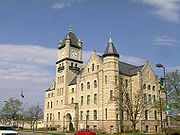 Production began on Monday, August 16, 1982, at a farm just west of Lawrence. Sunshine was needed but it turned out to be a dreadfully overcast day. The set required a floodlight. The crew set fire to the farm's red barn for one scene during the blast sequence (it was eventually cut). The owner of the farm was not paid, but ABC did compensate by building him a new barn. A set in rural Lawrence, depicting a schoolhouse, was made in six days from fiberglass
"skins." On Monday, August 30, 1982, ABC shut down Rusty's IGA supermarket in Lawrence's Hillcrest Shopping Center from 7 A.M. until 2 P.M. to shoot a scene representing panic buying
. A local man and his infant son came to the market, apparently unaware that ABC was filming a movie. The man reportedly saw the chaos and ran back into his car in fear.
Local extras were paid $
75 to shave heads bald, have latex scar tissue and burn-marks pasted on their faces, be plastered with coats of artificial mud, and be dressed in tattered clothes for scenes of radiation sickness. They were requested not to bathe or shower until filming was completed. In a small Lawrence park, ABC set up a grimy shantytown to serve as home to survivors. It was known as "Tent City." On Friday, September 3, 1982, the cameras rolled with many students as extras. The next day, Jason Robards
, the best-known "star" of the film, arrived and production moved to Lawrence Memorial Hospital.
Many local individuals and businesses profited. It was estimated in newspaper accounts that ABC spent $1 million in Lawrence, not all on the production. Meyer said he wanted the film not to take political stands, but rather just remind people of nuclear war's perils. He thought of the TV film as a gigantic public service announcement.
On September 6, in downtown Lawrence, the filmmakers repainted signs, changing the names of stores, staining the facades with soot. The large windows were shattered into sharp teeth, bricks were scattered and junked cars were painted with clouds of black spray. Two industrial-sized yellow fans bolted to a flatbed trailer blew clouds of white flakes into the air. This fallout-matter was actually cornflakes painted white.
Next day, students poured into Allen Fieldhouse
, the basketball arena, the only place on campus big enough to accommodate so many wounded. A scene was filmed with thousands of radiation victims stretched out on the court floor.
On September 8, a four-mile stretch on K-10
between the Edgerton Road exit and the DeSoto interchange at former K-285 (now Lexington Avenue) was closed for shooting highway scenes representing a mass exodus on Interstate 70. On September 10, Robards' character was filmed returning to what is left of Kansas City to find his home.
ABC used the demolition site of the former St. Joseph Hospital located at Linwood Boulevard and Prospect Avenue in an inner-city neighborhood in Kansas City as the set. The network paid the city to halt demolition for a month so it could film scenes of destruction there. However, when the crew arrived, more demolition had apparently taken place. Meyer was angry, but then realized he could populate the area with fake corpses and junked cars "and then I got real happy." Robards was in makeup at 6 a.m. to look like a radiation poisoning victim. The makeup took three hours to apply. Passers-by strained for a closer look as Robards lifted the arm of a body stuck under fallen debris — just the arm, severed at the shoulder. It was at this site that the moving final scene where Dr. Oakes confronts a family of squatters was filmed.
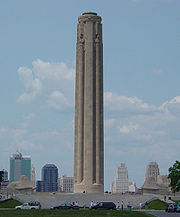 There were more problems on September 11. Meyer had desperately wanted the Liberty Memorial
, a tall war memorial in Penn Valley Park
overlooking downtown Kansas City, for two scenes: postcard-perfect shots of Kansas City near the beginning and a scene of Robards stumbling through the ruins. However, one director of the local parks department was opposed to letting it be used for commercial purposes and expressed concern that ABC would damage the Memorial. A resolution was reached. By using fiberglass, the filmmakers made it look as if the Memorial had been reduced to rubble. Robards stumbled through debris once again. That evening, the cast and crew flew to Los Angeles.
Interior hospital scenes with Robards and JoBeth Williams were shot in L.A. Many scientific advisors from various fields were on set to ensure the accuracy of the explosion, its effects and its victims. The government, nervous of how it would be portrayed, didn't allow the production to use stock footage
of nuclear explosions in the film, so ABC hired special effects creators. The result was a frighteningly real explosion and iconic "mushroom cloud" created by injecting oil-based paints and inks downward into a water tank with a piston, filmed at high speed with the camera mounted upside down. The image was then optically color- and contrast-inverted. The water tank used for the "mushroom clouds" was the same water tank used to create the "Mutara Nebula" special effect in The Wrath of Khan.
The Day After relied heavily on footage from other movies and from declassified
government films. Extensive use of stock footage was interspersed with special effects of the mushroom clouds. While the majority of the missile launches came from United States Department of Defense
footage of ICBM missile tests (mainly Minuteman IIIs from Vandenberg Air Force Base
adjacent to Lompoc, California
), all of the stock footage of missile launches were acquired from declassified DoD film libraries. The scenes of Air Force personnel aboard the Airborne Command Post receiving news of the incoming attack are footage of actual military personnel during a drill and had been aired several years earlier in a 1979 PBS
documentary, "First Strike
". In the original footage, the silo is "destroyed" by an incoming "attack" just moments before launching its missiles, which is why the final seconds of the launch countdown are not seen in this movie.
Further stock footage was taken from news events (fires and explosions) and the 1979 theatrical film Meteor
(such as a bridge collapsing and the destruction of a tall office building originally used to depict the destruction of the World Trade Center
in that film). Brief scenes of stampeding crowds were also borrowed from the disaster film Two-Minute Warning
(1976). Other footage had been previously used in theatrical films such as Superman and Damnation Alley
.
The editing of The Day After was one of the most nerve-wracking processes ABC had ever gone through in post-production of any of their films. There were many meetings with the censors and Nicholas Meyer was enraged and confused because the network actually cut out many scenes due to what it considered slow pacing, not because they were too controversial or too graphic.
The film was originally planned by the network as a four-hour "event" to be spread over two nights, having an actual total running time of 180 minutes without commercials. Meyer had felt the script was padded, and had suggested cutting out an hour worth of material and presenting the whole film during one night. The network had disagreed, and Meyer had filmed the entire script. Meanwhile, the network had found out it was difficult to find advertisers, considering the subject matter, and Meyer was told he could edit the film for a one-night version. Meyer's original cut ran two hours and twenty minutes, which he presented to the network. After the screening, the executives were sobbing and seemed deeply affected, making Meyer believe they approved of his cut. However, a long six-month struggle began over the final shape of the film. The network now wanted to trim the film to the bone, but Meyer and his editor Bill Dornisch refused to cooperate. Dornisch was fired, and Meyer walked off. Other editors were brought in to do their versions, but the network ultimately was not happy with their work. Meyer was finally brought back in, and a compromise was reached, with a final running time of 120 minutes.
It was originally planned The Day After would be aired in May, but it was pushed back to November to allow for the post-production work that would reduce the film's length. The first major cut was made to the film that could be called "censorship": censors forced ABC to cut an entire scene of a child having a nightmare about nuclear holocaust and then sitting up, screaming. A psychiatrist told ABC that this would disturb children. "This strikes me as ludicrous", Meyer wrote in TV Guide
at the time. "Not only in relation to the rest of the film, but also when contrasted with the huge doses of violence to be found on any average evening of TV viewing." In any case, a few more cuts were made, including to a scene where Denise is shown to possess a diaphragm
and another scene where a hospital patient abruptly sits up screaming (this was excised from the original television broadcast, but then restored for home video releases). Meyer persuaded ABC to dedicate the film to the citizens of Lawrence and also to put a disclaimer at the end of the film, following the credits, letting the viewer know that The Day After downplayed the true effects of nuclear war so they would be able to have a story. The disclaimer also included a list of books the viewer can read to find out more on the subject. When the film was finished, Meyer vowed never to work in television again.
The Day After received one of the largest promotional campaigns prior to its broadcast. Commercials aired several months in advance, ABC distributed half a million "viewer's guides", which discussed the dangers of nuclear war and prepared the viewer for the graphic scenes of mushroom clouds and radiation burn victims. Discussion groups were also formed nationwide. Some schools required their students to watch it as a homework assignment and discuss it the next morning in class, while others encouraged parents not to allow their children to view the film at all.
wrote original music and adapted music from The River
(a documentary film score by concert composer Virgil Thomson
). Although he recorded just under 30 minutes of music, much of it was edited out of the final cut.
ABC censors severely toned down scenes to reduce the body count or severe burn victims. Meyer refused to remove key scenes (such as the "lady in the bathtub" near the film's end), but reportedly some 8½ minutes of excised footage still exist, significantly more graphic. Some footage was reinstated for the film's release on home video.
JoBeth Williams
' character was originally scripted with a death scene, asking whether the living envy the dead in a nuclear war's aftermath. This scene was cut when the film was reduced to 2½ hours. In the released version, Nurse Bauer's death occurs off-camera and is mentioned by Dr. Hachiya as having been due to meningitis. The dialogue was garbled and some viewers failed to hear the cause of death on the first viewing.
One cut scene shows a battle between surviving students over food. The two sides were to be athletes versus the science students under the guidance of Professor Huxley. Another brief scene later cut related to a firing squad, where two U. S. soldiers are blindfolded and executed. An officer reads the charges, verdict and sentence, as a bandaged chaplain reads the Last Rites
. A similar sequence occurs in a 1965 UK-produced faux documentary, The War Game
.
In the original broadcast, when the President addressed the nation, the voice was an imitation of Ronald Reagan
. In subsequent broadcasts, that voice was overdubbed by a stock actor.
, featuring scientist Carl Sagan
, former Secretary of State Henry Kissinger
, Elie Wiesel
, former Secretary of Defense Robert McNamara
, General Brent Scowcroft
and conservative writer William F. Buckley, Jr.
. Sagan argued against nuclear proliferation
, while Buckley promoted the concept of nuclear deterrence
. Sagan described the arms race
in the following terms: "Imagine a room awash in gasoline, and there are two implacable enemies in that room. One of them has nine thousand matches, the other seven thousand matches. Each of them is concerned about who's ahead, who's stronger."
One psychotherapist counseled viewers at Shawnee Mission East High School in the Kansas City suburbs and 1,000 others held candles at a peace vigil in Penn Valley Park
. A discussion group called Let Lawrence Live was formed by the English department at the university and dozens from the Humanities department gathered on the Kansas campus in front of the Memorial Campanile and lit candles in a peace vigil. At Baker University
, a private school in Baldwin City, Kansas
, roughly 10 miles south of Lawrence, a number of students drove around the city, looking at sites depicted in the film as having been destroyed.
The film provoked much political debate. Some argued that the film underscored the true personal horror of nuclear conflict and that the United States should therefore renounce the "first use" of nuclear weapons, a policy which had been a cornerstone of NATO defense planning in Europe.
Critics tended to claim the film was either sensationalizing nuclear war or that it was too tame. The special effects and realistic portrayal of nuclear war received praise. The film received twelve Emmy nominations and won two Emmy awards.
Nearly 100 million Americans watched The Day After on its first broadcast, a record audience for a made-for-TV movie. Producers Sales Organization
picked up international distribution rights to the film for the sum of $1,500 and released the film theatrically around the world to great success in the Eastern Bloc
, China, North Korea and Cuba (this international version contained six minutes of footage not in the telecast edition). Since commercials are not sold in these markets, Producers Sales Organization lost an undisclosed sum of money. Years later this international version was released to tape by Embassy Home Entertainment (Metro-Goldwyn-Mayer
now holds the video rights in the US).
Commentator Ben Stein
, critical of the movie's message (i.e. that the strategy of Mutual Assured Destruction
would lead to a war), wrote in the Los Angeles Herald-Examiner
what life might be like in an America under Soviet occupation. (Stein's idea was eventually dramatized in the miniseries Amerika
, also broadcast by ABC.)
The New York Post
accused Meyer of being a traitor, writing, "Why is Nicholas Meyers doing Yuri Andropov
's work for him?" Phyllis Schlafly
declared that "This film was made by people who want to disarm the country, and who are willing to make a $7 million contribution to that cause". Much press comment focused on the unanswered question in the film of who started the war.
watched the film several days before its screening, on 5 November 1983. He wrote in his diary that the film was "very effective and left me greatly depressed," and that it changed his mind on the prevailing policy on a "nuclear war". The film was also screened for the Joint Chiefs of Staff
. A government advisor who attended the screening, a friend of Meyer's, told him "If you wanted to draw blood, you did it. Those guys sat there like they were turned to stone." Three years later, the Intermediate-Range Nuclear Forces Treaty
was signed at Reykjavik, and in Reagan's memoirs he drew a direct line from the film to the signing. An oft-repeated story was that Reagan sent Meyer a telegram after the summit, saying, "Don't think your movie didn't have any part of this, because it did." In a 2010 interview, Meyer said that this was a myth, and that the sentiment stemmed from a friend's letter to Meyer; he suggested the story had origins in editing notes received from the White House during the production, which "may have been a joke, but it wouldn't surprise me, him being an old Hollywood guy".
The film also had impact outside the U.S. In 1987, during the era of Mikhail Gorbachev
's glasnost
and perestroika
reforms, the film was shown on Soviet television. Four years earlier, Georgia Rep. Elliott Levitas and 91 co-sponsors introduced a resolution in the U.S. House of Representatives "[expressing] the sense of the Congress
that the American Broadcasting Company
, the Department of State, and the U.S. Information Agency should work to have the television movie 'The Day After' aired to the Soviet public."
and John Cullum
were the best-known actors in the production. Bibi Besch
was a relative unknown, recently thrust into the spotlight as Dr. Carol Marcus in Meyer's Star Trek II: The Wrath of Khan
. Steve Guttenberg
, who went on to considerable success, was at the time known for the 1982 Barry Levinson
comedy Diner
. Stephen Furst
was known primarily as Flounder in National Lampoon's Animal House
. George Petrie, a stock player on several incarnations of Jackie Gleason
's television series and the Ewing family lawyer in Dallas, had a small role as a doctor. Cullum and Besch later played Holling Vincoeur and Maggie O'Connell's mother on Northern Exposure
.
Locals filled smaller supporting roles. Jeff East, who played Bruce Gallatin, was a local Kansas City actor who had appeared in Superman
as the young Clark Kent. Doug Scott and Ellen Anthony, who played the younger Dahlberg children, were found in Lawrence (Anthony was the daughter of the film's Kansas casting director Jack Wright). Arliss Howard
(who played an Airman) went on to major films, but at the time was a local thespian. Charles Oldfather, Herk Harvey
and Charles Whitman, all at one time professors at The University of Kansas, were cast as farmers.
John Lithgow
, JoBeth Williams
and Amy Madigan
were relative newcomers. Williams had recently starred in Poltergeist and Lithgow in The World According to Garp
, earning an Academy Award nomination. He soon appeared 1983's eventual Best Picture Terms of Endearment
and was nominated again. Madigan would star in films such as Field of Dreams
.
The Oakes:
The Dahlbergs:
Hospital staff:
Others:
s won:
Emmy Award nominations:
-->
Television movie
A television film is a feature film that is a television program produced for and originally distributed by a television network, in contrast to...
which aired on November 20, 1983, on the ABC
American Broadcasting Company
The American Broadcasting Company is an American commercial broadcasting television network. Created in 1943 from the former NBC Blue radio network, ABC is owned by The Walt Disney Company and is part of Disney-ABC Television Group. Its first broadcast on television was in 1948...
television network. It was seen by more than 100 million people during its initial broadcast.
The film portrays a fictional war between NATO forces and the Warsaw Pact
Warsaw Pact
The Warsaw Treaty Organization of Friendship, Cooperation, and Mutual Assistance , or more commonly referred to as the Warsaw Pact, was a mutual defense treaty subscribed to by eight communist states in Eastern Europe...
that rapidly escalates into a full scale nuclear exchange
Nuclear warfare
Nuclear warfare, or atomic warfare, is a military conflict or political strategy in which nuclear weaponry is detonated on an opponent. Compared to conventional warfare, nuclear warfare can be vastly more destructive in range and extent of damage...
between the United States
United States
The United States of America is a federal constitutional republic comprising fifty states and a federal district...
and the Soviet Union
Soviet Union
The Soviet Union , officially the Union of Soviet Socialist Republics , was a constitutionally socialist state that existed in Eurasia between 1922 and 1991....
. It focuses on the residents of Lawrence, Kansas
Lawrence, Kansas
Lawrence is the sixth largest city in the U.S. State of Kansas and the county seat of Douglas County. Located in northeastern Kansas, Lawrence is the anchor city of the Lawrence, Kansas, Metropolitan Statistical Area, which encompasses all of Douglas County...
, and Kansas City, Missouri
Kansas City, Missouri
Kansas City, Missouri is the largest city in the U.S. state of Missouri and is the anchor city of the Kansas City Metropolitan Area, the second largest metropolitan area in Missouri. It encompasses in parts of Jackson, Clay, Cass, and Platte counties...
, as well as several family farms situated next to nuclear missile silos.
The cast includes JoBeth Williams
JoBeth Williams
JoBeth Williams is an American film and television actress and director, and current President of the Screen Actors Guild Foundation.-Early life:...
, Steve Guttenberg
Steve Guttenberg
Steven Robert "Steve" Guttenberg is an American actor and comedian. He became well known during the 1980s, after a series of starring roles in major Hollywood films, including Cocoon, Three Men and a Baby, Police Academy, and Short Circuit.-Early life:Guttenberg was born in Brooklyn, New York, the...
, John Cullum
John Cullum
John Cullum is an American actor and singer. He has appeared in many stage musicals and dramas, including On the Twentieth Century and Shenandoah , winning the Tony Awards for Best Leading Actor in a Musical for each...
, Jason Robards
Jason Robards
Jason Nelson Robards, Jr. was an American actor on stage, and in film and television, and a winner of the Tony Award , two Academy Awards and the Emmy Award...
and John Lithgow
John Lithgow
John Arthur Lithgow is an American actor, musician, and author. Presently, he is involved with a wide range of media projects, including stage, television, film, and radio...
. The film was written by Edward Hume
Edward Hume
Edward Hume is an American film and television writer, best known for creating and developing several TV series in the 1970s, and for writing the 1983 TV movie The Day After.-TV series:...
, produced by Robert Papazian and directed by Nicholas Meyer
Nicholas Meyer
Nicholas Meyer is an American screenwriter, producer, director and novelist, known best for his best-selling novel The Seven-Per-Cent Solution, and for directing the films Time After Time, two of the Star Trek feature film series, and the 1983 television movie The Day After.Meyer graduated from...
. It was released on DVD
DVD
A DVD is an optical disc storage media format, invented and developed by Philips, Sony, Toshiba, and Panasonic in 1995. DVDs offer higher storage capacity than Compact Discs while having the same dimensions....
on May 18, 2004, with MGM
Metro-Goldwyn-Mayer
Metro-Goldwyn-Mayer Inc. is an American media company, involved primarily in the production and distribution of films and television programs. MGM was founded in 1924 when the entertainment entrepreneur Marcus Loew gained control of Metro Pictures, Goldwyn Pictures Corporation and Louis B. Mayer...
.
Background on the war
The chronology of the events leading up to the war is depicted entirely via television and radio news broadcasts. The Soviet UnionSoviet Union
The Soviet Union , officially the Union of Soviet Socialist Republics , was a constitutionally socialist state that existed in Eurasia between 1922 and 1991....
is shown to have commenced a military buildup in East Germany with the goal of intimidating the United States into withdrawing from West Berlin
West Berlin
West Berlin was a political exclave that existed between 1949 and 1990. It comprised the western regions of Berlin, which were bordered by East Berlin and parts of East Germany. West Berlin consisted of the American, British, and French occupation sectors, which had been established in 1945...
. When the United States does not back down, Soviet armored divisions are sent to the border between West and East Germany.
During the late hours of Friday, September 15, news broadcasts report a "widespread rebellion among several divisions of the East German Army." As a result, the Soviets blockade
Blockade
A blockade is an effort to cut off food, supplies, war material or communications from a particular area by force, either in part or totally. A blockade should not be confused with an embargo or sanctions, which are legal barriers to trade, and is distinct from a siege in that a blockade is usually...
West Berlin. Tensions mount and the United States issues an ultimatum that the Soviets stand down from the blockade by 6:00 A.M. the next day, or it will be interpreted as an act of war. The Soviets refuse, and the President of the United States
President of the United States
The President of the United States of America is the head of state and head of government of the United States. The president leads the executive branch of the federal government and is the commander-in-chief of the United States Armed Forces....
puts all U.S. military forces around the world on a "stage 2 alert."
On Saturday, September 16, NATO forces in West Germany
West Germany
West Germany is the common English, but not official, name for the Federal Republic of Germany or FRG in the period between its creation in May 1949 to German reunification on 3 October 1990....
invade East Germany through the Helmstedt checkpoint
Helmstedt-Marienborn border crossing
The Border checkpoint Helmstedt–Marienborn , named Grenzübergangsstelle Marienborn by the German Democratic Republic , was the largest and most important border crossing on the Inner German border during the division of Germany...
to free Berlin
Berlin
Berlin is the capital city of Germany and is one of the 16 states of Germany. With a population of 3.45 million people, Berlin is Germany's largest city. It is the second most populous city proper and the seventh most populous urban area in the European Union...
. The Soviets hold the Marienborn corridor and inflict heavy casualties on NATO troops. Two Soviet MiG-25s cross into West German airspace and bomb a NATO munitions storage facility, also striking a school and a hospital. A subsequent radio broadcast states that Moscow
Moscow
Moscow is the capital, the most populous city, and the most populous federal subject of Russia. The city is a major political, economic, cultural, scientific, religious, financial, educational, and transportation centre of Russia and the continent...
is being evacuated. At this point, major U.S. cities begin mass evacuations as well. There soon follow unconfirmed reports that nuclear weapons were used in Wiesbaden
Wiesbaden
Wiesbaden is a city in southwest Germany and the capital of the federal state of Hesse. It has about 275,400 inhabitants, plus approximately 10,000 United States citizens...
and Frankfurt
Frankfurt
Frankfurt am Main , commonly known simply as Frankfurt, is the largest city in the German state of Hesse and the fifth-largest city in Germany, with a 2010 population of 688,249. The urban area had an estimated population of 2,300,000 in 2010...
. Meanwhile, in the Persian Gulf
Persian Gulf
The Persian Gulf, in Southwest Asia, is an extension of the Indian Ocean located between Iran and the Arabian Peninsula.The Persian Gulf was the focus of the 1980–1988 Iran-Iraq War, in which each side attacked the other's oil tankers...
, naval warfare erupts, as radio reports tell of ship sinkings on both sides.
Eventually the Soviet Army
Red Army
The Workers' and Peasants' Red Army started out as the Soviet Union's revolutionary communist combat groups during the Russian Civil War of 1918-1922. It grew into the national army of the Soviet Union. By the 1930s the Red Army was among the largest armies in history.The "Red Army" name refers to...
reaches the Rhine. Seeking to prevent Soviet forces from invading France
France
The French Republic , The French Republic , The French Republic , (commonly known as France , is a unitary semi-presidential republic in Western Europe with several overseas territories and islands located on other continents and in the Indian, Pacific, and Atlantic oceans. Metropolitan France...
and causing the rest of Western Europe
Western Europe
Western Europe is a loose term for the collection of countries in the western most region of the European continents, though this definition is context-dependent and carries cultural and political connotations. One definition describes Western Europe as a geographic entity—the region lying in the...
to fall, NATO halts the Soviet advance by airbursting
Air burst
An air burst is the detonation of an explosive device such as an anti-personnel artillery shell or a nuclear weapon in the air instead of on contact with the ground or target or a delayed armor piercing explosion....
three low-yield nuclear weapons over advancing Soviet troops. Soviet forces counter by launching a nuclear strike on NATO headquarters in Brussels
Brussels
Brussels , officially the Brussels Region or Brussels-Capital Region , is the capital of Belgium and the de facto capital of the European Union...
. In response, the United States Strategic Air Command
Strategic Air Command
The Strategic Air Command was both a Major Command of the United States Air Force and a "specified command" of the United States Department of Defense. SAC was the operational establishment in charge of America's land-based strategic bomber aircraft and land-based intercontinental ballistic...
begins scrambling B-52
B-52 Stratofortress
The Boeing B-52 Stratofortress is a long-range, subsonic, jet-powered strategic bomber operated by the United States Air Force since the 1950s. The B-52 was designed and built by Boeing, who have continued to provide maintainence and upgrades to the aircraft in service...
bombers.
After the initial nuclear exchange in Europe, the United States enacts its "launch on warning
Launch on warning
Launch on warning is a strategy of nuclear weapon retaliation that gained recognition during the Cold War between the United States and the Soviet Union. With the invention of intercontinental ballistic missiles , launch on warning became an integral part of mutually assured destruction theory...
" policy which will launch a full-scale nuclear attack on the Soviet Union if and when the United States receives indication that the Soviet Union is preparing to do the same.
The Soviet Air Force
Soviet Air Force
The Soviet Air Force, officially known in Russian as Военно-воздушные силы or Voenno-Vozdushnye Sily and often abbreviated VVS was the official designation of one of the air forces of the Soviet Union. The other was the Soviet Air Defence Forces...
then destroys a BMEWS
Ballistic Missile Early Warning System
The United States Air Force Ballistic Missile Early Warning System was the first operational ballistic missile detection radar. The original system was built in 1959 and could provide long-range warning of a ballistic missile attack over the polar region of the Northern Hemisphere. They also...
station in RAF Fylingdales
RAF Fylingdales
RAF Fylingdales is a Royal Air Force station on Snod Hill in the North York Moors, England. Its motto is "Vigilamus" . It is a radar base and part of the United States-controlled Ballistic Missile Early Warning System...
, England
England
England is a country that is part of the United Kingdom. It shares land borders with Scotland to the north and Wales to the west; the Irish Sea is to the north west, the Celtic Sea to the south west, with the North Sea to the east and the English Channel to the south separating it from continental...
and another at Beale Air Force Base
Beale Air Force Base
Beale Air Force Base is a United States Air Force base located approximately east of Marysville, California. Originally known as Camp Beale....
in California
California
California is a state located on the West Coast of the United States. It is by far the most populous U.S. state, and the third-largest by land area...
. Meanwhile, on board the EC-135 Looking Glass aircraft, the order comes in from the President of the United States for a full nuclear strike against the Soviet Union. Almost simultaneously, an Air Force officer receives a report that a massive Soviet nuclear assault against the United States has been launched, stating "32 targets in track, with 10 impacting points." Another airman receives a report that over 300 Soviet ICBMs are inbound. It is deliberately unclear in the film whether the Soviet Union or the United States launches the main nuclear attack first.
The first salvo of the Soviet nuclear attack on the central United States (as shown from the point of view of the residents of Kansas
Kansas
Kansas is a US state located in the Midwestern United States. It is named after the Kansas River which flows through it, which in turn was named after the Kansa Native American tribe, which inhabited the area. The tribe's name is often said to mean "people of the wind" or "people of the south...
and western Missouri
Missouri
Missouri is a US state located in the Midwestern United States, bordered by Iowa, Illinois, Kentucky, Tennessee, Arkansas, Oklahoma, Kansas and Nebraska. With a 2010 population of 5,988,927, Missouri is the 18th most populous state in the nation and the fifth most populous in the Midwest. It...
) occurs at 3:38 PM Central Daylight Time when a large-yield nuclear weapon is air burst
Air burst
An air burst is the detonation of an explosive device such as an anti-personnel artillery shell or a nuclear weapon in the air instead of on contact with the ground or target or a delayed armor piercing explosion....
at a high altitude over Kansas City, Missouri
Kansas City, Missouri
Kansas City, Missouri is the largest city in the U.S. state of Missouri and is the anchor city of the Kansas City Metropolitan Area, the second largest metropolitan area in Missouri. It encompasses in parts of Jackson, Clay, Cass, and Platte counties...
, in order to generate an electromagnetic pulse
Electromagnetic pulse
An electromagnetic pulse is a burst of electromagnetic radiation. The abrupt pulse of electromagnetic radiation usually results from certain types of high energy explosions, especially a nuclear explosion, or from a suddenly fluctuating magnetic field...
and disable any defensive weapons covering the nearby Minuteman III missile silos of Whiteman AFB. Thirty seconds later, incoming Soviet ICBMs begin to hit military and population targets, including Kansas City. Sedalia, Missouri
Sedalia, Missouri
Sedalia is a city located about south of the Missouri River in Pettis County, Missouri. U.S. Highway 50 and U.S. Highway 65 intersect in the city. As of 2006, the city had a total population of 20,669. It is the county seat of Pettis County. The Sedalia Micropolitan Statistical Area consists of...
, all the way south to El Dorado Springs, Missouri
El Dorado Springs, Missouri
El Dorado Springs is the largest city in Cedar County, Missouri, United States. The population was 3,775 at the 2000 census. The name is commonly shortened to El Dorado or just El Do.-Geography:El Dorado Springs is located at ....
, is blanketed with ground burst
Ground burst
A groundburst is the detonation of an explosive device such as an artillery shell, nuclear weapon or air-dropped bomb that explodes upon hitting the ground...
nuclear weapons. While there are no specifics given, it is strongly suggested in the film that America's cities, military, and industrial base are heavily damaged or destroyed. The aftermath depicts the central United States as a blackened wasteland of burned-out cities filled with radiation, burn, and blast victims. Eventually, the American President gives a radio address in which he declares that there is a ceasefire between the United States and the Soviet Union, which suffered similar damage.
Plot
The story follows several citizens and those they encounter after a nuclear attack on Kansas City, Missouri. The narrative structure of the film is presented as a before and after scenario with the first half introducing us to the various characters and their stories. The center section is the nuclear disaster itself. The latter half of the film shows the effects of the fallout on the characters.Dr. Russell Oakes (Jason Robards
Jason Robards
Jason Nelson Robards, Jr. was an American actor on stage, and in film and television, and a winner of the Tony Award , two Academy Awards and the Emmy Award...
) lives in the upper-class Brookside neighborhood with his wife (Georgann Johnson) and works in a hospital in downtown Kansas City. He is scheduled to teach a hematology
Hematology
Hematology, also spelled haematology , is the branch of biology physiology, internal medicine, pathology, clinical laboratory work, and pediatrics that is concerned with the study of blood, the blood-forming organs, and blood diseases...
class at the University of Kansas
University of Kansas
The University of Kansas is a public research university and the largest university in the state of Kansas. KU campuses are located in Lawrence, Wichita, Overland Park, and Kansas City, Kansas with the main campus being located in Lawrence on Mount Oread, the highest point in Lawrence. The...
hospital in nearby Lawrence, Kansas
Lawrence, Kansas
Lawrence is the sixth largest city in the U.S. State of Kansas and the county seat of Douglas County. Located in northeastern Kansas, Lawrence is the anchor city of the Lawrence, Kansas, Metropolitan Statistical Area, which encompasses all of Douglas County...
, and is en route when he hears an alarming Emergency Broadcast System
Emergency Broadcast System
The Emergency Broadcast System was an emergency warning system in the United States, used from 1963 to 1997, when it was replaced by the Emergency Alert System.-Purpose:...
alert on his car radio. He pulls off the crowded motorway, attempts to contact his wife, but gives up due to the incredibly long line at a phone booth. Oakes heads back home down I-70, the only eastbound motorist. The nuclear attack begins and Kansas City is gripped with panic as air raid sirens wail. Oakes' car is disabled by the electromagnetic pulse
Electromagnetic pulse
An electromagnetic pulse is a burst of electromagnetic radiation. The abrupt pulse of electromagnetic radiation usually results from certain types of high energy explosions, especially a nuclear explosion, or from a suddenly fluctuating magnetic field...
, as is all electricity. Oakes is about thirty miles away from downtown when the missiles hit. His family, many colleagues and millions of others are killed. He walks ten miles to Lawrence and at the university hospital treats the wounded with Dr. Sam Hachiya (Calvin Jung
Calvin Jung
Calvin Jung is an American actor.Graduating from high school in New York, Jung attended Massanutten Military Academy in Virginia. He attended Hillsdale College in Michigan, and left his senior year to pursue acting back in New York. His first professional acting job was a commercial in Canada in...
) and Nurse Bauer (JoBeth Williams
JoBeth Williams
JoBeth Williams is an American film and television actress and director, and current President of the Screen Actors Guild Foundation.-Early life:...
). Also at the university, science Professor Joe Huxley (John Lithgow
John Lithgow
John Arthur Lithgow is an American actor, musician, and author. Presently, he is involved with a wide range of media projects, including stage, television, film, and radio...
) and students use a Geiger counter
Geiger counter
A Geiger counter, also called a Geiger–Müller counter, is a type of particle detector that measures ionizing radiation. They detect the emission of nuclear radiation: alpha particles, beta particles or gamma rays. A Geiger counter detects radiation by ionization produced in a low-pressure gas in a...
to monitor the level of nuclear fallout
Nuclear fallout
Fallout is the residual radioactive material propelled into the upper atmosphere following a nuclear blast, so called because it "falls out" of the sky after the explosion and shock wave have passed. It commonly refers to the radioactive dust and ash created when a nuclear weapon explodes...
outside. They build a makeshift radio to maintain contact with Dr. Oakes at the hospital, as well as to locate any other broadcasting survivors outside the city.
Billy McCoy (William Allen Young
William Allen Young
William Allen Young is an American actor best known for playing a role of Frank Mitchell on UPN's Moesha in 1996 and directing a few episodes of the show, and made a guest appearance on UPN's The Parkers as Frank Mitchell...
) is an Airman First Class in the United States Air Force
United States Air Force
The United States Air Force is the aerial warfare service branch of the United States Armed Forces and one of the American uniformed services. Initially part of the United States Army, the USAF was formed as a separate branch of the military on September 18, 1947 under the National Security Act of...
stationed at Whiteman AFB near Kansas City who is called into duty during the DEFCON 2 alert. He is among the first to witness the initial missile launches signaling the start of a full-scale nuclear war. After it becomes clear that a Soviet counterstrike
Counterattack
A counterattack is a tactic used in response against an attack. The term originates in military strategy. The general objective is to negate or thwart the advantage gained by the enemy in attack and the specific objectives are usually to regain lost ground or to destroy attacking enemy units.It is...
is imminent, the unit panics; several Airmen stubbornly insist they stay on duty while the others, including McCoy, point out that it is futile. McCoy drives away in a truck to retrieve his wife and child in Sedalia, but it is disabled by the EMP blast. McCoy, realizing what has happened, flees the truck and finds an abandoned bunker, barely escaping the oncoming nuclear blast. After the attack, McCoy walks towards a town and finds an abandoned store, where he takes candy bars and other provisions while gunfire is heard in the distance. While standing in line for a drink of water from a well pump, McCoy befriends a man who is mute and shares his provisions. As they both begin to suffer the effects of radiation sickness
Radiation Sickness
Radiation Sickness is a VHS by the thrash metal band Nuclear Assault. The video is a recording of a concert at the Hammersmith Odeon, London in 1988. It was released in 1991...
, they leave a refugee camp and head to the hospital at Lawrence, where McCoy ultimately succumbs to the disease.
Farmer Jim Dahlberg (John Cullum
John Cullum
John Cullum is an American actor and singer. He has appeared in many stage musicals and dramas, including On the Twentieth Century and Shenandoah , winning the Tony Awards for Best Leading Actor in a Musical for each...
) and his family live in rural Harrisonville, Missouri
Harrisonville, Missouri
Harrisonville is a city in Cass County, Missouri, United States. The population was 10,019 at the 2010 census. It is the county seat of CassCounty.Harrisonville was found in 1837, and was named for Congressman Albert G. Harrison...
, far outside of Kansas City but very close to a field of missile silos. While the family is preparing for the wedding of their eldest daughter, Denise, they are forced to prepare for the impending attack by converting their basement into a makeshift fallout shelter. As the missiles are launched, Dahlberg forcefully carries his wife Eve, who denied the severity of the escalating crisis and continued the wedding preparations, down to the basement from their bedroom. Eve collapses into a fit of hysteria
Hysteria
Hysteria, in its colloquial use, describes unmanageable emotional excesses. People who are "hysterical" often lose self-control due to an overwhelming fear that may be caused by multiple events in one's past that involved some sort of severe conflict; the fear can be centered on a body part, or,...
upon realizing a nuclear war has begun. While running to the shelter, the Dahlberg's son, Danny, stared directly at a nuclear explosion and was flash-blinded. University of Kansas student Stephen Klein (Steve Guttenberg
Steve Guttenberg
Steven Robert "Steve" Guttenberg is an American actor and comedian. He became well known during the 1980s, after a series of starring roles in major Hollywood films, including Cocoon, Three Men and a Baby, Police Academy, and Short Circuit.-Early life:Guttenberg was born in Brooklyn, New York, the...
), hitchhiking home to Joplin, Missouri
Joplin, Missouri
Joplin is a city in southern Jasper County and northern Newton County in the southwestern corner of the US state of Missouri. Joplin is the largest city in Jasper County, though it is not the county seat. As of the 2010 census, the city population was 50,150...
, stumbles upon the farm and is taken in by the Dahlbergs. After several days in the basement, Denise, distraught over the situation and the unknown whereabouts of her fiance, Bruce, leaves the basement and runs outside. Klein goes after her and forces her back into the basement. In the weeks afterwards, Danny's condition deteriorates as does Denise's, who begins hemorrhaging while at a makeshift church service. Klein takes Danny and Denise to Lawrence for treatment. Dr. Hachiya attempts to treat Danny with no improvement, and Klein and Denise develop terminal radiation sickness. Dahlberg, upon returning from an emergency farmers meeting, confronts a group of survivors squatting on the farm and is shot to death.
Ultimately, the overall situation at the hospital becomes dire and grim. Dr. Oakes collapses from exhaustion and upon awakening finds out that Nurse Bauer has died from meningitis
Meningitis
Meningitis is inflammation of the protective membranes covering the brain and spinal cord, known collectively as the meninges. The inflammation may be caused by infection with viruses, bacteria, or other microorganisms, and less commonly by certain drugs...
. Oakes, suffering from terminal radiation sickness, decides to return to Kansas City to "see my home one last time before I die" while Dr. Hachiya stays behind. Oakes hitches a ride on an Army National Guard truck, where he witnesses military personnel blindfolding and executing looters. At his home, he finds the charred remains of his wife's wristwatch and a family huddled in the ruins. Oakes angrily orders them to leave. The family silently offers Oakes food, causing him to collapse in despair.
As the scene fades to black, Professor Huxley forlornly calls into his makeshift radio: "Hello? This is Lawrence, Lawrence, Kansas. Is anybody there? Anybody? Anybody at all..."
Production
The Day After was the idea of ABC Motion Picture Division president Brandon Stoddard, who, after watching The China SyndromeThe China Syndrome
The China Syndrome is a 1979 American thriller film that tells the story of a reporter and cameraman who discover safety coverups at a nuclear power plant. It stars Jane Fonda, Jack Lemmon, Michael Douglas, Scott Brady, James Hampton, Peter Donat, Richard Herd, and Wilford Brimley.The film was...
, was so impressed that he envisioned creating a film exploring the effects of nuclear war on the United States. Stoddard asked his executive vice president of television movies and miniseries Stu Samuels to develop a script. Samuels created the title The Day After to emphasize that the story was not to be about a nuclear war itself but the aftermath. Samuels suggested several writers and eventually Stoddard commissioned veteran television writer Edward Hume
Edward Hume
Edward Hume is an American film and television writer, best known for creating and developing several TV series in the 1970s, and for writing the 1983 TV movie The Day After.-TV series:...
to write the script in 1981. The American Broadcasting Company, which financed the production, was concerned about the graphic nature of the film and how to appropriately portray the subject on a family-oriented television channel. Hume undertook a massive amount of research on nuclear war and went through several drafts until finally ABC deemed the plot and characters acceptable.
Originally, the film was based more around and in Kansas City, Missouri. Kansas City was not bombed in the original script, although Whiteman Air Force Base
Whiteman Air Force Base
Whiteman Air Force Base is a United States Air Force base located approximately south of Knob Noster, Missouri; east-southeast of Kansas City, Missouri....
was, making Kansas City suffer shock waves and the horde of survivors staggering into town. There was no Lawrence, Kansas in the story, although there was a small Kansas town called "Hampton". While Hume was writing the script, he and producer Robert Papazian, who had great experience in on-location shooting, took several trips to Kansas City to scout locations and met with officials from the Kansas film commission and from the Kansas tourist offices to search for a suitable location for "Hampton." It came down to a choice of either Warrensburg, Missouri
Warrensburg, Missouri
Warrensburg is a city in Johnson County, Missouri, United States. The population was 16,340 at the 2000 census. It is the county seat of Johnson County. The Warrensburg Micropolitan Statistical Area consists of Johnson County. It is home to the University of Central Missouri.-History:Warrensburg...
and Lawrence, Kansas, both college towns — Warrensburg was home of Central Missouri State University and was near Whiteman Air Force Base and Lawrence was home of the University of Kansas
University of Kansas
The University of Kansas is a public research university and the largest university in the state of Kansas. KU campuses are located in Lawrence, Wichita, Overland Park, and Kansas City, Kansas with the main campus being located in Lawrence on Mount Oread, the highest point in Lawrence. The...
and was near Kansas City. Hume and Papazian ended up selecting Lawrence, due to the access to a number of good locations: a university, a hospital, football and basketball venues, farms, beautiful countryside. Lawrence was also agreed upon as being the "geographic center" of the United States
United States
The United States of America is a federal constitutional republic comprising fifty states and a federal district...
. The Lawrence people were urging ABC to change the name "Hampton" to "Lawrence" in the script.
Back in Los Angeles, the idea of making a TV movie showing the true effects of nuclear war on average American citizens was still stirring up controversy. ABC, Hume and Papazian realized that for the scene depicting the nuclear blast, they would have to use state-of-the-art special effects and they took the first step by hiring some of the best special effects people in the business to draw up some storyboards for the complicated blast scene. Then, ABC hired Robert Butler to direct the project. For several months, this group worked on drawing up storyboards and revising the script again and again; then, in the spring of 1982, Butler was forced to leave The Day After because of other contractual commitments. ABC then offered the project to two other directors, who both turned it down. Finally, in May, ABC hired feature film director Nicholas Meyer
Nicholas Meyer
Nicholas Meyer is an American screenwriter, producer, director and novelist, known best for his best-selling novel The Seven-Per-Cent Solution, and for directing the films Time After Time, two of the Star Trek feature film series, and the 1983 television movie The Day After.Meyer graduated from...
, who had just completed the blockbuster Star Trek II: The Wrath of Khan
Star Trek II: The Wrath of Khan
Star Trek II: The Wrath of Khan is a 1982 American science fiction film released by Paramount Pictures. The film is the second feature based on the Star Trek science fiction franchise. The plot features James T...
. Meyer was apprehensive at first and doubted ABC would get away with making a television film on nuclear war without the censors diminishing its effect. However, after reading the script, Meyer agreed to direct The Day After.
However, Meyer wanted to make sure he would film the script he was offered. He didn't want the censors to chop up the film, nor did he want the film to be a regular Hollywood disaster movie from the start. Meyer figured the more The Day After resembled such a film, the less effective it would be. Meyer just wanted to dump the facts on nuclear war in people's laps. So first of all he made it clear to ABC that no TV or film stars should be in The Day After. ABC agreed, although they wanted to have one star to help attract European audiences to the film when it would be shown theatrically there. Later, while flying to visit his parents in New York City
New York City
New York is the most populous city in the United States and the center of the New York Metropolitan Area, one of the most populous metropolitan areas in the world. New York exerts a significant impact upon global commerce, finance, media, art, fashion, research, technology, education, and...
, Meyer happened to be on the same plane with Jason Robards
Jason Robards
Jason Nelson Robards, Jr. was an American actor on stage, and in film and television, and a winner of the Tony Award , two Academy Awards and the Emmy Award...
and asked the star to join the cast.
Meyer plunged into several months of nuclear research, which made him quite pessimistic about the future. Every day, Meyer would come home feeling ill. He soon realized that what he was learning was making him sick. Meyer and Papazian also made trips to the ABC censors, and to the United States Department of Defense
United States Department of Defense
The United States Department of Defense is the U.S...
during this time. There were conflicts with both. Meyer had many heated arguments over elements in the script, both little and big, that the network censors wanted cut out of the film. The Department of Defense said they would cooperate with ABC if it was made clear in the script that the Soviet Union launched their missiles first, something Meyer and Papazian were at pains not to do.
In any case, Meyer, Papazian, Hume, and several casting directors spent most of July, 1982 taking numerous trips to Kansas City. In between casting in Los Angeles
Los Ángeles
Los Ángeles is the capital of the province of Biobío, in the commune of the same name, in Region VIII , in the center-south of Chile. It is located between the Laja and Biobío rivers. The population is 123,445 inhabitants...
, where they stuck mostly to unknowns, they would fly to the Kansas City area to interview local actors and scenery. They were hoping to find some real Midwesterners for smaller roles. Hollywood casting directors strolled through shopping malls in Kansas City, looking for local people to fill small and supporting roles, while the daily newspaper in Lawrence ran an advertisement calling for local residents of all ages to sign up for jobs as a large number of extras in the film and a professor of theater and film at the University of Kansas
University of Kansas
The University of Kansas is a public research university and the largest university in the state of Kansas. KU campuses are located in Lawrence, Wichita, Overland Park, and Kansas City, Kansas with the main campus being located in Lawrence on Mount Oread, the highest point in Lawrence. The...
was hired to head up the local casting of the movie. Out of the eighty or so speaking parts, only fifteen were cast in Los Angeles. The remaining roles were filled in Kansas City and Lawrence.
While in Kansas City, Meyer and Papazian toured the Federal Emergency Management Agency
Federal Emergency Management Agency
The Federal Emergency Management Agency is an agency of the United States Department of Homeland Security, initially created by Presidential Reorganization Plan No. 1 of 1978 and implemented by two Executive Orders...
offices in Kansas City. When asked what their plans for surviving nuclear war were, a FEMA official replied that they were experimenting with putting evacuation instructions in telephone books in New England
New England
New England is a region in the northeastern corner of the United States consisting of the six states of Maine, New Hampshire, Vermont, Massachusetts, Rhode Island, and Connecticut...
. "In about six years, everyone should have them." This meeting led Meyer to later refer to FEMA as "a complete joke." It was during this time that the decision was made to change "Hampton" in the script to "Lawrence." Meyer and Hume figured since Lawrence was a real town, that it would be more believable and besides, Lawrence was a perfect choice to be a representative of Middle America. The town boasted a "socio-cultural mix," sat near the exact geographic center of the continental U.S., and Hume and Meyer's research told them that Lawrence was a prime missile target, because 150 Minuteman missile silos stood nearby. Lawrence had some great locations, and the people there were more supportive of the project. Suddenly, less emphasis was put on Kansas City, the decision was made to have the city completely annihilated in the script, and Lawrence was made the primary location in the film.
Filming
Fiberglass
Glass fiber is a material consisting of numerous extremely fine fibers of glass.Glassmakers throughout history have experimented with glass fibers, but mass manufacture of glass fiber was only made possible with the invention of finer machine tooling...
"skins." On Monday, August 30, 1982, ABC shut down Rusty's IGA supermarket in Lawrence's Hillcrest Shopping Center from 7 A.M. until 2 P.M. to shoot a scene representing panic buying
Panic buying
Panic buying is an imprecise common use term to describe the act of people buying unusually large amounts of a product in anticipation of or after a disaster or perceived disaster, or in anticipation of a large price increase or shortage, as can occur before a blizzard or hurricane or government...
. A local man and his infant son came to the market, apparently unaware that ABC was filming a movie. The man reportedly saw the chaos and ran back into his car in fear.
Local extras were paid $
United States dollar
The United States dollar , also referred to as the American dollar, is the official currency of the United States of America. It is divided into 100 smaller units called cents or pennies....
75 to shave heads bald, have latex scar tissue and burn-marks pasted on their faces, be plastered with coats of artificial mud, and be dressed in tattered clothes for scenes of radiation sickness. They were requested not to bathe or shower until filming was completed. In a small Lawrence park, ABC set up a grimy shantytown to serve as home to survivors. It was known as "Tent City." On Friday, September 3, 1982, the cameras rolled with many students as extras. The next day, Jason Robards
Jason Robards
Jason Nelson Robards, Jr. was an American actor on stage, and in film and television, and a winner of the Tony Award , two Academy Awards and the Emmy Award...
, the best-known "star" of the film, arrived and production moved to Lawrence Memorial Hospital.
Many local individuals and businesses profited. It was estimated in newspaper accounts that ABC spent $1 million in Lawrence, not all on the production. Meyer said he wanted the film not to take political stands, but rather just remind people of nuclear war's perils. He thought of the TV film as a gigantic public service announcement.
On September 6, in downtown Lawrence, the filmmakers repainted signs, changing the names of stores, staining the facades with soot. The large windows were shattered into sharp teeth, bricks were scattered and junked cars were painted with clouds of black spray. Two industrial-sized yellow fans bolted to a flatbed trailer blew clouds of white flakes into the air. This fallout-matter was actually cornflakes painted white.
Next day, students poured into Allen Fieldhouse
Allen Fieldhouse
Allen Fieldhouse is an indoor arena at the University of Kansas in Lawrence, Kansas. The arena, named in honor of Dr. Forrest C. "Phog" Allen, who coached the university's men's basketball team for 39 years, is one of college basketball's most historically significant and prestigious buildings...
, the basketball arena, the only place on campus big enough to accommodate so many wounded. A scene was filmed with thousands of radiation victims stretched out on the court floor.
On September 8, a four-mile stretch on K-10
K-10 (Kansas highway)
K-10 is a 38 mile state highway in the U.S. state of Kansas. It was originally designated in 1929. It is mostly a controlled-access freeway, linking Lawrence to Lenexa. It provides an important toll-free alternate route to Interstate 70...
between the Edgerton Road exit and the DeSoto interchange at former K-285 (now Lexington Avenue) was closed for shooting highway scenes representing a mass exodus on Interstate 70. On September 10, Robards' character was filmed returning to what is left of Kansas City to find his home.
ABC used the demolition site of the former St. Joseph Hospital located at Linwood Boulevard and Prospect Avenue in an inner-city neighborhood in Kansas City as the set. The network paid the city to halt demolition for a month so it could film scenes of destruction there. However, when the crew arrived, more demolition had apparently taken place. Meyer was angry, but then realized he could populate the area with fake corpses and junked cars "and then I got real happy." Robards was in makeup at 6 a.m. to look like a radiation poisoning victim. The makeup took three hours to apply. Passers-by strained for a closer look as Robards lifted the arm of a body stuck under fallen debris — just the arm, severed at the shoulder. It was at this site that the moving final scene where Dr. Oakes confronts a family of squatters was filmed.
Liberty Memorial
The Liberty Memorial, located in Kansas City, Missouri, USA, is a memorial to the fallen soldiers of World War I and houses the The National World War I Museum, as designated by the United States Congress in 2004.. Groundbreaking commenced November 1, 1921, and the city held a site dedication...
, a tall war memorial in Penn Valley Park
Penn Valley Park
Penn Valley Park is an urban park overlooking Downtown Kansas City Kansas City, Missouri.The park was developed in 1904 on land through which the Santa Fe Trail had passed. It contains two famous landmarks: The Scout and the United States' official World War I museum with its Liberty Memorial...
overlooking downtown Kansas City, for two scenes: postcard-perfect shots of Kansas City near the beginning and a scene of Robards stumbling through the ruins. However, one director of the local parks department was opposed to letting it be used for commercial purposes and expressed concern that ABC would damage the Memorial. A resolution was reached. By using fiberglass, the filmmakers made it look as if the Memorial had been reduced to rubble. Robards stumbled through debris once again. That evening, the cast and crew flew to Los Angeles.
Interior hospital scenes with Robards and JoBeth Williams were shot in L.A. Many scientific advisors from various fields were on set to ensure the accuracy of the explosion, its effects and its victims. The government, nervous of how it would be portrayed, didn't allow the production to use stock footage
Stock footage
Stock footage, and similarly, archive footage, library pictures and file footage are film or video footage that may or may not be custom shot for use in a specific film or television program. Stock footage is of beneficial use to filmmakers as it is sometimes less expensive than shooting new...
of nuclear explosions in the film, so ABC hired special effects creators. The result was a frighteningly real explosion and iconic "mushroom cloud" created by injecting oil-based paints and inks downward into a water tank with a piston, filmed at high speed with the camera mounted upside down. The image was then optically color- and contrast-inverted. The water tank used for the "mushroom clouds" was the same water tank used to create the "Mutara Nebula" special effect in The Wrath of Khan.
The Day After relied heavily on footage from other movies and from declassified
Declassified
Declassified is an American television series produced by Ten Worlds Productions on The History Channel that originally aired on November 9, 2004. The series takes viewers inside vaults and archives around the world to reveal the untold stories of modern history...
government films. Extensive use of stock footage was interspersed with special effects of the mushroom clouds. While the majority of the missile launches came from United States Department of Defense
United States Department of Defense
The United States Department of Defense is the U.S...
footage of ICBM missile tests (mainly Minuteman IIIs from Vandenberg Air Force Base
Vandenberg Air Force Base
Vandenberg Air Force Base is a United States Air Force Base, located approximately northwest of Lompoc, California. It is under the jurisdiction of the 30th Space Wing, Air Force Space Command ....
adjacent to Lompoc, California
Lompoc, California
Lompoc is a city in Santa Barbara County, California, United States. The city was incorporated in 1888. The population was 42,434 at the 2010 census, up from 41,103 at the 2000 census....
), all of the stock footage of missile launches were acquired from declassified DoD film libraries. The scenes of Air Force personnel aboard the Airborne Command Post receiving news of the incoming attack are footage of actual military personnel during a drill and had been aired several years earlier in a 1979 PBS
Public Broadcasting Service
The Public Broadcasting Service is an American non-profit public broadcasting television network with 354 member TV stations in the United States which hold collective ownership. Its headquarters is in Arlington, Virginia....
documentary, "First Strike
First Strike (1979 film)
First Strike was a 1979 documentary created by PBS which discusses the United States armed forces strategy for dealing with nuclear warfare. The film became far better known when various clips were edited into the 1983 TV film The Day After....
". In the original footage, the silo is "destroyed" by an incoming "attack" just moments before launching its missiles, which is why the final seconds of the launch countdown are not seen in this movie.
Further stock footage was taken from news events (fires and explosions) and the 1979 theatrical film Meteor
Meteor (film)
Meteor is a 1979 science fiction Technicolor disaster film in which scientists detect an asteroid on a collision course with Earth and struggle with international, cold war politics in their efforts to prevent disaster. The movie starred Sean Connery and Natalie Wood.It was directed by Ronald Neame...
(such as a bridge collapsing and the destruction of a tall office building originally used to depict the destruction of the World Trade Center
World Trade Center
The original World Trade Center was a complex with seven buildings featuring landmark twin towers in Lower Manhattan, New York City, United States. The complex opened on April 4, 1973, and was destroyed in 2001 during the September 11 attacks. The site is currently being rebuilt with five new...
in that film). Brief scenes of stampeding crowds were also borrowed from the disaster film Two-Minute Warning
Two-Minute Warning
Two-Minute Warning is a 1976 suspense and action film directed by Larry Peerce and starring Charlton Heston, John Cassavetes, Martin Balsam, Beau Bridges, Jack Klugman, Gena Rowlands, and David Janssen. It was based on the novel of the same name written by George La Fountaine, Sr...
(1976). Other footage had been previously used in theatrical films such as Superman and Damnation Alley
Damnation Alley (film)
Damnation Alley is a 1977 film, directed by Jack Smight, loosely based on the novel of the same name by Roger Zelazny. The original music score was composed by Jerry Goldsmith.-Plot:...
.
The editing of The Day After was one of the most nerve-wracking processes ABC had ever gone through in post-production of any of their films. There were many meetings with the censors and Nicholas Meyer was enraged and confused because the network actually cut out many scenes due to what it considered slow pacing, not because they were too controversial or too graphic.
The film was originally planned by the network as a four-hour "event" to be spread over two nights, having an actual total running time of 180 minutes without commercials. Meyer had felt the script was padded, and had suggested cutting out an hour worth of material and presenting the whole film during one night. The network had disagreed, and Meyer had filmed the entire script. Meanwhile, the network had found out it was difficult to find advertisers, considering the subject matter, and Meyer was told he could edit the film for a one-night version. Meyer's original cut ran two hours and twenty minutes, which he presented to the network. After the screening, the executives were sobbing and seemed deeply affected, making Meyer believe they approved of his cut. However, a long six-month struggle began over the final shape of the film. The network now wanted to trim the film to the bone, but Meyer and his editor Bill Dornisch refused to cooperate. Dornisch was fired, and Meyer walked off. Other editors were brought in to do their versions, but the network ultimately was not happy with their work. Meyer was finally brought back in, and a compromise was reached, with a final running time of 120 minutes.
It was originally planned The Day After would be aired in May, but it was pushed back to November to allow for the post-production work that would reduce the film's length. The first major cut was made to the film that could be called "censorship": censors forced ABC to cut an entire scene of a child having a nightmare about nuclear holocaust and then sitting up, screaming. A psychiatrist told ABC that this would disturb children. "This strikes me as ludicrous", Meyer wrote in TV Guide
TV Guide
TV Guide is a weekly American magazine with listings of TV shows.In addition to TV listings, the publication features television-related news, celebrity interviews, gossip and film reviews and crossword puzzles...
at the time. "Not only in relation to the rest of the film, but also when contrasted with the huge doses of violence to be found on any average evening of TV viewing." In any case, a few more cuts were made, including to a scene where Denise is shown to possess a diaphragm
Diaphragm
-Optics and photography:* Diaphragm , a stop in the light path of a lens, having an aperture that regulates the amount of light that passes* Diaphragm shutter, a type of leaf shutter consisting of a number of thin blades in a camera-Acoustics:...
and another scene where a hospital patient abruptly sits up screaming (this was excised from the original television broadcast, but then restored for home video releases). Meyer persuaded ABC to dedicate the film to the citizens of Lawrence and also to put a disclaimer at the end of the film, following the credits, letting the viewer know that The Day After downplayed the true effects of nuclear war so they would be able to have a story. The disclaimer also included a list of books the viewer can read to find out more on the subject. When the film was finished, Meyer vowed never to work in television again.
The Day After received one of the largest promotional campaigns prior to its broadcast. Commercials aired several months in advance, ABC distributed half a million "viewer's guides", which discussed the dangers of nuclear war and prepared the viewer for the graphic scenes of mushroom clouds and radiation burn victims. Discussion groups were also formed nationwide. Some schools required their students to watch it as a homework assignment and discuss it the next morning in class, while others encouraged parents not to allow their children to view the film at all.
Music
Composer David RaksinDavid Raksin
David Raksin was an American composer born in Philadelphia, Pennsylvania. With over 100 film scores and 300 television scores to his credit, he became known as the "Grandfather of Film Music." One of his earliest film assignments was as assistant to Charlie Chaplin in the composition of the score...
wrote original music and adapted music from The River
The River (1938 film)
The River is a 1938 short documentary film which shows the importance of the Mississippi River to the United States, and how farming and timber practices had caused topsoil to be swept down the river and into the Gulf of Mexico, leading to catastrophic floods and impoverishing farmers...
(a documentary film score by concert composer Virgil Thomson
Virgil Thomson
Virgil Thomson was an American composer and critic. He was instrumental in the development of the "American Sound" in classical music...
). Although he recorded just under 30 minutes of music, much of it was edited out of the final cut.
Deleted and alternate scenes
Due to the film being shortened from the original four hours to 2½, several planned special-effects scenes were scrapped, although storyboards were made in anticipation of a possible "expanded" version. They included a "bird's eye" view of Kansas City at the moment of two nuclear detonations as seen from a 737 on approach, as well as simulated newsreel footage of the tactical nuclear exchanges in Germany between NATO and Warsaw Pact troops.ABC censors severely toned down scenes to reduce the body count or severe burn victims. Meyer refused to remove key scenes (such as the "lady in the bathtub" near the film's end), but reportedly some 8½ minutes of excised footage still exist, significantly more graphic. Some footage was reinstated for the film's release on home video.
JoBeth Williams
JoBeth Williams
JoBeth Williams is an American film and television actress and director, and current President of the Screen Actors Guild Foundation.-Early life:...
' character was originally scripted with a death scene, asking whether the living envy the dead in a nuclear war's aftermath. This scene was cut when the film was reduced to 2½ hours. In the released version, Nurse Bauer's death occurs off-camera and is mentioned by Dr. Hachiya as having been due to meningitis. The dialogue was garbled and some viewers failed to hear the cause of death on the first viewing.
One cut scene shows a battle between surviving students over food. The two sides were to be athletes versus the science students under the guidance of Professor Huxley. Another brief scene later cut related to a firing squad, where two U. S. soldiers are blindfolded and executed. An officer reads the charges, verdict and sentence, as a bandaged chaplain reads the Last Rites
Anointing of the Sick (Catholic Church)
Anointing of the Sick is a sacrament of the Catholic Church that is administered to Catholics who because of sickness or old age are in danger of death, even if the danger is not proximate...
. A similar sequence occurs in a 1965 UK-produced faux documentary, The War Game
The War Game
The War Game is a 1965 television documentary-style drama depicting the effects of nuclear war on Britain. Written, directed, and produced by Peter Watkins for the BBC's The Wednesday Play anthology series, it caused dismay within the BBC and in government and was withdrawn from television...
.
In the original broadcast, when the President addressed the nation, the voice was an imitation of Ronald Reagan
Ronald Reagan
Ronald Wilson Reagan was the 40th President of the United States , the 33rd Governor of California and, prior to that, a radio, film and television actor....
. In subsequent broadcasts, that voice was overdubbed by a stock actor.
Reaction
On its original broadcast (Sunday, November 20, 1983), ABC and local TV affiliates opened 1-800 hotlines with counselors standing by. There were no commercial breaks after the nuclear attack. ABC then aired a live debate, hosted by Nightlines Ted KoppelTed Koppel
Edward James "Ted" Koppel is an English-born American broadcast journalist, best known as the anchor for Nightline from the program's inception in 1980 until his retirement in late 2005. After leaving Nightline, Koppel worked as managing editor for the Discovery Channel before resigning in 2008...
, featuring scientist Carl Sagan
Carl Sagan
Carl Edward Sagan was an American astronomer, astrophysicist, cosmologist, author, science popularizer and science communicator in astronomy and natural sciences. He published more than 600 scientific papers and articles and was author, co-author or editor of more than 20 books...
, former Secretary of State Henry Kissinger
Henry Kissinger
Heinz Alfred "Henry" Kissinger is a German-born American academic, political scientist, diplomat, and businessman. He is a recipient of the Nobel Peace Prize. He served as National Security Advisor and later concurrently as Secretary of State in the administrations of Presidents Richard Nixon and...
, Elie Wiesel
Elie Wiesel
Sir Eliezer "Elie" Wiesel KBE; born September 30, 1928) is a Hungarian-born Jewish-American writer, professor, political activist, Nobel Laureate, and Holocaust survivor. He is the author of 57 books, including Night, a work based on his experiences as a prisoner in the Auschwitz, Buna, and...
, former Secretary of Defense Robert McNamara
Robert McNamara
Robert Strange McNamara was an American business executive and the eighth Secretary of Defense, serving under Presidents John F. Kennedy and Lyndon B. Johnson from 1961 to 1968, during which time he played a large role in escalating the United States involvement in the Vietnam War...
, General Brent Scowcroft
Brent Scowcroft
Brent Scowcroft, KBE was the United States National Security Advisor under Presidents Gerald Ford and George H. W. Bush and a Lieutenant General in the United States Air Force. He also served as Military Assistant to President Richard Nixon and as Deputy Assistant to the President for National...
and conservative writer William F. Buckley, Jr.
William F. Buckley, Jr.
William Frank Buckley, Jr. was an American conservative author and commentator. He founded the political magazine National Review in 1955, hosted 1,429 episodes of the television show Firing Line from 1966 until 1999, and was a nationally syndicated newspaper columnist. His writing was noted for...
. Sagan argued against nuclear proliferation
Nuclear proliferation
Nuclear proliferation is a term now used to describe the spread of nuclear weapons, fissile material, and weapons-applicable nuclear technology and information, to nations which are not recognized as "Nuclear Weapon States" by the Treaty on the Nonproliferation of Nuclear Weapons, also known as the...
, while Buckley promoted the concept of nuclear deterrence
Mutual assured destruction
Mutual Assured Destruction, or mutually assured destruction , is a doctrine of military strategy and national security policy in which a full-scale use of high-yield weapons of mass destruction by two opposing sides would effectively result in the complete, utter and irrevocable annihilation of...
. Sagan described the arms race
Arms race
The term arms race, in its original usage, describes a competition between two or more parties for the best armed forces. Each party competes to produce larger numbers of weapons, greater armies, or superior military technology in a technological escalation...
in the following terms: "Imagine a room awash in gasoline, and there are two implacable enemies in that room. One of them has nine thousand matches, the other seven thousand matches. Each of them is concerned about who's ahead, who's stronger."
One psychotherapist counseled viewers at Shawnee Mission East High School in the Kansas City suburbs and 1,000 others held candles at a peace vigil in Penn Valley Park
Penn Valley Park
Penn Valley Park is an urban park overlooking Downtown Kansas City Kansas City, Missouri.The park was developed in 1904 on land through which the Santa Fe Trail had passed. It contains two famous landmarks: The Scout and the United States' official World War I museum with its Liberty Memorial...
. A discussion group called Let Lawrence Live was formed by the English department at the university and dozens from the Humanities department gathered on the Kansas campus in front of the Memorial Campanile and lit candles in a peace vigil. At Baker University
Baker University
Baker University is a private, residential university located in Baldwin City, Kansas, United States. Founded in 1858, it is the oldest university in Kansas and is affiliated with the United Methodist Church. Baker University is made up of four schools...
, a private school in Baldwin City, Kansas
Baldwin City, Kansas
Baldwin City is a city in Douglas County, Kansas, United States about south of Lawrence and west of Gardner. As of the 2010 census, the city population was 4,515. It is part of the Lawrence, Kansas Metropolitan Statistical Area...
, roughly 10 miles south of Lawrence, a number of students drove around the city, looking at sites depicted in the film as having been destroyed.
The film provoked much political debate. Some argued that the film underscored the true personal horror of nuclear conflict and that the United States should therefore renounce the "first use" of nuclear weapons, a policy which had been a cornerstone of NATO defense planning in Europe.
Critics tended to claim the film was either sensationalizing nuclear war or that it was too tame. The special effects and realistic portrayal of nuclear war received praise. The film received twelve Emmy nominations and won two Emmy awards.
Nearly 100 million Americans watched The Day After on its first broadcast, a record audience for a made-for-TV movie. Producers Sales Organization
Producers Sales Organization
Producers Sales Organization was an independent production/distribution company founded in 1977.Inititated by Mark Damon, an actor-turned-producer, PSO largely handled foreign sales of independent films...
picked up international distribution rights to the film for the sum of $1,500 and released the film theatrically around the world to great success in the Eastern Bloc
Eastern bloc
The term Eastern Bloc or Communist Bloc refers to the former communist states of Eastern and Central Europe, generally the Soviet Union and the countries of the Warsaw Pact...
, China, North Korea and Cuba (this international version contained six minutes of footage not in the telecast edition). Since commercials are not sold in these markets, Producers Sales Organization lost an undisclosed sum of money. Years later this international version was released to tape by Embassy Home Entertainment (Metro-Goldwyn-Mayer
Metro-Goldwyn-Mayer
Metro-Goldwyn-Mayer Inc. is an American media company, involved primarily in the production and distribution of films and television programs. MGM was founded in 1924 when the entertainment entrepreneur Marcus Loew gained control of Metro Pictures, Goldwyn Pictures Corporation and Louis B. Mayer...
now holds the video rights in the US).
Commentator Ben Stein
Ben Stein
Benjamin Jeremy "Ben" Stein is an American actor, writer, lawyer, and commentator on political and economic issues. He attained early success as a speechwriter for American presidents Richard Nixon and Gerald Ford...
, critical of the movie's message (i.e. that the strategy of Mutual Assured Destruction
Mutual assured destruction
Mutual Assured Destruction, or mutually assured destruction , is a doctrine of military strategy and national security policy in which a full-scale use of high-yield weapons of mass destruction by two opposing sides would effectively result in the complete, utter and irrevocable annihilation of...
would lead to a war), wrote in the Los Angeles Herald-Examiner
Los Angeles Herald-Examiner
The Los Angeles Herald Examiner was a major Los Angeles daily newspaper, published Monday through Friday in the afternoon, and in the morning on Saturdays and Sundays. It was part of the Hearst syndicate. The afternoon Herald-Express and the morning Examiner, both of which had been publishing in...
what life might be like in an America under Soviet occupation. (Stein's idea was eventually dramatized in the miniseries Amerika
Amerika (TV miniseries)
Amerika – suggesting a Russified name for the United States – is an American television miniseries that was broadcast in 1987 on ABC. It starred Kris Kristofferson, Mariel Hemingway, Sam Neill, Robert Urich, and a 17-year-old Lara Flynn Boyle in her first major role. Amerika was about life in the...
, also broadcast by ABC.)
The New York Post
New York Post
The New York Post is the 13th-oldest newspaper published in the United States and is generally acknowledged as the oldest to have been published continuously as a daily, although – as is the case with most other papers – its publication has been periodically interrupted by labor actions...
accused Meyer of being a traitor, writing, "Why is Nicholas Meyers doing Yuri Andropov
Yuri Andropov
Yuri Vladimirovich Andropov was a Soviet politician and the General Secretary of the Communist Party of the Soviet Union from 12 November 1982 until his death fifteen months later.-Early life:...
's work for him?" Phyllis Schlafly
Phyllis Schlafly
Phyllis McAlpin Stewart Schlafly is a Constitutional lawyer and an American politically conservative activist and author who founded the Eagle Forum. She is known for her opposition to modern feminism ideas and for her campaign against the proposed Equal Rights Amendment...
declared that "This film was made by people who want to disarm the country, and who are willing to make a $7 million contribution to that cause". Much press comment focused on the unanswered question in the film of who started the war.
Effects on policymakers
President Ronald ReaganRonald Reagan
Ronald Wilson Reagan was the 40th President of the United States , the 33rd Governor of California and, prior to that, a radio, film and television actor....
watched the film several days before its screening, on 5 November 1983. He wrote in his diary that the film was "very effective and left me greatly depressed," and that it changed his mind on the prevailing policy on a "nuclear war". The film was also screened for the Joint Chiefs of Staff
Joint Chiefs of Staff
The Joint Chiefs of Staff is a body of senior uniformed leaders in the United States Department of Defense who advise the Secretary of Defense, the Homeland Security Council, the National Security Council and the President on military matters...
. A government advisor who attended the screening, a friend of Meyer's, told him "If you wanted to draw blood, you did it. Those guys sat there like they were turned to stone." Three years later, the Intermediate-Range Nuclear Forces Treaty
Intermediate-Range Nuclear Forces Treaty
The Intermediate-Range Nuclear Forces Treaty is a 1987 agreement between the United States and the Soviet Union. Signed in Washington, D.C. by U.S. President Ronald Reagan and General Secretary Mikhail Gorbachev on December 8, 1987, it was ratified by the United States Senate on May 27, 1988 and...
was signed at Reykjavik, and in Reagan's memoirs he drew a direct line from the film to the signing. An oft-repeated story was that Reagan sent Meyer a telegram after the summit, saying, "Don't think your movie didn't have any part of this, because it did." In a 2010 interview, Meyer said that this was a myth, and that the sentiment stemmed from a friend's letter to Meyer; he suggested the story had origins in editing notes received from the White House during the production, which "may have been a joke, but it wouldn't surprise me, him being an old Hollywood guy".
The film also had impact outside the U.S. In 1987, during the era of Mikhail Gorbachev
Mikhail Gorbachev
Mikhail Sergeyevich Gorbachev is a former Soviet statesman, having served as General Secretary of the Communist Party of the Soviet Union from 1985 until 1991, and as the last head of state of the USSR, having served from 1988 until its dissolution in 1991...
's glasnost
Glasnost
Glasnost was the policy of maximal publicity, openness, and transparency in the activities of all government institutions in the Soviet Union, together with freedom of information, introduced by Mikhail Gorbachev in the second half of the 1980s...
and perestroika
Perestroika
Perestroika was a political movement within the Communist Party of the Soviet Union during 1980s, widely associated with the Soviet leader Mikhail Gorbachev...
reforms, the film was shown on Soviet television. Four years earlier, Georgia Rep. Elliott Levitas and 91 co-sponsors introduced a resolution in the U.S. House of Representatives "[expressing] the sense of the Congress
Congress
A congress is a formal meeting of the representatives of different nations, constituent states, independent organizations , or groups....
that the American Broadcasting Company
American Broadcasting Company
The American Broadcasting Company is an American commercial broadcasting television network. Created in 1943 from the former NBC Blue radio network, ABC is owned by The Walt Disney Company and is part of Disney-ABC Television Group. Its first broadcast on television was in 1948...
, the Department of State, and the U.S. Information Agency should work to have the television movie 'The Day After' aired to the Soviet public."
Cast
Striving for a documentary style, casting director Hank McCann used many newcomers or obscure actors. Jason RobardsJason Robards
Jason Nelson Robards, Jr. was an American actor on stage, and in film and television, and a winner of the Tony Award , two Academy Awards and the Emmy Award...
and John Cullum
John Cullum
John Cullum is an American actor and singer. He has appeared in many stage musicals and dramas, including On the Twentieth Century and Shenandoah , winning the Tony Awards for Best Leading Actor in a Musical for each...
were the best-known actors in the production. Bibi Besch
Bibi Besch
Bibiana "Bibi" Besch was an Austrian/American actress.-Early life:Besch was born in Vienna, Austria, the daughter of theater actress Gusti Huber, who starred in German films during World War II and left Austria in the mid 1940s. Besch had a stepfather, Joseph Besch, a radio executive and former...
was a relative unknown, recently thrust into the spotlight as Dr. Carol Marcus in Meyer's Star Trek II: The Wrath of Khan
Star Trek II: The Wrath of Khan
Star Trek II: The Wrath of Khan is a 1982 American science fiction film released by Paramount Pictures. The film is the second feature based on the Star Trek science fiction franchise. The plot features James T...
. Steve Guttenberg
Steve Guttenberg
Steven Robert "Steve" Guttenberg is an American actor and comedian. He became well known during the 1980s, after a series of starring roles in major Hollywood films, including Cocoon, Three Men and a Baby, Police Academy, and Short Circuit.-Early life:Guttenberg was born in Brooklyn, New York, the...
, who went on to considerable success, was at the time known for the 1982 Barry Levinson
Barry Levinson
Barry Levinson is an American screenwriter, film director, actor, and producer of film and television. His films include Good Morning, Vietnam, Sleepers and Rain Man.-Early life:...
comedy Diner
Diner (film)
Diner is a 1982 comedy-drama film written and directed by Barry Levinson. Levinson's screen directing debut, Diner is the first in his "Baltimore films", which also include the subsequent Tin Men, Avalon and Liberty Heights.-Plot:...
. Stephen Furst
Stephen Furst
Stephen Furst is an American actor and film and television director. He was a regular in the science fiction series Babylon 5 playing Centauri diplomatic attaché Vir Cotto and as Dr. Elliot Axelrod on St...
was known primarily as Flounder in National Lampoon's Animal House
National Lampoon's Animal House
National Lampoon's Animal House is a 1978 American comedy film directed by John Landis. The film was a direct spin-off of National Lampoon magazine...
. George Petrie, a stock player on several incarnations of Jackie Gleason
Jackie Gleason
Jackie Gleason was an American comedian, actor and musician. He was known for his brash visual and verbal comedy style, especially by his character Ralph Kramden on The Honeymooners, a situation-comedy television series. His most noted film roles were as Minnesota Fats in the drama film The...
's television series and the Ewing family lawyer in Dallas, had a small role as a doctor. Cullum and Besch later played Holling Vincoeur and Maggie O'Connell's mother on Northern Exposure
Northern Exposure
Northern Exposure is an American television series that ran on CBS from 1990 to 1995, with a total of 110 episodes.-Overview:The series was given a pair of consecutive Peabody Awards: in 1991–92 for the show's "depict[ion] in a comedic and often poetic way, [of] the cultural clash between a...
.
Locals filled smaller supporting roles. Jeff East, who played Bruce Gallatin, was a local Kansas City actor who had appeared in Superman
Superman
Superman is a fictional comic book superhero appearing in publications by DC Comics, widely considered to be an American cultural icon. Created by American writer Jerry Siegel and Canadian-born American artist Joe Shuster in 1932 while both were living in Cleveland, Ohio, and sold to Detective...
as the young Clark Kent. Doug Scott and Ellen Anthony, who played the younger Dahlberg children, were found in Lawrence (Anthony was the daughter of the film's Kansas casting director Jack Wright). Arliss Howard
Arliss Howard
Arliss Howard is an American actor, writer and film director.-Life and career:Howard was born in Independence, Missouri in 1954, and graduated from Truman High School and Columbia College at Columbia, Missouri. Howard established his career with stand-out roles in Full Metal Jacket and Ruby...
(who played an Airman) went on to major films, but at the time was a local thespian. Charles Oldfather, Herk Harvey
Herk Harvey
Harold Arnold "Herk" Harvey was an American film director, actor, and film producer.-Early life:Harvey was born in Windsor, Colorado, the son of Everett and Minnie R. Prewitt Harvey. He grew up in Fort Collins and was a graduate of Fort Collins High School before serving in the U.S...
and Charles Whitman, all at one time professors at The University of Kansas, were cast as farmers.
John Lithgow
John Lithgow
John Arthur Lithgow is an American actor, musician, and author. Presently, he is involved with a wide range of media projects, including stage, television, film, and radio...
, JoBeth Williams
JoBeth Williams
JoBeth Williams is an American film and television actress and director, and current President of the Screen Actors Guild Foundation.-Early life:...
and Amy Madigan
Amy Madigan
Amy Marie Madigan is an American actress who is known for her role as Annie Kinsella in the 1989 film Field of Dreams and Iris Crowe in the HBO television series Carnivale...
were relative newcomers. Williams had recently starred in Poltergeist and Lithgow in The World According to Garp
The World According to Garp (film)
The World According to Garp is 1982 American comedy drama film directed by George Roy Hill, based on the novel of the same title by John Irving, who also wrote the script together with Steve Tesich...
, earning an Academy Award nomination. He soon appeared 1983's eventual Best Picture Terms of Endearment
Terms of Endearment
Terms of Endearment is a 1983 romantic comedy-drama film adapted by James L. Brooks from the novel by Larry McMurtry and starring Shirley MacLaine, Debra Winger, and Jack Nicholson...
and was nominated again. Madigan would star in films such as Field of Dreams
Field of Dreams
Field of Dreams is a 1989 American fantasy-drama film directed by Phil Alden Robinson and is from the novel Shoeless Joe by W. P. Kinsella...
.
The Oakes:
- Jason RobardsJason RobardsJason Nelson Robards, Jr. was an American actor on stage, and in film and television, and a winner of the Tony Award , two Academy Awards and the Emmy Award...
as Dr. Russell Oakes - Georgann Johnson as Helen Oakes
- Kyle Aletter as Marilyn Oakes
The Dahlbergs:
- John CullumJohn CullumJohn Cullum is an American actor and singer. He has appeared in many stage musicals and dramas, including On the Twentieth Century and Shenandoah , winning the Tony Awards for Best Leading Actor in a Musical for each...
as Jim Dahlberg - Bibi BeschBibi BeschBibiana "Bibi" Besch was an Austrian/American actress.-Early life:Besch was born in Vienna, Austria, the daughter of theater actress Gusti Huber, who starred in German films during World War II and left Austria in the mid 1940s. Besch had a stepfather, Joseph Besch, a radio executive and former...
as Eve Dahlberg - Lori Lethin as Denise Dahlberg
- Doug Scott as Danny Dahlberg
- Ellen Anthony as Joleen Dahlberg
Hospital staff:
- JoBeth WilliamsJoBeth WilliamsJoBeth Williams is an American film and television actress and director, and current President of the Screen Actors Guild Foundation.-Early life:...
as Nurse Nancy Bauer - Calvin JungCalvin JungCalvin Jung is an American actor.Graduating from high school in New York, Jung attended Massanutten Military Academy in Virginia. He attended Hillsdale College in Michigan, and left his senior year to pursue acting back in New York. His first professional acting job was a commercial in Canada in...
as Dr. Sam Hachiya - Lin McCarthy as Dr. Austin
- Rosanna Huffman as Dr. Wallenberg
- George Petrie as Dr. Landowska
- Jonathan Estrin as Julian French
Others:
- Steve GuttenbergSteve GuttenbergSteven Robert "Steve" Guttenberg is an American actor and comedian. He became well known during the 1980s, after a series of starring roles in major Hollywood films, including Cocoon, Three Men and a Baby, Police Academy, and Short Circuit.-Early life:Guttenberg was born in Brooklyn, New York, the...
as Stephen Klein - John LithgowJohn LithgowJohn Arthur Lithgow is an American actor, musician, and author. Presently, he is involved with a wide range of media projects, including stage, television, film, and radio...
as Joe Huxley - Amy MadiganAmy MadiganAmy Marie Madigan is an American actress who is known for her role as Annie Kinsella in the 1989 film Field of Dreams and Iris Crowe in the HBO television series Carnivale...
as Alison Ransom - William Allen YoungWilliam Allen YoungWilliam Allen Young is an American actor best known for playing a role of Frank Mitchell on UPN's Moesha in 1996 and directing a few episodes of the show, and made a guest appearance on UPN's The Parkers as Frank Mitchell...
as Airman First Class Billy McCoy - Jeff EastJeff EastJeff East is an American actor. His best-known role is in the 1978 hit film Superman as the teenage Clark Kent.-Film and television credits:...
as Bruce Gallatin - Dennis LipscombDennis LipscombDennis Lipscomb is an American actor.Lipscomb's first feature film was Union City . From the early 1980s to the 1990s, Lipscomb appeared in key roles in various motion pictures including Eyes of Fire , WarGames , The Day After , A Soldier's Story , Amazing Grace and Chuck , Sister, Sister , The...
as Reverend Walker - Clayton Day as Dennis Hendry
- Antonie Becker as Ellen Hendry
- Stephen FurstStephen FurstStephen Furst is an American actor and film and television director. He was a regular in the science fiction series Babylon 5 playing Centauri diplomatic attaché Vir Cotto and as Dr. Elliot Axelrod on St...
as Aldo - Arliss HowardArliss HowardArliss Howard is an American actor, writer and film director.-Life and career:Howard was born in Independence, Missouri in 1954, and graduated from Truman High School and Columbia College at Columbia, Missouri. Howard established his career with stand-out roles in Full Metal Jacket and Ruby...
as Tom Cooper - Stan Wilson as Vinnie Conrad
- Harry BuginHarry BuginHarry Bugin was an American film, stage and television actor and musician.-Life and career:Born in the Bronx, New York City, the son of Isidore and Sadie Bugin,and brother to Ruth Bugin, he was a graduate of the New York Public School system and a graduate of the American Academy of Dramatic Arts...
as Man at phone
Awards
Emmy AwardEmmy Award
An Emmy Award, often referred to simply as the Emmy, is a television production award, similar in nature to the Peabody Awards but more focused on entertainment, and is considered the television equivalent to the Academy Awards and the Grammy Awards .A majority of Emmys are presented in various...
s won:
- Outstanding Film Sound Editing for a Limited Series or a Special
- Outstanding Achievement In Special Visual EffectsEmmy Award for Outstanding Special Visual EffectsThis is a list of the winning and nominated programs of the Primetime Emmy Award for Outstanding Special Visual Effects in a television series, miniseries, or television movie...
Emmy Award nominations:
- Outstanding Achievement in Hairstyling
- Outstanding Achievement in Makeup
- Outstanding Art Direction for a Limited Series or a Special
- Outstanding Cinematography for a Limited Series or a Special (Gayne Rescher)
- Outstanding Directing in a Limited Series or a Special (Nicholas MeyerNicholas MeyerNicholas Meyer is an American screenwriter, producer, director and novelist, known best for his best-selling novel The Seven-Per-Cent Solution, and for directing the films Time After Time, two of the Star Trek feature film series, and the 1983 television movie The Day After.Meyer graduated from...
) - Outstanding Drama/Comedy Special (Robert Papazian)
- Outstanding Film Editing for a Limited Series or a Special (William Dornisch and Robert Florio)
- Outstanding Film Sound Mixing for a Limited Series or a Special
- Outstanding Supporting Actor in a Limited Series or a Special (John LithgowJohn LithgowJohn Arthur Lithgow is an American actor, musician, and author. Presently, he is involved with a wide range of media projects, including stage, television, film, and radio...
) - Outstanding Writing in a Limited Series or a Special (Edward Hume)
See also
- Kansas City PlantKansas City PlantThe Kansas City Plant is a National Nuclear Security Administration facility managed and operated by Honeywell Federal Manufacturing & Technologies that produces 85 percent of the nonnuclear material used in the United States nuclear bomb arsenal...
- Able Archer 83Able Archer 83Able Archer 83 was a ten-day NATO command post exercise starting on November 2, 1983 that spanned Western Europe, centred on the Supreme Headquarters Allied Powers Europe Headquarters situated at Casteau, north of the Belgian city of Mons. Able Archer exercises simulated a period of conflict...
- Doomsday deviceDoomsday deviceA doomsday device is a hypothetical construction — usually a weapon, or collection of weapons — which could destroy all life on a planet, particularly the Earth, or destroy the planet itself, bringing "doomsday", a term used for the end of planet Earth...
- Nuclear weapons in popular cultureNuclear weapons in popular cultureSince their public debut in August 1945, nuclear weapons and their potential effects have been a recurring motif in popular culture, to the extent that the decades of the Cold War are often referred to as the "atomic age."-Images of nuclear weapons:...
- List of nuclear holocaust fiction
- Barefoot GenBarefoot Genis a Japanese manga series by Keiji Nakazawa. Loosely based on Nakazawa's own experiences as a Hiroshima survivor, the series begins in 1945 in and around Hiroshima, Japan, where the six-year-old boy Gen lives with his family...
Fact-based mangaMangaManga is the Japanese word for "comics" and consists of comics and print cartoons . In the West, the term "manga" has been appropriated to refer specifically to comics created in Japan, or by Japanese authors, in the Japanese language and conforming to the style developed in Japan in the late 19th...
which subsequently was adapted into film, animeAnimeis the Japanese abbreviated pronunciation of "animation". The definition sometimes changes depending on the context. In English-speaking countries, the term most commonly refers to Japanese animated cartoons....
and television drama formats. - The War GameThe War GameThe War Game is a 1965 television documentary-style drama depicting the effects of nuclear war on Britain. Written, directed, and produced by Peter Watkins for the BBC's The Wednesday Play anthology series, it caused dismay within the BBC and in government and was withdrawn from television...
1965 BBC television drama documentary. - Testament (film)Testament (film)Testament is a drama film directed by Lynne Littman and starring Jane Alexander.The film tells the story of how one small suburban town near the San Francisco Bay Area slowly falls apart after a nuclear war destroys outside civilization....
1983 made for television movie. - WardayWardayWarday is a novel by Whitley Strieber and James Kunetka, first published in 1984. It is a fictionalized account of the authors traveling across America five years after a limited nuclear attack in order to assess how the nation had changed after the war. The novel takes the form of a research...
1984 novel. - ThreadsThreadsThreads is a British television drama produced by the BBC in 1984. Written by Barry Hines and directed by Mick Jackson, it is a documentary-style account of a nuclear war and its effects on the city of Sheffield in northern England....
1984 BBC television drama. - AmerikaAmerika (TV miniseries)Amerika – suggesting a Russified name for the United States – is an American television miniseries that was broadcast in 1987 on ABC. It starred Kris Kristofferson, Mariel Hemingway, Sam Neill, Robert Urich, and a 17-year-old Lara Flynn Boyle in her first major role. Amerika was about life in the...
1987 ABC television miniseries.
Sources and references
- Cheers, Michael, "Search for TV Stars Not Yielding Right Types", Kansas City TimesKansas City TimesThe Kansas City Times was a morning newspaper in Kansas City, Missouri, that was published from 1867 to 1990.The morning Kansas City Times, under ownership of afternoon The Kansas City Star, won two Pulitzer Prizes and was actually bigger than its parent when its name was changed to the...
, July 19, 1982. - Twardy, Chuck, "Moviemakers Cast About for Local Crowds", Lawrence Journal-WorldLawrence Journal-WorldThe Lawrence Journal-World is a daily newspaper published in Lawrence, Kansas by The World Company.-History:Though the Journal-World title only came into existence in 1911, according to the volume number of the current masthead of the paper, the paper dates itself back to 1858.The Simons family...
, August 16, 1982. - Twardy, Chuck, "Fake Farmstead Goes Up in Flames for Film", Lawrence Journal-World, August 17, 1982.
- Laird, Linda, "The Days Before 'The Day After'", Midway, the Sunday Magazine Section of the Topeka Capital-Journal, August 22, 1982.
- Twardy, Chuck, "Shooting on Schedule 'Day After' Movie", Lawrence Journal-World, August 23, 1982.
- Lazzarino, Evie, "From Production Crew to Extras, a Day in the Life of 'Day After'", Lawrence Journal-World, August 29, 1982.
- Rosenberg, Howard, "'Humanizing' Nuclear Devastation in Kansas", Los Angeles TimesLos Angeles TimesThe Los Angeles Times is a daily newspaper published in Los Angeles, California, since 1881. It was the second-largest metropolitan newspaper in circulation in the United States in 2008 and the fourth most widely distributed newspaper in the country....
, September 1, 1982. - Schrenier, Bruce, "'The Day After' Filming Continues at KU", University Daily KansanUniversity Daily KansanThe University Daily Kansan is an editorially and financially independent student newspaper serving the University of Kansas. It was founded in 1904....
, September 2, 1982. - Appelbaum, Sharon, "Lawrence Folks Are Dying for a Part in TV's Armageddon", The Kansas City StarThe Kansas City StarThe Kansas City Star is a McClatchy newspaper based in Kansas City, Missouri, in the United States. Published since 1880, the paper is the recipient of eight Pulitzer Prizes...
, September 3, 1982. - Hitchcock, Doug, "Movie Makeup Manufactures Medical Mess", Lawrence Journal-World, September 5, 1982.
- Twardy, Chuck, "Nicholas Meyer Tackles Biggest Fantasy", Lawrence Journal-World, September 5, 1982.
- Twardy, Chuck, "How to Spend $1 Million in Lawrence", Lawrence Journal-World, September 5, 1982.
- Twardy, Chuck, "Students Assume War-Torn Look as Film Shooting Winds Down", Lawrence Journal-World, September 8, 1982.
- Goodman, Howard, "KC 'Holocaust' a Mix of Horror and Hollywood", Kansas City Times, September 11, 1982.
- Jordan, Gerald B., "Local Filming of Nuclear Disaster Almost Fizzles", The Kansas City Star, September 13, 1982.
- Kindall, James, "Apocalypse Now", The Kansas City Star Weekly Magazine, October 17, 1982.
- Loverock, Patricia, "ABC Films Nuclear Holocaust in Kansas", On Location magazine, November 1983.
- Bauman, Melissa, "ABC Official Denies Network Can't Find Sponsors for Show", Lawrence Journal-World, November 13, 1983.
- Meyer, Nicholas, "'The Day After': Bringing the Unwatchable to TV", TV GuideTV GuideTV Guide is a weekly American magazine with listings of TV shows.In addition to TV listings, the publication features television-related news, celebrity interviews, gossip and film reviews and crossword puzzles...
, November 19, 1983. - Torriero, E.A., "The Day Before 'The Day After'", Kansas City Times, November 20, 1983.
- Hoenk, Mary, "'Day After': Are Young Viewers Ready?", Lawrence Journal-World, November 20, 1983.
- Helliker, Kevin, "'Day After' Yields a Grim Evening", Kansas City Times, November 21, 1983.
- Trowbridge, Caroline and Hoenk, Mary, "Film's Fallout: A Solemn Plea for Peace", Lawrence Journal-World, November 21, 1983.
- Greenberger, Robert, "Nicholas Meyer: Witness at the End of the World", Starlog magazine, January 1984.
- Eisenberg, Adam, "Waging a Four-Minute War", Cinefex magazine, January 1984.
-->