

The Dakota

Encyclopedia
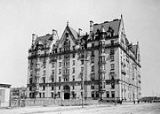
The Dakota, constructed from October 25, 1880 to October 27, 1884, is a co-op
apartment
building located on the northwest corner of 72nd Street
and Central Park West
in the Upper West Side
of Manhattan
in New York City
. The building is most widely known as the location of the murder of musician John Lennon
.
The architectural firm of Henry Janeway Hardenbergh
was commissioned to create the design for Edward Clark
, head of the Singer Sewing Machine Company
. The firm also designed the Plaza Hotel
.
The building's high gable
s and deep roofs with a profusion of dormer
s, terracotta spandrel
s and panels, niches
, balconies, and balustrades
give it a North German Renaissance
character, an echo of a Hanseatic
townhall. Nevertheless, its layout and floor plan
betray a strong influence of French
architectural trends in housing design that had become known in New York in the 1870s.
According to often repeated stories, the Dakota was so named because at the time it was built, the Upper West Side
of Manhattan was sparsely inhabited and considered as remote as the Dakota Territory
. However, the earliest recorded appearance of this account is in a 1933 newspaper story. It is more likely that the building was named "The Dakota" because of Clark's fondness for the names of the new western states and territories. High above the 72nd Street entrance, the figure of a Dakota
Indian keeps watch. The Dakota was added to the National Register of Historic Places in 1972, and was declared a National Historic Landmark
in 1976.
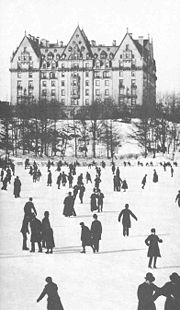

_entrance_by_david_shankbone.jpg) The Dakota is square, built around a central courtyard. The arched main entrance is a porte cochère large enough for the horse-drawn carriages that once entered and allowed passengers to disembark sheltered from the weather. Many of these carriages were housed in a multi-story stable building built in two sections, 1891–94, at the southwest corner of 77th Street and Amsterdam Avenue, where elevators lifted them to the upper floors. The "Dakota Stables" building was in operation as a garage until February 2007, when it was slated to be transformed by the Related Companies into a condominium residence. Since then, the large condominium building "The Harrison" occupies its spot. As of 2011, there is no onsite commemoration of the stable building having ever existed.
The Dakota is square, built around a central courtyard. The arched main entrance is a porte cochère large enough for the horse-drawn carriages that once entered and allowed passengers to disembark sheltered from the weather. Many of these carriages were housed in a multi-story stable building built in two sections, 1891–94, at the southwest corner of 77th Street and Amsterdam Avenue, where elevators lifted them to the upper floors. The "Dakota Stables" building was in operation as a garage until February 2007, when it was slated to be transformed by the Related Companies into a condominium residence. Since then, the large condominium building "The Harrison" occupies its spot. As of 2011, there is no onsite commemoration of the stable building having ever existed.
The general layout of the apartments is in the French style of the period, with all major rooms not only connected to each other, in enfilade, in the traditional way, but also accessible from a hall or corridor, an arrangement that allows a natural migration for guests from one room to another, especially on festive occasions, yet gives service staff discreet separate circulation patterns that offer service access to the main rooms. The principal rooms, such as parlors or the master bedroom, face the street, while the dining room
, kitchen, and other auxiliary rooms are oriented toward the courtyard. Apartments thus are aired from two sides, which was a relative novelty in Manhattan at the time. (In the Stuyvesant
building, which was built in 1869, a mere ten years earlier, and which is considered Manhattan's first apartment building in the French style, many apartments have windows to one side only.) Some of the drawing rooms are 49 ft (14.9 m) long, and many of the ceilings are 14 ft (4.3 m) high; the floors are inlaid with mahogany
, oak
, and cherry
(although in the apartment of Clark, the building's founder, famously, some floors were inlaid with sterling silver
).
Originally, the Dakota had sixty-five apartments with four to twenty rooms, no two being alike. These apartments are accessed by staircases and elevators placed in the four corners of the courtyard. Separate service stairs and elevators serving the kitchens are located in mid-block. Built to cater for the well-to-do, The Dakota featured many amenities and a modern infrastructure that was exceptional for the time. The building has a large dining hall; meals also could be sent up to the apartments by dumbwaiters
. Electricity was generated by an in-house power plant and the building has central heating
. Beside servant quarters, there was a playroom and a gymnasium under the roof. In later years, these spaces on the tenth floor were converted into apartments for economic reasons. The Dakota property also contained a garden, private croquet
lawns, and a tennis
court behind the building between 72nd and 73rd Streets.
The Dakota was a huge social success from the very start (all apartments were let before the building opened), but it was a long-term drain on the fortune of Clark (who died before it was completed) and his heirs. For the high society of Manhattan, it became fashionable to live in the building, or at least to rent an apartment there as a secondary city residence, and The Dakota's success prompted the construction of many other luxury apartment buildings in Manhattan.
John Lennon
from 1973 on, and was the location of Lennon's murder by Mark David Chapman
on December 8, 1980. As of 2010, Lennon's wife, Yoko Ono
, still has several apartments in the building. The Strawberry Fields memorial
was laid out in memory of Lennon in Central Park
directly across Central Park West. Every year, Ono marks the anniversary of Lennon's death with a now-public pilgrimage to the memorial, and by placing a single lit candle in the window of one of her apartments.
Although historically home to many creative or artistic people, the building and its co-op board of directors were criticized in 2005 by former resident Albert Maysles. He attempted to sell his ownership to actors Melanie Griffith
and Antonio Banderas
, but they were rejected. Maysles expressed his "disappointment with the way the building seems to be changing" by telling The New York Times
: "What's so shocking is that the building is losing its touch with interesting people. More and more, they're moving away from creative people and going toward people who just have the money." Even prior to this, both Gene Simmons
, Billy Joel
, and Carly Simon
were denied residency by the board. In 2002 The Dakota rejected corrugated-cardboard magnate and Democratic nominee for Lieutenant Governor of New York, Dennis Mehiel.
Housing cooperative
A housing cooperative is a legal entity—usually a corporation—that owns real estate, consisting of one or more residential buildings. Each shareholder in the legal entity is granted the right to occupy one housing unit, sometimes subject to an occupancy agreement, which is similar to a lease. ...
apartment
Apartment
An apartment or flat is a self-contained housing unit that occupies only part of a building...
building located on the northwest corner of 72nd Street
72nd Street (Manhattan)
72nd Street is one of the major bi-directional crosstown streets in the New York City borough of Manhattan. Where the west end of 72nd Street curves into the south end of Riverside Drive, the memorial to Eleanor Roosevelt stands in Riverside Park. At this end of the street is the landmarked...
and Central Park West
Central Park West
Central Park West is an avenue that runs north-south in the New York City borough of Manhattan, in the United States....
in the Upper West Side
Upper West Side
The Upper West Side is a neighborhood in the borough of Manhattan, New York City, that lies between Central Park and the Hudson River and between West 59th Street and West 125th Street...
of Manhattan
Manhattan
Manhattan is the oldest and the most densely populated of the five boroughs of New York City. Located primarily on the island of Manhattan at the mouth of the Hudson River, the boundaries of the borough are identical to those of New York County, an original county of the state of New York...
in New York City
New York City
New York is the most populous city in the United States and the center of the New York Metropolitan Area, one of the most populous metropolitan areas in the world. New York exerts a significant impact upon global commerce, finance, media, art, fashion, research, technology, education, and...
. The building is most widely known as the location of the murder of musician John Lennon
John Lennon
John Winston Lennon, MBE was an English musician and singer-songwriter who rose to worldwide fame as one of the founding members of The Beatles, one of the most commercially successful and critically acclaimed acts in the history of popular music...
.
The architectural firm of Henry Janeway Hardenbergh
Henry Janeway Hardenbergh
Henry Janeway Hardenbergh was an American architect, best known for his hotels and apartment buildings.-Life and career:...
was commissioned to create the design for Edward Clark
Edward Clark (manufacturer)
Edward C. Clark or Edward S. Clark was a founder of the Singer Sewing Machine Company, along with his business partner of Isaac Merritt Singer...
, head of the Singer Sewing Machine Company
Singer Corporation
Singer Corporation is a manufacturer of sewing machines, first established as I.M. Singer & Co. in 1851 by Isaac Merritt Singer with New York lawyer Edward Clark. Best known for its sewing machines, it was renamed Singer Manufacturing Company in 1865, then The Singer Company in 1963. It is...
. The firm also designed the Plaza Hotel
Plaza Hotel
The Plaza Hotel in New York City is a landmark 20-story luxury hotel with a height of and length of that occupies the west side of Grand Army Plaza, from which it derives its name, and extends along Central Park South in Manhattan. Fifth Avenue extends along the east side of Grand Army Plaza...
.
The building's high gable
Gable
A gable is the generally triangular portion of a wall between the edges of a sloping roof. The shape of the gable and how it is detailed depends on the structural system being used and aesthetic concerns. Thus the type of roof enclosing the volume dictates the shape of the gable...
s and deep roofs with a profusion of dormer
Dormer
A dormer is a structural element of a building that protrudes from the plane of a sloping roof surface. Dormers are used, either in original construction or as later additions, to create usable space in the roof of a building by adding headroom and usually also by enabling addition of windows.Often...
s, terracotta spandrel
Spandrel
A spandrel, less often spandril or splaundrel, is the space between two arches or between an arch and a rectangular enclosure....
s and panels, niches
Niche (architecture)
A niche in classical architecture is an exedra or an apse that has been reduced in size, retaining the half-dome heading usual for an apse. Nero's Domus Aurea was the first semi-private dwelling that possessed rooms that were given richly varied floor plans, shaped with niches and exedras;...
, balconies, and balustrades
Baluster
A baluster is a moulded shaft, square or of lathe-turned form, one of various forms of spindle in woodwork, made of stone or wood and sometimes of metal, standing on a unifying footing, and supporting the coping of a parapet or the handrail of a staircase. Multiplied in this way, they form a...
give it a North German Renaissance
German Renaissance
The German Renaissance, part of the Northern Renaissance, was a cultural and artistic movement that spread among German thinkers in the 15th and 16th centuries, which originated from the Italian Renaissance in Italy...
character, an echo of a Hanseatic
Hanseatic League
The Hanseatic League was an economic alliance of trading cities and their merchant guilds that dominated trade along the coast of Northern Europe...
townhall. Nevertheless, its layout and floor plan
Floor plan
In architecture and building engineering, a floor plan, or floorplan, is a diagram, usually to scale, showing a view from above of the relationships between rooms, spaces and other physical features at one level of a structure....
betray a strong influence of French
France
The French Republic , The French Republic , The French Republic , (commonly known as France , is a unitary semi-presidential republic in Western Europe with several overseas territories and islands located on other continents and in the Indian, Pacific, and Atlantic oceans. Metropolitan France...
architectural trends in housing design that had become known in New York in the 1870s.
According to often repeated stories, the Dakota was so named because at the time it was built, the Upper West Side
Upper West Side
The Upper West Side is a neighborhood in the borough of Manhattan, New York City, that lies between Central Park and the Hudson River and between West 59th Street and West 125th Street...
of Manhattan was sparsely inhabited and considered as remote as the Dakota Territory
Dakota Territory
The Territory of Dakota was an organized incorporated territory of the United States that existed from March 2, 1861, until November 2, 1889, when the final extent of the reduced territory was split and admitted to the Union as the states of North and South Dakota.The Dakota Territory consisted of...
. However, the earliest recorded appearance of this account is in a 1933 newspaper story. It is more likely that the building was named "The Dakota" because of Clark's fondness for the names of the new western states and territories. High above the 72nd Street entrance, the figure of a Dakota
Sioux
The Sioux are Native American and First Nations people in North America. The term can refer to any ethnic group within the Great Sioux Nation or any of the nation's many language dialects...
Indian keeps watch. The Dakota was added to the National Register of Historic Places in 1972, and was declared a National Historic Landmark
National Historic Landmark
A National Historic Landmark is a building, site, structure, object, or district, that is officially recognized by the United States government for its historical significance...
in 1976.
Features
The general layout of the apartments is in the French style of the period, with all major rooms not only connected to each other, in enfilade, in the traditional way, but also accessible from a hall or corridor, an arrangement that allows a natural migration for guests from one room to another, especially on festive occasions, yet gives service staff discreet separate circulation patterns that offer service access to the main rooms. The principal rooms, such as parlors or the master bedroom, face the street, while the dining room
Dining room
A dining room is a room for consuming food. In modern times it is usually adjacent to the kitchen for convenience in serving, although in medieval times it was often on an entirely different floor level...
, kitchen, and other auxiliary rooms are oriented toward the courtyard. Apartments thus are aired from two sides, which was a relative novelty in Manhattan at the time. (In the Stuyvesant
Stuyvesant High School
Stuyvesant High School , commonly referred to as Stuy , is a New York City public high school that specializes in mathematics and science. The school opened in 1904 on Manhattan's East Side and moved to a new building in Battery Park City in 1992. Stuyvesant is noted for its strong academic...
building, which was built in 1869, a mere ten years earlier, and which is considered Manhattan's first apartment building in the French style, many apartments have windows to one side only.) Some of the drawing rooms are 49 ft (14.9 m) long, and many of the ceilings are 14 ft (4.3 m) high; the floors are inlaid with mahogany
Mahogany
The name mahogany is used when referring to numerous varieties of dark-colored hardwood. It is a native American word originally used for the wood of the species Swietenia mahagoni, known as West Indian or Cuban mahogany....
, oak
Oak
An oak is a tree or shrub in the genus Quercus , of which about 600 species exist. "Oak" may also appear in the names of species in related genera, notably Lithocarpus...
, and cherry
Cherry
The cherry is the fruit of many plants of the genus Prunus, and is a fleshy stone fruit. The cherry fruits of commerce are usually obtained from a limited number of species, including especially cultivars of the wild cherry, Prunus avium....
(although in the apartment of Clark, the building's founder, famously, some floors were inlaid with sterling silver
Sterling silver
Sterling silver is an alloy of silver containing 92.5% by mass of silver and 7.5% by mass of other metals, usually copper. The sterling silver standard has a minimum millesimal fineness of 925....
).
Originally, the Dakota had sixty-five apartments with four to twenty rooms, no two being alike. These apartments are accessed by staircases and elevators placed in the four corners of the courtyard. Separate service stairs and elevators serving the kitchens are located in mid-block. Built to cater for the well-to-do, The Dakota featured many amenities and a modern infrastructure that was exceptional for the time. The building has a large dining hall; meals also could be sent up to the apartments by dumbwaiters
Dumbwaiter (elevator)
Dumbwaiters are small freight elevators intended to carry objects rather than people. Dumbwaiters found within modern structures, including both commercial and private buildings, are often connected between two floors...
. Electricity was generated by an in-house power plant and the building has central heating
Central heating
A central heating system provides warmth to the whole interior of a building from one point to multiple rooms. When combined with other systems in order to control the building climate, the whole system may be a HVAC system.Central heating differs from local heating in that the heat generation...
. Beside servant quarters, there was a playroom and a gymnasium under the roof. In later years, these spaces on the tenth floor were converted into apartments for economic reasons. The Dakota property also contained a garden, private croquet
Croquet
Croquet is a lawn game, played both as a recreational pastime and as a competitive sport. It involves hitting plastic or wooden balls with a mallet through hoops embedded into the grass playing court.-History:...
lawns, and a tennis
Tennis
Tennis is a sport usually played between two players or between two teams of two players each . Each player uses a racket that is strung to strike a hollow rubber ball covered with felt over a net into the opponent's court. Tennis is an Olympic sport and is played at all levels of society at all...
court behind the building between 72nd and 73rd Streets.
The Dakota was a huge social success from the very start (all apartments were let before the building opened), but it was a long-term drain on the fortune of Clark (who died before it was completed) and his heirs. For the high society of Manhattan, it became fashionable to live in the building, or at least to rent an apartment there as a secondary city residence, and The Dakota's success prompted the construction of many other luxury apartment buildings in Manhattan.
Death of John Lennon
The building was the home of former BeatleThe Beatles
The Beatles were an English rock band, active throughout the 1960s and one of the most commercially successful and critically acclaimed acts in the history of popular music. Formed in Liverpool, by 1962 the group consisted of John Lennon , Paul McCartney , George Harrison and Ringo Starr...
John Lennon
John Lennon
John Winston Lennon, MBE was an English musician and singer-songwriter who rose to worldwide fame as one of the founding members of The Beatles, one of the most commercially successful and critically acclaimed acts in the history of popular music...
from 1973 on, and was the location of Lennon's murder by Mark David Chapman
Mark David Chapman
Mark David Chapman is an American prison inmate who murdered former Beatles member John Lennon on December 8, 1980. He committed the crime as Lennon and Yoko Ono were outside of The Dakota apartment building in New York City. Chapman aimed five shots at Lennon, hitting him four times in his back...
on December 8, 1980. As of 2010, Lennon's wife, Yoko Ono
Yoko Ono
is a Japanese artist, musician, author and peace activist, known for her work in avant-garde art, music and filmmaking as well as her marriage to John Lennon...
, still has several apartments in the building. The Strawberry Fields memorial
Strawberry Fields Memorial
Strawberry Fields is a landscaped section in New York City's Central Park that is dedicated to the memory of the musician John Lennon. It is named after the Beatles song "Strawberry Fields Forever".-Creation and location:...
was laid out in memory of Lennon in Central Park
Central Park
Central Park is a public park in the center of Manhattan in New York City, United States. The park initially opened in 1857, on of city-owned land. In 1858, Frederick Law Olmsted and Calvert Vaux won a design competition to improve and expand the park with a plan they entitled the Greensward Plan...
directly across Central Park West. Every year, Ono marks the anniversary of Lennon's death with a now-public pilgrimage to the memorial, and by placing a single lit candle in the window of one of her apartments.
In popular culture
- In the film Rosemary's BabyRosemary's Baby (film)Rosemary's Baby is a 1968 American horror film written and directed by Roman Polanski, based on the bestselling 1967 novel Rosemary's Baby by Ira Levin...
, the Dakota is used for exterior shots of the apartment building where the couple lives.
- In the film Cruel IntentionsCruel IntentionsCruel Intentions is a 1999 American drama film starring Sarah Michelle Gellar, Ryan Phillippe, Reese Witherspoon, and Selma Blair. The film is an adaptation of the 18th-century French epistolary novel Les Liaisons dangereuses by Laclos and is set among wealthy teenagers living in modern New York...
, the Dakota is used for the exterior shots of the apartment building where Kathryn and Sebastian live.
- It is an important element in the novel Time and AgainTime and Again (novel)Time and Again is a 1970 illustrated novel by Jack Finney. The many illustrations in the book are real, though, as explained in an endnote, not all are from the 1882 period in which the actions of the book take place. It had long been rumored that Robert Redford would convert the book into a movie...
.
- The song 20 Years In the Dakota by HoleHole (band)Hole is an American alternative rock band that originally formed in Los Angeles in 1989. The band is fronted by vocalist/songwriter and rhythm guitarist Courtney Love, who co-founded Hole with former songwriter/lead guitarist Eric Erlandson...
discusses Yoko OnoYoko Onois a Japanese artist, musician, author and peace activist, known for her work in avant-garde art, music and filmmaking as well as her marriage to John Lennon...
's life in the building after John LennonJohn LennonJohn Winston Lennon, MBE was an English musician and singer-songwriter who rose to worldwide fame as one of the founding members of The Beatles, one of the most commercially successful and critically acclaimed acts in the history of popular music...
's death; it was released on their 1997 compilation album, My Body, the Hand GrenadeMy Body, the Hand GrenadeMy Body, the Hand Grenade is a compilation album by alternative rock band Hole that includes b-sides, demo recordings, live songs, and other rarities and unreleased tracks by the band...
.
- It is also the home of Hunter Rose, from the graphic novel series GrendelGrendel (comics)Grendel is a long-running series of comic books originally created by American author Matt Wagner. First published by Comico, Wagner has now moved his character to Dark Horse. Originally a noir comic in the style of European titles such as Diabolik, it has evolved into, in Wagner's words, a study...
.
- It is also the home of Tsukasa Domyouji, from the popular 2007 Japanese live-action drama Hana Yori Dango ReturnsHana Yori Dango Returns (TV series)Hana Yori Dango Returns is a Japanese television drama series, broadcast on TBS in 2007. It is the sequel to 2005 Hana Yori Dango TV series, based on Japanese shōjo manga series, , written by Yoko Kamio, and followed by movie adaptation Hana Yori Dango Final.-Synopsis:Hana Yori Dango returns for...
.
Notable residents
Well-known residents of the Dakota building have included:- John Angelo, financier
- Lauren BacallLauren BacallLauren Bacall is an American film and stage actress and model, known for her distinctive husky voice and sultry looks.She first emerged as leading lady in the Humphrey Bogart film To Have And Have Not and continued on in the film noir genre, with appearances in The Big Sleep and Dark Passage ,...
, actress - Harley BaldwinHarley BaldwinHarley Baldwin was an American developer and art dealer who divided his time between residences in Aspen, Colorado, and New York City...
, real estate developer and art dealer - Ward Bennett, architect and designer,
- Leonard BernsteinLeonard BernsteinLeonard Bernstein August 25, 1918 – October 14, 1990) was an American conductor, composer, author, music lecturer and pianist. He was among the first conductors born and educated in the United States of America to receive worldwide acclaim...
, composer and conductor - Connie ChungConnie ChungConnie Chung, full name: Constance Yu-Hwa Chung Povich is an American journalist who has been an anchor and reporter for the U.S. television news networks NBC, CBS, ABC, CNN, and MSNBC. Some of her more famous interview subjects include Claus von Bülow and U.S...
, newscaster - Rosemary ClooneyRosemary ClooneyRosemary Clooney was an American singer and actress. She came to prominence in the early 1950s with the novelty hit "Come On-a My House" written by William Saroyan and his cousin Ross Bagdasarian , which was followed by other pop numbers such as "Botch-a-Me" Rosemary Clooney (May 23, 1928 –...
singer, actor - Harlan CobenHarlan CobenHarlan Coben is an American author of mystery novels and thrillers. The plots of his novels often involve the resurfacing of unresolved or misinterpreted events in the past and often have multiple plot twists...
, author - José FerrerJosé FerrerJosé Vicente Ferrer de Otero y Cintrón , best known as José Ferrer, was a Puerto Rican actor, as well as a theater and film director...
, actor - Roberta FlackRoberta FlackRoberta Flack is an American singer, songwriter, and musician who is notable for jazz, soul, R&B, and folk music...
, singer. Flack lives next door to Yoko Ono. - Judy GarlandJudy GarlandJudy Garland was an American actress and singer. Through a career that spanned 45 of her 47 years and for her renowned contralto voice, she attained international stardom as an actress in musical and dramatic roles, as a recording artist and on the concert stage...
, actress - Lillian GishLillian GishLillian Diana Gish was an American stage, screen and television actress whose film acting career spanned 75 years, from 1912 to 1987....
, actress - Paul GoldbergerPaul GoldbergerPaul Goldberger is the Architecture Critic for The New Yorker, where since 1997 he has written the magazine's celebrated "Sky Line" column. He also holds the Joseph Urban Chair in Design and Architecture at The New School in New York City...
, architecture critic - William IngeWilliam IngeWilliam Motter Inge was an American playwright and novelist, whose works typically feature solitary protagonists encumbered with strained sexual relations. In the early 1950s, he had a string of memorable Broadway productions, and one of these, Picnic, earned him a Pulitzer Prize...
, playwright - Boris KarloffBoris KarloffWilliam Henry Pratt , better known by his stage name Boris Karloff, was an English actor.Karloff is best remembered for his roles in horror films and his portrayal of Frankenstein's monster in Frankenstein , Bride of Frankenstein , and Son of Frankenstein...
, actor - John LennonJohn LennonJohn Winston Lennon, MBE was an English musician and singer-songwriter who rose to worldwide fame as one of the founding members of The Beatles, one of the most commercially successful and critically acclaimed acts in the history of popular music...
, musician and composer Lennon owned five apartments in The Dakota. - Sean LennonSean Lennonis an American singer, songwriter, musician, guitarist and actor. He is the only child of John Lennon and Yoko Ono. His godfather is Sir Elton John.-Early life and education:...
, singer - Warner LeRoyWarner LeRoyWarner LeRoy , was a New York businessman. LeRoy was the son of film producer-director Mervyn LeRoy and Mervyn's second wife, Doris Warner, and was the grandson of Harry Warner, one of the founders of Warner Bros...
, producer and restaurateur - John MaddenJohn MaddenJohn Madden may refer to:*Jack Madden, basketball referee*John Madden , American former football coach and television announcer*John Madden , ice hockey player...
, football coach and commentator - Albert MayslesAlbert and David MayslesAlbert and David Maysles were a documentary filmmaking team whose cinéma vérité works include Salesman , Gimme Shelter and Grey Gardens . Their 1964 film on The Beatles forms the backbone of the DVD, The Beatles: The First U.S. Visit...
, documentary filmmaker - Rudolf NureyevRudolf NureyevRudolf Khametovich Nureyev was a Russian dancer, considered one of the most celebrated ballet dancers of the 20th century. Nureyev's artistic skills explored expressive areas of the dance, providing a new role to the male ballet dancer who once served only as support to the women.In 1961 he...
, dancer - Joe NamathJoe NamathJoseph William "Joe" Namath , nicknamed "Broadway Joe" or "Joe Willie", is a former American football quarterback. He played college football for the University of Alabama under coach Paul "Bear" Bryant and his assistant, Howard Schnellenberger, from 1962–1964, and professional football in the...
, football player - Yoko OnoYoko Onois a Japanese artist, musician, author and peace activist, known for her work in avant-garde art, music and filmmaking as well as her marriage to John Lennon...
, artist - Jack PalanceJack PalanceJack Palance , was an American actor. During half a century of film and television appearances, Palance was nominated for three Academy Awards, all as Best Actor in a Supporting Role, winning in 1991 for his role in City Slickers.-Early life:Palance, one of five children, was born Volodymyr...
, actor - Ruth Porat, investment banker
- Maury PovichMaury PovichMaurice Richard "Maury" Povich is an American TV talk show host who currently hosts his self-titled talk show Maury.-Personal background:...
, television host - Gilda RadnerGilda RadnerGilda Susan Radner was an American comedian and actress, best known as one of the original cast members of the NBC sketch comedy show Saturday Night Live, for which she won an Emmy Award in 1978.-Early life:...
, comedian - Rex ReedRex ReedRex Taylor Reed is an American film critic and former co-host of the syndicated television show At the Movies. He currently writes the column "On the Town with Rex Reed" for The New York Observer.-Life and career:...
, critic - Jason RobardsJason RobardsJason Nelson Robards, Jr. was an American actor on stage, and in film and television, and a winner of the Tony Award , two Academy Awards and the Emmy Award...
, actor - Jane RosenthalJane RosenthalJane Rosenthal is an American film producer.Rosenthal was born in Denver, Colorado and raised in Providence, Rhode Island; she attended both Brown and New York University...
, film producer - Wilbur RossWilbur RossWilbur L. Ross, Jr. is an American investor known for restructuring failed companies in industries such as steel, coal, telecommunications, foreign investment and textiles. He specializes in leveraged buyouts and distressed businesses. In 2011, Forbes magazine listed Ross as one of the world's...
, financier - Robert RyanRobert RyanRobert Bushnell Ryan was an American actor who often played hardened cops and ruthless villains.-Early life and career:...
, actor. Robert Ryan initially sublet his apartment (#72) to John Lennon and Yoko Ono. They eventually purchased his former apartment after his death.
Although historically home to many creative or artistic people, the building and its co-op board of directors were criticized in 2005 by former resident Albert Maysles. He attempted to sell his ownership to actors Melanie Griffith
Melanie Griffith
Melanie Richards Griffith is an American actress. She is an Academy Award nominee and Golden Globe winner for her performance in the 1988 film Working Girl...
and Antonio Banderas
Antonio Banderas
José Antonio Domínguez Banderas , better known as Antonio Banderas, is a Spanish film actor, film director, film producer and singer...
, but they were rejected. Maysles expressed his "disappointment with the way the building seems to be changing" by telling The New York Times
The New York Times
The New York Times is an American daily newspaper founded and continuously published in New York City since 1851. The New York Times has won 106 Pulitzer Prizes, the most of any news organization...
: "What's so shocking is that the building is losing its touch with interesting people. More and more, they're moving away from creative people and going toward people who just have the money." Even prior to this, both Gene Simmons
Gene Simmons
Gene Simmons is an Israeli-American entrepreneur, singer-songwriter, actor, and rock bassist. Known as "The Demon", he is the bassist/vocalist of Kiss, a hard rock band he co-founded in the early 1970s.-Early life:...
, Billy Joel
Billy Joel
William Martin "Billy" Joel is an American musician and pianist, singer-songwriter, and classical composer. Since releasing his first hit song, "Piano Man", in 1973, Joel has become the sixth best-selling recording artist and the third best-selling solo artist in the United States, according to...
, and Carly Simon
Carly Simon
Carly Elisabeth Simon is an American singer-songwriter, musician, and children's author. She rose to fame in the 1970s with a string of hit records, and has since been the recipient of two Grammy Awards, an Academy Award, and a Golden Globe Award for her work...
were denied residency by the board. In 2002 The Dakota rejected corrugated-cardboard magnate and Democratic nominee for Lieutenant Governor of New York, Dennis Mehiel.