

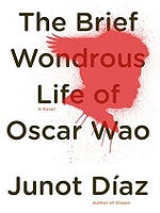
The Brief Wondrous Life of Oscar Wao

Encyclopedia
The Brief Wondrous Life of Oscar Wao (2007) is a best-selling novel
written by Dominican
author Junot Díaz
. Although a work of fiction, the novel is set in New Jersey
where Díaz was raised and deals explicitly with his ancestral homeland's experience under dictator
Rafael Trujillo. It has received numerous positive reviews from critics and went on to win numerous prestigious awards in 2008, such as the National Book Critics Circle Award
and the Pulitzer Prize for Fiction
. The title is a nod to Hemingway
's short story "The Short Happy Life of Francis Macomber
".
who is obsessed with science fiction
and fantasy novels and with falling in love, as well as the curse that has plagued his family for generations.
The middle sections of the novel center on the lives of Oscar's runaway sister, Lola; his mother, Hypatia Belicia Cabral; and his grandfather, Abelard. Rife with footnotes, science fiction and fantasy references, comic book analogies, and various Spanish dialects, the novel is also a meditation on story-telling, the Dominican diaspora and identity, masculinity, and oppression.
Most of the story is told by an apparently omniscient narrator who is eventually revealed to be Yunior de Las Casas, a college roommate of Oscar's who dated Lola. Yunior also appears in many of Diaz's short stories.
This chapter explains Oscar's history as a child through high school, focusing on his inability to find love.
When he was seven, Oscar had a week-long relationship with two girls at the same time, Maritza Chacón and Olga Polanco. When Maritza gives Oscar an ultimatum, he breaks up with Olga, only to be quickly dumped by Maritza. The narrator mentions that this event will cause all three of them to be unlucky in love.
In high school, Oscar is an outcast. He is very overweight and his fascination with "the Genres" causes him to be teased. When his two friends Al and Miggs both find girlfriends and do not involve Oscar (or try to help Oscar find a girlfriend), Oscar quickly stops spending time with them.
During his senior year of high school, Oscar takes an SAT review course. There, he meets and shortly begins to spend a lot of time with a girl named Ana Obregón. Oscar shortly falls in love with Ana. When her ex-boyfriend Manny returns from the Army, Ana stops spending time with Oscar. It is around this time that Oscar begins to start writing heavily, science fiction or fantasy stories, mostly centered around the end of the world.
When Oscar discovers that Manny has been physically abusing Ana, Oscar takes his uncle's gun and stands outside of Manny's apartment, but Manny never returns that night.
The chapter ends with Oscar revealing his love to Ana, Ana rejecting him, and Oscar going away to college at Rutgers.
It opens with Lola telling, in the second person (after a few pages changing to first person), the story of how she found out her mother had breast cancer. It then proceeds to explore the negative relationship that Lola had with her mother. This poor relationship causes Lola to run away from home to live with her boyfriend and his father on the Jersey Shore
. After a bit of time, Lola finds herself again unhappy and calls home. She talks with Oscar and convinces him to bring money and meet Lola at a coffee shop. When they meet up, Lola discovers that Oscar told their mother about the meeting.
In an effort to run away from the coffee shop and from her mother, Lola accidentally knocks her cancer-ridden mother over. When Lola turns around to make sure her mother is okay, her mother grabs Lola by the hand, revealing that she was faking crying in an effort to get Lola to come back.
As a result of her running away, Lola is sent to live with her grandmother, La Inca, in the Dominican Republic.
It is revealed that Beli's family died when she was one, with rumors that Trujillo was responsible. She was raised by a series of abusive foster families until her father's cousin, La Inca, rescues her from such a life. La Inca continually tells Beli that her father was a doctor, and that her mother was a nurse as a way to remind Beli of her heritage. La Inca brings Beli back to her hometown of Baní, where La Inca runs a bakery.
At the age of 13, Beli lands a scholarship at El Redentor, one of the best schools in Baní. There, she falls in love with a light-skinned boy named Jack Pujols, and spends a lot of her time trying to earn his affection, to no avail. Because she is poor and dark-skinned, Beli is often made fun of, and is a social outcast. However, during the summer of sophomore year, Beli quickly develops into a full grown and well endowed woman, and the book describes how Beli becomes very popular with men of all ages.
With her new body, Beli is finally able to catch the attention of Jack Pujols and loses her virginity to him. However, when they are discovered in a closet together, Beli is kicked out of school. Instead of transferring to a different school, however, she earns a job at a restaurant run by two Chinese immigrants brothers, Juan and José Then, where she works as a waitress.
After a time, Beli goes to a club with another waitress named Constantina. There, she meets a gangster, and the two of them form a relationship. Eventually, Beli becomes pregnant with the gangster's child. It is then revealed that the gangster is in fact married to one of Trujillo's sisters, "known affectionately as La Fea" (The Ugly). When La Fea discovers that Beli is pregnant with her husband's child, she has two large cops resembling Elvis, with pompadour hairstyles, kidnap Beli, with plans to take her to have a forced abortion. As she is being led to the car, she sees a third cop who does not have a face. Before the cops can drive away, Beli spots and calls for help from the Then brothers, who save her, but only temporarily. Soon, Beli is tricked into being taken by the cops. On the drive to a cane field, the two cops physically beat Beli close to death, and continue to do so in the cane field. Her fetus dies due to the injuries.
When she discovers that Beli has been taken, La Inca begins to pray very intensely, and in short order, a small but intense prayer group forms around La Inca.
Back in the cane field, after she has been left for dead, a mongoose with golden eyes appears and leads Beli out of the cane, telling her that she will have two children. As Beli returns to the road, she is picked up by a group of traveling musicians. Thanks to La Inca's connections in the medical community, Beli is nursed back to health.
After Beli returns to La Inca's care, it quickly becomes apparent that Beli will not be safe in the Dominican Republic under Trujillo, and so she is sent to live in New York.
Oscar is captured by the Capitan's friends, whom Yunior calls Gorilla Grod and Solomon Grundy, and they drive Oscar (and Clives) again to the cane field. Oscar reiterates the power of love and indicates that death would turn him into a "hero, an avenger. Because anything you can dream... you can be. " They then shoot Oscar, but his speech suggests that he is fulfilling his life-long dream of becoming something worth writing about.
The chapter ends with the word "Oscar" interrupted by a dash. It is unclear if this is interrupted narration for Yunior or a direct address to Oscar.
Yunior even makes reference in the footnotes to his present life earlier in the novel than when he describes it in Chapter Eight. “In my first draft, Samaná
was actually Jarabacoa
, but then my girl Leonie, resident expert in all things Domo, pointed out that there are no beaches in Jarabacoa. ” Yunior thus builds the writing of the novel and his relationship with Oscar into the greater history of the Dominican Republic. The many science fiction references throughout the novel and footnotes emphasize (Yunior believes) the fantastical elements of Dominican history. Yunior cites the fall of Mordor and the dispelling of evil from Middle Earth from The Lord of the Rings
trilogy as a complement to the fall of Trujillo.
The footnotes contain many references specifically to the reign of Rafael Trujillo from 1930 to 1961, providing historical background on figures like the Mirabal Sisters
, who were assassinated by Trujillo, and Anacaona
, an indigenous woman who fought against the invading Spanish colonialists. While referencing historical figures, Yunior frequently includes the novel’s fictional characters in the historical events.
“But what was even more ironic was that Abelard had a reputation for being able to keep his head down during the worst of the regime’s madness-- for unseeing, as it were. In 1937, for example, while the Friends of the Dominican Republic were prerejiling Haitians and Haitian-Dominicans and Haitian-looking Dominicans to death, while genocide was, in fact, in the making, Abelard kept his head, eyes, and nose safely tucked into his books (let his wife take care of hiding his servants, didn’t ask her nothing about it) and when survivors staggered into his surgery with unspeakable machete wounds, he fixed them up as best he could without making any comments as to the ghastliness of their wounds. ”
Yunior thus builds a context for the Dominican history, where the characters are used just as much in the footnotes as they are in the body of the novel.
Much of the footnotes, ultimately, connect back to themes of coming to a new world (emphasized through the novel’s references to fantasy and sci-fi) or having one’s own world completely changed. Trujillo’s reign as revealed in the footnotes of the novel becomes just as dystopian as one of Oscar’s favorite science fiction novels.
Before her family is taken, Abelard’s wife has dreams of a faceless man standing over the beds of her husband and children, suggesting the man represents the approaching ill fates of her family.
Oscar also sees the faceless man as an old man in a rocking chair near a gas station as he is being taken to the cane field for the first time. Soon after, he has the impression that the faceless man has joined his two torturers in beating him. In this instance, the faceless man not only precedes the violence but is also perceived as participating in it.
It is possible that facelessness of the man mirrors the loss of identity throughout the generations of the de Leon family. Abelard is dehumanized in prison when the curse starts, and Beli is orphaned and unable to find a place where she fits in. Her children are deprived of their identity when forced to grow up separated from their heritage and the Dominican Republic.
It is possible to view the faceless man as more than the manifestation of fuku. With the one exception of Oscar’s beating in the cane field, the faceless man is never even perceived as participating in the violence, and instead often acts as a warning of pain to come. The fact that the warnings were not heeded cannot be used as evidence for his malevolence. Furthermore, it is the dream of the man without a face that Yunior believes will spur Lola’s daughter to break the curse. Yunior also has dreams of Oscar as the faceless man that are harder to explain. It is possible that they serve as a warning to Yunior, as his life is spiraling out of his control. This dream also may suggest that fuku still exists and has claimed Oscar. However, if in claiming him, the curse has stolen Oscar’s face, it raises the question of who the earlier faceless men are and how evil they may actually be.
is a small, fast mammal, native to Asia, Africa, and Europe. The mongoose is known for its sociability and cunning. Like the de Leon family, the mongoose is an immigrant, an invasive, non-native species. The mongoose was transplanted westward to the Dominican Republic, just as Oscar’s family was forced out of the Dominican Republic. Diaz has stated the importance of the mongoose as being alien, creating an other-worldly quality to its assistance. Furthermore, in a footnote, the mongoose is described as “an enemy of kingly charriots, chains, and hierarchies.... an ally of Man”, suggesting the mongoose’s importance in helping the de Leon family not just for their misfortune but also as a means of undermining Trujillo’s oppression.
At the most superficial level, the Mongoose can be equated with the zafa, the counterspell to the family’s fuku. For example, when Beli is beaten in the canefield, a “creature that would have been an amiable mongoose if not for its golden lion eyes and the absolute black of its pelt” motivates Beli and sings to her to guide her out of the canefield. The creature acts as her protector, saving her after the atrocities just committed against her. The Mongoose further stops a bus directly in front of her, preventing her from being hit and providing her transportation to safety. Similarly, Oscar remembers a “Golden Mongoose” which appeared just before he throws himself from the bridge and again when he is beaten in the canefield for the first time. In the canefield, the Mongoose talks to Oscar and saves him just as Beli was saved. Furthermore, just as the singing mongoose leads Beli to safety, a singing voice leads Clives to Oscar.
However, not all interactions with the Mongoose are unequivocally positive, suggesting some complexity in defining this creature as the family’s zafa. The Mongoose that appears to Oscar before he jumps makes no move to stop Oscar from jumping, and although Oscar’s survival is miraculous, the Mongoose played no explicit role in this survival (though the supernatural could easily be credited).
Finally, the Mongoose and the man without a face are seen together in Oscar’s dream about a bus which his entire family gets onto, and “who is driving the bus but the Mongoose, and who is the cobrador but the Man Without a Face” (cobrador can be defined as the collector—Annotated). In this vision, the expected roles of mongoose as zafa and faceless man as fuku are questioned. It is the mongoose who is driving the whole family along their path and the faceless man is simply collecting the inevitable payment for the journey chosen by the mongoose.
“Of what import are brief, nameless lives…to Galactus?” (epigraph 1): asks the reader to consider the storytelling premise of Oscar Wao – to what extent can the travails of Oscar, Lola, Belicia, Yunior – all brief, nameless lives – be generalized to an entire culture or at least some specific collective? I.e., why is this a story Yunior thinks is worth telling? Diaz perhaps provides the beginning of an answer to this question in epigraph 2, with a line from Derek Walcott’s The Schooner ‘Flight’: “either I’m nobody, or I’m a nation.”
You want to know what being an X-man feels like…growing out of your chest (p. 23 fn 6): an early instance of the use of comic book/sci-fi/fantasy allusions with regard to their importance to Oscar and their usefulness to Yunior in telling Oscar’s story. Strong suggestion that this fantastical element of Oscar’s life is a powerful method for him to relate to other people and to their problems. Inverse of this statement suggests something about Oscar this is superpowerful and hints at developments late in the novel.
He realized…embarrassed by him (p. 29): judgmental, arguably ‘real world’ personalities clash with Oscar’s naïve, romantic, generally kindhearted attitude toward life, which includes among other things a lack of hierarchy. This instance might be read as a wake-up call for Oscar (although one that, given the ending, Oscar does not seem to particularly heed), or as a test of his goodness in refusing to judge anybody other than himself.
there was something in the seamlessness…impossible to know (pp. 34–5): description of Ana, one of Oscar’s many objects of affection. Idea of ‘switching masks’ and concealing one’s identity ties in nicely with the concept of a superhero’s ‘secret identity.’ Raises the question: how well can you really know a person?, or how well can one really know one’s self?, which in turn prods the reader toward Oscar Wao’s central issue of cultural identity. E.g. speaking in terms of cultural/personal identity, to what extent is this ability to change masks valuable or productive? Or might it instead be something dangerous and harmful? NB by way of answer ‘man with no face’ as perhaps instantiation of the fuku.
What a world she spun! (p. 86): refers to Beli and the stories she tells to her neighbors about the respect she commands and adoration she commands from her female and male classmates, respectively. Has less to do with comic books specifically per se as with storytelling and fiction in general. Obviously something deeply therapeutic about the act of telling a story – Yunior suggests early in the narrative it might be for him a sort of zafa for himself. Difficult to say whether Beli telling these untruths is either good or bad; they do no explicit harm and allow Beli to indulge in some characteristic self-aggrandizement, which act cannot be condemned without condemning Beli the character, in her entirety. More an instantiation of herself and her personality than anything else, i.e. this is just who she is. Also interesting that the self she presents later comes to be – relates to the idea of a story as self-fulfilling and powerful (cf annotation 1 re importance/usefulness of fiction).
one day he walked…old to the new (pp. 269–70): confirms the culture with which Oscar is so enamored as the one he grew up in and continues to live in – i.e. it’s not ‘childish’ in the strictest sense of the word. Oscar becomes old and disdainful of the new/young within the context of his sci-fi/fantasy culture. Reminds the reader how much a fundamental part of Oscar all this is. To the extent that comic books and fantasy have defined Oscar as an individual, may also have some explanatory usefulness with regard to Oscar’s choice to return to the D.R. and his resultant death.
as well as the Pulitzer Prize for Fiction
in 2008. New York
magazine named it the Best Novel of the Year and Time
magazine's Lev Grossman
named it #1 of the Top 10 Fiction Books of 2007, praising it as "a massive, heaving, sparking tragicomedy".
A staged version of the novel, called Fukú Americanus, was adapted by Sean San Jose and co-directed by San Jose and Marc Bamuthi Joséph through San Jose’s Campo Santo theatre company in 2009. The production received mixed reviews, with one critic stating that “Fukú" doesn't show us how that works or what the curse has to do with anything... for that, you have to read the book. ”
Novel
A novel is a book of long narrative in literary prose. The genre has historical roots both in the fields of the medieval and early modern romance and in the tradition of the novella. The latter supplied the present generic term in the late 18th century....
written by Dominican
Dominican Republic
The Dominican Republic is a nation on the island of La Hispaniola, part of the Greater Antilles archipelago in the Caribbean region. The western third of the island is occupied by the nation of Haiti, making Hispaniola one of two Caribbean islands that are shared by two countries...
author Junot Díaz
Junot Díaz
Junot Díaz is a Dominican-American writer and creative writing professor at Massachusetts Institute of Technology . Central to Díaz's work is the immigrant experience...
. Although a work of fiction, the novel is set in New Jersey
New Jersey
New Jersey is a state in the Northeastern and Middle Atlantic regions of the United States. , its population was 8,791,894. It is bordered on the north and east by the state of New York, on the southeast and south by the Atlantic Ocean, on the west by Pennsylvania and on the southwest by Delaware...
where Díaz was raised and deals explicitly with his ancestral homeland's experience under dictator
Dictator
A dictator is a ruler who assumes sole and absolute power but without hereditary ascension such as an absolute monarch. When other states call the head of state of a particular state a dictator, that state is called a dictatorship...
Rafael Trujillo. It has received numerous positive reviews from critics and went on to win numerous prestigious awards in 2008, such as the National Book Critics Circle Award
National Book Critics Circle Award
The National Book Critics Circle Award is an annual award given by the National Book Critics Circle to promote the finest books and reviews published in English....
and the Pulitzer Prize for Fiction
Pulitzer Prize for Fiction
The Pulitzer Prize for Fiction has been awarded for distinguished fiction by an American author, preferably dealing with American life. It originated as the Pulitzer Prize for the Novel, which was awarded between 1918 and 1947.-1910s:...
. The title is a nod to Hemingway
Ernest Hemingway
Ernest Miller Hemingway was an American author and journalist. His economic and understated style had a strong influence on 20th-century fiction, while his life of adventure and his public image influenced later generations. Hemingway produced most of his work between the mid-1920s and the...
's short story "The Short Happy Life of Francis Macomber
The Short Happy Life of Francis Macomber
"The Short Happy Life of Francis Macomber" is a short story by Ernest Hemingway. Set in Africa, it was published in the September 1936 issue of Cosmopolitan magazine concurrently with "The Snows of Kilimanjaro"...
".
Plot introduction
The book chronicles both the life of Oscar de Leon, an overweight Dominican boy growing up in Paterson, New JerseyPaterson, New Jersey
Paterson is a city serving as the county seat of Passaic County, New Jersey, United States. As of the 2010 United States Census, its population was 146,199, rendering it New Jersey's third largest city and one of the largest cities in the New York City Metropolitan Area, despite a decrease of 3,023...
who is obsessed with science fiction
Science fiction
Science fiction is a genre of fiction dealing with imaginary but more or less plausible content such as future settings, futuristic science and technology, space travel, aliens, and paranormal abilities...
and fantasy novels and with falling in love, as well as the curse that has plagued his family for generations.
The middle sections of the novel center on the lives of Oscar's runaway sister, Lola; his mother, Hypatia Belicia Cabral; and his grandfather, Abelard. Rife with footnotes, science fiction and fantasy references, comic book analogies, and various Spanish dialects, the novel is also a meditation on story-telling, the Dominican diaspora and identity, masculinity, and oppression.
Most of the story is told by an apparently omniscient narrator who is eventually revealed to be Yunior de Las Casas, a college roommate of Oscar's who dated Lola. Yunior also appears in many of Diaz's short stories.
Plot
This novel opens with an introductory section which explains the fukú -- "generally a curse or a doom of some kind; specifically the Curse and the Doom of the New World," and the zafa—a counterspell to the fukú. The narrator of the book, unknown to the reader at this point, explains that the story he is about to tell is his own form of a zafa.Part I
Part I of the book contains an introductory section, as well as the first four chapters of the story, and runs for over half the novel's length.Chapter One: Ghetto Nerd at the End of the World (1974-1987)
TEVIN'S chapter introduces the reader to the titular character Oscar de León. Oscar comes from a Dominican family, and is therefore expected to be successful with girls. However, Oscar is more interested in science fiction, cartoons, reading, and role-playing games.This chapter explains Oscar's history as a child through high school, focusing on his inability to find love.
When he was seven, Oscar had a week-long relationship with two girls at the same time, Maritza Chacón and Olga Polanco. When Maritza gives Oscar an ultimatum, he breaks up with Olga, only to be quickly dumped by Maritza. The narrator mentions that this event will cause all three of them to be unlucky in love.
In high school, Oscar is an outcast. He is very overweight and his fascination with "the Genres" causes him to be teased. When his two friends Al and Miggs both find girlfriends and do not involve Oscar (or try to help Oscar find a girlfriend), Oscar quickly stops spending time with them.
During his senior year of high school, Oscar takes an SAT review course. There, he meets and shortly begins to spend a lot of time with a girl named Ana Obregón. Oscar shortly falls in love with Ana. When her ex-boyfriend Manny returns from the Army, Ana stops spending time with Oscar. It is around this time that Oscar begins to start writing heavily, science fiction or fantasy stories, mostly centered around the end of the world.
When Oscar discovers that Manny has been physically abusing Ana, Oscar takes his uncle's gun and stands outside of Manny's apartment, but Manny never returns that night.
The chapter ends with Oscar revealing his love to Ana, Ana rejecting him, and Oscar going away to college at Rutgers.
Chapter Two: Wildwood (1982-1985)
The narrative changes to the first person, from the perspective of Lola, Oscar's sister. It explores the distant and often verbally abusive relationship that Lola has with her Old World Dominican mother, and Lola's resulting rebellion.It opens with Lola telling, in the second person (after a few pages changing to first person), the story of how she found out her mother had breast cancer. It then proceeds to explore the negative relationship that Lola had with her mother. This poor relationship causes Lola to run away from home to live with her boyfriend and his father on the Jersey Shore
Jersey Shore
The Jersey Shore is a term used to refer to both the Atlantic coast of the U.S. state of New Jersey and the adjacent resort and residential communities. . The New Jersey State Department of Tourism considers the Shore Region, Greater Atlantic City, and the Southern Shore to be distinct, each having...
. After a bit of time, Lola finds herself again unhappy and calls home. She talks with Oscar and convinces him to bring money and meet Lola at a coffee shop. When they meet up, Lola discovers that Oscar told their mother about the meeting.
In an effort to run away from the coffee shop and from her mother, Lola accidentally knocks her cancer-ridden mother over. When Lola turns around to make sure her mother is okay, her mother grabs Lola by the hand, revealing that she was faking crying in an effort to get Lola to come back.
As a result of her running away, Lola is sent to live with her grandmother, La Inca, in the Dominican Republic.
Chapter Three: The Three Heartbreaks of Belicia Cabral (1955-1962)
This chapter introduces the reader to the history of Oscar and Lola's mother, whose full name is revealed to be Hypatía Belicia Cabral, though she is usually referred to simply as Beli.It is revealed that Beli's family died when she was one, with rumors that Trujillo was responsible. She was raised by a series of abusive foster families until her father's cousin, La Inca, rescues her from such a life. La Inca continually tells Beli that her father was a doctor, and that her mother was a nurse as a way to remind Beli of her heritage. La Inca brings Beli back to her hometown of Baní, where La Inca runs a bakery.
At the age of 13, Beli lands a scholarship at El Redentor, one of the best schools in Baní. There, she falls in love with a light-skinned boy named Jack Pujols, and spends a lot of her time trying to earn his affection, to no avail. Because she is poor and dark-skinned, Beli is often made fun of, and is a social outcast. However, during the summer of sophomore year, Beli quickly develops into a full grown and well endowed woman, and the book describes how Beli becomes very popular with men of all ages.
With her new body, Beli is finally able to catch the attention of Jack Pujols and loses her virginity to him. However, when they are discovered in a closet together, Beli is kicked out of school. Instead of transferring to a different school, however, she earns a job at a restaurant run by two Chinese immigrants brothers, Juan and José Then, where she works as a waitress.
After a time, Beli goes to a club with another waitress named Constantina. There, she meets a gangster, and the two of them form a relationship. Eventually, Beli becomes pregnant with the gangster's child. It is then revealed that the gangster is in fact married to one of Trujillo's sisters, "known affectionately as La Fea" (The Ugly). When La Fea discovers that Beli is pregnant with her husband's child, she has two large cops resembling Elvis, with pompadour hairstyles, kidnap Beli, with plans to take her to have a forced abortion. As she is being led to the car, she sees a third cop who does not have a face. Before the cops can drive away, Beli spots and calls for help from the Then brothers, who save her, but only temporarily. Soon, Beli is tricked into being taken by the cops. On the drive to a cane field, the two cops physically beat Beli close to death, and continue to do so in the cane field. Her fetus dies due to the injuries.
When she discovers that Beli has been taken, La Inca begins to pray very intensely, and in short order, a small but intense prayer group forms around La Inca.
Back in the cane field, after she has been left for dead, a mongoose with golden eyes appears and leads Beli out of the cane, telling her that she will have two children. As Beli returns to the road, she is picked up by a group of traveling musicians. Thanks to La Inca's connections in the medical community, Beli is nursed back to health.
After Beli returns to La Inca's care, it quickly becomes apparent that Beli will not be safe in the Dominican Republic under Trujillo, and so she is sent to live in New York.
Chapter Four: Sentimental Education (1988-1992)
This chapter explores Oscar's time at Rutgers, and introduces the narrator, Yunior, who was Oscar's roommate and Lola's boyfriend.Part II
Part II of the book contains an introductory section, as well as chapters Five and Six of the story.Chapter Five: Poor Abelard (1944-1946)
This chapter is the story of Abelard, Belicia's father (Oscar and Lola's grandfather), and the "Bad Thing he said about Trujillo," which causes his family to be torn apart leaving most family members dead. The dictator, Trujillo, known for his sexual desire for young girls, whose families cannot protect them, learns that Abelard's oldest daughter, Jaquelyn, has become a beautiful young teenager. As a father Abelard does not want to give his daughter to Trujillo, as so many other fathers had been forced to do, and does not bring her to the event it had been demanded she come to. Some four weeks later Abelard is arrested for supposedly making a joke that there were no bodies in the trunk of his car. As Trujillo's henchmen disposed of opponents this way he was accused of slandering the dictator. After his arrest and torture his wife learns she is pregnant with what turns out to be her third daughter, Belicia. Two months after the baby's birth she is killed by an army truck in a probable suicide. Her two older daughters die under suspicious circumstance and the baby is taken to be criada, a child slave. Mistreated and bearing the scars of the hot oil thrown on her back she is rescued at the age of nine by her father's cousin, La Inca, whom she comes to regard as her mother.Chapter Six: Land of the Lost (1992-1995)
This chapter is about the post-college life of Oscar, and the time he spends in the Dominican Republic. He falls in love with an older prostitute named Ybón Pimentel. This results in Oscar being severely beaten, reflecting the same situation of his mother. The golden mongoose, which saved his mother's life, returns to save Oscar's life. Oscar returns to the United States.Part III
Part III of the book contains chapters Seven and Eight, an unnamed section, and the novel's epilogue, "The Final Letter." Part III contains an introductory section where Oscar visits and lies to Yunior about his plans for the future. They also discuss Yunior's relationship with Lola.Chapter Seven: The Final Voyage
Oscar returns to the Dominican Republic to write and to attempt to be with Ybón. His attempts take place over twenty-seven days in which he writes numerous letters to Ybón and shakes off any attempts from family or friends, including Lola, Yunior, La Inca, and Clives, to forget Ybón. Ybón herself resists Oscar for fear of the Capitan, but Oscar is persistent and waves off his family's fears as misunderstanding of their love.Oscar is captured by the Capitan's friends, whom Yunior calls Gorilla Grod and Solomon Grundy, and they drive Oscar (and Clives) again to the cane field. Oscar reiterates the power of love and indicates that death would turn him into a "hero, an avenger. Because anything you can dream... you can be. " They then shoot Oscar, but his speech suggests that he is fulfilling his life-long dream of becoming something worth writing about.
The chapter ends with the word "Oscar" interrupted by a dash. It is unclear if this is interrupted narration for Yunior or a direct address to Oscar.
Chapter Eight: The End of the Story
The narrator reveals the eventual fates of the characters. Beli's cancer returns one year after Oscar's return, killing her ten months later. Yunior speculates that she had given up. La Inca moves back to Bani. Lola breaks up with Yunior, asserting herself after having had enough of his cheating. She soon after meets someone in Miami, marries him, and has a baby girl, named Isis. Yunior has dreams of Oscar for ten years while his life deteriorates, until he hits rock bottom, and follows Oscar's request presumably to write this novel. At the time of the novel, Yunior is married in New Jersey (almost faithfully) and teaches composition at Community College. He and Lola still run into each other occasionally. Although he still thinks about her and how he might have saved their relationship, they only ever talk about Oscar.The Final Letter
This serves as an epilogue to the novel wherein Yunior describes letters he and Lola received from Oscar before he died. Lola was told to expect Oscar’s novel in the mail, which never arrives. Yunior, on the other hand, finds out that Oscar and Ybón did consummate their relationship.Footnotes
The Brief Wondrous Life of Oscar Wao makes extensive use of footnotes to the point that many of the characters are developed in the footnotes in addition to the story. Rather than just provide factual background, Yunior’s narrative continues in the footnotes just as it does in the body of the novel. When describing Oscar’s deep love of science fiction and fantasy literature, Yunior continues in the footnotes: “Where this outsized love of genre jumped off from no one quite seems to know. It might have been a consequence being Antillean (who more sci-fi than us?)... ” The presence of Yunior’s footnotes, therefore, remind the reader that there is always more to one’s story.Yunior even makes reference in the footnotes to his present life earlier in the novel than when he describes it in Chapter Eight. “In my first draft, Samaná
Samaná
Samaná is a province of the Dominican Republic. Its capital is Santa Bárbara de Samaná, usually known as Samaná.Samaná is located on the coast of the Atlantic Ocean in the northeastern part of the Dominican Republic. It is known for its mountains of which it is almost entirely formed...
was actually Jarabacoa
Jarabacoa
Jarabacoa is a town and the second largest municipality in La Vega Province, Dominican Republic.- History :In 1805, during the Haitian invasion of the Cibao, survivors from the massacres of Santiago de los Caballeros and La Vega escaped to the mountains of the Cordillera Central and settled in the...
, but then my girl Leonie, resident expert in all things Domo, pointed out that there are no beaches in Jarabacoa. ” Yunior thus builds the writing of the novel and his relationship with Oscar into the greater history of the Dominican Republic. The many science fiction references throughout the novel and footnotes emphasize (Yunior believes) the fantastical elements of Dominican history. Yunior cites the fall of Mordor and the dispelling of evil from Middle Earth from The Lord of the Rings
The Lord of the Rings
The Lord of the Rings is a high fantasy epic written by English philologist and University of Oxford professor J. R. R. Tolkien. The story began as a sequel to Tolkien's earlier, less complex children's fantasy novel The Hobbit , but eventually developed into a much larger work. It was written in...
trilogy as a complement to the fall of Trujillo.
The footnotes contain many references specifically to the reign of Rafael Trujillo from 1930 to 1961, providing historical background on figures like the Mirabal Sisters
Mirabal sisters
The Mirabal sisters were four Dominican political dissidents who opposed the dictatorship of Rafael Trujillo. Three of the sisters were assassinated by unknown persons...
, who were assassinated by Trujillo, and Anacaona
Anacaona
Anacaona , also called the Golden Flower, was a Taíno cacica , sister of Bohechío, chief of Jaragua, and wife of Caonabo, chief of the nearby territory of Maguana, two of the five highest caciques who ruled the island of Hispaniola when the Spaniards settled there in 1492...
, an indigenous woman who fought against the invading Spanish colonialists. While referencing historical figures, Yunior frequently includes the novel’s fictional characters in the historical events.
“But what was even more ironic was that Abelard had a reputation for being able to keep his head down during the worst of the regime’s madness-- for unseeing, as it were. In 1937, for example, while the Friends of the Dominican Republic were prerejiling Haitians and Haitian-Dominicans and Haitian-looking Dominicans to death, while genocide was, in fact, in the making, Abelard kept his head, eyes, and nose safely tucked into his books (let his wife take care of hiding his servants, didn’t ask her nothing about it) and when survivors staggered into his surgery with unspeakable machete wounds, he fixed them up as best he could without making any comments as to the ghastliness of their wounds. ”
Yunior thus builds a context for the Dominican history, where the characters are used just as much in the footnotes as they are in the body of the novel.
Much of the footnotes, ultimately, connect back to themes of coming to a new world (emphasized through the novel’s references to fantasy and sci-fi) or having one’s own world completely changed. Trujillo’s reign as revealed in the footnotes of the novel becomes just as dystopian as one of Oscar’s favorite science fiction novels.
Fukú and Zafa
Yunior, throughout the novel, draws the events of the story back to the themes of fukú (a curse) and zafa (its counterspell). Yunior ascribes Oscar’s tragic family history as the result of fukú. Some say the fukú was “carried in the screams of the enslaved ” meant to doom the New World. Yunior traces the power of fukú through Oscar’s family, beginning with the Trujillo-dominated Abelard and ending with, Yunior hopes, Oscar’s death. The fukú represents the burdens every family carries, particularly immigrant families, with which The Brief Wondrous Life of Oscar Wao deals explicitly. Zafa, on the other hand, is the counterspell. Yunior hopes that telling Oscar’s story will act as zafa to the de León family’s fukú. For the characters in The Brief Wondrous Life of Oscar Wao, there are two sides to every story, and so whether one’s experience is fukú or zafa is based entirely on perspective. For Yunior, Trujillo’s reign and the hardships Oscar’s family face are firmly fukú, but Yunior’s story helps to enact the zafa. Fukú and zafa, characters of their own in the immigrant experience, relate to the themes of encountering new worlds and the limits of one’s own world that Díaz builds throughout the novel.The Faceless Man
Members of the de Leon family see a man without a face associated with moments of crisis, suggesting that the faceless man represents fuku. As Beli flees homeward after her weekend with the Gangster, she sees “that a man sitting in a rocking chair in front of one of the hovels had no face”. This sighting occurs just before she discovers that she is pregnant and her relationship with the Gangster and her safety in the Dominican Republic begin to crumble. She again sees a faceless man in the park as she is being taken by Elvises One and Two, this time in the form of a cop. This sighting occurs during her struggle to escape.Before her family is taken, Abelard’s wife has dreams of a faceless man standing over the beds of her husband and children, suggesting the man represents the approaching ill fates of her family.
Oscar also sees the faceless man as an old man in a rocking chair near a gas station as he is being taken to the cane field for the first time. Soon after, he has the impression that the faceless man has joined his two torturers in beating him. In this instance, the faceless man not only precedes the violence but is also perceived as participating in it.
It is possible that facelessness of the man mirrors the loss of identity throughout the generations of the de Leon family. Abelard is dehumanized in prison when the curse starts, and Beli is orphaned and unable to find a place where she fits in. Her children are deprived of their identity when forced to grow up separated from their heritage and the Dominican Republic.
It is possible to view the faceless man as more than the manifestation of fuku. With the one exception of Oscar’s beating in the cane field, the faceless man is never even perceived as participating in the violence, and instead often acts as a warning of pain to come. The fact that the warnings were not heeded cannot be used as evidence for his malevolence. Furthermore, it is the dream of the man without a face that Yunior believes will spur Lola’s daughter to break the curse. Yunior also has dreams of Oscar as the faceless man that are harder to explain. It is possible that they serve as a warning to Yunior, as his life is spiraling out of his control. This dream also may suggest that fuku still exists and has claimed Oscar. However, if in claiming him, the curse has stolen Oscar’s face, it raises the question of who the earlier faceless men are and how evil they may actually be.
The Mongoose
Mongooses appear throughout The Brief Wondrous Life of Oscar Wao as guardians of the family. The mongooseMongoose
Mongoose are a family of 33 living species of small carnivorans from southern Eurasia and mainland Africa. Four additional species from Madagascar in the subfamily Galidiinae, which were previously classified in this family, are also referred to as "mongooses" or "mongoose-like"...
is a small, fast mammal, native to Asia, Africa, and Europe. The mongoose is known for its sociability and cunning. Like the de Leon family, the mongoose is an immigrant, an invasive, non-native species. The mongoose was transplanted westward to the Dominican Republic, just as Oscar’s family was forced out of the Dominican Republic. Diaz has stated the importance of the mongoose as being alien, creating an other-worldly quality to its assistance. Furthermore, in a footnote, the mongoose is described as “an enemy of kingly charriots, chains, and hierarchies.... an ally of Man”, suggesting the mongoose’s importance in helping the de Leon family not just for their misfortune but also as a means of undermining Trujillo’s oppression.
At the most superficial level, the Mongoose can be equated with the zafa, the counterspell to the family’s fuku. For example, when Beli is beaten in the canefield, a “creature that would have been an amiable mongoose if not for its golden lion eyes and the absolute black of its pelt” motivates Beli and sings to her to guide her out of the canefield. The creature acts as her protector, saving her after the atrocities just committed against her. The Mongoose further stops a bus directly in front of her, preventing her from being hit and providing her transportation to safety. Similarly, Oscar remembers a “Golden Mongoose” which appeared just before he throws himself from the bridge and again when he is beaten in the canefield for the first time. In the canefield, the Mongoose talks to Oscar and saves him just as Beli was saved. Furthermore, just as the singing mongoose leads Beli to safety, a singing voice leads Clives to Oscar.
However, not all interactions with the Mongoose are unequivocally positive, suggesting some complexity in defining this creature as the family’s zafa. The Mongoose that appears to Oscar before he jumps makes no move to stop Oscar from jumping, and although Oscar’s survival is miraculous, the Mongoose played no explicit role in this survival (though the supernatural could easily be credited).
Finally, the Mongoose and the man without a face are seen together in Oscar’s dream about a bus which his entire family gets onto, and “who is driving the bus but the Mongoose, and who is the cobrador but the Man Without a Face” (cobrador can be defined as the collector—Annotated). In this vision, the expected roles of mongoose as zafa and faceless man as fuku are questioned. It is the mongoose who is driving the whole family along their path and the faceless man is simply collecting the inevitable payment for the journey chosen by the mongoose.
Comic Books
Comic books and [science fiction]/[fantasy] play an important role in Oscar's upbringing and identity, and influence the choices he makes throughout the novel.“Of what import are brief, nameless lives…to Galactus?” (epigraph 1): asks the reader to consider the storytelling premise of Oscar Wao – to what extent can the travails of Oscar, Lola, Belicia, Yunior – all brief, nameless lives – be generalized to an entire culture or at least some specific collective? I.e., why is this a story Yunior thinks is worth telling? Diaz perhaps provides the beginning of an answer to this question in epigraph 2, with a line from Derek Walcott’s The Schooner ‘Flight’: “either I’m nobody, or I’m a nation.”
You want to know what being an X-man feels like…growing out of your chest (p. 23 fn 6): an early instance of the use of comic book/sci-fi/fantasy allusions with regard to their importance to Oscar and their usefulness to Yunior in telling Oscar’s story. Strong suggestion that this fantastical element of Oscar’s life is a powerful method for him to relate to other people and to their problems. Inverse of this statement suggests something about Oscar this is superpowerful and hints at developments late in the novel.
He realized…embarrassed by him (p. 29): judgmental, arguably ‘real world’ personalities clash with Oscar’s naïve, romantic, generally kindhearted attitude toward life, which includes among other things a lack of hierarchy. This instance might be read as a wake-up call for Oscar (although one that, given the ending, Oscar does not seem to particularly heed), or as a test of his goodness in refusing to judge anybody other than himself.
there was something in the seamlessness…impossible to know (pp. 34–5): description of Ana, one of Oscar’s many objects of affection. Idea of ‘switching masks’ and concealing one’s identity ties in nicely with the concept of a superhero’s ‘secret identity.’ Raises the question: how well can you really know a person?, or how well can one really know one’s self?, which in turn prods the reader toward Oscar Wao’s central issue of cultural identity. E.g. speaking in terms of cultural/personal identity, to what extent is this ability to change masks valuable or productive? Or might it instead be something dangerous and harmful? NB by way of answer ‘man with no face’ as perhaps instantiation of the fuku.
What a world she spun! (p. 86): refers to Beli and the stories she tells to her neighbors about the respect she commands and adoration she commands from her female and male classmates, respectively. Has less to do with comic books specifically per se as with storytelling and fiction in general. Obviously something deeply therapeutic about the act of telling a story – Yunior suggests early in the narrative it might be for him a sort of zafa for himself. Difficult to say whether Beli telling these untruths is either good or bad; they do no explicit harm and allow Beli to indulge in some characteristic self-aggrandizement, which act cannot be condemned without condemning Beli the character, in her entirety. More an instantiation of herself and her personality than anything else, i.e. this is just who she is. Also interesting that the self she presents later comes to be – relates to the idea of a story as self-fulfilling and powerful (cf annotation 1 re importance/usefulness of fiction).
one day he walked…old to the new (pp. 269–70): confirms the culture with which Oscar is so enamored as the one he grew up in and continues to live in – i.e. it’s not ‘childish’ in the strictest sense of the word. Oscar becomes old and disdainful of the new/young within the context of his sci-fi/fantasy culture. Reminds the reader how much a fundamental part of Oscar all this is. To the extent that comic books and fantasy have defined Oscar as an individual, may also have some explanatory usefulness with regard to Oscar’s choice to return to the D.R. and his resultant death.
Critical reception
The novel was an overwhelming critical success, appearing in over thirty-five best-of-the-year book lists and winning the John Sargent Senior First Novel Prize, the Dayton Peace Prize in Fiction, the National Book Critics Circle AwardNational Book Critics Circle Award
The National Book Critics Circle Award is an annual award given by the National Book Critics Circle to promote the finest books and reviews published in English....
as well as the Pulitzer Prize for Fiction
Pulitzer Prize for Fiction
The Pulitzer Prize for Fiction has been awarded for distinguished fiction by an American author, preferably dealing with American life. It originated as the Pulitzer Prize for the Novel, which was awarded between 1918 and 1947.-1910s:...
in 2008. New York
New York (magazine)
New York is a weekly magazine principally concerned with the life, culture, politics, and style of New York City. Founded by Milton Glaser and Clay Felker in 1968 as a competitor to The New Yorker, it was brasher and less polite than that magazine, and established itself as a cradle of New...
magazine named it the Best Novel of the Year and Time
Time (magazine)
Time is an American news magazine. A European edition is published from London. Time Europe covers the Middle East, Africa and, since 2003, Latin America. An Asian edition is based in Hong Kong...
magazine's Lev Grossman
Lev Grossman
Lev Grossman is an American novelist and journalist, notably the author of the novels Warp , Codex , The Magicians and The Magician King...
named it #1 of the Top 10 Fiction Books of 2007, praising it as "a massive, heaving, sparking tragicomedy".
Adaptations
The Brief Wondrous Life of Oscar Wao was optioned by Miramax Pictures and producer Scott Rudin in 2007.A staged version of the novel, called Fukú Americanus, was adapted by Sean San Jose and co-directed by San Jose and Marc Bamuthi Joséph through San Jose’s Campo Santo theatre company in 2009. The production received mixed reviews, with one critic stating that “Fukú" doesn't show us how that works or what the curse has to do with anything... for that, you have to read the book. ”
External links
- Audio recording of Junot Díaz reading from The Brief Wondrous Life of Oscar Wao, with commentary. From the Key West Literary Seminar, 2008.
- The Annotated Oscar Wao Website explaining many of the book's Spanish phrases and cultural references