


The Bible and history

Encyclopedia
The Bible
from a historical perspective, includes numerous fields of study, ranging from archeology and astronomy
to linguistics
and methods of comparative literature
. The Bible may provide insight into pursuits, including but not limited to; our understanding of ancient and modern culture, mythology, anthropology and morality. Examining the historical context, importance ascribed to events, and the contrast between the descriptions of these events and historical evidence of their occurrence (or lack thereof) is useful in providing information on topics beyond the simple factual accuracy of the Bible.
s, and multiple canons
, none of which completely agree on which books have sufficient authority to be included or their order (see Books of the Bible
).
To determine the accuracy of a copied manuscript, textual critics
scrutinize the way the transcripts have passed through history to their extant forms. The higher the volume of the earliest texts (and their parallels to each other), the greater the textual reliability and the less chance that the transcript's content has been changed over the years. Multiple copies may also be grouped into text types (see New Testament text types), with some types judged closer to the hypothetical original than others. Differences often extend beyond minor variations and may involve, for instance, interpolation of material central to issues of historicity and doctrine, such as the ending of Mark 16.
The books comprising the Hebrew bible
and the Old Testament
(the two are almost, but not exactly, the same) were written largely in Hebrew, with a few exceptions in Aramaic. Today it exists in several traditions, including the Masoretic Text
, the Septuagint 47 books (a Greek translation widely used in the period from the 3rd century BC to roughly the 5th century AD, and still regarded as authoritative by the Orthodox Christian churches), the Samaritan Torah, the Westminster
containing the modern 39 books , and others. Variations between these traditions are useful for reconstructing the most likely original text, and for tracing the intellectual histories of various Jewish and Christian communities. The very oldest fragment resembling part of the text of the Hebrew Bible so far discovered is a small silver amulet, dating from approximately 600 BCE, and containing a version of the Priestly Blessing
("May God make his face to shine upon you...").
According to the dominant theory called Greek primacy
, the New Testament
was originally written in Greek
, of which 5,650 handwritten copies have survived in Greek, over 10,000 in Latin. When other languages are included, the total of ancient copies approaches 25,000. The next ancient text to come close to rivaling that number is Homer
's Iliad
, which is thought to have survived in 643 ancient copies. Recognizing this, F. E. Peters remarked that "on the basis of manuscript tradition alone, the works that make up the Christians' New Testament texts were the most frequently copied and widely circulated [surviving] books of antiquity". (This may be due to their preservation, popularity, and distribution brought about by the ease of seaborne travel and the many roads constructed during the time of the Roman Empire
). When a comparison is made between the seven major critical editions
of the Greek NT verse-by-verse – namely Tischendorf, Westcott-Hort
, Von Soden, Vogels, Merk, Bover, and Nestle-Aland
– only 62.9% of verses are variant free.
A four gospel canon (the Tetramorph) was first asserted by Irenaeus
, c. 180. The many other gospels that then existed were eventually deemed non-canonical (see Biblical canon
) and suppressed. In his Easter letter of 367, Athanasius, Bishop of Alexandria, gave a list of exactly the same books as what would become the New Testament
canon, and he used the phrase "being canonized" (kanonizomena) in regards to them. The Council of Rome
in 382 under the authority of Pope Damasus I
issued an identical canon, and his decision to commission the Latin Vulgate
edition of the Bible, c. 383, was instrumental in the fixation of the canon in the West. See Development of the New Testament canon
for details.
Torah
: Genesis to Deuteronomy
God creates the world; the world God creates is good, but it becomes thoroughly corrupted by man's decision to sin. God destroys all but the eight remaining righteous people in a deluge and shortens man's lifespan significantly. God selects Abraham
to inherit the land of Canaan
. The children of Israel
, Abraham's grandson, go into Egypt
, where their descendants are enslaved. The Israelites are led out of Egypt by Moses
(Exodus) and receive the laws of God, who renews the promise of the land of Canaan.
Deuteronomic history: Joshua
to 2 Kings
The Israelites conquer the land of Canaan under Joshua, successor to Moses. Under the Judges
they live in a state of constant conflict and insecurity, until the prophet Samuel
anoints Saul
as king over them. Saul proves unworthy, and God selects David
as his successor. Under David the Israelites are united and conquer their enemies, and under Solomon
his son they live in peace and prosperity. But the kingdom is divided under Solomon's successors, Israel in the north and Judah
in the south, and the kings of Israel fall away from God and eventually the people of the north are taken into captivity by outsiders. Judah, unlike Israel, has some kings who follow God, but many do not, and eventually it too is taken into captivity, and the Temple
of God built by Solomon is destroyed.
Chronicler's history: Chronicles
and Ezra
/Nehemiah
(Chronicles begins by reprising the history of the Torah and the Deuteronomistic history, with some differences over details. It introduces new material following its account of the fall of Jerusalem, the event which concludes the Deuteronomic history). The Babylonians, who had destroyed the Temple and taken the people into captivity, are themselves defeated by the Persians under their king Cyrus
. Cyrus permits the exiles to return to Jerusalem. The Temple is rebuilt, and the Laws of Moses are read to the people.
Other
(Several other books of the Hebrew bible are set in a historical context or otherwise give information which can be regarded as historical, although these books do not present themselves as histories).
The prophets Amos
and Hosea
write of events during the 8th century kingdom of Israel; the prophet Jeremiah
writes of events preceding and following the fall of Judah; Ezekiel
writes of events during and preceding the exile in Babylon; and other prophets similarly touch on various periods, usually those in which they write.
Several books are included in some canons but not in others. Among these, Maccabees
is a purely historical work that treats of the events of the 2nd century BC. Others are not historical in orientation but are set in historical contexts or reprise earlier histories, such as Enoch
, an apocalyptic work of the 2nd century BC.
Gospels/Acts
Jesus
is born to Joseph
and Mary
; he is baptised by John the Baptist
and begins a preaching and healing mission
in Galilee
; he comes up to Jerusalem
to celebrate Passover
, is arrested, tried, condemned, and crucified. He is raised from the dead by God, appears before his followers
, issuing the Great Commission
, and ascends to Heaven, with a promise to return
. The followers of Jesus
, who had been fearful following the Crucifixion
, are encouraged by Jesus' resurrection and continue to practice and to preach his teachings. The Apostle Paul preaches throughout the eastern Mediterranean, is arrested, and appeals. He is sent to Rome
for trial, and the narrative breaks off.
Epistles/Revelation
The epistles (literally "letters") are largely concerned with theology, but the theological arguments they present form a "history of theology". Revelation deals with the last judgement and the end of the world
.
Biblical history has also taken on different meanings in the modern era. The project of biblical archaeology
associated with W.F. Albright, which sought to validate the historicity of the events narrated in the Bible through the ancient texts and material remains of the Near East
, has little in common with the view of history described by archaeologist William Dever
. In discussing the role of his discipline in interpreting the biblical record, Dever has pointed to multiple histories within the Bible, including the history of theology (the relationship between God and believers), political history (usually the account of "Great Men"), narrative history (the chronology of events), intellectual history (ideas and their development, context and evolution), socio-cultural history (institutions, including their social underpinnings in family, clan, tribe and social class and the state), cultural history (overall cultural evolution, demography, socio-economic and political structure and ethnicity), technological history (the techniques by which humans adapt to, exploit and make use of the resources of their environment), natural history (how humans discover and adapt to the ecological facts of their natural environment), and material history (artefacts as correlates of changes in human behaviour).
A special challenge for assessing the historicity of the Bible is sharply differing perspectives on the relationship between narrative history and theological meaning. Supporters of biblical literalism
"deny that Biblical infallibility and inerrancy are limited to spiritual, religious, or redemptive themes, exclusive of assertions in the fields of history and science. We further deny that scientific hypotheses about earth history may properly be used to overturn the teaching of Scripture on creation and the flood." But prominent scholars have expressed diametrically opposing views: "[T]he stories about the promise given to the patriarchs in Genesis are not historical, nor do they intend to be historical; they are rather historically determined expressions about Israel and Israel's relationship to its God, given in forms legitimate to their time, and their truth lies not in their facticity, nor in the historicity, but their ability to express the reality that Israel experienced."
This apparently irreconcilable clash of views is most acute for the questions of the greatest contemporary political significance (such as the promise of land by God to Abraham) and theological import (the Virgin Birth
and Resurrection
of Jesus), which are also the "events" that have proved the least susceptible to extra-biblical confirmation.
It may also be noted that the Bible itself as it exists today seems to claim for itself inerrancy, insomuch as it claims that "Scripture" was written by God (2 Timothy 3:16) and states that God cannot lie (Hebrews 6:18).
was that the earth was created about 4,000 - 5,500 years before the birth of Christ
, and that the Garden of Eden
, the Flood, the Tower of Babel
, and the stories of Abraham and the Exodus described actual events, constituting a genuine narrative history from Creation to the founding of Israel . However, there had always been a critical tradition as well, dating back to at least St Augustine of Hippo (354–430), with interpretations "plainly at variance with what are commonly perceived in evangelicalism
as traditional views of Genesis." The Jewish tradition has also maintained a critical thread in its approach to biblical primeval history. The influential medieval philosopher Maimonides
maintained a skeptical ambiguity towards creation ex nihilo
and considered the stories about Adam
more as "philosophical anthropology, rather than as historical stories whose protagonist is the 'first man'." Greek philosophers held that the world was eternal, not created some thousand years ago, and that belief was common among learned Christians.
Galileo is the name most closely associated with the first scientific assault on biblical authority, but the heliocentric universe was sufficiently peripheral to biblical ontology to be eventually accommodated. Galileo's writings were on the Catholic Index of prohibited books
All traces of official opposition to heliocentrism by the church disappeared in 1835 when these works were finally dropped from the Index. Nevertheless heliocentricism has been accepted by most (but not all) of today's fundamentalists. It was in fact the birth of geology
, marked by the publication of James Hutton
's Theory of the Earth in 1788, which set in train the intellectual revolution that would dethrone Genesis as the ultimate authority on primeval earth and prehistory
. The first casualty was the Creation story itself, and by the early 19th century "no responsible scientist contended for the literal credibility of the Mosaic account of creation." (p. 224) The battle between uniformitarianism
and catastrophism
kept the Flood alive in the emerging discipline, until Adam Sedgwick
, the president of the Geological Society, publicly recanted his previous support in his 1831 presidential address:
All of which left the "first man" and his putative descendants in the awkward position of being stripped of all historical context until Charles Darwin
naturalized the Garden of Eden with the publication of The Origin of Species
in 1859. Public acceptance of this scientific revolution was, and remains, uneven but the mainstream scholarly community soon arrived at a consensus, which holds today, that Genesis 1–11 is a highly schematic literary work representing theology
/mythology
rather than history.
A central pillar of the Bible's historical authority was the tradition that it had been composed by the principal actors or eyewitnesses to the events described – the Pentateuch was the work of Moses, Joshua was by Joshua, and so on. But the Protestant Reformation
had brought the actual texts to a much wider audience, which combined with the growing climate of intellectual ferment in the 17th century that was the start of the Age of Enlightenment
threw a harsh sceptical spotlight on these traditional claims. In Protestant England the philosopher Thomas Hobbes
in his major work Leviathan
denied Mosaic authorship of the Pentateuch, and identified Joshua, Judges, Samuel, Kings and Chronicles as having been written long after the events they purported to describe. His conclusions rested on internal textual evidence, but in an argument that resonates with modern debates, he noted: "Who were the original writers of the several Books of Holy Scripture, has not been made evident by any sufficient testimony of other History, (which is the only proof of matter of fact)."
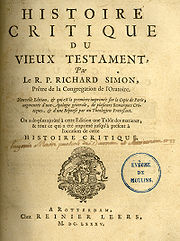 The Jewish philosopher and pantheist Baruch Spinoza
echoed Hobbes's doubts about the provenance of the historical books in his A Theologico-Political Treatise (published in 1670), and elaborated on the suggestion that the final redaction of these texts was post-exilic under the auspices of Ezra (Chapter IX). He had earlier been effectively excommunicated by the rabbinical council of Amsterdam
for his "heresies". The French priest Richard Simon
brought these critical perspectives to the Catholic
tradition in 1678, observing "the most part of the Holy Scriptures that are come to us, are but Abridgments and as Summaries of ancient Acts which were kept in the Registries of the Hebrews," in what was probably the first work of biblical textual criticism in the modern sense.
In response Jean Astruc
, applying source criticism
methods common in the analysis of classical secular texts to the Pentateuch, believed he could detect four different manuscript traditions, which he claimed Moses himself had redacted. (p. 62–64) His 1753 book initiated the school known as higher criticism that culminated in Julius Wellhausen
formalising the documentary hypothesis
in the 1870s, which in various modified forms still dominates understanding of the composition of the historical narratives.
By the end of the 19th century the scholarly consensus was that the Pentateuch was the work of many authors writing from 1000 BCE (the time of David
) to 500 BCE (the time of Ezra
) and redacted c.450, and as a consequence whatever history it contained was more often polemical than strictly factual – a conclusion reinforced by the then fresh scientific refutations of what were now widely classed as biblical mythologies, as discussed above.
In the following decades Hermann Gunkel
drew attention to the mythic aspects of the Pentateuch, and Albrecht Alt
, Martin Noth
and the tradition history
school argued that although its core traditions had genuinely ancient roots, the narratives were fictional framing devices and were not intended as history in the modern sense. Though doubts have been cast on the historiographic reconstructions of this school (particularly the notion of oral traditions as a primary ancient source), much of its critique of biblical historicity found wide acceptance. Gunkel's observation that
In the United States the biblical archaeology
movement, under the influence of Albright, counter-attacked, arguing that the broad outline within the framing narratives was also true, so that while scholars could not realistically expect to prove or disprove individual episodes from the life of Abraham and the other patriarchs, these were real individuals who could be placed in a context proven from the archaeological record. But as more discoveries were made, and anticipated finds failed to materialise, it became apparent that archaeology did not in fact support the claims made by Albright and his followers. Today, only a minority of scholars continue to work within this framework, mainly for reasons of religious conviction. "[Albright's] central theses have all been overturned, partly by further advances in Biblical criticism, but mostly by the continuing archaeological research of younger Americans and Israelis to whom he himself gave encouragement and momentum ... The irony is that, in the long run, it will have been the newer 'secular' archaeology that contributed the most to Biblical studies, not 'Biblical archaeology'."
The scholarly history of the Deuteronomic history parallels that of the Pentateuch: the European tradition history
school argued that the narrative was untrustworthy and could not be used to construct a narrative history; the American Albright school asserted that it could when tested against the archaeological record; and modern archaeological techniques proved crucial in deciding the issue. The test case was the book of Joshua and its account of a rapid, destructive conquest of the Canaanite cities: but by the 1960s it had become clear that the archaeological record did not, in fact, support the account of the conquest given in Joshua: the cities which the bible records as having been destroyed by the Israelites were either uninhabited at the time, or, if destroyed, were destroyed at widely different times, not in one brief period. The most high-profile example was the "fall of Jericho
", when new excavations in the 1950s by Kathleen Kenyon
revealed that the city had already been abandoned by the time of Joshua.
Thomas L. Thompson
, a leading minimalist scholar for example has written
Proponents of this theory also point to the fact that the division of the land into two entities, centered at Jerusalem and Shechem
, goes back to the Egyptian rule of Israel in the New Kingdom
. Solomon's empire is said to have stretched from the Euphrates
in the north to the Red Sea
in the south; it would have required a large commitment of men and arms and a high level of organization to conquer, subdue, and govern this area. But there is little archaeological evidence of Jerusalem being a sufficiently large city in the 10th century BCE, and Judah
seems to be sparsely settled in that time period. Since Jerusalem has been destroyed and then subsequently rebuilt approximately 15 to 20 times since the time of David and Solomon, some argue much of the evidence could easily have been eliminated.
The conquests of David and Solomon are also not mentioned in contemporary histories. Culturally, the Bronze Age collapse
is otherwise a period of general cultural impoverishment of the whole Levantine region, making it difficult to consider the existence of any large territorial unit such as the Davidic kingdom, whose cultural features rather seem to resemble the later kingdom of Hezekiah
or Josiah
than the political and economic conditions of the 11th century. Moreover the biblical account makes no claim that they directly governed the areas included in their empires which are portrayed instead as tributaries. However, since the discovery of an inscription dating to the 9th or 8th century BCE on the Tel Dan Stele
unearthed in the north of Israel, which may refer to the "house of David
" as a monarchic dynast, the debate has continued. This is still hotly disputed, as well as a heated debate extends as to whether the united monarchy, the vast empire of King Solomon, and the rebellion of Jeroboam
ever existed, or whether they are a late fabrication. The Mesha Stele
, dated to circa 840 BC, may reference the House of David, and mentions events and names found in Kings.
Once again there is a problem here with the sources for this period of history. There are no contemporary independent documents other than the claimed accounts of the Books of Samuel, which clearly shows too many anachronisms to have been a contemporary account. For example there is mention of late armor (1 Samuel 17:4–7, 38–39; 25:13), use of camels (1 Samuel 30:17) and cavalry (as distinct from chariotry) (1 Samuel 13:5, 2 Samuel 1:6), iron picks and axes (as though they were common, 2 Samuel 12:31), sophisticated siege techniques (2 Samuel 20:15), there is a gargantuan troop (2 Samuel 17:1), a battle with 20,000 casualties (2 Samuel 18:7), and refer to Kushite paramilitary and servants, clearly giving evidence of a date in which Kushites were common, after the 26th Dynasty of Egypt
, the period of the last quarter of the 8th century BCE.
" began as early as the 18th century, and has continued to this day. The most notable recent scholarship came in the 1980s and '90s with the work of J.D. Crossan, James D.G. Dunn, John P. Meier
, E.P. Sanders and N.T. Wright being the most widely read and discussed. The earliest New Testament texts which refer to Jesus, Paul
's letters, are usually dated in the 50s CE. Since Paul records very little of Jesus' life and activities, these are of little help in determining facts about the life of Jesus, although they may contain references to information given to Paul from the eyewitnesses of Jesus.
The discovery of the Dead Sea Scrolls
has shed light into the context of 1st century Palestine, noting the diversity of Jewish belief as well as shared expectations and teachings. For example the expectation of the coming messiah
, the beatitudes of the Sermon on the Mount
and much else of the early Christian movement are found to have existed within apocalyptic Judaism of the period. This has had the effect of centering Early Christianity
much more within its Jewish roots than was previously the case. It is now recognised that Rabbinical Judaism and Early Christianity are only two of the many strands which survived until the Jewish revolt of 66 to 70 CE, see also Split of early Christianity and Judaism.
Most modern scholars hold that the canonical Gospel
accounts were written between 70 and 100 or 110 CE, four to eight decades after the crucifixion, although based on earlier traditions and texts, such as "Q", Logia
or sayings gospels, the passion account or other earlier literature (See List of Gospels). Some scholars argue that these accounts were compiled by witnesses although this view is disputed by other scholars. There are also secular references to Jesus, although they are few and quite late. Almost all historical critics agree, however, that a historical figure named Jesus taught throughout the Galilean countryside c. 30 CE, was believed by his followers to have performed supernatural acts, and was sentenced to death by the Romans possibly for insurrection.
Many scholars have pointed out, that the Gospel of Mark
shows signs of a lack of knowledge of geographical, political and religious matters in Palestine in the time of Jesus. Thus, today the most common opinion is, that the author is unknown and both geographically and historically at a distance to the narrated events although opinion varies and scholars such as Craig Blomberg
accept the more traditional view. The use of expressions that may be described as awkward and rustic cause the Gospel of Mark to appear somewhat unlettered or even crude. This may be attributed to the influence that Saint Peter
, a fisherman, is suggested to have on the writing of Mark. The writers of the Gospel of Matthew
and Gospel of Luke
used Mark as a source, with changes and improvement to peculiarities and crudities in Mark.
The absence of evidence of Jesus' life before his meeting with John the Baptist
has led to many speculations. It would seem that part of the explanation may lie in the early conflict between Paul and the Desposyni
Ebionim, led by James the Just
, supposedly the brother of Jesus, that led to Gospel passages critical of Jesus' family
The historical reliability of the Acts of the Apostles
, the primary source
for the Apostolic Age
, is a major issue for biblical scholars and historians of Early Christianity
.
While some biblical scholars view the Book of Acts as being extremely accurate and corroborated by archaeology
, others view the work as being inaccurate and in conflict with the Pauline epistles
. Acts portrays Paul as more inline with Jewish Christianity, while the Pauline epistles record more conflict, such as the Incident at Antioch, see also Paul of Tarsus and Judaism
.
have sometimes upheld and sometimes challenged the traditional authorship of various books and passages of the Bible.
, but they disagree about when it was written. Proposed dates vary from the 15th century BCE to the 6th century BCE. One popular hypothesis points to the reign of Josiah
(7th century BCE). In this hypothesis, the events of, for example, Exodus would have happened centuries before they were finally edited. This topic is expanded upon in dating the Bible
.
An important point to keep in mind is the documentary hypothesis
, which using the biblical evidence itself, claims to demonstrate that our current version was based on older written sources that were lost. Although it has been modified heavily over the years, most scholars accept some form of this hypothesis. There have also been and are a number of scholars who reject it, for example Egyptologist Kenneth Kitchen
and the late Umberto Cassuto
and Gleason Archer
.
There are three loosely defined historical schools of thought with regard to the historical accuracy of the Bible,
Note that historical opinions fall on a spectrum, rather than into tightly defined camps. Since there is a wide range of opinions regarding the historical accuracy of the Bible, it should not be surprising that any given scholar may have views that fall anywhere between these loosely defined camps.
Recently the difference between the Maximalist and Minimalist has reduced, however a new school started with a work, "The Quest for the Historical Israel: Debating Archaeology and the History of Early Israel" by Israel Finkelstein
, Amihai Mazar
, and Brian B. Schmidt. This school argues that post-processual archaeology enables us to recognise the existence of a middle ground between Minimalism and Maximalism, and that both these extremes need to be rejected. Archaeology offers both confirmation of parts of the biblical record and also poses challenges to the naive interpretations made by some. The careful examination of the evidence demonstrates that the historical accuracy of the first part of the Old Testament is greatest during the reign of Josiah
. Some feel that the accuracy diminishes, the further backwards one proceeds from this date. This they claim would confirm that a major redaction of the texts seems to have occurred at about that date.
and apologetic
work, and all stories within it are of an aetiological character. The early stories are held to have a historical basis that was reconstructed centuries later, and the stories possess at most only a few tiny fragments of genuine historical memory—which by their definition are only those points which are supported by archaeological discoveries. In this view, all of the stories about the biblical patriarchs are fictional, and the patriarchs mere legendary eponyms to describe later historical realities. Further, biblical minimalists hold that the twelve tribes of Israel were a later construction, the stories of King David and King Saul were modeled upon later Irano-Hellenistic examples, and that there is no archaeological evidence that the united kingdom of Israel, which the Bible says that David and Solomon ruled over an empire from the Euphrates to Eilath, ever existed.
In published books, one of the early advocates of the current school of thought known as biblical minimalism is Giovanni Garbini,Storia e ideologia nell'Israele antico (1986), translated into English as History and Ideology in Ancient Israel(1988). In his footsteps followed Thomas L. Thompson
with his lengthy Early History of the Israelite People: From the Written & Archaeological Sources (1992) and, building explicitly on Thompson's book, P. R. Davies' shorter work, In Search of 'Ancient Israel' (1992). In the latter, Davies finds historical Israel only in archaeological remains, biblical Israel only in Scripture, and recent reconstructions of "ancient Israel" to be an unacceptable amalgam of the two. Thompson and Davies see the entire Hebrew Bible (Old Testament) as the imaginative creation of a small community of Jews at Jerusalem during the period which the Bible assigns to after the return from the Babylonian exile, from 539 BCE onward. Niels Peter Lemche
, Thompson's fellow faculty member at the University of Copenhagen
, also followed with several titles that show Thompson's influence, including The Israelites in history and tradition (1998). The presence of both Thompson and Lemche at the same institution has led to the use of the term "Copenhagen school
". Although the immediate effect of biblical minimalism from 1992 onward was heated debate from several sides (not just two), some calmer critiques, none of which was neutral, eventually appeared.
in the 6th century BCE, and that the events predating the United Monarchy
cannot be shown to have any historicity, the positions of "maximalists" vs. "minimalists" concern the monarchy period, spanning the 10th to 7th centuries BC The maximalist position holds that the accounts of the United Monarchy and the early kings of Israel, king David and king Saul, are to be taken as largely historical.
and Neil Asher Silberman
published the book The Bible Unearthed. Archaeology's New Vision of Ancient Israel and the Origin of Its Sacred Texts
which advocated a view midway toward biblical minimalism and caused an uproar among many conservatives. The 25th anniversary issue of Biblical Archeological Review(March/April 2001 edition), editor Hershel Shanks
quoted several biblical scholars who insisted that minimalism was dying, although leading minimalists deny this and a claim has been made "We are all minimalists now".
In 2003, Kenneth Kitchen
, a scholar who adopts a more maximalist point of view, authored the book On the Reliability of the Old Testament. Kitchen advocated the reliability of many (though not all) parts of the Torah and in no uncertain terms criticizes the work of Finkelstein and Silberman, to which Finkelstein has since responded.
Jennifer Wallace describes archaeologist Israel Finkelstein's view in her article Shifting Ground in the Holy Land, appearing in Smithsonian Magazine, May 2006:
However, despite problems with the archaeological record, some maximalists place Joshua in the mid second millennium, at about the time the Egyptian Empire came to rule over Canaan, and not the 13th century as Finkelstein or Kitchen claim, and view the destruction layers of the period as corroboration of the biblical account. The destruction of Hazor in the mid-13th century is seen as corroboration of the biblical account of the later destruction carried out by Deborah and Barak as recorded in the Book of Judges
. The location that Finkelstein refers to as "Ai" is generally dismissed as the location of the biblical Ai, since it was destroyed and buried in the 3rd millennium. The prominent site has been known by that name since at least Hellenistic times, if not before. Minimalists all hold that dating these events as contemporary are etiological
explanations written centuries after the events they claim to report.
For the united monarchy
both Finkelstein and Silberman do accept that David and Solomon were really existing persons (no kings but bandit leaders or hill country chieftains) from Judah about the 10th century BC - they do not assume that there was such a thing as united monarchy
with a capital in Jerusalem.
Others such as David Ussishkin
argue that those who follow the biblical depiction of a united monarchy
do so on the basis of limited evidence while hoping to uncover real archaeological proof in the future. Gunnar Lehmann suggests that there is still a possibility that David and Solomon were able to become local chieftains of some importance and claims that Jerusalem at the time was at best a small town in a sparsely populated area in which alliances of tribal kinship groups formed the basis of society. He goes on further to claim that it was at best a small regional centre, one of three to four in the territory of Judah and neither David nor Solomon had the manpower or the requisite social/political/administrative structure to rule the kind of empire described in the Bible.
These views are strongly criticized by William G. Dever
, Helga Weippert, Amihai Mazar
and Amnon Ben-Tor.
André Lemaire states in Ancient Israel: From Abraham to the Roman Destruction of the Temple that the principal points of the biblical tradition with Solomon as generally trustworthy, as does Kenneth Kitchen
, who argue that Solomon ruled over a comparatively wealthy "mini-empire", rather than a small city-state.
Recently Finkelstein has joined with the more conservative Amihai Mazar
, to explore the areas of agreement and disagreement and there are signs the intensity of the debate between the so-called minimalist and maximalist scholars is diminishing. This view is also taken by Richard S. Hess, which shows there is in fact a plurality of views between maximalists and minimalists. Jack Cargill has recently shown that popular textbooks not only fail to give readers the up to date archaeological evidence, but that they also fail to correctly represent the diversity of views present on the subject.
Bible
The Bible refers to any one of the collections of the primary religious texts of Judaism and Christianity. There is no common version of the Bible, as the individual books , their contents and their order vary among denominations...
from a historical perspective, includes numerous fields of study, ranging from archeology and astronomy
Astronomy
Astronomy is a natural science that deals with the study of celestial objects and phenomena that originate outside the atmosphere of Earth...
to linguistics
Linguistics
Linguistics is the scientific study of human language. Linguistics can be broadly broken into three categories or subfields of study: language form, language meaning, and language in context....
and methods of comparative literature
Comparative literature
Comparative literature is an academic field dealing with the literature of two or more different linguistic, cultural or national groups...
. The Bible may provide insight into pursuits, including but not limited to; our understanding of ancient and modern culture, mythology, anthropology and morality. Examining the historical context, importance ascribed to events, and the contrast between the descriptions of these events and historical evidence of their occurrence (or lack thereof) is useful in providing information on topics beyond the simple factual accuracy of the Bible.
Manuscripts and canons
The Bible exists in multiple manuscripts, none of them autographAutograph
An autograph is a document transcribed entirely in the handwriting of its author, as opposed to a typeset document or one written by an amanuensis or a copyist; the meaning overlaps with that of the word holograph.Autograph also refers to a person's artistic signature...
s, and multiple canons
Biblical canon
A biblical canon, or canon of scripture, is a list of books considered to be authoritative as scripture by a particular religious community. The term itself was first coined by Christians, but the idea is found in Jewish sources. The internal wording of the text can also be specified, for example...
, none of which completely agree on which books have sufficient authority to be included or their order (see Books of the Bible
Books of the Bible
The Books of the Bible are listed differently in the canons of Judaism and the Catholic, Protestant, Greek Orthodox, Slavonic Orthodox, Georgian, Armenian Apostolic, Syriac and Ethiopian churches, although there is substantial overlap. A table comparing the canons of some of these traditions...
).
To determine the accuracy of a copied manuscript, textual critics
Textual criticism
Textual criticism is a branch of literary criticism that is concerned with the identification and removal of transcription errors in the texts of manuscripts...
scrutinize the way the transcripts have passed through history to their extant forms. The higher the volume of the earliest texts (and their parallels to each other), the greater the textual reliability and the less chance that the transcript's content has been changed over the years. Multiple copies may also be grouped into text types (see New Testament text types), with some types judged closer to the hypothetical original than others. Differences often extend beyond minor variations and may involve, for instance, interpolation of material central to issues of historicity and doctrine, such as the ending of Mark 16.
The books comprising the Hebrew bible
Hebrew Bible
The Hebrew Bible is a term used by biblical scholars outside of Judaism to refer to the Tanakh , a canonical collection of Jewish texts, and the common textual antecedent of the several canonical editions of the Christian Old Testament...
and the Old Testament
Old Testament
The Old Testament, of which Christians hold different views, is a Christian term for the religious writings of ancient Israel held sacred and inspired by Christians which overlaps with the 24-book canon of the Masoretic Text of Judaism...
(the two are almost, but not exactly, the same) were written largely in Hebrew, with a few exceptions in Aramaic. Today it exists in several traditions, including the Masoretic Text
Masoretic Text
The Masoretic Text is the authoritative Hebrew text of the Jewish Bible and is regarded as Judaism's official version of the Tanakh. While the Masoretic Text defines the books of the Jewish canon, it also defines the precise letter-text of these biblical books, with their vocalization and...
, the Septuagint 47 books (a Greek translation widely used in the period from the 3rd century BC to roughly the 5th century AD, and still regarded as authoritative by the Orthodox Christian churches), the Samaritan Torah, the Westminster
Westminster
Westminster is an area of central London, within the City of Westminster, England. It lies on the north bank of the River Thames, southwest of the City of London and southwest of Charing Cross...
containing the modern 39 books , and others. Variations between these traditions are useful for reconstructing the most likely original text, and for tracing the intellectual histories of various Jewish and Christian communities. The very oldest fragment resembling part of the text of the Hebrew Bible so far discovered is a small silver amulet, dating from approximately 600 BCE, and containing a version of the Priestly Blessing
Priestly Blessing
The Priestly Blessing, , also known in Hebrew as Nesiat Kapayim, , or Dukhanen , is a Jewish prayer recited by Kohanim during certain Jewish services...
("May God make his face to shine upon you...").
According to the dominant theory called Greek primacy
Greek Primacy
Greek primacy is a scholarly term in general use for the dominance of Hellenism at certain periods of history. In the context of the language of the New Testament, "Greek primacy" is a Wikipedia neologism for the majority view that the New Testament or its sources were originally written in Koine...
, the New Testament
New Testament
The New Testament is the second major division of the Christian biblical canon, the first such division being the much longer Old Testament....
was originally written in Greek
Koine Greek
Koine Greek is the universal dialect of the Greek language spoken throughout post-Classical antiquity , developing from the Attic dialect, with admixture of elements especially from Ionic....
, of which 5,650 handwritten copies have survived in Greek, over 10,000 in Latin. When other languages are included, the total of ancient copies approaches 25,000. The next ancient text to come close to rivaling that number is Homer
Homer
In the Western classical tradition Homer , is the author of the Iliad and the Odyssey, and is revered as the greatest ancient Greek epic poet. These epics lie at the beginning of the Western canon of literature, and have had an enormous influence on the history of literature.When he lived is...
's Iliad
Iliad
The Iliad is an epic poem in dactylic hexameters, traditionally attributed to Homer. Set during the Trojan War, the ten-year siege of the city of Troy by a coalition of Greek states, it tells of the battles and events during the weeks of a quarrel between King Agamemnon and the warrior Achilles...
, which is thought to have survived in 643 ancient copies. Recognizing this, F. E. Peters remarked that "on the basis of manuscript tradition alone, the works that make up the Christians' New Testament texts were the most frequently copied and widely circulated [surviving] books of antiquity". (This may be due to their preservation, popularity, and distribution brought about by the ease of seaborne travel and the many roads constructed during the time of the Roman Empire
Roman Empire
The Roman Empire was the post-Republican period of the ancient Roman civilization, characterised by an autocratic form of government and large territorial holdings in Europe and around the Mediterranean....
). When a comparison is made between the seven major critical editions
Textual criticism
Textual criticism is a branch of literary criticism that is concerned with the identification and removal of transcription errors in the texts of manuscripts...
of the Greek NT verse-by-verse – namely Tischendorf, Westcott-Hort
The New Testament in the Original Greek
The New Testament in the Original Greek is the name of a Greek language version of the New Testament published in 1881. It is also known as the Westcott and Hort text, after its editors Brooke Foss Westcott and Fenton John Anthony Hort...
, Von Soden, Vogels, Merk, Bover, and Nestle-Aland
Novum Testamentum Graece
Novum Testamentum Graece is the Latin name editions of the original Greek-language version of the New Testament.The first printed edition was the Complutensian Polyglot Bible by Cardinal Francisco Jiménez de Cisneros, printed in 1514, but not published until 1520...
– only 62.9% of verses are variant free.
A four gospel canon (the Tetramorph) was first asserted by Irenaeus
Irenaeus
Saint Irenaeus , was Bishop of Lugdunum in Gaul, then a part of the Roman Empire . He was an early church father and apologist, and his writings were formative in the early development of Christian theology...
, c. 180. The many other gospels that then existed were eventually deemed non-canonical (see Biblical canon
Biblical canon
A biblical canon, or canon of scripture, is a list of books considered to be authoritative as scripture by a particular religious community. The term itself was first coined by Christians, but the idea is found in Jewish sources. The internal wording of the text can also be specified, for example...
) and suppressed. In his Easter letter of 367, Athanasius, Bishop of Alexandria, gave a list of exactly the same books as what would become the New Testament
New Testament
The New Testament is the second major division of the Christian biblical canon, the first such division being the much longer Old Testament....
canon, and he used the phrase "being canonized" (kanonizomena) in regards to them. The Council of Rome
Council of Rome
The Council of Rome was a meeting of Christian Church officials and theologians which took place in 382 under the authority of the bishop of Rome, Damasus I. The previous year, the Emperor Theodosius I had appointed the "dark horse" candidate Nectarius Archbishop of Constantinople...
in 382 under the authority of Pope Damasus I
Pope Damasus I
Pope Saint Damasus I was the bishop of Rome from 366 to 384.He was born around 305, probably near the city of Idanha-a-Velha , in what is present-day Portugal, then part of the Western Roman Empire...
issued an identical canon, and his decision to commission the Latin Vulgate
Vulgate
The Vulgate is a late 4th-century Latin translation of the Bible. It was largely the work of St. Jerome, who was commissioned by Pope Damasus I in 382 to make a revision of the old Latin translations...
edition of the Bible, c. 383, was instrumental in the fixation of the canon in the West. See Development of the New Testament canon
Development of the New Testament canon
The Canon of the New Testament is the set of books Christians regard as divinely inspired and constituting the New Testament of the Christian Bible. For most, it is an agreed-upon list of twenty-seven books that includes the Canonical Gospels, Acts, letters of the Apostles, and Revelation...
for details.
Hebrew bible
The Hebrew bible is not a single book but rather a collection of texts, most of them anonymous, and most of them the product of more or less extensive editing prior to reaching their modern form. These texts are in many different genres, but three distinct blocks approximating modern narrative history can be made out.Torah
Torah
Torah- A scroll containing the first five books of the BibleThe Torah , is name given by Jews to the first five books of the bible—Genesis , Exodus , Leviticus , Numbers and Deuteronomy Torah- A scroll containing the first five books of the BibleThe Torah , is name given by Jews to the first five...
: Genesis to Deuteronomy
Deuteronomy
The Book of Deuteronomy is the fifth book of the Hebrew Bible, and of the Jewish Torah/Pentateuch...
God creates the world; the world God creates is good, but it becomes thoroughly corrupted by man's decision to sin. God destroys all but the eight remaining righteous people in a deluge and shortens man's lifespan significantly. God selects Abraham
Abraham
Abraham , whose birth name was Abram, is the eponym of the Abrahamic religions, among which are Judaism, Christianity and Islam...
to inherit the land of Canaan
Canaan
Canaan is a historical region roughly corresponding to modern-day Israel, Palestine, Lebanon, and the western parts of Jordan...
. The children of Israel
Israel
The State of Israel is a parliamentary republic located in the Middle East, along the eastern shore of the Mediterranean Sea...
, Abraham's grandson, go into Egypt
Egypt
Egypt , officially the Arab Republic of Egypt, Arabic: , is a country mainly in North Africa, with the Sinai Peninsula forming a land bridge in Southwest Asia. Egypt is thus a transcontinental country, and a major power in Africa, the Mediterranean Basin, the Middle East and the Muslim world...
, where their descendants are enslaved. The Israelites are led out of Egypt by Moses
Moses
Moses was, according to the Hebrew Bible and Qur'an, a religious leader, lawgiver and prophet, to whom the authorship of the Torah is traditionally attributed...
(Exodus) and receive the laws of God, who renews the promise of the land of Canaan.
Deuteronomic history: Joshua
Joshua
Joshua , is a minor figure in the Torah, being one of the spies for Israel and in few passages as Moses's assistant. He turns to be the central character in the Hebrew Bible's Book of Joshua...
to 2 Kings
The Israelites conquer the land of Canaan under Joshua, successor to Moses. Under the Judges
Book of Judges
The Book of Judges is the seventh book of the Hebrew bible and the Christian Old Testament. Its title describes its contents: it contains the history of Biblical judges, divinely inspired prophets whose direct knowledge of Yahweh allows them to act as decision-makers for the Israelites, as...
they live in a state of constant conflict and insecurity, until the prophet Samuel
Samuel
Samuel is a leader of ancient Israel in the Books of Samuel in the Hebrew Bible. He is also known as a prophet and is mentioned in the Qur'an....
anoints Saul
Saul
-People:Saul is a given/first name in English, the Anglicized form of the Hebrew name Shaul from the Hebrew Bible:* Saul , including people with this given namein the Bible:* Saul , a king of Edom...
as king over them. Saul proves unworthy, and God selects David
David
David was the second king of the united Kingdom of Israel according to the Hebrew Bible and, according to the Gospels of Matthew and Luke, an ancestor of Jesus Christ through both Saint Joseph and Mary...
as his successor. Under David the Israelites are united and conquer their enemies, and under Solomon
Solomon
Solomon , according to the Book of Kings and the Book of Chronicles, a King of Israel and according to the Talmud one of the 48 prophets, is identified as the son of David, also called Jedidiah in 2 Samuel 12:25, and is described as the third king of the United Monarchy, and the final king before...
his son they live in peace and prosperity. But the kingdom is divided under Solomon's successors, Israel in the north and Judah
Kingdom of Judah
The Kingdom of Judah was a Jewish state established in the Southern Levant during the Iron Age. It is often referred to as the "Southern Kingdom" to distinguish it from the northern Kingdom of Israel....
in the south, and the kings of Israel fall away from God and eventually the people of the north are taken into captivity by outsiders. Judah, unlike Israel, has some kings who follow God, but many do not, and eventually it too is taken into captivity, and the Temple
Temple
A temple is a structure reserved for religious or spiritual activities, such as prayer and sacrifice, or analogous rites. A templum constituted a sacred precinct as defined by a priest, or augur. It has the same root as the word "template," a plan in preparation of the building that was marked out...
of God built by Solomon is destroyed.
Chronicler's history: Chronicles
Books of Chronicles
The Books of Chronicles are part of the Hebrew Bible. In the Masoretic Text, it appears as the first or last book of the Ketuvim . Chronicles largely parallels the Davidic narratives in the Books of Samuel and the Books of Kings...
and Ezra
Ezra
Ezra , also called Ezra the Scribe and Ezra the Priest in the Book of Ezra. According to the Hebrew Bible he returned from the Babylonian exile and reintroduced the Torah in Jerusalem...
/Nehemiah
Nehemiah
Nehemiah ]]," Standard Hebrew Nəḥemya, Tiberian Hebrew Nəḥemyāh) is the central figure of the Book of Nehemiah, which describes his work rebuilding Jerusalem and purifying the Jewish community. He was the son of Hachaliah, Nehemiah ]]," Standard Hebrew Nəḥemya, Tiberian Hebrew Nəḥemyāh) is the...
(Chronicles begins by reprising the history of the Torah and the Deuteronomistic history, with some differences over details. It introduces new material following its account of the fall of Jerusalem, the event which concludes the Deuteronomic history). The Babylonians, who had destroyed the Temple and taken the people into captivity, are themselves defeated by the Persians under their king Cyrus
Cyrus the Great
Cyrus II of Persia , commonly known as Cyrus the Great, also known as Cyrus the Elder, was the founder of the Achaemenid Empire. Under his rule, the empire embraced all the previous civilized states of the ancient Near East, expanded vastly and eventually conquered most of Southwest Asia and much...
. Cyrus permits the exiles to return to Jerusalem. The Temple is rebuilt, and the Laws of Moses are read to the people.
Other
(Several other books of the Hebrew bible are set in a historical context or otherwise give information which can be regarded as historical, although these books do not present themselves as histories).
The prophets Amos
Amos (prophet)
Amos is a minor prophet in the Old Testament, and the author of the Book of Amos. Before becoming a prophet, Amos was a sheep herder and a sycamore fig farmer. Amos' prior professions and his claim "I am not a prophet nor a son of a prophet" indicate that Amos was not from the school of prophets,...
and Hosea
Hosea
Hosea was the son of Beeri and a prophet in Israel in the 8th century BC. He is one of the Twelve Prophets of the Jewish Hebrew Bible, also known as the Minor Prophets of the Christian Old Testament. Hosea is often seen as a "prophet of doom", but underneath his message of destruction is a promise...
write of events during the 8th century kingdom of Israel; the prophet Jeremiah
Jeremiah
Jeremiah Hebrew:יִרְמְיָה , Modern Hebrew:Yirməyāhū, IPA: jirməˈjaːhu, Tiberian:Yirmĭyahu, Greek:Ἰερεμίας), meaning "Yahweh exalts", or called the "Weeping prophet" was one of the main prophets of the Hebrew Bible...
writes of events preceding and following the fall of Judah; Ezekiel
Ezekiel
Ezekiel , "God will strengthen" , is the central protagonist of the Book of Ezekiel in the Hebrew Bible. In Judaism, Christianity and Islam, Ezekiel is acknowledged as a Hebrew prophet...
writes of events during and preceding the exile in Babylon; and other prophets similarly touch on various periods, usually those in which they write.
Several books are included in some canons but not in others. Among these, Maccabees
Maccabees
The Maccabees were a Jewish rebel army who took control of Judea, which had been a client state of the Seleucid Empire. They founded the Hasmonean dynasty, which ruled from 164 BCE to 63 BCE, reasserting the Jewish religion, expanding the boundaries of the Land of Israel and reducing the influence...
is a purely historical work that treats of the events of the 2nd century BC. Others are not historical in orientation but are set in historical contexts or reprise earlier histories, such as Enoch
Book of Enoch
The Book of Enoch is an ancient Jewish religious work, traditionally ascribed to Enoch, the great-grandfather of Noah. It is not part of the biblical canon as used by Jews, apart from Beta Israel...
, an apocalyptic work of the 2nd century BC.
New Testament
While the authorship of a number of the Pauline epistles is largely undisputed, there is no scholarly consensus on the authors of the other books of the New Testament, which most modern scholars acknowledge as pseudonymous autographs written more than a generation after the events they describe.Gospels/Acts
ACTS
Acts or ACTS may refer to:Christianity* Acts of the Apostles , a genre of early Christian literature* Acts of the Apostles, the fifth book in the Bible's New Testament...
Jesus
Jesus
Jesus of Nazareth , commonly referred to as Jesus Christ or simply as Jesus or Christ, is the central figure of Christianity...
is born to Joseph
Saint Joseph
Saint Joseph is a figure in the Gospels, the husband of the Virgin Mary and the earthly father of Jesus Christ ....
and Mary
Mary (mother of Jesus)
Mary , commonly referred to as "Saint Mary", "Mother Mary", the "Virgin Mary", the "Blessed Virgin Mary", or "Mary, Mother of God", was a Jewish woman of Nazareth in Galilee...
; he is baptised by John the Baptist
John the Baptist
John the Baptist was an itinerant preacher and a major religious figure mentioned in the Canonical gospels. He is described in the Gospel of Luke as a relative of Jesus, who led a movement of baptism at the Jordan River...
and begins a preaching and healing mission
Ministry of Jesus
In the Christian gospels, the Ministry of Jesus begins with his Baptism in the countryside of Judea, near the River Jordan and ends in Jerusalem, following the Last Supper with his disciples. The Gospel of Luke states that Jesus was "about 30 years of age" at the start of his ministry...
in Galilee
Galilee
Galilee , is a large region in northern Israel which overlaps with much of the administrative North District of the country. Traditionally divided into Upper Galilee , Lower Galilee , and Western Galilee , extending from Dan to the north, at the base of Mount Hermon, along Mount Lebanon to the...
; he comes up to Jerusalem
Jerusalem in Christianity
For Christians, Jerusalem's place in the ministry of Jesus and the Apostolic Age gives it great importance, in addition to its place in the Old Testament, the Hebrew Bible.-Jerusalem in the New Testament and early Christianity:...
to celebrate Passover
Passover
Passover is a Jewish holiday and festival. It commemorates the story of the Exodus, in which the ancient Israelites were freed from slavery in Egypt...
, is arrested, tried, condemned, and crucified. He is raised from the dead by God, appears before his followers
Resurrection appearances of Jesus
The major Resurrection appearances of Jesus in the Canonical gospels are reported to have occurred after his death, burial and resurrection, but prior to his Ascension. Among these primary sources, most scholars believe First Corinthians was written first, authored by Paul of Tarsus along with...
, issuing the Great Commission
Great Commission
The Great Commission, in Christian tradition, is the instruction of the resurrected Jesus Christ to his disciples, that they spread his teachings to all the nations of the world. It has become a tenet in Christian theology emphasizing missionary work, evangelism, and baptism...
, and ascends to Heaven, with a promise to return
Second Coming
In Christian doctrine, the Second Coming of Christ, the Second Advent, or the Parousia, is the anticipated return of Jesus Christ from Heaven, where he sits at the Right Hand of God, to Earth. This prophecy is found in the canonical gospels and in most Christian and Islamic eschatologies...
. The followers of Jesus
Disciple (Christianity)
In Christianity, the disciples were the students of Jesus during his ministry. While Jesus attracted a large following, the term disciple is commonly used to refer specifically to "the Twelve", an inner circle of men whose number perhaps represented the twelve tribes of Israel...
, who had been fearful following the Crucifixion
Crucifixion of Jesus
The crucifixion of Jesus and his ensuing death is an event that occurred during the 1st century AD. Jesus, who Christians believe is the Son of God as well as the Messiah, was arrested, tried, and sentenced by Pontius Pilate to be scourged, and finally executed on a cross...
, are encouraged by Jesus' resurrection and continue to practice and to preach his teachings. The Apostle Paul preaches throughout the eastern Mediterranean, is arrested, and appeals. He is sent to Rome
Rome
Rome is the capital of Italy and the country's largest and most populated city and comune, with over 2.7 million residents in . The city is located in the central-western portion of the Italian Peninsula, on the Tiber River within the Lazio region of Italy.Rome's history spans two and a half...
for trial, and the narrative breaks off.
Epistles/Revelation
Revelation
In religion and theology, revelation is the revealing or disclosing, through active or passive communication with a supernatural or a divine entity...
The epistles (literally "letters") are largely concerned with theology, but the theological arguments they present form a "history of theology". Revelation deals with the last judgement and the end of the world
Christian eschatology
Christian eschatology is a major branch of study within Christian theology. Eschatology, from two Greek words meaning last and study , is the study of the end of things, whether the end of an individual life, the end of the age, or the end of the world...
.
Extra-biblical sources
Prior to the 19th century, textual analysis of the Bible itself was the only tool available to extract and evaluate whatever historical data it contained. The past two hundred years, however, have seen a proliferation of new sources of data and analytical tools, including:- Other Near Eastern texts, documents and inscriptions
- The material remains recovered throughout the Near East by archaeological excavation, analysed by ever more sophisticated technical and statistical apparatus
- Historical geography, demography, soil science, technology studies, and comparative linguistics
- Anthropological and sociological modelling
- The ApocryphaApocryphaThe term apocrypha is used with various meanings, including "hidden", "esoteric", "spurious", "of questionable authenticity", ancient Chinese "revealed texts and objects" and "Christian texts that are not canonical"....
, or non-canonical texts
Writing and reading history
The meaning of the term "history" is itself dependent on social and historical context. Paula McNutt, for instance, notes that the Old Testament narratives "do not record 'history' in the sense that history is understood in the twentieth century ... The past, for biblical writers as well as for twentieth-century readers of the Bible, has meaning only when it is considered in light of the present, and perhaps an idealized future." (p. 4, emphasis added)Biblical history has also taken on different meanings in the modern era. The project of biblical archaeology
Biblical archaeology school
Biblical archaeology, also known as Palestinology is the school of archaeology which concerns itself with the biblical world.-18th Century:...
associated with W.F. Albright, which sought to validate the historicity of the events narrated in the Bible through the ancient texts and material remains of the Near East
Near East
The Near East is a geographical term that covers different countries for geographers, archeologists, and historians, on the one hand, and for political scientists, economists, and journalists, on the other...
, has little in common with the view of history described by archaeologist William Dever
William G. Dever
William G. Dever is an American archaeologist, specialising in the history of Israel and the Near East in Biblical times. He was Professor of Near Eastern Archaeology and Anthropology at the University of Arizona in Tucson from 1975 to 2002...
. In discussing the role of his discipline in interpreting the biblical record, Dever has pointed to multiple histories within the Bible, including the history of theology (the relationship between God and believers), political history (usually the account of "Great Men"), narrative history (the chronology of events), intellectual history (ideas and their development, context and evolution), socio-cultural history (institutions, including their social underpinnings in family, clan, tribe and social class and the state), cultural history (overall cultural evolution, demography, socio-economic and political structure and ethnicity), technological history (the techniques by which humans adapt to, exploit and make use of the resources of their environment), natural history (how humans discover and adapt to the ecological facts of their natural environment), and material history (artefacts as correlates of changes in human behaviour).
A special challenge for assessing the historicity of the Bible is sharply differing perspectives on the relationship between narrative history and theological meaning. Supporters of biblical literalism
Biblical literalism
Biblical literalism is the interpretation or translation of the explicit and primary sense of words in the Bible. A literal Biblical interpretation is associated with the fundamentalist and evangelical hermeneutical approach to Scripture, and is used almost exclusively by conservative Christians...
"deny that Biblical infallibility and inerrancy are limited to spiritual, religious, or redemptive themes, exclusive of assertions in the fields of history and science. We further deny that scientific hypotheses about earth history may properly be used to overturn the teaching of Scripture on creation and the flood." But prominent scholars have expressed diametrically opposing views: "[T]he stories about the promise given to the patriarchs in Genesis are not historical, nor do they intend to be historical; they are rather historically determined expressions about Israel and Israel's relationship to its God, given in forms legitimate to their time, and their truth lies not in their facticity, nor in the historicity, but their ability to express the reality that Israel experienced."
This apparently irreconcilable clash of views is most acute for the questions of the greatest contemporary political significance (such as the promise of land by God to Abraham) and theological import (the Virgin Birth
Virgin Birth
The virgin birth of Jesus is a tenet of Christianity and Islam which holds that Mary miraculously conceived Jesus while remaining a virgin. The term "virgin birth" is commonly used, rather than "virgin conception", due to the tradition that Joseph "knew her not till she brought forth her firstborn...
and Resurrection
Resurrection
Resurrection refers to the literal coming back to life of the biologically dead. It is used both with respect to particular individuals or the belief in a General Resurrection of the dead at the end of the world. The General Resurrection is featured prominently in Jewish, Christian, and Muslim...
of Jesus), which are also the "events" that have proved the least susceptible to extra-biblical confirmation.
It may also be noted that the Bible itself as it exists today seems to claim for itself inerrancy, insomuch as it claims that "Scripture" was written by God (2 Timothy 3:16) and states that God cannot lie (Hebrews 6:18).
The Hebrew Bible
Until the 18th century, the general belief in ChristendomChristendom
Christendom, or the Christian world, has several meanings. In a cultural sense it refers to the worldwide community of Christians, adherents of Christianity...
was that the earth was created about 4,000 - 5,500 years before the birth of Christ
Christ
Christ is the English term for the Greek meaning "the anointed one". It is a translation of the Hebrew , usually transliterated into English as Messiah or Mashiach...
, and that the Garden of Eden
Garden of Eden
The Garden of Eden is in the Bible's Book of Genesis as being the place where the first man, Adam, and his wife, Eve, lived after they were created by God. Literally, the Bible speaks about a garden in Eden...
, the Flood, the Tower of Babel
Tower of Babel
The Tower of Babel , according to the Book of Genesis, was an enormous tower built in the plain of Shinar .According to the biblical account, a united humanity of the generations following the Great Flood, speaking a single language and migrating from the east, came to the land of Shinar, where...
, and the stories of Abraham and the Exodus described actual events, constituting a genuine narrative history from Creation to the founding of Israel . However, there had always been a critical tradition as well, dating back to at least St Augustine of Hippo (354–430), with interpretations "plainly at variance with what are commonly perceived in evangelicalism
Evangelicalism
Evangelicalism is a Protestant Christian movement which began in Great Britain in the 1730s and gained popularity in the United States during the series of Great Awakenings of the 18th and 19th century.Its key commitments are:...
as traditional views of Genesis." The Jewish tradition has also maintained a critical thread in its approach to biblical primeval history. The influential medieval philosopher Maimonides
Maimonides
Moses ben-Maimon, called Maimonides and also known as Mūsā ibn Maymūn in Arabic, or Rambam , was a preeminent medieval Jewish philosopher and one of the greatest Torah scholars and physicians of the Middle Ages...
maintained a skeptical ambiguity towards creation ex nihilo
Ex nihilo
Ex nihilo is a Latin phrase meaning "out of nothing". It often appears in conjunction with the concept of creation, as in creatio ex nihilo, meaning "creation out of nothing"—chiefly in philosophical or theological contexts, but also occurs in other fields.In theology, the common phrase creatio ex...
and considered the stories about Adam
Adam
Adam is a figure in the Book of Genesis. According to the creation myth of Abrahamic religions, he is the first human. In the Genesis creation narratives, he was created by Yahweh-Elohim , and the first woman, Eve was formed from his rib...
more as "philosophical anthropology, rather than as historical stories whose protagonist is the 'first man'." Greek philosophers held that the world was eternal, not created some thousand years ago, and that belief was common among learned Christians.
Galileo is the name most closely associated with the first scientific assault on biblical authority, but the heliocentric universe was sufficiently peripheral to biblical ontology to be eventually accommodated. Galileo's writings were on the Catholic Index of prohibited books
Index Librorum Prohibitorum
The Index Librorum Prohibitorum was a list of publications prohibited by the Catholic Church. A first version was promulgated by Pope Paul IV in 1559, and a revised and somewhat relaxed form was authorized at the Council of Trent...
All traces of official opposition to heliocentrism by the church disappeared in 1835 when these works were finally dropped from the Index. Nevertheless heliocentricism has been accepted by most (but not all) of today's fundamentalists. It was in fact the birth of geology
Geology
Geology is the science comprising the study of solid Earth, the rocks of which it is composed, and the processes by which it evolves. Geology gives insight into the history of the Earth, as it provides the primary evidence for plate tectonics, the evolutionary history of life, and past climates...
, marked by the publication of James Hutton
James Hutton
James Hutton was a Scottish physician, geologist, naturalist, chemical manufacturer and experimental agriculturalist. He is considered the father of modern geology...
's Theory of the Earth in 1788, which set in train the intellectual revolution that would dethrone Genesis as the ultimate authority on primeval earth and prehistory
Prehistory
Prehistory is the span of time before recorded history. Prehistory can refer to the period of human existence before the availability of those written records with which recorded history begins. More broadly, it refers to all the time preceding human existence and the invention of writing...
. The first casualty was the Creation story itself, and by the early 19th century "no responsible scientist contended for the literal credibility of the Mosaic account of creation." (p. 224) The battle between uniformitarianism
Uniformitarianism
In the philosophy of naturalism, the uniformitarianism assumption is that the same natural laws and processes that operate in the universe now, have always operated in the universe in the past and apply everywhere in the universe. It has included the gradualistic concept that "the present is the...
and catastrophism
Catastrophism
Catastrophism is the theory that the Earth has been affected in the past by sudden, short-lived, violent events, possibly worldwide in scope. The dominant paradigm of modern geology is uniformitarianism , in which slow incremental changes, such as erosion, create the Earth's appearance...
kept the Flood alive in the emerging discipline, until Adam Sedgwick
Adam Sedgwick
Adam Sedgwick was one of the founders of modern geology. He proposed the Devonian period of the geological timescale...
, the president of the Geological Society, publicly recanted his previous support in his 1831 presidential address:
We ought indeed to have paused before we first adopted the diluvian theory, and referred all our old superficial gravel to the action of the Mosaic Flood. For of man, and the works of his hands, we have not yet found a single trace among the remnants of the former world entombed in those deposits.
All of which left the "first man" and his putative descendants in the awkward position of being stripped of all historical context until Charles Darwin
Charles Darwin
Charles Robert Darwin FRS was an English naturalist. He established that all species of life have descended over time from common ancestry, and proposed the scientific theory that this branching pattern of evolution resulted from a process that he called natural selection.He published his theory...
naturalized the Garden of Eden with the publication of The Origin of Species
The Origin of Species
Charles Darwin's On the Origin of Species, published on 24 November 1859, is a work of scientific literature which is considered to be the foundation of evolutionary biology. Its full title was On the Origin of Species by Means of Natural Selection, or the Preservation of Favoured Races in the...
in 1859. Public acceptance of this scientific revolution was, and remains, uneven but the mainstream scholarly community soon arrived at a consensus, which holds today, that Genesis 1–11 is a highly schematic literary work representing theology
Theology
Theology is the systematic and rational study of religion and its influences and of the nature of religious truths, or the learned profession acquired by completing specialized training in religious studies, usually at a university or school of divinity or seminary.-Definition:Augustine of Hippo...
/mythology
Mythology
The term mythology can refer either to the study of myths, or to a body or collection of myths. As examples, comparative mythology is the study of connections between myths from different cultures, whereas Greek mythology is the body of myths from ancient Greece...
rather than history.
A central pillar of the Bible's historical authority was the tradition that it had been composed by the principal actors or eyewitnesses to the events described – the Pentateuch was the work of Moses, Joshua was by Joshua, and so on. But the Protestant Reformation
Protestant Reformation
The Protestant Reformation was a 16th-century split within Western Christianity initiated by Martin Luther, John Calvin and other early Protestants. The efforts of the self-described "reformers", who objected to the doctrines, rituals and ecclesiastical structure of the Roman Catholic Church, led...
had brought the actual texts to a much wider audience, which combined with the growing climate of intellectual ferment in the 17th century that was the start of the Age of Enlightenment
Age of Enlightenment
The Age of Enlightenment was an elite cultural movement of intellectuals in 18th century Europe that sought to mobilize the power of reason in order to reform society and advance knowledge. It promoted intellectual interchange and opposed intolerance and abuses in church and state...
threw a harsh sceptical spotlight on these traditional claims. In Protestant England the philosopher Thomas Hobbes
Thomas Hobbes
Thomas Hobbes of Malmesbury , in some older texts Thomas Hobbs of Malmsbury, was an English philosopher, best known today for his work on political philosophy...
in his major work Leviathan
Leviathan
Leviathan , is a sea monster referred to in the Bible. In Demonology, Leviathan is one of the seven princes of Hell and its gatekeeper . The word has become synonymous with any large sea monster or creature...
denied Mosaic authorship of the Pentateuch, and identified Joshua, Judges, Samuel, Kings and Chronicles as having been written long after the events they purported to describe. His conclusions rested on internal textual evidence, but in an argument that resonates with modern debates, he noted: "Who were the original writers of the several Books of Holy Scripture, has not been made evident by any sufficient testimony of other History, (which is the only proof of matter of fact)."
Baruch Spinoza
Baruch de Spinoza and later Benedict de Spinoza was a Dutch Jewish philosopher. Revealing considerable scientific aptitude, the breadth and importance of Spinoza's work was not fully realized until years after his death...
echoed Hobbes's doubts about the provenance of the historical books in his A Theologico-Political Treatise (published in 1670), and elaborated on the suggestion that the final redaction of these texts was post-exilic under the auspices of Ezra (Chapter IX). He had earlier been effectively excommunicated by the rabbinical council of Amsterdam
Amsterdam
Amsterdam is the largest city and the capital of the Netherlands. The current position of Amsterdam as capital city of the Kingdom of the Netherlands is governed by the constitution of August 24, 1815 and its successors. Amsterdam has a population of 783,364 within city limits, an urban population...
for his "heresies". The French priest Richard Simon
Richard Simon
Richard Simon was a French Oratorian, influential advanced biblical critic, orientalist, and controversialist.-Early years:...
brought these critical perspectives to the Catholic
Catholic
The word catholic comes from the Greek phrase , meaning "on the whole," "according to the whole" or "in general", and is a combination of the Greek words meaning "about" and meaning "whole"...
tradition in 1678, observing "the most part of the Holy Scriptures that are come to us, are but Abridgments and as Summaries of ancient Acts which were kept in the Registries of the Hebrews," in what was probably the first work of biblical textual criticism in the modern sense.
In response Jean Astruc
Jean Astruc
Jean Astruc was a professor of medicine at Montpellier and Paris, who wrote the first great treatise on syphilis and venereal diseases, and also, with a small anonymously published book, played a fundamental part in the origins of critical textual analysis of works of scripture...
, applying source criticism
Source criticism
A source criticism is a published source evaluation . An information source may be a document, a person, a speech, a fingerprint, a photo, an observation or anything used in order to obtain knowledge. In relation to a given purpose, a given information source may be more or less valid, reliable or...
methods common in the analysis of classical secular texts to the Pentateuch, believed he could detect four different manuscript traditions, which he claimed Moses himself had redacted. (p. 62–64) His 1753 book initiated the school known as higher criticism that culminated in Julius Wellhausen
Julius Wellhausen
Julius Wellhausen , was a German biblical scholar and orientalist, noted particularly for his contribution to scholarly understanding of the origin of the Pentateuch/Torah ....
formalising the documentary hypothesis
Documentary hypothesis
The documentary hypothesis , holds that the Pentateuch was derived from originally independent, parallel and complete narratives, which were subsequently combined into the current form by a series of redactors...
in the 1870s, which in various modified forms still dominates understanding of the composition of the historical narratives.
By the end of the 19th century the scholarly consensus was that the Pentateuch was the work of many authors writing from 1000 BCE (the time of David
David
David was the second king of the united Kingdom of Israel according to the Hebrew Bible and, according to the Gospels of Matthew and Luke, an ancestor of Jesus Christ through both Saint Joseph and Mary...
) to 500 BCE (the time of Ezra
Ezra
Ezra , also called Ezra the Scribe and Ezra the Priest in the Book of Ezra. According to the Hebrew Bible he returned from the Babylonian exile and reintroduced the Torah in Jerusalem...
) and redacted c.450, and as a consequence whatever history it contained was more often polemical than strictly factual – a conclusion reinforced by the then fresh scientific refutations of what were now widely classed as biblical mythologies, as discussed above.
In the following decades Hermann Gunkel
Hermann Gunkel
Hermann Gunkel was a German Protestant Old Testament scholar. He is noted for his contribution to form criticism and the study of oral tradition in biblical texts. He was an outstanding representative of the "History of Religion School."...
drew attention to the mythic aspects of the Pentateuch, and Albrecht Alt
Albrecht Alt
Albrecht Alt , was a leading German Protestant theologian.Eldest son of a Lutheran minister, he completed high school in Ansbach and studied theology at the Friedrich-Alexander-University in Erlangen and the University of Leipzig...
, Martin Noth
Martin Noth
Martin Noth was a German scholar of the Hebrew Bible who specialized in the pre-Exilic history of the Hebrews. With Gerhard von Rad he pioneered the traditional-historical approach to biblical studies, emphasising the role of oral traditions in the formation of the biblical texts.-Life:Noth was...
and the tradition history
Tradition history
Tradition history or criticism is a methodology of Biblical criticism that was developed by Hermann Gunkel. Tradition history seeks to analyze biblical literature in terms of the process by which biblical traditions passed from stage to stage into their final form, especially how they passed from...
school argued that although its core traditions had genuinely ancient roots, the narratives were fictional framing devices and were not intended as history in the modern sense. Though doubts have been cast on the historiographic reconstructions of this school (particularly the notion of oral traditions as a primary ancient source), much of its critique of biblical historicity found wide acceptance. Gunkel's observation that
if, however, we consider figures like Abraham, Issac, and Jacob to be actual persons with no original mythic foundations, that does not at all mean that they are historical figures ... For even if, as may well be assumed, there was once a man call 'Abraham,' everyone who knows the history of legends is sure that the legend is in no position at the distance of so many centuries to preserve a picture of the personal piety of Abraham. The 'religion of Abraham' is, in reality, the religion of the legend narrators which they attribute to Abrahamhas in various forms become a commonplace of contemporary criticism.
In the United States the biblical archaeology
Biblical archaeology
For the movement associated with William F. Albright and also known as biblical archaeology, see Biblical archaeology school. For the interpretation of biblical archaeology in relation to biblical historicity, see The Bible and history....
movement, under the influence of Albright, counter-attacked, arguing that the broad outline within the framing narratives was also true, so that while scholars could not realistically expect to prove or disprove individual episodes from the life of Abraham and the other patriarchs, these were real individuals who could be placed in a context proven from the archaeological record. But as more discoveries were made, and anticipated finds failed to materialise, it became apparent that archaeology did not in fact support the claims made by Albright and his followers. Today, only a minority of scholars continue to work within this framework, mainly for reasons of religious conviction. "[Albright's] central theses have all been overturned, partly by further advances in Biblical criticism, but mostly by the continuing archaeological research of younger Americans and Israelis to whom he himself gave encouragement and momentum ... The irony is that, in the long run, it will have been the newer 'secular' archaeology that contributed the most to Biblical studies, not 'Biblical archaeology'."
The scholarly history of the Deuteronomic history parallels that of the Pentateuch: the European tradition history
Tradition history
Tradition history or criticism is a methodology of Biblical criticism that was developed by Hermann Gunkel. Tradition history seeks to analyze biblical literature in terms of the process by which biblical traditions passed from stage to stage into their final form, especially how they passed from...
school argued that the narrative was untrustworthy and could not be used to construct a narrative history; the American Albright school asserted that it could when tested against the archaeological record; and modern archaeological techniques proved crucial in deciding the issue. The test case was the book of Joshua and its account of a rapid, destructive conquest of the Canaanite cities: but by the 1960s it had become clear that the archaeological record did not, in fact, support the account of the conquest given in Joshua: the cities which the bible records as having been destroyed by the Israelites were either uninhabited at the time, or, if destroyed, were destroyed at widely different times, not in one brief period. The most high-profile example was the "fall of Jericho
Jericho
Jericho ; is a city located near the Jordan River in the West Bank of the Palestinian territories. It is the capital of the Jericho Governorate and has a population of more than 20,000. Situated well below sea level on an east-west route north of the Dead Sea, Jericho is the lowest permanently...
", when new excavations in the 1950s by Kathleen Kenyon
Kathleen Kenyon
Dame Kathleen Mary Kenyon , was a leading archaeologist of Neolithic culture in the Fertile Crescent. She is best known for her excavations in Jericho in 1952-1958.-Early life:...
revealed that the city had already been abandoned by the time of Joshua.
Thomas L. Thompson
Thomas L. Thompson
Thomas L. Thompson is a biblical theologian associated with the movement known as the Copenhagen School. He was professor of theology at the University of Copenhagen from 1993–2009, lives in Denmark and is now a Danish citizen.-Background:Thompson obtained a B.A...
, a leading minimalist scholar for example has written
- "There is no evidence of a United MonarchyUnited MonarchyAccording to Biblical tradition, the united Kingdom of Israel was a kingdom that existed in the Land of Israel, a period referred to by scholars as the United Monarchy. Biblical historians date the kingdom from c. 1020 BCE to c...
, no evidence of a capital in Jerusalem or of any coherent, unified political force that dominated western Palestine, let alone an empire of the size the legends describe. We do not have evidence for the existence of kings named Saul, David or Solomon; nor do we have evidence for any temple at Jerusalem in this early period. What we do know of Israel and Judah of the tenth century does not allow us to interpret this lack of evidence as a gap in our knowledge and information about the past, a result merely of the accidental nature of archeology. There is neither room nor context, no artifact or archive that points to such historical realities in Palestine's tenth century. One cannot speak historically of a state without a population. Nor can one speak of a capital without a town. Stories are not enough."
Proponents of this theory also point to the fact that the division of the land into two entities, centered at Jerusalem and Shechem
Shechem
Shechem was a Canaanite city mentioned in the Amarna letters, and is mentioned in the Hebrew Bible as an Israelite city of the tribe of Manasseh and the first capital of the Kingdom of Israel...
, goes back to the Egyptian rule of Israel in the New Kingdom
New Kingdom
The New Kingdom of Egypt, also referred to as the Egyptian Empire is the period in ancient Egyptian history between the 16th century BC and the 11th century BC, covering the Eighteenth, Nineteenth, and Twentieth Dynasties of Egypt....
. Solomon's empire is said to have stretched from the Euphrates
Euphrates
The Euphrates is the longest and one of the most historically important rivers of Western Asia. Together with the Tigris, it is one of the two defining rivers of Mesopotamia...
in the north to the Red Sea
Red Sea
The Red Sea is a seawater inlet of the Indian Ocean, lying between Africa and Asia. The connection to the ocean is in the south through the Bab el Mandeb strait and the Gulf of Aden. In the north, there is the Sinai Peninsula, the Gulf of Aqaba, and the Gulf of Suez...
in the south; it would have required a large commitment of men and arms and a high level of organization to conquer, subdue, and govern this area. But there is little archaeological evidence of Jerusalem being a sufficiently large city in the 10th century BCE, and Judah
Kingdom of Judah
The Kingdom of Judah was a Jewish state established in the Southern Levant during the Iron Age. It is often referred to as the "Southern Kingdom" to distinguish it from the northern Kingdom of Israel....
seems to be sparsely settled in that time period. Since Jerusalem has been destroyed and then subsequently rebuilt approximately 15 to 20 times since the time of David and Solomon, some argue much of the evidence could easily have been eliminated.
The conquests of David and Solomon are also not mentioned in contemporary histories. Culturally, the Bronze Age collapse
Bronze Age collapse
The Bronze Age collapse is a transition in southwestern Asia and the Eastern Mediterranean from the Late Bronze Age to the Early Iron Age that some historians believe was violent, sudden and culturally disruptive...
is otherwise a period of general cultural impoverishment of the whole Levantine region, making it difficult to consider the existence of any large territorial unit such as the Davidic kingdom, whose cultural features rather seem to resemble the later kingdom of Hezekiah
Hezekiah
Hezekiah was the son of Ahaz and the 14th king of Judah. Edwin Thiele has concluded that his reign was between c. 715 and 686 BC. He is also one of the most prominent kings of Judah mentioned in the Hebrew Bible....
or Josiah
Josiah
Josiah or Yoshiyahu or Joshua was a king of Judah who instituted major reforms. Josiah is credited by most historians with having established or compiled important Jewish scriptures during the Deuteronomic reform that occurred during his rule.Josiah became king of Judah at the age of eight, after...
than the political and economic conditions of the 11th century. Moreover the biblical account makes no claim that they directly governed the areas included in their empires which are portrayed instead as tributaries. However, since the discovery of an inscription dating to the 9th or 8th century BCE on the Tel Dan Stele
Tel Dan Stele
The Tel Dan Stele is a stele discovered in 1993/94 during excavations at Tel Dan in northern Israel. Its author was a king of Damascus, Hazael or one of his sons, and it contains an Aramaic inscription commemorating victories over local ancient peoples including "Israel" and the "House of...
unearthed in the north of Israel, which may refer to the "house of David
David
David was the second king of the united Kingdom of Israel according to the Hebrew Bible and, according to the Gospels of Matthew and Luke, an ancestor of Jesus Christ through both Saint Joseph and Mary...
" as a monarchic dynast, the debate has continued. This is still hotly disputed, as well as a heated debate extends as to whether the united monarchy, the vast empire of King Solomon, and the rebellion of Jeroboam
Jeroboam
Jeroboam was the first king of the northern Israelite Kingdom of Israel after the revolt of the ten northern Israelite tribes against Rehoboam that put an end to the United Monarchy....
ever existed, or whether they are a late fabrication. The Mesha Stele
Mesha Stele
The Mesha Stele is a black basalt stone bearing an inscription by the 9th century BC ruler Mesha of Moab in Jordan....
, dated to circa 840 BC, may reference the House of David, and mentions events and names found in Kings.
Once again there is a problem here with the sources for this period of history. There are no contemporary independent documents other than the claimed accounts of the Books of Samuel, which clearly shows too many anachronisms to have been a contemporary account. For example there is mention of late armor (1 Samuel 17:4–7, 38–39; 25:13), use of camels (1 Samuel 30:17) and cavalry (as distinct from chariotry) (1 Samuel 13:5, 2 Samuel 1:6), iron picks and axes (as though they were common, 2 Samuel 12:31), sophisticated siege techniques (2 Samuel 20:15), there is a gargantuan troop (2 Samuel 17:1), a battle with 20,000 casualties (2 Samuel 18:7), and refer to Kushite paramilitary and servants, clearly giving evidence of a date in which Kushites were common, after the 26th Dynasty of Egypt
Twenty-sixth dynasty of Egypt
The Twenty-sixth Dynasty of Egypt was the last native dynasty to rule Egypt before the Persian conquest in 525 BC . The Dynasty's reign The Twenty-sixth Dynasty of Egypt (also written Dynasty XXVI or Dynasty 26) was the last native dynasty to rule Egypt before the Persian conquest in 525 BC...
, the period of the last quarter of the 8th century BCE.
New Testament
The historicity, teachings, and nature of Jesus are also currently debated among biblical scholars. The "quest for the historical JesusQuest for the Historical Jesus
The quest for the historical Jesus is the attempt to use historical rather than religious methods to construct a verifiable biography of Jesus. As originally defined by Albert Schweitzer, the quest began in the 18th century with Hermann Samuel Reimarus, up to William Wrede in the 19th century...
" began as early as the 18th century, and has continued to this day. The most notable recent scholarship came in the 1980s and '90s with the work of J.D. Crossan, James D.G. Dunn, John P. Meier
John P. Meier
John Paul Meier is a Biblical scholar and Catholic priest. He attended St. Joseph's Seminary and College , Gregorian University [Rome] , and the Biblical Institute [Rome]...
, E.P. Sanders and N.T. Wright being the most widely read and discussed. The earliest New Testament texts which refer to Jesus, Paul
Paul of Tarsus
Paul the Apostle , also known as Saul of Tarsus, is described in the Christian New Testament as one of the most influential early Christian missionaries, with the writings ascribed to him by the church forming a considerable portion of the New Testament...
's letters, are usually dated in the 50s CE. Since Paul records very little of Jesus' life and activities, these are of little help in determining facts about the life of Jesus, although they may contain references to information given to Paul from the eyewitnesses of Jesus.
The discovery of the Dead Sea Scrolls
Dead Sea scrolls
The Dead Sea Scrolls are a collection of 972 texts from the Hebrew Bible and extra-biblical documents found between 1947 and 1956 on the northwest shore of the Dead Sea, from which they derive their name...
has shed light into the context of 1st century Palestine, noting the diversity of Jewish belief as well as shared expectations and teachings. For example the expectation of the coming messiah
Messiah
A messiah is a redeemer figure expected or foretold in one form or another by a religion. Slightly more widely, a messiah is any redeemer figure. Messianic beliefs or theories generally relate to eschatological improvement of the state of humanity or the world, in other words the World to...
, the beatitudes of the Sermon on the Mount
Sermon on the Mount
The Sermon on the Mount is a collection of sayings and teachings of Jesus, which emphasizes his moral teaching found in the Gospel of Matthew...
and much else of the early Christian movement are found to have existed within apocalyptic Judaism of the period. This has had the effect of centering Early Christianity
Early Christianity
Early Christianity is generally considered as Christianity before 325. The New Testament's Book of Acts and Epistle to the Galatians records that the first Christian community was centered in Jerusalem and its leaders included James, Peter and John....
much more within its Jewish roots than was previously the case. It is now recognised that Rabbinical Judaism and Early Christianity are only two of the many strands which survived until the Jewish revolt of 66 to 70 CE, see also Split of early Christianity and Judaism.
Most modern scholars hold that the canonical Gospel
Gospel
A gospel is an account, often written, that describes the life of Jesus of Nazareth. In a more general sense the term "gospel" may refer to the good news message of the New Testament. It is primarily used in reference to the four canonical gospels of Matthew, Mark, Luke, and John...
accounts were written between 70 and 100 or 110 CE, four to eight decades after the crucifixion, although based on earlier traditions and texts, such as "Q", Logia
Logia
In New Testament scholarship, the term logia is a term applied to collections of sayings credited to Jesus. Such a collection of sayings of Jesus are believed to be referred to by Papias of Hierapolis...
or sayings gospels, the passion account or other earlier literature (See List of Gospels). Some scholars argue that these accounts were compiled by witnesses although this view is disputed by other scholars. There are also secular references to Jesus, although they are few and quite late. Almost all historical critics agree, however, that a historical figure named Jesus taught throughout the Galilean countryside c. 30 CE, was believed by his followers to have performed supernatural acts, and was sentenced to death by the Romans possibly for insurrection.
Many scholars have pointed out, that the Gospel of Mark
Gospel of Mark
The Gospel According to Mark , commonly shortened to the Gospel of Mark or simply Mark, is the second book of the New Testament. This canonical account of the life of Jesus of Nazareth is one of the three synoptic gospels. It was thought to be an epitome, which accounts for its place as the second...
shows signs of a lack of knowledge of geographical, political and religious matters in Palestine in the time of Jesus. Thus, today the most common opinion is, that the author is unknown and both geographically and historically at a distance to the narrated events although opinion varies and scholars such as Craig Blomberg
Craig Blomberg
Craig L. Blomberg is an American New Testament scholar. Since 1986 he has been Distinguished Professor of the New Testament at Denver Seminary in Colorado.-Life:...
accept the more traditional view. The use of expressions that may be described as awkward and rustic cause the Gospel of Mark to appear somewhat unlettered or even crude. This may be attributed to the influence that Saint Peter
Saint Peter
Saint Peter or Simon Peter was an early Christian leader, who is featured prominently in the New Testament Gospels and the Acts of the Apostles. The son of John or of Jonah and from the village of Bethsaida in the province of Galilee, his brother Andrew was also an apostle...
, a fisherman, is suggested to have on the writing of Mark. The writers of the Gospel of Matthew
Gospel of Matthew
The Gospel According to Matthew is one of the four canonical gospels, one of the three synoptic gospels, and the first book of the New Testament. It tells of the life, ministry, death, and resurrection of Jesus of Nazareth...
and Gospel of Luke
Gospel of Luke
The Gospel According to Luke , commonly shortened to the Gospel of Luke or simply Luke, is the third and longest of the four canonical Gospels. This synoptic gospel is an account of the life and ministry of Jesus of Nazareth. It details his story from the events of his birth to his Ascension.The...
used Mark as a source, with changes and improvement to peculiarities and crudities in Mark.
The absence of evidence of Jesus' life before his meeting with John the Baptist
John the Baptist
John the Baptist was an itinerant preacher and a major religious figure mentioned in the Canonical gospels. He is described in the Gospel of Luke as a relative of Jesus, who led a movement of baptism at the Jordan River...
has led to many speculations. It would seem that part of the explanation may lie in the early conflict between Paul and the Desposyni
Desposyni
The term Desposyni refers to alleged blood relatives of Jesus. The term was coined by Sextus Julius Africanus, a writer of the early 3rd century. Some scholars argue that Jesus' relatives held positions of special honor in the Early Christian Church...
Ebionim, led by James the Just
James the Just
James , first Bishop of Jerusalem, who died in 62 AD, was an important figure in Early Christianity...
, supposedly the brother of Jesus, that led to Gospel passages critical of Jesus' family
Rejection of Jesus
The Canonical Gospels of the New Testament include some accounts of the rejection of Jesus in the course of his ministry. Judaism's view of Jesus, Jesus in Islam, and the view of the Historical Jesus all differ from Christian views of Jesus.-Hometown rejection:...
The historical reliability of the Acts of the Apostles
Historical reliability of the Acts of the Apostles
The historical reliability of the Acts of the Apostles, the primary source for the Apostolic Age, is a major issue for biblical scholars and historians of Early Christianity. The historicity of Acts became hotly debated between 1895-1915...
, the primary source
Primary source
Primary source is a term used in a number of disciplines to describe source material that is closest to the person, information, period, or idea being studied....
for the Apostolic Age
Apostolic Age
The Apostolic Age of the history of Christianity is traditionally the period of the Twelve Apostles, dating from the Crucifixion of Jesus and the Great Commission in Jerusalem until the death of John the Apostle in Anatolia...
, is a major issue for biblical scholars and historians of Early Christianity
Early Christianity
Early Christianity is generally considered as Christianity before 325. The New Testament's Book of Acts and Epistle to the Galatians records that the first Christian community was centered in Jerusalem and its leaders included James, Peter and John....
.
While some biblical scholars view the Book of Acts as being extremely accurate and corroborated by archaeology
Archaeology
Archaeology, or archeology , is the study of human society, primarily through the recovery and analysis of the material culture and environmental data that they have left behind, which includes artifacts, architecture, biofacts and cultural landscapes...
, others view the work as being inaccurate and in conflict with the Pauline epistles
Pauline epistles
The Pauline epistles, Epistles of Paul, or Letters of Paul, are the thirteen New Testament books which have the name Paul as the first word, hence claiming authorship by Paul the Apostle. Among these letters are some of the earliest extant Christian documents...
. Acts portrays Paul as more inline with Jewish Christianity, while the Pauline epistles record more conflict, such as the Incident at Antioch, see also Paul of Tarsus and Judaism
Paul of Tarsus and Judaism
The relationship between Paul of Tarsus and Second Temple Judaism continues to be the subject of much scholarly research, as it is thought that Paul played an important role in the relationship between Christianity and Judaism as a whole...
.
Challenge to authorship of Biblical books
Scholars of higher criticism and textual criticismTextual criticism
Textual criticism is a branch of literary criticism that is concerned with the identification and removal of transcription errors in the texts of manuscripts...
have sometimes upheld and sometimes challenged the traditional authorship of various books and passages of the Bible.
Overview of academic views
An educated reading of the biblical text requires knowledge of when it was written, by whom, and for what purpose. For example, most academics would agree that the Pentateuch was in existence some time shortly after the 6th century BCECommon Era
Common Era ,abbreviated as CE, is an alternative designation for the calendar era originally introduced by Dionysius Exiguus in the 6th century, traditionally identified with Anno Domini .Dates before the year 1 CE are indicated by the usage of BCE, short for Before the Common Era Common Era...
, but they disagree about when it was written. Proposed dates vary from the 15th century BCE to the 6th century BCE. One popular hypothesis points to the reign of Josiah
Josiah
Josiah or Yoshiyahu or Joshua was a king of Judah who instituted major reforms. Josiah is credited by most historians with having established or compiled important Jewish scriptures during the Deuteronomic reform that occurred during his rule.Josiah became king of Judah at the age of eight, after...
(7th century BCE). In this hypothesis, the events of, for example, Exodus would have happened centuries before they were finally edited. This topic is expanded upon in dating the Bible
Dating the Bible
The Bible is a compilation of various texts of different ages. The dates of some of the texts of the Hebrew Bible are difficult to establish....
.
An important point to keep in mind is the documentary hypothesis
Documentary hypothesis
The documentary hypothesis , holds that the Pentateuch was derived from originally independent, parallel and complete narratives, which were subsequently combined into the current form by a series of redactors...
, which using the biblical evidence itself, claims to demonstrate that our current version was based on older written sources that were lost. Although it has been modified heavily over the years, most scholars accept some form of this hypothesis. There have also been and are a number of scholars who reject it, for example Egyptologist Kenneth Kitchen
Kenneth Kitchen
Kenneth Anderson Kitchen is Personal and Brunner Professor Emeritus of Egyptology and Honorary Research Fellow at the School of Archaeology, Classics and Egyptology, University of Liverpool, England...
and the late Umberto Cassuto
Umberto Cassuto
Umberto Cassuto, also known as Moshe David Cassuto, , was a rabbi and Biblical scholar born in Florence, Italy. -Early life and career:...
and Gleason Archer
Gleason Archer
Gleason Leonard Archer, Jr. was a Biblical scholar, theologian, educator and author.-Early life:Archer's father was Gleason Archer, Sr., the founder of Suffolk University in Boston. Archer graduated in 1938 with a B.A. from Harvard University and received an LL.B...
.
There are three loosely defined historical schools of thought with regard to the historical accuracy of the Bible,
- biblical minimalism — which holds the primacy of modern archaeological evidence, and maintains the theology and apology, and all stories within it are of a later aetiological character — and
- biblical maximalism — which holds that also the historical accounts of the Exodus, Judges and United Monarchy, king David and king Saul, are to be taken as largely accurate — as well as a
- non-historical method of reading the Bible; the traditional religious reading of the Bible independent of archaeological evidence, assuming it to be accurate.
Note that historical opinions fall on a spectrum, rather than into tightly defined camps. Since there is a wide range of opinions regarding the historical accuracy of the Bible, it should not be surprising that any given scholar may have views that fall anywhere between these loosely defined camps.
Maximalist – Minimalist dichotomy
The major split of biblical Scholarship into two opposing schools is strongly disapproved by non-fundamentalist biblical scholars, as being an attempt by so-called "conservative" Christians to portray the field as a bipolar argument, of which only one side is correct. Examination of the so-called "liberal/secular" views in detail shows many differences of opinion, clearly demonstrating that to portray biblical scholarship in such "us" against "them" terms reflects a particular sectarian point of view, not supported by the evidence.Recently the difference between the Maximalist and Minimalist has reduced, however a new school started with a work, "The Quest for the Historical Israel: Debating Archaeology and the History of Early Israel" by Israel Finkelstein
Israel Finkelstein
Israel Finkelstein is an Israeli archaeologist and academic. He is currently the Jacob M. Alkow Professor of the Archaeology of Israel in the Bronze Age and Iron Ages at Tel Aviv University and is also the co-director of excavations at Megiddo in northern Israel...
, Amihai Mazar
Amihai Mazar
Amihai "Ami" Mazar is an Israeli archaeologist. Born in Haifa, Israel , he is currently Professor at the Institute of Archaeology of the Hebrew University of Jerusalem, holding the Eleazer Sukenik Chair in the Archaeology of Israel.Mazar has directed archaeological excavations at a number of...
, and Brian B. Schmidt. This school argues that post-processual archaeology enables us to recognise the existence of a middle ground between Minimalism and Maximalism, and that both these extremes need to be rejected. Archaeology offers both confirmation of parts of the biblical record and also poses challenges to the naive interpretations made by some. The careful examination of the evidence demonstrates that the historical accuracy of the first part of the Old Testament is greatest during the reign of Josiah
Josiah
Josiah or Yoshiyahu or Joshua was a king of Judah who instituted major reforms. Josiah is credited by most historians with having established or compiled important Jewish scriptures during the Deuteronomic reform that occurred during his rule.Josiah became king of Judah at the age of eight, after...
. Some feel that the accuracy diminishes, the further backwards one proceeds from this date. This they claim would confirm that a major redaction of the texts seems to have occurred at about that date.
Biblical minimalism
Biblical minimalists generally hold that the Bible is principally a theologicalTheology
Theology is the systematic and rational study of religion and its influences and of the nature of religious truths, or the learned profession acquired by completing specialized training in religious studies, usually at a university or school of divinity or seminary.-Definition:Augustine of Hippo...
and apologetic
Apologetics
Apologetics is the discipline of defending a position through the systematic use of reason. Early Christian writers Apologetics (from Greek ἀπολογία, "speaking in defense") is the discipline of defending a position (often religious) through the systematic use of reason. Early Christian writers...
work, and all stories within it are of an aetiological character. The early stories are held to have a historical basis that was reconstructed centuries later, and the stories possess at most only a few tiny fragments of genuine historical memory—which by their definition are only those points which are supported by archaeological discoveries. In this view, all of the stories about the biblical patriarchs are fictional, and the patriarchs mere legendary eponyms to describe later historical realities. Further, biblical minimalists hold that the twelve tribes of Israel were a later construction, the stories of King David and King Saul were modeled upon later Irano-Hellenistic examples, and that there is no archaeological evidence that the united kingdom of Israel, which the Bible says that David and Solomon ruled over an empire from the Euphrates to Eilath, ever existed.
- "It is hard to pinpoint when the movement started but 1968 seems to be a reasonable date. During this year, two prize winning essays were written in Copenhagen; one by Niels Peter LemcheNiels Peter LemcheNiels Peter Lemche is a biblical scholar at the University of Copenhagen.-Biblical minimalism:Lemche is closely identified with the movement known as biblical minimalism, and "has assumed the role of philosophical and methodological spokesperson" for the movement.In common with the general trend...
, the other by Heike Friis, which advocated a complete rethinking of the way we approach the Bible and attempt to draw historical conclusions from it"
In published books, one of the early advocates of the current school of thought known as biblical minimalism is Giovanni Garbini,Storia e ideologia nell'Israele antico (1986), translated into English as History and Ideology in Ancient Israel(1988). In his footsteps followed Thomas L. Thompson
Thomas L. Thompson
Thomas L. Thompson is a biblical theologian associated with the movement known as the Copenhagen School. He was professor of theology at the University of Copenhagen from 1993–2009, lives in Denmark and is now a Danish citizen.-Background:Thompson obtained a B.A...
with his lengthy Early History of the Israelite People: From the Written & Archaeological Sources (1992) and, building explicitly on Thompson's book, P. R. Davies' shorter work, In Search of 'Ancient Israel' (1992). In the latter, Davies finds historical Israel only in archaeological remains, biblical Israel only in Scripture, and recent reconstructions of "ancient Israel" to be an unacceptable amalgam of the two. Thompson and Davies see the entire Hebrew Bible (Old Testament) as the imaginative creation of a small community of Jews at Jerusalem during the period which the Bible assigns to after the return from the Babylonian exile, from 539 BCE onward. Niels Peter Lemche
Niels Peter Lemche
Niels Peter Lemche is a biblical scholar at the University of Copenhagen.-Biblical minimalism:Lemche is closely identified with the movement known as biblical minimalism, and "has assumed the role of philosophical and methodological spokesperson" for the movement.In common with the general trend...
, Thompson's fellow faculty member at the University of Copenhagen
University of Copenhagen
The University of Copenhagen is the oldest and largest university and research institution in Denmark. Founded in 1479, it has more than 37,000 students, the majority of whom are female , and more than 7,000 employees. The university has several campuses located in and around Copenhagen, with the...
, also followed with several titles that show Thompson's influence, including The Israelites in history and tradition (1998). The presence of both Thompson and Lemche at the same institution has led to the use of the term "Copenhagen school
The Copenhagen School (theology)
Biblical minimalism is a term used by its detractors to refer to a tendency in biblical exegesis which stresses a heavily skeptical approach to archaeological evidence when establishing the history of Ancient Israel and Judah...
". Although the immediate effect of biblical minimalism from 1992 onward was heated debate from several sides (not just two), some calmer critiques, none of which was neutral, eventually appeared.
Biblical maximalism
While there is no scholarly controversy on the historicity of the events recounted from the Babylonian captivityBabylonian captivity
The Babylonian captivity was the period in Jewish history during which the Jews of the ancient Kingdom of Judah were captives in Babylon—conventionally 587–538 BCE....
in the 6th century BCE, and that the events predating the United Monarchy
United Monarchy
According to Biblical tradition, the united Kingdom of Israel was a kingdom that existed in the Land of Israel, a period referred to by scholars as the United Monarchy. Biblical historians date the kingdom from c. 1020 BCE to c...
cannot be shown to have any historicity, the positions of "maximalists" vs. "minimalists" concern the monarchy period, spanning the 10th to 7th centuries BC The maximalist position holds that the accounts of the United Monarchy and the early kings of Israel, king David and king Saul, are to be taken as largely historical.
Decreasing conflict between the maximalist and minimalist schools
In 2001, Israel FinkelsteinIsrael Finkelstein
Israel Finkelstein is an Israeli archaeologist and academic. He is currently the Jacob M. Alkow Professor of the Archaeology of Israel in the Bronze Age and Iron Ages at Tel Aviv University and is also the co-director of excavations at Megiddo in northern Israel...
and Neil Asher Silberman
Neil Asher Silberman
Neil Asher Silberman is an archaeologist and historian with a special interest in history, archaeology, public interpretation and heritage policy. He is a graduate of Wesleyan University and was trained in Near Eastern archaeology at the Hebrew University of Jerusalem...
published the book The Bible Unearthed. Archaeology's New Vision of Ancient Israel and the Origin of Its Sacred Texts
The Bible Unearthed
The Bible Unearthed: Archaeology's New Vision of Ancient Israel and the Origin of Its Sacred Texts is a 2001 book about the archaeology of Israel and its relationship to the origins of the Hebrew Bible...
which advocated a view midway toward biblical minimalism and caused an uproar among many conservatives. The 25th anniversary issue of Biblical Archeological Review(March/April 2001 edition), editor Hershel Shanks
Hershel Shanks
Hershel Shanks is the founder of the Biblical Archaeology Society and the editor of the Biblical Archaeology Review and has written and edited numerous works on Biblical archaeology including the Dead Sea Scrolls....
quoted several biblical scholars who insisted that minimalism was dying, although leading minimalists deny this and a claim has been made "We are all minimalists now".
In 2003, Kenneth Kitchen
Kenneth Kitchen
Kenneth Anderson Kitchen is Personal and Brunner Professor Emeritus of Egyptology and Honorary Research Fellow at the School of Archaeology, Classics and Egyptology, University of Liverpool, England...
, a scholar who adopts a more maximalist point of view, authored the book On the Reliability of the Old Testament. Kitchen advocated the reliability of many (though not all) parts of the Torah and in no uncertain terms criticizes the work of Finkelstein and Silberman, to which Finkelstein has since responded.
Jennifer Wallace describes archaeologist Israel Finkelstein's view in her article Shifting Ground in the Holy Land, appearing in Smithsonian Magazine, May 2006:
- He [Finkelstein] cites the fact – now accepted by most archaeologists – that many of the cities JoshuaJoshuaJoshua , is a minor figure in the Torah, being one of the spies for Israel and in few passages as Moses's assistant. He turns to be the central character in the Hebrew Bible's Book of Joshua...
is supposed to have sacked in the late 13th century B.C. had ceased to exist by that time. Hazor was destroyed in the middle of that century, AiAi (Bible)Ai refers to one or two places in ancient Israel:*A city mentioned along with Heshbon by Jeremiah 49:3, whose location is currently unknown, and which may or may not be the same as:...
was abandoned before 2000 B.C. Even JerichoJerichoJericho ; is a city located near the Jordan River in the West Bank of the Palestinian territories. It is the capital of the Jericho Governorate and has a population of more than 20,000. Situated well below sea level on an east-west route north of the Dead Sea, Jericho is the lowest permanently...
, where Joshua is said to have brought the walls tumbling down by circling the city seven times with blaring trumpets, was destroyed in 1500 B.C. Now controlled by the Palestinian Authority, the JerichoJerichoJericho ; is a city located near the Jordan River in the West Bank of the Palestinian territories. It is the capital of the Jericho Governorate and has a population of more than 20,000. Situated well below sea level on an east-west route north of the Dead Sea, Jericho is the lowest permanently...
site consists of crumbling pits and trenches that testify to a century of fruitless digging.
However, despite problems with the archaeological record, some maximalists place Joshua in the mid second millennium, at about the time the Egyptian Empire came to rule over Canaan, and not the 13th century as Finkelstein or Kitchen claim, and view the destruction layers of the period as corroboration of the biblical account. The destruction of Hazor in the mid-13th century is seen as corroboration of the biblical account of the later destruction carried out by Deborah and Barak as recorded in the Book of Judges
Book of Judges
The Book of Judges is the seventh book of the Hebrew bible and the Christian Old Testament. Its title describes its contents: it contains the history of Biblical judges, divinely inspired prophets whose direct knowledge of Yahweh allows them to act as decision-makers for the Israelites, as...
. The location that Finkelstein refers to as "Ai" is generally dismissed as the location of the biblical Ai, since it was destroyed and buried in the 3rd millennium. The prominent site has been known by that name since at least Hellenistic times, if not before. Minimalists all hold that dating these events as contemporary are etiological
Etiology
Etiology is the study of causation, or origination. The word is derived from the Greek , aitiologia, "giving a reason for" ....
explanations written centuries after the events they claim to report.
For the united monarchy
United Monarchy
According to Biblical tradition, the united Kingdom of Israel was a kingdom that existed in the Land of Israel, a period referred to by scholars as the United Monarchy. Biblical historians date the kingdom from c. 1020 BCE to c...
both Finkelstein and Silberman do accept that David and Solomon were really existing persons (no kings but bandit leaders or hill country chieftains) from Judah about the 10th century BC - they do not assume that there was such a thing as united monarchy
United Monarchy
According to Biblical tradition, the united Kingdom of Israel was a kingdom that existed in the Land of Israel, a period referred to by scholars as the United Monarchy. Biblical historians date the kingdom from c. 1020 BCE to c...
with a capital in Jerusalem.
Others such as David Ussishkin
David Ussishkin
David Ussishkin is an Israeli archaeologist. Now retired as Professor of Archaeology at Tel Aviv University, Ussishkin has directed and co-directed important excavations at a variety of sites, including Lachish, Jezreel and Megiddo....
argue that those who follow the biblical depiction of a united monarchy
United Monarchy
According to Biblical tradition, the united Kingdom of Israel was a kingdom that existed in the Land of Israel, a period referred to by scholars as the United Monarchy. Biblical historians date the kingdom from c. 1020 BCE to c...
do so on the basis of limited evidence while hoping to uncover real archaeological proof in the future. Gunnar Lehmann suggests that there is still a possibility that David and Solomon were able to become local chieftains of some importance and claims that Jerusalem at the time was at best a small town in a sparsely populated area in which alliances of tribal kinship groups formed the basis of society. He goes on further to claim that it was at best a small regional centre, one of three to four in the territory of Judah and neither David nor Solomon had the manpower or the requisite social/political/administrative structure to rule the kind of empire described in the Bible.
These views are strongly criticized by William G. Dever
William G. Dever
William G. Dever is an American archaeologist, specialising in the history of Israel and the Near East in Biblical times. He was Professor of Near Eastern Archaeology and Anthropology at the University of Arizona in Tucson from 1975 to 2002...
, Helga Weippert, Amihai Mazar
Amihai Mazar
Amihai "Ami" Mazar is an Israeli archaeologist. Born in Haifa, Israel , he is currently Professor at the Institute of Archaeology of the Hebrew University of Jerusalem, holding the Eleazer Sukenik Chair in the Archaeology of Israel.Mazar has directed archaeological excavations at a number of...
and Amnon Ben-Tor.
André Lemaire states in Ancient Israel: From Abraham to the Roman Destruction of the Temple that the principal points of the biblical tradition with Solomon as generally trustworthy, as does Kenneth Kitchen
Kenneth Kitchen
Kenneth Anderson Kitchen is Personal and Brunner Professor Emeritus of Egyptology and Honorary Research Fellow at the School of Archaeology, Classics and Egyptology, University of Liverpool, England...
, who argue that Solomon ruled over a comparatively wealthy "mini-empire", rather than a small city-state.
Recently Finkelstein has joined with the more conservative Amihai Mazar
Amihai Mazar
Amihai "Ami" Mazar is an Israeli archaeologist. Born in Haifa, Israel , he is currently Professor at the Institute of Archaeology of the Hebrew University of Jerusalem, holding the Eleazer Sukenik Chair in the Archaeology of Israel.Mazar has directed archaeological excavations at a number of...
, to explore the areas of agreement and disagreement and there are signs the intensity of the debate between the so-called minimalist and maximalist scholars is diminishing. This view is also taken by Richard S. Hess, which shows there is in fact a plurality of views between maximalists and minimalists. Jack Cargill has recently shown that popular textbooks not only fail to give readers the up to date archaeological evidence, but that they also fail to correctly represent the diversity of views present on the subject.
See also
Other books and articles
- Barenboim, Peter. "Biblical Roots of Separation of Powers", Moscow : Letny Sad, 2005, ISBN 5943811230, http://lccn.loc.gov/2006400578
- Biran, Avraham. "'David' Found at Dan." Biblical Archaeology Review 20:2 (1994): 26–39.
- Brettler, Marc Z., “The Copenhagen School: The Historiographical Issues,” AJS Review 27 (2003): 1–21.
- Coogan, Michael D. "Canaanites: Who Were They and Where Did They Live?" Bible Review 9:3 (1993): 44ff.
- Davies, Philip R. 1992, 2nd edition 1995, reprinted 2004.In Search of 'Ancient Israel' . Edinburgh: T. & T. Clark.
- Dawood, N.J. 1978. Tales from the Arabian Nights, Doubleday, A delightful children's version translated from the original Arabic.
- Dever, William G. What Did the Biblical Writers Know and When Did They Know It?What Did the Biblical Writers Know and When Did They Know It?What Did the Biblical Writers Know and When Did They Know It? is a book by biblical scholar and archaeologist William G. Dever detailing his response to the claims of minimalists to the historicity and value of the Hebrew Bible.- Summary :...
, Grand Rapids: Eerdmans 2001 - Finkelstein, Israel and Silberman, Neil A. 2001 The Bible UnearthedThe Bible UnearthedThe Bible Unearthed: Archaeology's New Vision of Ancient Israel and the Origin of Its Sacred Texts is a 2001 book about the archaeology of Israel and its relationship to the origins of the Hebrew Bible...
. New York: Simon and Schuster - Garbini, Giovanni. 1988. History and Ideology in Ancient Israel. Translated by John Bowden from the original Italian edition. New York: Crossroad.
- Harpur, Tom. 2004. "The Pagan Christ. Recovering the Lost Light" Thomas Allen Publishers, Toronto.
- Kitchen, Kenneth A. 2003 On the Reliability of the Old Testament. Grand Rapids: Eerdmans.
- Larsson, G. 2007. "The Chronological System of the Old Testament". Peter Lang GmbH.
- Lemche, Niels P. 1998. The Israelites in History and Tradition London : SPCK ; Louisville, Ky. : Westminster John Knox Press.
- Mazar, Amihai. 1992. Archaeology of the Land of the Bible: 10,000–586 B.C.E. New York: Doubleday.
- Miller, J. Maxwell, and John Haralson Hayes, "A history of ancient Israel and Judah" (Westminster John Knox Press, 1986)
- Mithraic Studies: Proceedings of the First International Congress of Mithraic Studies. Manchester U. Press, 1975.
- Mykytiuk, Lawrence J. 2010. "Strengthening Biblical Historicity vis-à-vis Minimalism, 1992–2008, Part 1: Introducing a Bibliographic Essay in Five Parts,” Journal of Religious and Theological Information 9/3–4: 71-83.
- Na'aman, Nadav. 1996 ."The Contribution of the Amarna Letters to the Debate on Jerusalem's Political Position in the Tenth Century B.C.E." BASOR. 304: 17–27.
- Na'aman, Nadav. 1997 "Cow Town or Royal Capital: Evidence for Iron Age Jerusalem." Biblical Archaeology Review. 23, no. 4: 43–47, 67.
- Noth, Martin, "Uberlieferungsgeschichtliche Studien", 1943; English translation as "The Deuteronomistic History", Sheffield, 1981, and "The Chronicler's History", Sheffield, 1987.
- Shanks, Hershel. 1995. Jerusalem: An Archaeological Biography. New York: Random House.
- Shanks, Hershel. 1997 "Face to Face: Biblical Minimalists Meet Their Challengers." Biblical Archaeology Review. 23, no. 4: 26–42, 66.
- Smith, Mark S. The Early History of GodThe Early History of GodThe Early History of God: Yahweh and Other Deities in Ancient Israel is a book on the history of ancient Israelite religion by Mark S. Smith, Skirball Professor of Bible and Ancient Near Eastern Studies at New York University...
, Eerdmans, 2002 (1st edition 1990) - Steiner, Margareet and Jane Cahill. "David's Jerusalem: Fiction or Reality?" Biblical Archaeology Review 24:4 (1998): 25–33, 62–63; 34–41, 63. This article presents a debate between a Biblical minimalist and a Biblical maximalist.
- Thompson, Thomas L. 1999. The Bible in History: How Writers Create a PastThe Bible in History: How Writers Create a PastThe Bible in History, subtitled How Writers Create a Past, , is a book by Thomas L. Thompson, Professor of Old Testament at the University of Copenhagen...
. London. - ________. 1992. The Early History of the Israelite People: From the Written and Archaeological Sources. Leiden and New York: Brill.
- Yamauchi, Edwin, The Stones and the Scriptures. Philadelphia: J.B. Lippincott Company, 1972.
External links
- Biblical History Portal site: The Jewish History Resource Center – Project of the Dinur Center for Research in Jewish History, The Hebrew University of Jerusalem
- Minimalism, "Ancient Israel", and Anti-Semitism By Philip Davies.
- 'Minimalism' – The Copenhagen School of Thought in Biblical Studies
- Bible History Tools and Resources from BibleStudyTools.com
- Why I Believe The New Testament Is Historically Reliable by Gary HabermasGary HabermasGary Robert Habermas is an American evangelical Christian apologist, historian, and philosopher of religion. He is a prolific author, lecturer, and debater on the topic of the Resurrection of Jesus...
- Biblical Archaeology Society: examines discoveries and controversies about historical veracity of the Bible
- Livius.org: Maximalism and minimalism
- Notes on minimalism by George Athas