
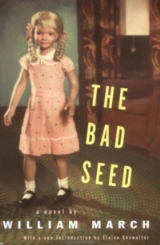
The Bad Seed is a 1954 novel by
William MarchWilliam March was an American author and a highly decorated US Marine. The author of six novels and four short-story collections, March was praised by critics and heralded as "the unrecognized genius of our time", without attaining popular appeal until after his death.March grew up in rural...
, nominated for the 1966
National Book Award for FictionThe National Book Awards are a set of American literary awards. Started in 1950, the Awards are presented annually to American authors for literature published in the current year. In 1989 the National Book Foundation, a nonprofit organization which now oversees and manages the National Book...
. It was the last major work written by March, and, although published in his lifetime, its enormous critical and commercial success was largely realized after his death, one month after publication. The novel was adapted into a successful and long-running
Broadway playThe Bad Seed was a successful and long-running Broadway play by Maxwell Anderson adapted from the novel of that name by William March, and was in turn adapted by John Lee Mahin into an Academy Award-nominated film of the same name directed by Mervyn Leroy. Staged by Reginald Denham, it opened...
by
Maxwell AndersonJames Maxwell Anderson was an American playwright, author, poet, journalist and lyricist.-Early years:Anderson was born in Atlantic, Pennsylvania, the second of eight children to William Lincoln "Link" Anderson, a Baptist minister, and Charlotte Perrimela Stephenson, both of Scots and Irish descent...
and an Academy Award-nominated
filmThe Bad Seed is a 1956 American horror-thrillerfilm directed by Mervyn LeRoy. It is based upon a play by Maxwell Anderson, which in turn is based upon William March's 1954 novel The Bad Seed. The play was adapted by John Lee Mahin for the screenplay of the film...
directed by
Mervyn LeRoyMervyn LeRoy was an American film director, producer and sometime actor.-Early life:Born to Jewish parents in San Francisco, California, his family was financially ruined by the 1906 earthquake...
.
Plot summary
Eight-year-old
RhodaRhoda Penmark is a fictional character in William March's 1954 novel The Bad Seed and the stage play adapted from it by Maxwell Anderson. She was portrayed by Patty McCormack in the 1956 film adaptation and by Carrie Wells in the 1985 made for TV remake....
is the only child of Kenneth and Christine Penmark. Kenneth Penmark goes away on business, leaving Christine and Rhoda at home. Christine begins to notice that Rhoda is acting strangely after one of her classmates mysteriously drowns, and eventually makes a horrible discovery: Rhoda killed the boy, and will almost certainly kill again.
Major characters
- Rhoda Penmark
Rhoda Penmark is a fictional character in William March's 1954 novel The Bad Seed and the stage play adapted from it by Maxwell Anderson. She was portrayed by Patty McCormack in the 1956 film adaptation and by Carrie Wells in the 1985 made for TV remake....
– Rhoda is portrayed as a sociopathAntisocial personality disorder is described by the American Psychiatric Association's Diagnostic and Statistical Manual, fourth edition , as an Axis II personality disorder characterized by "...a pervasive pattern of disregard for, and violation of, the rights of others that begins in childhood...
, although the term was not widely used at the time. She has no conscienceConscience is an aptitude, faculty, intuition or judgment of the intellect that distinguishes right from wrong. Moral judgement may derive from values or norms...
and will kill if necessary to get whatever she wants. By the time Christine, her mother, puts the truth together, Rhoda has already killed two people (a neighbor in BaltimoreBaltimore is the largest independent city in the United States and the largest city and cultural center of the US state of Maryland. The city is located in central Maryland along the tidal portion of the Patapsco River, an arm of the Chesapeake Bay. Baltimore is sometimes referred to as Baltimore...
, and her classmate Claude Daigle). In time, she also kills Leroy, the apartment building's gardener and the only adult who sees through her. An adept manipulatorIn robotics a manipulator is a device used to manipulate materials without direct contact. The applications were originally for dealing with radioactive or biohazardous materials, using robotic arms, or they were used in inaccessible places. In more recent developments they have been used in...
, she can easily charm adults while eliciting fear and revulsion from other children, who can sense something wrong with her.
- Christine Penmark – The mother of Rhoda Penmark. As the novel unfolds, Christine slowly pieces together that Rhoda had killed Claude Daigle, and will undoubtedly kill again. She writes letters to her husband about her worries and discovery of Rhoda's true nature, but in the end disposes of them. Christine is described as beautiful. She has Nordic feminine features that are traced to her biological father. Richard Bravo adopted Christine. She has suspected being adopted since her late teenage years, but did not pursue the idea in fear of upsetting her adopted parents. Christine’s biological mother is Bessie Denker, an infamous serial killer
A serial killer, as typically defined, is an individual who has murdered three or more people over a period of more than a month, with down time between the murders, and whose motivation for killing is usually based on psychological gratification...
who was executed when Christine was a child. In the end, Christine attempts to kill Rhoda by giving her sleeping pillsHypnotic drugs are a class of psychoactives whose primary function is to induce sleep and to be used in the treatment of insomnia and in surgical anesthesia...
and then shoots herself with a revolver.
- Monica Breedlove – The Penmarks’ landlady and Christine's best friend. She considers herself to be somewhat of a psychotherapist
Psychotherapy is a general term referring to any form of therapeutic interaction or treatment contracted between a trained professional and a client or patient; family, couple or group...
and claims she had been examined by Sigmund FreudSigmund Freud , born Sigismund Schlomo Freud , was an Austrian neurologist who founded the discipline of psychoanalysis...
. She is very social and holds many parties. Monica adores Rhoda and believes her to be a very extraordinary child. She gives Rhoda a locket she received when she was eight and a pair of sunglasses with a case. Monica knows that Christine is upset and suspects she is either sick, or that her marriage with Kenneth is under strain. She never discovers the truth about Rhoda and is ultimately upset and befuddled as to why Christine would commit suicideSuicide is the act of intentionally causing one's own death. Suicide is often committed out of despair or attributed to some underlying mental disorder, such as depression, bipolar disorder, schizophrenia, alcoholism, or drug abuse...
.
- Reginald Tasker- A writer and friend of Monica Breedlove. He provides Christine with information about Bessie Denker. He is friends with and fairly attracted to Christine. He informs Christine that her supposed father, Richard Bravo, worked diligently on the Bessie Denker case. Reginald Tasker also makes mention that Bessie Denker's youngest daughter was the only one who survived from the family.
- Leroy Jessup – The maintenance man who works for Monica Breedlove. He is the only adult character, other than Christine, who notices that Rhoda is unlike other children and constantly taunts her. Leroy tells Rhoda that blood cannot wash off with water. Rhoda only reacts to Leroy’s taunting when he claims to have the shoes with which she killed Claude Daigle. Leroy refuses to return the shoes to Rhoda, and when the realization sets in that she actually did kill Claude, he denies ever having them. Shortly after, Leroy is burned to death on his makeshift bed in the garage; Rhoda is later revealed to have been responsible.
- Claude Daigle – The little boy whom Rhoda drowned the day of the Fern Grammar School picnic. He won the Penmanship medal that Rhoda declared to be hers. He is described as a timid and shy boy who rarely stood up to others. He was the only child of Hortense and Dwight Daigle. Rhoda murdered Claude because he would not give her the penmanship medal.
- Bessie Denker – A well-known (fictional) serial killer
A serial killer, as typically defined, is an individual who has murdered three or more people over a period of more than a month, with down time between the murders, and whose motivation for killing is usually based on psychological gratification...
. She is the biological mother of Christine Penmark and the grandmother of Rhoda Penmark. Christine faintly remembers living with her biological family and escaping from her mother. Bessie Denker never makes a physical appearance in the novel. The character's life and murderous history is thoroughly described in the notes of Reginald Tasker. Bessie Denker's career is based very roughly on the real-life careers of Belle GunnessBelle Sorenson Gunness was a Norwegian-American serial killer....
and Jane ToppanJane Toppan , born Honora Kelley, was an American female serial killer. She confessed to 11 murders in 1901. She is quoted as saying that her ambition was "to have killed more people — helpless people — than any other man or woman who ever lived...".-Early life:Though scant records...
. The description of her execution in the electric chairExecution by electrocution, usually performed using an electric chair, is an execution method originating in the United States in which the condemned person is strapped to a specially built wooden chair and electrocuted through electrodes placed on the body...
is based on that of Ruth SnyderRuth Brown Snyder was an American murderess. Her execution, in the electric chair at Sing Sing Prison, for the murder of her husband, Albert, was captured in a well-known photograph.-The crime:...
.
Minor characters
- Kenneth Penmark – The father of Rhoda and husband of Christine. Kenneth is already away on business when the novel begins and he does not return until the very end, after his wife's suicide. Kenneth never discovers the truth about Rhoda or the reasoning behind Christine's suicide
Suicide is the act of intentionally causing one's own death. Suicide is often committed out of despair or attributed to some underlying mental disorder, such as depression, bipolar disorder, schizophrenia, alcoholism, or drug abuse...
and attempted murderMurder is the unlawful killing, with malice aforethought, of another human being, and generally this state of mind distinguishes murder from other forms of unlawful homicide...
of Rhoda.
- Emory Wages – Monica Breedlove's brother, who lives with his sister. He flirts with Christine at different social gatherings.
- Claudia Fern – The Fern sister that reprimands Rhoda for harassing Claude the day of the picnic. She describes the events the day of the picnic
In contemporary usage, a picnic can be defined simply as a pleasure excursion at which a meal is eaten outdoors , ideally taking place in a beautiful landscape such as a park, beside a lake or with an interesting view and possibly at a public event such as before an open air theatre performance,...
to Christine along with her two other sisters, and she informs Christine that her sisters and she do not wish to have Rhoda attend their school the following year.
- Octavia Fern – Fern sister who explains to Christine why the sisters did not ask the Penmarks to donate money for a flower arrangement to be presented at Claude’s funeral
A funeral is a ceremony for celebrating, sanctifying, or remembering the life of a person who has died. Funerary customs comprise the complex of beliefs and practices used by a culture to remember the dead, from interment itself, to various monuments, prayers, and rituals undertaken in their honor...
.
- Burgess Fern – Fern sister in charge of enrollment
Education in its broadest, general sense is the means through which the aims and habits of a group of people lives on from one generation to the next. Generally, it occurs through any experience that has a formative effect on the way one thinks, feels, or acts...
at the Fern School. She would not hold the penmanship medal for Claude Daigle the day of the Fern Grammar School picnic.
- Richard Bravo – Christine's adopted father, who was killed in an airplane crash during World War II
World War II, or the Second World War , was a global conflict lasting from 1939 to 1945, involving most of the world's nations—including all of the great powers—eventually forming two opposing military alliances: the Allies and the Axis...
. He was a well-known columnistA columnist is a journalist who writes for publication in a series, creating an article that usually offers commentary and opinions. Columns appear in newspapers, magazines and other publications, including blogs....
and war correspondentA war correspondent is a journalist who covers stories firsthand from a war zone. In the 19th century they were also called Special Correspondents.-Methods:...
, performing great research in the "Bessie Denker" case. He never told Christine she was adopted or that Bessie Denker was her biological mother.
- Hortense Daigle – Mother of Claude Daigle. She is a plain, large woman who believes that the Fern sisters look down on her for being a hairdresser and marrying late. She is devastated by her son’s death and turns to alcohol as a source of comfort. She knows that Rhoda had something to do with Claude’s death and seeks her out to find answers.
- Dwight Daigle – Father of Claude Daigle. He tries to help his wife, Hortense Daigle, and keep her under control as she suffers from the death of their son.
- Thelma
- Mrs. Forsythe – She is an elderly woman who, towards the end of the novel, baby-sits Rhoda. Rhoda never harms Mrs. Forsythe because she does not have anything Rhoda wants.
- Belle Blackwell – Teacher of the Sunday school Rhoda attends who gives Rhoda a copy of Elsie Dinsmore
Elsie Dinsmore is a children's book series written by Martha Finley between 1867 and 1905.An adapted version has been published, which leaves out several important facts and details.-Original story:...
.
- Clara Post – The old woman who lived with the Penmarks and her daughter, Edna, in the same apartment house in Baltimore
Baltimore is the largest independent city in the United States and the largest city and cultural center of the US state of Maryland. The city is located in central Maryland along the tidal portion of the Patapsco River, an arm of the Chesapeake Bay. Baltimore is sometimes referred to as Baltimore...
. She befriended Rhoda and believed her to be truly delightful. She promised Rhoda that when she died Rhoda could have an item.
- Edna – She is the widowed daughter of Mrs. Clara Post. She lives with her mother in the same apartment house in Baltimore
Baltimore is the largest independent city in the United States and the largest city and cultural center of the US state of Maryland. The city is located in central Maryland along the tidal portion of the Patapsco River, an arm of the Chesapeake Bay. Baltimore is sometimes referred to as Baltimore...
as the Penmarks. Her mother died the day she left to go to the supermarket. Edna was skeptical of Rhoda's story of her mother's accidental death. She did not invite the Penmarks to the funeralA funeral is a ceremony for celebrating, sanctifying, or remembering the life of a person who has died. Funerary customs comprise the complex of beliefs and practices used by a culture to remember the dead, from interment itself, to various monuments, prayers, and rituals undertaken in their honor...
or speak to them after the incident.
Nature versus nurture
In the decade the novel was published,
juvenile delinquencyJuvenile delinquency is participation in illegal behavior by minors who fall under a statutory age limit. Most legal systems prescribe specific procedures for dealing with juveniles, such as juvenile detention centers. There are a multitude of different theories on the causes of crime, most if not...
, although not as prevalent as seen in present
societyA society, or a human society, is a group of people related to each other through persistent relations, or a large social grouping sharing the same geographical or virtual territory, subject to the same political authority and dominant cultural expectations...
, began to be far more common, and/or more extensively reported and documented. Compared to earlier
historyHistory is the discovery, collection, organization, and presentation of information about past events. History can also mean the period of time after writing was invented. Scholars who write about history are called historians...
, the idea of child crimes was a new
phenomenonA phenomenon , plural phenomena, is any observable occurrence. Phenomena are often, but not always, understood as 'appearances' or 'experiences'...
. The nature-nurture controversy was a psychiatric proposal to explain the increase in and
motiveA motive, in law, especially criminal law, is the cause that moves people to induce a certain action. Motive, in itself, is not an element of any given crime; however, the legal system typically allows motive to be proven in order to make plausible the accused's reasons for committing a crime, at...
behind juvenile delinquency. Supporters of the “nature” side suggested that a key component of the "nature" side was that some people are born evil. There is great implication to the theory that the majority of people are not born
evilEvil is the violation of, or intent to violate, some moral code. Evil is usually seen as the dualistic opposite of good. Definitions of evil vary along with analysis of its root motive causes, however general actions commonly considered evil include: conscious and deliberate wrongdoing,...
or with malicious tendencies. The idea that nature prevails over nurture is implied in
The Bad Seed. March incorporates the notion that a murderous genetic trait is being passed down through the generations; within the plot of the story. Rhoda is a serial murderer just like her grandmother. Rhoda has inherited the murderous
geneA gene is a molecular unit of heredity of a living organism. It is a name given to some stretches of DNA and RNA that code for a type of protein or for an RNA chain that has a function in the organism. Living beings depend on genes, as they specify all proteins and functional RNA chains...
that has been passed down from her grandmother. Rhoda had been brought up as a privileged child; she was nurtured emotionally and physically. Reginald Tasker hints and suggests at the idea of nature taking effect when he quotes that "some people are just born evil", when discussing Bessie Denker with Christine.
The nurture side is people develop evil through their environment they live in and nature is that they are born to intend to be evil
Reviews
- James Kelly, New York Times:
"Let it be said quickly:
William MarchWilliam March was an American author and a highly decorated US Marine. The author of six novels and four short-story collections, March was praised by critics and heralded as "the unrecognized genius of our time", without attaining popular appeal until after his death.March grew up in rural...
knows where human fears and secrets are buried. He announced it in
Company KCompany K is a 1933 novel by William March, first serialised in parts in the New York magazine Forum from 1930 to 1932, and published in its entirety by Smith and Haas on 19 January 1933, in New York. The book's title was taken from the Marine company that March served in during World War I...
, a novel published twenty years ago and equaled only by Dos Passos'
Three SoldiersThree Soldiers is a 1920 novel by the American writer and critic John Dos Passos. It is one of the key American war novels of the First World War, and remains a classic of the realist war novel genre. H.L. Mencken, then practising primarily as an American literary critic, praised the book in the...
as a sampling of men at war. He has proved it again and again in the other novels and short stories, all of them floored and walled in what
Clifton FadimanClifton P. "Kip" Fadiman was an American intellectual, author, editor, radio and television personality.-Literary career:...
decided to call "Psychological acumen". But nowhere is this gift better displayed than in
The Bad Seed — the portrayal of a coldly evil, murderous child and what she does to both victims and family. In the author's hands this is adequate material for an absolutely first class novel of
moralA moral is a message conveyed or a lesson to be learned from a story or event. The moral may be left to the hearer, reader or viewer to determine for themselves, or may be explicitly encapsulated in a maxim...
bewilderments and responsibilities nearest the heart of our decade."
- Dan Wickenden, New York Herald Tribune
The New York Herald Tribune was a daily newspaper created in 1924 when the New York Tribune acquired the New York Herald.Other predecessors, which had earlier merged into the New York Tribune, included the original The New Yorker newsweekly , and the Whig Party's Log Cabin.The paper was home to...
:
"Dark, original, ultimately appalling, William March's extraordinary new novel is, on the obvious level, a straightforward, technically accomplished story of suspense. The manner of its telling — the dispassionate, exact, almost starched
proseProse is the most typical form of written language, applying ordinary grammatical structure and natural flow of speech rather than rhythmic structure...
, with its occasional glints of sardonic humor — is an impressive achievement in itself. It lends some credibility to a
narrativeA narrative is a constructive format that describes a sequence of non-fictional or fictional events. The word derives from the Latin verb narrare, "to recount", and is related to the adjective gnarus, "knowing" or "skilled"...
against which the imagination rebels; and towards the end, as horror is piled upon horror, it saves the book from falling headlong into absurdity... This is a novel bound to arouse strong responses, to generate vehement discussion, and so not easily to be forgotten."
- August Derleth
August William Derleth was an American writer and anthologist. Though best remembered as the first publisher of the writings of H. P...
, Chicago Sunday Tribune:
"
The Bad Seed would have been a stronger novel without this false premise — the granddaughter of a murderess is no more likely to be a murderess than the granddaughter of a seamstress, or anyone else. Apart from this flaw, however,
The Bad Seed is a novel of suspense and mounting horror, which the reader who can close his eyes to March's unnecessary premise will enjoy as the work of one of the most satisfying of American novelists."
- L.A.G. Strong, The Spectator
The Spectator is a weekly British magazine first published on 6 July 1828. It is currently owned by David and Frederick Barclay, who also owns The Daily Telegraph. Its principal subject areas are politics and culture...
(UK):
"
The Bad Seed is terrifyingly good, not only because its theme is worked out so powerfully, but because every character is convincing. One has to believe that these appalling things took place exactly as the author says they did."
Broadway play
Maxwell AndersonJames Maxwell Anderson was an American playwright, author, poet, journalist and lyricist.-Early years:Anderson was born in Atlantic, Pennsylvania, the second of eight children to William Lincoln "Link" Anderson, a Baptist minister, and Charlotte Perrimela Stephenson, both of Scots and Irish descent...
adapted the book for the stage almost immediately after its publication. Anderson had previously won the New York Drama Critics' Circle Award in 1935 and 1936 for his plays
WintersetWinterset is a play by Maxwell Anderson.A verse drama written largely in poetic form, the tragedy deals indirectly with the famous Sacco-Vanzetti case, in which two Italian immigrants with radical political beliefs were executed...
and
High TorHigh Tor is a 1936 play by Maxwell Anderson. Twenty years after the original production, Anderson adapted it into a television musical with Arthur Schwartz.-Play:...
, as well as the
Pulitzer PrizeThe Pulitzer Prize is a U.S. award for achievements in newspaper and online journalism, literature and musical composition. It was established by American publisher Joseph Pulitzer and is administered by Columbia University in New York City...
for Drama in 1933 for his play
Both Your HousesBoth Your Houses is a 1933 play written by American playwright Maxwell Anderson. Produced by the Theatre Guild, it opened at the Royale Theatre on March 5, 1933 and ran 72 performances. It was awarded the 1933 Pulitzer Prize for Drama....
. Reginald Denham directed the play using Anderson's script. The play opened on Broadway on December 8, 1954 at the 46th Street Theatre (now the
Richard Rodgers TheatreThe Richard Rodgers Theatre, is a Broadway theater in New York City, built by Irwin Chanin in 1925. When it was first opened, it was called Chanin's 46th Street Theatre. Chanin almost immediately leased it to the Shuberts, who bought the building outright in 1931 and renamed it the 46th Street...
), less than a year after the publication of the novel.
On April 25, 1955, the play transferred to the Coronet Theatre (now the
Eugene O'Neill TheatreThe Eugene O'Neill Theatre is a Broadway theatre located at 230 West 49th Street in midtown-Manhattan.Designed by architect Herbert J. Krapp, it was built for the Shuberts as part of a theatre-hotel complex named for 19th century tragedian Edwin Forrest...
), where it completed its successful run of 334 performances on September 27, 1955.
Nancy KellyNancy Kelly was an American actress, who was a movie leading lady in the 1930s, making 36 movies between 1926 and 1977, including portraying Tyrone Power's love interest in the classic Jesse James , which also featured Henry Fonda, and playing opposite Spencer Tracy in Stanley and Livingstone...
, the actress who played Christine, won the 1955
Tony AwardThe Antoinette Perry Award for Excellence in Theatre, more commonly known as a Tony Award, recognizes achievement in live Broadway theatre. The awards are presented by the American Theatre Wing and The Broadway League at an annual ceremony in New York City. The awards are given for Broadway...
for Best Actress in a Play. The audience made claims that
Patty McCormackPatty McCormack is an American actress with a career in theater, films and television.She achieved success as a child actress, and received a nomination for an Academy Award for Best Supporting Actress for her performance in The Bad Seed...
, the child actress who played Rhoda, was the most memorable character.
1956 film
Mervyn LeRoyMervyn LeRoy was an American film director, producer and sometime actor.-Early life:Born to Jewish parents in San Francisco, California, his family was financially ruined by the 1906 earthquake...
was the director of
the 1956 movieThe Bad Seed is a 1956 American horror-thrillerfilm directed by Mervyn LeRoy. It is based upon a play by Maxwell Anderson, which in turn is based upon William March's 1954 novel The Bad Seed. The play was adapted by John Lee Mahin for the screenplay of the film...
. In LeRoy's Hollywood career, he produced and or directed over 70 films including
Little CaesarLittle Caesar is a 1931 Warner Bros. Pre-Code crime film. It tells the story of a hoodlum who ascends the ranks of organized crime until he reaches its upper echelons. Directed by Mervyn LeRoy, the film stars Edward G. Robinson and Douglas Fairbanks, Jr.. The story was adapted by Francis Edward...
and
Little WomenLittle Women directed by Mervyn LeRoy is based on Louisa May Alcott's novel of the same name. The screenplay was written by Sally Benson, Victor Heerman, Sarah Y. Mason, and Andrew Solt...
.
Nancy KellyNancy Kelly was an American actress, who was a movie leading lady in the 1930s, making 36 movies between 1926 and 1977, including portraying Tyrone Power's love interest in the classic Jesse James , which also featured Henry Fonda, and playing opposite Spencer Tracy in Stanley and Livingstone...
,
Patty McCormackPatty McCormack is an American actress with a career in theater, films and television.She achieved success as a child actress, and received a nomination for an Academy Award for Best Supporting Actress for her performance in The Bad Seed...
and the majority of the original cast acted in the 1956 movie. Unfortunately, unlike the play and the book, the movie was not a great success. The ending of the 1956 film was changed from the novel in order to comply with the Hays Code. Rhoda is struck and killed abruptly by
lightningLightning is an atmospheric electrostatic discharge accompanied by thunder, which typically occurs during thunderstorms, and sometimes during volcanic eruptions or dust storms...
when she goes back to the scene of her crime to retrieve the medal, while Christine survives her suicide attempt. During the closing credits, LeRoy added a light-hearted sequence of
Nancy KellyNancy Kelly was an American actress, who was a movie leading lady in the 1930s, making 36 movies between 1926 and 1977, including portraying Tyrone Power's love interest in the classic Jesse James , which also featured Henry Fonda, and playing opposite Spencer Tracy in Stanley and Livingstone...
, Christine, holding
Patty McCormackPatty McCormack is an American actress with a career in theater, films and television.She achieved success as a child actress, and received a nomination for an Academy Award for Best Supporting Actress for her performance in The Bad Seed...
, Rhoda, over her leg and spanking her — possibly to remind audiences that this is just a play.
1985 film
The
Bad Seed was remade as a
television movieA television film is a feature film that is a television program produced for and originally distributed by a television network, in contrast to...
in 1985, adapted by George Eckstein and directed by
Paul WendkosPaul Wendkos was an American television and film director....
and kept the novel's original ending. It starred
Blair BrownBonnie Blair Brown is an American theater, film, and television actress. She has had a number of high profile roles, including a Tony Award-winning turn in the play Copenhagen on Broadway, as well as a run as the title character in the television comedy-drama The Days and Nights of Molly Dodd,...
,
Lynn RedgraveLynn Rachel Redgrave, OBE was an English actress.A member of the well-known British family of actors, Redgrave trained in London before making her theatrical debut in 1962...
,
David CarradineDavid Carradine was an American actor and martial artist, best known for his role as a warrior monk, Kwai Chang Caine, in the 1970s television series, Kung Fu, which later had a 1990s sequel series, Kung Fu: The Legend Continues...
,
Richard Kiley, and
Chad AllenChad Allen is an American actor. Beginning a prolific career as a child actor at the age of seven, Allen is a three-time Young Artist Award winner and GLAAD Media Award honoree, best known for rising to prominence as a teen idol during the late 1980s as David Witherspoon on the NBC family drama,...
. Claire Welles played the title character, who's name was modernized as "Rachel." The TV-movie version was considered inferior to both the play and original film.
Potential remake
Eli RothEli Raphael Roth is an American film director, producer, writer and actor. He is known for his role as Donny "The Bear Jew" Donowitz in Quentin Tarantino's Inglourious Basterds for which he won both a SAG Award and a BFCA Critic's Choice Award...
was set to direct a new remake of the film, as stated by MovieWeb.com. Roth promised a new take with a modern horror sensibility. "The original was a great psychological thriller, and we are going to bastardize and exploit it, ramping up the body counts and killings," said Roth. "This is going to be scary, bloody fun, and we're going to create the next horror icon, a la
FreddyFrederick Charles "Freddy" Krueger is a fictional, horrifying character from the Nightmare on Elm Street series of horror films. He first appears in Wes Craven's A Nightmare on Elm Street as a disfigured dream stalker who uses a glove armed with razors to kill his victims in their dreams,...
,
JasonJason Voorhees is a fictional character from the Friday the 13th series of slasher films. He first appeared in Friday the 13th , as the son of camp cook-turned-murderer, Mrs. Voorhees, in which he was portrayed by Ari Lehman. Created by Victor Miller, with contributions by Ron Kurz, Sean S...
and Chucky. She's this cunning, adorable kid who loves to kill, but also loves
'N SyncN Sync was an American boy band formed in Orlando, Florida, in 1995 and launched in Germany by BMG Ariola Munich, *NSYNC consisted of JC Chasez, Justin Timberlake, Lance Bass, Joey Fatone and Chris Kirkpatrick...
."
Works cited
- March, William. The Bad Seed. New York: HarperCollins Publishers, 1997.
- Showalter, Elaine. Insights, Interviews & More. New York: HarperCollins Publishers, 1997.
- Murray, Rebecca. “The Bad Seed” Sprouts for Director Eli Roth: About.com Guide
External links