
|
|
|
|
The 33 Strategies of War
|
| |
|
| |
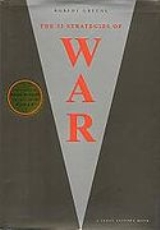
The 33 Strategies of War by Robert Greene is a collection of discussions and examples on offensive and defensive strategies released in 2006, which teaches the reader how to apply these strategies to resolve conflicts in daily life. The book uses examples from a wide variety of people and conditions such as Napoleon Bonaparte, Lawrence of Arabia, Alexander the Great, and the Tet Offensive. Although one reviewer has called the book "an indispensable book, provides all the psychological ammunition you need to overcome patterns of failure and forever gain the upper hand," another one found it "perplexing — if not downright unhealthy — a book on the lessons of war for everything but war at a time when we are, er, at war." Yet another reviewer found the book's coverage of military history informative, but the political tales "mostly foolish or just plain wrong".
The 33 Strategies of War was part of the reading list for youths attending the Indigenous Leadership Forum organized by the University of Victoria, which aimed to redesign radical Indigenous politics and the Indigenist movement.

Discussion
Ask a question about 'The 33 Strategies of War'
Start a new discussion about 'The 33 Strategies of War'
Answer questions from other users
|
Encyclopedia
The 33 Strategies of War by Robert Greene is a collection of discussions and examples on offensive and defensive strategies released in 2006, which teaches the reader how to apply these strategies to resolve conflicts in daily life. The book uses examples from a wide variety of people and conditions such as Napoleon Bonaparte, Lawrence of Arabia, Alexander the Great, and the Tet Offensive. Although one reviewer has called the book "an indispensable book, provides all the psychological ammunition you need to overcome patterns of failure and forever gain the upper hand," another one found it "perplexing — if not downright unhealthy — a book on the lessons of war for everything but war at a time when we are, er, at war." Yet another reviewer found the book's coverage of military history informative, but the political tales "mostly foolish or just plain wrong".
The 33 Strategies of War was part of the reading list for youths attending the Indigenous Leadership Forum organized by the University of Victoria, which aimed to redesign radical Indigenous politics and the Indigenist movement. It is also read by students attending a Southwestern Baptist Theological Seminary course in Christian apologetics.
Summary
The 33 Strategies of War is not as much about war as it is about strategies of dealing in various environments and understanding the strategies and methods to counter them. Greene's examples are from a wide variety of people and conditions; Napoleon Bonaparte, Alfred Hitchcock, Sun Tzu, Margaret Thatcher, Shaka the Zulu, Lord Nelson, Franklin Roosevelt, Hannibal, Ulysses S. Grant, and many more.
The book is broken into five parts: Self-Directed Warfare, Organizational (Team) Warfare, Defensive Warfare, Offensive Warfare and Unconventional (Dirty) Warfare. Each part contains a differing number of strategies, each in a chapter. Each chapter has the similar layout. There are multiple examples of political situations (most are battles, but there are plenty of political or business examples) and an accompanying interpretation. There is an occasional "instructional" section followed by examples. All chapters end with a "Reversal" to give a brief
discussion of where the strategy may not apply, a contrary view or defense. Throughout the book Mr. Greene liberally sprinkles quotes from a variety of sources for the reader's interpretation. These are artfully laced in the margins and between sections.
|
| |
|
|