

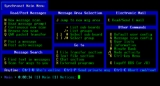
Text user interface

Encyclopedia
TUI short for: Text User Interface or Textual User Interface (and sometimes Terminal User Interface), is a retronym
that was coined sometime after the invention of graphical user interface
s, to distinguish them from text-based user interface
s. TUIs are different from command-line interface
s in that, like GUIs, they use the entire screen area and do not necessarily provide line-by-line output. However, TUIs only use text, symbols and colors available on a typical text terminal, while GUIs typically use high-resolution raster graphics.
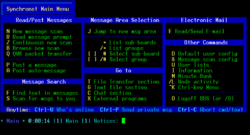 ANSI
ANSI
standard ANSI X3.64 defines a standard set of escape sequence
s that can be used to drive terminals to create TUIs (see ANSI escape code
.) However, not all terminals follow this standard, and many non-compatible but functionally equivalent sequences exist.
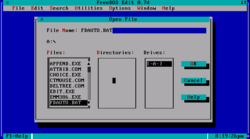 On IBM PC
s and compatible
s, the BIOS
and MS-DOS
system calls provide a way of writing text on the screen, and the ANSI.SYS
driver could process standard ANSI escape sequences. However, programmers soon learned that writing data directly to the screen buffer
was much faster, as well as being much simpler to program and less error-prone. This change in programming technique resulted in a large number of MS-DOS TUI programs.
Most often those programs used a blue background for the main screen, with white or yellow characters, although commonly they had also user color customization. Later, the interface became deeply influenced by GUI
s, adding pull-down menus, overlapping windows
, dialog box
es and GUI widgets operated by mnemonics
or keyboard shortcut
s. Soon mouse input was added—either at text resolution as a simple colored box or at graphical resolution thanks to the ability of the EGA
and VGA
display adapters to redefine the text character shapes by software—providing additional functionality.
Some notable programs of this kind were Microsoft Word
, MS-DOS Shell, WordPerfect
, Norton Commander
, Turbo Vision
based Borland
Turbo Pascal
and Turbo C
(the latter included the conio
library
), Lotus 1-2-3
and many others. Some of these interfaces survive even during the Microsoft
Windows
3.x age in the first 1990s; for example, the Microsoft C 6.0 compiler, employed to write true GUI
programs under 16-bit
MS Windows
, still features its own TUI.
Since the beginning, Microsoft Windows
includes a console for displaying MS-DOS software. Later versions added the Win32 console
as a native interface for command line
and TUI programs. The console usually opens in window mode, but it can be switched to full true text mode screen and vice versa by pressing the Alt
and Enter
keys together.
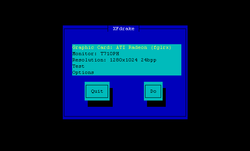 In Unix-like
operating systems, TUIs are often constructed using the terminal control library
curses
, or ncurses
, a mostly compatible library.
The advent of the curses library with Berkeley Unix created a portable and stable API for which to write TUIs. The ability to talk to various text terminal types using the same interfaces
led to more widespread use of "visual" Unix programs, which occupied the entire terminal screen instead of using a simple line interface. This can be seen in text editor
s such as vi
, mail clients
such as pine
or mutt
, system management tools such as SMIT, SAM, FreeBSD
's Sysinstall
and web browser
s such as lynx
. Some applications, such as w3m
, as well as older versions of pine
and vi
use the less-capable termcap
library, performing many of the functions associated with curses
within the application.
In addition, the rise in popularity of Linux
brought many former MS-DOS users to a Unix-like platform, which has fostered an MS-DOS influence in many TUIs. The program minicom, for example, is modeled after the popular MS-DOS program Telix
. Some other TUI programs, such as the Twin desktop, were ported over.
The free software
program GNU Screen
provides for managing multiple sessions inside a single TUI, and so can be thought of as being like a window manager
for text-mode interfaces.
The proprietary Mac OS X
text editor
BBEdit
includes a 'shell worksheet' function that works as a full-screen shell window.
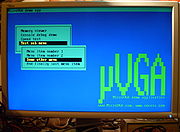 Modern embedded system
s are capable of displaying TUI on a monitor like personal computers. This functionality is usually implemented using specialized integrated circuits, modules, or using FPGA.
Video circuits or modules are usually controlled using VT100
-compatible command set over UART, FPGA designs usually allow direct video memory access.
Retronym
A retronym is a type of neologism that provides a new name for an object or concept to differentiate the original form or version of it from a more recent form or version. The original name is most often augmented with an adjective to account for later developments of the object or concept itself...
that was coined sometime after the invention of graphical user interface
Graphical user interface
In computing, a graphical user interface is a type of user interface that allows users to interact with electronic devices with images rather than text commands. GUIs can be used in computers, hand-held devices such as MP3 players, portable media players or gaming devices, household appliances and...
s, to distinguish them from text-based user interface
User interface
The user interface, in the industrial design field of human–machine interaction, is the space where interaction between humans and machines occurs. The goal of interaction between a human and a machine at the user interface is effective operation and control of the machine, and feedback from the...
s. TUIs are different from command-line interface
Command-line interface
A command-line interface is a mechanism for interacting with a computer operating system or software by typing commands to perform specific tasks...
s in that, like GUIs, they use the entire screen area and do not necessarily provide line-by-line output. However, TUIs only use text, symbols and colors available on a typical text terminal, while GUIs typically use high-resolution raster graphics.
TUI on ANSI-compatible terminals
American National Standards Institute
The American National Standards Institute is a private non-profit organization that oversees the development of voluntary consensus standards for products, services, processes, systems, and personnel in the United States. The organization also coordinates U.S. standards with international...
standard ANSI X3.64 defines a standard set of escape sequence
Escape sequence
An escape sequence is a series of characters used to change the state of computers and their attached peripheral devices. These are also known as control sequences, reflecting their use in device control. Some control sequences are special characters that always have the same meaning...
s that can be used to drive terminals to create TUIs (see ANSI escape code
ANSI escape code
ANSI escape sequences are characters embedded in the text used to control formatting, color, and other output options on video text terminals. Almost all terminal emulators designed to show text output from a remote computer, and to show text output from local software, interpret at least some of...
.) However, not all terminals follow this standard, and many non-compatible but functionally equivalent sequences exist.
TUI under MS-DOS and Microsoft Windows
IBM PC
The IBM Personal Computer, commonly known as the IBM PC, is the original version and progenitor of the IBM PC compatible hardware platform. It is IBM model number 5150, and was introduced on August 12, 1981...
s and compatible
IBM PC compatible
IBM PC compatible computers are those generally similar to the original IBM PC, XT, and AT. Such computers used to be referred to as PC clones, or IBM clones since they almost exactly duplicated all the significant features of the PC architecture, facilitated by various manufacturers' ability to...
s, the BIOS
BIOS
In IBM PC compatible computers, the basic input/output system , also known as the System BIOS or ROM BIOS , is a de facto standard defining a firmware interface....
and MS-DOS
MS-DOS
MS-DOS is an operating system for x86-based personal computers. It was the most commonly used member of the DOS family of operating systems, and was the main operating system for IBM PC compatible personal computers during the 1980s to the mid 1990s, until it was gradually superseded by operating...
system calls provide a way of writing text on the screen, and the ANSI.SYS
ANSI.SYS
ANSI.SYS is a device driver in the DOS operating system that provides extra console functions through ANSI escape sequences. It is partially based upon a subset of the text terminal control standard proposed by the ANSI X3L2 Technical Committee on Codes and Character Sets .-Usage:To use ANSI.SYS...
driver could process standard ANSI escape sequences. However, programmers soon learned that writing data directly to the screen buffer
Screen buffer
In computing, screen buffer is a part of computer memory used by a computer application for the representation of the content to be shown on the computer display....
was much faster, as well as being much simpler to program and less error-prone. This change in programming technique resulted in a large number of MS-DOS TUI programs.
Most often those programs used a blue background for the main screen, with white or yellow characters, although commonly they had also user color customization. Later, the interface became deeply influenced by GUI
Gui
Gui or guee is a generic term to refer to grilled dishes in Korean cuisine. These most commonly have meat or fish as their primary ingredient, but may in some cases also comprise grilled vegetables or other vegetarian ingredients. The term derives from the verb, "gupda" in Korean, which literally...
s, adding pull-down menus, overlapping windows
Window (computing)
In computing, a window is a visual area containing some kind of user interface. It usually has a rectangular shape that can overlap with the area of other windows...
, dialog box
Dialog box
In a graphical user interface of computers, a dialog box is a type of window used to enable reciprocal communication or "dialog" between a computer and its user. It may communicate information to the user, prompt the user for a response, or both...
es and GUI widgets operated by mnemonics
Mnemonics (keyboard)
A mnemonic is an underlined alphanumeric character, typically appearing in a menu title, menu item, or the text of a button or component of the User interface...
or keyboard shortcut
Keyboard shortcut
In computing, a keyboard shortcut is a finite set of one or more keys that invoke a software or operating system operation when triggered by the user. A meaning of term "keyboard shortcut" can vary depending on software manufacturer...
s. Soon mouse input was added—either at text resolution as a simple colored box or at graphical resolution thanks to the ability of the EGA
Enhanced Graphics Adapter
The Enhanced Graphics Adapter is the IBM PC computer display standard specification which is between CGA and VGA in terms of color and space resolution. Introduced in October 1984 by IBM shortly after its new PC/AT, EGA produces a display of 16 simultaneous colors from a palette of 64 at a...
and VGA
Video Graphics Array
Video Graphics Array refers specifically to the display hardware first introduced with the IBM PS/2 line of computers in 1987, but through its widespread adoption has also come to mean either an analog computer display standard, the 15-pin D-subminiature VGA connector or the 640×480 resolution...
display adapters to redefine the text character shapes by software—providing additional functionality.
Some notable programs of this kind were Microsoft Word
Microsoft Word
Microsoft Word is a word processor designed by Microsoft. It was first released in 1983 under the name Multi-Tool Word for Xenix systems. Subsequent versions were later written for several other platforms including IBM PCs running DOS , the Apple Macintosh , the AT&T Unix PC , Atari ST , SCO UNIX,...
, MS-DOS Shell, WordPerfect
WordPerfect
WordPerfect is a word processing application, now owned by Corel.Bruce Bastian, a Brigham Young University graduate student, and BYU computer science professor Dr. Alan Ashton joined forces to design a word processing system for the city of Orem's Data General Corp. minicomputer system in 1979...
, Norton Commander
Norton Commander
Norton Commander was a prototypical orthodox file manager , written by John Socha and released by Peter Norton Computing . NC is a file manager which provides a text user interface on top of DOS. It was officially produced by Symantec between 1986 and 1998...
, Turbo Vision
Turbo Vision
Turbo Vision is a DOS-based character-mode text user interface framework developed around 1992 by Borland for Pascal, and C++. Later it was deprecated in favor of Object Windows Library for the then-increasingly important Win16 API....
based Borland
Borland
Borland Software Corporation is a software company first headquartered in Scotts Valley, California, Cupertino, California and finally Austin, Texas. It is now a Micro Focus subsidiary. It was founded in 1983 by Niels Jensen, Ole Henriksen, Mogens Glad and Philippe Kahn.-The 1980s:...
Turbo Pascal
Turbo Pascal
Turbo Pascal is a software development system that includes a compiler and an integrated development environment for the Pascal programming language running on CP/M, CP/M-86, and DOS, developed by Borland under Philippe Kahn's leadership...
and Turbo C
Turbo C
Turbo C is an Integrated Development Environment and compiler for the C programming language from Borland. First introduced in 1987, it was noted for its integrated development environment, small size, extremely fast compile speed, comprehensive manuals and low price.In May 1990, Borland replaced...
(the latter included the conio
Conio.h
conio.h is a C header file used in old MS-DOS compilers to create text user interfaces. It is not described in The C Programming Language book, and it is not part of the C standard library, ISO C nor is it defined by POSIX....
library
Library (computer science)
In computer science, a library is a collection of resources used to develop software. These may include pre-written code and subroutines, classes, values or type specifications....
), Lotus 1-2-3
Lotus 1-2-3
Lotus 1-2-3 is a spreadsheet program from Lotus Software . It was the IBM PC's first "killer application"; its huge popularity in the mid-1980s contributed significantly to the success of the IBM PC in the corporate environment.-Beginnings:...
and many others. Some of these interfaces survive even during the Microsoft
Microsoft
Microsoft Corporation is an American public multinational corporation headquartered in Redmond, Washington, USA that develops, manufactures, licenses, and supports a wide range of products and services predominantly related to computing through its various product divisions...
Windows
Microsoft Windows
Microsoft Windows is a series of operating systems produced by Microsoft.Microsoft introduced an operating environment named Windows on November 20, 1985 as an add-on to MS-DOS in response to the growing interest in graphical user interfaces . Microsoft Windows came to dominate the world's personal...
3.x age in the first 1990s; for example, the Microsoft C 6.0 compiler, employed to write true GUI
Gui
Gui or guee is a generic term to refer to grilled dishes in Korean cuisine. These most commonly have meat or fish as their primary ingredient, but may in some cases also comprise grilled vegetables or other vegetarian ingredients. The term derives from the verb, "gupda" in Korean, which literally...
programs under 16-bit
16-bit
-16-bit architecture:The HP BPC, introduced in 1975, was the world's first 16-bit microprocessor. Prominent 16-bit processors include the PDP-11, Intel 8086, Intel 80286 and the WDC 65C816. The Intel 8088 was program-compatible with the Intel 8086, and was 16-bit in that its registers were 16...
MS Windows
Microsoft Windows
Microsoft Windows is a series of operating systems produced by Microsoft.Microsoft introduced an operating environment named Windows on November 20, 1985 as an add-on to MS-DOS in response to the growing interest in graphical user interfaces . Microsoft Windows came to dominate the world's personal...
, still features its own TUI.
Since the beginning, Microsoft Windows
Microsoft Windows
Microsoft Windows is a series of operating systems produced by Microsoft.Microsoft introduced an operating environment named Windows on November 20, 1985 as an add-on to MS-DOS in response to the growing interest in graphical user interfaces . Microsoft Windows came to dominate the world's personal...
includes a console for displaying MS-DOS software. Later versions added the Win32 console
Win32 console
Win32 console is a text user interface implementation within the system of Windows API, which runs console applications. A Win32 console has a screen buffer and an input buffer, and is available both as a window or in text mode screen, with switching back and forth available via Alt-Enter...
as a native interface for command line
Command-line interface
A command-line interface is a mechanism for interacting with a computer operating system or software by typing commands to perform specific tasks...
and TUI programs. The console usually opens in window mode, but it can be switched to full true text mode screen and vice versa by pressing the Alt
Alt key
The Alt key on a computer keyboard is used to change the function of other pressed keys. Thus, the Alt key is a modifier key, used in a similar fashion to the Shift key. For example, simply pressing "A" will type the letter a, but if you hold down either Alt key while pressing A, the computer...
and Enter
Enter key
In computer keyboards, the enter key in most cases causes a command line, window form, or dialog box to operate its default function...
keys together.
TUI under Unix-like systems
Unix-like
A Unix-like operating system is one that behaves in a manner similar to a Unix system, while not necessarily conforming to or being certified to any version of the Single UNIX Specification....
operating systems, TUIs are often constructed using the terminal control library
Library (computer science)
In computer science, a library is a collection of resources used to develop software. These may include pre-written code and subroutines, classes, values or type specifications....
curses
Curses (programming library)
curses is a terminal control library for Unix-like systems, enabling the construction of text user interface applications.The name is a pun on the term “cursor optimization”. It is a library of functions that manage an application's display on character-cell terminals .- Overview :The curses API...
, or ncurses
Ncurses
ncurses is a programming library that provides an API which allows the programmer to write text user interfaces in a terminal-independent manner. It is a toolkit for developing "GUI-like" application software that runs under a terminal emulator...
, a mostly compatible library.
The advent of the curses library with Berkeley Unix created a portable and stable API for which to write TUIs. The ability to talk to various text terminal types using the same interfaces
Application programming interface
An application programming interface is a source code based specification intended to be used as an interface by software components to communicate with each other...
led to more widespread use of "visual" Unix programs, which occupied the entire terminal screen instead of using a simple line interface. This can be seen in text editor
Text editor
A text editor is a type of program used for editing plain text files.Text editors are often provided with operating systems or software development packages, and can be used to change configuration files and programming language source code....
s such as vi
Vi
vi is a screen-oriented text editor originally created for the Unix operating system. The portable subset of the behavior of vi and programs based on it, and the ex editor language supported within these programs, is described by the Single Unix Specification and POSIX.The original code for vi...
, mail clients
E-mail client
An email client, email reader, or more formally mail user agent , is a computer program used to manage a user's email.The term can refer to any system capable of accessing the user's email mailbox, regardless of it being a mail user agent, a relaying server, or a human typing on a terminal...
such as pine
Pine (e-mail client)
Pine is a freeware, text-based email client developed at the University of Washington. The first version of this client was written in 1989. Source code was available for only the Unix version under a license written by the University of Washington...
or mutt
Mutt (e-mail client)
Mutt is a text-based email client for Unix-like systems. It was originally written by Michael Elkins in 1995 and released under the GNU General Public License version 2 or any later version....
, system management tools such as SMIT, SAM, FreeBSD
FreeBSD
FreeBSD is a free Unix-like operating system descended from AT&T UNIX via BSD UNIX. Although for legal reasons FreeBSD cannot be called “UNIX”, as the direct descendant of BSD UNIX , FreeBSD’s internals and system APIs are UNIX-compliant...
's Sysinstall
Sysinstall
Sysinstall, also known as sysinstall, is the graphical FreeBSD system installation and configuration tool. It was written in C by Jordan Hubbard, is curses based and first appeared in FreeBSD 2.0....
and web browser
Web browser
A web browser is a software application for retrieving, presenting, and traversing information resources on the World Wide Web. An information resource is identified by a Uniform Resource Identifier and may be a web page, image, video, or other piece of content...
s such as lynx
Lynx (web browser)
Lynx is a text-based web browser for use on cursor-addressable character cell terminals and is very configurable.-Usage:Browsing in Lynx consists of highlighting the chosen link using cursor keys, or having all links on a page numbered and entering the chosen link's number. Current versions support...
. Some applications, such as w3m
W3m
w3m is a free software/open source text-based web browser. It has support for tables, frames, SSL connections, color and inline images on suitable terminals...
, as well as older versions of pine
Pine (e-mail client)
Pine is a freeware, text-based email client developed at the University of Washington. The first version of this client was written in 1989. Source code was available for only the Unix version under a license written by the University of Washington...
and vi
Vi
vi is a screen-oriented text editor originally created for the Unix operating system. The portable subset of the behavior of vi and programs based on it, and the ex editor language supported within these programs, is described by the Single Unix Specification and POSIX.The original code for vi...
use the less-capable termcap
Termcap
Termcap is a software library and database used on Unix-like computers. It enables programs to use display computer terminals in a device-independent manner, which greatly simplifies the process of writing portable text mode applications...
library, performing many of the functions associated with curses
Curses (programming library)
curses is a terminal control library for Unix-like systems, enabling the construction of text user interface applications.The name is a pun on the term “cursor optimization”. It is a library of functions that manage an application's display on character-cell terminals .- Overview :The curses API...
within the application.
In addition, the rise in popularity of Linux
Linux
Linux is a Unix-like computer operating system assembled under the model of free and open source software development and distribution. The defining component of any Linux system is the Linux kernel, an operating system kernel first released October 5, 1991 by Linus Torvalds...
brought many former MS-DOS users to a Unix-like platform, which has fostered an MS-DOS influence in many TUIs. The program minicom, for example, is modeled after the popular MS-DOS program Telix
Telix
Telix is a telecommunications program originally written for MS-DOS by Colin Sampaleanu and released in 1986. More recent versions were distributed by deltaComm Development, including a version for Microsoft Windows....
. Some other TUI programs, such as the Twin desktop, were ported over.
The free software
Free software
Free software, software libre or libre software is software that can be used, studied, and modified without restriction, and which can be copied and redistributed in modified or unmodified form either without restriction, or with restrictions that only ensure that further recipients can also do...
program GNU Screen
GNU Screen
GNU Screen is a software application that can be used to multiplex several virtual consoles, allowing a user to access multiple separate terminal sessions inside a single terminal window or remote terminal session...
provides for managing multiple sessions inside a single TUI, and so can be thought of as being like a window manager
Window manager
A window manager is system software that controls the placement and appearance of windows within a windowing system in a graphical user interface. Most window managers are designed to help provide a desktop environment...
for text-mode interfaces.
The proprietary Mac OS X
Mac OS X
Mac OS X is a series of Unix-based operating systems and graphical user interfaces developed, marketed, and sold by Apple Inc. Since 2002, has been included with all new Macintosh computer systems...
text editor
Text editor
A text editor is a type of program used for editing plain text files.Text editors are often provided with operating systems or software development packages, and can be used to change configuration files and programming language source code....
BBEdit
BBEdit
BBEdit is a proprietary text editor made by Bare Bones Software. It was originally developed for Macintosh System Software 6 and is now available for Mac OS X.BBEdit is marketed under the trademark slogan, "It doesn't suck."-History:...
includes a 'shell worksheet' function that works as a full-screen shell window.
TUI in embedded systems
Embedded system
An embedded system is a computer system designed for specific control functions within a larger system. often with real-time computing constraints. It is embedded as part of a complete device often including hardware and mechanical parts. By contrast, a general-purpose computer, such as a personal...
s are capable of displaying TUI on a monitor like personal computers. This functionality is usually implemented using specialized integrated circuits, modules, or using FPGA.
Video circuits or modules are usually controlled using VT100
VT100
The VT100 is a video terminal that was made by Digital Equipment Corporation . Its detailed attributes became the de facto standard for terminal emulators.-History:...
-compatible command set over UART, FPGA designs usually allow direct video memory access.
Other TUIs
- The full screen editor of the Commodore 64Commodore 64The Commodore 64 is an 8-bit home computer introduced by Commodore International in January 1982.Volume production started in the spring of 1982, with machines being released on to the market in August at a price of US$595...
8-bit computers was advanced in its market segment for its time. Users could move the cursor over the entire screen area, entering and editing BASICBASICBASIC is a family of general-purpose, high-level programming languages whose design philosophy emphasizes ease of use - the name is an acronym from Beginner's All-purpose Symbolic Instruction Code....
program lines, as well as direct modeDirect modeDirect mode, also known as immediate mode is a computing term referring to the input of textual commands outside the context of a program. The command would be executed immediately and the results printed on screen, in contrast to programming mode where nothing would be executed until a specific...
commands. - Apple's Macintosh Programmer's WorkshopMacintosh Programmer's WorkshopMacintosh Programmer's Workshop or MPW, is a software development environment for the Classic Mac OS, written by Apple Computer. For Macintosh developers, it was one of the primary tools for building applications for System 7.x and Mac OS 8.x and 9.x. Initially, MPW was sold as a commercial product...
programming environment included Commando, a TUI shell. It was the inspiration for BBEdit's shell worksheet. - A TUI was the primary interface of the Oberon operating systemOberon operating systemOberon is an operating system developed in the late 1980s at ETH Zürich using the Oberon programming language. It has an innovative visual text-based user interface for activating commands.- History :...
as released in 1988. - Later Apple IIApple IIThe Apple II is an 8-bit home computer, one of the first highly successful mass-produced microcomputer products, designed primarily by Steve Wozniak, manufactured by Apple Computer and introduced in 1977...
models included MouseTextMouseTextMouseText designed by Bruce Tognazzini is a set of 32 graphical characters first implemented in the Apple IIc. They were then retrofitted to the Apple IIe forming part of the Enhanced IIe upgrade. A slightly revised version was then released with the Apple IIgs....
, a set of graphical glyphs used for making a TUI.
See also
- Text terminal for the computer interface of textual programs
- Text modeText modeText mode is a kind of computer display mode in which the content of the screen is internally represented in terms of characters rather than individual pixels. Typically, the screen consists of a uniform rectangular grid of character cells, each of which contains one of the characters of a...
- Text mode demosText mode demosText mode demos are real-time calculated computer animations which make use of the native text graphic mode common on the IBM PC compatibles. The text mode demo scene is one of many different facets of the demoscene....
- Command-line interfaceCommand-line interfaceA command-line interface is a mechanism for interacting with a computer operating system or software by typing commands to perform specific tasks...
- Console applicationConsole applicationA console application is a computer program designed to be used via a text-only computer interface, such as a text terminal, the command line interface of some operating systems or the text-based interface included with most Graphical User Interface operating systems, such as the Win32 console in...
- RoguelikeRoguelikeThe roguelike is a sub-genre of role-playing video games, characterized by randomization for replayability, permanent death, and turn-based movement. Most roguelikes feature ASCII graphics, with newer ones increasingly offering tile-based graphics. Games are typically dungeon crawls, with many...
, a type of game typically using a TUI
Examples of programming libraries
- CDK
- DialogDialog (software)Dialog is an application used in shell scripts which displays text user interface widgets. It uses the curses or ncurses library. The latter provides users with the ability to use a mouse, e.g., in an xterm....
- ncursesNcursesncurses is a programming library that provides an API which allows the programmer to write text user interfaces in a terminal-independent manner. It is a toolkit for developing "GUI-like" application software that runs under a terminal emulator...
- NewtNewt (programming library)Newt is a programming library for color text mode, widget-based user interfaces. Newt can be used to add stacked windows, entry widgets, checkboxes, radio buttons, labels, plain text fields, scrollbars, etc., to text user interfaces...
, a widget-based toolkit - PDCursesPDCursesPDCurses is a public domain curses programming library for DOS, Windows, X11 and SDL. While development of the original curses library halted in the mid-1990s, the development of ncurses and PDcurses continued. PDcurses implements most of the functions available in the original X/Open and System V...
- SMG$SMG$SMG$ is a library of screen management routines for OpenVMS. These routines allow programs to create text-based, terminal interfaces in a terminal-independent manner. This is similar in concept to the ncurses library made popular under UNIX....
- Turbo VisionTurbo VisionTurbo Vision is a DOS-based character-mode text user interface framework developed around 1992 by Borland for Pascal, and C++. Later it was deprecated in favor of Object Windows Library for the then-increasingly important Win16 API....