

Tetralogy of Fallot

Encyclopedia
Tetralogy of Fallot is a congenital heart defect
which is classically understood to involve four anatomical abnormalities (although only three of them are always present). It is the most common cyanotic
heart defect, and the most common cause of blue baby syndrome
.
It was described in 1672 by Niels Stensen, in 1773 by Edward Sandifort, and in 1888 by the French physician Étienne-Louis Arthur Fallot
, after whom it is named.
of blood due to the mixing of oxygenated and deoxygenated blood in the left ventricle via the VSD
and preferential flow of the mixed blood from both ventricles through the aorta because of the obstruction to flow through the pulmonary valve. This is known as a right-to-left shunt
. The primary symptom is low blood oxygen saturation with or without cyanosis
from birth or developing in the first year of life. If the baby is not cyanotic then it is sometimes referred to as a "pink tet". Other symptoms include a heart murmur
which may range from almost imperceptible to very loud, difficulty in feeding, failure to gain weight, retarded growth and physical development, dyspnea on exertion, clubbing of the fingers and toes, and polycythemia
.
Children with tetralogy of Fallot may develop "tet spells". The precise mechanism of these episodes is in doubt, but presumably results from a transient increase in resistance to blood flow to the lungs with increased preferential flow of desaturated blood to the body. Tet spells are characterized by a sudden, marked increase in cyanosis followed by syncope, and may result in hypoxic brain injury and death. Older children will often squat during a tet spell, which increases systemic vascular resistance and allows for a temporary reversal of the shunt.
.
Specific genetic associations include:
It occurs slightly more often in males than in females.
Embryology
studies show that it is a result of anterior malalignment of the aorticopulmonary septum
, resulting in the clinical combination of a VSD, pulmonary stenosis, and an overriding aorta. Right ventricular hypertrophy results from this combination, which causes resistance to blood flow from the right ventricle.
" denotes a four-part phenomenon in various fields, including literature
, and the four parts the syndrome's name implies are its four sign
s. This is not to be confused with the similarly named teratology
, a field of medicine concerned with abnormal development and congenital malformations, which thereby includes tetralogy of Fallot as part of its subject matter.
As such, by definition, tetralogy of Fallot involves exactly four heart
malformations which present together:


There is anatomic variation between the hearts of individuals with tetralogy of Fallot. Primarily, the degree of right ventricular outflow tract obstruction varies between patients and generally determines clinical symptoms and disease progression.
Tetralogy of Fallot with pulmonary atresia (pseudotruncus arteriosus) is a severe variant in which there is complete obstruction (atresia) of the right ventricular outflow tract, causing an absence of the pulmonary trunk during embryonic development. In these individuals, blood shunts completely from the right ventricle to the left where it is pumped only through the aorta. The lungs are perfused via extensive collaterals from the systemic arteries, and sometimes also via the ductus arteriosus.
to reduce ventilatory drive and a vasopressor such as epinephrine
, phenylephrine
, or norepinephrine
to increase blood pressure. Oxygen (100%) is effective in treating spells because it is a potent pulmonary vasodilator and systemic vasoconstrictor. This allows more blood flow to the lungs. There are also simple procedures such as squatting
and the knee chest position which increases aortic wave reflection, increasing pressure on the left side of the heart, decreasing the right to left shunt thus decreasing the amount of deoxygenated blood entering the systemic circulation.
, cardiologist Helen B. Taussig
, and lab assistant Vivien Thomas
at Johns Hopkins University developed a palliative surgical procedure, which involved forming an anastomosis between the subclavian artery and the pulmonary artery (See movie "Something the Lord Made
"). It was actually Helen Taussig who convinced Alfred Blalock that the shunt was going to work. This redirected a large portion of the partially oxygenated blood leaving the heart for the body into the lungs, increasing flow through the pulmonary circuit, and greatly relieving symptoms in patients. The first Blalock-Thomas-Taussig shunt surgery was performed on 15-month old Eileen Saxon
on November 29, 1944 with dramatic results.
The Potts shunt and the Waterston-Cooley shunt are other shunt procedures which were developed for the same purpose. These are no longer used.
Currently, Blalock-Thomas-Taussig shunts are not normally performed on infants with TOF except for severe variants such as TOF with pulmonary atresia
(pseudotruncus arteriosus).
at the University of Minnesota
in 1954 on a 11-year-old boy. Total repair on infants has had success from 1981, with research indicating that it has a comparatively low mortality rate.
Total repair of Tetralogy of Fallot initially carried a high mortality risk. This risk has gone down steadily over the years. Surgery is now often carried out in infants one year of age or younger with less than 5% perioperative mortality. The open-heart surgery is designed (1) to relieve the right ventricular outflow tract stenosis by careful resection
of muscle and (2) to repair the VSD with a Gore-Tex
patch or a homograft. Additional reparative or reconstructive surgery may be done on patients as required by their particular cardiac anatomy.
Patients who have undergone total surgical repair of Tetralogy of Fallot have improved hemodynamics and often have good to excellent cardiac function after the operation with some to no exercise intolerance (New York Heart Association Class I-II). Surgical success and long-term outcome greatly depends on the particular anatomy of the patient and the surgeon's skill and experience with this type of repair.
Ninety percent of patients with total repair as infants develop a progressively leaky pulmonary valve as the heart grows to its adult size but the valve does not. Patients also may have damage to the electrical system of the heart from surgical incisions if the middle cardiac nerve is accidentally tapped during surgery. If the nerve is touched, it will cause abnormalities as detected by EKG and/or arrhythmias.
Long-term follow up studies show that patients with total repair of TOF are at risk for sudden cardiac death and for heart failure. Therefore, lifetime follow-up care by an adult congenital cardiologist is recommended to monitor these risks and to recommend treatment, such as interventional procedures or re-operation, if it becomes necessary.
The use of antibiotics is no longer required by cardiologists and varies from case to case.
Congenital heart defect
A congenital heart defect is a defect in the structure of the heart and great vessels which is present at birth. Many types of heart defects exist, most of which either obstruct blood flow in the heart or vessels near it, or cause blood to flow through the heart in an abnormal pattern. Other...
which is classically understood to involve four anatomical abnormalities (although only three of them are always present). It is the most common cyanotic
Cyanosis
Cyanosis is the appearance of a blue or purple coloration of the skin or mucous membranes due to the tissues near the skin surface being low on oxygen. The onset of cyanosis is 2.5 g/dL of deoxyhemoglobin. The bluish color is more readily apparent in those with high hemoglobin counts than it is...
heart defect, and the most common cause of blue baby syndrome
Blue baby syndrome
Blue baby syndrome is a layman's term used to describe newborns with cyanotic heart lesions, such as* Persistent Truncus Arteriosus* Transposition of the great vessels* Tricuspid atresia* Tetralogy of Fallot...
.
It was described in 1672 by Niels Stensen, in 1773 by Edward Sandifort, and in 1888 by the French physician Étienne-Louis Arthur Fallot
Etienne Fallot
Étienne-Louis Arthur Fallot was a French physician.Fallot attended medical school in Montpellier in 1867.While in residence in Marseille he wrote a thesis on pneumothorax...
, after whom it is named.
Signs and symptoms
Tetralogy of Fallot results in low oxygenationOxygenation (medical)
Oxygenation occurs when oxygen molecules enter the tissues of the body. For example, blood is oxygenated in the lungs, where oxygen molecules travel from the air and into the blood...
of blood due to the mixing of oxygenated and deoxygenated blood in the left ventricle via the VSD
Ventricular septal defect
A ventricular septal defect is a defect in the ventricular septum, the wall dividing the left and right ventricles of the heart.The ventricular septum consists of an inferior muscular and superior membranous portion and is extensively innervated with conducting cardiomyocytes.The membranous...
and preferential flow of the mixed blood from both ventricles through the aorta because of the obstruction to flow through the pulmonary valve. This is known as a right-to-left shunt
Right-to-left shunt
A right-to-left shunt is a cardiac shunt which allows blood to flow from the right heart to the left heart. This terminology is used both for the abnormal state in humans and for normal physiological shunts in reptiles...
. The primary symptom is low blood oxygen saturation with or without cyanosis
Cyanosis
Cyanosis is the appearance of a blue or purple coloration of the skin or mucous membranes due to the tissues near the skin surface being low on oxygen. The onset of cyanosis is 2.5 g/dL of deoxyhemoglobin. The bluish color is more readily apparent in those with high hemoglobin counts than it is...
from birth or developing in the first year of life. If the baby is not cyanotic then it is sometimes referred to as a "pink tet". Other symptoms include a heart murmur
Heart murmur
Murmurs are extra heart sounds that are produced as a result of turbulent blood flow that is sufficient to produce audible noise. Most murmurs can only be heard with the assistance of a stethoscope ....
which may range from almost imperceptible to very loud, difficulty in feeding, failure to gain weight, retarded growth and physical development, dyspnea on exertion, clubbing of the fingers and toes, and polycythemia
Polycythemia
Polycythemia is a disease state in which the proportion of blood volume that is occupied by red blood cells increases...
.
Children with tetralogy of Fallot may develop "tet spells". The precise mechanism of these episodes is in doubt, but presumably results from a transient increase in resistance to blood flow to the lungs with increased preferential flow of desaturated blood to the body. Tet spells are characterized by a sudden, marked increase in cyanosis followed by syncope, and may result in hypoxic brain injury and death. Older children will often squat during a tet spell, which increases systemic vascular resistance and allows for a temporary reversal of the shunt.
Cause
Its cause is thought to be due to environmental or genetic factors or a combination. It is associated with chromosome 22 deletions and DiGeorge syndromeDiGeorge syndrome
22q11.2 deletion syndrome, which has several presentations including DiGeorge syndrome , DiGeorge anomaly, velo-cardio-facial syndrome, Shprintzen syndrome, conotruncal anomaly face syndrome, Strong syndrome, congenital thymic aplasia, and thymic hypoplasia is a syndrome caused by the deletion of a...
.
Specific genetic associations include:
- JAG1JAG1JAG1 is a protein associated with Alagille syndrome. JAG1 has also been designated as CD339 .-External links:* *...
- NKX2-5NKX2-5Homeobox protein Nkx-2.5 is a protein that in humans is encoded by the NKX2-5 gene.-Interactions:NKX2-5 has been shown to interact with GATA4 and TBX5....
- ZFPM2ZFPM2Zinc finger protein ZFPM2 is a protein that in humans is encoded by the ZFPM2 gene.-Interactions:ZFPM2 has been shown to interact with GATA4, GATA1 and CTBP2.-Further reading:...
- VEGFVascular endothelial growth factorVascular endothelial growth factor is a signal protein produced by cells that stimulates vasculogenesis and angiogenesis. It is part of the system that restores the oxygen supply to tissues when blood circulation is inadequate....
It occurs slightly more often in males than in females.
Embryology
Embryology
Embryology is a science which is about the development of an embryo from the fertilization of the ovum to the fetus stage...
studies show that it is a result of anterior malalignment of the aorticopulmonary septum
Aorticopulmonary septum
The aorticopulmonary septum is developmentally formed from neural crest, specifically the cardiac...
, resulting in the clinical combination of a VSD, pulmonary stenosis, and an overriding aorta. Right ventricular hypertrophy results from this combination, which causes resistance to blood flow from the right ventricle.
Primary four malformations
"TetralogyTetralogy
A tetralogy is a compound work that is made up of four distinct works, just as a trilogy is made up of three works....
" denotes a four-part phenomenon in various fields, including literature
Literature
Literature is the art of written works, and is not bound to published sources...
, and the four parts the syndrome's name implies are its four sign
Medical sign
A medical sign is an objective indication of some medical fact or characteristic that may be detected by a physician during a physical examination of a patient....
s. This is not to be confused with the similarly named teratology
Teratology
Teratology is the study of abnormalities of physiological development. It is often thought of as the study of human birth defects, but it is much broader than that, taking in other non-birth developmental stages, including puberty; and other non-human life forms, including plants.- Etymology :The...
, a field of medicine concerned with abnormal development and congenital malformations, which thereby includes tetralogy of Fallot as part of its subject matter.
As such, by definition, tetralogy of Fallot involves exactly four heart
Heart
The heart is a myogenic muscular organ found in all animals with a circulatory system , that is responsible for pumping blood throughout the blood vessels by repeated, rhythmic contractions...
malformations which present together:
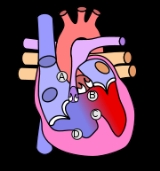
| Condition | Description |
|---|---|
| A: Pulmonary Infundibular Stenosis | A narrowing of the right ventricular outflow tract and can occur at the pulmonary valve Heart The heart is a myogenic muscular organ found in all animals with a circulatory system , that is responsible for pumping blood throughout the blood vessels by repeated, rhythmic contractions... (valvular stenosis) or just below the pulmonary valve Heart The heart is a myogenic muscular organ found in all animals with a circulatory system , that is responsible for pumping blood throughout the blood vessels by repeated, rhythmic contractions... (infundibular stenosis). Infundibular pulmonic stenosis is mostly caused by overgrowth of the heart muscle wall (hypertrophy of the septoparietal trabeculae), however the events leading to the formation of the overriding aorta are also believed to be a cause. The pulmonic stenosis is the major cause of the malformations, with the other associated malformations acting as compensatory mechanisms to the pulmonic stenosis. The degree of stenosis varies between individuals with TOF, and is the primary determinant of symptoms and severity. This malformation is infrequently described as sub-pulmonary stenosis or subpulmonary obstruction. |
| B: Overriding aorta Overriding aorta An overriding aorta is a congenital heart defect where the aorta is positioned directly over a ventricular septal defect, instead of over the left ventricle.... |
An aortic valve Aortic valve The aortic valve is one of the valves of the heart. It is normally tricuspid , although in 1% of the population it is found to be congenitally bicuspid . It lies between the left ventricle and the aorta.... with biventricular connection, that is, it is situated above the ventricular septal defect and connected to both the right and the left ventricle. The degree to which the aorta is attached to the right ventricle is referred to as its degree of "override." The aortic root can be displaced toward the front (anteriorly) or directly above the septal defect, but it is always abnormally located to the right of the root of the pulmonary artery. The degree of override is quite variable, with 5-95% of the valve being connected to the right ventricle. |
| C: ventricular septal defect Ventricular septal defect A ventricular septal defect is a defect in the ventricular septum, the wall dividing the left and right ventricles of the heart.The ventricular septum consists of an inferior muscular and superior membranous portion and is extensively innervated with conducting cardiomyocytes.The membranous... (VSD) |
A hole between the two bottom chambers (ventricles) of the heart. The defect is centered around the most superior aspect of the ventricular septum (the outlet septum), and in the majority of cases is single and large. In some cases thickening of the septum (septal hypertrophy) can narrow the margins of the defect. |
| D: Right ventricular hypertrophy Right ventricular hypertrophy Right ventricular hypertrophy is a form of ventricular hypertrophy affecting the right ventricle.Blood travels through the right ventricle to the lungs via the pulmonary arteries. If conditions occur which decrease pulmonary circulation, meaning blood does not flow well from the heart to the... |
The right ventricle Right ventricle The right ventricle is one of four chambers in the human heart. It receives deoxygenated blood from the right atrium via the tricuspid valve, and pumps it into the pulmonary artery via the pulmonary valve and pulmonary trunk.... is more muscular than normal, causing a characteristic boot-shaped (coeur-en-sabot) appearance as seen by chest X-ray. Due to the misarrangement of the external ventricular septum, the right ventricular wall increases in size to deal with the increased obstruction to the right outflow tract. This feature is now generally agreed to be a secondary anomaly, as the level of hypertrophy generally increases with age. |
There is anatomic variation between the hearts of individuals with tetralogy of Fallot. Primarily, the degree of right ventricular outflow tract obstruction varies between patients and generally determines clinical symptoms and disease progression.
Additional anomalies
In addition, tetralogy of Fallot may present with other anatomical anomalies, including:- stenosis of the left pulmonary arteryLeft pulmonary arteryThe left pulmonary artery or left branch of the pulmonary artery, shorter and somewhat smaller than the right, passes horizontally in front of the descending aorta and left bronchus to the root of the left lung, where it divides into two branches, one for each lobe of the lung.Above, it is...
, in 40% of patients - a bicuspid pulmonary valve, in 40% of patients
- right-sided aortic arch, in 25% of patients
- coronary artery anomalies, in 10% of patients
- a foramen ovaleForamen ovaleThere are multiple structures in the human body with the name foramen ovale :* In the fetal heart, the foramen ovale is a shunt from the right atrium to left atrium....
or atrial septal defectAtrial septal defectAtrial septal defect is a form of congenital heart defect that enables blood flow between the left and right atria via the interatrial septum. The interatrial septum is the tissue that divides the right and left atria...
, in which case the syndrome is sometimes called a pentalogy of Fallot - an atrioventricular septal defectAtrioventricular septal defectAtrioventricular septal defect or atrioventricular canal defect , previously known as "common atrioventricular canal" or "endocardial cushion defect", is characterized by a deficiency of the atrioventricular septum of the heart...
- partially or totally anomalous pulmonary venous return
- forked ribs and scoliosisScoliosisScoliosis is a medical condition in which a person's spine is curved from side to side. Although it is a complex three-dimensional deformity, on an X-ray, viewed from the rear, the spine of an individual with scoliosis may look more like an "S" or a "C" than a straight line...
Tetralogy of Fallot with pulmonary atresia (pseudotruncus arteriosus) is a severe variant in which there is complete obstruction (atresia) of the right ventricular outflow tract, causing an absence of the pulmonary trunk during embryonic development. In these individuals, blood shunts completely from the right ventricle to the left where it is pumped only through the aorta. The lungs are perfused via extensive collaterals from the systemic arteries, and sometimes also via the ductus arteriosus.
Diagnosis
The abnormal "coeur-en-sabot" (boot-like) appearance of a heart with tetralogy of Fallot is easily visible via chest x-ray, and before more sophisticated techniques became available, this was the definitive method of diagnosis. Congenital heart defects are now diagnosed with echocardiography, which is quick, involves no radiation, is very specific, and can be done prenatally.Emergency management of tet spells
Prior to corrective surgery, children with tetralogy of Fallot may be prone to consequential acute hypoxia (tet spells), characterized by sudden cyanosis and syncope. These may be treated with beta-blockers such as propranolol, but acute episodes may require rapid intervention with morphineMorphine
Morphine is a potent opiate analgesic medication and is considered to be the prototypical opioid. It was first isolated in 1804 by Friedrich Sertürner, first distributed by same in 1817, and first commercially sold by Merck in 1827, which at the time was a single small chemists' shop. It was more...
to reduce ventilatory drive and a vasopressor such as epinephrine
Epinephrine
Epinephrine is a hormone and a neurotransmitter. It increases heart rate, constricts blood vessels, dilates air passages and participates in the fight-or-flight response of the sympathetic nervous system. In chemical terms, adrenaline is one of a group of monoamines called the catecholamines...
, phenylephrine
Phenylephrine
Phenylephrine is a selective α1-adrenergic receptor agonist used primarily as a decongestant, as an agent to dilate the pupil, and to increase blood pressure...
, or norepinephrine
Norepinephrine
Norepinephrine is the US name for noradrenaline , a catecholamine with multiple roles including as a hormone and a neurotransmitter...
to increase blood pressure. Oxygen (100%) is effective in treating spells because it is a potent pulmonary vasodilator and systemic vasoconstrictor. This allows more blood flow to the lungs. There are also simple procedures such as squatting
Squatting position
Squatting is a posture where the weight of the body is on the feet but the knees are bent either fully or partially . In contrast, sitting, involves taking the weight of the body, at least in part, on the buttocks against the ground or a horizontal object such as a chair seat...
and the knee chest position which increases aortic wave reflection, increasing pressure on the left side of the heart, decreasing the right to left shunt thus decreasing the amount of deoxygenated blood entering the systemic circulation.
Palliative surgery
The condition was initially thought untreatable until surgeon Alfred BlalockAlfred Blalock
Alfred Blalock was a 20th-century American surgeon most noted for his research on the medical condition of shock and the development of the Blalock-Taussig Shunt, surgical relief of the cyanosis from Tetralogy of Fallot—known commonly as the blue baby syndrome—with Vivien Thomas and pediatric...
, cardiologist Helen B. Taussig
Helen B. Taussig
Helen Brooke Taussig was an American cardiologist, working in Baltimore and Boston, who founded the field of pediatric cardiology. Notably, she is credited with developing the concept for a procedure that would extend the lives of children born with Tetrology of Fallot...
, and lab assistant Vivien Thomas
Vivien Thomas
Vivien Theodore Thomas was an African-American surgical technician who developed the procedures used to treat blue baby syndrome in the 1940s...
at Johns Hopkins University developed a palliative surgical procedure, which involved forming an anastomosis between the subclavian artery and the pulmonary artery (See movie "Something the Lord Made
Something the Lord Made
Something The Lord Made is a film about the black cardiac pioneer Vivien Thomas and his complex and volatile partnership with white surgeon Alfred Blalock, the world famous "Blue Baby doctor" who pioneered modern heart surgery...
"). It was actually Helen Taussig who convinced Alfred Blalock that the shunt was going to work. This redirected a large portion of the partially oxygenated blood leaving the heart for the body into the lungs, increasing flow through the pulmonary circuit, and greatly relieving symptoms in patients. The first Blalock-Thomas-Taussig shunt surgery was performed on 15-month old Eileen Saxon
Eileen Saxon
Eileen Saxon was an infant known as "The Blue Baby", because of a condition called Tetralogy of Fallot, one of the primary congenital defects that lead to blue baby syndrome. In this condition, defects in the great vessels and wall of the heart lead to a chronic lack of oxygen in the blood...
on November 29, 1944 with dramatic results.
The Potts shunt and the Waterston-Cooley shunt are other shunt procedures which were developed for the same purpose. These are no longer used.
Currently, Blalock-Thomas-Taussig shunts are not normally performed on infants with TOF except for severe variants such as TOF with pulmonary atresia
Pulmonary atresia
Pulmonary atresia is a congenital malformation of the pulmonary valve in which the valve orifice fails to develop. The valve is completely closed thereby obstructing the outflow of blood from the heart to the lungs. The pulmonary valve is located on the right side of the heart between the right...
(pseudotruncus arteriosus).
Total surgical repair
The Blalock-Thomas-Taussig procedure, initially the only surgical treatment available for Tetralogy of Fallot, was palliative but not curative. The first total repair of Tetralogy of Fallot was done by a team led by C. Walton LilleheiC. Walton Lillehei
Clarence Walton Lillehei , was an American surgeon who pioneered open-heart surgery, as well as numerous techniques, equipment and prostheses for cardiothoracic surgery.-Background:...
at the University of Minnesota
University of Minnesota
The University of Minnesota, Twin Cities is a public research university located in Minneapolis and St. Paul, Minnesota, United States. It is the oldest and largest part of the University of Minnesota system and has the fourth-largest main campus student body in the United States, with 52,557...
in 1954 on a 11-year-old boy. Total repair on infants has had success from 1981, with research indicating that it has a comparatively low mortality rate.
Total repair of Tetralogy of Fallot initially carried a high mortality risk. This risk has gone down steadily over the years. Surgery is now often carried out in infants one year of age or younger with less than 5% perioperative mortality. The open-heart surgery is designed (1) to relieve the right ventricular outflow tract stenosis by careful resection
Segmental resection
Segmental resection is a surgical procedure to remove part of an organ or gland. It may also be used to remove a tumor and normal tissue around it. In lung cancer surgery, segmental resection refers to removing a section of a lobe of the lung.- External links :* entry in the public domain NCI...
of muscle and (2) to repair the VSD with a Gore-Tex
Gore-Tex
Gore-Tex is a waterproof/breathable fabric, and a registered trademark of W. L. Gore and Associates. It was co-invented by Wilbert L. Gore, Rowena Taylor, and Gore's son, Robert W. Gore. Robert Gore was granted on April 27, 1976, for a porous form of polytetrafluoroethylene with a...
patch or a homograft. Additional reparative or reconstructive surgery may be done on patients as required by their particular cardiac anatomy.
Prognosis
Untreated, Tetralogy of Fallot rapidly results in progressive right ventricular hypertrophy due to the increased resistance on the right ventricle. This progresses to heart failure (dilated cardiomyopathy) which begins in the right heart and often leads to left heart failure. Actuarial survival for untreated Tetralogy of Fallot is approximately 75% after the first year of life, 60% by four years, 30% by ten years, and 5% by forty years.Patients who have undergone total surgical repair of Tetralogy of Fallot have improved hemodynamics and often have good to excellent cardiac function after the operation with some to no exercise intolerance (New York Heart Association Class I-II). Surgical success and long-term outcome greatly depends on the particular anatomy of the patient and the surgeon's skill and experience with this type of repair.
Ninety percent of patients with total repair as infants develop a progressively leaky pulmonary valve as the heart grows to its adult size but the valve does not. Patients also may have damage to the electrical system of the heart from surgical incisions if the middle cardiac nerve is accidentally tapped during surgery. If the nerve is touched, it will cause abnormalities as detected by EKG and/or arrhythmias.
Long-term follow up studies show that patients with total repair of TOF are at risk for sudden cardiac death and for heart failure. Therefore, lifetime follow-up care by an adult congenital cardiologist is recommended to monitor these risks and to recommend treatment, such as interventional procedures or re-operation, if it becomes necessary.
The use of antibiotics is no longer required by cardiologists and varies from case to case.
Notable cases
- Shaun WhiteShaun WhiteShaun Roger White is an American professional snowboarder and skateboarder. He is a two-time Olympic gold medalist. He rides regular stance, twelve and negative three degrees on his board.-Early life:Shaun White is an Irish American...
, snowboarder and 2006 and 2010 Olympic gold medallist - Beau CassonBeau CassonBeau Casson is a former Australian cricketer who played for Western Australia and New South Wales, in a career spanning from 2002 to 2011, and has represented Australia at Test cricket. Primarily a left arm wrist spinner, Casson is also capable with the bat and has a highest First-class score of 99...
, Australian cricketer - Dennis McEldowneyDennis McEldowneyDennis McEldowney was a New Zealand born author and publisher. His best known work was The World Regained. Auto-biographical in nature, it described how he dealt with being an invalid due to having a Tetralogy of Fallot. This book won McEldowney the 1958 Hubert Church Memorial Prize.-Early...
, New Zealand author and publisher - Darcy Davis, notable Rhode Island violinist
- Max Page (actor)Max Page (actor)Max Page plays Reed Hellstrom on the American TV soap opera The Young and the Restless. At age six, he appeared in his first national commercial, a spot for Volkswagen which aired during The 2011 Super Bowl, in which he appeared as a boy in a Darth Vader costume.-Acting career:Max has appeared in...
, Volkswagen's "Little Darth Vader" from the 2011 Super Bowl commercial
External links
- Tetralogy of Fallot - Children's Hospital Boston
- Diseases and Conditions Index: TOF at National Institute of Health
- Tetralogy of Fallot information from Seattle Children's Hospital Heart Center
- Tetralogy of Fallot Information by the University of Michigan C.S. Mott Children’s Hospital
- Diagram of the condition at University of UtahUniversity of UtahThe University of Utah, also known as the U or the U of U, is a public, coeducational research university in Salt Lake City, Utah, United States. The university was established in 1850 as the University of Deseret by the General Assembly of the provisional State of Deseret, making it Utah's oldest...
- Designer Heart, A Congenital Heart Defect Social Network.