


Test Act

Encyclopedia
The Test Acts were a series of English
penal law
s that served as a religious test
for public office and imposed various civil disabilities on Roman Catholics and Nonconformists. The principle was that none but persons professing the Established Church
were eligible for public employment, and the severe penalties pronounced against recusants, whether Catholic or Nonconformist, were affirmations of this principle. In practice nonconformists were often exempted from some of these laws through the regular passage of Acts of Indemnity.
provided that all such as were naturalized or restored in blood should receive the sacrament
of the Lord's Supper
. It was not, however, until the reign of Charles II
that actually receiving communion
in the Church of England
was made a precondition for holding public office. The earliest imposition of this test was by the Corporation Act of 1661 requiring that, besides taking the Oath of Supremacy
, all members of corporations were, within one year after election, to receive the sacrament
of the Lord's Supper according to the rites
of the Church of England.
of which is "An act for preventing dangers which may happen from popish recusants"). This act enforced upon all persons filling any office, civil or military, the obligation of taking the oaths of supremacy and allegiance and subscribing to a declaration against transubstantiation
and also of receiving the sacrament within three months after admittance to office. The oath for the Test Act of 1673 was:
; but in 1678 the Act was extended by a further Act (30 Car. II. st. 2) which required that all peers and members of the House of Commons
should make a declaration against transubstantiation, invocation of saints, and the sacrifice of the Mass
. The effect of this was to exclude Catholic
s from both houses, and in particular the "Five Popish Lords" from the House of Lords
, a change motivated largely by the alleged Popish Plot
.
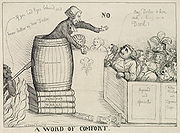 The necessity of receiving the sacrament as a qualification for office was repealed in 1828
under George IV
and all acts requiring the taking of oaths and declarations against transubstantiation
were repealed by the Catholic Relief Act 1829
.
Kingdom of England
The Kingdom of England was, from 927 to 1707, a sovereign state to the northwest of continental Europe. At its height, the Kingdom of England spanned the southern two-thirds of the island of Great Britain and several smaller outlying islands; what today comprises the legal jurisdiction of England...
penal law
Penal law
In the most general sense, penal is the body of laws that are enforced by the State in its own name and impose penalties for their violation, as opposed to civil law that seeks to redress private wrongs...
s that served as a religious test
Religious test
The Test Act of 1673 in England obligated all persons filling any office, civil or military, to take oaths of supremacy and allegiance, to subscribe to a declaration against transubstantiation, and to receive the sacrament within three months of taking office....
for public office and imposed various civil disabilities on Roman Catholics and Nonconformists. The principle was that none but persons professing the Established Church
Church of England
The Church of England is the officially established Christian church in England and the Mother Church of the worldwide Anglican Communion. The church considers itself within the tradition of Western Christianity and dates its formal establishment principally to the mission to England by St...
were eligible for public employment, and the severe penalties pronounced against recusants, whether Catholic or Nonconformist, were affirmations of this principle. In practice nonconformists were often exempted from some of these laws through the regular passage of Acts of Indemnity.
Corporation Act
The Act of James IJames I of England
James VI and I was King of Scots as James VI from 24 July 1567 and King of England and Ireland as James I from the union of the English and Scottish crowns on 24 March 1603...
provided that all such as were naturalized or restored in blood should receive the sacrament
Sacrament
A sacrament is a sacred rite recognized as of particular importance and significance. There are various views on the existence and meaning of such rites.-General definitions and terms:...
of the Lord's Supper
Eucharist
The Eucharist , also called Holy Communion, the Sacrament of the Altar, the Blessed Sacrament, the Lord's Supper, and other names, is a Christian sacrament or ordinance...
. It was not, however, until the reign of Charles II
Charles II of England
Charles II was monarch of the three kingdoms of England, Scotland, and Ireland.Charles II's father, King Charles I, was executed at Whitehall on 30 January 1649, at the climax of the English Civil War...
that actually receiving communion
Eucharist
The Eucharist , also called Holy Communion, the Sacrament of the Altar, the Blessed Sacrament, the Lord's Supper, and other names, is a Christian sacrament or ordinance...
in the Church of England
Church of England
The Church of England is the officially established Christian church in England and the Mother Church of the worldwide Anglican Communion. The church considers itself within the tradition of Western Christianity and dates its formal establishment principally to the mission to England by St...
was made a precondition for holding public office. The earliest imposition of this test was by the Corporation Act of 1661 requiring that, besides taking the Oath of Supremacy
Oath of Supremacy
The Oath of Supremacy, originally imposed by King Henry VIII of England through the Act of Supremacy 1534, but repealed by his daughter, Queen Mary I of England and reinstated under Mary's sister, Queen Elizabeth I of England under the Act of Supremacy 1559, provided for any person taking public or...
, all members of corporations were, within one year after election, to receive the sacrament
Sacrament
A sacrament is a sacred rite recognized as of particular importance and significance. There are various views on the existence and meaning of such rites.-General definitions and terms:...
of the Lord's Supper according to the rites
Christian liturgy
A liturgy is a set form of ceremony or pattern of worship. Christian liturgy is a pattern for worship used by a Christian congregation or denomination on a regular basis....
of the Church of England.
1673 Act
This act was followed by the Test Act of 1673 (25 Car. II. c. 2) (the long titleLong title
The long title is the formal title appearing at the head of a statute or other legislative instrument...
of which is "An act for preventing dangers which may happen from popish recusants"). This act enforced upon all persons filling any office, civil or military, the obligation of taking the oaths of supremacy and allegiance and subscribing to a declaration against transubstantiation
Transubstantiation
In Roman Catholic theology, transubstantiation means the change, in the Eucharist, of the substance of wheat bread and grape wine into the substance of the Body and Blood, respectively, of Jesus, while all that is accessible to the senses remains as before.The Eastern Orthodox...
and also of receiving the sacrament within three months after admittance to office. The oath for the Test Act of 1673 was:
- "I, N, do declare that I do believe that there is not any transubstantiation in the sacrament of the Lord's Supper, or in the elements of the bread and wineSacramentA sacrament is a sacred rite recognized as of particular importance and significance. There are various views on the existence and meaning of such rites.-General definitions and terms:...
, at or after the consecrationConsecrationConsecration is the solemn dedication to a special purpose or service, usually religious. The word "consecration" literally means "to associate with the sacred". Persons, places, or things can be consecrated, and the term is used in various ways by different groups...
thereof by any person whatsoever."
1678 Act
Initially, the Act did not extend to peersHouse of Lords
The House of Lords is the upper house of the Parliament of the United Kingdom. Like the House of Commons, it meets in the Palace of Westminster....
; but in 1678 the Act was extended by a further Act (30 Car. II. st. 2) which required that all peers and members of the House of Commons
British House of Commons
The House of Commons is the lower house of the Parliament of the United Kingdom, which also comprises the Sovereign and the House of Lords . Both Commons and Lords meet in the Palace of Westminster. The Commons is a democratically elected body, consisting of 650 members , who are known as Members...
should make a declaration against transubstantiation, invocation of saints, and the sacrifice of the Mass
Mass (liturgy)
"Mass" is one of the names by which the sacrament of the Eucharist is called in the Roman Catholic Church: others are "Eucharist", the "Lord's Supper", the "Breaking of Bread", the "Eucharistic assembly ", the "memorial of the Lord's Passion and Resurrection", the "Holy Sacrifice", the "Holy and...
. The effect of this was to exclude Catholic
Catholic
The word catholic comes from the Greek phrase , meaning "on the whole," "according to the whole" or "in general", and is a combination of the Greek words meaning "about" and meaning "whole"...
s from both houses, and in particular the "Five Popish Lords" from the House of Lords
House of Lords
The House of Lords is the upper house of the Parliament of the United Kingdom. Like the House of Commons, it meets in the Palace of Westminster....
, a change motivated largely by the alleged Popish Plot
Popish Plot
The Popish Plot was a fictitious conspiracy concocted by Titus Oates that gripped England, Wales and Scotland in Anti-Catholic hysteria between 1678 and 1681. Oates alleged that there existed an extensive Catholic conspiracy to assassinate Charles II, accusations that led to the execution of at...
.
Repeal
Sacramental Test Act 1828
The Sacramental Test Act 1828 was an Act passed by the British Parliament.-Background:The Corporation Act 1661 laid down that all mayors and officials in municipal corporations had to receive the sacrament of Holy Communion in accordance with the rites of the Church of England...
under George IV
George IV of the United Kingdom
George IV was the King of the United Kingdom of Great Britain and Ireland and also of Hanover from the death of his father, George III, on 29 January 1820 until his own death ten years later...
and all acts requiring the taking of oaths and declarations against transubstantiation
Transubstantiation
In Roman Catholic theology, transubstantiation means the change, in the Eucharist, of the substance of wheat bread and grape wine into the substance of the Body and Blood, respectively, of Jesus, while all that is accessible to the senses remains as before.The Eastern Orthodox...
were repealed by the Catholic Relief Act 1829
Catholic Relief Act 1829
The Roman Catholic Relief Act 1829 was passed by the Parliament of the United Kingdom on 24 March 1829, and received Royal Assent on 13 April. It was the culmination of the process of Catholic Emancipation throughout the nation...
.
External links
- Committees for the Repeal of the Test and Corporation Acts: the minutes of two committees for the repeal of the Act. First published by the London Record Society, available as part of British History Online.