

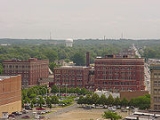
Terre Haute, Indiana

Encyclopedia
Terre Haute (ˌ) is a city and the county seat
of Vigo County
, Indiana
, United States
, near the state's western border with Illinois
. As of the 2010 census, the city had a total population of 60,785 and its metropolitan area had a population of 170,943. The city is the county seat
of Vigo County
and the self-proclaimed capital of the Wabash Valley
. The federal death row
is in Terre Haute at the Terre Haute Federal Correctional Complex
.
in western Indiana
. The city lies about 75 miles (120.7 km) west of Indianapolis
.
According to the United States Census Bureau
, the city has a total area of 32.1 square miles (83.1 km²), of which, 31.2 square miles (80.8 km²) of it is land and 0.9 square miles (2.3 km²) of it (2.68%) is water.
The Wabash River
dominates the physical geography of the city, forming its western border. Small bluffs on the east side of city mark the edge of the historic flood plain. Lost Creek and Honey Creek drain the northern and southern sections of the city, respectively. In the late 19th century (particularly during the Terre Haute Oil Craze of 1889), several oil and mineral wells were productive in and near the center of the city. Those have not been tapped for many years.
Terre Haute is at the intersection of two major roadways: US Hwy 40 from California to Maryland, and US Hwy 41 from Michigan to Florida (locally named "3rd Street" and historically was "7th Street". Making "7th and Wabash" the Crossroads of America). Terre Haute is located 77 miles (123.9 km) southwest of Indianapolis and within 185 miles (297.7 km) of Chicago, St. Louis, Louisville, and Cincinnati.
When Interstate 70
was built in the early 1970s, the community's major shopping area became centered near the interchange south of the city. U.S. Route 40
still runs through the downtown area as of 2005. The Indiana Department of Transportation
(INDOT) plans to transfer the route number to State Road 46 and Interstate 70 through the Terre Haute area once the new State Road 641 bypass is completed. The old US 40, known as Wabash Avenue, will be transferred to city and county control.
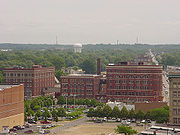 The name of the city has been derived from the French
phrase terre haute , meaning "High Ground". It was named by French explorers in the area in the early 18th century to describe the unique location in the Wabash Valley and beside the Wabash River (see French colonization of the Americas
). When the area was claimed by the French and English, these highlands were considered the border between Canada
and Louisiana
.
During "Tecumseh's War
" in 1811, the construction of Fort Harrison during an expedition led by William Henry Harrison
marked the known beginning of a permanent population of European-Americans. A Wea
village called Weautano (also known as "Rising Sun" and "Old Orchard Town") already existed near the fort. Captain Zachary Taylor defended the fort from a British–inspired attack by an estimated 600 Native Americans during the Battle of Fort Harrison
on September 4, 1812. The orchards and meadows kept by the local Wea populations became the site of present–day Terre Haute, a few miles south of Fort Harrison. Before 1830, the few remaining Wea had departed under pressure from white settlement.
The village of Terre Haute, then a part of Knox County, Indiana
, was platted in 1816. Its early identity was as an agricultural and pork-packing center and as a port on the then-navigable Wabash River
for steamboats and other river-craft. Between 1835 and late 1839, Terre Haute served as the headquarters for the U.S. Army Corps of Engineers under Major Cornelius A. Ogden during the construction of the National Road
. As a result, a number of West Point graduates and other highly educated people located in the town. Wealthy Terre Haute entrepreneur Chauncey Rose
built The Prairie House, a fancy hotel, in 1838 primarily to accommodate those families. In 1855, the name of The Prairie House was changed to the Terre Haute House
.
Development in anticipation of completion of the Wabash and Erie Canal
, the longest man-made body of water in the western hemisphere, also brought prosperity to the community. The canal finally reached Terre Haute in October 1849. Founded by Chauncey Rose
, the Terre Haute and Richmond Railroad began operations between Terre Haute and Indianapolis
in February 1852 and its traffic soon surpassed that on the canal. The name of the Terre Haute and Richmond Railroad (West of Indianapolis) soon was changed to the Terre Haute and Indianapolis Railroad. It became the operating company of the Vandalia Railroad System. The community quickly gained the reputation as a transportation hub.
In 1832, Terre Haute became a town and, in May 1853, elected to become a city. After the American Civil War
, it developed into an industrial and mining center, with iron and steel mills, hominy plants and, late in the 19th century, distilleries, breweries, coal mines and coal operating companies. Business boomed.
Terre Haute's Famous "Four-Cornered" Race Track was the site of more than 20 world harness racing records and helped trigger the city's reputation as a sporting center. The bustling economy also led to establishing several institutes of higher education: Saint Mary-of-the Woods Institute (now Saint Mary-of-the-Woods College
), John Covert
's Terre Haute Female College, Indiana State Normal School (now Indiana State University
), Terre Haute School of Industrial Science (now Rose-Hulman Institute of Technology
) and Coates College for Women
. The city developed culture and a reputation in the arts. As a base of industry, it also developed a strong tradition of union activity, which resulted in hosting a two-day conclave beginning on August 3, 1881, of the National Trade Union Congress, renamed the Federation of Organized Trades and Labor Unions
of the U.S. and Canada. In 1886, the Federation was renamed the American Federation of Labor
. The city also produced labor leader Eugene V. Debs
.
The city's river traffic contributed to its reputation for being "wide open", with gambling and a well-developed "red light district
". The latter was not fully eliminated until urban renewal of the riverfront in the 1960s. During the second decade of the 20th century, Terre Haute was rocked by political scandal and that reputation persisted for several decades. In 1955, Terre Haute was labeled Sin City
by the monthly magazine Stag.
Prohibition had a major adverse impact on the city's economy. It forced the closure of several distilleries and all but one brewery, which reduced its payroll by 70% and converted to produce root beer. Four large glass manufacturing firms drastically reduced production, and two eventually closed. The Root Glass Company
survived, primarily because it had secured the patent for the Coca-Cola
bottle in 1915. Two of the distilleries were sold to Commercial Solvents Corporation, which acquired the rights to produce acetone
from Chaim Weizmann
in exchange for royalties.
With some aspects of the economy booming in the mid-1920s, the owners of the Terre Haute House
decided to demolish their older building and erect a grand edifice befitting such a modern city as Terre Haute. In 1928, the new Terre Haute House
opened, attracting the wealthy – famous and infamous alike – to its luxurious splendor. Al Capone
is rumored to have been a guest in the new hotel's early years. After closing in 1970, the structure remained nonoperational for 35 years until 2005 when it was sold to a local developer. He demolished it and two other properties on the same block and sold the property to Dora Brothers Hospitality for development of a Hilton Garden Inn
.
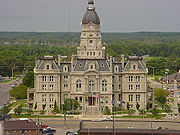 The current Mayor is Duke Bennett, a Republican (the first Republican mayor of Terre Haute in over 35 years). Businessman Kevin Burke was elected the city’s Mayor in 2003 and vowed to make cleaning up the city’s image and notorious smell one of his administration’s top priorities. The offensive odors that plagued the city were primarily emitted from a coal tar creosote railroad tie manufacturing facility, a waste water treatment facility, and a paper plant.
Duke Bennett was elected Mayor in late 2007, but Bennett's election was subsequently challenged by the losing incumbent, Kevin Burke, based on an alleged violation of the "Little Hatch Act" by Bennett (the violation of which would have made Bennett ineligible for office). Former Mayor Burke filed suit, and following a bench trial, the trial court rejected Burke's challenge and declared Bennett elected as the qualified candidate who received the highest number of votes. The Court of Appeals reversed and remanded for a new election. The Indiana Supreme Court, on June 16, 2009, unanimously affirmed the trial court's confirmation of Bennett's election as Mayor. Former Mayor Burke stated that he would not appeal the decision further to the U.S. Supreme Court.
The City Council has six members each representing a district and three members-at-large. The National Arbor Day Foundation has designated Terre Haute a "Tree City." The city is also home to a federally-sponsored AmeriCorps
program called the Sycamore Service Corps
.
. Inmates are held at the Terre Haute Federal Correctional Complex
. Located on Highway 63, two miles (3 km) south of the city of Terre Haute, the complex includes the medium security Federal Correctional Institution and the high security United States Penitentiary. The penitentiary houses the Special Confinement Unit for inmates serving federal death sentences.
Terre Haute received attention for the June 11, 2001, execution of Timothy McVeigh
at the Federal Correctional Complex for his role in the deadly Oklahoma City bombing
.
of 2000, there were 59,614 people, 22,870 households, and 13,025 families residing in the city. The population density
is 1,908.3 people per square mile (736.8/km²). The racial makeup of the city is 86.3% White, 9.8% African American, 0.3% Native American, 1.2% Asian, 0.5% from other races, and 1.9% from two or more races. 1.6% of the population are Hispanic or Latino of any race.
There are 22,870 households out of which 27.2% have children under the age of 18 living with them, 39.0% are married couples
living together, 14.0% have a female householder with no husband present, and 43.0% are non-families. 34.9% of all households are made up of individuals and 14.1% have someone living alone who is 65 years of age or older. The average household size is 2.28 and the average family size is 2.95.
The median income for a household in the city is $28,018, and the median income for a family is $37,618. Males have a median income of $29,375 versus $21,374 for females. The per capita income
for the city is $15,728. 19.2% of the population and 14.8% of families are below the poverty line. Out of the total population, 17.4% of those under the age of 18 and 11.4% of those 65 and older are living below the poverty line.
In addition to the downtown business district and the south side, there are several smaller business districts in the city. The first suburban shopping area was Twelve Points, on the northeast side of town; later, Idaho Station developed near Seventh Street and Lockport Road. In the post-World War II era, auto-centered shopping developed on the east side at Meadows. Plaza North is another important shopping area in the northern city neighborhoods.
The original curved Coca-Cola
bottle was designed and first produced by the Root Glass Company, which was based in Terre Haute. In the mid-1990s, Coca-Cola honored this part of its past by introducing a short-lived Coke bottle-shaped can that was sold only in Terre Haute and one other city. Terre Haute was also one of the primary test markets for Pringles Potato Chips. The city is a familiar address to many, as it was home to the Columbia House
mail-order club. It also is the home of the largest disc production facility in the United States, Sony
DADC, which was the first facility in the United States to manufacture Compact Disc
s.
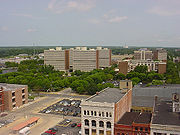
 Terre Haute is served by the Vigo County School Corporation
. McLean Education Center is located on Lafayette Avenue and serves 200-300 students.
Terre Haute is home to Indiana State University
(ISU). Indiana State has a student population of approximately 10,500. The Princeton Review has named ISU one of the nation’s “best value” undergraduate institutions. The Princeton Review has also placed ISU on its “Best in the Midwest” list of colleges and universities. The private engineering school Rose–Hulman Institute of Technology is located just east of the city, and is consistently rated as the top undergraduate engineering school in the nation. The Wabash Valley region of Ivy Tech Community College, a full-service community college, and Harrison College
are also located in the city. Saint Mary-of-the-Woods College
, a four-year, private Roman Catholic women's college, is north of West Terre Haute, Indiana
.
The LaVern Gibson Championship Cross Country Course
has the distinction of being one of the few purpose-built cross-country courses in the world. The facility is part of 240 acre (0.9712464 km²) that comprise the Wabash Valley Family Sports Center east of Terre Haute. The course itself is built on a reclaimed coal mine and consists of an external loop of 3 km and four internal loops that allow for circuits of varying lengths. Indiana State University's Cross-Country team uses the Gibson Course for its home meets.
published an article on the local music scene in 2001 entitled "Garage Band Actually Believes there is a 'Terre Haute Sound.'"
However, more recently the town has worked to improve its image. Its revitalization efforts were recognized in 2010 when the Indiana Chamber of Commerce
named Terre Haute Indiana's Community of the Year.
, open and free to the public since 1942, boasts a nationally recognized collection of American art including work by Edward Hopper
, Grant Wood
, Thomas Hart Benton
, Janet Scudder
, Andy Warhol
, Ruth Pratt Bobbs, Robert Motherwell
, Robert Rauschenberg
and many others.
The Turman Art Gallery at Indiana State University
features rotating exhibitions by student and faculty artists. In 2007, the university was the recipient of nearly 150 Andy Warhol
photographs and prints as part of the Andy Warhol Photographic Legacy Program. These recent additions will be added to the other Andy Warhol
prints already held in the university's permanent collection.
Located on Seventh Street between Wabash Avenue and Ohio Street, Terre Haute's Art Corridor includes the Swope Art Museum as well as two galleries: the Halcyon Contemporary Art Gallery and Gopalan Contemporary Art. The first Friday of every month features art openings, musical performances, and socializing.
Terre Haute is home to several arts non-profits, including Wabash Valley Art Spaces
and Arts Illiana, as well as the long-running volunteer-based Community Theatre of Terre Haute, which put on its first shows in 1928.
Recent prominent musicians from Terre Haute include Dave Frey, lead singer of the Dove Award-winning band Sidewalk Prophets
, and the band Yearbook Committee
, a 2011 showcasing artist at the South by Southwest Music Festival in Austin, Texas
.
Terre Haute is also the birthplace of the Kiss Army
, a fan club for the rock group Kiss
.
The three-story Children's Museum is at the intersection of Wabash Avenue and Eighth Street in downtown Terre Haute.
The CANDLES Holocaust Museum and Education Center
is run by Holocaust survivor Eva Mozes Kor
and has exhibits and artifacts related to the Holocaust, eugenics
and forgiveness
.
and the father of esteemed journalist Robert Debs Heinl, which is located in Highland Lawn Cemetery. The statue is now housed in the Terre Haute Historical Society Museum.
County seat
A county seat is an administrative center, or seat of government, for a county or civil parish. The term is primarily used in the United States....
of Vigo County
Vigo County, Indiana
Vigo County is a county located along the western border of the U.S. state of Indiana. Vigo County is included in the Terre Haute, Indiana, Metropolitan Statistical Area. The county seat is Terre Haute....
, Indiana
Indiana
Indiana is a US state, admitted to the United States as the 19th on December 11, 1816. It is located in the Midwestern United States and Great Lakes Region. With 6,483,802 residents, the state is ranked 15th in population and 16th in population density. Indiana is ranked 38th in land area and is...
, United States
United States
The United States of America is a federal constitutional republic comprising fifty states and a federal district...
, near the state's western border with Illinois
Illinois
Illinois is the fifth-most populous state of the United States of America, and is often noted for being a microcosm of the entire country. With Chicago in the northeast, small industrial cities and great agricultural productivity in central and northern Illinois, and natural resources like coal,...
. As of the 2010 census, the city had a total population of 60,785 and its metropolitan area had a population of 170,943. The city is the county seat
County seat
A county seat is an administrative center, or seat of government, for a county or civil parish. The term is primarily used in the United States....
of Vigo County
Vigo County, Indiana
Vigo County is a county located along the western border of the U.S. state of Indiana. Vigo County is included in the Terre Haute, Indiana, Metropolitan Statistical Area. The county seat is Terre Haute....
and the self-proclaimed capital of the Wabash Valley
Wabash Valley
The Wabash Valley is a region with parts in both Illinois and Indiana. It is named for the Wabash River and spans the middle to the middle-lower portion of the river and is centered at Terre Haute, Indiana...
. The federal death row
Capital punishment in the United States
Capital punishment in the United States, in practice, applies only for aggravated murder and more rarely for felony murder. Capital punishment was a penalty at common law, for many felonies, and was enforced in all of the American colonies prior to the Declaration of Independence...
is in Terre Haute at the Terre Haute Federal Correctional Complex
Federal Correctional Complex, Terre Haute
The Federal Correctional Complex, Terre Haute, is a federal prison for adult males located at the intersection of State Road 63 and Springhill Drive, two miles south of Terre Haute, Indiana United States...
.
Geography
Terre Haute is located at 39°28′11"N 87°23′23"W (39.469586, -87.389762), alongside the eastern bank of the Wabash RiverWabash River
The Wabash River is a river in the Midwestern United States that flows southwest from northwest Ohio near Fort Recovery across northern Indiana to southern Illinois, where it forms the Illinois-Indiana border before draining into the Ohio River, of which it is the largest northern tributary...
in western Indiana
Indiana
Indiana is a US state, admitted to the United States as the 19th on December 11, 1816. It is located in the Midwestern United States and Great Lakes Region. With 6,483,802 residents, the state is ranked 15th in population and 16th in population density. Indiana is ranked 38th in land area and is...
. The city lies about 75 miles (120.7 km) west of Indianapolis
Indianapolis
Indianapolis is the capital of the U.S. state of Indiana, and the county seat of Marion County, Indiana. As of the 2010 United States Census, the city's population is 839,489. It is by far Indiana's largest city and, as of the 2010 U.S...
.
According to the United States Census Bureau
United States Census Bureau
The United States Census Bureau is the government agency that is responsible for the United States Census. It also gathers other national demographic and economic data...
, the city has a total area of 32.1 square miles (83.1 km²), of which, 31.2 square miles (80.8 km²) of it is land and 0.9 square miles (2.3 km²) of it (2.68%) is water.
The Wabash River
Wabash River
The Wabash River is a river in the Midwestern United States that flows southwest from northwest Ohio near Fort Recovery across northern Indiana to southern Illinois, where it forms the Illinois-Indiana border before draining into the Ohio River, of which it is the largest northern tributary...
dominates the physical geography of the city, forming its western border. Small bluffs on the east side of city mark the edge of the historic flood plain. Lost Creek and Honey Creek drain the northern and southern sections of the city, respectively. In the late 19th century (particularly during the Terre Haute Oil Craze of 1889), several oil and mineral wells were productive in and near the center of the city. Those have not been tapped for many years.
Terre Haute is at the intersection of two major roadways: US Hwy 40 from California to Maryland, and US Hwy 41 from Michigan to Florida (locally named "3rd Street" and historically was "7th Street". Making "7th and Wabash" the Crossroads of America). Terre Haute is located 77 miles (123.9 km) southwest of Indianapolis and within 185 miles (297.7 km) of Chicago, St. Louis, Louisville, and Cincinnati.
When Interstate 70
Interstate 70
Interstate 70 is an Interstate Highway in the United States that runs from Interstate 15 near Cove Fort, Utah, to a Park and Ride near Baltimore, Maryland. It was the first Interstate Highway project in the United States. I-70 approximately traces the path of U.S. Route 40 east of the Rocky...
was built in the early 1970s, the community's major shopping area became centered near the interchange south of the city. U.S. Route 40
U.S. Route 40
U.S. Route 40 is an east–west United States highway. As with most routes whose numbers end in a zero, U.S. 40 once traversed the entire United States. It is one of the original 1920s U.S. Highways, and its first termini were San Francisco, California, and Atlantic City, New Jersey...
still runs through the downtown area as of 2005. The Indiana Department of Transportation
Indiana Department of Transportation
The Indiana Department of Transportation is a governmental agency of the U.S. state of Indiana charged with maintaining and regulating transportation and transportation related infrastructure such as state owned airports, state highways and state owned canals or railroads.-Districts:INDOT is...
(INDOT) plans to transfer the route number to State Road 46 and Interstate 70 through the Terre Haute area once the new State Road 641 bypass is completed. The old US 40, known as Wabash Avenue, will be transferred to city and county control.
Climate
History
French language
French is a Romance language spoken as a first language in France, the Romandy region in Switzerland, Wallonia and Brussels in Belgium, Monaco, the regions of Quebec and Acadia in Canada, and by various communities elsewhere. Second-language speakers of French are distributed throughout many parts...
phrase terre haute , meaning "High Ground". It was named by French explorers in the area in the early 18th century to describe the unique location in the Wabash Valley and beside the Wabash River (see French colonization of the Americas
French colonization of the Americas
The French colonization of the Americas began in the 16th century, and continued in the following centuries as France established a colonial empire in the Western Hemisphere. France founded colonies in much of eastern North America, on a number of Caribbean islands, and in South America...
). When the area was claimed by the French and English, these highlands were considered the border between Canada
Canada
Canada is a North American country consisting of ten provinces and three territories. Located in the northern part of the continent, it extends from the Atlantic Ocean in the east to the Pacific Ocean in the west, and northward into the Arctic Ocean...
and Louisiana
Louisiana (New France)
Louisiana or French Louisiana was an administrative district of New France. Under French control from 1682–1763 and 1800–03, the area was named in honor of Louis XIV, by French explorer René-Robert Cavelier, Sieur de la Salle...
.
During "Tecumseh's War
Tecumseh's War
Tecumseh's War or Tecumseh's Rebellion are terms sometimes used to describe a conflict in the Old Northwest between the United States and an American Indian confederacy led by the Shawnee leader Tecumseh...
" in 1811, the construction of Fort Harrison during an expedition led by William Henry Harrison
William Henry Harrison
William Henry Harrison was the ninth President of the United States , an American military officer and politician, and the first president to die in office. He was 68 years, 23 days old when elected, the oldest president elected until Ronald Reagan in 1980, and last President to be born before the...
marked the known beginning of a permanent population of European-Americans. A Wea
Wea
The Wea were a Miami-Illinois-speaking tribe originally located in western Indiana, closely related to the Miami. The name Wea is used today as the a shortened version of their many recorded names...
village called Weautano (also known as "Rising Sun" and "Old Orchard Town") already existed near the fort. Captain Zachary Taylor defended the fort from a British–inspired attack by an estimated 600 Native Americans during the Battle of Fort Harrison
Battle of Fort Harrison
The Siege of Fort Harrison was an engagement that lasted from 4 September–15 September 1812. The first American land victory during the War of 1812, it was won by an outnumbered United States force garrisoned inside the fort against a combined Native American force near modern Terre Haute,...
on September 4, 1812. The orchards and meadows kept by the local Wea populations became the site of present–day Terre Haute, a few miles south of Fort Harrison. Before 1830, the few remaining Wea had departed under pressure from white settlement.
The village of Terre Haute, then a part of Knox County, Indiana
Knox County, Indiana
As of the census of 2000, there were 39,256 people, 15,552 households, and 10,139 families residing in the county. The population density was 76 people per square mile . There were 17,305 housing units at an average density of 34 per square mile...
, was platted in 1816. Its early identity was as an agricultural and pork-packing center and as a port on the then-navigable Wabash River
Wabash River
The Wabash River is a river in the Midwestern United States that flows southwest from northwest Ohio near Fort Recovery across northern Indiana to southern Illinois, where it forms the Illinois-Indiana border before draining into the Ohio River, of which it is the largest northern tributary...
for steamboats and other river-craft. Between 1835 and late 1839, Terre Haute served as the headquarters for the U.S. Army Corps of Engineers under Major Cornelius A. Ogden during the construction of the National Road
National Road
The National Road or Cumberland Road was the first major improved highway in the United States to be built by the federal government. Construction began heading west in 1811 at Cumberland, Maryland, on the Potomac River. It crossed the Allegheny Mountains and southwestern Pennsylvania, reaching...
. As a result, a number of West Point graduates and other highly educated people located in the town. Wealthy Terre Haute entrepreneur Chauncey Rose
Chauncey Rose
Chauncey Rose was a successful American businessman of the 19th century.-Early life:Chauncey Rose was born in Wethersfield, Connecticut to Scottish immigrants on December 24, 1794. Chauncey was one of eight children, all of whom died childless...
built The Prairie House, a fancy hotel, in 1838 primarily to accommodate those families. In 1855, the name of The Prairie House was changed to the Terre Haute House
Terre Haute House
The Terre Haute House was a historic former hotel located in downtown Terre Haute, Indiana, USA, that was demolished despite numerous efforts to preserve it...
.
Development in anticipation of completion of the Wabash and Erie Canal
Wabash and Erie Canal
The Wabash and Erie Canal was a shipping canal that linked the Great Lakes to the Ohio River via an artificial waterway. The canal provided traders with access from the Great Lakes all the way to the Gulf of Mexico...
, the longest man-made body of water in the western hemisphere, also brought prosperity to the community. The canal finally reached Terre Haute in October 1849. Founded by Chauncey Rose
Chauncey Rose
Chauncey Rose was a successful American businessman of the 19th century.-Early life:Chauncey Rose was born in Wethersfield, Connecticut to Scottish immigrants on December 24, 1794. Chauncey was one of eight children, all of whom died childless...
, the Terre Haute and Richmond Railroad began operations between Terre Haute and Indianapolis
Indianapolis
Indianapolis is the capital of the U.S. state of Indiana, and the county seat of Marion County, Indiana. As of the 2010 United States Census, the city's population is 839,489. It is by far Indiana's largest city and, as of the 2010 U.S...
in February 1852 and its traffic soon surpassed that on the canal. The name of the Terre Haute and Richmond Railroad (West of Indianapolis) soon was changed to the Terre Haute and Indianapolis Railroad. It became the operating company of the Vandalia Railroad System. The community quickly gained the reputation as a transportation hub.
In 1832, Terre Haute became a town and, in May 1853, elected to become a city. After the American Civil War
American Civil War
The American Civil War was a civil war fought in the United States of America. In response to the election of Abraham Lincoln as President of the United States, 11 southern slave states declared their secession from the United States and formed the Confederate States of America ; the other 25...
, it developed into an industrial and mining center, with iron and steel mills, hominy plants and, late in the 19th century, distilleries, breweries, coal mines and coal operating companies. Business boomed.
Terre Haute's Famous "Four-Cornered" Race Track was the site of more than 20 world harness racing records and helped trigger the city's reputation as a sporting center. The bustling economy also led to establishing several institutes of higher education: Saint Mary-of-the Woods Institute (now Saint Mary-of-the-Woods College
Saint Mary-of-the-Woods College
Saint Mary-of-the-Woods College is a Roman Catholic, four-year liberal arts women's college located northwest of Terre Haute, Indiana, between the Wabash River and the Illinois state line. There is also a small village of the same name located nearby...
), John Covert
John Covert
John Covert was an American painter born in Pittsburgh, USA. He was one of the founders of the Society of Independent Artists and was at the forefront of American Modernism. He died in New York.-External links:*...
's Terre Haute Female College, Indiana State Normal School (now Indiana State University
Indiana State University
Indiana State University is a public university located in Terre Haute, Indiana, United States.The Princeton Review has named Indiana State as one of the "Best in the Midwest" seven years running, and the College of Education's Graduate Program was recently named as a 'Top 100' by U.S...
), Terre Haute School of Industrial Science (now Rose-Hulman Institute of Technology
Rose-Hulman Institute of Technology
Rose–Hulman Institute of Technology , formerly Rose Polytechnic Institute, is a small private college specializing in teaching engineering, mathematics, and science. RHIT is highly regarded for its undergraduate engineering program, which US News and World Reports ranked in 2011 as No...
) and Coates College for Women
Coates College for Women
Coates College for Women was a liberal arts women's college in Terre Haute, Indiana. It opened in 1885 and closed in 1897.-Founding:St. Mary-of-the-Woods College, founded in 1840, was originally the only women's college in the Terre Haute area...
. The city developed culture and a reputation in the arts. As a base of industry, it also developed a strong tradition of union activity, which resulted in hosting a two-day conclave beginning on August 3, 1881, of the National Trade Union Congress, renamed the Federation of Organized Trades and Labor Unions
Federation of Organized Trades and Labor Unions
The Federation of Organized Trades and Labor Unions of the United States and Canada was a federation of labor unions created on November 15, 1881, in Pittsburgh...
of the U.S. and Canada. In 1886, the Federation was renamed the American Federation of Labor
American Federation of Labor
The American Federation of Labor was one of the first federations of labor unions in the United States. It was founded in 1886 by an alliance of craft unions disaffected from the Knights of Labor, a national labor association. Samuel Gompers was elected president of the Federation at its...
. The city also produced labor leader Eugene V. Debs
Eugene V. Debs
Eugene Victor Debs was an American union leader, one of the founding members of the International Labor Union and the Industrial Workers of the World , and several times the candidate of the Socialist Party of America for President of the United States...
.
The city's river traffic contributed to its reputation for being "wide open", with gambling and a well-developed "red light district
Red-light district
A red-light district is a part of an urban area where there is a concentration of prostitution and sex-oriented businesses, such as sex shops, strip clubs, adult theaters, etc...
". The latter was not fully eliminated until urban renewal of the riverfront in the 1960s. During the second decade of the 20th century, Terre Haute was rocked by political scandal and that reputation persisted for several decades. In 1955, Terre Haute was labeled Sin City
Sin City (description)
Sin City is an urban area that caters to various vices, perhaps the most well known example being the Las Vegas metropolitan area, USA...
by the monthly magazine Stag.
Prohibition had a major adverse impact on the city's economy. It forced the closure of several distilleries and all but one brewery, which reduced its payroll by 70% and converted to produce root beer. Four large glass manufacturing firms drastically reduced production, and two eventually closed. The Root Glass Company
The Root Glass Company
The Root Glass Company in Terre Haute, Indiana, was one of Coca-Cola's bottle suppliers. It was Earl R. Dean, Root Glass Company's bottle designer, who designed the famous contour Coca-Cola bottle. In the mid 1930s, Chapman J. Root, the company's president, sold the Root Glass Company to...
survived, primarily because it had secured the patent for the Coca-Cola
Coca-Cola
Coca-Cola is a carbonated soft drink sold in stores, restaurants, and vending machines in more than 200 countries. It is produced by The Coca-Cola Company of Atlanta, Georgia, and is often referred to simply as Coke...
bottle in 1915. Two of the distilleries were sold to Commercial Solvents Corporation, which acquired the rights to produce acetone
Acetone
Acetone is the organic compound with the formula 2CO, a colorless, mobile, flammable liquid, the simplest example of the ketones.Acetone is miscible with water and serves as an important solvent in its own right, typically as the solvent of choice for cleaning purposes in the laboratory...
from Chaim Weizmann
Chaim Weizmann
Chaim Azriel Weizmann, , was a Zionist leader, President of the Zionist Organization, and the first President of the State of Israel. He was elected on 1 February 1949, and served until his death in 1952....
in exchange for royalties.
With some aspects of the economy booming in the mid-1920s, the owners of the Terre Haute House
Terre Haute House
The Terre Haute House was a historic former hotel located in downtown Terre Haute, Indiana, USA, that was demolished despite numerous efforts to preserve it...
decided to demolish their older building and erect a grand edifice befitting such a modern city as Terre Haute. In 1928, the new Terre Haute House
Terre Haute House
The Terre Haute House was a historic former hotel located in downtown Terre Haute, Indiana, USA, that was demolished despite numerous efforts to preserve it...
opened, attracting the wealthy – famous and infamous alike – to its luxurious splendor. Al Capone
Al Capone
Alphonse Gabriel "Al" Capone was an American gangster who led a Prohibition-era crime syndicate. The Chicago Outfit, which subsequently became known as the "Capones", was dedicated to smuggling and bootlegging liquor, and other illegal activities such as prostitution, in Chicago from the early...
is rumored to have been a guest in the new hotel's early years. After closing in 1970, the structure remained nonoperational for 35 years until 2005 when it was sold to a local developer. He demolished it and two other properties on the same block and sold the property to Dora Brothers Hospitality for development of a Hilton Garden Inn
Hilton Garden Inn
Hilton Garden Inn is a chain of hotels trademarked by the Hilton Worldwide. Hilton Garden Inns are considered to be upscale mid-priced hotels that are designed for both business and leisure travelers. The hotel brand is similar to that of the Courtyard by Marriott brand, a key competitor...
.
Government
Duke Bennett was elected Mayor in late 2007, but Bennett's election was subsequently challenged by the losing incumbent, Kevin Burke, based on an alleged violation of the "Little Hatch Act" by Bennett (the violation of which would have made Bennett ineligible for office). Former Mayor Burke filed suit, and following a bench trial, the trial court rejected Burke's challenge and declared Bennett elected as the qualified candidate who received the highest number of votes. The Court of Appeals reversed and remanded for a new election. The Indiana Supreme Court, on June 16, 2009, unanimously affirmed the trial court's confirmation of Bennett's election as Mayor. Former Mayor Burke stated that he would not appeal the decision further to the U.S. Supreme Court.
The City Council has six members each representing a district and three members-at-large. The National Arbor Day Foundation has designated Terre Haute a "Tree City." The city is also home to a federally-sponsored AmeriCorps
AmeriCorps
AmeriCorps is a U.S. federal government program that was created under President Bill Clinton by the National and Community Service Trust Act of 1993 and later expanded by 50 percent under President George W. Bush...
program called the Sycamore Service Corps
Sycamore Service Corps
Sycamore Service Corps is a local program of AmeriCorps in Terre Haute, Indiana. It is sponsored by the Center for Public Service and Community Engagement at Indiana State University. Sycamore Service Corps provide service to local non-profit organizations....
.
Terre Haute Federal Correctional Complex
Terre Haute is the location of the federal death rowCapital punishment in the United States
Capital punishment in the United States, in practice, applies only for aggravated murder and more rarely for felony murder. Capital punishment was a penalty at common law, for many felonies, and was enforced in all of the American colonies prior to the Declaration of Independence...
. Inmates are held at the Terre Haute Federal Correctional Complex
Federal Correctional Complex, Terre Haute
The Federal Correctional Complex, Terre Haute, is a federal prison for adult males located at the intersection of State Road 63 and Springhill Drive, two miles south of Terre Haute, Indiana United States...
. Located on Highway 63, two miles (3 km) south of the city of Terre Haute, the complex includes the medium security Federal Correctional Institution and the high security United States Penitentiary. The penitentiary houses the Special Confinement Unit for inmates serving federal death sentences.
Terre Haute received attention for the June 11, 2001, execution of Timothy McVeigh
Timothy McVeigh
Timothy James McVeigh was a United States Army veteran and security guard who detonated a truck bomb in front of the Alfred P. Murrah Building in Oklahoma City on April 19, 1995...
at the Federal Correctional Complex for his role in the deadly Oklahoma City bombing
Oklahoma City bombing
The Oklahoma City bombing was a terrorist bomb attack on the Alfred P. Murrah Federal Building in downtown Oklahoma City on April 19, 1995. It was the most destructive act of terrorism on American soil until the September 11, 2001 attacks. The Oklahoma blast claimed 168 lives, including 19...
.
Demographics
As of the censusCensus
A census is the procedure of systematically acquiring and recording information about the members of a given population. It is a regularly occurring and official count of a particular population. The term is used mostly in connection with national population and housing censuses; other common...
of 2000, there were 59,614 people, 22,870 households, and 13,025 families residing in the city. The population density
Population density
Population density is a measurement of population per unit area or unit volume. It is frequently applied to living organisms, and particularly to humans...
is 1,908.3 people per square mile (736.8/km²). The racial makeup of the city is 86.3% White, 9.8% African American, 0.3% Native American, 1.2% Asian, 0.5% from other races, and 1.9% from two or more races. 1.6% of the population are Hispanic or Latino of any race.
There are 22,870 households out of which 27.2% have children under the age of 18 living with them, 39.0% are married couples
Marriage
Marriage is a social union or legal contract between people that creates kinship. It is an institution in which interpersonal relationships, usually intimate and sexual, are acknowledged in a variety of ways, depending on the culture or subculture in which it is found...
living together, 14.0% have a female householder with no husband present, and 43.0% are non-families. 34.9% of all households are made up of individuals and 14.1% have someone living alone who is 65 years of age or older. The average household size is 2.28 and the average family size is 2.95.
The median income for a household in the city is $28,018, and the median income for a family is $37,618. Males have a median income of $29,375 versus $21,374 for females. The per capita income
Per capita income
Per capita income or income per person is a measure of mean income within an economic aggregate, such as a country or city. It is calculated by taking a measure of all sources of income in the aggregate and dividing it by the total population...
for the city is $15,728. 19.2% of the population and 14.8% of families are below the poverty line. Out of the total population, 17.4% of those under the age of 18 and 11.4% of those 65 and older are living below the poverty line.
Economy
Terre Haute entered a period of economic decline once the coal mines were spent and the importance of the railroads diminished. The town was labeled a "bad labor town" following the Terre Haute General Strike of 1935 and the city center began a steep decline from which it has just recently begun to recover. Once home to many large department stores and other retail establishments, the 1970s and 1980s witnessed the abandonment of downtown by the department stores and most retail businesses. However, in conjunction with the efforts of non-profit groups such as Downtown Terre Haute, the expansion of the campus of Indiana State University has begun to have a positive effect on growth downtown. Several new hotels and businesses have been added to the "Crossroads of America" near 7th & Wabash and outdoor events and festivals are area attractions nearly every weekend during the summer months. Overall, however, the downtown area of Terre Haute continues to be plagued by much blight and poverty.In addition to the downtown business district and the south side, there are several smaller business districts in the city. The first suburban shopping area was Twelve Points, on the northeast side of town; later, Idaho Station developed near Seventh Street and Lockport Road. In the post-World War II era, auto-centered shopping developed on the east side at Meadows. Plaza North is another important shopping area in the northern city neighborhoods.
The original curved Coca-Cola
Coca-Cola
Coca-Cola is a carbonated soft drink sold in stores, restaurants, and vending machines in more than 200 countries. It is produced by The Coca-Cola Company of Atlanta, Georgia, and is often referred to simply as Coke...
bottle was designed and first produced by the Root Glass Company, which was based in Terre Haute. In the mid-1990s, Coca-Cola honored this part of its past by introducing a short-lived Coke bottle-shaped can that was sold only in Terre Haute and one other city. Terre Haute was also one of the primary test markets for Pringles Potato Chips. The city is a familiar address to many, as it was home to the Columbia House
Columbia House
The Columbia House brand was introduced in the early 1970s by the Columbia Records division of CBS, Inc. as an umbrella for its mail-order music clubs, the primary incarnation of which was the Columbia Record Club, established in 1955. It had a significant market presence in the 1980s and early...
mail-order club. It also is the home of the largest disc production facility in the United States, Sony
Sony
, commonly referred to as Sony, is a Japanese multinational conglomerate corporation headquartered in Minato, Tokyo, Japan and the world's fifth largest media conglomerate measured by revenues....
DADC, which was the first facility in the United States to manufacture Compact Disc
Compact Disc
The Compact Disc is an optical disc used to store digital data. It was originally developed to store and playback sound recordings exclusively, but later expanded to encompass data storage , write-once audio and data storage , rewritable media , Video Compact Discs , Super Video Compact Discs ,...
s.
Education
Vigo County School Corporation
Vigo County School Corporation is a school corporation that services Terre Haute, Indiana along with the rest of Vigo County, Indiana. The corporation is led by superintendent Daniel Tanoos and by the Board of Trustees including: Gene Shike, President; Jackie Lower, Vice-President; Mel Burks,...
. McLean Education Center is located on Lafayette Avenue and serves 200-300 students.
Terre Haute is home to Indiana State University
Indiana State University
Indiana State University is a public university located in Terre Haute, Indiana, United States.The Princeton Review has named Indiana State as one of the "Best in the Midwest" seven years running, and the College of Education's Graduate Program was recently named as a 'Top 100' by U.S...
(ISU). Indiana State has a student population of approximately 10,500. The Princeton Review has named ISU one of the nation’s “best value” undergraduate institutions. The Princeton Review has also placed ISU on its “Best in the Midwest” list of colleges and universities. The private engineering school Rose–Hulman Institute of Technology is located just east of the city, and is consistently rated as the top undergraduate engineering school in the nation. The Wabash Valley region of Ivy Tech Community College, a full-service community college, and Harrison College
Harrison College (Indiana)
Harrison College, formerly known as Indiana Business College, is a private sector college based in Indianapolis, Indiana, with locations across Indiana, online and in Ohio...
are also located in the city. Saint Mary-of-the-Woods College
Saint Mary-of-the-Woods College
Saint Mary-of-the-Woods College is a Roman Catholic, four-year liberal arts women's college located northwest of Terre Haute, Indiana, between the Wabash River and the Illinois state line. There is also a small village of the same name located nearby...
, a four-year, private Roman Catholic women's college, is north of West Terre Haute, Indiana
West Terre Haute, Indiana
West Terre Haute is a town in Sugar Creek Township, Vigo County, Indiana, on the western side of the Wabash River near Terre Haute. The population was 2,236 at the 2010 census...
.
The LaVern Gibson Championship Cross Country Course
LaVern Gibson Championship Cross Country Course
The LaVern Gibson Championship Cross Country Course, in Terre Haute, Indiana was dedicated October 17, 1997. This course has the distinction of being one of the few purpose-built cross-country courses in the world. The facility is part of that comprise the Wabash Valley Family Sports Center just...
has the distinction of being one of the few purpose-built cross-country courses in the world. The facility is part of 240 acre (0.9712464 km²) that comprise the Wabash Valley Family Sports Center east of Terre Haute. The course itself is built on a reclaimed coal mine and consists of an external loop of 3 km and four internal loops that allow for circuits of varying lengths. Indiana State University's Cross-Country team uses the Gibson Course for its home meets.
Airports
- Terre Haute International AirportTerre Haute International AirportTerre Haute International Airport is a public airport located east of the central business district of Terre Haute, a city in Vigo County, Indiana, United States. It is included in the FAA's National Plan of Integrated Airport Systems for 2011–2015, which categorized it as a general aviation...
- Hulman Field (HUF) serves Terre Haute and Vigo CountyVigo County, IndianaVigo County is a county located along the western border of the U.S. state of Indiana. Vigo County is included in the Terre Haute, Indiana, Metropolitan Statistical Area. The county seat is Terre Haute....
. 2010, Most flights are from pilot school students from Ivy Tech and Indiana State and the F-16 fighter jets of the Indiana Air National GuardAir National GuardThe Air National Guard , often referred to as the Air Guard, is the air force militia organized by each of the fifty U.S. states, the commonwealth of Puerto Rico, the territories of Guam and the U.S. Virgin Islands, and the District of Columbia of the United States. Established under Title 10 and...
's 181st Fighter Wing, which has been recommended for realignment to non-flying status. A local unit of the U.S. Air Force Auxiliary, the Civil Air PatrolCivil Air PatrolCivil Air Patrol is a Congressionally chartered, federally supported, non-profit corporation that serves as the official civilian auxiliary of the United States Air Force . CAP is a volunteer organization with an aviation-minded membership that includes people from all backgrounds, lifestyles, and...
, also conducts operations out of Hulman Field. - Sky King AirportSky King AirportSky King Airport is a public use airport located five nautical miles north of the central business district of Terre Haute, a city in Vigo County, Indiana, United States.- Facilities and aircraft :...
- public use airport situated about two miles (3 km) north of Terre Haute on U.S. Highway 41. Most flights into and out of the airport are training flights from Indiana State University.
Highways
- Terre Haute is served by two exits on I-70. The easternmost, (Exit 11), connects with State Road 46, approximately four miles south of Rose-Hulman; the other one, (Exit 7), connects with U.S. 41 (which goes both north and south of the city) on the south-west area of the city. A third exit serves West Terre Haute, IndianaWest Terre Haute, IndianaWest Terre Haute is a town in Sugar Creek Township, Vigo County, Indiana, on the western side of the Wabash River near Terre Haute. The population was 2,236 at the 2010 census...
via Darwin Road and provides easy access to western Terre Haute.
- U.S. Highway 40 enters from the west and travels with Interstate 70 to Exit 11 and heads north with SR 46 ,then it heads east to Brazil on Wabash Ave. US 40 ran through Terre Haute on Wabash Ave. ,but in January 2011 INDOT gave the road to the city and paid the city to take care of Wabash Ave.
- U.S. Highway 41 is the main north-south thoroughfare on Terre Haute's west side. From Maple St. south to I-70, it is marked as 3rd St.; along this stretch is US-41's interchange with I-70. From the north, US-41 comes from RockvilleRockville, IndianaRockville is a town in Adams Township, Parke County, Indiana, United States. The population was 2,607 at the 2010 census. The town is the county seat of Parke County. It is known as "The Covered Bridge Capital of the World".-Geography:...
. Traveling south, the highway passes SullivanSullivan, IndianaSullivan is a city in Hamilton Township, Sullivan County, Indiana, United States. The population was 4,617 at the 2000 census. It is part of the Terre Haute Metropolitan Statistical Area. The city is the county seat of Sullivan County...
and VincennesVincennes, IndianaVincennes is a city in and the county seat of Knox County, Indiana, United States. It is located on the Wabash River in the southwestern part of the state. The population was 18,701 at the 2000 census...
on its way to EvansvilleEvansville, IndianaEvansville is the third-largest city in the U.S. state of Indiana and the largest city in Southern Indiana. As of the 2010 census, the city had a total population of 117,429. It is the county seat of Vanderburgh County and the regional hub for both Southwestern Indiana and the...
.
- U.S. Highway 150 enters Terre Haute from the west on the same route as US-40. At 3rd St., US-150 turns south, following the path of US-41.
- State Road 46's western terminus is located its intersection with US-40 just west of Rose-Hulman. From here, the highway runs south with US 40 to an interchange with I-70. The road then heads through RileyRiley, IndianaRiley, once known as Lockport, is a town in Riley Township, Vigo County, Indiana, United States. The population was 221 at the 2010 census. It is part of the Terre Haute Metropolitan Statistical Area.-History:...
on its way to BloomingtonBloomington, IndianaBloomington is a city in and the county seat of Monroe County in the southern region of the U.S. state of Indiana. The population was 80,405 at the 2010 census....
.
- State Road 63 enters Terre Haute on the city's north side crossing the Wabash RiverWabash RiverThe Wabash River is a river in the Midwestern United States that flows southwest from northwest Ohio near Fort Recovery across northern Indiana to southern Illinois, where it forms the Illinois-Indiana border before draining into the Ohio River, of which it is the largest northern tributary...
. SR 63 ends at the interchange with US 41 on the north side of town.
- State Road 641, also known as the Terre Haute Bypass, is a project currently underway by INDOT. The bypass will be a limited access highway running from the interchange of IN-46 & I-70 to US-41 near the industrial parkIndustrial parkAn industrial park is an area zoned and planned for the purpose of industrial development...
on the city's southside.
Bus Service
- The Terre Haute Transit Utility provides bus service via seven day and three evening routes throughout the city. The system's ridership in 2009 was 299,949.
- Greyhound LinesGreyhound LinesGreyhound Lines, Inc., based in Dallas, Texas, is an intercity common carrier of passengers by bus serving over 3,700 destinations in the United States, Canada and Mexico, operating under the well-known logo of a leaping greyhound. It was founded in Hibbing, Minnesota, USA, in 1914 and...
provides an intercity bus service (St.Louis—Indianapolis).
Culture
Terre Haute is often portrayed negatively in the media, such as a 2003 Indianapolis Star article that called the city a "model of stagnation," citing high unemployment rates, low retention rate of graduating students, odor from the town's industries, and general lack of culture. The city has a similar reputation in popular media. For instance, the satiric newspaper The OnionThe Onion
The Onion is an American news satire organization. It is an entertainment newspaper and a website featuring satirical articles reporting on international, national, and local news, in addition to a non-satirical entertainment section known as The A.V. Club...
published an article on the local music scene in 2001 entitled "Garage Band Actually Believes there is a 'Terre Haute Sound.'"
However, more recently the town has worked to improve its image. Its revitalization efforts were recognized in 2010 when the Indiana Chamber of Commerce
Chamber of commerce
A chamber of commerce is a form of business network, e.g., a local organization of businesses whose goal is to further the interests of businesses. Business owners in towns and cities form these local societies to advocate on behalf of the business community...
named Terre Haute Indiana's Community of the Year.
The Arts
The Swope Art MuseumSwope Art Museum
The Sheldon Swope Art Museum in Terre Haute, Indiana, was originally funded by a bequest from Michael Sheldon Swope , a Civil War veteran and jeweler who lived in Terre Haute much of his adult life. Planning for the art museum began on September 26, 1939, and the museum was officially open to the...
, open and free to the public since 1942, boasts a nationally recognized collection of American art including work by Edward Hopper
Edward Hopper
Edward Hopper was a prominent American realist painter and printmaker. While most popularly known for his oil paintings, he was equally proficient as a watercolorist and printmaker in etching...
, Grant Wood
Grant Wood
Grant DeVolson Wood was an American painter, born four miles east of Anamosa, Iowa. He is best known for his paintings depicting the rural American Midwest, particularly the painting American Gothic, an iconic image of the 20th century.- Life and career :His family moved to Cedar Rapids after his...
, Thomas Hart Benton
Thomas Hart Benton (painter)
Thomas Hart Benton was an American painter and muralist. Along with Grant Wood and John Steuart Curry, he was at the forefront of the Regionalist art movement. His fluid, almost sculpted paintings showed everyday scenes of life in the United States...
, Janet Scudder
Janet Scudder
Janet Scudder was an American sculptor.-Biography:Born as Netta Deweze Frazee, Scudder's childhood was marred by tragedy. Her father was a hardworking Terre Haute, Indiana confectioner who was active in community affairs. Her mother died, aged 38, on September 6, 1874...
, Andy Warhol
Andy Warhol
Andrew Warhola , known as Andy Warhol, was an American painter, printmaker, and filmmaker who was a leading figure in the visual art movement known as pop art...
, Ruth Pratt Bobbs, Robert Motherwell
Robert Motherwell
Robert Motherwell American painter, printmaker and editor. He was one of the youngest of the New York School , which also included Jackson Pollock, Mark Rothko, Willem de Kooning, and Philip Guston....
, Robert Rauschenberg
Robert Rauschenberg
Robert Rauschenberg was an American artist who came to prominence in the 1950s transition from Abstract Expressionism to Pop Art. Rauschenberg is well-known for his "Combines" of the 1950s, in which non-traditional materials and objects were employed in innovative combinations...
and many others.
The Turman Art Gallery at Indiana State University
Indiana State University
Indiana State University is a public university located in Terre Haute, Indiana, United States.The Princeton Review has named Indiana State as one of the "Best in the Midwest" seven years running, and the College of Education's Graduate Program was recently named as a 'Top 100' by U.S...
features rotating exhibitions by student and faculty artists. In 2007, the university was the recipient of nearly 150 Andy Warhol
Andy Warhol
Andrew Warhola , known as Andy Warhol, was an American painter, printmaker, and filmmaker who was a leading figure in the visual art movement known as pop art...
photographs and prints as part of the Andy Warhol Photographic Legacy Program. These recent additions will be added to the other Andy Warhol
Andy Warhol
Andrew Warhola , known as Andy Warhol, was an American painter, printmaker, and filmmaker who was a leading figure in the visual art movement known as pop art...
prints already held in the university's permanent collection.
Located on Seventh Street between Wabash Avenue and Ohio Street, Terre Haute's Art Corridor includes the Swope Art Museum as well as two galleries: the Halcyon Contemporary Art Gallery and Gopalan Contemporary Art. The first Friday of every month features art openings, musical performances, and socializing.
Terre Haute is home to several arts non-profits, including Wabash Valley Art Spaces
Wabash Valley Art Spaces
Wabash Valley Art Spaces, incorporated as Art Spaces, Inc. — Wabash Valley Outdoor Sculpture Collection, is a non-profit arts organization based in Terre Haute, Indiana and serving the Wabash Valley region. It sponsors the creation and installation of site-specific outdoor sculpture...
and Arts Illiana, as well as the long-running volunteer-based Community Theatre of Terre Haute, which put on its first shows in 1928.
Music
Terre Haute has multiple music venues and a strong music community. The Wabash Valley Musicians Hall of Fame recognizes local musicians yearly.Recent prominent musicians from Terre Haute include Dave Frey, lead singer of the Dove Award-winning band Sidewalk Prophets
Sidewalk Prophets
Sidewalk Prophets is a Contemporary Christian music band from Nashville, TN. Their album These Simple Truths contained the single "The Words I Would Say", which is also featured on WOW Hits 2010 and WOW Hits 2011...
, and the band Yearbook Committee
Yearbook Committee
Yearbook Committee is a folk/folk rock band from Terre Haute, Indiana founded in May 2009. Current band members are Christina Blust, Jon DaCosta, Travis Dillon, David Goodier, Brad Lone and Rachel Rasley, all of whom share songwriting and lead vocal performance duties. The band is known for its...
, a 2011 showcasing artist at the South by Southwest Music Festival in Austin, Texas
Austin, Texas
Austin is the capital city of the U.S. state of :Texas and the seat of Travis County. Located in Central Texas on the eastern edge of the American Southwest, it is the fourth-largest city in Texas and the 14th most populous city in the United States. It was the third-fastest-growing large city in...
.
Terre Haute is also the birthplace of the Kiss Army
Kiss Army
The KISS Army is the official fan club for the American rock band KISS, as well as the unofficial name used to refer to KISS fans in general. It was started unofficially in 1975, by fans Bill Starkey and Jay Evans.-History:...
, a fan club for the rock group Kiss
KISS (band)
Kiss is an American rock band formed in New York City in January 1973. Well-known for its members' face paint and flamboyant stage outfits, the group rose to prominence in the mid to late 1970s on the basis of their elaborate live performances, which featured fire breathing, blood spitting,...
.
Museums
The Vigo County Historical Society Museum, at the intersection of Washington Avenue and South Sixth Street, boasts an extraordinary collection of artifacts maintained in a 150+-year old former residence.The three-story Children's Museum is at the intersection of Wabash Avenue and Eighth Street in downtown Terre Haute.
The CANDLES Holocaust Museum and Education Center
CANDLES Holocaust Museum and Education Center
CANDLES Holocaust Museum and Education Center is a museum in Terre Haute, Indiana which educates the public about the Holocaust. The museum was founded by Holocaust survivor Eva Mozes Kor, who with her twin sister Miriam was subjected to human experimentation under Dr. Josef Mengele at Auschwitz....
is run by Holocaust survivor Eva Mozes Kor
Eva Mozes Kor
Eva Mozes Kor is a survivor of the Holocaust who, with her twin sister Miriam, was subjected to human experimentation under Josef Mengele at Auschwitz. Both of her parents and two older sisters were killed at the camp; only she and Miriam survived...
and has exhibits and artifacts related to the Holocaust, eugenics
Eugenics
Eugenics is the "applied science or the bio-social movement which advocates the use of practices aimed at improving the genetic composition of a population", usually referring to human populations. The origins of the concept of eugenics began with certain interpretations of Mendelian inheritance,...
and forgiveness
Forgiveness
Forgiveness is typically defined as the process of concluding resentment, indignation or anger as a result of a perceived offense, difference or mistake, or ceasing to demand punishment or restitution. The Oxford English Dictionary defines forgiveness as 'to grant free pardon and to give up all...
.
Sister City
Terre Haute has had a strong sister-city relationship with Tajimi, Japan, since the 1960s.Legends
One well known Terre Haute legend is the story of Stiffy Green, a stone bulldog that allegedly at one time guarded the mausoleum of florist John G. Heinl, the brother-in-law of Eugene V. DebsEugene V. Debs
Eugene Victor Debs was an American union leader, one of the founding members of the International Labor Union and the Industrial Workers of the World , and several times the candidate of the Socialist Party of America for President of the United States...
and the father of esteemed journalist Robert Debs Heinl, which is located in Highland Lawn Cemetery. The statue is now housed in the Terre Haute Historical Society Museum.
See also
- List of attractions and events in Terre Haute, Indiana
- List of people from Terre Haute, Indiana
- List of public art in Terre Haute, Indiana
External links
- Terre Haute Tribune-Star
- The Journal of Business.
- City of Terre Haute, Indiana website
- Terre Haute Convention and Visitor's Bureau
- Vigo County Public Library
- History of Terre Haute: An excerpt from Indiana: A New Historical Guide
- Hometown: A Journey Through Terre Haute, IN: A documentary about Terre Haute in the 1920s.
- The Wabash Valley : A forum about Terre Haute and surrounding communities.