

Tequesta

Encyclopedia

Native Americans in the United States
Native Americans in the United States are the indigenous peoples in North America within the boundaries of the present-day continental United States, parts of Alaska, and the island state of Hawaii. They are composed of numerous, distinct tribes, states, and ethnic groups, many of which survive as...
tribe, at the time of first Europe
Europe
Europe is, by convention, one of the world's seven continents. Comprising the westernmost peninsula of Eurasia, Europe is generally 'divided' from Asia to its east by the watershed divides of the Ural and Caucasus Mountains, the Ural River, the Caspian and Black Seas, and the waterways connecting...
an contact, occupied an area along the southeastern Atlantic coast of Florida
Florida
Florida is a state in the southeastern United States, located on the nation's Atlantic and Gulf coasts. It is bordered to the west by the Gulf of Mexico, to the north by Alabama and Georgia and to the east by the Atlantic Ocean. With a population of 18,801,310 as measured by the 2010 census, it...
. They had infrequent contact with Europeans and had largely disappeared by the middle of the 18th century.
Location and extent
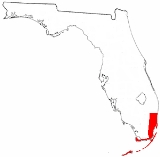
The Tequesta tribe lived on Biscayne BayBiscayne Bay
Biscayne Bay is a lagoon that is approximately 35 miles long and up to 8 miles wide located on the Atlantic coast of South Florida, United States. It is usually divided for purposes of discussion and analysis into three parts: North Bay, Central Bay, and South Bay. Its area is...
in what are now Miami-Dade County
Miami-Dade County, Florida
Miami-Dade County is a county located in the southeastern part of the state of Florida. As of 2010 U.S. Census, the county had a population of 2,496,435, making it the most populous county in Florida and the eighth-most populous county in the United States...
and at least the southern half of Broward County
Broward County, Florida
-2000 Census:As of the census of 2000, there were 1,623,018 people, 654,445 households, and 411,645 families residing in the county. The population density was 1,346 people per square mile . There were 741,043 housing units at an average density of 615 per square mile...
. Their territory may have also included the northern half of Broward County. They also occupied the Florida Keys
Florida Keys
The Florida Keys are a coral archipelago in southeast United States. They begin at the southeastern tip of the Florida peninsula, about south of Miami, and extend in a gentle arc south-southwest and then westward to Key West, the westernmost of the inhabited islands, and on to the uninhabited Dry...
at times, and may have had a village on Cape Sable
Cape Sable
Cape Sable, Florida is the southernmost point of the US mainland and mainland Florida. It is located in southwestern Florida, in Monroe County, and is part of the Everglades National Park. The cape is a peninsula issuing from the southeastern part of the Florida mainland, running west and curving...
, at the southern end of the Florida peninsula, in the 16th Century. The central town (also called Tequesta) was probably at the mouth of the Miami River
Miami River (Florida)
The Miami River is a river in the United States state of Florida that drains out of the Everglades and runs through the Downtown and the city of Miami. The long river flows from the terminus of the Miami Canal at Miami International Airport to Biscayne Bay...
. A village had been at that site at least since 1200. The tribal chief was also called Tequesta. The Tequestas arrived in the Biscayne Bay area before the beginning of the Current Era. The Tequestas placed their towns and camps at the mouths of rivers and streams, on inlets from the Atlantic Ocean to inland waters, and on barrier islands and keys.
The Tequestas were more or less dominated by the more numerous Calusa
Calusa
The Calusa were a Native American people who lived on the coast and along the inner waterways of Florida's southwest coast. Calusa society developed from that of archaic peoples of the Everglades region; at the time of European contact, the Calusa were the people of the Caloosahatchee culture...
of the southwest coast of Florida. The Tequestas were closely allied to their immediate neighbors to the north, the Jaega
Jaega
The Jaegas were a tribe of Native Americans living along the coast of present-day Martin County and Palm Beach County, Florida at the time of initial European contact, and until sometime in the 18th Century...
. Estimates of the number of Tequestas at the time of initial European contact range from 800 to 10,000, while estimates of the number of Calusas on the southwest coast of Florida range from 2,000 to 20,000. Occupation of the Florida Keys may have swung back and forth between the two tribes. Although there is a Spanish record of a Tequesta village on Cape Sable, Calusa artifacts outnumber Tequesta artifacts by four to one at archaeological sites there.
On a map the Dutch cartographer Hessel Gerritsz
Hessel Gerritsz
Hessel Gerritsz was a Dutch engraver, cartographer and publisher. Despite strong competition, he is considered by some “unquestionably the chief Dutch cartographer of the 17th century”...
published in 1630 in Joannes de Laet
Joannes de Laet
Joannes or Johannes de Laet was a Dutch geographer and director of the Dutch West India Company. Philip Burden called his History of the New World, "...arguably the finest description of the Americas published in the seventeenth century" and "...one of the foundation maps of Canada"...
's History of the New World, the Florida peninsula is labeled "Tegesta" after the tribe. A map from the 18th century labeled the area around Biscayne Bay "Tekesta". A 1794 map by cartographer Bernard Romans labeled this area "Tegesta".
Origins and language
The archaeological record of the Glades culture, which included the area occupied by the Tequestas, indicates a continuous development of an indigenous ceramics tradition from about 700BCE
Common Era
Common Era ,abbreviated as CE, is an alternative designation for the calendar era originally introduced by Dionysius Exiguus in the 6th century, traditionally identified with Anno Domini .Dates before the year 1 CE are indicated by the usage of BCE, short for Before the Common Era Common Era...
until after European contact. The Tequesta language may have been closely related to the language of the Calusa
Calusa
The Calusa were a Native American people who lived on the coast and along the inner waterways of Florida's southwest coast. Calusa society developed from that of archaic peoples of the Everglades region; at the time of European contact, the Calusa were the people of the Caloosahatchee culture...
s of the southwest Florida coast and the Mayaimi
Mayaimi
The Mayaimi were a Native American people who lived around Lake Okeechobee in Florida from the beginning of the Common Era until the 17th or 18th century. The group took their name from the lake, which was then called Mayaimi, which meant "big water" in the language of the Mayaimi, Calusa, and...
s who lived around Lake Okeechobee
Lake Okeechobee
Lake Okeechobee , locally referred to as The Lake or The Big O, is the largest freshwater lake in the state of Florida. It is the seventh largest freshwater lake in the United States and the second largest freshwater lake contained entirely within the lower 48 states...
in the middle of the lower Florida peninsula. There are only ten words from the languages of those tribes for which meanings were recorded. The Tequesta were once thought to be related to the Taino
Taíno people
The Taínos were pre-Columbian inhabitants of the Bahamas, Greater Antilles, and the northern Lesser Antilles. It is thought that the seafaring Taínos are relatives of the Arawak people of South America...
, the Arawakan people of the Antilles
Antilles
The Antilles islands form the greater part of the West Indies in the Caribbean Sea. The Antilles are divided into two major groups: the "Greater Antilles" to the north and west, including the larger islands of Cuba, Jamaica, Hispaniola , and Puerto Rico; and the smaller "Lesser Antilles" on the...
, but most anthropologists now doubt this, based on archaeological information and the length of their establishment in Florida. Carl O. Sauer
Carl O. Sauer
Carl Ortwin Sauer was an American geographer. Sauer was a professor of geography at the University of California at Berkeley from 1923 until becoming professor emeritus in 1957 and was instrumental in the early development of the geography graduate school at Berkeley. One of his best known works...
called the Florida Straits "one of the most strongly marked cultural boundaries in the New World", noting that the Straits were also a boundary between agricultural systems, with Florida Indians growing seed crops that originated in Mexico
Mexico
The United Mexican States , commonly known as Mexico , is a federal constitutional republic in North America. It is bordered on the north by the United States; on the south and west by the Pacific Ocean; on the southeast by Guatemala, Belize, and the Caribbean Sea; and on the east by the Gulf of...
, while the Lucayans of the Bahamas grew root crops that originated in South America.
Diet
The Tequestas did practice any form of agriculture. They fished, hunted, and gathered the fruit and roots of local plants. Most of their food came from the sea. Hernando de Escalante FontanedaHernando de Escalante Fontaneda
Hernando de Escalante Fontaneda was a Spanish shipwreck survivor who lived among the Indians of Florida for 17 years...
, who lived among the tribes of southern Florida for seventeen years in the 16th Century, described their "common" diet as "fish, turtle and snails, and tunny and whale..."; the "sea-wolf" (Caribbean monk seal
Caribbean Monk Seal
The Caribbean monk seal or West Indian monk seal is an extinct species of seal. It is the only seal ever known to be native to the Caribbean Sea and the Gulf of Mexico. The last verified recorded sighting occurred in 1952 at Serranilla Bank...
) was reserved for the upper classes. According to Fontaneda, a lesser part of the diet consisted of trunkfish and lobster
Spiny lobster
Spiny lobsters, also known as langouste or rock lobsters, are a family of about 45 species of achelate crustaceans, in the Decapoda Reptantia...
. The "fish" caught included manatee
Manatee
Manatees are large, fully aquatic, mostly herbivorous marine mammals sometimes known as sea cows...
s, shark
Shark
Sharks are a type of fish with a full cartilaginous skeleton and a highly streamlined body. The earliest known sharks date from more than 420 million years ago....
s, sailfish
Sailfish
'Sailfish' are two species of fish in the genus Istiophorus, living in warmer sections of all the oceans of the world. They are predominately blue to gray in color and have a characteristic erectile dorsal fin known as a sail, which often stretches the entire length of the back...
, porpoise
Porpoise
Porpoises are small cetaceans of the family Phocoenidae; they are related to whales and dolphins. They are distinct from dolphins, although the word "porpoise" has been used to refer to any small dolphin, especially by sailors and fishermen...
s, stingray
Stingray
The stingrays are a group of rays, which are cartilaginous fishes related to sharks. They are classified in the suborder Myliobatoidei of the order Myliobatiformes, and consist of eight families: Hexatrygonidae , Plesiobatidae , Urolophidae , Urotrygonidae , Dasyatidae , Potamotrygonidae The...
s, and small fish. Despite their local abundance, clam
Clam
The word "clam" can be applied to freshwater mussels, and other freshwater bivalves, as well as marine bivalves.In the United States, "clam" can be used in several different ways: one, as a general term covering all bivalve molluscs...
s, oyster
Oyster
The word oyster is used as a common name for a number of distinct groups of bivalve molluscs which live in marine or brackish habitats. The valves are highly calcified....
s and conch
Conch
A conch is a common name which is applied to a number of different species of medium-sized to large sea snails or their shells, generally those which are large and have a high spire and a siphonal canal....
s were only a minor part of the Tequesta diet (their shells are much less common at Tequesta archeological sites than they are at Calusa or Jaega
Jaega
The Jaegas were a tribe of Native Americans living along the coast of present-day Martin County and Palm Beach County, Florida at the time of initial European contact, and until sometime in the 18th Century...
sites). Venison
Venison
Venison is the meat of a game animal, especially a deer but also other animals such as antelope, wild boar, etc.-Etymology:The word derives from the Latin vēnor...
also
popular; deer
Deer
Deer are the ruminant mammals forming the family Cervidae. Species in the Cervidae family include white-tailed deer, elk, moose, red deer, reindeer, fallow deer, roe deer and chital. Male deer of all species and female reindeer grow and shed new antlers each year...
bones are frequently found in archeological sites, as are terrapin
Turtle
Turtles are reptiles of the order Testudines , characterised by a special bony or cartilaginous shell developed from their ribs that acts as a shield...
shells and bones. Sea turtle
Sea turtle
Sea turtles are marine reptiles that inhabit all of the world's oceans except the Arctic.-Distribution:...
s and their eggs were consumed during the turtles' nesting season.
The Tequesta gathered many plant foods, including saw palmetto
Saw Palmetto
Serenoa repens, commonly known as saw palmetto, is the sole species currently classified in the genus Serenoa. It has been known by a number of synonyms, including Sabal serrulatum, under which name it still often appears in alternative medicine. It is a small palm, normally reaching a height of...
(Serenoa repens) berries, cocoplums (Chrysobalanus icaco
Chrysobalanus icaco
Chrysobalanus icaco, the cocoplum, Paradise Plum and icaco , is found near sea beaches and inland throughout the tropical Americas and the Caribbean, including Cuba, southern Florida, and the Bahamas. The inland subspecies is Chrysobalanus icaco pellocarpus.-Description:Chrysobalanus icaco is a...
), sea grapes (Coccoloba uvifera
Coccoloba uvifera
Coccoloba uvifera is a species of flowering plant in the buckwheat family, Polygonaceae, that is native to coastal beaches throughout tropical America and the Caribbean, including southern Florida, the Bahamas, Barbados and Bermuda...
), prickly pear fruits (Opuntia
Opuntia
Opuntia, also known as nopales or paddle cactus , is a genus in the cactus family, Cactaceae.Currently, only prickly pears are included in this genus of about 200 species distributed throughout most of the Americas. Chollas are now separated into the genus Cylindropuntia, which some still consider...
spp.), gopher apples (Licania
Licania
Licania is a plant genus in the family Chrysobalanaceae. Mainly due to deforestation, several species of these shrubs and smallish trees have declined, some markedly so, and L. caldasiana from Colombia appears to have gone extinct in recent years....
micbauxii), pigeon plum
Pigeon plum
Coccoloba diversifolia , is a species of Coccoloba native to coastal areas of the Caribbean, Central America , southern Mexico, southern Florida and The Bahamas.-Description:Coccoloba diversifolia is a small to...
s (Cocoloba diversifolia), palm
Arecaceae
Arecaceae or Palmae , are a family of flowering plants, the only family in the monocot order Arecales. There are roughly 202 currently known genera with around 2600 species, most of which are restricted to tropical, subtropical, and warm temperate climates...
nuts, false mastic (Mastichodedron) seeds, cabbage palm (Sabal palmetto
Sabal palmetto
Sabal palmetto, also known as cabbage palm, palmetto, cabbage palmetto, palmetto palm, blue palmetto, Carolina palmetto, common palmetto, swamp cabbage and sabal palm, is one of 15 species of palmetto palm . It is native to the southeastern United States, Cuba, and the Bahamas...
) and hog plum (Ximenia americana
Ximenia americana
Ximenia americana, commonly known as Yellow Plum or Sea Lemon, is a small sprawling tree of woodlands native to Australia and Asia....
). The roots of certain plants, such as Smilax
Smilax
Smilax is a genus of about 300-350 species, found in temperate zones, tropics and subtropics worldwide. In China for example about 80 are found , while there are 20 in North America north of Mexico...
spp. and coontie (Zamia integrifolia
Zamia integrifolia
Zamia integrifolia is a small, tough, woody cycad native to the southeast United States , the Bahamas and the Caribbean south to Grand Cayman and Puerto Rico ....
), were edible when ground into flour, processed to remove toxins (in the case of coontie), and made into a type of unleavened bread. (Archaeologists have commented, however, on the lack of evidence for coontie use in excavated sites.) Briton Hammond, the sole survivor of an English
England
England is a country that is part of the United Kingdom. It shares land borders with Scotland to the north and Wales to the west; the Irish Sea is to the north west, the Celtic Sea to the south west, with the North Sea to the east and the English Channel to the south separating it from continental...
sloop that was attacked by Tequestas after grounding off Key Biscayne
Key Biscayne
Key Biscayne is an island located in Miami-Dade County, Florida, United States, between the Atlantic Ocean and Biscayne Bay. It is the southernmost of the barrier islands along the Atlantic coast of Florida, and lies south of Miami Beach and southeast of Miami...
in 1748, reported that the Tequestas fed him boil'd corn.
The Tequestas changed their habitation during the year. In particular, most of the inhabitants of the main village relocated to barrier islands or to the Florida Keys
Florida Keys
The Florida Keys are a coral archipelago in southeast United States. They begin at the southeastern tip of the Florida peninsula, about south of Miami, and extend in a gentle arc south-southwest and then westward to Key West, the westernmost of the inhabited islands, and on to the uninhabited Dry...
during the worst of the mosquito season, which lasted about three months. While the resources of the Biscayne Bay
Biscayne Bay
Biscayne Bay is a lagoon that is approximately 35 miles long and up to 8 miles wide located on the Atlantic coast of South Florida, United States. It is usually divided for purposes of discussion and analysis into three parts: North Bay, Central Bay, and South Bay. Its area is...
area and the Florida Keys allowed for a somewhat settled non-agricultural existence, they were not as rich as those of the southwest Florida coast, home of the more numerous Calusa.
Housing, clothing and tools
Briton Hammond reported that the Tequesta lived in hutts. No other description is not available of Tequesta housing. Other tribes in southern Florida lived in houses with wooden posts, raised floors, and roofs thatched with palmetto leaves, something like the chickeeChickee
Chikee or Chickee is a shelter supported by posts, with a raised floor, a thatched roof and open sides. The chickee style of architecture — palmetto thatch over a bald cypress log frame — was adopted by Seminoles during the Second and Third Seminole War as U.S...
s of the Seminole
Seminole
The Seminole are a Native American people originally of Florida, who now reside primarily in that state and Oklahoma. The Seminole nation emerged in a process of ethnogenesis out of groups of Native Americans, most significantly Creeks from what is now Georgia and Alabama, who settled in Florida in...
s. These houses may have had temporary walls of plaited palmetto-leaf mats to break the wind or block the sun.
Clothing was minimal. The men wore a sort of loincloth
Loincloth
A loincloth is a one-piece male garment, sometimes kept in place by a belt, which covers the genitals and, at least partially, the buttocks.-History and types:Loincloths are being and have been worn:*in societies where no other clothing is needed or wanted...
made from deer hide, while the women wore skirts of Spanish moss
Spanish Moss
Spanish moss is a flowering plant that grows upon larger trees, commonly the Southern Live Oak or Bald Cypress in the southeastern United States....
or plant fibers hanging from a belt.
The Tequesta had ocean-going canoes [that were carved with shark teeth], nets, spears, atlatls, bows and arrows (although they may have acquired those after European contact) and utilitarian pottery with little or no decoration.
Customs
By one account, when the Tequestas buried their chiefs, they buried the small bones with the body, and put the large bones in a box for the village people to adore and hold as their gods. Another account says that the Tequestas stripped the flesh from the bones, burning the flesh, and then distributed the cleaned bones to the dead chief's relatives, with the larger bones going to the closest relations.The Tequesta men consumed cassina, the black drink
Black drink
Black drink was the name given by colonists to a ritual beverage called Asi, brewed by Native Americans in the Southeastern United States...
, in ceremonies similar to those common throughout the southeastern United States
Southeastern United States
The Southeastern United States, colloquially referred to as the Southeast, is the eastern portion of the Southern United States. It is one of the most populous regions in the United States of America....
.
The Spanish missionaries also reported that the Tequesta worshipped a stuffed deer as the representative of the sun, and as late as 1743 worshipped a picture of a badly deformed barracuda crossed by a harpoon, and surrounded by small tongue-like figures painted on a small board. There was also a god of the graveyard, a bird's head carved in pine. The painted board and bird's head were stored in a temple in the cemetery, along with carved masks used in festivals. By this time the tribe's shaman was calling himself a bishop.
The Tequestas may have practiced human sacrifice. While enroute from Havana to Biscayne Bay in 1743, Spanish missionaries heard that the Indians of the Keys (including, apparently, the Tequestas) had gone to Santaluz (the village of Santa Lucea was at the St. Lucie Inlet) for a celebration of a recent peace treaty, and that the chief of Santaluz was going to sacrifice a young girl as part of the celebration. The missionaries sent a message to the chief begging him not to sacrifice the girl, and the chief relented.
Miami Circle
The Miami CircleMiami Circle
The Miami Circle, also known as The Miami River Circle, Brickell Point, or The Miami Circle at Brickell Point Site, is an archaeological site in Downtown Miami, Florida...
is located on the site of a known Tequesta village south of the mouth of the Miami River (probably the town of Tequesta). It consists of 24 large holes or basins, and many smaller holes, which have been cut into bedrock. Together these holes form a circle approximately 38 feet in diameter. Other arrangements of holes are apparent as well. The Circle was discovered during an archeological survey of a site being cleared for construction of a high-rise building. Charcoal samples collected in the circle have been radiocarbon-dated to approximately 1,900 years ago.
Post-European-contact History
In 1513 Juan Ponce de LeonJuan Ponce de León
Juan Ponce de León was a Spanish explorer. He became the first Governor of Puerto Rico by appointment of the Spanish crown. He led the first European expedition to Florida, which he named...
stopped at a bay on the Florida coast that he called Chequesta, which apparently was what is now called Biscayne Bay
Biscayne Bay
Biscayne Bay is a lagoon that is approximately 35 miles long and up to 8 miles wide located on the Atlantic coast of South Florida, United States. It is usually divided for purposes of discussion and analysis into three parts: North Bay, Central Bay, and South Bay. Its area is...
. In 1565 one of the ships in Pedro Menéndez de Avilés
Pedro Menéndez de Avilés
Pedro Menéndez de Avilés was a Spanish admiral and explorer, best remembered for founding St. Augustine, Florida in 1565. This was the first successful Spanish foothold in La Florida and remained the most significant city in the region for several hundred years. St...
' fleet took refuge from a storm in Biscayne Bay. The main Tequesta village was located there, and Menéndez was well received by the Tequestas. The Jesuits with him took the Tequesta chief's nephew with them back to Havana
Havana
Havana is the capital city, province, major port, and leading commercial centre of Cuba. The city proper has a population of 2.1 million inhabitants, and it spans a total of — making it the largest city in the Caribbean region, and the most populous...
, Cuba
Cuba
The Republic of Cuba is an island nation in the Caribbean. The nation of Cuba consists of the main island of Cuba, the Isla de la Juventud, and several archipelagos. Havana is the largest city in Cuba and the country's capital. Santiago de Cuba is the second largest city...
, to be educated, while the chief's brother went to Spain
Spain
Spain , officially the Kingdom of Spain languages]] under the European Charter for Regional or Minority Languages. In each of these, Spain's official name is as follows:;;;;;;), is a country and member state of the European Union located in southwestern Europe on the Iberian Peninsula...
with Menéndez, where he converted to Christianity
Christianity
Christianity is a monotheistic religion based on the life and teachings of Jesus as presented in canonical gospels and other New Testament writings...
. In March of 1567, Menéndez returned to the Tequesta and established a mission within a stockade, situated near the south bank of the Miami River
Miami River (Florida)
The Miami River is a river in the United States state of Florida that drains out of the Everglades and runs through the Downtown and the city of Miami. The long river flows from the terminus of the Miami Canal at Miami International Airport to Biscayne Bay...
below the native village. Menendez left a contingent of thirty soldiers and the Jesuit brother Francisco Villareal to convert the Tequestas to Christianity
Christianity
Christianity is a monotheistic religion based on the life and teachings of Jesus as presented in canonical gospels and other New Testament writings...
. Villareal had learned something of the Tequesta language from the chief's nephew in Havana. He felt he had been winning converts until the soldiers executed an uncle of the chief. Brother Francisco was forced to abandon the mission for a while, but when the chief's brother returned from Spain, Brother Francisco was able to return. However, the mission was abandoned shortly thereafter, in 1570.
Starting in 1704, it was the policy of the Spanish government to resettle Florida Indians in Cuba so that they could be indoctrinated into the Catholic faith. The first group of Indians, including the cacique
Cacique
Cacique is a title derived from the Taíno word for the pre-Columbian chiefs or leaders of tribes in the Bahamas, Greater Antilles, and the northern Lesser Antilles...
of Cayo de Guesos (Key West), arrived in Cuba in 1704, and most, if not all of them, soon died. In 1710, 280 Florida Indians were taken to Cuba, where almost 200 soon died. The survivors were returned to the Keys in 1716 or 1718. In 1732 some Indians fled from the Keys to Cuba.
In early 1743 the Governor of Cuba received a petition from three Calusa
Calusa
The Calusa were a Native American people who lived on the coast and along the inner waterways of Florida's southwest coast. Calusa society developed from that of archaic peoples of the Everglades region; at the time of European contact, the Calusa were the people of the Caloosahatchee culture...
chiefs who were visiting in Havana. The petition, which was written in good Spanish
Spanish language
Spanish , also known as Castilian , is a Romance language in the Ibero-Romance group that evolved from several languages and dialects in central-northern Iberia around the 9th century and gradually spread with the expansion of the Kingdom of Castile into central and southern Iberia during the...
and showed a good understanding of how the government and church bureaucracies worked, asked that missionaries be sent to the Cayos (Florida Keys) to provide religious instruction. The Governor and his advisors finally decided it would be cheaper to send missionaries to the Keys rather than bringing the Indians to Cuba, and that keeping the Indians in the Keys would mean they would be available to help shipwrecked Spanish sailors and keep the English out of the area.
The governor sent two Jesuit missionaries from Havana, Fathers Mónaco and Alaña, with an escort of soldiers. On reaching Biscayne Bay, they established a chapel and fort at the mouth of a river feeding into Biscayne Bay that they called the Rio Ratones. This may have been the Little River
Little River (Florida)
The Little River is a river passing through the northern part of Miami, Florida, United States. It empties into Biscayne Bay.-History:There was a small settlement here in the early 20th century called Little River that was annexed by the city of Miami in 1925.-External links:*...
, in the northern part of Biscayne Bay
Biscayne Bay
Biscayne Bay is a lagoon that is approximately 35 miles long and up to 8 miles wide located on the Atlantic coast of South Florida, United States. It is usually divided for purposes of discussion and analysis into three parts: North Bay, Central Bay, and South Bay. Its area is...
, or the Miami River.
The Spanish missionaries were not well received. The Keys Indians, as the Spanish called them, denied that they had requested missionaries. They did permit a mission to be established because the Spanish had brought gifts for them, but the cacique denied that the King of Spain had dominion over his land, and insisted on tribute for allowing the Spanish to build a church or bring in settlers. The Indians demanded food, rum and clothing, but refused to work for the Spanish. Father Morano reported attacks on the mission by bands of Uchizas (the Creeks
Creek people
The Muscogee , also known as the Creek or Creeks, are a Native American people traditionally from the southeastern United States. Mvskoke is their name in traditional spelling. The modern Muscogee live primarily in Oklahoma, Alabama, Georgia, and Florida...
who later became known as Seminole
Seminole
The Seminole are a Native American people originally of Florida, who now reside primarily in that state and Oklahoma. The Seminole nation emerged in a process of ethnogenesis out of groups of Native Americans, most significantly Creeks from what is now Georgia and Alabama, who settled in Florida in...
s).
Fathers Mónaco and Alaña developed a plan to have a stockade manned by twenty-five soldiers, and to bring in Spanish settlers to grow food for the soldiers and the Indians. They felt that the new settlement would soon supplant the need for St. Augustine. Father Alaña returned to Havana,leaving twelve soldiers and a corporal to protect Father Mónaco.
The governor in Havana was not pleased. He ordered that Father Mónaco and the soldiers be withdrawn, and the stockade burned to deny it to the Uchizas. He also forwarded the missionaries' plan to Spain, where the Council of the Indies decided that the proposed mission on Biscayne Bay would be costly and impractical. The second attempt to establish a mission on Biscayne Bay had lasted less than three months.
When Spain surrendered Florida to Britain
United Kingdom
The United Kingdom of Great Britain and Northern IrelandIn the United Kingdom and Dependencies, other languages have been officially recognised as legitimate autochthonous languages under the European Charter for Regional or Minority Languages...
in 1763, the remaining Tequestas, along with other Indians that had taken refuge in the Florida Keys, were evacuated to Cuba
Cuba
The Republic of Cuba is an island nation in the Caribbean. The nation of Cuba consists of the main island of Cuba, the Isla de la Juventud, and several archipelagos. Havana is the largest city in Cuba and the country's capital. Santiago de Cuba is the second largest city...
. In the 1770s, Bernard Romans
Bernard Romans
Bernard Romans was a Dutch-born American navigator, surveyor, cartographer, naturalist, engineer, soldier, promoter and writer. His best known work, A Concise Natural History of East and West Florida, published in 1775, is a valuable source of information about the Floridas during the period of...
reported seeing abandoned villages in the area, but no inhabitants.