

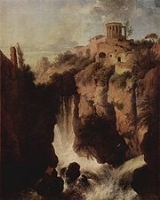
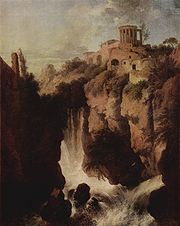
Temple of Vesta, Tivoli

Encyclopedia
Roman temple
Ancient Roman temples are among the most visible archaeological remains of Roman culture, and are a significant source for Roman architecture. Their construction and maintenance was a major part of ancient Roman religion. The main room housed the cult image of the deity to whom the temple was...
in Tivoli, Italy
Tivoli, Italy
Tivoli , the classical Tibur, is an ancient Italian town in Lazio, about 30 km east-north-east of Rome, at the falls of the Aniene river where it issues from the Sabine hills...
, dating to the early 1st century BC. Its ruins sit on the acropolis of the city, overlooking the falls of the Aniene
Aniene
-External links:* http://www.humnet.ucla.edu/humnet/horaces-villa/glossary/Anio.gloss.html*...
that are now included in the Villa Gregoriana
Villa Gregoriana
Villa Gregoriana is a park located in Tivoli, Italy.The park, located at the feet of the city's ancient acropolis was commissioned by Pope Gregory XVI in 1835 to rebuild the bed of the Aniene River, which had been damaged by the flood of 1826. Since ancient times, the river formed a wide curve...
.
It is not known for certain to whom the temple was dedicated, whether to Hercules
Hercules
Hercules is the Roman name for Greek demigod Heracles, son of Zeus , and the mortal Alcmene...
, the protecting god of Tibur, or to Albunea, the Tiburtine Sibyl
Tiburtine Sibyl
The Tiburtine Sibyl was a Roman sibyl, whose seat was the ancient Etruscan town of Tibur .The mythic meeting of Cæsar Augustus with the Sibyl, of whom he inquired whether he should be worshiped as a god, was a favored motif of Christian artists. Whether the sibyl in question was the Etruscan Sibyl...
, or to Tiburnus, the eponymous hero of the city, or to Vesta
Vesta (mythology)
Vesta was the virgin goddess of the hearth, home, and family in Roman religion. Vesta's presence was symbolized by the sacred fire that burned at her hearth and temples...
herself, whose more familiar circular peripteral Temple of Vesta
Temple of Vesta
The Temple of Vesta is an ancient edifice in Rome, Italy, located in the Roman Forum near the Regia and the House of the Vestal Virgins. The temple's most recognizable feature is its circular footprint. Since the worship of Vesta began in private homes, the architecture seems to be a reminder of...
is to be seen in the Roman Forum
Roman Forum
The Roman Forum is a rectangular forum surrounded by the ruins of several important ancient government buildings at the center of the city of Rome. Citizens of the ancient city referred to this space, originally a marketplace, as the Forum Magnum, or simply the Forum...
. A rectangular temple stands nearby, equally difficult to attribute, often called the Temple of the Sibyl".
The name of the builder or restorer of the "Temple of Vesta" is Lucius Gellius, memorialized in the inscription on the architrave
Architrave
An architrave is the lintel or beam that rests on the capitals of the columns. It is an architectural element in Classical architecture.-Classical architecture:...
. The peripteral temple in the Corinthian order
Corinthian order
The Corinthian order is one of the three principal classical orders of ancient Greek and Roman architecture. The other two are the Doric and Ionic. When classical architecture was revived during the Renaissance, two more orders were added to the canon, the Tuscan order and the Composite order...
surrounds its circular cella
Cella
A cella or naos , is the inner chamber of a temple in classical architecture, or a shop facing the street in domestic Roman architecture...
, which is raised on a high brick podium clad in blocks of travertine
Travertine
Travertine is a form of limestone deposited by mineral springs, especially hot springs. Travertine often has a fibrous or concentric appearance and exists in white, tan, and cream-colored varieties. It is formed by a process of rapid precipitation of calcium carbonate, often at the mouth of a hot...
: the cella has a door and two windows. The ambulacrum that surrounds the cella had eighteen Corinthian columns (ten remain standing). The frieze
Frieze
thumb|267px|Frieze of the [[Tower of the Winds]], AthensIn architecture the frieze is the wide central section part of an entablature and may be plain in the Ionic or Doric order, or decorated with bas-reliefs. Even when neither columns nor pilasters are expressed, on an astylar wall it lies upon...
is decorated with carved garlands and bucrania.
The comparatively good condition of the temple is owing to its Christianization
Christianization
The historical phenomenon of Christianization is the conversion of individuals to Christianity or the conversion of entire peoples at once...
as a church, "Santa Maria della Rotonda". The Christian accretions were removed in the late 19th century.
Careful measured drawings of the 'Temple of Vesta" were published by Antoine Desgodetz
Antoine Desgodetz
Antoine Babuty Desgodetzs publication Les edifices antiques de Rome dessinés et mesurés très exactement provided detailed engravings of the monuments and antiquities of Rome to serve French artists and architects...
(1682) who gave elevation and plan as well as carefully rendered details of the carved capitals and the frieze. in the following century both Giuseppe Vasi
Giuseppe Vasi
Giuseppe Vasi was an Italian engraver and architect, best known for his vedute.He was born in Corleone, Sicily and later moved to Rome. From 1746 to 1761 he published a series of ten volumes including 240 engravings of vedute of Rome...
and Giovanni Battista Piranesi
Giovanni Battista Piranesi
Giovanni Battista Piranesi was an Italian artist famous for his etchings of Rome and of fictitious and atmospheric "prisons" .-His Life:...
made etchings and engravings of the "Temple of Vesta".
Imitations
The "Temple of Vesta" provided a model for numerous landscape gardens outside Italy.In England, examples include William Kent
William Kent
William Kent , born in Bridlington, Yorkshire, was an eminent English architect, landscape architect and furniture designer of the early 18th century.He was baptised as William Cant.-Education:...
's "Temple of Ancient Virtue" at Stowe and Sir William Chambers
William Chambers (architect)
Sir William Chambers was a Scottish architect, born in Gothenburg, Sweden, where his father was a merchant. Between 1740 and 1749 he was employed by the Swedish East India Company making several voyages to China where he studied Chinese architecture and decoration.Returning to Europe, he studied...
' "Temple of Solitude" at Kew. Sir John Soane
John Soane
Sir John Soane, RA was an English architect who specialised in the Neo-Classical style. His architectural works are distinguished by their clean lines, massing of simple form, decisive detailing, careful proportions and skilful use of light sources...
's drawings, which he used as comparative examples in his lectures, are preserved at Sir John Soane's Museum, London.
In France, the temple inspired Richard Mique
Richard Mique
Richard Mique was a neoclassical French architect born in Lorraine. He is most remembered for his picturesque hamlet, the Hameau de la reine — not particularly characteristic of his working style — for Marie Antoinette in the Petit Trianon gardens within the estate of Palace of...
's "Temple of Love" in his jardin anglo-chinois at the Petit Trianon
Petit Trianon
The Petit Trianon is a small château located on the grounds of the Palace of Versailles in Versailles, France.-Design and construction:...
and Gabriel Davioud
Gabriel Davioud
Jean-Antoine-Gabriel Davioud was a French architect.Davioud was born in Paris and studied at the École des Beaux-Arts under Léon Vaudoyer...
's "Temple de Sibylle" in the Parc des Buttes Chaumont.
In Poland, the Temple of the Sibyl
Temple of the Sibyl
The Temple of the Sibyl is a colonnaded round monopteral temple-like structure at Puławy, Poland, built in the late 18th century as a museum by Izabela Czartoryska.-History:...
in Puławy was erected by Izabela Czartoryska to designs by the Polish architect Chrystian Piotr Aigner
Chrystian Piotr Aigner
Chrystian Piotr Aigner was a Polish architect and theoretician of architecture.-Life:...
and served as a museum.
In northern California, a version of the temple was set as a landscape feature in the English tradition. The "Sunol Water Temple
Sunol Water Temple
The Sunol Water Temple is located at 505 Paloma Way in Sunol, California. Designed by Willis Polk, the 59 foot high classical pavilion is made up of twelve concrete Corinthian columns and a concrete ring girder that supports the conical wood and tile roof...
" was designed in 1910 by California architect Willis Polk
Willis Polk
Willis Jefferson Polk was an American architect best known for his work in San Francisco, California.-Life:He was born in Jacksonville, Illinois and was related to United States President James Polk....
for the Spring Valley Water Company to mark the spot in California's Sunol Valley where the waters came together to supply San Francisco.