


Telson

Encyclopedia
Crustacean
Crustaceans form a very large group of arthropods, usually treated as a subphylum, which includes such familiar animals as crabs, lobsters, crayfish, shrimp, krill and barnacles. The 50,000 described species range in size from Stygotantulus stocki at , to the Japanese spider crab with a leg span...
. It is not considered a true segment because it does not arise in the embryo from teloblast
Teloblast
A teloblast is a large cell in the embryos of clitellate annelids which asymmetrically divide to form many smaller cells known as blast cells. These blast cells further proliferate and differentiate to form the segmental tissues of the annelid...
areas as do real segments. It never carries any appendage
Appendage
In invertebrate biology, an appendage is an external body part, or natural prolongation, that protrudes from an organism's body . It is a general term that covers any of the homologous body parts that may extend from a body segment...
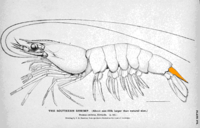
s, but a forked "tail" called the caudal furca is often present. Together with the uropods, the telson forms the tail fan of lobster
Lobster
Clawed lobsters comprise a family of large marine crustaceans. Highly prized as seafood, lobsters are economically important, and are often one of the most profitable commodities in coastal areas they populate.Though several groups of crustaceans are known as lobsters, the clawed lobsters are most...
s, shrimp
Shrimp
Shrimp are swimming, decapod crustaceans classified in the infraorder Caridea, found widely around the world in both fresh and salt water. Adult shrimp are filter feeding benthic animals living close to the bottom. They can live in schools and can swim rapidly backwards. Shrimp are an important...
and other decapods
Decapoda
The decapods or Decapoda are an order of crustaceans within the class Malacostraca, including many familiar groups, such as crayfish, crabs, lobsters, prawns and shrimp. Most decapods are scavengers. It is estimated that the order contains nearly 15,000 species in around 2,700 genera, with...
. These are used as a paddle in the caridoid escape reaction
Caridoid escape reaction
The Caridoid Escape Reaction, also known as lobstering or tail-flipping, refers to an innate escape mechanism in marine and freshwater crustaceans such as lobsters, krill, shrimp and crayfish....
("lobstering"), whereby an alarmed animal rapidly flexes its tail, causing it to dart backwards. Krill
Krill
Krill is the common name given to the order Euphausiacea of shrimp-like marine crustaceans. Also known as euphausiids, these small invertebrates are found in all oceans of the world...
can reach speeds of over 60 cm per second by this means. The trigger time to optical stimulus
Stimulus (physiology)
In physiology, a stimulus is a detectable change in the internal or external environment. The ability of an organism or organ to respond to external stimuli is called sensitivity....
is, in spite of the low temperatures, only 55 ms
Millisecond
A millisecond is a thousandth of a second.10 milliseconds are called a centisecond....
.
The same term telson is widely used for the caudal spine of Chelicerata
Chelicerata
The subphylum Chelicerata constitutes one of the major subdivisions of the phylum Arthropoda, and includes horseshoe crabs, scorpions, spiders and mites...
. The chelicerate telson can be clearly seen in a number of fossil species (like in eurypterid
Eurypterid
Eurypterids are an extinct group of arthropods related to arachnids which include the largest known arthropods that ever lived. They are members of the extinct order Eurypterida ; which is the most diverse Paleozoic chelicerate order in terms of species...
s) and in extant animals (like the horseshoe crab
Horseshoe crab
The Atlantic horseshoe crab, Limulus polyphemus, is a marine chelicerate arthropod. Despite its name, it is more closely related to spiders, ticks, and scorpions than to crabs. Horseshoe crabs are most commonly found in the Gulf of Mexico and along the northern Atlantic coast of North America...
"tail" and the scorpion
Scorpion
Scorpions are predatory arthropod animals of the order Scorpiones within the class Arachnida. They have eight legs and are easily recognized by the pair of grasping claws and the narrow, segmented tail, often carried in a characteristic forward curve over the back, ending with a venomous stinger...
sting). Some authorities, like Karl-Ernst Lauterbach, have urged that the usage of this word in this context be discouraged.