
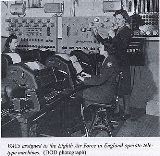
A
teleprinter is a electromechanical typewriter that can be used to communicate typed messages from point to point and point to multipoint over a variety of communication channels that range from a simple electrical connection, such as a pair of wires, to the use of
radioRadio is the transmission of signals through free space by modulation of electromagnetic waves with frequencies below those of visible light. Electromagnetic radiation travels by means of oscillating electromagnetic fields that pass through the air and the vacuum of space...
and
microwaveMicrowaves, a subset of radio waves, have wavelengths ranging from as long as one meter to as short as one millimeter, or equivalently, with frequencies between 300 MHz and 300 GHz. This broad definition includes both UHF and EHF , and various sources use different boundaries...
as the
transmission mediumA transmission medium is a material substance that can propagate energy waves...
. They could also serve as a command line interface to early
mainframe computerMainframes are powerful computers used primarily by corporate and governmental organizations for critical applications, bulk data processing such as census, industry and consumer statistics, enterprise resource planning, and financial transaction processing.The term originally referred to the...
s and
minicomputerA minicomputer is a class of multi-user computers that lies in the middle range of the computing spectrum, in between the largest multi-user systems and the smallest single-user systems...
s, sending typed data to the computer with or without printed output, and printing the response from the computer.
Teleprinters are now largely obsolete, though they are still widely used in the aviation industry (AFTN and airline teletype system), and variations called Telecommunications Devices for the Deaf (
TDDs) are still used by the hearing impaired for typed communications over ordinary telephone lines. In computing teleprinters have been replaced by fully electronic
computer terminalA computer terminal is an electronic or electromechanical hardware device that is used for entering data into, and displaying data from, a computer or a computing system...
s which usually use a display screen instead of a printer, though the term "TTY" is still occasionally used to refer to them, such as in
UnixUnix is a multitasking, multi-user computer operating system originally developed in 1969 by a group of AT&T employees at Bell Labs, including Ken Thompson, Dennis Ritchie, Brian Kernighan, Douglas McIlroy, and Joe Ossanna...
systems.
History
A predecessor to the teleprinter, the
stock ticker machineTicker tape was the earliest digital electronic communications medium, transmitting stock price information over telegraph lines, in use between around 1870 through 1970...
, was used as early as the 1870s as a method of displaying text transmitted over wires. A specially-designed
telegraphTelegraphy is the long-distance transmission of messages via some form of signalling technology. Telegraphy requires messages to be converted to a code which is known to both sender and receiver...
typewriter was used to send
stock exchangeA stock exchange is an entity that provides services for stock brokers and traders to trade stocks, bonds, and other securities. Stock exchanges also provide facilities for issue and redemption of securities and other financial instruments, and capital events including the payment of income and...
information over telegraph wires to the ticker machines.
In 1902, electrical engineer Frank Pearne approached
Joy Morton, Joy Morton founded the Morton Salt Company and The Morton Arboretum.Morton grew to manhood in Nebraska City, Nebraska in Nebraska Territory. His mother, Caroline Joy, was an accomplished artist, musician, and gardener...
, head of
Morton SaltMorton Salt is a United States company producing salt for food, water conditioning, industrial, agricultural, and road/highway use. Based in Chicago, the business is North America's leading producer and marketer of salt. It is a subsidiary of the German company K+S.-History:The company began in...
, seeking a sponsor for research into the practicalities of developing a printing telegraph system. Joy Morton needed to determine whether this was worthwhile and so consulted mechanical engineer
Charles KrumCharles L. Krum was a key figure in the development of the teleprinter, a machine which played a key role in the history of telegraphy and computing....
, who was vice president of the Western Cold Storage Company. Krum was interested in helping Pearne, so space was set up in a laboratory in the attic of Western Cold Storage. Frank Pearne lost interest in the project after a year and left to get involved in teaching. Krum was prepared to continue Pearne’s work, and in August, 1903 a patent was filed for a ‘typebar page printer’. In 1904, Krum filed a patent for a ‘type wheel printing telegraph machine’ which was issued in August, 1907. In 1906 Charles Krum's son, Howard Krum, joined his father in this work. It was Howard who developed and patented the start-stop synchronizing method for code telegraph systems, which made possible the practical teleprinter.
In 1908, a working teleprinter was produced by the Morkrum Company, called the Morkrum Printing Telegraph, which was field tested with the Alton Railroad.
In 1910, the Morkrum Company designed and installed the first commercial teletypewriter system on Postal Telegraph Company lines between Boston and New York City using the "Blue Code Version" of the Morkrum Printing Telegraph.
The teleprinter evolved through a series of inventions by a number of engineers, including
Royal Earl HouseRoyal Earl House was the inventor of the first printing telegraph, which is now kept in the Smithsonian Institution. His nephew Henry Alonzo House is also a noted early American inventor....
,
David E. HughesDavid Edward Hughes , was a British scientist and musician. Hughes was co-inventor of the microphone, a harpist and a professor of music.-Biography:...
,
Edward KleinschmidtEdward Ernst Kleinschmidt was one of the inventors of the teleprinter, and was a prolific inventor who obtained 118 patents in the course of his 101-year life.-Career:...
,
Charles KrumCharles L. Krum was a key figure in the development of the teleprinter, a machine which played a key role in the history of telegraphy and computing....
,
Emile BaudotJean-Maurice-Émile Baudot , French telegraph engineer and inventor of the first means of digital communication Baudot code, was one of the pioneers of telecommunications...
and
Frederick G. CreedFrederick George Creed was a Canadian inventor, who worked in the field of telecommunications, and played an early role in the development of SWATH vessels, The CCGS Frederick G...
.
Ways in which teleprinters were used
There were at least five major types of teleprinter networks:
- Exchange systems such as Telex
Telex may refer to:* Telex , , a communications network** Teleprinter, the device used on the above network* Telex , a Belgian pop group...
and TWXTWX may refer to:* Teletypewriter eXchange , a telegraphy system.* Time Warner's stock ticker symbol....
. These created a real-time circuit between two machines, so that anything typed on one machine appeared at the other end immediately. US and UK systems had actual telephone dials; German systems did "dialing" via the keyboard. Typed "chat" was possible, but because billing was by connect time, it was common to prepare messages on paper tapePunched tape or paper tape is an obsolete form of data storage, consisting of a long strip of paper in which holes are punched to store data...
and transmit them without pauses for typing.
- Leased line
A leased line is a service contract between a provider and a customer, whereby the provider agrees to deliver a symmetric telecommunications line connecting two or more locations in exchange for a monthly rent . It is sometimes known as a 'Private Circuit' or 'Data Line' in the UK or as CDN in Italy...
and radioteletypeRadioteletype is a telecommunications system consisting originally of two or more electromechanical teleprinters in different locations, later superseded by personal computers running software to emulate teleprinters, connected by radio rather than a wired link.The term radioteletype is used to...
networks arranged in point-to-point and / or multipoint configurations to support data processingComputer data processing is any process that a computer program does to enter data and summarise, analyse or otherwise convert data into usable information. The process may be automated and run on a computer. It involves recording, analysing, sorting, summarising, calculating, disseminating and...
applications for government and industry such as integrating the accounting, billing, management, production, purchasing, sales, shipping and receiving departments within an organization to speed internal communications.
- Message switching
In telecommunications, message switching was the precursor of packet switching, where messages were routed in their entirety, one hop at a time. It was first introduced by Leonard Kleinrock in 1961. Message switching systems are nowadays mostly implemented over packet-switched or circuit-switched...
systems. This was an early form of E-mailElectronic mail, commonly known as email or e-mail, is a method of exchanging digital messages from an author to one or more recipients. Modern email operates across the Internet or other computer networks. Some early email systems required that the author and the recipient both be online at the...
, done with electromechanical gear. See Telegram, Western UnionThe Western Union Company is a financial services and communications company based in the United States. Its North American headquarters is in Englewood, Colorado. Up until 2006, Western Union was the best-known U.S...
, Plan 55-APlan 55-A was a store and forward message switching system developed by Western Union and used from 1948 to 1976. Western Union's own system handled telegrams, and a military version of the system was used by the U.S...
. Military organizations had similar but separate systems. See Autodin.
- Broadcast systems such as weather information distribution and "news wires". See Associated Press
The Associated Press is an American news agency. The AP is a cooperative owned by its contributing newspapers, radio and television stations in the United States, which both contribute stories to the AP and use material written by its staff journalists...
, National Weather ServiceThe National Weather Service , once known as the Weather Bureau, is one of the six scientific agencies that make up the National Oceanic and Atmospheric Administration of the United States government...
, ReutersReuters is a news agency headquartered in New York City. Until 2008 the Reuters news agency formed part of a British independent company, Reuters Group plc, which was also a provider of financial market data...
, and United Press (later UPI).
- "Loop" systems, where anything typed on any machine on the loop printed on all the machines. Police departments used such systems to interconnect precincts.
Teleprinter operation
Most teleprinters used the 5-
bitA bit is the basic unit of information in computing and telecommunications; it is the amount of information stored by a digital device or other physical system that exists in one of two possible distinct states...
Baudot codeThe Baudot code, invented by Émile Baudot, is a character set predating EBCDIC and ASCII. It was the predecessor to the International Telegraph Alphabet No 2 , the teleprinter code in use until the advent of ASCII. Each character in the alphabet is represented by a series of bits, sent over a...
(also known as
ITA2The Baudot code, invented by Émile Baudot, is a character set predating EBCDIC and ASCII. It was the predecessor to the International Telegraph Alphabet No 2 , the teleprinter code in use until the advent of ASCII. Each character in the alphabet is represented by a series of bits, sent over a...
). This limited the character set to 32 codes (2
5 = 32). One had to use a "FIGS"
shift keyThe shift key is a modifier key on a keyboard, used to type capital letters and other alternate "upper" characters. There are typically two shift keys, on the left and right sides of the row below the home row...
to type numbers and special characters. Special versions of teleprinters had FIGS characters for specific applications, such as weather symbols for weather reports. Print quality was poor by modern standards. The Baudot code was used
asynchronously with start and stop bitsAsynchronous serial communication describes an asynchronous, serial transmission protocol in which a start signal is sent prior to each byte, character or code word and a stop signal is sent after each code word...
: the asynchronous code design was intimately linked with the start-stop electro-mechanical design of teleprinters. (Early systems had used synchronous codes, but were hard to synchronize mechanically). Other codes, such as
ASCIIThe American Standard Code for Information Interchange is a character-encoding scheme based on the ordering of the English alphabet. ASCII codes represent text in computers, communications equipment, and other devices that use text...
,
FieldataFieldata was a pioneering computer project run by the US Army Signal Corps in the late 1950s that intended to create a single standard for collecting and distributing battlefield information...
and
FlexowriterThe Friden Flexowriter was a teleprinter, a heavy duty electric typewriter capable of being driven not only by a human typing, but also automatically by several methods including direct attachment to a computer and by use of paper tape....
, were introduced but never became as popular as Baudot.
Mark and
space are terms describing
logic levelIn digital circuits, a logic level is one of a finite number of states that a signal can have. Logic levels are usually represented by the voltage difference between the signal and ground , although other standards exist...
s in teleprinter circuits. The native mode of communication for a teleprinter is a simple series
DC circuitWithin electrical engineering, a DC circuit is an electrical circuit that consists of any combination of constant voltage sources, constant current sources, and resistors. In this case, the circuit voltages and currents are constant, i.e., independent of time. More technically, a DC circuit has...
that is interrupted, much as a
rotary dialThe rotary dial is a device mounted on or in a telephone or switchboard that is designed to send electrical pulses, known as pulse dialing, corresponding to the number dialed. The early form of the rotary dial used lugs on a finger plate instead of holes. Almon Brown Strowger filed the first patent...
interrupts a telephone signal. The marking condition is when the circuit is closed (current is flowing), the spacing condition is when the circuit is open (no current is flowing). The "idle" condition of the circuit is a continuous marking state, with the start of a character signalled by a "start bit", which is always a space. Following the start bit, the character is represented by a fixed number of bits, such as 5 bits in the Baudot code, each either a mark or a space to denote the specific character or machine function. After the character's bits, the sending machine sends one or more stop bits. The stop bits are marking, so as to be distinct from the subsequent start bit. If the sender has nothing more to send, the line simply remains in the marking state (as if a continuing series of stop bits) until a later space denotes the start of the next character. The time between characters need not be an integral multiple of a bit time, but it must be at least the minimum number of stop bits required by the receiving machine.
When the line is broken, the continuous spacing (open circuit, no current flowing) causes a receiving teleprinter to cycle continuously, even in the absence of stop bits. It prints nothing because the characters received are all zeros, the
BaudotBaudot:*Marc Antoine Baudot , deputy during the French Revolution*Émile Baudot , French telegraph engineer, inventor of the Baudot code*Anatole de Baudot , French architect...
blank (or
ASCIIThe American Standard Code for Information Interchange is a character-encoding scheme based on the ordering of the English alphabet. ASCII codes represent text in computers, communications equipment, and other devices that use text...
)
null characterThe null character , abbreviated NUL, is a control character with the value zero.It is present in many character sets, including ISO/IEC 646 , the C0 control code, the Universal Character Set , and EBCDIC...
.
Teleprinter circuits were generally leased from a communications
common carrierA common carrier in common-law countries is a person or company that transports goods or people for any person or company and that is responsible for any possible loss of the goods during transport...
and consisted of
twisted pairTwisted pair cabling is a type of wiring in which two conductors are twisted together for the purposes of canceling out electromagnetic interference from external sources; for instance, electromagnetic radiation from unshielded twisted pair cables, and crosstalk between neighboring pairs...
copper wires through ordinary telephone cables that extended from the teleprinter located at the customer location to the common carrier central office. These teleprinter circuits were connected to switching equipment at the central office for
TelexTelex may refer to:* Telex , , a communications network** Teleprinter, the device used on the above network* Telex , a Belgian pop group...
and TWX service.
Private lineIn wired telephony, a private line or tie line is a service that involves dedicated circuits, private switching arrangements, and/or predefined transmission paths, whether virtual or physical, which provide communications between specific locations. Most private lines connect only two locations...
teleprinter circuits were not directly connected to switching equipment. Instead, these private line circuits were connected to network hubs and
repeaterA repeater is an electronic device that receives asignal and retransmits it at a higher level and/or higher power, or onto the other side of an obstruction, so that the signal can cover longer distances.-Description:...
s configured to provide point to point or point to multipoint service. More than two teleprinters could be connected to the same wire circuit by means of a
current loopA current loop describes two different electrical signalling schemes.- Digital :For digital serial communications, a current loop is a communication interface that uses current instead of voltage for signaling...
.
Earlier Teletype machines had three rows of keys and only supported upper case letters. They used the 5 bit
baudot codeThe Baudot code, invented by Émile Baudot, is a character set predating EBCDIC and ASCII. It was the predecessor to the International Telegraph Alphabet No 2 , the teleprinter code in use until the advent of ASCII. Each character in the alphabet is represented by a series of bits, sent over a...
and generally worked at 60 words per minute.
Teletypes with ASCII code were an innovation that came into widespread use in the same period as computers began to become widely available.
Speed, intended to be roughly comparable to
words per minuteWords per minute, commonly abbreviated wpm, is a measure of input or output speed.For the purposes of WPM measurement a word is standardized to five characters or keystrokes. For instance, "I run" counts as one word, but "rhinoceros" counts as two...
, was the standard designation introduced by
Western UnionThe Western Union Company is a financial services and communications company based in the United States. Its North American headquarters is in Englewood, Colorado. Up until 2006, Western Union was the best-known U.S...
for a mechanical teleprinter data transmission rate using the 5-bit
baudot codeThe Baudot code, invented by Émile Baudot, is a character set predating EBCDIC and ASCII. It was the predecessor to the International Telegraph Alphabet No 2 , the teleprinter code in use until the advent of ASCII. Each character in the alphabet is represented by a series of bits, sent over a...
that was popular in the 1940s and for several decades thereafter. Such a machine would send 1 start bit, 5 data bits, and 1.42 stop bits. This unusual stop bit time was actually a rest period to allow the mechanical printing mechanism to recycle. Since modern computer equipment cannot easily generate 1.42 bits for the stop period, common practice is to either approximate this with 1.5 bits, or to send 2.0 bits while accepting 1.0 bits receiving.
For example, a "60 speed" machine is geared at 45.5
baudIn telecommunications and electronics, baud is synonymous to symbols per second or pulses per second. It is the unit of symbol rate, also known as baud rate or modulation rate; the number of distinct symbol changes made to the transmission medium per second in a digitally modulated signal or a...
(22.0
msA millisecond is a thousandth of a second.10 milliseconds are called a centisecond....
per bit), a "66 speed" machine is geared at 50.0
baudIn telecommunications and electronics, baud is synonymous to symbols per second or pulses per second. It is the unit of symbol rate, also known as baud rate or modulation rate; the number of distinct symbol changes made to the transmission medium per second in a digitally modulated signal or a...
(20.0 ms per bit), a "75 speed" machine is geared at 56.9 baud (17.5 ms per bit), a "100 speed" machine is geared at 74.2 baud (13.5 ms per bit), and a "133 speed" machine is geared at 100.0 baud (10.0 ms per bit). 60 speed became the
de factoDe facto is a Latin expression that means "concerning fact." In law, it often means "in practice but not necessarily ordained by law" or "in practice or actuality, but not officially established." It is commonly used in contrast to de jure when referring to matters of law, governance, or...
standard for
amateur radioAmateur radio is the use of designated radio frequency spectrum for purposes of private recreation, non-commercial exchange of messages, wireless experimentation, self-training, and emergency communication...
RTTYRadioteletype is a telecommunications system consisting originally of two or more electromechanical teleprinters in different locations, later superseded by personal computers running software to emulate teleprinters, connected by radio rather than a wired link.The term radioteletype is used to...
operation because of the widespread availability of equipment at that speed and the U.S.
Federal Communications CommissionThe Federal Communications Commission is an independent agency of the United States government, created, Congressional statute , and with the majority of its commissioners appointed by the current President. The FCC works towards six goals in the areas of broadband, competition, the spectrum, the...
(FCC) restrictions to only 60 speed from 1953 to 1972. Telex,
news agencyA news agency is an organization of journalists established to supply news reports to news organizations: newspapers, magazines, and radio and television broadcasters. Such an agency may also be referred to as a wire service, newswire or news service.-History:The oldest news agency is Agence...
wires and similar services commonly used 66 speed services. There was some migration to 75 and 100 speed as more reliable devices were introduced. However, the limitations of HF transmission such as excessive error rates due to multipath distortion and the nature of ionospheric propagation kept many users at 60 and 66 speed. Most Teletype
sound effectFor the album by The Jam, see Sound Affects.Sound effects or audio effects are artificially created or enhanced sounds, or sound processes used to emphasize artistic or other content of films, television shows, live performance, animation, video games, music, or other media...
s in existence today are at 60 speed, and mostly of the Model 15.
Another measure of the speed of a Teletype machine was in total "operations per minute (OPM)". For example, 60 speed was usually 368 OPM, 66 speed was 404 OPM, 75 speed was 460 OPM, and 100 speed was 600 OPM. Western Union Telexes were usually set at 390 OPM, with 7.0 total bits instead of the customary 7.42 bits.
Both wire-service and private teleprinters had bells to signal important incoming messages and could ring 24/7 while the power was turned on. For example, ringing 4 bells on UPI wire-service machines meant an "Urgent" message; 5 bells was a "Bulletin"; and 10 bells was a FLASH, used only for very important news.
The teleprinter circuit was often linked to a 5-bit
paper tapePunched tape or paper tape is an obsolete form of data storage, consisting of a long strip of paper in which holes are punched to store data...
punch (or "reperforator") and reader, allowing messages received to be resent on another circuit. Complex military and commercial communications networks were built using this technology. Message centers had rows of teleprinters and large racks for paper tapes awaiting transmission. Skilled operators could read the priority code from the hole pattern and might even feed a "FLASH PRIORITY" tape into a reader while it was still coming out of the punch. Routine traffic often had to wait hours for relay. Many teleprinters had built-in paper tape readers and punches, allowing messages to be saved in machine-readable form and edited
off-lineThe terms "online" and "offline" have specific meanings in regard to computer technology and telecommunications. In general, "online" indicates a state of connectivity, while "offline" indicates a disconnected state...
.
Communication by radio,
RTTYRadioteletype is a telecommunications system consisting originally of two or more electromechanical teleprinters in different locations, later superseded by personal computers running software to emulate teleprinters, connected by radio rather than a wired link.The term radioteletype is used to...
, was also common.
Amateur radioAmateur radio is the use of designated radio frequency spectrum for purposes of private recreation, non-commercial exchange of messages, wireless experimentation, self-training, and emergency communication...
operators continue to use this mode of communication today.
Control characters
A typewriter or electromechanical printer can print characters on paper, and execute operations such as move the carriage back to the left margin of the same line (
carriage returnCarriage return, often shortened to return, refers to a control character or mechanism used to start a new line of text.Originally, the term "carriage return" referred to a mechanism or lever on a typewriter...
), advance to the same column of the next line (line feed), and so on. Commands to control non-printing operations were transmitted in exactly the same way as printable characters by sending control characters with defined functions (e.g., the
line feed character forced the carriage to move to the same position on the next line) to teleprinters. In modern computing and communications a few control characters, such as carriage return and line feed, have retained their original functions (although they are often implemented in software rather than activating electromechanical mechanisms to move a physical printer carriage) but many others are no longer required and are used for other purposes.
"Here is" key
Some teleprinters had a "Here is" key, which transmitted a fixed sequence 20 or 22 characters, programmable by breaking tabs off a drum. This sequence could also be transmitted automatically upon receipt of an ENQ (control E) signal, if enabled. This was commonly used to identify a station; the operator could press the key to send the station identifier to the other end, or the remote station could trigger its transmission by sending the ENQ character, essentially asking "who are you?"
Morkrum
Morkrum made their first commercial installation of a printing telegraph with the Postal Telegraph Company in
BostonBoston is the capital of and largest city in Massachusetts, and is one of the oldest cities in the United States. The largest city in New England, Boston is regarded as the unofficial "Capital of New England" for its economic and cultural impact on the entire New England region. The city proper had...
and
New YorkNew York is a state in the Northeastern region of the United States. It is the nation's third most populous state. New York is bordered by New Jersey and Pennsylvania to the south, and by Connecticut, Massachusetts and Vermont to the east...
in 1910. It became popular with railroads, and the
Associated PressThe Associated Press is an American news agency. The AP is a cooperative owned by its contributing newspapers, radio and television stations in the United States, which both contribute stories to the AP and use material written by its staff journalists...
adopted it in 1914 for their
wire serviceWire Service is an American drama series that aired on ABC as part of its 1956-57 season lineup.-Synopsis:Wire Service focuses on three reporters for the fictional Trans-Globe wire service, which was similar to real-life news wire services such as the Associated Press and United Press International...
. Morkrum merged with their competitor Kleinschmidt Electric Company to become Morkrum-Kleinschmidt Corporation shortly before being renamed the Teletype Corporation.
Teletype
Teletype was a
trademarkA trademark, trade mark, or trade-mark is a distinctive sign or indicator used by an individual, business organization, or other legal entity to identify that the products or services to consumers with which the trademark appears originate from a unique source, and to distinguish its products or...
of the
Teletype CorporationThe Teletype Corporation, a part of American Telephone and Telegraph Company's Western Electric manufacturing arm since 1930, came into being in 1928 when the Morkrum-Kleinschmidt Company changed its name to the name of its trademark equipment...
of
Skokie, IllinoisSkokie is a village in Cook County, Illinois, United States. Its name comes from a Native American word for "fire". A Chicago suburb, for many years Skokie promoted itself as "The World's Largest Village". Its population, per the 2000 census, was 63,348...
, and was the successor to the Morkrum-Kleinschmidt Company. Despite its longlasting trademark status, the word went into common generic usage in the news and telecommunications industries. Records of the United States Patent and Trademark Office indicate the trademark has expired and is considered dead.
Teletype and Kleinschmidt competed for many decades following, each concentrating on their strengths. "Teletype" machines tended to be large, heavy, and extremely robust, capable of running non-stop for months at a time if properly lubricated. In particular the Model 15 and Model 28 lines had very strong frames (cast iron in the Model 15; resilient sheet metal "plates" in the Model 28), heavy-duty mechanisms, and heavy sound-proofed cases. The "Kleinschmidt" line tended to be somewhat more typewriter-like—lighter, quieter, more aluminum and less iron. While Teletype Corp. developed a strong civilian customer base in addition to their military products, Kleinschmidt tended to be satisfied with the United States Signal Corps as their primary customer.
Teletype machines were given a model number, often modified by letters indicating the configuration:
- RO – Receive only
- KSR – Keyboard send and receive
- ASR – Automatic send and receive, i.e., built-in paper tape reader and punch
Teletype Corporation documents suffixed the configuration to the model number, e.g., "Model 33 ASR" (Model 33 Automatic Send and Receive). In contrast, some customers and users tended to place the configuration before the model number, e.g., "ASR-33". The U.S. military had their own system of identifying the various models, often identifying various improvements, included options / features, etc. The TT-47/UG was the first Model 28 KSR, and while Teletype's designation for the basic machine remained the same over the next 20+ years, the TT-47/UG took on suffixes to identify the specific version. The last TT-47/UG was the TT-47L/UG. The U.S. Navy also assigned some "set" designations using the standard Army/Navy system, such as the AN/UGC-5, a Teletype Model 28 ASR which has a keyboard, printer, tape punch and reader facilities all in one cabinet.
Major models and their dates:
- 12 (1922) – First general purpose page teleprinter. Baudot code. (Morkrum) Based on an Underwood
Underwood is a surname of English topographic origin.-History:Deriving from the Old English "under" a preposition meaning "under" or "below", plus "wuda", a wood. The name was originally given to one dwelling at the foot of a wood or literally "below the trees of a forest"...
typewriter mechanism.
- 14 (1925) – A family of devices, printing, reading or punching narrow tapes; Baudot code. About 60,000 were built.
- 15 (1930) – Baudot code page printer; the mainstay of U.S. military communications in WWII
World War II, or the Second World War , was a global conflict lasting from 1939 to 1945, involving most of the world's nations—including all of the great powers—eventually forming two opposing military alliances: the Allies and the Axis...
. About 200,000 were built; a reliable, heavy-duty machine with a cast frame.
- 20 (1950s) – Model 15 variant; upper/lower case printer machine with four rows of keys, using a six-bit code for TeleTypeSetter (TTS) use
- 26 (1946) – Baudot code page printer; a lower-cost machine using a typewheel. The platen and paper moved while typing, like a manual typewriter.
- 28 (1950s) – Baudot code page printer; regarded as the most rugged machine Teletype ever built. Used a moving type block for printing.
- 29 (1950s) – Eight-bit machine using an IBM BCD code
- 32/33 (1963) – A low-cost, all-mechanical design; used a type cylinder for printing. Many plastic parts. The Model 32 was Baudot, the Model 33 was ASCII, but still upper-case only. The Teletype Model 33 ASR was ubiquitous as a console device in the early minicomputer
A minicomputer is a class of multi-user computers that lies in the middle range of the computing spectrum, in between the largest multi-user systems and the smallest single-user systems...
era. About 100,000 were made.
- 35 (1963) – an ASCII version of the model 28
- 37 (1973) – Upper/lower case, 150 baud
In telecommunications and electronics, baud is synonymous to symbols per second or pulses per second. It is the unit of symbol rate, also known as baud rate or modulation rate; the number of distinct symbol changes made to the transmission medium per second in a digitally modulated signal or a...
version of the model 35
- 38 (1973) – Upper/lower case, wide carriage version of the model 33
- Dataspeed 40 (late 1970s) – used for Switching Control Center System
The Switching Control Center System was an Operations Support System developed by Bell Laboratories and deployed during the early 1970s. This computer system was first based on the PDP-11 product line from Digital Equipment Corporation and used the CB Unix operating system and custom application...
and similar purposes
- 42/43 (1979) – an electronic, dot-matrix printer design, 42 being Baudot and 43 ASCII
The Model 15 stands out as one of a few machines that remained in production for many years. It was introduced in 1935 and remained in production until 1963, a total of 28 years of continuous production. Very few complex machines can match that record. The production run was stretched somewhat by World War II—the Model 28 was scheduled to replace the Model 15 in the mid-1940s, but Teletype built so many factories to produce the Model 15 during World War II, it was more economical to continue mass production of the Model 15. The Model 15, in its RO (Receive Only, no keyboard) version was the classic "news Teletype" for decades.
The last vestiges of what had been Teletype Corporation ceased in 1990, bringing to a close the dedicated teleprinter business.
Creed & Company
Creed & CompanyCreed & Company was a British telecommunications company founded by Frederick George Creed which was an important pioneer in the field of teleprinter machines...
, a British company, built teleprinters for the
GPOGeneral Post Office is the name of the British postal system from 1660 until 1969.General Post Office may also refer to:* General Post Office, Perth* General Post Office, Sydney* General Post Office, Melbourne* General Post Office, Brisbane...
's teleprinter service.
- Creed model 7B
- Creed model 7
- Creed model 7/RP (teleprinter reperforator)
- Creed model 54
- Creed model 75
- Creed model 85 (reperforator)
- Creed model 86 (reperforator)
- Creed model 444 (GPO type 15)
Kleinschmidt
In 1931 Edward Kleinschmidt formed
Kleinschmidt LabsKleinschmidt Inc. was established in 1898 by Edward Kleinschmidt. It is a privately owned firm that provides electronic commerce, electronic data interchange , and value-added network services...
to pursue a different type design of Teletype. In 1944 Kleinschmidt demonstrated their lightweight unit to the Signal Corps and in 1949 their design was adopted for the Army's portable needs. In 1956 Kleinschmidt Labs merged with Smith-Corona, which then merged with Marchant Calculators, forming the SCM Corporation. By 1979 the Kleinschmidt division was branching off into Electronic Data Interchange, a business in which they became very successful, and replaced the mechanical products, including teleprinters.
Kleinschmidt machines, with the military as their primary customer, used standard military designations for their machines. The teleprinter was identified with designations such as a TT-4/FG, while communication "sets" to which a teleprinter might be a part generally used the standard Army/Navy designation system such as AN/FGC-25. This includes Kleinschmidt teleprinter TT-117/FG and tape reperforator TT-179/FG.
Siemens & Halske
Siemens & HalskeSiemens & Halske AG was a German electrical engineering company that later became part of Siemens AG.It was founded on 12 October 1847 as Telegraphen-Bauanstalt von Siemens & Halske by Ernst Werner von Siemens and Johann Georg Halske...
, a German company, founded in 1897.
- Teleprinter Model 100 Ser 1 (early 1960s) – Used for Telex service
- Teleprinter Model 100 Ser. 11 – Later version with minor changes
Olivetti
Italian office equipment maker
OlivettiOlivetti S.p.A. is an Italian manufacturer of computers, printers and other business machines.- Founding :The company was founded as a typewriter manufacturer in 1908 in Ivrea, near Turin, by Camillo Olivetti. The firm was mainly developed by his son Adriano Olivetti...
(est. 1908) started to manufacture teleprinters in order to provide Italian post offices with modern equipment to send and receive telegrams. The first models typed on a paper ribbon, which was then cut and glued into telegram forms.
- Olivetti T1 (1938 - 1948)
- Olivetti T2 (1948 - 1968)
- Olivetti Te300 (1968 - 1975)
- Olivetti Te400 (1975 - 1991)
Telex
A global teleprinter network, called the "Telex network", was established in the 1920s, and was used through most of the 20th century for business communications. The main difference from a standard teleprinter is that Telex includes a switched routing network, originally based on pulse-
telephoneThe telephone , colloquially referred to as a phone, is a telecommunications device that transmits and receives sounds, usually the human voice. Telephones are a point-to-point communication system whose most basic function is to allow two people separated by large distances to talk to each other...
dialing, which in the United States was provided by Western Union. AT&T developed a competing network called "TWX" which initially also used rotary dialing and Baudot code, carried to the customer premises as pulses of DC on a metallic copper pair. TWX later added a second ASCII-based service using
Bell 103The Bell 103 modem or Bell 103 dataset was the second commercial modem for computers, released by AT&T in 1962. It allowed digital data to be transmitted over regular unconditioned telephone lines at a speed of 300 bits per second. It followed the introduction of the 110 baud Bell 101 dataset in...
type modems served over lines whose physical interface was identical to regular telephone lines. In many cases, the TWX service was provided by the same telephone central office that handled voice calls, using class of service to prevent
POTSPlain old telephone service is the voice-grade telephone service that remains the basic form of residential and small business service connection to the telephone network in many parts of the world....
customers from connecting to TWX customers. Telex is still in use in some countries for certain applications such as shipping, news, weather reporting and military command. Many business applications have moved to the
InternetThe Internet is a global system of interconnected computer networks that use the standard Internet protocol suite to serve billions of users worldwide...
as most countries have discontinued telex/TWX services.
Teletypesetter
In addition to the 5-bit Baudot code and the much later seven-bit ASCII code, there was a six-bit code known as the TTS code (Teletypesetter) used by news wire services. Through the use of "shift in" and "shift out" codes, this six-bit code could represent a full set of upper and lower case characters, digits, symbols commonly used in newspapers, and limited typesetting instructions such as "flush left" or "center". A Model 20 Teletype machine with a punch ("reperforator") was installed at subscriber newspaper sites. Originally these machines would simply punch paper tapes and these tapes could be read by a tape reader attached to a
Linotype machineThe Linotype typesetting machine is a "line casting" machine used in printing. The name of the machine comes from the fact that it produces an entire line of metal type at once, hence a line-o'-type, a significant improvement over manual typesetting....
, creating type for printing in newspapers and magazines. In later years the incoming 6-bit current loop signal was coupled directly into a minicomputer or mainframe for storage, editing, and eventual feed to a phototypesetting machine.
Teleprinters in computing
Computers used teleprinters for input and output from the early days of computing.
Punched cardA punched card, punch card, IBM card, or Hollerith card is a piece of stiff paper that contains digital information represented by the presence or absence of holes in predefined positions...
readers and fast printers replaced teleprinters for most purposes, but teleprinters continued to be used as interactive
time-sharingTime-sharing is the sharing of a computing resource among many users by means of multiprogramming and multi-tasking. Its introduction in the 1960s, and emergence as the prominent model of computing in the 1970s, represents a major technological shift in the history of computing.By allowing a large...
terminalsA computer terminal is an electronic or electromechanical hardware device that is used for entering data into, and displaying data from, a computer or a computing system...
until video
displayA monitor or display is an electronic visual display for computers. The monitor comprises the display device, circuitry, and an enclosure...
s became widely available in the late 1970s.
Users typed commands after a prompt character was printed. Printing was unidirectional; if the user wanted to delete what had been typed, further characters were printed to indicate that previous text had been cancelled. When video displays first became available the user interface was initially exactly the same as for an electromechanical printer; expensive and scarce video terminals could be used interchangeably with teleprinters. This was the origin of the text terminal and the command line interface.
Paper tape was sometimes used to prepare input for the computer session off line and to capture computer output. The popular ASR-33 Teletype used 7-bit
ASCIIThe American Standard Code for Information Interchange is a character-encoding scheme based on the ordering of the English alphabet. ASCII codes represent text in computers, communications equipment, and other devices that use text...
code (with an eighth
parity bitA parity bit is a bit that is added to ensure that the number of bits with the value one in a set of bits is even or odd. Parity bits are used as the simplest form of error detecting code....
) instead of Baudot. The common
modemA modem is a device that modulates an analog carrier signal to encode digital information, and also demodulates such a carrier signal to decode the transmitted information. The goal is to produce a signal that can be transmitted easily and decoded to reproduce the original digital data...
communications settings,
Start/Stop Bits and
Parity, stem from the Teletype era.
In early operating systems such as
Digital'sDigital Equipment Corporation was a major American company in the computer industry and a leading vendor of computer systems, software and peripherals from the 1960s to the 1990s...
RT-11RT-11 was a small, single-user real-time operating system for the Digital Equipment Corporation PDP-11 family of 16-bit computers...
, serial communication lines were often connected to teleprinters and were given device names starting with
tt. This and similar conventions were adopted by many other operating systems.
UnixUnix is a multitasking, multi-user computer operating system originally developed in 1969 by a group of AT&T employees at Bell Labs, including Ken Thompson, Dennis Ritchie, Brian Kernighan, Douglas McIlroy, and Joe Ossanna...
and
Unix-likeA Unix-like operating system is one that behaves in a manner similar to a Unix system, while not necessarily conforming to or being certified to any version of the Single UNIX Specification....
operating systemAn operating system is a set of programs that manage computer hardware resources and provide common services for application software. The operating system is the most important type of system software in a computer system...
s use the prefix
tty, for example
/dev/tty13, or
pty (for pseudo-tty), such as
/dev/ptya0. In many computing contexts, "TTY" has become the name for any text terminal, such as an external
consoleThe system console, root console or simply console is the text entry and display device for system administration messages, particularly those from the BIOS or boot loader, the kernel, from the init system and from the system logger...
device, a user dialing in to the system on a
modemA modem is a device that modulates an analog carrier signal to encode digital information, and also demodulates such a carrier signal to decode the transmitted information. The goal is to produce a signal that can be transmitted easily and decoded to reproduce the original digital data...
on a
serial portIn computing, a serial port is a serial communication physical interface through which information transfers in or out one bit at a time...
device, a printing or graphical
computer terminalA computer terminal is an electronic or electromechanical hardware device that is used for entering data into, and displaying data from, a computer or a computing system...
on a computer's serial port or the
RS-232In telecommunications, RS-232 is the traditional name for a series of standards for serial binary single-ended data and control signals connecting between a DTE and a DCE . It is commonly used in computer serial ports...
port on a USB-to-RS-232 converter attached to a computer's USB port, or even a
terminal emulatorA terminal emulator, terminal application, term, or tty for short, is a program that emulates a video terminal within some other display architecture....
application in the window system using a
pseudo terminalIn some operating systems, including Unix, a pseudo terminal is a pseudo-device pair that provides a text terminal interface without an associated device, such as a virtual console, computer terminal or serial port...
device.
Teleprinters were also used to record fault printout and other information in some
TXETXE, which stands for Telephone eXchange Electronic, was the designation given to a family of telephone exchanges developed by the British General Post Office , now BT, designed to replace the ageing Strowger systems....
telephone exchanges.
Obsolescence of teleprinters
Although printing news, messages, and other text at a distance is still universal, the dedicated teleprinter tied to a pair of leased copper wires was made functionally obsolete by the
faxFax , sometimes called telecopying, is the telephonic transmission of scanned printed material , normally to a telephone number connected to a printer or other output device...
,
personal computerA personal computer is any general-purpose computer whose size, capabilities, and original sales price make it useful for individuals, and which is intended to be operated directly by an end-user with no intervening computer operator...
,
inkjet printerAn inkjet printer is a type of computer printer that creates a digital image by propelling droplets of ink onto paper. Inkjet printers are the most commonly used type of printer and range from small inexpensive consumer models to very large professional machines that can cost up to thousands of...
,
broadbandThe term broadband refers to a telecommunications signal or device of greater bandwidth, in some sense, than another standard or usual signal or device . Different criteria for "broad" have been applied in different contexts and at different times...
, and the
InternetThe Internet is a global system of interconnected computer networks that use the standard Internet protocol suite to serve billions of users worldwide...
.
In the 1980s,
packet radioPacket radio is a form of packet switching technology used to transmit digital data via radio or wireless communications links. It uses the same concepts of data transmission via Datagram that are fundamental to communications via the Internet, as opposed to the older techniques used by dedicated...
became the most common form of digital communications used in amateur radio. Soon, advanced multimode electronic interfaces such as the AEA PK-232 were developed, which could send and receive not only packet, but various other modulation types including Baudot. This made it possible for a home or laptop computer to replace teleprinters, saving money, complexity, space and the massive amount of paper which mechanical machines used.
As a result, by the mid-1990s, amateur use of actual Teletype machines had waned, though a core of "purists" still operate on equipment originally manufactured in the 1940s, 1950s, 1960s and 1970s, a testament to the workmanship and durability of this equipment.
See also
- Letter-quality printer
A letter-quality printer was a form of computer impact printer that was able to print with the quality typically expected from a business typewriter such as an IBM Selectric.A letter-quality printer operates in much the same fashion as a typewriter...
- Plan 55-A
Plan 55-A was a store and forward message switching system developed by Western Union and used from 1948 to 1976. Western Union's own system handled telegrams, and a military version of the system was used by the U.S...
, a message switchingIn telecommunications, message switching was the precursor of packet switching, where messages were routed in their entirety, one hop at a time. It was first introduced by Leonard Kleinrock in 1961. Message switching systems are nowadays mostly implemented over packet-switched or circuit-switched...
system for telegrams.
- Radioteletype
Radioteletype is a telecommunications system consisting originally of two or more electromechanical teleprinters in different locations, later superseded by personal computers running software to emulate teleprinters, connected by radio rather than a wired link.The term radioteletype is used to...
- Siemens and Halske T52
The Siemens and Halske T52, also known as the Geheimfernschreiber , or Schlüsselfernschreibmaschine , was a World War II German teleprinter cipher machine...
- the Geheimfernschreiber (secrets teleprinter)
Patents
"Telegraph printer" (Type 12 Teletype), filed June 1924, issued April 1928 "Telegraph receiver" (Type 14 Teletype), filed December 1924, issued February 1930 "Signalling system and apparatus therefor" (Type 15 Teletype) - filed July 1930, issued April 1933 "Frequency-Shift Teletypewriter" - filed August 1966, issued April 1970
Further reading
External links