

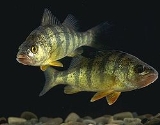
Teleostei

Encyclopedia
Teleostei is one of three infraclasses in class Actinopterygii
, the ray-finned fishes. This diverse group, which arose in the Triassic
period, includes 20,000 extant species in about 40 orders; most living fishes are members of this group. The other two infraclasses, Holostei
and Chondrostei
, may be paraphyletic.
and premaxilla
and corresponding modifications in the jaw musculature. These modifications make it possible for teleosts to protrude their jaws outwards from the mouth. The caudal fin
is homocercal, meaning the upper and lower lobes are about equal in size. The spine
ends at the caudal peduncle, distinguishing this group from those in which the spine extends into the upper lobe of the caudal fin.
. Teleosts are here divided into twelve superorders, but this system is unlikely to be entirely correct and is in the process of being studied.
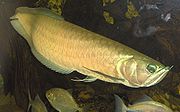
Actinopterygii
The Actinopterygii or ray-finned fishes constitute a class or sub-class of the bony fishes.The ray-finned fishes are so called because they possess lepidotrichia or "fin rays", their fins being webs of skin supported by bony or horny spines , as opposed to the fleshy, lobed fins that characterize...
, the ray-finned fishes. This diverse group, which arose in the Triassic
Triassic
The Triassic is a geologic period and system that extends from about 250 to 200 Mya . As the first period of the Mesozoic Era, the Triassic follows the Permian and is followed by the Jurassic. Both the start and end of the Triassic are marked by major extinction events...
period, includes 20,000 extant species in about 40 orders; most living fishes are members of this group. The other two infraclasses, Holostei
Holostei
Holostei are bony fish that show primitive characteristics. There are eight species divided among two orders, the Amiiformes represented by a single living species, the bowfin , and the Lepisosteiformes, the gars. There are more species to be found in the fossil record.Holostei share with other...
and Chondrostei
Chondrostei
Chondrostei are primarily cartilaginous fish showing some ossification. There are 52 species divided among two orders, the Acipenseriformes and the Polypteriformes ....
, may be paraphyletic.
Characteristics
Teleosts have a movable maxillaMaxilla
The maxilla is a fusion of two bones along the palatal fissure that form the upper jaw. This is similar to the mandible , which is also a fusion of two halves at the mental symphysis. Sometimes The maxilla (plural: maxillae) is a fusion of two bones along the palatal fissure that form the upper...
and premaxilla
Premaxilla
The incisive bone is the portion of the maxilla adjacent to the incisors. It is a pair of small cranial bones at the very tip of the jaws of many animals, usually bearing teeth, but not always. They are connected to the maxilla and the nasals....
and corresponding modifications in the jaw musculature. These modifications make it possible for teleosts to protrude their jaws outwards from the mouth. The caudal fin
Fish anatomy
Fish anatomy is primarily governed by the physical characteristics of water, which is much denser than air, holds a relatively small amount of dissolved oxygen, and absorbs more light than air does.- Body :...
is homocercal, meaning the upper and lower lobes are about equal in size. The spine
Vertebral column
In human anatomy, the vertebral column is a column usually consisting of 24 articulating vertebrae, and 9 fused vertebrae in the sacrum and the coccyx. It is situated in the dorsal aspect of the torso, separated by intervertebral discs...
ends at the caudal peduncle, distinguishing this group from those in which the spine extends into the upper lobe of the caudal fin.
Systematics and evolution
The oldest teleost fossils date back to early TriassicTriassic
The Triassic is a geologic period and system that extends from about 250 to 200 Mya . As the first period of the Mesozoic Era, the Triassic follows the Permian and is followed by the Jurassic. Both the start and end of the Triassic are marked by major extinction events...
. Teleosts are here divided into twelve superorders, but this system is unlikely to be entirely correct and is in the process of being studied.
- Superorder OsteoglossomorphaOsteoglossomorphaOsteoglossomorpha is a group of bony fish in the Teleostei.-Notable members:A notable member is the Arapaima , the largest freshwater fish in South America and one of the very largest bony fishes alive. Other notable members include the bizarre freshwater elephantfishes .-Systematics:Most...
- Order OsteoglossiformesOsteoglossiformesOsteoglossiformes is a relatively primitive order of ray-finned fish that contains two sub-orders, the Osteoglossoidei and the Notopteroidei. All of the living species inhabit freshwater...
, the bony-tongued fishes - Order HiodontiformesHiodontiformesHiodontiformes is a relatively new order of fish, consisting of the two living species of the mooneye family Hiodontidae and three genera of extinct types....
, including the mooneyeMooneyeThe mooneyes are a family, the Hiodontidae, of primitive ray-finned fish comprising two living and three extinct species in the genus Hiodon. They are large-eyed, fork-tailed fish that physically resemble shads. Their common name comes from the metallic gold or silver shine of their eyes.The higher...
and goldeyeGoldeyeThe goldeye, Hiodon alosoides, is a species of fish in the mooneye family . It occurs from as far down the Mackenzie River as Aklavik in the north to Mississippi in the south, and from Alberta in the west to Ohio south of the Great Lakes, with an isolated population south of James Bay. It is...
- Order Osteoglossiformes
- Superorder ElopomorphaElopomorphaThe superorder Elopomorpha contains a variety of types of fishes that range from typical silvery colored fish-like species such as the tarpons and ladyfishes of the Elopiformes and the bonefishes of the Albuliformes, to the long and slender, smooth bodied eels of the Anguilliformes...
- Order ElopiformesElopiformesElopiformes is the order of ray-finned fish that includes the tarpons, tenpounders, and ladyfish, as well as a number of extinct types. They have a long fossil record, easily distinguished from other fishes by the presence of an additional set of bones in the throat.They are related to the order...
, including the ladyfishes and tarponTarponTarpons are large fish of the genus Megalops. There are two species of Megalops, one native to the Atlantic, and the other to the Indo-Pacific oceans.They are the only members of the family Megalopidae.- Species and habitats :... - Order Albuliformes, the bonefishBonefishThe bonefish is the type species of the Albulidae family, or bonefishes in order Albuliformes. It is amphidromous, living in inshore tropical waters, moving onto shallow mudflats to feed with the incoming tide, and retreating to deeper water as the tide ebbs...
es - Order NotacanthiformesNotacanthiformesNotacanthiformes is an order of deep-sea ray-finned fishes, consisting of the families Halosauridae and Notacanthidae The order is of relatively recent vintage; Fishes of the World lists it as a suborder Notacanthoidei of Albuliformes...
, including the halosaurs and spiny eelSpiny eelThe name spiny eel is used to describe members of two different families of fish: the freshwater Mastacembelidae of Asia and Africa, and the marine Notacanthidae. Both are so-named because of their eel-like shape and sturdy fin spines....
s - Order Anguilliformes, the true eelEelEels are an order of fish, which consists of four suborders, 20 families, 111 genera and approximately 800 species. Most eels are predators...
s and gulpers - Order SaccopharyngiformesSaccopharyngiformesSaccopharyngiformes is an order of unusual ray-finned fish superficially similar to eels, but with many internal differences. Most of the fish in this order are deep-sea types known from only a handful of specimens such as the Umbrella Mouth Gulper Eel. Saccopharyngiformes are also bioluminescent...
, including the gulper eel
- Order Elopiformes
- Superorder Clupeomorpha
- Order ClupeiformesClupeiformesClupeiformes is the order of ray-finned fish that includes the herring family, Clupeidae, and the anchovy family, Engraulidae. The group includes many of the most important food fish....
, including herringHerringHerring is an oily fish of the genus Clupea, found in the shallow, temperate waters of the North Pacific and the North Atlantic oceans, including the Baltic Sea. Three species of Clupea are recognized. The main taxa, the Atlantic herring and the Pacific herring may each be divided into subspecies...
s and anchoviesAnchovyAnchovies are a family of small, common salt-water forage fish. There are 144 species in 17 genera, found in the Atlantic, Indian, and Pacific Oceans. Anchovies are usually classified as an oily fish.-Description:...
- Order Clupeiformes
- Superorder OstariophysiOstariophysiOstariophysi is the second-largest superorder of fish. Members of this superorder are called ostariophysians. This diverse group contains almost 8,000 species, about 28% of known fish species in the world and 68% of freshwater species, and are present on all major continents except Antarctica...
- Order GonorynchiformesGonorynchiformesGonorynchiformes is an order of ray-finned fish that includes the important food source, the milkfish , and a number of lesser-known types, both marine and freshwater....
, including the milkfishMilkfishThe milkfish is the sole living species in the family Chanidae. - Description and biology :...
es - Order CypriniformesCypriniformesThe Cypriniformes are an order of ray-finned fish, including the carps, minnows, loaches and relatives. This order contains 5-6 families, over 320 genera, and more than 3,250 species, with new species being described every few months or so, and new genera being recognized regularly...
, including barbs, carpCarpCarp are various species of oily freshwater fish of the family Cyprinidae, a very large group of fish native to Europe and Asia. The cypriniformes are traditionally grouped with the Characiformes, Siluriformes and Gymnotiformes to create the superorder Ostariophysi, since these groups have certain...
, danios, goldfishGoldfishThe goldfish is a freshwater fish in the family Cyprinidae of order Cypriniformes. It was one of the earliest fish to be domesticated, and is one of the most commonly kept aquarium fish....
es, loachesLoach (fish)Cobitidae is the family of the true loaches, which are Old World freshwater fish. They occur throughout Eurasia and in Morocco, and inhabit riverine ecosystems. Today, most "loaches" are placed in other families...
, minnowMinnowMinnow is a general term used to refer to small freshwater and saltwater fish, especially those used as bait fish or for fishing bait. More specifically, it refers to small freshwater fish of the carp family.-True minnows:...
s, rasboraRasboraA rasbora is a member of a group of small minnow-type fish in the family Cyprinidae . Fish from genera such as Boraras, Microrasbora, Rasbora and Trigonostigma are commonly referred to as rasboras...
s - Order CharaciformesCharaciformesThe Characiformes are an order of ray-finned fish, comprising the characins and their allies. Grouped in 18 recognized families, there are a few thousand different species, including the well-known piranha and tetras.-Taxonomy:...
, including characins, pencilfishes, hatchetfishHatchetfishThe name hatchetfish may refer to two unrelated groups of fishes:*Marine hatchetfishes, small deep-sea bioluminescent fishes of the family Sternoptychidae, subfamily Sternoptychinae....
es, piranhaPiranhaA piranha or piraña is a member of family Characidae in order Characiformes, an omnivorous freshwater fish that inhabits South American rivers. In Venezuela, they are called caribes...
s, tetraTetrathumb|right|250px|Pristella tetra — [[Pristella maxillaris]].thumb|right|250px|Golden Pristella tetra, a [[morph |morph]] of [[Pristella maxillaris]].thumb|right|250px|[[Silvertip tetra]] — Hasemania nana....
s. - Order GymnotiformesGymnotiformesThe Gymnotiformes are a group of teleost bony fishes commonly known as the Neotropical or South American knifefishes. They have long bodies and swim using undulations of their elongated anal fin...
, including electric eelElectric eelThe electric eel , is an electric fish, and the only species of the genus Electrophorus. It is capable of generating powerful electric shocks, of up to six hundred volts, which it uses for both hunting and self-defense. It is an apex predator in its South American range...
s and knifefishKnifefishKnifefish may refer to several knife-shaped fishes:* The Neotropical or weakly electric knifefishes, order Gymnotiformes, containing five families:** Family Gymnotidae ** Family Rhamphichthyidae...
es - Order Siluriformes, the catfishCatfishCatfishes are a diverse group of ray-finned fish. Named for their prominent barbels, which resemble a cat's whiskers, catfish range in size and behavior from the heaviest and longest, the Mekong giant catfish from Southeast Asia and the second longest, the wels catfish of Eurasia, to detritivores...
es
- Order Gonorynchiformes
- Superorder ProtacanthopterygiiProtacanthopterygiiProtacanthopterygii is a ray-finned fish taxon ranked as a superorder of the infraclass Teleostei. They inhabit both marine and freshwater habitat...
- Order ArgentiniformesArgentiniformesArgentiniformes is an order of ray-finned fish whose distinctness was recognized only fairly recently. In former times, they were included in the Osmeriformes as suborder Argentinoidei. That term refers only to the suborder of marine smelts and barreleyes in the classification used here, with the...
, including the barreleyeBarreleyeBarreleyes, also known as spook fish , are small deep-sea osmeriform fish comprising the family Opisthoproctidae...
s and slickheads (formerly in Osmeriformes) - Order Salmoniformes, including salmonSalmonSalmon is the common name for several species of fish in the family Salmonidae. Several other fish in the same family are called trout; the difference is often said to be that salmon migrate and trout are resident, but this distinction does not strictly hold true...
and troutTroutTrout is the name for a number of species of freshwater and saltwater fish belonging to the Salmoninae subfamily of the family Salmonidae. Salmon belong to the same family as trout. Most salmon species spend almost all their lives in salt water... - Order EsociformesEsociformesEsociformes is a small order of ray-finned fish, with two families, the Umbridae and the Esocidae . The pikes of genus Esox give the order its name. There are ten species — five in each family....
the pikeEsoxEsox is a genus of freshwater fish, the only living genus in the family Esocidae — the esocids which were endemic to North America, Europe and Eurasia during the Paleogene through present.The type species is E. lucius, the northern pike... - Order OsmeriformesOsmeriformesOsmeriformes is an order of ray-finned fish that includes the true or freshwater smelts and allies, such as the galaxiids and noodlefishes; they are also collectively called osmeriforms. They belong to the teleost superorder Protacanthopterygii, which also includes pike and salmon, among others...
, including the smelts and galaxiidGalaxiidThe Galaxiidae, also known by the anglicised name as galaxiids, are a family of mostly small freshwater fish in the southern hemisphere. The majority of species live in Australia or New Zealand, some are also found in South Africa, South America, Lord Howe Island, New Caledonia and the Falkland...
s
- Order Argentiniformes
- Superorder StenopterygiiStenopterygiiStenopterygii are a superorder of ray-finned fish in the infraclass Teleostei. Their validity is somewhat doubtful, as the group was established to separate, out of a large group of closely related Teleostei, a mere two rather peculiarly autapomorphic orders at best...
(may belong in Protacanthopterygii)- Order Ateleopodiformes, the jellynose fishJellynose fishThe jellynose fishes or tadpole fishes are the small order Ateleopodiformes. This group of ray-finned fish is monotypic, containing a single family Ateleopodidae...
- Order StomiiformesStomiiformesStomiiformes is an order of deep-sea ray-finned fishes of very diverse morphology. It includes for example dragonfishes, lightfishes, loosejaws, marine hatchetfishes and viperfishes. The order contains 4 families with more than 50 genera and almost 400 species...
, including the bristlemouths and marine hatchetfishMarine hatchetfishMarine hatchetfishes or deep-sea hatchetfishes are small deep-sea mesopelagic ray-finned fish of the stomiiform subfamily Sternoptychinae...
es
- Order Ateleopodiformes, the jellynose fish
- Superorder Cyclosquamata (may belong in Protacanthopterygii)
- Order AulopiformesAulopiformesAulopiformes is an order of marine ray-finned fish consisting of some 15 extant and several prehistoric families with about 45 genera and over 230 species. The common names grinners, lizardfishes and allies or aulopiforms are sometimes used for this group...
, including the Bombay duckBombay duckThe Bombay duck or bummalo is, despite its name, not a duck but a lizardfish. It is native to the waters between Mumbai and Kutch in the Arabian Sea, and a small number are also found in the Bay of Bengal. Great numbers are also caught in the South China Sea...
and lancetfishLancetfishLancetfishes are large oceanic predatory fishes in the genus Alepisaurus , the only living genus in the family Alepisauridae....
es
- Order Aulopiformes
- Superorder Scopelomorpha
- Order MyctophiformesMyctophiformesMyctophiformes is an order of ray-finned fish consisting of two families of deep-sea marine fish, most notably the highly abundant lanternfishes...
, including the lanternfishLanternfishCooper Lanternfishes are small mesopelagic fish of the large family Myctophidae. One of two families in the order Myctophiformes, the Myctophidae are represented by 246 species in 33 genera, and are found in oceans worldwide. They are aptly named after their conspicuous use of bioluminescence...
es
- Order Myctophiformes
- Superorder Lampridiomorpha
- Order LampriformesLampriformesLampriformes is an order of ray-finned fish. They are collectively called "lamprids" or lampriforms, and unite such open-ocean and partially deep-sea Teleostei as the crestfishes, oarfish, opahs and ribbonfishes...
, including the oarfishOarfishOarfish are large, greatly elongated, pelagic Lampriform fishes comprising the small family Regalecidae. Found in all temperate to tropical oceans yet rarely seen, the oarfish family contains four species in two genera...
, opahOpahOpah are large, colorful, deep-bodied pelagic Lampriform fish comprising the small family Lampridae . There are only two living species in a single genus: Lampris...
and ribbonfishes
- Order Lampriformes
- Superorder Polymyxiomorpha
- Order Polymixiiformes, the beardfishBeardfishThe beardfishes are a small family of deep-sea marine ray-finned fish named for their pair of long hyoid barbels. They have little economic importance....
es
- Order Polymixiiformes, the beardfish
- Superorder ParacanthopterygiiParacanthopterygiiParacanthopterygii is a superorder of fishes. Members of this superorder are called paracanthopterygians.It includes five orders:* Percopsiformes * Batrachoidiformes * Lophiiformes...
- Order PercopsiformesPercopsiformesPercopsiformes is a small order of ray-finned fish, comprising the trout-perch and its allies. It contains just nine species, grouped into three families....
, including the cavefishes and trout-perches - Order Batrachoidiformes, the toadfishes
- Order Lophiiformes, including the anglerfishAnglerfishAnglerfishes are members of the teleost order Lophiiformes . They are bony fishes named for their characteristic mode of predation, wherein a fleshy growth from the fish's head acts as a lure; this is considered analogous to angling.Some anglerfishes are pelagic , while others are benthic...
es - Order GadiformesGadiformesGadiformes is an order of ray-finned fish, also called the Anacanthini, that includes the cod and its allies. Many major food fish are in this order. They are found in marine waters throughout the world, and there are also a small number of freshwater species.Common characteristics include the...
, including codCodCod is the common name for genus Gadus, belonging to the family Gadidae, and is also used in the common name for various other fishes. Cod is a popular food with a mild flavor, low fat content and a dense, flaky white flesh. Cod livers are processed to make cod liver oil, an important source of...
s - Order OphidiiformesOphidiiformesOphidiiformes is an order of ray-finned fish that includes the cusk eels , pearlfishes , brotulas , and others....
, including the pearlfishPearlfishPearlfish is a general name for a variety of marine fish species in the Carapidae family. Pearlfish have been found in tropical waters of the Atlantic, Indian, and Pacific Oceans at depths up to along oceanic shelves and slopes....
es
- Order Percopsiformes
- Superorder AcanthopterygiiAcanthopterygiiAcanthopterygii is a superorder of bony fishes in the class Actinopterygii. Members of this superorder are also known as the ray-finned fishes for the characteristic sharp, bony rays in their fins; however this name is also often given to the class Actinopterygii as a whole.Orders:* Order...
- Order Mugiliformes, the mulletsMullet (fish)The mullets or grey mullets are a family and order of ray-finned fish found worldwide in coastal temperate and tropical waters, and in some species in fresh water. Mullets have served as an important source of food in Mediterranean Europe since Roman times...
- Order AtheriniformesAtheriniformesAtheriniformes, also known as the silversides, is an order of ray-finned fish that includes the Old World silversides and several less-familiar families, including the unusual Phallostethidae...
, including silversidesSilverside (fish)The Old World silversides are a family, Atherinidae, of fish in the order Atheriniformes. They occur worldwide in tropical and temperate waters...
and rainbowfishRainbowfishThe rainbowfish are a family of small, colourful, freshwater fish that are found in northern and eastern Australia and New Guinea and in the Southeast Asian islands....
es - Order BeloniformesBeloniformesThe Beloniformes are an order of five families of freshwater and marine ray-finned fish: the Adrianichthyidae ; Belonidae ; Exocoetidae ; Hemiramphidae ; and the Scomberesocidae...
, including the flyingfishFlyingfishExocoetidae, is a family of marine fish in the order Beloniformes of class Actinopterygii. Fish of this family are known as flying fish. There are about 64 species grouped in seven to nine genera.- Etymology :...
es - Order CetomimiformesCetomimiformesThe Cetomimiformes or whalefishes are an order of small, deep-sea ray-finned fish. Some authorities include the whalefishes as part of the order Stephanoberyciformes, within the superfamily Cetomimoidea. Their sister order, the Beryciformes, includes the flashlight fish and squirrelfish.Within this...
, the whalefishes - Order CyprinodontiformesCyprinodontiformesThe Cyprinodontiformes is an order of ray-finned fish, comprising mostly small, fresh-water fish. Many popular aquarium fish, such as killifish and live-bearers, are included. They are closely related to the Atheriniformes and are occasionally included with them...
, including livebearersLive-bearing aquarium fishLive-bearing aquarium fish, often simply called livebearers, are fish that retain the eggs inside the body and give birth to live, free-swimming young.-Common aquarium livebearers:...
, killifishKillifishA killifish is any of various oviparous cyprinodontiform fish . Altogether, there are some 1270 different species of killifish, the biggest family being Rivulidae, containing more than 320 species...
es - Order StephanoberyciformesStephanoberyciformesThe Stephanoberyciformes are an order of marine ray-finned fishes, consisting of about 45 species, the majority of which belong to the ridgehead family . The Stephanoberyciformes are mostly uncommon deep-sea species with little, if any, importance to commercial fishery...
, including the ridgeheadRidgeheadRidgeheads, also known as bigscales, are a family of small, deep-sea stephanoberyciform fish. The family contains approximately 37 species in five genera; their distribution is worldwide, but ridgeheads are absent from the Arctic Ocean and Mediterranean Sea...
s - Order BeryciformesBeryciformesBeryciformes is an order of ray-finned fishes. This is a very poorly understood group of 16 families, 57 genera, and about 219 species. Some people believe that it is probably an artificial assemblage of unrelated taxa that are thrown together for convenience only; there are no convincing...
, including the fangtoothFangtoothFangtooths are beryciform fish of the family Anoplogastridae that live in the deep sea. The name is from Greek anoplo meaning "unarmed" and gaster meaning "stomach"...
s and pineconefishes - Order ZeiformesZeiformesThe Zeiformes are a small order of marine ray-finned fishes most notable for the dories, a group of common food fish. The order consists of about 40 species in seven families, mostly deep-sea types....
, including the doriesDory (fish)The common name dory is shared by members of several different families of large-eyed, silvery, deep-bodied, laterally compressed, and roughly discoid marine fish. As well as resembling each other, dories are also similar in habit: most are deep-sea and demersal... - Order Gobiesociformes, the clingfishes
- Order GasterosteiformesGasterosteiformesGasterosteiformes is an order of ray-finned fishes that includes the sticklebacks and relatives.In the Gasterosteiformes, the pelvic girdle is never attached to the cleithra directly, and the supramaxillary, orbitosphenoid, and basisphenoid bones are absent. The body is often partly or completely...
including sticklebackSticklebackThe Gasterosteidae are a family of fish including the sticklebacks. FishBase currently recognises sixteen species in the family, grouped in five genera. However several of the species have a number of recognised subspecies, and the taxonomy of the family is thought to be in need of revision...
s, pipefishPipefishPipefishes or pipe-fishes are a subfamily of small fishes, which, together with the seahorses, form the family Syngnathidae.-Anatomy:...
es, seahorses - Order SyngnathiformesSyngnathiformesSyngnathiformes is an order of ray-finned fishes that includes the pipefishes and seahorses.These fishes have elongate, narrow, bodies surrounded by a series of bony rings, and small, tubular mouths. Several groups live among seaweed and swim with the body aligned vertically, to blend in with the...
, including the seahorses and pipefishPipefishPipefishes or pipe-fishes are a subfamily of small fishes, which, together with the seahorses, form the family Syngnathidae.-Anatomy:...
es - Order SynbranchiformesSynbranchiformesSynbranchiformes, often called swamp eels, is an order of ray-finned fishes that are eel-like but have spiny rays, indicating that they belong to the superorder Acanthopterygii.-Taxonomy:...
, including the swamp eelSwamp eelThe swamp eels are a family of freshwater eel-like fishes of the worldwide tropics.-Description:...
s - Order TetraodontiformesTetraodontiformesThe Tetraodontiformes are an order of highly derived ray-finned fish, also called the Plectognathi. Sometimes these are classified as a suborder of the Perciformes...
, including the filefishFilefishFilefish are tropical to subtropical tetraodontiform marine fish of the diverse family Monacanthidae. Found in the Atlantic, Pacific and Indian Oceans, the filefish family contains approximately 107 species in 26 genera...
es and pufferfishPufferfishTetraodontidae is a family of primarily marine and estuarine fish of the Tetraodontiformes order. The family includes many familiar species which are variously called pufferfish, balloonfish, blowfish, bubblefish, globefish, swellfish, toadfish, toadies, honey toads, sugar toads, and sea squab... - Order Pleuronectiformes, the flatfishFlatfishThe flatfish are an order of ray-finned fish, also called the Heterosomata, sometimes classified as a suborder of Perciformes. In many species, both eyes lie on one side of the head, one or the other migrating through and around the head during development...
es - Order ScorpaeniformesScorpaeniformesScorpaeniformes is an order of ray-finned fish, but it has also been called the Scleroparei.They are known as "mail-cheeked" fishes due to their distinguishing characteristic, the suborbital stay: a backwards extension of the third circumorbital bone across the cheek to the preoperculum, to which...
, including scorpionfishScorpionfishScorpaenidae, the scorpionfish, are a family of mostly marine fish that includes many of the world's most venomous species. As the name suggests, scorpionfish have a type of "sting" in the form of sharp spines coated with venomous mucus. The family is a large one, with hundreds of members. They are...
es and the sculpinSculpinA Sculpin is a fish that belongs to the order Scorpaeniformes, suborder Cottoidei and superfamily Cottoidea, that contains 11 families, 149 genera, and 756 species...
s - Order PerciformesPerciformesThe Perciformes, also called the Percomorphi or Acanthopteri, is one of the largest orders of vertebrates, containing about 40% of all bony fish. Perciformes means perch-like. They belong to the class of ray-finned fish and comprise over 7,000 species found in almost all aquatic environments...
40% of all fish including anabantids, bassBass (fish)Bass is a name shared by many different species of popular gamefish. The term encompasses both freshwater and marine species. All belong to the large order Perciformes, or perch-like fishes, and in fact the word bass comes from Middle English bars, meaning "perch."-Types of basses:*The temperate...
, cichlidCichlidCichlids are fishes from the family Cichlidae in the order Perciformes. Cichlids are members of a group known as the Labroidei along with the wrasses , damselfish , and surfperches . This family is both large and diverse. At least 1,300 species have been scientifically described, making it one of...
s, gobies, gouramiGouramiGouramis are a family, Osphronemidae, of freshwater perciform fishes. The fish are native to Asia, from Pakistan and India to the Malay Archipelago and north-easterly towards Korea. The name "gourami" is also used for fish of the families Helostomatidae and Anabantidae. "Gouramis" is an example of...
s, mackerelMackerelMackerel is a common name applied to a number of different species of fish, mostly, but not exclusively, from the family Scombridae. They may be found in all tropical and temperate seas. Most live offshore in the oceanic environment but a few, like the Spanish mackerel , enter bays and can be...
, perchPerchPerch is a common name for fish of the genus Perca, freshwater gamefish belonging to the family Percidae. The perch, of which there are three species in different geographical areas, lend their name to a large order of vertebrates: the Perciformes, from the Greek perke meaning spotted, and the...
es, scatsScatophagidaeThe scats are a small family, Scatophagidae, of fishes in the order Perciformes.They are small fish native to the Indian and western Pacific Ocean that have been popular in the aquarium trade in the last 30 years...
, whiting, wrasses
- Order Mugiliformes, the mullets