

Teamsters

Encyclopedia
The International Brotherhood of Teamsters (IBT) is a labor union
in the United States
and Canada
. Formed in 1903 by the merger of several local and regional locals of teamster
s, the union now represents a diverse membership of blue-collar
and professional
workers in both the public
and private sector
s. The union had approximately 1.4 million members in 2008. Formerly known as the International Brotherhood of Teamsters, Chauffeurs, Warehousemen and Helpers of America, the IBT is a member of the Change to Win Federation
and Canadian Labour Congress
.
 The American Federation of Labor
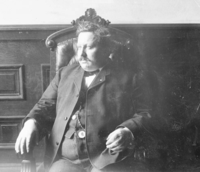
(AFL) had helped form local unions of teamsters since 1887. In November 1898, the AFL organized the Team Drivers' International Union (TDIU). In 1901, a group of Teamsters in Chicago, Illinois, broke from the TDIU and formed the Teamsters National Union. The new union permitted only employees, teamster helpers, and owner-operators owning only a single team to join, unlike the TDIU (which permitted large employers to be members), and was more aggressive than the TDIU in advocating higher wages and shorter hours. Claiming more than 28,000 members in 47 locals, its president, Albert Young, applied for membership in the AFL. The AFL asked the TDIU to merge with Young's union to form a new, AFL-affiliated union and the two groups did so in 1903, creating the International Brotherhood of Teamsters (IBT). Cornelius Shea
was elected the new union's first president. Shea's election was a tumultuous one. Shea effectively controlled the convention because the Chicago locals—representing nearly half the IBT's membership—were united in their support for his candidacy. Shea was opposed by John Sheridan, president of the Ice Drivers' Union of Chicago. Sheridan and George Innes, president of the TDIU, accused Shea of embezzlement in an attempt to prevent his election. Shea won election on August 8, 1903, by a vote of 605 to 480. Edward L. Turley of Chicago was elected secretary-treasurer and Albert Young general organizer.
The union, like most unions within the American Federation of Labor
(AFL) at the time, was largely decentralized, with a number of local unions that governed themselves autonomously and tended to look only after their own interests in the geographical jurisdiction in which they operated. The Teamsters were vitally important to the labor movement, for a strike
or sympathy strike
by the Teamsters could paralyze the movement of goods throughout the city and bring a strike into nearly every neighborhood. It also meant that Teamsters leaders were able to demand bribes in order to avoid strikes, and control of a Teamsters local could bring organized crime
significant revenues. During Shea's presidency, the entire Teamsters union was notoriously corrupt. Noted labor historian
John R. Commons
famously concluded that during this time, the Teamsters were less a union and more a criminal organization.
Several major strikes occupied the union in its first three years. In November 1903, Teamsters employed by the Chicago City Railway
went out on strike. Shea attempted to stop sympathy strikes by other Teamster locals, but three locals walked out and eventually disaffiliated over the sympathy strike issue. A sympathy strike in support of 18,000 striking meat cutters in Chicago in July 1904 led to riots before the extensive use of strikebreaker
s led Shea to force his members back to work (leading to the collapse of the meat cutters' strike). In the midst of the strife in 1904, Shea was re-elected by acclamation on August 8, 1904, at the Teamsters convention in Cincinnati, Ohio
. Under his leadership, the union had expanded to nearly 50,000 members in 821 locals in 300 cities, making the Teamsters one of the largest unions in the United States. In 1905, 10,000 Teamsters struck
in support of locked out
tailors at Montgomery Ward
, and eventually more than 25,000 Teamsters were on the picket line. But when local newspapers discovered that Shea was living in a local brothel, kept a 19-year-old waitress as a mistress, and had spent the strike hosting parties, public support for the strike collapsed and the strike ended on August 1, 1905. Despite the revelations, Shea won re-election on August 12, 1905, by a vote of 129 to 121.
Shea was re-elected again in 1905 and 1906, although significant challenges to his presidency occurred each time. Shea's first trial on charges stemming from the 1905 Montgomery Ward strike ended in a mistrial. However, during the 1906 re-election Shea had promised that he would resign the presidency once his trial had ended. But he did not, and most union members withdrew their support for him. Daniel J. Tobin
of Boston was elected Shea's successor by a vote of 104 to 94 in August 1907. Historic references to early freight transportation in the US refer to "teamsters" as those who drove teams of horses pulling huge wagons. This seems to be an early origin of the term "teamsters" in the US (see the symbol of the Brotherhood which includes two horse-heads in the info-box).
The Teamsters began to expand dramatically and mature organizationally under Tobin. He pushed for the development of "joint councils" to which all local unions were forced to affiliate. Varying in geographical and industrial jurisdiction, the joint councils became important incubators for up-and-coming leadership and negotiating master agreements which covered all employers in a given industry. Tobin also actively discouraged strikes in order to bring discipline to the union and encourage employers to sign contracts, and founded and edited the union magazine, the International Teamster. Under Tobin, the Teamsters also first developed the "regional conference" system (developed by Dave Beck
in Seattle), which provided stability, organizing strength, and leadership to the international union.
Tobin undertook long jurisdiction
al battles with many unions during this period. Fierce disputes occurred between the Teamsters and the Gasoline State Operators' National Council (an AFL federal union
of gas station attendants), the International Longshoremen's Association
, the Retail Clerks International Union
, and the Brotherhood of Railway Clerks
. The most significant disagreement, however, was with the United Brewery Workers
over the right to represent beer wagon drivers. While the Teamsters lost this battle in 1913, when the AFL awarded jurisdiction to the Brewers, they won when the issue came before the AFL Executive Board again in 1933, when the Brewers were still recovering from their near-elimination during Prohibition
. The raids and new member organizing in the 1930s led to significant membership increases. Teamster membership stood at just 82,000 in 1932. Tobin took advantage of the wave of pro-union sentiment engendered by the passage of the National Industrial Recovery Act
, and by 1935 union membership had increased nearly 65 percent to 135,000. By 1941, Tobin had a dues-paying membership of 530,000—making the Teamsters the fastest-growing labor union in the United States.
One of the most significant events in union history occurred in 1934. A group of radicals in Local 574 in Minneapolis—led by Farrell Dobbs
, Carl Skoglund
, and the Dunne brothers (Ray, Miles and Grant), all members of the Trotskyite
Communist League of America
—began successfully organizing coal truck drivers in the winter of 1933. Tobin, an ardent anti-communist, opposed their efforts and refused to support their 1933 strike. Local 574 struck again in 1934, leading to several riots over a nine-day period in May. When the employers' association reneged on the agreement, Local 574 resumed the strike, although it ended again after nine days when martial law
was declared by Governor
Floyd B. Olson
. Although Local 574 won a contract recognizing the union and which broke the back of the anti-union Citizens Alliance in Minneapolis, Tobin expelled Local 574 from the Teamsters. Member outrage was extensive, and in August 1936 he was forced to recharter the local as 544. Within a year the newly formed Local 544 had organized 250,000 truckers in the Midwest and formed the Central Conference of Teamsters.
Extensive organizing also occurred in the West
. Harry Bridges
, radical leader of the International Longshoremen's and Warehousemen's Union (ILWU), was leading "the march inland"—an attempt to organize warehouse workers away from shipping ports. Alarmed by Bridges' radical politics and worried that the ILWU would encroach on Teamster jurisdictions, Dave Beck formed a large regional organization (the Western Conference of Teamsters) to engage in fierce organizing battles and membership raids against the ILWU which led to the establishment of many new locals and the organization of tens of thousands of new members.
But corruption became even more widespread in the Teamsters during the Tobin administration. By 1941, the union was considered the most corrupt in the United States, and the most abusive towards its own members. Tobin vigorously defended the union against such accusations, but also instituted many constitutional and organizational changes and practices which made it easier for union officials to engage in criminal offenses.
, the Teamsters was one of the most powerful unions in the country, and Teamster leaders influential in the corridors of power. Union membership had risen more than 390 percent between 1935 and 1941 to 530,000. In June 1940, President Franklin Roosevelt appointed General President Dan Tobin to be the official White House liaison to organized labor, and later that year chair of the Labor Division of the Democratic National Committee. In 1942, President Roosevelt appointed Tobin special representative to the United Kingdom
and charged him with investigating the state of the labor movement there. Tobin was considered three times for Secretary of Labor, and twice refused the post—in 1943 and 1947. On September 23, 1944, Roosevelt gave his famous "Fala speech" while campaigning in the 1944 presidential election. Because of Roosevelt's strong relationship with Tobin and the union's large membership, the President delivered his speech before the Teamster convention.
Nonetheless, Teamsters members were restive. Dissident members of the union accused the leadership of suppressing democracy in the union, a charge President Tobin angrily denied. Over the next year, Tobin cracked down on dissidents and trusteed several large locals led by his political opponents.
During World War II
, The Teamsters strongly endorsed the American labor movement's no-strike pledge. The Teamsters agreed to cease raiding other unions and not strike for the duration of the national emergency. President Tobin even ordered Teamsters members to cross picket lines put up by other unions. Nevertheless, the national leadership sanctioned strikes by Midwestern truckers in August 1942, Southern truckers in October 1943, and brewery workers and milk delivery drivers in January 1945. The Teamsters did not, however, participate in the great post-war wave of labor strikes. In the two years following the cessation of hostilities, the Teamsters struck only three times: 10,000 truckers in New Jersey struck for two weeks; workers at UPS
struck nationwide for three weeks; and workers at Railway Express Agency
struck for almost a month.
Teamsters leaders strongly opposed enactment of the Taft-Hartley Act
and repeatedly called for its repeal. President Tobin, however, was one of the first labor leaders to sign the non-communist affidavit required by the law.
The great wave of organizing which the union engaged in during the Great Depression and the war significantly boosted the political power of a number of regional Teamsters leaders, and the leadership of the union engaged in a number of power struggles in the post-war period. By 1949, the union's membership had topped one million. Dave Beck (elected an international vice-president in 1940) was increasingly influential in the international union, and Tobin attempted to check his growing power but failed. In 1946, Beck successfully overcame Tobin's opposition and won approval of an amendment to the union's constitution creating the post of executive vice-president. Beck then won the 1947 election to fill the position. Beck also successfully opposed in 1947 a Tobin-backed dues increase to fund new organizing. The following year, Beck was able to demand the ouster of the editor of International Teamster magazine and install his own man in the job.
In 1948, Beck allied with his long-time rival Jimmy Hoffa
and effectively seized control of the union. He announced a raid on the International Association of Machinists local at Boeing
. Although President Dan Tobin publicly repudiated Beck's actions, Beck had more than enough support from Hoffa and other members of the executive board to force Tobin to back down. Five months later, Beck won approval of a plan to dissolve the union's four divisions and replace them with 16 divisions organized around each of the major job categories in the union's membership. In 1951, Tom Hickey, reformist leader of the Teamsters in New York City, won election to the Teamsters executive board. Tobin needed Beck's support to prevent Hickey's election, and Beck refused to give it.
On September 4, 1952, Tobin announced he would step down as president of the Teamsters at the end of his term. At the union's 1952 convention, Beck was elected General President and pushed through a number of changes intended to make it harder for a challenger to build the necessary majority to unseat a president or reject his policies.
, who supported his election, and federation vice presidents who felt Beck was corrupt and should not be elected to the post. Beck was the first Teamster president to negotiate a nationwide master contract and a national grievance arbitration plan, established organizing drives in the Deep South
and the East
, and built the current Teamsters headquarters (the "Marble Palace") in Washington, D.C.
on Louisiana Avenue NW (across a small plaza from the United States Senate
). But his intervention in a construction and a milk strike (both centered on New York City), and refusal to intervene in a Northeastern
trucking strike created major political problems for him. Perceiving Beck to be weak, Jimmy Hoffa began challenging Beck on various union decisions and policies in 1956 with an eye to unseating him as General President in the regularly scheduled union elections in 1957.
Infiltration by organized crime dominated the agenda of the Teamsters throughout the 1950s. The Teamsters had suffered from extensive corruption since its formation in 1903. Although the more extreme, public forms of corruption had been eliminated after General President Cornelius Shea was removed from office, the extent of corruption and control by organized crime increased during General President Tobin's time in office (1907 to 1952). In 1929, the Teamsters and unions in Chicago even approached gangster Roger Touhy
and asked for his protection from Al Capone
and his Chicago Outfit
, which were seeking to control the area's unions. Evidence of widespread corruption within the Teamsters began emerging shortly after Tobin retired. In Kansas City, corrupt Teamsters locals spent years seeking bribes, embezzling money, and engaging in extensive extortion and labor rackets as well as beatings, vandalism and even bombings in an attempt to control the construction and trucking industries. The problem was so serious that the U.S. House of Representatives held hearings on the issue.
Hoffa's attempt to challenge Beck caused a major national scandal which led to two Congressional investigations, several indictments for fraud and other crimes against Beck and Hoffa, strict new federal legislation and regulations regarding labor unions, and even helped launch the political career of Robert F. Kennedy
. Believing he needed additional votes to unseat Beck, in October 1956 mobster Johnny Dio met with Hoffa in New York City and the two men conspired to create as many as 15 paper local
s to boost Hoffa's delegate totals. When the paper locals applied for charters from the international union, Hoffa's political foes were outraged. A major battle broke out within the Teamsters over whether to charter the locals, and the media attention led to inquiries by the U.S. Department of Justice
and the Permanent Subcommittee on Investigations of the U.S. Senate Committee on Government Operations
. Beck and other Teamster leaders challenged the authority of the U.S. Senate to investigate the union, which caused the Senate to establish the Select Committee on Improper Activities in Labor and Management
– a new committee with broad subpeona and investigative powers. Senator John L. McClellan, chair of the select committee, hired Robert F. Kennedy
as the subcommittee's chief counsel and investigator.
The Select Committee (also known as the McClellan Committee, after its chairman), exposed widespread corruption in the Teamsters union. Dave Beck fled the country for a month to avoid its subpoenas before returning. Four of the paper locals were dissolved to avoid committee scrutiny, several Teamster staffers were charged with contempt of Congress, and union records were lost or destroyed (allegedly on purpose), and wiretaps were played in public before a national television audience in which Dio and Hoffa discussed the creation of even more paper locals. Evidence was unearthed of a mob-sponsored plot in which Oregon Teamsters unions would seize control of the state legislature, state police, and state attorney general's office through bribery, extortion and blackmail. Initially, members of the union did not believe the charges, and support for Beck was strong, but after three months of continuous allegations of wrong-doing many rank-and-file Teamsters withdrew their support and openly called for Beck to resign. Beck initially refused to address the allegations, but broke his silence and denounced the committee's inquiry on March 6. But even as the committee conducted its investigation, the Teamsters chartered even more paper locals. In mid-March 1957, Jimmy Hoffa was arrested for allegedly trying to bribe a Senate aide. Hoffa denied the charges, but the arrest triggered additional investigations and more arrests and indictments over the following weeks. A week later, Beck admitted to receiving an interest-free $300,000 loan from the Teamsters which he had never repaid, and Senate investigators claimed that loans to Beck and other union officials (and their businesses) had cost the union more than $700,000. Beck appeared before the select committee for the first time on March 25, 1957, and invoked his Fifth Amendment
right against self-incrimination 117 times. The McClellan Committee turned its focus to Hoffa and other Teamsters officials, and presented testimony and evidence alleging widespread corruption in Hoffa-controlled Teamster units.
Several historic legal developments came out of the select committee's investigation. The scandals uncovered by the McClellan committee, which affected not only the Teamsters but several other unions, led directly to the passage of the Labor-Management Reporting and Disclosure Act (also known as the Landrum-Griffin Act) in 1959. The right of union officials to exercise their Fifth Amendment rights was upheld and a significant refinement of constitutional law made when the U.S. Supreme Court
reaffirmed the right of union officials to not divulge the location of union records in Curcio v. United States, 354 U.S. 118
(1957).
Rank-and-file anger over the McClellan Committee's revelations eventually led Beck to retire from the Teamsters and allowed Jimmy Hoffa to take over. Immediately after his testimony in late March 1957, Beck won approval from the union's executive board to establish a $1 million fund to defend himself and the union from the committee's allegations. But member outrage at the expenditure was significant, and permission to establish the fund rescinded. Member anger continued to grow throughout the spring, and Beck's majority support on the executive board vanished. Beck was called before the McClellan Committee again in early May 1957, and additional interest-free loans and other potentially illegal and unethical financial transactions exposed. Based on these revelations, Beck was indicted for tax evasion on May 2, 1957.
Beck's legal troubles led him to retire and Hoffa to win election to the union presidency. Support for Beck among the membership evaporated. Beck announced on May 25 he would not run for re-election in October. The announcement created chaos among the union leadership, and despite additional indictments Hoffa announced he would seek the presidency on July 19. Rank-and-file support for Hoffa was strong, although there were some attempts to organize an opposition candidate. Hoffa's opponents asked a federal judge to postpone the election, but the request was granted only temporarily and Hoffa was duly elected General President of the union on October 4, 1957. Beck offered to retire early to allow Hoffa to take control of the union in December. A federal district court barred Hoffa from taking power unless he was acquitted in his wiretapping trial. The ruling was upheld by a court of appeals, but the trial ended in a hung jury on December 19, 1957, and Hoffa assumed the presidency on February 1, 1958.
The worsening corruption scandal led the AFL-CIO to eject the Teamsters. AFL-CIO President George Meany, worried that corruption scandals plaguing a number of unions at the time might lead to harsh regulation of unions or even the withdrawal of federal labor law protection, began an anti-corruption drive in April 1956. New rules were enacted by the labor federation's executive council that provided for the removal of vice presidents engaged in corruption as well as the ejection of unions considered corrupt. The McClellan Committee's investigation only worsened the dispute between the AFL-CIO and the Teamsters. In January 1957, the AFL-CIO proposed a new rule which would bar officers of the federation from continuing to hold office if they exercised their Fifth Amendment rights in a corruption investigation. Beck opposed the new rule, but the Ethical Practices Committee of AFL-CIO instituted rule on January 31, 1957. The Teamsters were given 90 days to reform, but Beck retaliated by promising more raids on AFL-CIO member unions if the union was ousted. Beck's opposition prompted a successful move by Meany to remove Beck from AFL-CIO executive council on grounds of corruption. After extensive hearings and appeals which lasted from July to September 1957, the AFL-CIO voted on September 25, 1957, to eject the Teamsters if the union did not institute reforms within 30 days. Beck refused to institute any reforms, and the election of Jimmy Hoffa (whom the AFL-CIO considered as corrupt as Beck) led the labor federation to suspend the Teamsters union on October 24, 1957. Meany offered to keep the Teamsters within the AFL-CIO if Hoffa resigned as president, but Hoffa refused and the formal expulsion occurred on December 6, 1957.
The Teamsters were not the only corrupt union in the AFL-CIO by any means. Another was the International Longshoremen's Association
(ILA), which represented stevedore
s in most East Coast
ports. The Teamsters had long desired to bring all shipping and transportation workers into the union, so that no product could be moved anywhere in the U.S. without it being touched by Teamsters hands. As the ILA came under increasing attack for permitting corruption in its locals, President Beck sought to bring the ILA into the Teamsters. The AFL ousted the ILA in September 1953, and formed the International Brotherhood of Longshoremen-AFL (IBL-AFL) to represent longshoremen on the Great Lakes and East Coast. The Teamsters planned to raid the expelled union, and may even have hoped to seize control of the IBL-AFL. Beck undertook a campaign to bring the ILA back into the AFL in early 1955, but the election of mob associate Anthony "Tough Tony" Anastasio
as an ILA vice president forced Beck to end the effort. But even as Beck backed away from any ILA deal, Jimmy Hoffa secretly negotiated a major package of financial and staff aid to the ILA and then went public with the deal – forcing Beck to accept it as a fait accompli or risk embarrassing Hoffa. The AFL-CIO threatened to expel the Teamsters if it aided the ILA. Beck fought Hoffa over the ILA aid package and won, withdrawing the offer to the ILA in the spring of 1956.
The ILA was not the only union the Teamsters sought to merge with. The union attempted to merge with the Mine, Mill & Smelter Workers
in 1955, but the effort failed. The union also sought a merger with the Brewery Workers, but the smaller union rejected the offer. When the overture failed, the Teamsters raided the Brewery Workers, leading to fierce protests by the CIO.
Raiding by the Teamsters was such a serious issue that it prompted the AFL and CIO, which had attempted to sign a no-raid agreement for years, to finally negotiate and implement such a pact in December 1953. President Beck initially refused to sign the agreement, and threatened to take the Teamsters out of the AFL if forced to adhere to it. Three months after the pact was signed, the Teamsters agreed to submit to the terms of the no-raid agreement. Shortly thereafter, the AFL adopted Article 20 of its constitution, which prevented its member unions from raiding one another. The union's affection for raiding led it to initially oppose the AFL-CIO merger in January 1955, but it quickly reversed itself.
In addition, Hoffa was instrumental in using the assets of the Teamsters' pension plans
, particularly the Central States plan, to support Mafia projects, such as the development of Las Vegas in the 1950s and 1960s. Pension funds were loaned to finance Las Vegas casinos such as the Stardust Resort & Casino
, the Fremont Hotel & Casino, the Desert Inn
, the Dunes (hotel and casino)
(which was controlled by Hoffa's attorney, Morris Shenker
), the Four Queens
, the Aladdin Hotel & Casino, Circus Circus
, and Caesars Palace
. The pension fund also made a number of loans to associates and relatives of high-ranking Teamster officials. A close associate of Hoffa during this period was Allen Dorfman
. Dorfman owned an insurance agency that provided insurance to the Teamsters' union, and which was the subject of an investigation by the McClellan Committee. Dorfman also had increasing influence over loans made by the Teamsters' pension fund, and after Hoffa went to prison in 1967, Dorfman had primary control over the fund. Dorfman was murdered in January 1983, shortly after his conviction, along with Teamsters' president Roy Lee Williams
, in a bribery case.
Hoffa was, moreover, defiantly unwilling to reform the union or limit his own power in response to the attacks from Robert F. Kennedy
, formerly chief counsel to the McClellan Committee, then Attorney General. Kennedy's Department of Justice
tried to convict Hoffa for a variety of offenses over the 1960s, finally succeeding on a witness tampering charge in 1964, with key testimony provided by Teamsters business agent Edward Grady Partin
of Baton Rouge
, Louisiana
. After exhausting his appeals, Hoffa entered prison in 1967.
Hoffa installed Frank Fitzsimmons
, an associate from his days in Local 299 in Detroit, to hold his place for him while he served time. Fitzsimmons, however, began to enjoy the exercise of power in Hoffa's absence; in addition, the organized crime figures around him found that he was more pliant than Hoffa had been. While President Nixon's pardon barred Hoffa from resuming any role in the Teamsters until 1980, Hoffa challenged the legality of that condition and planned to run again for presidency of the union, but disappeared in 1975 under mysterious circumstances. He is presumed dead, although his body has never been found.
, supporting universal health care, an immediate end to the Vietnam War
, urban renewal, and community organizing
. In 1968, Fitzsimmons and United Auto Workers
President Walter Reuther
formed the Alliance for Labor Action
, a new national trade union center
which competed with the AFL-CIO. The Alliance dissolved in 1972 after Reuther's death. While the Teamsters won rich national master contract
s in trucking and package delivery in the 1970s, it did little to adapt to the changes occurring in the transportation industry.
A major jurisdictional battle with the United Farm Workers
(UFW) broke out in 1970, and did not end until 1977. The Teamsters and UFW had both claimed jurisdiction over farm workers for many years, and in 1967 had signed an agreement settling their differences. But decentralization of power within the union led several Teamster leaders in California to repudiate this agreement without Fitzsimmons' permission and organize large numbers of field workers. His hand forced, Fitzsimmons ordered Teamsters contract negotiators to re-open the handful of contracts it had signed with California growers. The UFW sued, the AFL-CIO condemned the action, and many employers negotiated contracts with the Teamsters rather than with the UFW. The Teamsters subsequently signed contracts (which many denounced as sweetheart deal
s) with more than 375 California growers. Although an agreement giving UFW jurisidction over field workers and the Teamsters jurisdiction over packing and warehouse workers was reached on September 27, 1973, Fitzsimmons reneged on the agreement within a month and moved ahead with forming a farm workers regional union in California. The organizing battles even became violent at times. By 1975, the UFW had won 24 elections and the Teamsters 14; UFW membership had plummeted to just 6,000 from nearly 70,000 while the Teamsters farmworker division counted 55,000 workers. The UFW signed an agreement with Fitzsimmons in March 1977 in which the UFW agreed to seek to organize only those workers covered by the California Agricultural Labor Relations Act
, while the Teamsters retained jurisdiction over some agricultural workers, who had been covered by Teamsters Local Union contracts prior to the formation of the UFW.
In October 1973, Fitzsimmons ended the long-running jurisdictional dispute with the United Brewery Workers
, and the Brewery Workers merged with the Teamsters.
In 1979 Congress passed legislation that deregulated the freight industry, removing the Interstate Commerce Commission
's power to impose detailed regulatory tariffs on interstate carriers. The union tried to fight deregulation by attempting to bribe Senator Howard Cannon
of Nevada
. That attempt not only failed, but resulted in the conviction in 1982 of Roy Williams
, the General President who had succeeded Fitzsimmons in 1981. Williams subsequently resigned in 1983 as a condition of remaining free on bail while his appeal proceeded.
Deregulation had catastrophic effects on the Teamsters, opening up the industry to competition from non-union companies who sought to cut costs by avoiding unionization and curbing wages. Nearly 200 unionized carriers went out of business in the first few years of deregulation, leaving thirty percent of Teamsters in the freight division unemployed. The remaining unionized carriers demanded concessions in wages, work rules, and hours.
Williams' successor, Jackie Presser
, was prepared to grant most of these concessions in the form of a special freight “relief rider” that would cut wages by up to 35 percent and establish two-tier wages. Teamsters for a Democratic Union
, which had grown out of efforts to reject the 1976 freight agreement, launched a successful national campaign to defeat the relief rider, which was defeated by a vote of 94,086 to 13,082.
The pressure on the freight industry and the national freight agreement continued, however. By the end of the 1990s the National Master Freight Agreement, which had covered 500,000 drivers in the late 1970s, dropped to less than 200,000, with numerous local riders weakening it further in some areas.
, led to the development of two nationwide dissident groups within the union in the 1980s: Teamsters for a Democratic Union
(TDU), an assemblage of a number of local efforts, and the Professional Drivers Council, better known as PROD, which began as a public interest group affiliated with Ralph Nader
that was concerned with worker safety. The two groups merged in 1979.
TDU was able to win some local offices within the union, although the International Union often attempted to make those victories meaningless by marginalizing the officer or the union. TDU acquired greater prominence, however, with the election reforms forced on the union by the consent decree it had entered into in 1989 on the eve of trial on a suit brought by the federal government under the Racketeer Influenced and Corrupt Organizations Act
(RICO).
The decree required the direct election of International officers by the membership, as TDU had been demanding for years leading up to the decree, to replace the indirect election by delegates at the union's convention. While the delegates at the union's 1991 convention balked at amending the Constitution, they ultimately capitulated under pressure from the government.
That consent decree might not have been possible, however, if it had not been for the testimony of Roy Williams
, who described, in an affidavit he gave the government in return for a delay of his imprisonment, his own dealings with organized crime as the Secretary-Treasurer of a local union in Kansas City and as an officer of the International Union. The decree also gave the government the power to install an Independent Review Board with the power to expel any member of the union for "conduct unbecoming to the union", which the IRB proceeded to exercise far more aggressively than the Teamsters officials who had agreed to the decree had expected.
While the government was pursuing a civil case against the union as an entity it was also indicting Presser, who had succeeded Williams as General President, for embezzling from two different local unions in Cleveland prior to his election as President. Presser resigned in 1988, but died before his trial was scheduled to begin. He was succeeded by William J. McCarthy
, who came from the same local that Dan Tobin had led eighty years earlier.
The Independent Review Board (IRB) is a three-member panel established to investigate and take appropriate action with respect to "any allegations of corruption," "any allegations of domination or control or influence" of any part of the Union by organized crime, and any failure to cooperate fully with the IRB.
 Ron Carey
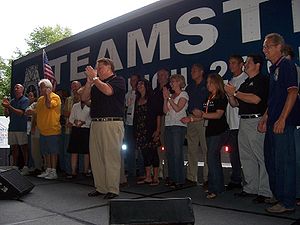
won a surprising victory in the first direct election for General President in the union's history, defeating two "old guard" candidates, R.V. Durham and Walter Shea. Carey's slate, supported by TDU, also won nearly all of the seats on the International Executive Board.
Carey acquired a fair amount of influence within the AFL-CIO, which had readmitted the Teamsters in 1985. Carey was close with the new leadership elected in 1995, particularly Richard Trumka
of the United Mine Workers of America, who became Secretary-Treasurer of the AFL-CIO under John Sweeney
. Carey had also swung the Teamsters support behind the Democratic Party, a change from past administrations that had supported the Republican Party. The new administration set out to break from the past in other ways, making energetic efforts to head off a vote to oust the union as representative of Northwest Airlines
' flight attendants, negotiating a breakthrough agreement covering carhaulers, and supporting local strikes, such as the one against Diamond Walnut, to restore the union's strength.
The Carey administration did not, on the other hand, have much power in the lower reaches of the Teamster hierarchy: all of the large regional conferences were run by "old guard" officers, as were most of the locals. Disagreements between those two camps led the old guard to campaign against the Carey administration's proposed dues increase; the Carey administration retaliated by dissolving the regional conferences, calling them expensive redundancies and fiefdoms for old guard union officers. and rearranging the boundaries of some joint councils that had fought against the dues increase.
The opposition responded by uniting around a single candidate, James P. Hoffa
, son of James R. Hoffa, to run against Carey in 1996. Hoffa ran a strong campaign, trading on the mystique still attached to his late father's name and promising to restore those days of glory. Carey appeared, however, to have won a close election.
Shortly afterward in 1997, the union initiated a large and successful strike against UPS
. The parcel services department by that time had become the largest division in the union.
Carey was removed from the union's leadership by the IRB shortly thereafter, when evidence that individuals in his office had arranged for transfer of several thousand dollars to an outside contractor, which then arranged for another entity to make an equivalent contribution to the Carey campaign. Carey was indicted for lying to investigators about his campaign funding but was acquitted of all charges in a 2001 trial.
In the 1998 election
to succeed Carey, James P. Hoffa was elected handily. He became president of the Teamsters on March 19, 1999, and took the union in a more moderate direction, tempering the union's support for Democrats and attempting to come to terms with powerful Republicans in Congress.
The union has merged in recent years with a number of unions from other industries, including the Graphic Communications International Union, a printing industry union, and the Brotherhood of Maintenance of Way Employes
and Brotherhood of Locomotive Engineers
, both from the railway industry.
On July 25, 2005, the Teamsters disaffiliated from the AFL-CIO
and became a founding member of the new national trade union center
, the Change to Win Federation
.
In 2009, UPS
, many employees of which are members of the Teamsters, lobbied
to have language added to the FAA Reauthorization Act of 2009 (H.R. 915) to change how UPS and FedEx
compete with one another. In response, FedEx launches a large, online advertising campaign aimed at UPS and the Teamsters, called 'Stop the Brown Bailout
'.
which is running a candidate against him for Teamster Presidency. Their candidate is Sandy Pope a former truck driver who currently serves as a local chapter president.
and George H.W. Bush for President in the 1980s, they have begun leaning largely toward the Democrats in recent years; they have donated 92% of their $24,418,589 in contributions since 1990 to the Democratic Party. Though the union opposed former President George W. Bush
's agenda to open US highways to Mexican truckers, it did previously support Bush's platform for oil drilling in the Arctic National Wildlife Refuge
. On July 23, 2008, however, Hoffa announced the union's withdrawal from the coalition favoring drilling there. Speaking before environmentalists and union leaders assembled to discuss good jobs and clean air, Hoffa said, "We are not going to drill our way out of the energy problems we are facing -- not here and not in the Arctic National Wildlife Refuge."
The Teamsters Union endorsed Barack Obama
for the 2008 Democratic Nomination on Feb. 20, 2008.
Trade union
A trade union, trades union or labor union is an organization of workers that have banded together to achieve common goals such as better working conditions. The trade union, through its leadership, bargains with the employer on behalf of union members and negotiates labour contracts with...
in the United States
United States
The United States of America is a federal constitutional republic comprising fifty states and a federal district...
and Canada
Canada
Canada is a North American country consisting of ten provinces and three territories. Located in the northern part of the continent, it extends from the Atlantic Ocean in the east to the Pacific Ocean in the west, and northward into the Arctic Ocean...
. Formed in 1903 by the merger of several local and regional locals of teamster
Teamster
A teamster, in modern American English, is a truck driver. The trade union named after them is the International Brotherhood of Teamsters , one of the largest unions in the United States....
s, the union now represents a diverse membership of blue-collar
Blue-collar worker
A blue-collar worker is a member of the working class who performs manual labor. Blue-collar work may involve skilled or unskilled, manufacturing, mining, construction, mechanical, maintenance, technical installation and many other types of physical work...
and professional
White-collar worker
The term white-collar worker refers to a person who performs professional, managerial, or administrative work, in contrast with a blue-collar worker, whose job requires manual labor...
workers in both the public
Public sector
The public sector, sometimes referred to as the state sector, is a part of the state that deals with either the production, delivery and allocation of goods and services by and for the government or its citizens, whether national, regional or local/municipal.Examples of public sector activity range...
and private sector
Private sector
In economics, the private sector is that part of the economy, sometimes referred to as the citizen sector, which is run by private individuals or groups, usually as a means of enterprise for profit, and is not controlled by the state...
s. The union had approximately 1.4 million members in 2008. Formerly known as the International Brotherhood of Teamsters, Chauffeurs, Warehousemen and Helpers of America, the IBT is a member of the Change to Win Federation
Change to Win Federation
The Change to Win Federation is a coalition of American labor unions originally formed in 2005 as an alternative to the AFL-CIO. The coalition is associated with strong advocacy of the organizing model...
and Canadian Labour Congress
Canadian Labour Congress
The Canadian Labour Congress, or CLC is a national trade union centre, the central labour body in English Canada to which most Canadian labour unions are affiliated.- Formation :...
.
Early history
American Federation of Labor
The American Federation of Labor was one of the first federations of labor unions in the United States. It was founded in 1886 by an alliance of craft unions disaffected from the Knights of Labor, a national labor association. Samuel Gompers was elected president of the Federation at its...
(AFL) had helped form local unions of teamsters since 1887. In November 1898, the AFL organized the Team Drivers' International Union (TDIU). In 1901, a group of Teamsters in Chicago, Illinois, broke from the TDIU and formed the Teamsters National Union. The new union permitted only employees, teamster helpers, and owner-operators owning only a single team to join, unlike the TDIU (which permitted large employers to be members), and was more aggressive than the TDIU in advocating higher wages and shorter hours. Claiming more than 28,000 members in 47 locals, its president, Albert Young, applied for membership in the AFL. The AFL asked the TDIU to merge with Young's union to form a new, AFL-affiliated union and the two groups did so in 1903, creating the International Brotherhood of Teamsters (IBT). Cornelius Shea
Cornelius Shea
Cornelius P. Shea was an American labor leader and organized crime figure. He was the founding president of the International Brotherhood of Teamsters, holding the position from 1903 until 1907. He became involved with the Chicago Outfit, and although he was indicted many times, he usually...
was elected the new union's first president. Shea's election was a tumultuous one. Shea effectively controlled the convention because the Chicago locals—representing nearly half the IBT's membership—were united in their support for his candidacy. Shea was opposed by John Sheridan, president of the Ice Drivers' Union of Chicago. Sheridan and George Innes, president of the TDIU, accused Shea of embezzlement in an attempt to prevent his election. Shea won election on August 8, 1903, by a vote of 605 to 480. Edward L. Turley of Chicago was elected secretary-treasurer and Albert Young general organizer.
The union, like most unions within the American Federation of Labor
American Federation of Labor
The American Federation of Labor was one of the first federations of labor unions in the United States. It was founded in 1886 by an alliance of craft unions disaffected from the Knights of Labor, a national labor association. Samuel Gompers was elected president of the Federation at its...
(AFL) at the time, was largely decentralized, with a number of local unions that governed themselves autonomously and tended to look only after their own interests in the geographical jurisdiction in which they operated. The Teamsters were vitally important to the labor movement, for a strike
Strike action
Strike action, also called labour strike, on strike, greve , or simply strike, is a work stoppage caused by the mass refusal of employees to work. A strike usually takes place in response to employee grievances. Strikes became important during the industrial revolution, when mass labour became...
or sympathy strike
Sympathy strike
Secondary action is industrial action by a trade union in support of a strike initiated by workers in another, separate enterprise...
by the Teamsters could paralyze the movement of goods throughout the city and bring a strike into nearly every neighborhood. It also meant that Teamsters leaders were able to demand bribes in order to avoid strikes, and control of a Teamsters local could bring organized crime
Organized crime
Organized crime or criminal organizations are transnational, national, or local groupings of highly centralized enterprises run by criminals for the purpose of engaging in illegal activity, most commonly for monetary profit. Some criminal organizations, such as terrorist organizations, are...
significant revenues. During Shea's presidency, the entire Teamsters union was notoriously corrupt. Noted labor historian
Labor history (discipline)
Labor history is a broad field of study concerned with the development of the labor movement and the working class. The central concerns of labor historians include the development of labor unions, strikes, lockouts and protest movements, industrial relations, and the progress of working class and...
John R. Commons
John R. Commons
John Rogers Commons was an American institutional economist and labor historian at the University of Wisconsin–Madison.-Biography:Born in Hollansburg, Ohio, John R. Commons had a religious upbringing which led him to be an advocate for social justice early in life...
famously concluded that during this time, the Teamsters were less a union and more a criminal organization.
Several major strikes occupied the union in its first three years. In November 1903, Teamsters employed by the Chicago City Railway
Chicago City Railway
The Chicago City Railway was a cable car system, designed by William Eppelsheimer and opened in Chicago in 1882.This system was to become, for a while, the largest and most profitable cable car system in the world. Counter to some people's expectations, the cable cars did not suffer much from the...
went out on strike. Shea attempted to stop sympathy strikes by other Teamster locals, but three locals walked out and eventually disaffiliated over the sympathy strike issue. A sympathy strike in support of 18,000 striking meat cutters in Chicago in July 1904 led to riots before the extensive use of strikebreaker
Strikebreaker
A strikebreaker is a person who works despite an ongoing strike. Strikebreakers are usually individuals who are not employed by the company prior to the trade union dispute, but rather hired prior to or during the strike to keep the organisation running...
s led Shea to force his members back to work (leading to the collapse of the meat cutters' strike). In the midst of the strife in 1904, Shea was re-elected by acclamation on August 8, 1904, at the Teamsters convention in Cincinnati, Ohio
Cincinnati, Ohio
Cincinnati is a city in the U.S. state of Ohio. Cincinnati is the county seat of Hamilton County. Settled in 1788, the city is located to north of the Ohio River at the Ohio-Kentucky border, near Indiana. The population within city limits is 296,943 according to the 2010 census, making it Ohio's...
. Under his leadership, the union had expanded to nearly 50,000 members in 821 locals in 300 cities, making the Teamsters one of the largest unions in the United States. In 1905, 10,000 Teamsters struck
1905 Chicago Teamsters' strike
The 1905 Chicago Teamsters' strike was a sympathy strike and lockout by the United Brotherhood of Teamsters in the summer of 1905 in the city of Chicago, Illinois. The strike was initiated by a small clothing workers' union. But it soon spread as nearly every union in the city, including the...
in support of locked out
Lockout (industry)
A lockout is a work stoppage in which an employer prevents employees from working. This is different from a strike, in which employees refuse to work.- Causes :...
tailors at Montgomery Ward
Montgomery Ward
Montgomery Ward is an online retailer that carries the same name as the former American department store chain, founded as the world's #1 mail order business in 1872 by Aaron Montgomery Ward, and which went out of business in 2001...
, and eventually more than 25,000 Teamsters were on the picket line. But when local newspapers discovered that Shea was living in a local brothel, kept a 19-year-old waitress as a mistress, and had spent the strike hosting parties, public support for the strike collapsed and the strike ended on August 1, 1905. Despite the revelations, Shea won re-election on August 12, 1905, by a vote of 129 to 121.
Shea was re-elected again in 1905 and 1906, although significant challenges to his presidency occurred each time. Shea's first trial on charges stemming from the 1905 Montgomery Ward strike ended in a mistrial. However, during the 1906 re-election Shea had promised that he would resign the presidency once his trial had ended. But he did not, and most union members withdrew their support for him. Daniel J. Tobin
Daniel J. Tobin
Daniel Joseph Tobin was an American labor leader and president of the International Brotherhood of Teamsters from 1907 to 1952. From 1917 to 1928, he was secretary-treasurer of the American Federation of Labor...
of Boston was elected Shea's successor by a vote of 104 to 94 in August 1907. Historic references to early freight transportation in the US refer to "teamsters" as those who drove teams of horses pulling huge wagons. This seems to be an early origin of the term "teamsters" in the US (see the symbol of the Brotherhood which includes two horse-heads in the info-box).
Organizing and growth during the Great Depression
Tobin was president of the Teamsters from 1907 to 1952. Although he faced opposition in his re-election races in 1908, 1909 and 1910, he never faced opposition again until his retirement in 1952.The Teamsters began to expand dramatically and mature organizationally under Tobin. He pushed for the development of "joint councils" to which all local unions were forced to affiliate. Varying in geographical and industrial jurisdiction, the joint councils became important incubators for up-and-coming leadership and negotiating master agreements which covered all employers in a given industry. Tobin also actively discouraged strikes in order to bring discipline to the union and encourage employers to sign contracts, and founded and edited the union magazine, the International Teamster. Under Tobin, the Teamsters also first developed the "regional conference" system (developed by Dave Beck
Dave Beck
Dave Beck was an American labor leader, and president of the International Brotherhood of Teamsters from 1952 to 1957...
in Seattle), which provided stability, organizing strength, and leadership to the international union.
Tobin undertook long jurisdiction
Jurisdiction
Jurisdiction is the practical authority granted to a formally constituted legal body or to a political leader to deal with and make pronouncements on legal matters and, by implication, to administer justice within a defined area of responsibility...
al battles with many unions during this period. Fierce disputes occurred between the Teamsters and the Gasoline State Operators' National Council (an AFL federal union
Directly Affiliated Local Union
A Directly Affiliated Local Union is a U.S. labor union that belongs to the AFL-CIO but is not a national union and is not entitled to the same rights and privileges within the Federation as national affiliates.Legally, the AFL-CIO is the parent union of the DALU, and the AFL-CIO is responsible...
of gas station attendants), the International Longshoremen's Association
International Longshoremen's Association
The International Longshoremen's Association is a labor union representing longshore workers along the East Coast of the United States and Canada, the Gulf Coast, the Great Lakes, Puerto Rico, and inland waterways...
, the Retail Clerks International Union
Retail Clerks International Union
The Retail Clerks International Union , was a labor union that represented retail employees. The RCIU was chartered as the "Retail Clerks National Protective Union" in 1890 by the American Federation of Labor. It later adopted the name Retail Clerks International Association, and subsequently...
, and the Brotherhood of Railway Clerks
Transportation Communications International Union
The Transportation Communications International Union or TCU is the successor to the union formerly known as the Brotherhood of Railway Clerks and includes within it many other organizations, including the Brotherhood of Railway Carmen of America and the Brotherhood of Sleeping Car Porters that...
. The most significant disagreement, however, was with the United Brewery Workers
International Union of United Brewery, Flour, Cereal, Soft Drink and Distillery Workers
The International Union of United Brewery, Flour, Cereal, Soft Drink and Distillery Workers was an labor union in the United States. The union merged with the Teamsters in 1973.-Early history:...
over the right to represent beer wagon drivers. While the Teamsters lost this battle in 1913, when the AFL awarded jurisdiction to the Brewers, they won when the issue came before the AFL Executive Board again in 1933, when the Brewers were still recovering from their near-elimination during Prohibition
Prohibition
Prohibition of alcohol, often referred to simply as prohibition, is the practice of prohibiting the manufacture, transportation, import, export, sale, and consumption of alcohol and alcoholic beverages. The term can also apply to the periods in the histories of the countries during which the...
. The raids and new member organizing in the 1930s led to significant membership increases. Teamster membership stood at just 82,000 in 1932. Tobin took advantage of the wave of pro-union sentiment engendered by the passage of the National Industrial Recovery Act
National Industrial Recovery Act
The National Industrial Recovery Act , officially known as the Act of June 16, 1933 The National Industrial Recovery Act (NIRA), officially known as the Act of June 16, 1933 The National Industrial Recovery Act (NIRA), officially known as the Act of June 16, 1933 (Ch. 90, 48 Stat. 195, formerly...
, and by 1935 union membership had increased nearly 65 percent to 135,000. By 1941, Tobin had a dues-paying membership of 530,000—making the Teamsters the fastest-growing labor union in the United States.
One of the most significant events in union history occurred in 1934. A group of radicals in Local 574 in Minneapolis—led by Farrell Dobbs
Farrell Dobbs
Farrell Dobbs was an American Trotskyist and trade unionist.He was born in Queen City, Missouri where his father was a worker in a coal mine. They moved to Minneapolis, and he graduated from North High School in 1925. In 1926, he left for North Dakota to find work, but returned the following fall...
, Carl Skoglund
Carl Skoglund
Carl Skoglund was a Swedish-American socialist, affectionately called Skogie by all his American friends and comrades. He was born in Dalsland and went to the United States in 1911. After spending some time in the I.W.W...
, and the Dunne brothers (Ray, Miles and Grant), all members of the Trotskyite
Trotskyism
Trotskyism is the theory of Marxism as advocated by Leon Trotsky. Trotsky considered himself an orthodox Marxist and Bolshevik-Leninist, arguing for the establishment of a vanguard party of the working-class...
Communist League of America
Communist League of America
The Communist League of America was founded by James P. Cannon, Max Shachtman and Martin Abern late in 1928 after their expulsion from the Communist Party USA for Trotskyism. The CLA was the United States section of Leon Trotsky's International Left Opposition and initially positioned itself as...
—began successfully organizing coal truck drivers in the winter of 1933. Tobin, an ardent anti-communist, opposed their efforts and refused to support their 1933 strike. Local 574 struck again in 1934, leading to several riots over a nine-day period in May. When the employers' association reneged on the agreement, Local 574 resumed the strike, although it ended again after nine days when martial law
Martial law
Martial law is the imposition of military rule by military authorities over designated regions on an emergency basis— only temporary—when the civilian government or civilian authorities fail to function effectively , when there are extensive riots and protests, or when the disobedience of the law...
was declared by Governor
Governor of Minnesota
The Governor of Minnesota is the chief executive of the U.S. state of Minnesota, leading the state's executive branch. Forty different people have been governors of the state, though historically there were also three governors of Minnesota Territory. Alexander Ramsey, the first territorial...
Floyd B. Olson
Floyd B. Olson
Floyd Bjørnstjerne Olson was an American politician. He served as the 22nd Governor of Minnesota from January 6, 1931 to August 22, 1936. He died in office from stomach cancer. He was a member of the Minnesota Farmer-Labor Party, and was the first member of the Farmer-Labor Party to win the...
. Although Local 574 won a contract recognizing the union and which broke the back of the anti-union Citizens Alliance in Minneapolis, Tobin expelled Local 574 from the Teamsters. Member outrage was extensive, and in August 1936 he was forced to recharter the local as 544. Within a year the newly formed Local 544 had organized 250,000 truckers in the Midwest and formed the Central Conference of Teamsters.
Extensive organizing also occurred in the West
West Coast of the United States
West Coast or Pacific Coast are terms for the westernmost coastal states of the United States. The term most often refers to the states of California, Oregon, and Washington. Although not part of the contiguous United States, Alaska and Hawaii do border the Pacific Ocean but can't be included in...
. Harry Bridges
Harry Bridges
Harry Bridges was an Australian-American union leader, in the International Longshore and Warehouse Union , a longshore and warehouse workers' union on the West Coast, Hawaii and Alaska which he helped form and led for over 40 years...
, radical leader of the International Longshoremen's and Warehousemen's Union (ILWU), was leading "the march inland"—an attempt to organize warehouse workers away from shipping ports. Alarmed by Bridges' radical politics and worried that the ILWU would encroach on Teamster jurisdictions, Dave Beck formed a large regional organization (the Western Conference of Teamsters) to engage in fierce organizing battles and membership raids against the ILWU which led to the establishment of many new locals and the organization of tens of thousands of new members.
But corruption became even more widespread in the Teamsters during the Tobin administration. By 1941, the union was considered the most corrupt in the United States, and the most abusive towards its own members. Tobin vigorously defended the union against such accusations, but also instituted many constitutional and organizational changes and practices which made it easier for union officials to engage in criminal offenses.
World War II and the post-war period
By the beginning of World War IIWorld War II
World War II, or the Second World War , was a global conflict lasting from 1939 to 1945, involving most of the world's nations—including all of the great powers—eventually forming two opposing military alliances: the Allies and the Axis...
, the Teamsters was one of the most powerful unions in the country, and Teamster leaders influential in the corridors of power. Union membership had risen more than 390 percent between 1935 and 1941 to 530,000. In June 1940, President Franklin Roosevelt appointed General President Dan Tobin to be the official White House liaison to organized labor, and later that year chair of the Labor Division of the Democratic National Committee. In 1942, President Roosevelt appointed Tobin special representative to the United Kingdom
United Kingdom
The United Kingdom of Great Britain and Northern IrelandIn the United Kingdom and Dependencies, other languages have been officially recognised as legitimate autochthonous languages under the European Charter for Regional or Minority Languages...
and charged him with investigating the state of the labor movement there. Tobin was considered three times for Secretary of Labor, and twice refused the post—in 1943 and 1947. On September 23, 1944, Roosevelt gave his famous "Fala speech" while campaigning in the 1944 presidential election. Because of Roosevelt's strong relationship with Tobin and the union's large membership, the President delivered his speech before the Teamster convention.
Nonetheless, Teamsters members were restive. Dissident members of the union accused the leadership of suppressing democracy in the union, a charge President Tobin angrily denied. Over the next year, Tobin cracked down on dissidents and trusteed several large locals led by his political opponents.
During World War II
World War II
World War II, or the Second World War , was a global conflict lasting from 1939 to 1945, involving most of the world's nations—including all of the great powers—eventually forming two opposing military alliances: the Allies and the Axis...
, The Teamsters strongly endorsed the American labor movement's no-strike pledge. The Teamsters agreed to cease raiding other unions and not strike for the duration of the national emergency. President Tobin even ordered Teamsters members to cross picket lines put up by other unions. Nevertheless, the national leadership sanctioned strikes by Midwestern truckers in August 1942, Southern truckers in October 1943, and brewery workers and milk delivery drivers in January 1945. The Teamsters did not, however, participate in the great post-war wave of labor strikes. In the two years following the cessation of hostilities, the Teamsters struck only three times: 10,000 truckers in New Jersey struck for two weeks; workers at UPS
United Parcel Service
United Parcel Service, Inc. , typically referred to by the acronym UPS, is a package delivery company. Headquartered in Sandy Springs, Georgia, United States, UPS delivers more than 15 million packages a day to 6.1 million customers in more than 220 countries and territories around the...
struck nationwide for three weeks; and workers at Railway Express Agency
Railway Express Agency
The Railway Express Agency was a the national monopoly set up by the Untied States federal government in 1917. Rail express services provided small package and parcel transportation using the extant railroad infrastructure much as UPS functions today using the road system...
struck for almost a month.
Teamsters leaders strongly opposed enactment of the Taft-Hartley Act
Taft-Hartley Act
The Labor–Management Relations Act is a United States federal law that monitors the activities and power of labor unions. The act, still effective, was sponsored by Senator Robert Taft and Representative Fred A. Hartley, Jr. and became law by overriding U.S. President Harry S...
and repeatedly called for its repeal. President Tobin, however, was one of the first labor leaders to sign the non-communist affidavit required by the law.
The great wave of organizing which the union engaged in during the Great Depression and the war significantly boosted the political power of a number of regional Teamsters leaders, and the leadership of the union engaged in a number of power struggles in the post-war period. By 1949, the union's membership had topped one million. Dave Beck (elected an international vice-president in 1940) was increasingly influential in the international union, and Tobin attempted to check his growing power but failed. In 1946, Beck successfully overcame Tobin's opposition and won approval of an amendment to the union's constitution creating the post of executive vice-president. Beck then won the 1947 election to fill the position. Beck also successfully opposed in 1947 a Tobin-backed dues increase to fund new organizing. The following year, Beck was able to demand the ouster of the editor of International Teamster magazine and install his own man in the job.
In 1948, Beck allied with his long-time rival Jimmy Hoffa
Jimmy Hoffa
James Riddle "Jimmy" Hoffa was an American labor union leader....
and effectively seized control of the union. He announced a raid on the International Association of Machinists local at Boeing
Boeing
The Boeing Company is an American multinational aerospace and defense corporation, founded in 1916 by William E. Boeing in Seattle, Washington. Boeing has expanded over the years, merging with McDonnell Douglas in 1997. Boeing Corporate headquarters has been in Chicago, Illinois since 2001...
. Although President Dan Tobin publicly repudiated Beck's actions, Beck had more than enough support from Hoffa and other members of the executive board to force Tobin to back down. Five months later, Beck won approval of a plan to dissolve the union's four divisions and replace them with 16 divisions organized around each of the major job categories in the union's membership. In 1951, Tom Hickey, reformist leader of the Teamsters in New York City, won election to the Teamsters executive board. Tobin needed Beck's support to prevent Hickey's election, and Beck refused to give it.
On September 4, 1952, Tobin announced he would step down as president of the Teamsters at the end of his term. At the union's 1952 convention, Beck was elected General President and pushed through a number of changes intended to make it harder for a challenger to build the necessary majority to unseat a president or reject his policies.
The influence of organized crime
Beck was elected to the Executive Council of the AFL on August 13, 1953, but his election generated a tremendous political battle between AFL President George MeanyGeorge Meany
William George Meany led labor union federations in the United States. As an officer of the American Federation of Labor, he represented the AFL on the National War Labor Board during World War II....
, who supported his election, and federation vice presidents who felt Beck was corrupt and should not be elected to the post. Beck was the first Teamster president to negotiate a nationwide master contract and a national grievance arbitration plan, established organizing drives in the Deep South
Deep South
The Deep South is a descriptive category of the cultural and geographic subregions in the American South. Historically, it is differentiated from the "Upper South" as being the states which were most dependent on plantation type agriculture during the pre-Civil War period...
and the East
East Coast of the United States
The East Coast of the United States, also known as the Eastern Seaboard, refers to the easternmost coastal states in the United States, which touch the Atlantic Ocean and stretch up to Canada. The term includes the U.S...
, and built the current Teamsters headquarters (the "Marble Palace") in Washington, D.C.
Washington, D.C.
Washington, D.C., formally the District of Columbia and commonly referred to as Washington, "the District", or simply D.C., is the capital of the United States. On July 16, 1790, the United States Congress approved the creation of a permanent national capital as permitted by the U.S. Constitution....
on Louisiana Avenue NW (across a small plaza from the United States Senate
United States Senate
The United States Senate is the upper house of the bicameral legislature of the United States, and together with the United States House of Representatives comprises the United States Congress. The composition and powers of the Senate are established in Article One of the U.S. Constitution. Each...
). But his intervention in a construction and a milk strike (both centered on New York City), and refusal to intervene in a Northeastern
Northeastern United States
The Northeastern United States is a region of the United States as defined by the United States Census Bureau.-Composition:The region comprises nine states: the New England states of Connecticut, Maine, Massachusetts, New Hampshire, Rhode Island and Vermont; and the Mid-Atlantic states of New...
trucking strike created major political problems for him. Perceiving Beck to be weak, Jimmy Hoffa began challenging Beck on various union decisions and policies in 1956 with an eye to unseating him as General President in the regularly scheduled union elections in 1957.
Infiltration by organized crime dominated the agenda of the Teamsters throughout the 1950s. The Teamsters had suffered from extensive corruption since its formation in 1903. Although the more extreme, public forms of corruption had been eliminated after General President Cornelius Shea was removed from office, the extent of corruption and control by organized crime increased during General President Tobin's time in office (1907 to 1952). In 1929, the Teamsters and unions in Chicago even approached gangster Roger Touhy
Roger Touhy
Roger Touhy was an Irish-American mob boss and prohibition-era bootlegger from Chicago, Illinois. He is best remembered for having been framed for the 1933 faked kidnapping of gangster John "Jake the Barber" Factor, a brother of cosmetics manufacturer Max Factor, Sr...
and asked for his protection from Al Capone
Al Capone
Alphonse Gabriel "Al" Capone was an American gangster who led a Prohibition-era crime syndicate. The Chicago Outfit, which subsequently became known as the "Capones", was dedicated to smuggling and bootlegging liquor, and other illegal activities such as prostitution, in Chicago from the early...
and his Chicago Outfit
Chicago Outfit
The Chicago Outfit, also known as the Chicago Syndicate or Chicago Mob and sometimes shortened to simply the Outfit, is a crime syndicate based in Chicago, Illinois, USA...
, which were seeking to control the area's unions. Evidence of widespread corruption within the Teamsters began emerging shortly after Tobin retired. In Kansas City, corrupt Teamsters locals spent years seeking bribes, embezzling money, and engaging in extensive extortion and labor rackets as well as beatings, vandalism and even bombings in an attempt to control the construction and trucking industries. The problem was so serious that the U.S. House of Representatives held hearings on the issue.
Hoffa's attempt to challenge Beck caused a major national scandal which led to two Congressional investigations, several indictments for fraud and other crimes against Beck and Hoffa, strict new federal legislation and regulations regarding labor unions, and even helped launch the political career of Robert F. Kennedy
Robert F. Kennedy
Robert Francis "Bobby" Kennedy , also referred to by his initials RFK, was an American politician, a Democratic senator from New York, and a noted civil rights activist. An icon of modern American liberalism and member of the Kennedy family, he was a younger brother of President John F...
. Believing he needed additional votes to unseat Beck, in October 1956 mobster Johnny Dio met with Hoffa in New York City and the two men conspired to create as many as 15 paper local
Paper local
A paper local is a local union with no or few members, chartered by an existing union or self-chartered, and formed for the purpose of criminal activity. As implied by the name, paper locals often "exist only on paper," and have no members...
s to boost Hoffa's delegate totals. When the paper locals applied for charters from the international union, Hoffa's political foes were outraged. A major battle broke out within the Teamsters over whether to charter the locals, and the media attention led to inquiries by the U.S. Department of Justice
United States Department of Justice
The United States Department of Justice , is the United States federal executive department responsible for the enforcement of the law and administration of justice, equivalent to the justice or interior ministries of other countries.The Department is led by the Attorney General, who is nominated...
and the Permanent Subcommittee on Investigations of the U.S. Senate Committee on Government Operations
United States Senate Committee on Homeland Security and Governmental Affairs
The United States Senate Committee on Homeland Security and Governmental Affairs has jurisdiction over matters related to the Department of Homeland Security and other homeland security concerns, as well as the functioning of the government itself, including the National Archives, budget and...
. Beck and other Teamster leaders challenged the authority of the U.S. Senate to investigate the union, which caused the Senate to establish the Select Committee on Improper Activities in Labor and Management
United States Senate Select Committee on Improper Activities in Labor and Management
The United States Senate Select Committee on Improper Activities in Labor and Management was a select committee created by the United States Senate on January 30, 1957, and dissolved on March 31, 1960...
– a new committee with broad subpeona and investigative powers. Senator John L. McClellan, chair of the select committee, hired Robert F. Kennedy
Robert F. Kennedy
Robert Francis "Bobby" Kennedy , also referred to by his initials RFK, was an American politician, a Democratic senator from New York, and a noted civil rights activist. An icon of modern American liberalism and member of the Kennedy family, he was a younger brother of President John F...
as the subcommittee's chief counsel and investigator.
The Select Committee (also known as the McClellan Committee, after its chairman), exposed widespread corruption in the Teamsters union. Dave Beck fled the country for a month to avoid its subpoenas before returning. Four of the paper locals were dissolved to avoid committee scrutiny, several Teamster staffers were charged with contempt of Congress, and union records were lost or destroyed (allegedly on purpose), and wiretaps were played in public before a national television audience in which Dio and Hoffa discussed the creation of even more paper locals. Evidence was unearthed of a mob-sponsored plot in which Oregon Teamsters unions would seize control of the state legislature, state police, and state attorney general's office through bribery, extortion and blackmail. Initially, members of the union did not believe the charges, and support for Beck was strong, but after three months of continuous allegations of wrong-doing many rank-and-file Teamsters withdrew their support and openly called for Beck to resign. Beck initially refused to address the allegations, but broke his silence and denounced the committee's inquiry on March 6. But even as the committee conducted its investigation, the Teamsters chartered even more paper locals. In mid-March 1957, Jimmy Hoffa was arrested for allegedly trying to bribe a Senate aide. Hoffa denied the charges, but the arrest triggered additional investigations and more arrests and indictments over the following weeks. A week later, Beck admitted to receiving an interest-free $300,000 loan from the Teamsters which he had never repaid, and Senate investigators claimed that loans to Beck and other union officials (and their businesses) had cost the union more than $700,000. Beck appeared before the select committee for the first time on March 25, 1957, and invoked his Fifth Amendment
Fifth Amendment to the United States Constitution
The Fifth Amendment to the United States Constitution, which is part of the Bill of Rights, protects against abuse of government authority in a legal procedure. Its guarantees stem from English common law which traces back to the Magna Carta in 1215...
right against self-incrimination 117 times. The McClellan Committee turned its focus to Hoffa and other Teamsters officials, and presented testimony and evidence alleging widespread corruption in Hoffa-controlled Teamster units.
Several historic legal developments came out of the select committee's investigation. The scandals uncovered by the McClellan committee, which affected not only the Teamsters but several other unions, led directly to the passage of the Labor-Management Reporting and Disclosure Act (also known as the Landrum-Griffin Act) in 1959. The right of union officials to exercise their Fifth Amendment rights was upheld and a significant refinement of constitutional law made when the U.S. Supreme Court
Supreme Court of the United States
The Supreme Court of the United States is the highest court in the United States. It has ultimate appellate jurisdiction over all state and federal courts, and original jurisdiction over a small range of cases...
reaffirmed the right of union officials to not divulge the location of union records in Curcio v. United States, 354 U.S. 118
Case citation
Case citation is the system used in many countries to identify the decisions in past court cases, either in special series of books called reporters or law reports, or in a 'neutral' form which will identify a decision wherever it was reported...
(1957).
Rank-and-file anger over the McClellan Committee's revelations eventually led Beck to retire from the Teamsters and allowed Jimmy Hoffa to take over. Immediately after his testimony in late March 1957, Beck won approval from the union's executive board to establish a $1 million fund to defend himself and the union from the committee's allegations. But member outrage at the expenditure was significant, and permission to establish the fund rescinded. Member anger continued to grow throughout the spring, and Beck's majority support on the executive board vanished. Beck was called before the McClellan Committee again in early May 1957, and additional interest-free loans and other potentially illegal and unethical financial transactions exposed. Based on these revelations, Beck was indicted for tax evasion on May 2, 1957.
Beck's legal troubles led him to retire and Hoffa to win election to the union presidency. Support for Beck among the membership evaporated. Beck announced on May 25 he would not run for re-election in October. The announcement created chaos among the union leadership, and despite additional indictments Hoffa announced he would seek the presidency on July 19. Rank-and-file support for Hoffa was strong, although there were some attempts to organize an opposition candidate. Hoffa's opponents asked a federal judge to postpone the election, but the request was granted only temporarily and Hoffa was duly elected General President of the union on October 4, 1957. Beck offered to retire early to allow Hoffa to take control of the union in December. A federal district court barred Hoffa from taking power unless he was acquitted in his wiretapping trial. The ruling was upheld by a court of appeals, but the trial ended in a hung jury on December 19, 1957, and Hoffa assumed the presidency on February 1, 1958.
The worsening corruption scandal led the AFL-CIO to eject the Teamsters. AFL-CIO President George Meany, worried that corruption scandals plaguing a number of unions at the time might lead to harsh regulation of unions or even the withdrawal of federal labor law protection, began an anti-corruption drive in April 1956. New rules were enacted by the labor federation's executive council that provided for the removal of vice presidents engaged in corruption as well as the ejection of unions considered corrupt. The McClellan Committee's investigation only worsened the dispute between the AFL-CIO and the Teamsters. In January 1957, the AFL-CIO proposed a new rule which would bar officers of the federation from continuing to hold office if they exercised their Fifth Amendment rights in a corruption investigation. Beck opposed the new rule, but the Ethical Practices Committee of AFL-CIO instituted rule on January 31, 1957. The Teamsters were given 90 days to reform, but Beck retaliated by promising more raids on AFL-CIO member unions if the union was ousted. Beck's opposition prompted a successful move by Meany to remove Beck from AFL-CIO executive council on grounds of corruption. After extensive hearings and appeals which lasted from July to September 1957, the AFL-CIO voted on September 25, 1957, to eject the Teamsters if the union did not institute reforms within 30 days. Beck refused to institute any reforms, and the election of Jimmy Hoffa (whom the AFL-CIO considered as corrupt as Beck) led the labor federation to suspend the Teamsters union on October 24, 1957. Meany offered to keep the Teamsters within the AFL-CIO if Hoffa resigned as president, but Hoffa refused and the formal expulsion occurred on December 6, 1957.
The Teamsters were not the only corrupt union in the AFL-CIO by any means. Another was the International Longshoremen's Association
International Longshoremen's Association
The International Longshoremen's Association is a labor union representing longshore workers along the East Coast of the United States and Canada, the Gulf Coast, the Great Lakes, Puerto Rico, and inland waterways...
(ILA), which represented stevedore
Stevedore
Stevedore, dockworker, docker, dock labourer, wharfie and longshoreman can have various waterfront-related meanings concerning loading and unloading ships, according to place and country....
s in most East Coast
East Coast of the United States
The East Coast of the United States, also known as the Eastern Seaboard, refers to the easternmost coastal states in the United States, which touch the Atlantic Ocean and stretch up to Canada. The term includes the U.S...
ports. The Teamsters had long desired to bring all shipping and transportation workers into the union, so that no product could be moved anywhere in the U.S. without it being touched by Teamsters hands. As the ILA came under increasing attack for permitting corruption in its locals, President Beck sought to bring the ILA into the Teamsters. The AFL ousted the ILA in September 1953, and formed the International Brotherhood of Longshoremen-AFL (IBL-AFL) to represent longshoremen on the Great Lakes and East Coast. The Teamsters planned to raid the expelled union, and may even have hoped to seize control of the IBL-AFL. Beck undertook a campaign to bring the ILA back into the AFL in early 1955, but the election of mob associate Anthony "Tough Tony" Anastasio
Anthony Anastasio
Anthony "Tough Tony" Anastasio was a New York City mobster and labor racketeer for the Gambino crime family who controlled the Brooklyn dockyards for over thirty years...
as an ILA vice president forced Beck to end the effort. But even as Beck backed away from any ILA deal, Jimmy Hoffa secretly negotiated a major package of financial and staff aid to the ILA and then went public with the deal – forcing Beck to accept it as a fait accompli or risk embarrassing Hoffa. The AFL-CIO threatened to expel the Teamsters if it aided the ILA. Beck fought Hoffa over the ILA aid package and won, withdrawing the offer to the ILA in the spring of 1956.
The ILA was not the only union the Teamsters sought to merge with. The union attempted to merge with the Mine, Mill & Smelter Workers
Western Federation of Miners
The Western Federation of Miners was a radical labor union that gained a reputation for militancy in the mines of the western United States and British Columbia. Its efforts to organize both hard rock miners and smelter workers brought it into sharp conflicts – and often pitched battles...
in 1955, but the effort failed. The union also sought a merger with the Brewery Workers, but the smaller union rejected the offer. When the overture failed, the Teamsters raided the Brewery Workers, leading to fierce protests by the CIO.
Raiding by the Teamsters was such a serious issue that it prompted the AFL and CIO, which had attempted to sign a no-raid agreement for years, to finally negotiate and implement such a pact in December 1953. President Beck initially refused to sign the agreement, and threatened to take the Teamsters out of the AFL if forced to adhere to it. Three months after the pact was signed, the Teamsters agreed to submit to the terms of the no-raid agreement. Shortly thereafter, the AFL adopted Article 20 of its constitution, which prevented its member unions from raiding one another. The union's affection for raiding led it to initially oppose the AFL-CIO merger in January 1955, but it quickly reversed itself.
The rise, fall and disappearance of Jimmy Hoffa
Hoffa achieved his goal of unifying all freight drivers under a single collective bargaining agreement, the National Master Freight Agreement, in 1964. Hoffa was a skillful strategist who used the grievance procedures of the agreement, which authorized selective strikes against particular employers, to police the agreement or, if Hoffa thought that it served the union's interest, to drive marginal employers out of the industry. The union won substantial gains for its members, fostering a nostalgic image of the Hoffa era as the golden age for Teamster drivers. Hoffa also succeeded where Tobin had failed, concentrating power at the international level, dominating the conferences which Beck and Dobbs had helped build.In addition, Hoffa was instrumental in using the assets of the Teamsters' pension plans
Pension fund
A pension fund is any plan, fund, or scheme which provides retirement income.Pension funds are important shareholders of listed and private companies. They are especially important to the stock market where large institutional investors dominate. The largest 300 pension funds collectively hold...
, particularly the Central States plan, to support Mafia projects, such as the development of Las Vegas in the 1950s and 1960s. Pension funds were loaned to finance Las Vegas casinos such as the Stardust Resort & Casino
Stardust Resort & Casino
The Stardust Resort & Casino was a casino resort located on along the Las Vegas Strip in Winchester, Nevada.The Stardust opened in 1958, although most of the modern casino complex was built in 1991. At its March 13, 2007 demolition it was the youngest undamaged high-rise building to ever be...
, the Fremont Hotel & Casino, the Desert Inn
Desert Inn
The Desert Inn was a Paradise, Nevada, hotel/casino that operated from April 24, 1950, to August 28, 2000. Designed by noted New York architect Jac Lessman, it was the fifth resort to open on the Las Vegas Strip. The property included an 18-hole golf course. Locals nicknamed the resort "The D.I."...
, the Dunes (hotel and casino)
Dunes (hotel and casino)
The Dunes Hotel was a Paradise, Nevada, hotel and casino that operated from May 23, 1955 to January 26, 1993, and was the tenth resort to open on the Las Vegas Strip. The Bellagio now stands on the former grounds.-History:...
(which was controlled by Hoffa's attorney, Morris Shenker
Morris Shenker
Morris A. Shenker was an American lawyer best known for his connections to labor leader Jimmy Hoffa and Teamster funding of Las Vegas in the 1960s....
), the Four Queens
Four Queens
The Four Queens Hotel and Casino is located in downtown Las Vegas on the Fremont Street Experience. Home to the Queen's Machine, the world's largest slot machine, the 690 room hotel and casino is owned and operated by TLC Enterprises, which acquired the property from the Elsinore Corporation in...
, the Aladdin Hotel & Casino, Circus Circus
Circus Circus
- Casinos :* Circus Circus Las Vegas** Circus Circus Heliport* Circus Circus Reno* Circus Circus Enterprises, a casino operator* Circus Circus Tunica, a former name of the Gold Strike Resort and Casino in Tunica, Mississippi- Music :...
, and Caesars Palace
Caesars Palace
Caesars Palace is a luxury hotel and casino located on the Las Vegas Strip in Paradise, Nevada, an unincorporated township in Clark County, Nevada, United States in the Las Vegas metropolitan area. Caesars Palace is owned and operated by Caesars Entertainment Corp....
. The pension fund also made a number of loans to associates and relatives of high-ranking Teamster officials. A close associate of Hoffa during this period was Allen Dorfman
Allen Dorfman
Allen Dorfman was an American attorney, and a leading official of the International Brotherhood of Teamsters . He was a close associate of longtime IBT President Jimmy Hoffa...
. Dorfman owned an insurance agency that provided insurance to the Teamsters' union, and which was the subject of an investigation by the McClellan Committee. Dorfman also had increasing influence over loans made by the Teamsters' pension fund, and after Hoffa went to prison in 1967, Dorfman had primary control over the fund. Dorfman was murdered in January 1983, shortly after his conviction, along with Teamsters' president Roy Lee Williams
Roy Lee Williams
Roy Lee Williams was an American labor leader who was president of the Teamsters from May 15, 1981, to April 14, 1983.-Early life and career:...
, in a bribery case.
Hoffa was, moreover, defiantly unwilling to reform the union or limit his own power in response to the attacks from Robert F. Kennedy
Robert F. Kennedy
Robert Francis "Bobby" Kennedy , also referred to by his initials RFK, was an American politician, a Democratic senator from New York, and a noted civil rights activist. An icon of modern American liberalism and member of the Kennedy family, he was a younger brother of President John F...
, formerly chief counsel to the McClellan Committee, then Attorney General. Kennedy's Department of Justice
United States Department of Justice
The United States Department of Justice , is the United States federal executive department responsible for the enforcement of the law and administration of justice, equivalent to the justice or interior ministries of other countries.The Department is led by the Attorney General, who is nominated...
tried to convict Hoffa for a variety of offenses over the 1960s, finally succeeding on a witness tampering charge in 1964, with key testimony provided by Teamsters business agent Edward Grady Partin
Edward Grady Partin
Edward Grady Partin, Sr. , was a business agent of the Teamsters Union in Baton Rouge, Louisiana. His testimony in 1964 helped to convict union president James Riddle Hoffa of jury tampering.-Early years:...
of Baton Rouge
Baton Rouge, Louisiana
Baton Rouge is the capital of the U.S. state of Louisiana. It is located in East Baton Rouge Parish and is the second-largest city in the state.Baton Rouge is a major industrial, petrochemical, medical, and research center of the American South...
, Louisiana
Louisiana
Louisiana is a state located in the southern region of the United States of America. Its capital is Baton Rouge and largest city is New Orleans. Louisiana is the only state in the U.S. with political subdivisions termed parishes, which are local governments equivalent to counties...
. After exhausting his appeals, Hoffa entered prison in 1967.
Hoffa installed Frank Fitzsimmons
Frank Fitzsimmons
Frank Edward Fitzsimmons , was an American labor leader. He was acting president of the International Brotherhood of Teamsters from 1967 to 1971, and president from 1971 to 1981.-Early life:...
, an associate from his days in Local 299 in Detroit, to hold his place for him while he served time. Fitzsimmons, however, began to enjoy the exercise of power in Hoffa's absence; in addition, the organized crime figures around him found that he was more pliant than Hoffa had been. While President Nixon's pardon barred Hoffa from resuming any role in the Teamsters until 1980, Hoffa challenged the legality of that condition and planned to run again for presidency of the union, but disappeared in 1975 under mysterious circumstances. He is presumed dead, although his body has never been found.
Decentralization, deregulation and drift
Under General President Frank Fitzsimmons, authority within the Teamsters was decentralized back into the hands of regional, joint council, and local leaders. While this helped solidify Fitzsimmons' own political position in the union, it also made it more difficult for the union to act decisively on policy issues. Fitzsimmons also moved the union's political stands slowly to the leftLeft-wing politics
In politics, Left, left-wing and leftist generally refer to support for social change to create a more egalitarian society...
, supporting universal health care, an immediate end to the Vietnam War
Vietnam War
The Vietnam War was a Cold War-era military conflict that occurred in Vietnam, Laos, and Cambodia from 1 November 1955 to the fall of Saigon on 30 April 1975. This war followed the First Indochina War and was fought between North Vietnam, supported by its communist allies, and the government of...
, urban renewal, and community organizing
Community Unionism
Community unionism describes the spectrum of ways in which trade unions work collaboratively with community organisations over issues of common importance to both...
. In 1968, Fitzsimmons and United Auto Workers
United Auto Workers
The International Union, United Automobile, Aerospace and Agricultural Implement Workers of America, better known as the United Auto Workers , is a labor union which represents workers in the United States and Puerto Rico, and formerly in Canada. Founded as part of the Congress of Industrial...
President Walter Reuther
Walter Reuther
Walter Philip Reuther was an American labor union leader, who made the United Automobile Workers a major force not only in the auto industry but also in the Democratic Party in the mid 20th century...
formed the Alliance for Labor Action
Alliance for Labor Action
The Alliance for Labor Action was an American and Canadian national trade union center which existed from July 1968 until January 1972. Its two main members were the United Auto Workers and the International Brotherhood of Teamsters, although it had some smaller affiliates.-Formation and...
, a new national trade union center
National trade union center
A national trade union center is a federation or confederation of trade unions in a single country. Nearly every country in the world has a national trade union center, and many have more than one. When there is more than one national center, it is often because of ideological differences—in some...
which competed with the AFL-CIO. The Alliance dissolved in 1972 after Reuther's death. While the Teamsters won rich national master contract
Master contract
A master contract is a contract reached between parties, in which the parties agree to most of the terms that will govern future transactions or future agreements...
s in trucking and package delivery in the 1970s, it did little to adapt to the changes occurring in the transportation industry.
A major jurisdictional battle with the United Farm Workers
United Farm Workers
The United Farm Workers of America is a labor union created from the merging of two groups, the Agricultural Workers Organizing Committee led by Filipino organizer Larry Itliong, and the National Farm Workers Association led by César Chávez...
(UFW) broke out in 1970, and did not end until 1977. The Teamsters and UFW had both claimed jurisdiction over farm workers for many years, and in 1967 had signed an agreement settling their differences. But decentralization of power within the union led several Teamster leaders in California to repudiate this agreement without Fitzsimmons' permission and organize large numbers of field workers. His hand forced, Fitzsimmons ordered Teamsters contract negotiators to re-open the handful of contracts it had signed with California growers. The UFW sued, the AFL-CIO condemned the action, and many employers negotiated contracts with the Teamsters rather than with the UFW. The Teamsters subsequently signed contracts (which many denounced as sweetheart deal
Sweetheart deal
The term sweetheart deal or sweetheart contract is used to describe an abnormally favorable contractual arrangement. A golden parachute is an example of a type of sweetheart deal...
s) with more than 375 California growers. Although an agreement giving UFW jurisidction over field workers and the Teamsters jurisdiction over packing and warehouse workers was reached on September 27, 1973, Fitzsimmons reneged on the agreement within a month and moved ahead with forming a farm workers regional union in California. The organizing battles even became violent at times. By 1975, the UFW had won 24 elections and the Teamsters 14; UFW membership had plummeted to just 6,000 from nearly 70,000 while the Teamsters farmworker division counted 55,000 workers. The UFW signed an agreement with Fitzsimmons in March 1977 in which the UFW agreed to seek to organize only those workers covered by the California Agricultural Labor Relations Act
California Agricultural Labor Relations Act
The California Agricultural Labor Relations Act is a landmark statute enacted by the state of California which became law on June 5, 1975, and which establishes collective bargaining for farmworkers in that state....
, while the Teamsters retained jurisdiction over some agricultural workers, who had been covered by Teamsters Local Union contracts prior to the formation of the UFW.
In October 1973, Fitzsimmons ended the long-running jurisdictional dispute with the United Brewery Workers
International Union of United Brewery, Flour, Cereal, Soft Drink and Distillery Workers
The International Union of United Brewery, Flour, Cereal, Soft Drink and Distillery Workers was an labor union in the United States. The union merged with the Teamsters in 1973.-Early history:...
, and the Brewery Workers merged with the Teamsters.
In 1979 Congress passed legislation that deregulated the freight industry, removing the Interstate Commerce Commission
Interstate Commerce Commission
The Interstate Commerce Commission was a regulatory body in the United States created by the Interstate Commerce Act of 1887. The agency's original purpose was to regulate railroads to ensure fair rates, to eliminate rate discrimination, and to regulate other aspects of common carriers, including...
's power to impose detailed regulatory tariffs on interstate carriers. The union tried to fight deregulation by attempting to bribe Senator Howard Cannon
Howard Cannon
Howard Walter Cannon was an American politician. He served as a United States Senator from Nevada from 1959 until 1983 as a member of the Democratic Party.-Early life:...
of Nevada
Nevada
Nevada is a state in the western, mountain west, and southwestern regions of the United States. With an area of and a population of about 2.7 million, it is the 7th-largest and 35th-most populous state. Over two-thirds of Nevada's people live in the Las Vegas metropolitan area, which contains its...
. That attempt not only failed, but resulted in the conviction in 1982 of Roy Williams
Roy Lee Williams
Roy Lee Williams was an American labor leader who was president of the Teamsters from May 15, 1981, to April 14, 1983.-Early life and career:...
, the General President who had succeeded Fitzsimmons in 1981. Williams subsequently resigned in 1983 as a condition of remaining free on bail while his appeal proceeded.
Deregulation had catastrophic effects on the Teamsters, opening up the industry to competition from non-union companies who sought to cut costs by avoiding unionization and curbing wages. Nearly 200 unionized carriers went out of business in the first few years of deregulation, leaving thirty percent of Teamsters in the freight division unemployed. The remaining unionized carriers demanded concessions in wages, work rules, and hours.
Williams' successor, Jackie Presser
Jackie Presser
Jackie Presser was an American labor leader and president of the International Brotherhood of Teamsters from 1983 until his death in 1988. He was closely connected to organized crime, and allegedly became president of the Teamsters based on the approval and support of the Cleveland Mafia...
, was prepared to grant most of these concessions in the form of a special freight “relief rider” that would cut wages by up to 35 percent and establish two-tier wages. Teamsters for a Democratic Union
Teamsters for a Democratic Union
Teamsters for a Democratic Union is a rank-and-file union democracy movement organizing to reform the International Brotherhood of Teamsters , or Teamsters. TDU was created out of the merger of the Professional Drivers Council and TDU in 1979...
, which had grown out of efforts to reject the 1976 freight agreement, launched a successful national campaign to defeat the relief rider, which was defeated by a vote of 94,086 to 13,082.
The pressure on the freight industry and the national freight agreement continued, however. By the end of the 1990s the National Master Freight Agreement, which had covered 500,000 drivers in the late 1970s, dropped to less than 200,000, with numerous local riders weakening it further in some areas.
Internal and external challenges
The decline in working conditions in the freight industry, combined with long-simmering unhappiness among members employed by the United Parcel ServiceUnited Parcel Service
United Parcel Service, Inc. , typically referred to by the acronym UPS, is a package delivery company. Headquartered in Sandy Springs, Georgia, United States, UPS delivers more than 15 million packages a day to 6.1 million customers in more than 220 countries and territories around the...
, led to the development of two nationwide dissident groups within the union in the 1980s: Teamsters for a Democratic Union
Teamsters for a Democratic Union
Teamsters for a Democratic Union is a rank-and-file union democracy movement organizing to reform the International Brotherhood of Teamsters , or Teamsters. TDU was created out of the merger of the Professional Drivers Council and TDU in 1979...
(TDU), an assemblage of a number of local efforts, and the Professional Drivers Council, better known as PROD, which began as a public interest group affiliated with Ralph Nader
Ralph Nader
Ralph Nader is an American political activist, as well as an author, lecturer, and attorney. Areas of particular concern to Nader include consumer protection, humanitarianism, environmentalism, and democratic government....
that was concerned with worker safety. The two groups merged in 1979.
TDU was able to win some local offices within the union, although the International Union often attempted to make those victories meaningless by marginalizing the officer or the union. TDU acquired greater prominence, however, with the election reforms forced on the union by the consent decree it had entered into in 1989 on the eve of trial on a suit brought by the federal government under the Racketeer Influenced and Corrupt Organizations Act
Racketeer Influenced and Corrupt Organizations Act
The Racketeer Influenced and Corrupt Organizations Act, commonly referred to as the RICO Act or simply RICO, is a United States federal law that provides for extended criminal penalties and a civil cause of action for acts performed as part of an ongoing criminal organization...
(RICO).
The decree required the direct election of International officers by the membership, as TDU had been demanding for years leading up to the decree, to replace the indirect election by delegates at the union's convention. While the delegates at the union's 1991 convention balked at amending the Constitution, they ultimately capitulated under pressure from the government.
That consent decree might not have been possible, however, if it had not been for the testimony of Roy Williams
Roy Lee Williams
Roy Lee Williams was an American labor leader who was president of the Teamsters from May 15, 1981, to April 14, 1983.-Early life and career:...
, who described, in an affidavit he gave the government in return for a delay of his imprisonment, his own dealings with organized crime as the Secretary-Treasurer of a local union in Kansas City and as an officer of the International Union. The decree also gave the government the power to install an Independent Review Board with the power to expel any member of the union for "conduct unbecoming to the union", which the IRB proceeded to exercise far more aggressively than the Teamsters officials who had agreed to the decree had expected.
While the government was pursuing a civil case against the union as an entity it was also indicting Presser, who had succeeded Williams as General President, for embezzling from two different local unions in Cleveland prior to his election as President. Presser resigned in 1988, but died before his trial was scheduled to begin. He was succeeded by William J. McCarthy
William J. McCarthy
William J. McCarthy was an American labor leader and official in the Teamsters. He was appointed president of the Teamsters on July 18, 1988, defeating interim president Weldon Mathis...
, who came from the same local that Dan Tobin had led eighty years earlier.
The Independent Review Board (IRB) is a three-member panel established to investigate and take appropriate action with respect to "any allegations of corruption," "any allegations of domination or control or influence" of any part of the Union by organized crime, and any failure to cooperate fully with the IRB.
Recent history
Ron Carey (labor leader)
Ronald Robert Carey was an American labor leader who served as president of the International Brotherhood of Teamsters from 1991 to 1997. He was the first Teamster General President elected by a direct vote of the membership...
won a surprising victory in the first direct election for General President in the union's history, defeating two "old guard" candidates, R.V. Durham and Walter Shea. Carey's slate, supported by TDU, also won nearly all of the seats on the International Executive Board.
Carey acquired a fair amount of influence within the AFL-CIO, which had readmitted the Teamsters in 1985. Carey was close with the new leadership elected in 1995, particularly Richard Trumka
Richard Trumka
Richard Louis Trumka is an organized labor leader in the United States. He was elected President of the AFL-CIO on September 16, 2009, at the labor federation's convention in Pittsburgh, Pennsylvania. He served as the Secretary-Treasurer of the AFL-CIO, from 1995 to 2009, and prior to that was...
of the United Mine Workers of America, who became Secretary-Treasurer of the AFL-CIO under John Sweeney
John Sweeney (labor leader)
John Joseph Sweeney was the president of the AFL-CIO from 1995 to 2009.-Early years:Born in The Bronx, New York, Sweeney is the son of Joseph and Agnes , both Irish immigrants. The family moved to Yonkers in 1944, where Sweeney attended St. Barnabas Elementary School and graduated from Cardinal...
. Carey had also swung the Teamsters support behind the Democratic Party, a change from past administrations that had supported the Republican Party. The new administration set out to break from the past in other ways, making energetic efforts to head off a vote to oust the union as representative of Northwest Airlines
Northwest Airlines
Northwest Airlines, Inc. was a major United States airline founded in 1926 and absorbed into Delta Air Lines by a merger approved on October 29, 2008, making Delta the largest airline in the world...
' flight attendants, negotiating a breakthrough agreement covering carhaulers, and supporting local strikes, such as the one against Diamond Walnut, to restore the union's strength.
The Carey administration did not, on the other hand, have much power in the lower reaches of the Teamster hierarchy: all of the large regional conferences were run by "old guard" officers, as were most of the locals. Disagreements between those two camps led the old guard to campaign against the Carey administration's proposed dues increase; the Carey administration retaliated by dissolving the regional conferences, calling them expensive redundancies and fiefdoms for old guard union officers. and rearranging the boundaries of some joint councils that had fought against the dues increase.
The opposition responded by uniting around a single candidate, James P. Hoffa
James P. Hoffa
James Phillip Hoffa is an attorney and labor leader and the General President of the International Brotherhood of Teamsters. Hoffa was first elected during December 1998 and took office on March 19, 1999...
, son of James R. Hoffa, to run against Carey in 1996. Hoffa ran a strong campaign, trading on the mystique still attached to his late father's name and promising to restore those days of glory. Carey appeared, however, to have won a close election.
Shortly afterward in 1997, the union initiated a large and successful strike against UPS
United Parcel Service
United Parcel Service, Inc. , typically referred to by the acronym UPS, is a package delivery company. Headquartered in Sandy Springs, Georgia, United States, UPS delivers more than 15 million packages a day to 6.1 million customers in more than 220 countries and territories around the...
. The parcel services department by that time had become the largest division in the union.
Carey was removed from the union's leadership by the IRB shortly thereafter, when evidence that individuals in his office had arranged for transfer of several thousand dollars to an outside contractor, which then arranged for another entity to make an equivalent contribution to the Carey campaign. Carey was indicted for lying to investigators about his campaign funding but was acquitted of all charges in a 2001 trial.
In the 1998 election
Election
An election is a formal decision-making process by which a population chooses an individual to hold public office. Elections have been the usual mechanism by which modern representative democracy operates since the 17th century. Elections may fill offices in the legislature, sometimes in the...
to succeed Carey, James P. Hoffa was elected handily. He became president of the Teamsters on March 19, 1999, and took the union in a more moderate direction, tempering the union's support for Democrats and attempting to come to terms with powerful Republicans in Congress.
The union has merged in recent years with a number of unions from other industries, including the Graphic Communications International Union, a printing industry union, and the Brotherhood of Maintenance of Way Employes
Brotherhood of Maintenance of Way Employes
The Brotherhood of Maintenance of Way Employes - later to become the Brotherhood of Maintenance of Way Employes Division of the International Brotherhood of Teamsters - is a national union representing the workers who build and maintain the tracks, bridges, buildings and other structures on the...
and Brotherhood of Locomotive Engineers
Brotherhood of Locomotive Engineers
The Brotherhood of Locomotive Engineers and Trainmen is a labor union founded in Marshall, Michigan, on May 8, 1863, as the Brotherhood of the Footboard. A year later, its name was changed to the Brotherhood of Locomotive Engineers, sometimes referred to as the Brotherhood of Engineers...
, both from the railway industry.
On July 25, 2005, the Teamsters disaffiliated from the AFL-CIO
AFL-CIO
The American Federation of Labor and Congress of Industrial Organizations, commonly AFL–CIO, is a national trade union center, the largest federation of unions in the United States, made up of 56 national and international unions, together representing more than 11 million workers...
and became a founding member of the new national trade union center
National trade union center
A national trade union center is a federation or confederation of trade unions in a single country. Nearly every country in the world has a national trade union center, and many have more than one. When there is more than one national center, it is often because of ideological differences—in some...
, the Change to Win Federation
Change to Win Federation
The Change to Win Federation is a coalition of American labor unions originally formed in 2005 as an alternative to the AFL-CIO. The coalition is associated with strong advocacy of the organizing model...
.
In 2009, UPS
United Parcel Service
United Parcel Service, Inc. , typically referred to by the acronym UPS, is a package delivery company. Headquartered in Sandy Springs, Georgia, United States, UPS delivers more than 15 million packages a day to 6.1 million customers in more than 220 countries and territories around the...
, many employees of which are members of the Teamsters, lobbied
Lobbying
Lobbying is the act of attempting to influence decisions made by officials in the government, most often legislators or members of regulatory agencies. Lobbying is done by various people or groups, from private-sector individuals or corporations, fellow legislators or government officials, or...
to have language added to the FAA Reauthorization Act of 2009 (H.R. 915) to change how UPS and FedEx
FedEx
FedEx Corporation , originally known as FDX Corporation, is a logistics services company, based in the United States with headquarters in Memphis, Tennessee...
compete with one another. In response, FedEx launches a large, online advertising campaign aimed at UPS and the Teamsters, called 'Stop the Brown Bailout
Brown Bailout
In 2009 a provision was added to the Federal Aviation Administration Reauthorization Act that would have changed the conditions under which some of FedEx Corporation's employees could unionize...
'.
Teamsters for a Democratic Union
Jimmy Hoffa currently faces opposition from a dissident group Teamsters for a Democratic UnionTeamsters for a Democratic Union
Teamsters for a Democratic Union is a rank-and-file union democracy movement organizing to reform the International Brotherhood of Teamsters , or Teamsters. TDU was created out of the merger of the Professional Drivers Council and TDU in 1979...
which is running a candidate against him for Teamster Presidency. Their candidate is Sandy Pope a former truck driver who currently serves as a local chapter president.
Political donations
The Teamsters Union is one of the largest labor unions in the world, as well as the 11th largest campaign contributor in the United States. While they supported Republicans Ronald ReaganRonald Reagan
Ronald Wilson Reagan was the 40th President of the United States , the 33rd Governor of California and, prior to that, a radio, film and television actor....
and George H.W. Bush for President in the 1980s, they have begun leaning largely toward the Democrats in recent years; they have donated 92% of their $24,418,589 in contributions since 1990 to the Democratic Party. Though the union opposed former President George W. Bush
George W. Bush
George Walker Bush is an American politician who served as the 43rd President of the United States, from 2001 to 2009. Before that, he was the 46th Governor of Texas, having served from 1995 to 2000....
's agenda to open US highways to Mexican truckers, it did previously support Bush's platform for oil drilling in the Arctic National Wildlife Refuge
Arctic National Wildlife Refuge
The Arctic National Wildlife Refuge is a national wildlife refuge in northeastern Alaska, United States. It consists of in the Alaska North Slope region. It is the largest National Wildlife Refuge in the country, slightly larger than the Yukon Delta National Wildlife Refuge...
. On July 23, 2008, however, Hoffa announced the union's withdrawal from the coalition favoring drilling there. Speaking before environmentalists and union leaders assembled to discuss good jobs and clean air, Hoffa said, "We are not going to drill our way out of the energy problems we are facing -- not here and not in the Arctic National Wildlife Refuge."
The Teamsters Union endorsed Barack Obama
Barack Obama
Barack Hussein Obama II is the 44th and current President of the United States. He is the first African American to hold the office. Obama previously served as a United States Senator from Illinois, from January 2005 until he resigned following his victory in the 2008 presidential election.Born in...
for the 2008 Democratic Nomination on Feb. 20, 2008.
Strikes
Following is a partial list of strikes which played a significant role in the history of the Teamsters union:- 1905 Chicago Teamsters' strike1905 Chicago Teamsters' strikeThe 1905 Chicago Teamsters' strike was a sympathy strike and lockout by the United Brotherhood of Teamsters in the summer of 1905 in the city of Chicago, Illinois. The strike was initiated by a small clothing workers' union. But it soon spread as nearly every union in the city, including the...
- 103 days, 25,000 Teamsters walked out, 21 lives lost - 1934 Minneapolis strikeMinneapolis Teamsters Strike of 1934The Minneapolis General Strike of 1934 grew out of a strike by Teamsters against most of the trucking companies operating in Minneapolis, a major distribution center for the Upper Midwest. The strike began on May 16, 1934 in the Market District and ensuing violence lasted periodically throughout...
- Four deaths occurred during this 97-day labor dispute, which turned into a general strikeGeneral strikeA general strike is a strike action by a critical mass of the labour force in a city, region, or country. While a general strike can be for political goals, economic goals, or both, it tends to gain its momentum from the ideological or class sympathies of the participants...
and led to the organization of interstate truckers - 1967 United Parcel ServiceUnited Parcel ServiceUnited Parcel Service, Inc. , typically referred to by the acronym UPS, is a package delivery company. Headquartered in Sandy Springs, Georgia, United States, UPS delivers more than 15 million packages a day to 6.1 million customers in more than 220 countries and territories around the...
- 180 day strike turns into a lockout of 643 drivers - 1970 Salad Bowl strikeSalad Bowl strikeThe Salad Bowl strike was a series of strikes, mass pickets, boycotts, and secondary boycotts that began on August 23, 1970, and led to the largest farm worker strike in U.S. history. The strike was led by the United Farm Workers against the International Brotherhood of Teamsters...
- Series of jurisdictional strikeJurisdictional strikeLabor unions use the term jurisdiction to refer to their claims to represent workers who perform a certain type of work and the right of their members to perform such work...
s and other actions (August 23, 1970 - June 5, 1975) by the United Farm WorkersUnited Farm WorkersThe United Farm Workers of America is a labor union created from the merging of two groups, the Agricultural Workers Organizing Committee led by Filipino organizer Larry Itliong, and the National Farm Workers Association led by César Chávez...
against the Teamsters that resulted in the enactment of the California Agricultural Labor Relations ActCalifornia Agricultural Labor Relations ActThe California Agricultural Labor Relations Act is a landmark statute enacted by the state of California which became law on June 5, 1975, and which establishes collective bargaining for farmworkers in that state.... - 1985 National Automobile Transporters Association - 19 days
- 1985 Watsonville cannery strike - 18 months
- 1991 Midwest Motor ExpressMidwest Motor ExpressMidwest Motor Express, popularly known as MME, is a Bismarck, North Dakota-based corporation providing LTL service in the central and northwestern United States and southeastern Alaska, as well as LCL and FCL service from Asia and Europe....
, Bismarck, North DakotaBismarck, North DakotaBismarck is the capital of the U.S. state of North Dakota and the county seat of Burleigh County. It is the second most populous city in North Dakota after Fargo. The city's population was 61,272 at the 2010 census, while its metropolitan population was 108,779...
- 32 months - 1995 Ryder SystemRyderRyder System, Inc. , or Ryder, is an American-based provider of transportation and supply chain management products, and is especially known for its fleet of rental trucks. Ryder specializes in fleet management, supply chain management and dedicated contracted carriage. Ryder operates in North...
(September 7 - October 10) - 1997 United Parcel ServiceUnited Parcel ServiceUnited Parcel Service, Inc. , typically referred to by the acronym UPS, is a package delivery company. Headquartered in Sandy Springs, Georgia, United States, UPS delivers more than 15 million packages a day to 6.1 million customers in more than 220 countries and territories around the...
- 15 days (August 4 - August 19) - 1999-2002 Overnite TransportationUPS FreightUPS Freight is the Less-Than-Truckload trucking division of UPS. UPS acquired on August 8, 2005 Overnite Transportation for $1.25 billion. On April 28, 2006 Overnite transportation officially became UPS Ground Freight, Inc. The logos on the doors of the Overnite tractors were covered with signs...
- 1,096 (October 24, 1999-October 25, 2002); documented in the film American StandoffAmerican StandoffAmerican Standoff is an American 2002 documentary film by Kristi Jacobson which documents much of a strike by the Teamsters against a package delivery company, Overnite Transportation . The film follows the strike from early 2000 to mid-2001.-Synopsis:The Teamsters' strike against Overnite began on...
General President
- 1903 Cornelius SheaCornelius SheaCornelius P. Shea was an American labor leader and organized crime figure. He was the founding president of the International Brotherhood of Teamsters, holding the position from 1903 until 1907. He became involved with the Chicago Outfit, and although he was indicted many times, he usually...
- 1907 Daniel J. TobinDaniel J. TobinDaniel Joseph Tobin was an American labor leader and president of the International Brotherhood of Teamsters from 1907 to 1952. From 1917 to 1928, he was secretary-treasurer of the American Federation of Labor...
- 1952 Dave BeckDave BeckDave Beck was an American labor leader, and president of the International Brotherhood of Teamsters from 1952 to 1957...
- 1957 Jimmy HoffaJimmy HoffaJames Riddle "Jimmy" Hoffa was an American labor union leader....
- 1973 Frank FitzsimmonsFrank FitzsimmonsFrank Edward Fitzsimmons , was an American labor leader. He was acting president of the International Brotherhood of Teamsters from 1967 to 1971, and president from 1971 to 1981.-Early life:...
- 1981 George MockGeorge MockGeorge Earl Mock was labor leader and official of the Teamsters. He was interim president of the Teamsters from May 7 to May 15, 1981, after the death of president Frank Fitzsimmons....
(interim) - 1981 Roy WilliamsRoy Lee WilliamsRoy Lee Williams was an American labor leader who was president of the Teamsters from May 15, 1981, to April 14, 1983.-Early life and career:...
- 1983 Jackie PresserJackie PresserJackie Presser was an American labor leader and president of the International Brotherhood of Teamsters from 1983 until his death in 1988. He was closely connected to organized crime, and allegedly became president of the Teamsters based on the approval and support of the Cleveland Mafia...
- 1988 Weldon MathisWeldon MathisWeldon Lamar Mathis was an American labor leader. He was secretary-treasurer of the Teamsters from 1985 to 1991. After Teamsters president Jackie Presser took a leave of absence for health reasons, Mathis was interim president from May 5, 1988 - July 18, 1988...
(interim) - 1989 William J. McCarthyWilliam J. McCarthyWilliam J. McCarthy was an American labor leader and official in the Teamsters. He was appointed president of the Teamsters on July 18, 1988, defeating interim president Weldon Mathis...
- 1991 Ron CareyRon Carey (labor leader)Ronald Robert Carey was an American labor leader who served as president of the International Brotherhood of Teamsters from 1991 to 1997. He was the first Teamster General President elected by a direct vote of the membership...
- 1998 James P. HoffaJames P. HoffaJames Phillip Hoffa is an attorney and labor leader and the General President of the International Brotherhood of Teamsters. Hoffa was first elected during December 1998 and took office on March 19, 1999...
Membership
- 1933 75,000 (depression era low)
- 1935 146,000
- 1949 1 million
- 1957 1.5 million
- 1976 2 million
- 1987 1 million
- 2003 1.7 million
- 2008 1.4 million
Divisions
- Airline Division
- Bakery and Laundry Conference
- Brewery and Soft Drink Conference
- Building Material and Construction Trade Division
- Carhaul Division
- Dairy Conference
- Express Division
- Freight Division
- Graphic Communications Conference
- Industrial Trade Division
- Motion Picture and Theatrical Trade Division
- Newspaper, Magazine and Electronic Media Worker
- Parcel and Small Package Division
- Port Division
- Public Services Trade Division
- Rail Conference
- Tankhaul Division
- Trade Show and Convention Centers Division
- Warehouse Division
- Waste Division
See also
- 2009-2010 Federal Aviation Administration Reauthorization Act
- Teamsters CanadaTeamsters CanadaTeamsters Canada is the Canadian trade union affiliate of the Teamsters. Established in 1992, it is also affiliated with the Canadian Labour Congress.- Teamsters Canada Rail Conference :...
External links
- TeamsterNet - 10 Years of Teamsters Forums
- RoadDrivers.Org
- Teamsters
- Official history of the IBT
- Brotherhood of Maintenance of Way Employes
- Brotherhood of Locomotive Engineers and Trainmen
- Official site of the Independent Review Board
- Teamsters' involvement in the City Front Federation strike in San Francisco in 1901
- 1934 Minneapolis Stike Reprinted from Revolutionary History, Vol.2 No.1, Spring 1989. Marxist Internet Archive. Accessed April 3, 2004.
- Trotskyist Work in the Trade Unions, by Chris Knox
- Report on organized crime influence in the Teamsters and other unions
- TDU history