
In
Egyptian mythologyAncient Egyptian religion was a complex system of polytheistic beliefs and rituals which were an integral part of ancient Egyptian society. It centered on the Egyptians' interaction with a multitude of deities who were believed to be present in, and in control of, the forces and elements of nature...
,
Taweret (also spelled
Taurt,
Tuat,
Taouris,
Tuart,
Ta-weret,
Tawaret, and
Taueret, and in
GreekGreek is an independent branch of the Indo-European family of languages. Native to the southern Balkans, it has the longest documented history of any Indo-European language, spanning 34 centuries of written records. Its writing system has been the Greek alphabet for the majority of its history;...
,
Θουέρις "
Thouéris" and
Toeris) is the Egyptian Goddess of childbirth and fertility. The name "Taweret" means, "she who is great" or simply, "great one". When paired with another deity, she became the wife of
ApepIn Egyptian mythology, Apep was an evil god, the deification of darkness and chaos , and thus opponent of light and Ma'at , whose existence was believed from the 8th Dynasty onwards...
, the devouring serpent god much feared by the Egyptians. However, the Egyptians essentially treated Taweret as a benevolent figure and this deity is attested as early as the Old Kingdom period "when she took three principal names: Opet or
Ipy ('harim' or favoured place), Taweret ('the great goddess') and Reret ('the sow'). She has been linked with the fierce, devouring goddess
Ammitthumb|right|400px|This detail scene from the [[Papyrus]] of [[Hunefer]] shows [[Hunefer]]'s heart being weighed on the scale of [[Maat]] against the [[feather of truth]], by the [[jackal]]-headed [[Anubis]]. The [[Ibis]]-headed [[Thoth]], [[scribe]] of the [[gods]], records the result...
"
While there is a temple of Opet at
KarnakThe Karnak Temple Complex—usually called Karnak—comprises a vast mix of decayed temples, chapels, pylons, and other buildings, notably the Great Temple of Amun and a massive structure begun by Pharaoh Ramses II . Sacred Lake is part of the site as well. It is located near Luxor, some...
, dating to the Late Period and Ptolemaic era, "it was the cult of Taweret that gained particular importance over time."
Early beliefs
Taweret was known as
mistress of the horizon. Like the dwarf god
BesBes was an Egyptian deity worshipped in the later periods of dynastic history as a protector of households and in particular mothers and children. In time he would be regarded as the defender of everything good and the enemy of all that is bad...
, Taweret:
- "appears to have had no cult temples
Egyptian temples were built for the official worship of the gods and commemoration of pharaohs in Ancient Egypt and in regions under Egyptian control. These temples were seen as houses for the gods or kings to whom they were dedicated...
of her own, although a few statues have survived, and she was sometimes portrayed in temple reliefs. The Egyptian system of constellations connected the hippopotamus with the northern sky, and it was in this role as Nebet-akhet ('mistress of the horizon') that Taweret was depicted on the ceiling of the tomb of Seti IMenmaatre Seti I was a Pharaoh of Ancient Egypt , the son of Ramesses I and Queen Sitre, and the father of Ramesses II...
...in the Valley of the KingsThe Valley of the Kings , less often called the Valley of the Gates of the Kings , is a valley in Egypt where, for a period of nearly 500 years from the 16th to 11th century BC, tombs were constructed for the Pharaohs and powerful nobles of the New Kingdom .The valley stands on the west bank of...
(KV15)."
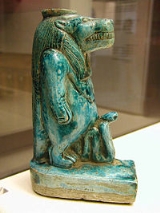
She was "usually portrayed with the arms and legs of a lion and the back and tail of a crocodile (or even a complete crocodile perched on her back), while her pendulous breasts and full belly conveyed the idea of pregnancy." On occasion, later, rather than having a crocodile back, she was seen as having a separate, small crocodile resting on her back, which was thus interpreted as
SobekSobek , and in Greek, Suchos was the deification of crocodiles, as crocodiles were deeply feared in the nation so dependent on the Nile River...
, the crocodile-god, and said to be her consort.
Later beliefs
Early during the
Old KingdomOld Kingdom is the name given to the period in the 3rd millennium BC when Egypt attained its first continuous peak of civilization in complexity and achievement – the first of three so-called "Kingdom" periods, which mark the high points of civilization in the lower Nile Valley .The term itself was...
, the Egyptians saw female hippopotami as less aggressive than the males, and began to view their aggression as only protecting their young--not territorial, as was male aggression. Consequently, Taweret became seen, very early in Egyptian history, as a deity of protection in pregnancy and childbirth. Pregnant women wore
amuletAn amulet, similar to a talisman , is any object intended to bring good luck or protection to its owner.Potential amulets include gems, especially engraved gems, statues, coins, drawings, pendants, rings, plants and animals; even words said in certain occasions—for example: vade retro satana—, to...
s with her name or likeness to protect their pregnancies. Because of her protective powers during childbirth, "the image of the hippopotamus-goddess was considered a suitable motif for the decoration of beds and headrests.
In most subsequent depictions, Taweret was depicted with features of a pregnant woman. In a composite addition to the animal-compound she was also seen with pendulous breasts, a full pregnant abdomen, and long, straight human hair on her head.
FaienceFaience or faïence is the conventional name in English for fine tin-glazed pottery on a delicate pale buff earthenware body, originally associated with Faenza in northern Italy. The invention of a white pottery glaze suitable for painted decoration, by the addition of an oxide of tin to the slip...
vases in the shape of the goddess "provided with a small pouring hole at the nipple, were sometimes used to serve milk, presumably in an attempt to invoke extra divine potency into the liquid."
As a protector, she often was shown with one arm resting on the sa symbol, which symbolized protection, and on occasion she carried an
ankhThe ankh , also known as key of life, the key of the Nile or crux ansata, was the ancient Egyptian hieroglyphic character that read "eternal life", a triliteral sign for the consonants ʻ-n-ḫ...
, the symbol of life, or a knife, which would be used to threaten evil spirits. As the hippopotamus was associated with the
NileThe Nile is a major north-flowing river in North Africa, generally regarded as the longest river in the world. It is long. It runs through the ten countries of Sudan, South Sudan, Burundi, Rwanda, Democratic Republic of the Congo, Tanzania, Kenya, Ethiopia, Uganda and Egypt.The Nile has two major...
, these more positive ideas of Taweret allowed her to be seen as a goddess of the annual flooding of the Nile and the bountiful harvest that it brought. Ultimately, although only a
household deityA household deity is a deity or spirit that protects the home, looking after the entire household or certain key members. It has been a common belief in pagan religions as well as in folklore across many parts of the world....
, since she was still considered the consort of Apep, Taweret was seen as one who protected against evil by restraining it.
In popular culture
A massive, skyscraper-sized statue of Taweret is a prominent feature of the American television series
LostLost is an American television series that originally aired on ABC from September 22, 2004 to May 23, 2010, consisting of six seasons. Lost is a drama series that follows the survivors of the crash of a commercial passenger jet flying between Sydney and Los Angeles, on a mysterious tropical island...
. Ruins of the statue were first seen in the second season finale "
Live Together, Die Alone"Live Together, Die Alone" is the second season finale of the ABC television series Lost, consisting of the 23rd and 24th episodes of the second season. It is also the 48th and 49th episodes overall. The episode was written by Damon Lindelof and Carlton Cuse, and directed by Jack Bender. It first...
", in the form of the statue's foot, broken off at the ankle. The full statue, viewed from the back, later appears in the fifth season episode "
LaFleur"LaFleur" is the eighth television episode of the fifth season of ABC's Lost. The 94th episode of the show overall, "LaFleur" aired on March 4, 2009 on ABC in the United States, being simulcast on A in Canada...
". In the April 2009
WiredWired is a full-color monthly American magazine and on-line periodical, published since January 1993, that reports on how new and developing technology affects culture, the economy, and politics...
magazine, which was guest-edited by the series' producer J.J. Abrams, one of the
coded messagesIn cryptography, a code is a method used to transform a message into an obscured form, preventing those who do not possess special information, or key, required to apply the transform from understanding what is actually transmitted. The usual method is to use a codebook with a list of common...
in the issue decrypted to the sentence, "The four toed statue is Taweret."
See also
- Ancient Egypt
Ancient Egypt was an ancient civilization of Northeastern Africa, concentrated along the lower reaches of the Nile River in what is now the modern country of Egypt. Egyptian civilization coalesced around 3150 BC with the political unification of Upper and Lower Egypt under the first pharaoh...
- Breccia statue of Taweret
- Meskhenet