


Tattoo artist

Encyclopedia
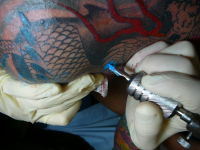
Tattoo
A tattoo is made by inserting indelible ink into the dermis layer of the skin to change the pigment. Tattoos on humans are a type of body modification, and tattoos on other animals are most commonly used for identification purposes...
s, often in an established business called a tattoo shop, tattoo studio or tattoo parlour. Tattoo Artists usually learn their craft via an apprenticeship
Apprenticeship
Apprenticeship is a system of training a new generation of practitioners of a skill. Apprentices or protégés build their careers from apprenticeships...
under a trained & experienced mentor.
Apprenticeships
To become a tattoo artist a person must first have a passion for art and for drawing and also be able to draw. A strong background in other visual media also will help in creating phenomenal works of art on skin. The next step is to gain an apprenticeship from a person that is already skilled in the art of tattooing.A tattoo apprenticeship traditionally last 5 years. 6 months to 1 year in your apprenticeship is when you are allowed to start tattooing. The rest of your time is spent improving your techniques and skill. After 5 years you become a journeyman. Although you have "finished" your apprenticeship, that was only the start of a long journey of education. You are always learning new techniques and skills from fellow journeyman along the way. At 10 years you are considered a well traveled journeyman.
Tattoo Artwork
Tattoo Artists can create original tattoos for their customersTattooers or Tattooists may use flash (pre-drawn, stock images that can be traced onto the skin).
Tattoo Tools
Some of the tools of the trade have greatly evolved, and some have stayed the same. Such as the tattoo machine. In itself the traditional machine has not changed from its original design and/or concept. With the rise of new machine designs, the rotary both air and electric powered tools has made its way into the industry.A practitioner can also have many different needle sets. Such as round liner needles, round shader needles, flat shaders, and mag needles. The amount of needles attached to the needle bar change as well. There are large magnum needle groups from 15 needles on one bar, all the way to 55 needles on one bar.
A practitioner must have the basic tools in order to provide a tattoo. All other items at the artist's disposal are as different as each tattoo. Basic tools are the tattoo machine, power supply, clip cord, foot pedal, grip, tips, grip stem, needles, and tattoo ink
Tattoo ink
Tattoo inks consist of pigments combined with a carrier, and are used in tattooing.Tattoo inks are available in a range of colors that can be thinned or mixed together to produce other colors and shades...
.
Tattoo Studio
The properly equipped tattoo studio will use biohazardBiological hazard
Biological hazards, refer to biological substances that pose a threat to the health of living organisms, primarily that of humans. This can include medical waste or samples of a microorganism, virus or toxin that can impact human health. It can also include substances harmful to animals...
containers for objects that have come into contact with blood or bodily fluids, sharps container
Sharps container
A sharps container is a container that is filled with used medical needles . They fit into two main types:* single use which are disposed of with the waste inside,...
s for old needles, and an autoclave
Autoclave
An autoclave is an instrument used to sterilize equipment and supplies by subjecting them to high pressure saturated steam at 121 °C for around 15–20 minutes depending on the size of the load and the contents. It was invented by Charles Chamberland in 1879, although a precursor known as the...
for sterilizing tools when they are not using disposables. Certain jurisdictions also require studios by law to have a sink in the work area supplied with both hot and cold water.
Proper hygiene requires a body modification artist to wash his or her hands before starting to prepare a client for the stencil,between clients, after a tattoo has been completed, and at any other time where cross contamination
Cross Contamination
Cross Contamination is an album by the rock bands Batmobile and Peter Pan Speedrock. It was released in 2008 by Suburban Records.-Track listing:#"Hellalujah"#"Go Satan Go"#"Killerspeed"#"Big Toy"#"Straight Back To Hormoneville"#"Transsylvanian Express"...
can occur. The use of single use disposable gloves is also mandatory. In some countries and U.S. states it is illegal to tattoo a minor even with parental consent, and it is usually not allowed to tattoo impaired persons (e.g. someone intoxicated or under the influence of drugs), people with contraindicated skin conditions, those who are pregnant or nursing, or those incapable of consent due to mental incapacity. Before the tattooing begins the client is asked to approve the position of the applied stencil. After approval is given the artist will open new, sterile needle packages in front of the client, and always use new, sterile or sterile disposable instruments and supplies, and fresh ink for each session (loaded into disposable ink caps which are discarded after each client). Also, all areas which may be touched with contaminated gloves will be wrapped in clear plastic to prevent cross-contamination. Equipment that cannot be autoclaved (such as countertops, machines, and furniture) will be cleaned with a low level disinfectant and then wiped with an approved high level disinfectant.
The local health department can/will do a hands on inspection of tattoo studios every 4 months in the state of Tennessee. The venue will be graded based on the areas being inspected. If the studio passed an inspection, the health department will sign off on a passing scorecard and the studio will be required to show their score publicly. If the studio fails an inspection, they will be given the opportunity to correct the mistakes (if minor) or be fined (major health risks)and can also be placed out of business on the spot.
Also, the possession of a working autoclave is mandatory in most states. An autoclave is a medical sterilization device used to sterilize stainless steel. The autoclave itself will be inspected by the health department and required to submit weekly spore tests. However if these jurisdictions are up to date, they will not require an autoclave if the practitioners are using 100% disposable tubes and grips which are made of plastic and some grips are made of rubber. These come EO Gas pre sterilized for one time use only and must never be re sterilized.
Membership in professional organizations, or certificates of appreciation/achievement, generally helps artists to be aware of the latest trends. However, many of the most notable tattooists do not belong to any association. While specific requirements to become a tattooist vary between jurisdictions, many mandate only formal training in bloodborne pathogens, and cross contamination. The local department of health regulates tattoo studios in many jurisdictions.
For example, according to the health departments in Oregon and Hawaii, tattoo artists in these states are required to take and pass a test ascertaining their knowledge of health and safety precautions, as well as the current state regulations. Performing a tattoo in Oregon state without a proper and current license or in an unlicensed facility is considered a felony offense. Tattooing was legalized in New York City, Massachusetts, South Carolina and Oklahoma between 2002 and 2006.