

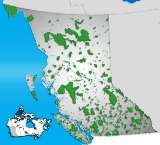
Tatshenshini-Alsek Park

Encyclopedia
Tatshenshini-Alsek Park or Tatshenshini-Alsek Provincial Wilderness Park is a provincial park in British Columbia, Canada (9,580 km²). It was established in 1993 after an intensive campaign by Canadian and American conservation organizations to halt mining exploration and development in the area and protect the area for its strong natural heritage and biodiversity values. The park is situated in the very northwestern corner of British Columbia bordering the American State of Alaska
and the Canadian Yukon Territory. It nestles between Kluane National Park and Reserve
in the Yukon and Glacier Bay
& Wrangell-St. Elias
National Park
s and Preserves in Alaska. It is part of the Kluane-Wrangell-St. Elias-Glacier Bay-Tatshenshini-Alsek
park system, a UNESCO
World Heritage Site
.
fishing villages were located along the rivers. The eastern edge of the park follows an ancient trade route used by the Chilkat tribe to barter with the Tutchone.
In the mid-19th century, the sudden breakup of a matural dam on the Alsek River
caused a tragic flood. The dam had been formed by the advance of a glacier across the entire Alsek River channel; the obstructed river formed a large temporary lake upstream of the blockage. A wall of water 7 metres high and 15 metres wide swept an entire Tutchone village into the sea at Dry Bay.
Tatshenshini-Alsek was one of the last areas of British Columbia to be mapped and explored. In the 1960s the first geological exploration for minerals took place in the area. Significant copper deposits were found in the vicinity of Windy Craggy Mountain, in the middle of the Tatshenshini region. In the mid-1970s two companies began rafting the Tatshenshini
(aka "the Tat", a term also used to refer to the region) and Alsek rivers for the first time. In the mid-1980s a proposal surfaced to develop Windy Craggy peak into a huge open-pit mine.
In 1991 Tatshenshini International was established, linking together the top 50 conservation organisations in North America. An extremely intensive campaign followed in Canada and in the United States, particularly the U.S. Congress, and eventually the White House
, when the active involvement of then Vice-President Al Gore
was enlisted. Eventually, then BC Premier Mike Harcourt
responded by undertaking a review of the issues surrounding Tatshenshini-Alsek by the Commission on Resources and the Environment (CORE). BC government under Premier Harcourt decided in June 1993 to protect Tatshenshini-Alsek as a Class A park. The owners of the Windy-Craggy mineral claims were given a $103.8 million settlement.
In combination with the adjoining national parks this completed the world's largest international park complex. The International Union for the Conservation of Nature (IUCN) then proposed the area for protection as a World Heritage Site.
The Kluane-Wrangell-St. Elias-Glacier Bay-Tatshenshini-Alsek
transfrontalier park system comprising Kluane
, Wrangell-St Elias
, Glacier Bay
and Tatshenshini-Alsek
parks, was declared a UNESCO
World Heritage Site
in 1994 for the spectacular glacier and icefield landscapes as well as for the importance of grizzly bears
, caribou
and Dall sheep
habitat.
In 1999, a party of sheep hunters found artifacts and remains of a human at the foot of a glacier, later named Kwäday Dän Ts’ìnchi
. The well-preserved frozen body turned out to be between 300 and 550 years old.
 The Alsek and Tatshenshini rivers flow through the park in glacier-carved U-shaped valleys. These valleys through the coastal mountains allow cool, moist ocean air into the cold interior. The quick change from ocean to interior environment, frequent floods, landslides and avalanches, a varied geology and great elevation changes have together created an exceptionally diverse range of habitat conditions.
Tatshenshini-Alsek Park supports a large grizzly bear
population. A green area that cuts through a barrier of mountain and ice connects coastal and interior grizzly bear populations and provides a perfect habitat. The park is the only Canadian home of the glacier bear. This extremely rare blue-grey colour phase of the black bear
is found only within the park and just over the border in to the United States.
As well as bears, Tatshenshini-Alsek Park also supports Dall's sheep, and exceptional numbers of mountain goat
s, Kenai moose
, grey wolves, eagles (bald
& golden
), falcon
s (peregrine
& gyr
), and trumpeter swan
s.
Along the coastline, sea lion
s and humpback whale
s can be seen.
Alsek Ranges are situated there and Mount Fairweather
, at 4,663 metres is the province’s highest peak. The Tatshenshini-Alsek area lies in a region of high earthquake activity. Slippages along the Fairweather and Hubbard/Boarder Faults
to the west and the Denali Fault
to the north cause regular quakes.
Alaska
Alaska is the largest state in the United States by area. It is situated in the northwest extremity of the North American continent, with Canada to the east, the Arctic Ocean to the north, and the Pacific Ocean to the west and south, with Russia further west across the Bering Strait...
and the Canadian Yukon Territory. It nestles between Kluane National Park and Reserve
Kluane National Park and Reserve
Kluane National Park and Reserve are two units of Canada's national park system, located in the extreme southwestern corner of Yukon Territory. Kluane National Park Reserve was established in 1972, covering 22,016 square kilometres....
in the Yukon and Glacier Bay
Glacier Bay National Park and Preserve
Glacier Bay National Park is a national park in Alaska. The area around Glacier Bay in southeastern Alaska was first proclaimed a U.S. National Monument on February 25, 1925. It was changed to Glacier Bay National Park and Preserve on Dec. 2, 1980 by the Alaska National Interest Lands Conservation...
& Wrangell-St. Elias
Wrangell-St. Elias National Park and Preserve
Wrangell–St. Elias National Park and Preserve is a United States National Park in southeastern Alaska. It was established in 1980 by the Alaska National Interest Lands Conservation Act. The park area is included in an International Biosphere Reserve and is part of a UNESCO World Heritage Site...
National Park
National park
A national park is a reserve of natural, semi-natural, or developed land that a sovereign state declares or owns. Although individual nations designate their own national parks differently A national park is a reserve of natural, semi-natural, or developed land that a sovereign state declares or...
s and Preserves in Alaska. It is part of the Kluane-Wrangell-St. Elias-Glacier Bay-Tatshenshini-Alsek
Kluane-Wrangell-St. Elias-Glacier Bay-Tatshenshini-Alsek
Kluane / Wrangell-St. Elias / Glacier Bay / Tatshenshini-Alsek is an international park system located in Canada and the U.S., at the border of Yukon, Alaska and British Columbia....
park system, a UNESCO
UNESCO
The United Nations Educational, Scientific and Cultural Organization is a specialized agency of the United Nations...
World Heritage Site
World Heritage Site
A UNESCO World Heritage Site is a place that is listed by the UNESCO as of special cultural or physical significance...
.
History
Sites of numerous Tlingit and Southern TutchoneSouthern Tutchone
The Southern Tutchone are a First Nations people living mainly in the southern Yukon in Canada. The Southern Tutchone language, originally spoken by the Southern Tutchone people is a variety of the Tutchone language, part of the Athabaskan language family, although it may be argued that Northern...
fishing villages were located along the rivers. The eastern edge of the park follows an ancient trade route used by the Chilkat tribe to barter with the Tutchone.
In the mid-19th century, the sudden breakup of a matural dam on the Alsek River
Alsek River
The Alsek River is a wilderness river flowing from the Yukon into Northern British Columbia and into Alaska. The surrounding area from the Western edge of the Alsek to East of the East Alsek is known to locals as Dry Bay.-Course:...
caused a tragic flood. The dam had been formed by the advance of a glacier across the entire Alsek River channel; the obstructed river formed a large temporary lake upstream of the blockage. A wall of water 7 metres high and 15 metres wide swept an entire Tutchone village into the sea at Dry Bay.
Tatshenshini-Alsek was one of the last areas of British Columbia to be mapped and explored. In the 1960s the first geological exploration for minerals took place in the area. Significant copper deposits were found in the vicinity of Windy Craggy Mountain, in the middle of the Tatshenshini region. In the mid-1970s two companies began rafting the Tatshenshini
Tatshenshini River
The Tatshenshini River is a river in the southwestern Yukon and the northwestern corner of British Columbia. It originates in British Columbia, near Haines Highway...
(aka "the Tat", a term also used to refer to the region) and Alsek rivers for the first time. In the mid-1980s a proposal surfaced to develop Windy Craggy peak into a huge open-pit mine.
In 1991 Tatshenshini International was established, linking together the top 50 conservation organisations in North America. An extremely intensive campaign followed in Canada and in the United States, particularly the U.S. Congress, and eventually the White House
White House
The White House is the official residence and principal workplace of the president of the United States. Located at 1600 Pennsylvania Avenue NW in Washington, D.C., the house was designed by Irish-born James Hoban, and built between 1792 and 1800 of white-painted Aquia sandstone in the Neoclassical...
, when the active involvement of then Vice-President Al Gore
Al Gore
Albert Arnold "Al" Gore, Jr. served as the 45th Vice President of the United States , under President Bill Clinton. He was the Democratic Party's nominee for President in the 2000 U.S. presidential election....
was enlisted. Eventually, then BC Premier Mike Harcourt
Mike Harcourt
Michael Franklin Harcourt served as the 30th Premier of the province of British Columbia in Canada from 1991 to 1996, and before that as the 34th mayor of BC's major city, Vancouver from 1980 to 1986....
responded by undertaking a review of the issues surrounding Tatshenshini-Alsek by the Commission on Resources and the Environment (CORE). BC government under Premier Harcourt decided in June 1993 to protect Tatshenshini-Alsek as a Class A park. The owners of the Windy-Craggy mineral claims were given a $103.8 million settlement.
In combination with the adjoining national parks this completed the world's largest international park complex. The International Union for the Conservation of Nature (IUCN) then proposed the area for protection as a World Heritage Site.
The Kluane-Wrangell-St. Elias-Glacier Bay-Tatshenshini-Alsek
Kluane-Wrangell-St. Elias-Glacier Bay-Tatshenshini-Alsek
Kluane / Wrangell-St. Elias / Glacier Bay / Tatshenshini-Alsek is an international park system located in Canada and the U.S., at the border of Yukon, Alaska and British Columbia....
transfrontalier park system comprising Kluane
Kluane National Park and Reserve
Kluane National Park and Reserve are two units of Canada's national park system, located in the extreme southwestern corner of Yukon Territory. Kluane National Park Reserve was established in 1972, covering 22,016 square kilometres....
, Wrangell-St Elias
Wrangell-St. Elias National Park and Preserve
Wrangell–St. Elias National Park and Preserve is a United States National Park in southeastern Alaska. It was established in 1980 by the Alaska National Interest Lands Conservation Act. The park area is included in an International Biosphere Reserve and is part of a UNESCO World Heritage Site...
, Glacier Bay
Glacier Bay National Park and Preserve
Glacier Bay National Park is a national park in Alaska. The area around Glacier Bay in southeastern Alaska was first proclaimed a U.S. National Monument on February 25, 1925. It was changed to Glacier Bay National Park and Preserve on Dec. 2, 1980 by the Alaska National Interest Lands Conservation...
and Tatshenshini-Alsek
Tatshenshini-Alsek Park
Tatshenshini-Alsek Park or Tatshenshini-Alsek Provincial Wilderness Park is a provincial park in British Columbia, Canada . It was established in 1993 after an intensive campaign by Canadian and American conservation organizations to halt mining exploration and development in the area and protect...
parks, was declared a UNESCO
UNESCO
The United Nations Educational, Scientific and Cultural Organization is a specialized agency of the United Nations...
World Heritage Site
World Heritage Site
A UNESCO World Heritage Site is a place that is listed by the UNESCO as of special cultural or physical significance...
in 1994 for the spectacular glacier and icefield landscapes as well as for the importance of grizzly bears
Grizzly Bear
The grizzly bear , also known as the silvertip bear, the grizzly, or the North American brown bear, is a subspecies of brown bear that generally lives in the uplands of western North America...
, caribou
Reindeer
The reindeer , also known as the caribou in North America, is a deer from the Arctic and Subarctic, including both resident and migratory populations. While overall widespread and numerous, some of its subspecies are rare and one has already gone extinct.Reindeer vary considerably in color and size...
and Dall sheep
Dall Sheep
The Dall sheep , Ovis dalli, is a species of sheep native to northwestern North America, ranging from white to slate brown in color and having curved yellowish brown horns...
habitat.
In 1999, a party of sheep hunters found artifacts and remains of a human at the foot of a glacier, later named Kwäday Dän Ts’ìnchi
Kwäday Dän Ts’ìnchi
Kwäday Dän Ts'ìnchi , or Canadian Ice Man, is a naturally mummified body found in Tatshenshini-Alsek Park in British Columbia, Canada, by a group of hunters in 1999. Radiocarbon dating of artifacts found with the body placed the age of the body at between 300 and 550 years old...
. The well-preserved frozen body turned out to be between 300 and 550 years old.
Wildlife
Tatshenshini-Alsek Park supports a large grizzly bear
Grizzly Bear
The grizzly bear , also known as the silvertip bear, the grizzly, or the North American brown bear, is a subspecies of brown bear that generally lives in the uplands of western North America...
population. A green area that cuts through a barrier of mountain and ice connects coastal and interior grizzly bear populations and provides a perfect habitat. The park is the only Canadian home of the glacier bear. This extremely rare blue-grey colour phase of the black bear
American black bear
The American black bear is a medium-sized bear native to North America. It is the continent's smallest and most common bear species. Black bears are omnivores, with their diets varying greatly depending on season and location. They typically live in largely forested areas, but do leave forests in...
is found only within the park and just over the border in to the United States.
As well as bears, Tatshenshini-Alsek Park also supports Dall's sheep, and exceptional numbers of mountain goat
Mountain goat
The Mountain Goat , also known as the Rocky Mountain Goat, is a large-hoofed mammal found only in North America. Despite its vernacular name, it is not a member of Capra, the genus of true goats...
s, Kenai moose
Moose
The moose or Eurasian elk is the largest extant species in the deer family. Moose are distinguished by the palmate antlers of the males; other members of the family have antlers with a dendritic configuration...
, grey wolves, eagles (bald
Bald Eagle
The Bald Eagle is a bird of prey found in North America. It is the national bird and symbol of the United States of America. This sea eagle has two known sub-species and forms a species pair with the White-tailed Eagle...
& golden
Golden Eagle
The Golden Eagle is one of the best known birds of prey in the Northern Hemisphere. Like all eagles, it belongs to the family Accipitridae. Once widespread across the Holarctic, it has disappeared from many of the more heavily populated areas...
), falcon
Falcon
A falcon is any species of raptor in the genus Falco. The genus contains 37 species, widely distributed throughout Europe, Asia, and North America....
s (peregrine
Peregrine Falcon
The Peregrine Falcon , also known as the Peregrine, and historically as the Duck Hawk in North America, is a widespread bird of prey in the family Falconidae. A large, crow-sized falcon, it has a blue-gray back, barred white underparts, and a black head and "moustache"...
& gyr
Gyrfalcon
The Gyrfalcon — Falco rusticolus — is the largest of the falcon species. The Gyrfalcon breeds on Arctic coasts and the islands of North America, Europe, and Asia. It is mainly resident there also, but some Gyrfalcons disperse more widely after the breeding season, or in winter.Individual vagrancy...
), and trumpeter swan
Trumpeter Swan
The Trumpeter Swan, Cygnus buccinator, is the largest native North American bird, if measured in terms of weight and length, and is the largest living waterfowl species on earth. It is the North American counterpart of the European Whooper Swan.-Description:Males typically measure from and weigh...
s.
Along the coastline, sea lion
Sea Lion
Sea lions are pinnipeds characterized by external ear-flaps, long fore-flippers, the ability to walk on all fours, and short thick hair. Together with the fur seal, they comprise the family Otariidae, or eared seals. There are six extant and one extinct species in five genera...
s and humpback whale
Humpback Whale
The humpback whale is a species of baleen whale. One of the larger rorqual species, adults range in length from and weigh approximately . The humpback has a distinctive body shape, with unusually long pectoral fins and a knobbly head. It is an acrobatic animal, often breaching and slapping the...
s can be seen.
Alsek Ranges are situated there and Mount Fairweather
Mount Fairweather
Mount Fairweather , is one of the world's highest coastal mountains at 4,671 metres It is located east of the Pacific Ocean on the border of Alaska, United States and western British Columbia, Canada...
, at 4,663 metres is the province’s highest peak. The Tatshenshini-Alsek area lies in a region of high earthquake activity. Slippages along the Fairweather and Hubbard/Boarder Faults
Geologic fault
In geology, a fault is a planar fracture or discontinuity in a volume of rock, across which there has been significant displacement along the fractures as a result of earth movement. Large faults within the Earth's crust result from the action of tectonic forces...
to the west and the Denali Fault
Denali Fault
The Denali Fault is a major intracontinental dextral strike-slip fault in western North America, extending from northwestern British Columbia, Canada to the U.S. state of central Alaska. It was the main fault along which the 2002 Denali earthquake occurred, which was measured as a magnitude of 7.9...
to the north cause regular quakes.