


Taphonomy

Encyclopedia
Research
Research can be defined as the scientific search for knowledge, or as any systematic investigation, to establish novel facts, solve new or existing problems, prove new ideas, or develop new theories, usually using a scientific method...
of decaying organism
Organism
In biology, an organism is any contiguous living system . In at least some form, all organisms are capable of response to stimuli, reproduction, growth and development, and maintenance of homoeostasis as a stable whole.An organism may either be unicellular or, as in the case of humans, comprise...
s over time and how they become fossilized (if they do). The term taphonomy (from the Greek taphos - τάφος meaning burial, and nomos - νόμος meaning law) was introduced to paleontology
Paleontology
Paleontology "old, ancient", ὄν, ὀντ- "being, creature", and λόγος "speech, thought") is the study of prehistoric life. It includes the study of fossils to determine organisms' evolution and interactions with each other and their environments...
in 1940 by Russian scientist Ivan Efremov to describe the study of the transition of remains, parts, or products of organism
Organism
In biology, an organism is any contiguous living system . In at least some form, all organisms are capable of response to stimuli, reproduction, growth and development, and maintenance of homoeostasis as a stable whole.An organism may either be unicellular or, as in the case of humans, comprise...
s, from the biosphere
Biosphere
The biosphere is the global sum of all ecosystems. It can also be called the zone of life on Earth, a closed and self-regulating system...
, to the lithosphere
Lithosphere
The lithosphere is the rigid outermost shell of a rocky planet. On Earth, it comprises the crust and the portion of the upper mantle that behaves elastically on time scales of thousands of years or greater.- Earth's lithosphere :...
, i.e. the creation of fossil
Fossil
Fossils are the preserved remains or traces of animals , plants, and other organisms from the remote past...
assemblages.
Taphonomists study such phenomena as biostratinomy
Biostratinomy
Biostratinomy is the study of the processes that take place after an organism dies but before its final burial. It is considered to be a subsection of the science of taphonomy, along with necrology and diagenesis...
, decomposition
Decomposition
Decomposition is the process by which organic material is broken down into simpler forms of matter. The process is essential for recycling the finite matter that occupies physical space in the biome. Bodies of living organisms begin to decompose shortly after death...
, diagenesis
Diagenesis
In geology and oceanography, diagenesis is any chemical, physical, or biological change undergone by a sediment after its initial deposition and during and after its lithification, exclusive of surface alteration and metamorphism. These changes happen at relatively low temperatures and pressures...
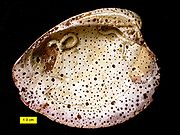
, and encrustation and bioerosion
Bioerosion
Bioerosion describes the erosion of hard ocean substrates – and less often terrestrial substrates – by living organisms. Marine bioerosion can be caused by mollusks, polychaete worms, phoronids, sponges, crustaceans, echinoids, and fish; it can occur on coastlines, on coral reefs, and...
by sclerobionts. (Sclerobiont
Sclerobiont
Sclerobionts are collectively known as organisms living in or on any kind of hard substrate . A few examples of sclerobionts include Entobia borings, Gastrochaenolites borings, Oichnus borings, Talpina borings, serpulids, encrusting oysters, encrusting foraminiferans, Stomatopora bryozoans, and...
s are organisms which dwell on hard substrates such as shells or rocks.)
One motivation behind taphonomy is to better understand biases present in the fossil
Fossil
Fossils are the preserved remains or traces of animals , plants, and other organisms from the remote past...
record. Fossils are ubiquitous in sedimentary rocks, yet paleontologist
Paleontology
Paleontology "old, ancient", ὄν, ὀντ- "being, creature", and λόγος "speech, thought") is the study of prehistoric life. It includes the study of fossils to determine organisms' evolution and interactions with each other and their environments...
s cannot draw the most accurate conclusions about the lives and ecology of the fossilized organisms without knowing about the processes involved in their fossilization. For example, if a fossil assemblage contains more of one type of fossil than another, one can either infer that that organism was present in greater numbers, or that its remains were more resistant to decomposition.
During the late twentieth century, taphonomic data began to be applied to other paleontological subfields such as paleobiology
Paleobiology
Paleobiology is a growing and comparatively new discipline which combines the methods and findings of the natural science biology with the methods and findings of the earth science paleontology...
, paleoceanography
Paleoceanography
Paleoceanography is the study of the history of the oceans in the geologic past with regard to circulation, chemistry, biology, geology and patterns of sedimentation.- Source of information :...
, ichnology
Ichnology
Ichnology is the branch of geology that deals with traces of organismal behavior, such as burrows and footprints. It is generally considered as a branch of paleontology; however, only one division of ichnology, paleoichnology, deals with trace fossils, while neoichnology is the study of modern traces...
(the study of trace fossils) and biostratigraphy
Biostratigraphy
Biostratigraphy is the branch of stratigraphy which focuses on correlating and assigning relative ages of rock strata by using the fossil assemblages contained within them. Usually the aim is correlation, demonstrating that a particular horizon in one geological section represents the same period...
. By coming to understand the oceanographic and ethological
Ethology
Ethology is the scientific study of animal behavior, and a sub-topic of zoology....
implications of observed taphonomic patterns, paleontologists have been able to provide new and meaningful interpretations and correlations that would have otherwise remained obscure in the fossil record.

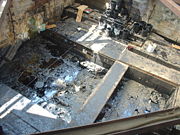
Forensic taphonomy is concerned with the study of the decomposition of human remains, particularly in the context of burial sites.
Experimental taphonomy testing usually consists of exposing the remains of organisms to various altering processes, and then examining the effects of the exposure.
Research areas
Taphonomy has undergone an explosion of interest since the 1980s, with research focusing on certain areas.- microbial, biogeochemical, and larger-scale controls on the preservation of different tissue types; in particular, exceptional preservation in Konzervat-lagerstattenLagerstätteA Lagerstätte is a sedimentary deposit that exhibits extraordinary fossil richness or completeness.Palaeontologists distinguish two kinds....
. Covered within this field is the dominance of biological versus physical agents in the destruction of remains from all major taxonomic groups (plants, invertebrates, vertebrates) - processes that concentrate biological remains; especially the degree to which different types of assemblages reflect the species composition and abundance of source faunas and floras
- the spatio-temporal resolution and ecological fidelity of species assemblages, particularly the relatively minor role of out-of-habitat transport contrasted with the major effects of time-averaging
- the outlines of megabiasMegabiasA megabias, or a taphonomic megabias is a large scale pattern in the quality of the fossil record that affects paleobiologic analysis at provincial to global levels and at timescales usually exceeding ten million years...
es in the fossil record, including the evolution of new bauplans and behavioral capabilities, and by broad-scale changes in climate, tectonics, and geochemistry of Earth surface systems.
Taphonomic biases in the fossil record
Because of the very select processes that cause preservation, not all organisms have the same chance of being preserved. An organism has a much greater chance of being preserved if it, say, has hard parts (e.g. most mollusks); this represents a bias in the fossil record towards organisms with hard parts. It is thus arguably the most important goal of taphonomy to identify the scope of such biases such that they can be quantified to allow correct interpretations of the relative abundances of organisms that make up a biota.Sources of bias result from relative eases of preservation due to many different factors. Each variable that affects preservation is a source of bias, which are listed below.
Spatial fidelity
A sedimentarySedimentology
Sedimentology encompasses the study of modern sediments such as sand, mud , and clay, and the processes that result in their deposition. Sedimentologists apply their understanding of modern processes to interpret geologic history through observations of sedimentary rocks and sedimentary...
deposit may have experienced a mixing of noncontemporaneous remains within single sedimentary units via physical or biological processes; i.e. a deposit could be ripped up and redeposited elsewhere, meaning that a deposit may contain a large amount of fossils from another place (an allochthonous deposit, as opposed to the usual autochthonous). Thus, a question that is often asked of fossil deposits is to what extent does the fossil deposit record the true biota that originally lived there? Many fossils are obviously autochthonous, such as rooted fossils like crinoids, and many fossils are intrisically obviously allocthonous, such as the presence of photoautotrophic plankton in a benthic deposit that must have sunk to be deposited. A fossil deposit may thus become biased towards exotic species (i.e. species not endemic to that area) when the sedimentology is dominated by gravity driven surges, such as mudslides, or may become biased if there is very little endemic organisms to be preserved. This is a particular problem in palynology
Palynology
Palynology is the science that studies contemporary and fossil palynomorphs, including pollen, spores, orbicules, dinoflagellate cysts, acritarchs, chitinozoans and scolecodonts, together with particulate organic matter and kerogen found in sedimentary rocks and sediments...
.
Temporal resolution
Because population turnover rates of individual taxa are much less than net rates of sediment accumulation, the biological remains of successive, noncontemporaneous populations of organisms may be admixed within a single bed, known as time-averaging. Because of the slow and episodic nature of the geologic record, two apparently contemporaneous fossils may have actually lived centuries, or even millennia, apart. Moreover, the degree of time averaging in an assemblage may vary. The degree varies on many factors, such as tissue type, the habitat, the frequency of burial events and exhumation events, and the depth of bioturbationBioturbation
In oceanography, limnology, pedology, geology , and archaeology, bioturbation is the displacement and mixing of sediment particles and solutes by fauna or flora . The mediators of bioturbation are typically annelid worms , bivalves In oceanography, limnology, pedology, geology (especially...
within the sedimentary column relative to net sediment accumulation rates. Like biases in spatial fidelity, there is a bias towards organisms that can survive reworking events, such as shell
Exoskeleton
An exoskeleton is the external skeleton that supports and protects an animal's body, in contrast to the internal skeleton of, for example, a human. In popular usage, some of the larger kinds of exoskeletons are known as "shells". Examples of exoskeleton animals include insects such as grasshoppers...
s. An example of a more ideal deposit with respect to time-averaging bias would be a volcanic ash
Volcanic ash
Volcanic ash consists of small tephra, which are bits of pulverized rock and glass created by volcanic eruptions, less than in diameter. There are three mechanisms of volcanic ash formation: gas release under decompression causing magmatic eruptions; thermal contraction from chilling on contact...
deposit, which captures an entire biota caught in the wrong place at the wrong time (e.g. the Silurian
Silurian
The Silurian is a geologic period and system that extends from the end of the Ordovician Period, about 443.7 ± 1.5 Mya , to the beginning of the Devonian Period, about 416.0 ± 2.8 Mya . As with other geologic periods, the rock beds that define the period's start and end are well identified, but the...
Herefordshire
Herefordshire
Herefordshire is a historic and ceremonial county in the West Midlands region of England. For Eurostat purposes it is a NUTS 3 region and is one of three counties that comprise the "Herefordshire, Worcestershire and Gloucestershire" NUTS 2 region. It also forms a unitary district known as the...
lagerstatte
Lagerstätte
A Lagerstätte is a sedimentary deposit that exhibits extraordinary fossil richness or completeness.Palaeontologists distinguish two kinds....
).
Compositional fidelity
This perhaps represents the biggest source of bias in the fossil record. First and foremost, biomineralizing organisms have a far greater chance of being represented in the fossil record than an entirely soft bodied organism. We know from habitats around the world that soft bodied organisms may form 30% to 100% of the biota, however most fossil assembalges preserve none of this unseen diversity. This bias thus acts at a very great taxonomicTaxonomy
Taxonomy is the science of identifying and naming species, and arranging them into a classification. The field of taxonomy, sometimes referred to as "biological taxonomy", revolves around the description and use of taxonomic units, known as taxa...
level, with entire phyla of animals cut out of the fossil record due to a lack of hard parts. Many animals that moult, on the other hand, are overrepresented, as one animal may leave multiple fossils due to its discarded body parts.
Completeness of time series
The geological record is very discontinuous, and deposition is episodic at all scales. At the largest scale, a sedimentological high-stand period may mean that no deposition may occur for tens of thousands of years and, in fact, erosion of the deposit may occur. Such a hiatus is called an unconformity. Conversely, a catastrophic event such as a mudslide may overrepresent a time period. At a shorter scale, scouring processes such as the formation of ripples and dunes and the passing of turbidity currentTurbidity current
A turbidity current is a current of rapidly moving, sediment-laden water moving down a slope through water, or another fluid. The current moves because it has a higher density and turbidity than the fluid through which it flows...
s may cause layers to be removed. Thus the fossil record is biased towards periods of greatest sedimentation; periods of time that have less sedimentation are consequently less well represented in the fossil record.
A related problem is the slow changes that occur in the depositional environment of an area; a deposit may experience periods of poor preservation to, for example, a lack of biomineralizing elements. This causes the taphonomic or diagenetic obliteration of fossils, producing gaps and condensation of the record.
Consistency in preservation over Geologic time
Major shifts in intrinsic and extrinsic properties of organisms, including morphology and behavior in relation to other organisms or shifts in the global environment, can cause secular or long-term cyclic changes in preservation (megabiasMegabias
A megabias, or a taphonomic megabias is a large scale pattern in the quality of the fossil record that affects paleobiologic analysis at provincial to global levels and at timescales usually exceeding ten million years...
).
Human biases
Much of the incompleteness of the fossil record is due to the fact that only a small amount of rock is ever exposed at the surface of the Earth, and not even most of that has been explored. Our fossil record relies on the small amount of exploration that has been done on this. Unfortunately, paleontologists as humans can be very biased in their methods of collection; a bias that must be identified. Potential sources of bias include,- Search images: field experiments have shown that paleontologists working on, say fossil clams are better at collecting clams than anything else, because their search images has been shaped to bias them in favour of clams.
- Relative ease of extraction: fossils that are easy to obtain (such as many phosphatic fossils that are easily extracted en mass by dissolution in acid) are overabundant in the fossil record.
- Taxonomic bias: fossils with easily discernable morphologies will be easy to distinguish as separate species, and will thus have an inflated abundance.
Preservation of biopolymers
The taphonomic pathways involved in relatively inert substances such as calcite (and to a lesser extent bone) are relatively obvious, as such body parts are stable and change little through time. However, the preservation of "soft tissue" is more interesting, as it requires more peculiar conditions. While usually only biomineralised material survives fossilisation, the preservation of soft tissue is not as rare as sometimes thought.Both DNA and proteins are unstable, and rarely survive more than hundreds of thousands of years before degrading. Polysaccharides also have low preservation potential, unless they are highly cross-linked; this interconnection is most common in structural tissues, and renders them resistant to chemical decay. Such tissues (resistant chemical in brackets) include wood (lignin
Lignin
Lignin or lignen is a complex chemical compound most commonly derived from wood, and an integral part of the secondary cell walls of plants and some algae. The term was introduced in 1819 by de Candolle and is derived from the Latin word lignum, meaning wood...
), spores and pollen (sporopollenin
Sporopollenin
thumb|right|270px|[[Scanning electron microscope|SEM]] image of pollen grainsSporopollenin is a major component of the tough outer walls of spores and pollen grains. It is chemically very stable and is usually well preserved in soils and sediments...
), the cuticles of plants (cutan
Cutan
Cutan is one of two polymers which occur in the cuticle of some plants. The other and better-known polymer is Cutin. Cutan is believed to be a hydrocarbon polymer, whereas cutin is a polyester, but the structure and synthesis of cutan are not yet fully understood...
) and animals, the cell walls of algae (algaenan
Algaenan
Algaenan is the resistant biopolymer in the cell walls of unrelated groups of green algae, and facilitates their preservation in the fossil record....
), and potentially the polysaccharide layer of some lichens. This interconnectedness makes the chemicals less prone to chemical decay, and also means they are a poorer source of energy so less likely to be digested by scavenging organisms. After being subjected to heat and pressure, these cross-linked organic molecules typically
'cook' and become kerogen
Kerogen
Kerogen is a mixture of organic chemical compounds that make up a portion of the organic matter in sedimentary rocks. It is insoluble in normal organic solvents because of the huge molecular weight of its component compounds. The soluble portion is known as bitumen. When heated to the right...
or short (<17 C atoms) aliphatic/aromatic carbon molecules. Other factors affect the likelihood of preservation; for instance scleritisation renders the jaws of polychaetes more readily preserved than the chemically equivalent but non-sclerotised body cuticle.
It was thought that only tough, cuticle type soft tissue could be preserved by Burgess shale type preservation
Burgess shale type preservation
The Burgess Shale of British Columbia is famous for its exceptional preservation of mid-Cambrian organisms. Around 40 other sites have been discovered of a similar age, with soft tissues preserved in a similar, though not identical, fashion...
, but an increasing number of organisms are being discovered that lack such cuticle, such as the probable chordate Pikaia
Pikaia
Pikaia gracilens is an extinct animal known from the Middle Cambrian Burgess Shale of British Columbia. -Discovery:It was discovered by Charles Walcott and was first described by him in 1911. It was named after Pika Peak, a mountain in Alberta, Canada. Based on the obvious and regular segmentation...
and the shellless Odontogriphus
Odontogriphus
Odontogriphus is a genus of soft-bodied animals known from middle Cambrian Lagerstätte. Reaching as much as in length, Odontogriphus is a flat, oval bilaterian which apparently had a single muscular foot, and a "shell" on its back that was moderately rigid but of a material unsuited to...
.
It is a common misconception that anaerobic conditions are necessary for the preservation of soft tissue; indeed much decay is mediated by sulfate reducing bacteria which can only survive in anaerobic conditions. Anoxia does, however, reduce the probability that scavengers will disturb the dead organism, and the activity of other organisms is undoubtedly one of the leading causes of soft-tissue destruction.
Plant cuticle is more prone to preservation if it contains cutan
Cutan
Cutan is one of two polymers which occur in the cuticle of some plants. The other and better-known polymer is Cutin. Cutan is believed to be a hydrocarbon polymer, whereas cutin is a polyester, but the structure and synthesis of cutan are not yet fully understood...
, rather than cutin
Cutin
Cutin is one of two waxy polymers that are the main components of the plant cuticle, which covers all aerial surfaces of plants. The other major cuticle polymer is cutan, which is much more readily preserved in the fossil record,...
.
Plants and algae produce the most preservable compounds, which are listed according to their preservation potential by Tegellaar (see reference).
Disintegration
How complete fossils are was once thought to be a proxy for the energy of the environment, with stormier waters leaving less articulated carcasses. However, the dominant force actually seems to be predation, with scavengers more likely than rough waters to break up a fresh carcass before it is buried.See also
- Fossil record
- PermineralizationPermineralizationPermineralization is a process of fossilization in which mineral deposits form internal casts of organisms. Carried by water, these minerals fill the spaces within organic tissue...
- Trace fossils
- Pseudofossils
- LagerstätteLagerstätteA Lagerstätte is a sedimentary deposit that exhibits extraordinary fossil richness or completeness.Palaeontologists distinguish two kinds....
- Beecher’s Trilobite type preservationBeecher’s Trilobite type preservationThe preservational regime of Beecher's Trilobite Bed and other similar localities involves the replacement of soft tissues with pyrite, producing a three dimensional fossil replicating the anatomy of the original organism...
- Bitter Springs type preservationBitter Springs type preservationThe Bitter Springs preservational mode is the preservation of microorganisms in silica, in shallow Precambrian waters.-Taphonomic processes:Silica is emplaced around the organisms very rapidly, before their cells can even collapse; the strong silica is able to withstand great pressures and...
- Burgess Shale type preservationBurgess shale type preservationThe Burgess Shale of British Columbia is famous for its exceptional preservation of mid-Cambrian organisms. Around 40 other sites have been discovered of a similar age, with soft tissues preserved in a similar, though not identical, fashion...
- Ediacaran type preservationEdiacaran type preservationEdiacaran type preservation relates to the dominant preservational mode in the Ediacaran period, where Ediacaran organisms were preserved as casts on the surface of microbial mats.- Exceptional preservation :...
- Doushantuo type preservationDoushantuo type preservationThe preservational mode of the Doushantuo formation involves very early phosphatisation on a cellular level - with cells being replaced by phosphate before they degrade.-Occurrence:...
Further reading
- Emig, C. C. (2002). Death: a key information in marine palaeoecology. In: Current topics on taphonomy and fossilization, Valencia. Col.lecio Encontres, 5: 21-26.
- Greenwood, D. R. (1991), The taphonomy of plant macrofossils. In, Donovan, S. K. (Ed.), The processes of fossilisation, p. 141-169. Belhaven Press.
- Lyman, R. L. (1994), Vertebrate Taphonomy. Cambridge University Press.
- Shipman, P. (1981), Life history of a fossil: An introduction to taphonomy and paleoecology. Harvard University Press.
- Taylor, P. D. and Wilson, M. A. (2003), Palaeoecology and evolution of marine hard substrate communities. Earth-Science Reviews 62: 1-103. http://www.wooster.edu/geology/Taylor%26Wilson2003.pdf
External links
- The Shelf and Slope Experimental Taphonomy Initiative is the first long-term large-scale deployment and re-collection of organism remains on the sea floor.
- The Journal of Taphonomy
- Bioerosion Website at The College of WoosterThe College of WoosterThe College of Wooster is a private liberal arts college primarily known for its Independent study program. It has roughly 2,000 students and is located in Wooster, Wayne County, Ohio, United States . Founded in 1866 by the Presbyterian church as the University of Wooster, it was from its creation...
http://www3.wooster.edu/geology/Bioerosion/Bioerosion.html - Comprehensive bioerosion bibliography compiled by Mark A. Wilson http://www3.wooster.edu/geology/bioerosion/BioerosionBiblio.pdf
- Taphonomy