


Tape drive

Encyclopedia
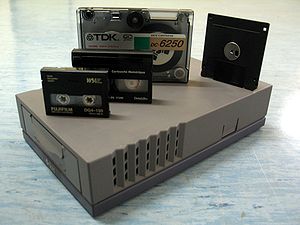
Digital recording
In digital recording, digital audio and digital video is directly recorded to a storage device as a stream of discrete numbers, representing the changes in air pressure for audio and chroma and luminance values for video through time, thus making an abstract template for the original sound or...
, writes data on a magnetic tape
Magnetic tape
Magnetic tape is a medium for magnetic recording, made of a thin magnetizable coating on a long, narrow strip of plastic. It was developed in Germany, based on magnetic wire recording. Devices that record and play back audio and video using magnetic tape are tape recorders and video tape recorders...
. Magnetic tape data storage
Magnetic tape data storage
Magnetic tape data storage uses digital recording on to magnetic tape to store digital information. Modern magnetic tape is most commonly packaged in cartridges and cassettes. The device that performs actual writing or reading of data is a tape drive...
is typically used for offline, archival data storage. Tape media generally has a favorable unit cost and long archival stability.
A tape drive provides sequential access
Sequential access
In computer science, sequential access means that a group of elements is accessed in a predetermined, ordered sequence. Sequential access is sometimes the only way of accessing the data, for example if it is on a tape...
storage, unlike a disk drive, which provides random access
Random access
In computer science, random access is the ability to access an element at an arbitrary position in a sequence in equal time, independent of sequence size. The position is arbitrary in the sense that it is unpredictable, thus the use of the term "random" in "random access"...
storage. A disk drive read/write head can move to any position on the disk in a few milliseconds, but a tape drive must physically wind tape between reels to read any one particular piece of data. As a result, tape drives have very slow average seek times. For sequential access once the tape is positioned, however, tape drives can stream data very fast. For example, Linear Tape-Open
Linear Tape-Open
Linear Tape-Open is a magnetic tape data storage technology originally developed in the late 1990s as an open standards alternative to the proprietary magnetic tape formats that were available at the time. Hewlett-Packard, IBM and Seagate initiated the LTO Consortium, which directs development...
(LTO) supported continuous data transfer rates of up to 140 MB/s, comparable to hard disk drives.
Design
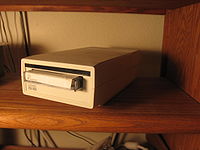
As some data can be compressed
Data compression
In computer science and information theory, data compression, source coding or bit-rate reduction is the process of encoding information using fewer bits than the original representation would use....
to a smaller size than the files on hard disc, it has become commonplace when marketing tape drives to state the capacity with the assumption of a 2:1 compression ratio; thus a tape with a capacity of 80 GB would be sold as "80/160". The true storage capacity is also known as the native capacity
Native capacity
Native capacity refers to the uncompressed storage capacity of any medium that is usually spoken of in compressed sizes. For example, tape cartridges are rated in compressed capacity, which usually assumes 2:1 compression ratio over the native capacity....
or the raw capacity. IBM and Sony have also used higher compression ratios in their marketing materials. The compression ratio actually achievable depends on the data being compressed. Some data has little redundancy; large video files, for example, already use compression technology and cannot be compressed further. A sparse database, on the other hand, may allow compression ratios better than 10:1.
Tape drives can be connected to a computer with SCSI
SCSI
Small Computer System Interface is a set of standards for physically connecting and transferring data between computers and peripheral devices. The SCSI standards define commands, protocols, and electrical and optical interfaces. SCSI is most commonly used for hard disks and tape drives, but it...
(most common), Fibre Channel
Fibre Channel
Fibre Channel, or FC, is a gigabit-speed network technology primarily used for storage networking. Fibre Channel is standardized in the T11 Technical Committee of the InterNational Committee for Information Technology Standards , an American National Standards Institute –accredited standards...
, SATA
Serial ATA
Serial ATA is a computer bus interface for connecting host bus adapters to mass storage devices such as hard disk drives and optical drives...
, USB, FireWire, FICON
FICON
FICON is the IBM proprietary name for the ANSI FC-SB-3 Single-Byte Command Code Sets-3 Mapping Protocol for Fibre Channel protocol. It is a FC layer 4 protocol used to map both IBM’s antecedent channel-to-control-unit cabling infrastructure and protocol onto standard FC services and infrastructure...
, or other interfaces. Tape drives are used with autoloaders and tape libraries which automatically load, unload, and store multiple tapes, increasing the volume of data which can be stored without manual intervention.
Some older tape drives were designed as inexpensive alternatives to very expensive disk drives. Examples include DECtape
DECtape
DECtape, originally called "Microtape", was a magnetic tape data storage medium used with many Digital Equipment Corporation computers, including the PDP-6, PDP-8, LINC-8, PDP-10, PDP-11, PDP-12, and the PDP-15. On DEC's 32-bit systems, VAX/VMS support for it was implemented but did not become an...
, the ZX Microdrive
ZX Microdrive
The ZX Microdrive is a magnetic tape data storage system launched in July 1983 by Sinclair Research for their ZX Spectrum home computer. The Microdrive technology was later also used in the Sinclair QL and ICL One Per Desk personal computers.-Development:...
and Rotronics Wafadrive
Rotronics Wafadrive
The Rotronics Wafadrive was a peripheral for the Sinclair ZX Spectrum home computer, intended to compete with Sinclair's ZX Interface 1 and ZX Microdrive....
. This is generally not feasible with modern tape drives that use advanced techniques like multilevel forward error correction, shingling, and linear serpentine layout for writing data to tape, and was made unnecessary by decreasing disk drive prices anyway.
Reliability
Gartner Group estimated that 10 to 50 percent of all tape restores fail. Storage Magazine and Gartner reported that 34% of surveyed companies never test a restore from tape, and of those that do test, 77% experienced tape backup failures.Performance problems
A disadvantageous effect of "shoe-shining" occurs during read/write if the data transfer rate falls below the minimum threshold at which the tape drive heads were designed to transfer data to or from a continuously running tape. In this situation, the modern fast-running tape drive is unable to stop the tape instantly. Instead, the drive must decelerate and stop the tape, rewind it a short distance, restart it, position back to the point at which streaming stopped and then resume the operation. If the condition repeats, the resulting back-and-forth tape motion resembles that of shining shoes with a cloth. Shoe-shining decreases the attainable data transfer rate, and drive and tape life.In early tape drives, non-continuous data transfer was normal and unavoidable - computer processing power and memory available were usually insufficient to provide a constant stream. So tape drives were typically designed for so called start-stop operation. Early drives used very large spools, which necessarily had high inertia and did not start and stop moving easily. To provide high start, stop, and seeking performance, several feet of loose tape was played out and pulled by a suction fan down into two deep open channels on either side of the tape head and capstans. The long thin loops of tape hanging in these vacuum columns had far less inertia than the two reels and could be rapidly started, stopped and repositioned. The large reels would occasionally move to take up written tape and play out more blank tape into the vacuum columns.
Later, most tape drives of the 1980s introduced the use of an internal data buffer
Buffer (computer science)
In computer science, a buffer is a region of a physical memory storage used to temporarily hold data while it is being moved from one place to another. Typically, the data is stored in a buffer as it is retrieved from an input device or just before it is sent to an output device...
to somewhat reduce start-stop situations. These drives are often referred to as tape streamers. The tape was stopped only when the buffer contained no data to be written
Buffer underrun
In computing, buffer underrun or buffer underflow is a state occurring when a buffer used to communicate between two devices or processes is fed with data at a lower speed than the data is being read from it. This requires the program or device reading from the buffer to pause its processing while...
, or when it was full of data during reading. As faster tape drives became available, despite being buffered the drives started to suffer from the shoe-shining sequence of stop, rewind, start.
Most recently, drives no longer operate at a single fixed linear speed, but have several speeds. Internally, they implement algorithms that dynamically match the tape speed level to the computer's data rate. Example speed levels could be 50 percent, 75 percent and 100 percent of full speed. A computer that streams data slower than the lowest speed level (e.g. at 49 percent) will still cause shoe-shining.
Media
Magnetic tapeMagnetic tape
Magnetic tape is a medium for magnetic recording, made of a thin magnetizable coating on a long, narrow strip of plastic. It was developed in Germany, based on magnetic wire recording. Devices that record and play back audio and video using magnetic tape are tape recorders and video tape recorders...
is commonly housed in a casing known as a cassette or cartridge—for example, the 4-track cartridge
4-track cartridge
The Muntz Stereo-Pak, commonly known as the 4-track cartridge, is a magnetic tape sound recording cartridge technology. The in-car tape player that played the Stereo-Pak cartridges was called the Autostereo, but it was generally marketed under the common Stereo-Pak trade name.The Stereo-Pak...
and the compact cassette
Compact Cassette
The Compact Cassette, often referred to as audio cassette, cassette tape, cassette, or simply tape, is a magnetic tape sound recording format. It was designed originally for dictation, but improvements in fidelity led the Compact Cassette to supplant the Stereo 8-track cartridge and reel-to-reel...
. The cassette contains magnetic tape to provide different audio content using the same player. The outer shell, made of plastic
Plastic
A plastic material is any of a wide range of synthetic or semi-synthetic organic solids used in the manufacture of industrial products. Plastics are typically polymers of high molecular mass, and may contain other substances to improve performance and/or reduce production costs...
, sometimes with metal plates and parts, permits ease of handling of the fragile tape, making it far more convenient and robust than having spools of exposed tape. Simple Compact Cassette
Compact Cassette
The Compact Cassette, often referred to as audio cassette, cassette tape, cassette, or simply tape, is a magnetic tape sound recording format. It was designed originally for dictation, but improvements in fidelity led the Compact Cassette to supplant the Stereo 8-track cartridge and reel-to-reel...
audio tape recorders were commonly used for data storage and distribution on home computer
Home computer
Home computers were a class of microcomputers entering the market in 1977, and becoming increasingly common during the 1980s. They were marketed to consumers as affordable and accessible computers that, for the first time, were intended for the use of a single nontechnical user...
s at a time when floppy disk
Floppy disk
A floppy disk is a disk storage medium composed of a disk of thin and flexible magnetic storage medium, sealed in a rectangular plastic carrier lined with fabric that removes dust particles...
drives were very expensive. The Commodore
Commodore International
Commodore is the commonly used name for Commodore Business Machines , the U.S.-based home computer manufacturer and electronics manufacturer headquartered in West Chester, Pennsylvania, which also housed Commodore's corporate parent company, Commodore International Limited...
Datassette
Datassette
The Commodore 1530 Datasette , was Commodore's dedicated computer tape drive.It provided access to an inexpensive storage medium for Commodore's 8-bit home/personal computers, notably the PET, VIC-20, and C64...
was a dedicated data version of the same system.
History
| Year | Manufacturer | Model | Capacity | Advancements |
|---|---|---|---|---|
| 1951 | Remington Rand Remington Rand Remington Rand was an early American business machines manufacturer, best known originally as a typewriter manufacturer and in a later incarnation as the manufacturer of the UNIVAC line of mainframe computers but with antecedents in Remington Arms in the early nineteenth century. For a time, the... |
UNISERVO UNISERVO The UNISERVO tape drive was the primary I/O device on the UNIVAC I computer. Its place in history is assured as it was the first tape drive for a commercially sold computer.... |
First computer tape drive | |
| 1952 | IBM IBM International Business Machines Corporation or IBM is an American multinational technology and consulting corporation headquartered in Armonk, New York, United States. IBM manufactures and sells computer hardware and software, and it offers infrastructure, hosting and consulting services in areas... |
726 IBM 726 The IBM 726 dual magnetic tape reader/recorder for the IBM 701 was announced on May 21, 1952. Unlike later IBM 7 track drives, the 726 could read backwards as well as forwards.... |
Use of plastic tape (cellulose acetate Cellulose acetate Cellulose acetate , first prepared in 1865, is the acetate ester of cellulose. Cellulose acetate is used as a film base in photography, as a component in some adhesives, and as a frame material for eyeglasses; it is also used as a synthetic fiber and in the manufacture of cigarette filters and... ); 7-track tape IBM 7 Track IBM's first magnetic tape data storage devices, introduced in 1952, use what is now generally known as 7 track tape. The magnetic tape is 1/2" wide and there are 6 data tracks plus 1 parity track for a total of 7 parallel tracks that span the length of the tape... recording 6-bit bytes |
|
| 1958 | IBM IBM International Business Machines Corporation or IBM is an American multinational technology and consulting corporation headquartered in Armonk, New York, United States. IBM manufactures and sells computer hardware and software, and it offers infrastructure, hosting and consulting services in areas... |
729 IBM 729 The IBM 729 Magnetic Tape Unit was IBM's iconic tape mass storage system from the late 1950s through the mid 1960s. Part of the IBM 7 track family of tape units, it was used on late 700, most 7000 and many 1400 series computers... |
Separate read/write heads providing transparent read-after-write verification. As of January 2009, the Computer History Museum Computer History Museum The Computer History Museum is a museum established in 1996 in Mountain View, California, USA. The Museum is dedicated to preserving and presenting the stories and artifacts of the information age, and exploring the computing revolution and its impact on our lives.-History:The museum's origins... in Mountain View, California has working IBM 729 tape drives attached to its working IBM 1401 IBM 1401 The IBM 1401 was a variable wordlength decimal computer that was announced by IBM on October 5, 1959. The first member of the highly successful IBM 1400 series, it was aimed at replacing electromechanical unit record equipment for processing data stored on punched cards... system. |
|
| 1964 | IBM IBM International Business Machines Corporation or IBM is an American multinational technology and consulting corporation headquartered in Armonk, New York, United States. IBM manufactures and sells computer hardware and software, and it offers infrastructure, hosting and consulting services in areas... |
2400 | 9-track tape that could store every 8-bit byte plus a parity bit. | |
| 1970's | IBM IBM International Business Machines Corporation or IBM is an American multinational technology and consulting corporation headquartered in Armonk, New York, United States. IBM manufactures and sells computer hardware and software, and it offers infrastructure, hosting and consulting services in areas... |
3400 | Auto-loading tape reels and drives, avoiding manual tape threading; Group code recording Group Code Recording In computer science, group code recording refers to several distinct but related encoding methods for magnetic media. The first, used in 6250 cpi magnetic tape, is an error-correcting code combined with a run length limited encoding scheme... for error recovery at 6250 bit-per-inch density |
|
| 1972 | 3M 3M 3M Company , formerly known as the Minnesota Mining and Manufacturing Company, is an American multinational conglomerate corporation based in Maplewood, Minnesota, United States.... |
QIC-11 Quarter Inch Cartridge Quarter inch cartridge tape is a magnetic tape data storage format introduced by 3M in 1972, with derivatives still in use as of 2009. QIC comes in a rugged enclosed package of aluminum and plastic that holds two tape reels driven by a single belt in direct contact with the tape. The tape was... |
Quarter-inch cartridge tape cassette (with two reels) | |
| 1974 | IBM | 3850 IBM 3850 The IBM 3850 Mass Storage System was an online tape library used to hold large amounts of infrequently accessed data.- History :Starting in the late-1960s IBM's lab in Boulder, Colorado began development of a low-cost mass storage system based on magnetic tape cartridges... |
Tape cartridge (with single reel) First tape library with robotic access |
|
| 1978 | Commodore International Commodore International Commodore is the commonly used name for Commodore Business Machines , the U.S.-based home computer manufacturer and electronics manufacturer headquartered in West Chester, Pennsylvania, which also housed Commodore's corporate parent company, Commodore International Limited... |
Commodore Datasette | 1978 kB | Use of standard audio cassettes Compact Cassette The Compact Cassette, often referred to as audio cassette, cassette tape, cassette, or simply tape, is a magnetic tape sound recording format. It was designed originally for dictation, but improvements in fidelity led the Compact Cassette to supplant the Stereo 8-track cartridge and reel-to-reel... |
| 1980 | Cipher | (F880?) | RAM buffer to mask start-stop delays | |
| 1984 | IBM | 3480 IBM 3480 Family The 3480 tape format is a magnetic tape data storage format developed by IBM. The tape is one half inch wide and is packaged in a 4"x5"x1" cartridge. The cartridge contains a single reel; the takeup reel is inside the tape drive.... |
Internal takeup reel with automatic tape takeup mechanism. Thin-film magnetoresistive (MR) head. |
|
| 1984 | DEC Digital Equipment Corporation Digital Equipment Corporation was a major American company in the computer industry and a leading vendor of computer systems, software and peripherals from the 1960s to the 1990s... |
TK50 Digital Linear Tape Digital Linear Tape is a magnetic tape data storage technology developed by Digital Equipment Corporation from 1984 onwards. In 1994 the technology was purchased by Quantum Corporation, who currently manufactures drives and licenses the technology and trademark. A variant with higher capacity... |
Digital Linear Tape Digital Linear Tape Digital Linear Tape is a magnetic tape data storage technology developed by Digital Equipment Corporation from 1984 onwards. In 1994 the technology was purchased by Quantum Corporation, who currently manufactures drives and licenses the technology and trademark. A variant with higher capacity... (DLT) |
|
| 1986 | IBM | 3480 IBM 3480 Family The 3480 tape format is a magnetic tape data storage format developed by IBM. The tape is one half inch wide and is packaged in a 4"x5"x1" cartridge. The cartridge contains a single reel; the takeup reel is inside the tape drive.... |
Hardware data compression (IDRC algorithm) | |
| 1987 | Exabyte Exabyte (company) Exabyte Corp. was a manufacturer of magnetic tape data storage products headquartered in Boulder, Colorado, United States. Exabyte Corp. is now defunct, but company's technology is sold by Tandberg Data under both brand names. Prior to the 2006 demise, Exabyte offered tape storage and automation... /Sony Sony , commonly referred to as Sony, is a Japanese multinational conglomerate corporation headquartered in Minato, Tokyo, Japan and the world's fifth largest media conglomerate measured by revenues.... |
EXB-8200 | First helical digital tape drive. Elimination of the capstan and pinch-roller system. |
|
| 1993 | DEC | Tx87 Digital Linear Tape Digital Linear Tape is a magnetic tape data storage technology developed by Digital Equipment Corporation from 1984 onwards. In 1994 the technology was purchased by Quantum Corporation, who currently manufactures drives and licenses the technology and trademark. A variant with higher capacity... |
Tape directory (database with first tapemark nr on each serpentine pass). | |
| 1995 | IBM | 3570 | Head assembly that follows pre-recorded tape servo tracks (Time Based Servoing or TBS) Tape on unload rewound to the midpoint — halving access time (requires two-reel cassette, resulting in lesser capacity) |
|
| 1996 | HP Hewlett-Packard Hewlett-Packard Company or HP is an American multinational information technology corporation headquartered in Palo Alto, California, USA that provides products, technologies, softwares, solutions and services to consumers, small- and medium-sized businesses and large enterprises, including... |
DDS3 Digital Data Storage Digital Data Storage is a format for storing computer data on a Digital Audio Tape .DDS uses tape with a width of 3.8mm, with the exception of the latest formats, DAT 160 and DAT 320, which are 8mm wide... |
Partial Response Maximum Likelihood (PRML) reading method — no fixed thresholds | |
| 1997 | IBM | VTS | Virtual tape — disk cache that emulates tape drive | |
| 1999 | Exabyte | Mammoth-2 | The small cloth-covered wheel cleaning tape heads. Inactive burnishing heads to prep the tape and deflect any debris or excess lubricant. Section of cleaning material at the beginning of each data tape. | |
| 2000 | Quantum | Super DLT | optical servo Visual Servoing Visual servoing, also known as Vision-Based Robot Control and abbreviated VS, is a technique which uses feedback information extracted from a vision sensor to control the motion of a robot. One of the earliest papers that talks about visual servoing was from the SRI International Labs. A first... allows more precise positioning of the heads relative to the tape. |
|
| 2003 | IBM | 3592 IBM 3592 The IBM 3592 is a series of tape drives and corresponding magnetic tape data storage media formats developed by IBM. The first drive, having the IBM product number 3592, was introduced under the nickname Jaguar. The next drive was the TS1120, also having the nickname Jaguar. As of June, 2011, the... |
Virtual backhitch | |
| 2003 | Sony | SAIT-1 Advanced Intelligent Tape Advanced Intelligent Tape is a discontinued high-speed, high-capacity magnetic tape data storage format developed and controlled by Sony. It competed mainly against the DLT, LTO, DAT/DDS, and VXA formats. AIT uses a cassette similar to Video8. Super AIT is a higher capacity variant using wider... |
Single-reel cartridge for helical recording | |
| 2006 | StorageTek Storage Technology Corporation Storage Technology Corporation , aka STC until about 1983, is a data storage technology company. Current StorageTek products focus on tape backup equipment and software to manage storage systems. New products include data retention systems, which they call information lifecycle management, or ILM.... |
T10000 StorageTek tape formats Storage Technology Corporation, or StorageTek, has created several magnetic tape data storage formats. These are commonly used with large computer systems, typically in conjunction with a robotic tape library. The most recent format is the T10000... |
Multiple head assemblies and servos per drive | |
| 2006 | IBM | 3592 IBM 3592 The IBM 3592 is a series of tape drives and corresponding magnetic tape data storage media formats developed by IBM. The first drive, having the IBM product number 3592, was introduced under the nickname Jaguar. The next drive was the TS1120, also having the nickname Jaguar. As of June, 2011, the... |
Encryption Encryption In cryptography, encryption is the process of transforming information using an algorithm to make it unreadable to anyone except those possessing special knowledge, usually referred to as a key. The result of the process is encrypted information... capability integrated into the drive |
|
| 2008 | IBM | TS1130 | GMR heads in a linear tape drive | |
| 2010 | IBM | TS2250 LTO Gen5 | Linear Tape File System (LTFS), which allows accessing files on tape in the same way as on a disk filesystem | |
| 2011 | Oracle | T10000C | ? |
Market Trends
In 2007, Gartner analyst Dave Russell predicted that recovery will move from tape to online disk-based storage by 2011, causing a major shift in the backup market.Future Capacity
Tape drives have yet to reach their maximum capacity.In 2011, Fujifilm
Fujifilm
is a multinational photography and imaging company headquartered in Tokyo, Japan.Fujifilm's principal activities are the development, production, sale and servicing of color photographic film, digital cameras, photofinishing equipment, color paper, photofinishing chemicals, medical imaging...
and IBM
IBM
International Business Machines Corporation or IBM is an American multinational technology and consulting corporation headquartered in Armonk, New York, United States. IBM manufactures and sells computer hardware and software, and it offers infrastructure, hosting and consulting services in areas...
announced that they had managed to record 29.5 billion bits per square inch with magnetic tape media developed using the BaFe particles and nanotechnologies allowing for an uncompressed tape drive of 35TB. The technology is not expected to be commercially available for at least another decade.