
Home      Discussion      Topics      Dictionary      Almanac
Signup       Login
Tancredo Neves

Tancredo Neves

Overview
Tancredo de Almeida Neves, SFO
Secular Franciscan Order
thumb|rigth|Lapel pin of Secular Franciscan Order.The Secular Franciscan Order is a community of Catholic men and women, of any of the Rites in communion with Rome , in the world who seek to pattern their lives after Christ in the spirit of St. Francis of Assisi. Secular Franciscans are...

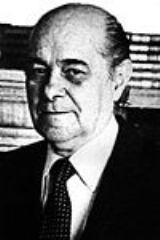
 more commonly Tancredo Neves (tɐ̃ˈkɾedu ˈnɛvis; March 4, 1910 – April 21, 1985) was a Brazilian politician
Politician
A politician, political leader, or political figure is an individual who is involved in influencing public policy and decision making...

. He was born in São João del Rey, in the state of Minas Gerais
Minas Gerais
Minas Gerais is one of the 26 states of Brazil, of which it is the second most populous, the third richest, and the fourth largest in area. Minas Gerais is the Brazilian state with the largest number of Presidents of Brazil, the current one, Dilma Rousseff, being one of them. The capital is the...

, of mostly Portuguese, but also Austrian
Austrian Brazilian
An Austrian Brazilian is a Brazilian person of full, partial, or predominantly Austrian ancestry, or an Austrian-born person residing in Brazil.-Notable Austrian Brazilians:*Cláudio Heinrich...

 descent and graduated in law
Law
Law is a system of rules and guidelines which are enforced through social institutions to govern behavior, wherever possible. It shapes politics, economics and society in numerous ways and serves as a social mediator of relations between people. Contract law regulates everything from buying a bus...

. The Neves family name comes from an Azorean great great grandfather. Tancredo Neves was a descendant of Amador Bueno
Amador Bueno
Amador Bueno was born around 1572 in the city of São Paulo, Captaincy of São Vicente which is now the State of São Paulo in Brazil. He was born to Bartholomeu Bueno da Ribeira, a Spanish settler from Seville and Maria Pires, from São Paulo, daughter of Salvador Pires and Mécia Fernandes...

, a noted paulista from the colonial Brazilian era
Colonial Brazil
In the history of Brazil, Colonial Brazil, officially the Viceroyalty of Brazil comprises the period from 1500, with the arrival of the Portuguese, until 1815, when Brazil was elevated to kingdom alongside Portugal as the United Kingdom of Portugal, Brazil and the Algarves.During the over 300 years...

.
Discussion
Ask a question about 'Tancredo Neves'
Start a new discussion about 'Tancredo Neves'
Answer questions from other users
Full Discussion Forum
 
Unanswered Questions
Encyclopedia
Tancredo de Almeida Neves, SFO
Secular Franciscan Order
thumb|rigth|Lapel pin of Secular Franciscan Order.The Secular Franciscan Order is a community of Catholic men and women, of any of the Rites in communion with Rome , in the world who seek to pattern their lives after Christ in the spirit of St. Francis of Assisi. Secular Franciscans are...

 more commonly Tancredo Neves (tɐ̃ˈkɾedu ˈnɛvis; March 4, 1910 – April 21, 1985) was a Brazilian politician
Politician
A politician, political leader, or political figure is an individual who is involved in influencing public policy and decision making...

. He was born in São João del Rey, in the state of Minas Gerais
Minas Gerais
Minas Gerais is one of the 26 states of Brazil, of which it is the second most populous, the third richest, and the fourth largest in area. Minas Gerais is the Brazilian state with the largest number of Presidents of Brazil, the current one, Dilma Rousseff, being one of them. The capital is the...

, of mostly Portuguese, but also Austrian
Austrian Brazilian
An Austrian Brazilian is a Brazilian person of full, partial, or predominantly Austrian ancestry, or an Austrian-born person residing in Brazil.-Notable Austrian Brazilians:*Cláudio Heinrich...

 descent and graduated in law
Law
Law is a system of rules and guidelines which are enforced through social institutions to govern behavior, wherever possible. It shapes politics, economics and society in numerous ways and serves as a social mediator of relations between people. Contract law regulates everything from buying a bus...

. The Neves family name comes from an Azorean great great grandfather. Tancredo Neves was a descendant of Amador Bueno
Amador Bueno
Amador Bueno was born around 1572 in the city of São Paulo, Captaincy of São Vicente which is now the State of São Paulo in Brazil. He was born to Bartholomeu Bueno da Ribeira, a Spanish settler from Seville and Maria Pires, from São Paulo, daughter of Salvador Pires and Mécia Fernandes...

, a noted paulista from the colonial Brazilian era
Colonial Brazil
In the history of Brazil, Colonial Brazil, officially the Viceroyalty of Brazil comprises the period from 1500, with the arrival of the Portuguese, until 1815, when Brazil was elevated to kingdom alongside Portugal as the United Kingdom of Portugal, Brazil and the Algarves.During the over 300 years...

.

He began his political career as a member of the legislative chamber
City council
A city council or town council is the legislative body that governs a city, town, municipality or local government area.-Australia & NZ:Because of the differences in legislation between the States, the exact definition of a City Council varies...

 of his hometown in 1934, and was elected in 1947 to the Minas Gerais state legislature. Three years later he became a representative of his state in the Brazilian Chamber of Deputies
National Congress of Brazil
The National Congress of Brazil is the legislative body of Brazil's federal government.Unlike regional legislative bodies – Legislative Assemblies and City Councils -, the Congress is bicameral, composed of the Federal Senate and the Chamber of Deputies .The Senate represents the 26 states and...

. In 1953 he was appointed by President Getúlio Dornelles Vargas to be the Minister of Justice. Neves served in that post until Vargas committed suicide in 1954. In 1960, Neves ran unsuccessfully for governor of Minas Gerais.

During the political crisis that began with the resignation of President Jânio da Silva Quadros on August 25, 1961, a parliamentary system
Parliamentary system
A parliamentary system is a system of government in which the ministers of the executive branch get their democratic legitimacy from the legislature and are accountable to that body, such that the executive and legislative branches are intertwined....

 was installed in Brazil by a constitutional amendment passed on September 2, 1961. Neves was appointed as Prime Minister
Prime minister
A prime minister is the most senior minister of cabinet in the executive branch of government in a parliamentary system. In many systems, the prime minister selects and may dismiss other members of the cabinet, and allocates posts to members within the government. In most systems, the prime...

 by President João Goulart
João Goulart
João Belchior Marques Goulart was a Brazilian politician and the 24th President of Brazil until a military coup d'état deposed him on April 1, 1964. He is considered to have been the last left-wing President of the country until Luiz Inácio Lula da Silva took office in 2003.-Name:João Goulart is...

 and served from September 1961 until July 1962. The parliamentary system was abolished by plebiscite in January 1963.

Goulart was overthrown by a coup in 1964 and Neves, who had up to that point been considered a moderate politician, became an opponent to the military regime in the Brazilian Democratic Movement
Brazilian Democratic Movement
The Brazilian Democratic Movement was a political party in Brazil that existed from 1965 to 1979. It was formed in 1965, when the military government that overthrew President João Goulart abolished all existing political parties...

 (MDB). He was elected Senator
Senate of Brazil
The Federal Senate of Brazil is the upper house of the National Congress of Brazil. Created by the first Constitution of the Brazilian Empire in 1824, it was inspired by the United Kingdom's House of Lords, but with the Proclamation of the Republic in 1889 it became closer to the United States...

 in 1978 and governor
Governor
A governor is a governing official, usually the executive of a non-sovereign level of government, ranking under the head of state...

 of Minas Gerais in 1982. In 1984, he was one of the leaders of the Diretas Já
Diretas Já
Diretas Já Now) was a civil unrest movement which, in 1984, demanded direct presidential elections in Brazil.-Participants of the movement: The movement brought together diverse elements of Brazilian society. Participants came from a broad spectrum of political parties, trade unions, civil,...

 movement that demanded direct elections for President of Brazil
President of Brazil
The president of Brazil is both the head of state and head of government of the Federative Republic of Brazil. The president leads the executive branch of the federal government and is the commander-in-chief of the Brazilian Armed Forces...

. Neves was the opposition candidate to succeed President João Baptista de Oliveira Figueiredo
João Baptista de Oliveira Figueiredo
João Baptista de Oliveira Figueiredo was a Brazilian military leader and politician. He was chief of the Secret Service during the term of his predecessor Ernesto Geisel. Figueiredo was chosen to be president of Brazil by the former military leader, General Ernesto Geisel. He took the oath of...

.

The campaign for direct elections failed. There was no popular public vote. Neves was elected President by a majority of the Electoral College on January 15, 1985, where he received 480 votes.

However, on March 14, on the last day of his predecessor's term and on the eve of his own inauguration, Neves became severely ill, requiring immediate surgery. He thus was not able to attend his own inauguration on March 15. The Constitution required the President and Vice-President elect to take oaths of office before the assembled National Congress. The inauguration was accordingly held for the Vice-President only, the Vice-President immediately assumed the powers of the presidency as Acting President. At that time, there was still hope that Neves would recover and appear before Congress to take the oath of office.

However, Neves suffered from abdominal complications and developed generalized infections. After seven operations, Neves died on April 21, more than one month after the beginning of his term of office, without ever having taken the oath of office as President. He was succeeded by José Sarney
José Sarney
José Sarney de Araújo Costa is a Brazilian lawyer, writer and politician. He served as president of Brazil from 15 March 1985 to 15 March 1990....

. Neves's ordeal was intensively covered by the Brazilian media and followed with anxiety by the whole nation, who had seen in him the way out of the authoritarian regime into what he had called a "New Republic" (Nova República).

His death caused an outpouring of national grief. Tancredo Neves is counted among the official list of presidents of Brazil
President of Brazil
The president of Brazil is both the head of state and head of government of the Federative Republic of Brazil. The president leads the executive branch of the federal government and is the commander-in-chief of the Brazilian Armed Forces...

 as a matter of homage and honour, since, not having taken the oath of office, he technically never became President. An Act of Congress was thus necessary to make this homage official. Accordingly on the first anniversary of his death, a statute was signed into law declaring that he should be counted among the Presidents of Brazil.

The Tancredo Neves International Airport
Tancredo Neves International Airport
Tancredo Neves International Airport , formerly called Confins International Airport, is the main airport serving Belo Horizonte, Brazil, located in the adjoining municipality of Confins...

 in Belo Horizonte
Belo Horizonte
Belo Horizonte is the capital of and largest city in the state of Minas Gerais, located in the southeastern region of Brazil. It is the third largest metropolitan area in the country...

 is named after him.
Tancredo de Almeida Neves, SFO
Secular Franciscan Order
thumb|rigth|Lapel pin of Secular Franciscan Order.The Secular Franciscan Order is a community of Catholic men and women, of any of the Rites in communion with Rome , in the world who seek to pattern their lives after Christ in the spirit of St. Francis of Assisi. Secular Franciscans are...

 more commonly Tancredo Neves (tɐ̃ˈkɾedu ˈnɛvis; March 4, 1910 – April 21, 1985) was a Brazilian politician
Politician
A politician, political leader, or political figure is an individual who is involved in influencing public policy and decision making...

. He was born in São João del Rey, in the state of Minas Gerais
Minas Gerais
Minas Gerais is one of the 26 states of Brazil, of which it is the second most populous, the third richest, and the fourth largest in area. Minas Gerais is the Brazilian state with the largest number of Presidents of Brazil, the current one, Dilma Rousseff, being one of them. The capital is the...

, of mostly Portuguese, but also Austrian
Austrian Brazilian
An Austrian Brazilian is a Brazilian person of full, partial, or predominantly Austrian ancestry, or an Austrian-born person residing in Brazil.-Notable Austrian Brazilians:*Cláudio Heinrich...

 descent and graduated in law
Law
Law is a system of rules and guidelines which are enforced through social institutions to govern behavior, wherever possible. It shapes politics, economics and society in numerous ways and serves as a social mediator of relations between people. Contract law regulates everything from buying a bus...

. The Neves family name comes from an Azorean great great grandfather. Tancredo Neves was a descendant of Amador Bueno
Amador Bueno
Amador Bueno was born around 1572 in the city of São Paulo, Captaincy of São Vicente which is now the State of São Paulo in Brazil. He was born to Bartholomeu Bueno da Ribeira, a Spanish settler from Seville and Maria Pires, from São Paulo, daughter of Salvador Pires and Mécia Fernandes...

, a noted paulista from the colonial Brazilian era
Colonial Brazil
In the history of Brazil, Colonial Brazil, officially the Viceroyalty of Brazil comprises the period from 1500, with the arrival of the Portuguese, until 1815, when Brazil was elevated to kingdom alongside Portugal as the United Kingdom of Portugal, Brazil and the Algarves.During the over 300 years...

.

He began his political career as a member of the legislative chamber
City council
A city council or town council is the legislative body that governs a city, town, municipality or local government area.-Australia & NZ:Because of the differences in legislation between the States, the exact definition of a City Council varies...

 of his hometown in 1934, and was elected in 1947 to the Minas Gerais state legislature. Three years later he became a representative of his state in the Brazilian Chamber of Deputies
National Congress of Brazil
The National Congress of Brazil is the legislative body of Brazil's federal government.Unlike regional legislative bodies – Legislative Assemblies and City Councils -, the Congress is bicameral, composed of the Federal Senate and the Chamber of Deputies .The Senate represents the 26 states and...

. In 1953 he was appointed by President Getúlio Dornelles Vargas to be the Minister of Justice. Neves served in that post until Vargas committed suicide in 1954. In 1960, Neves ran unsuccessfully for governor of Minas Gerais.

During the political crisis that began with the resignation of President Jânio da Silva Quadros on August 25, 1961, a parliamentary system
Parliamentary system
A parliamentary system is a system of government in which the ministers of the executive branch get their democratic legitimacy from the legislature and are accountable to that body, such that the executive and legislative branches are intertwined....

 was installed in Brazil by a constitutional amendment passed on September 2, 1961. Neves was appointed as Prime Minister
Prime minister
A prime minister is the most senior minister of cabinet in the executive branch of government in a parliamentary system. In many systems, the prime minister selects and may dismiss other members of the cabinet, and allocates posts to members within the government. In most systems, the prime...

 by President João Goulart
João Goulart
João Belchior Marques Goulart was a Brazilian politician and the 24th President of Brazil until a military coup d'état deposed him on April 1, 1964. He is considered to have been the last left-wing President of the country until Luiz Inácio Lula da Silva took office in 2003.-Name:João Goulart is...

 and served from September 1961 until July 1962. The parliamentary system was abolished by plebiscite in January 1963.

Goulart was overthrown by a coup in 1964 and Neves, who had up to that point been considered a moderate politician, became an opponent to the military regime in the Brazilian Democratic Movement
Brazilian Democratic Movement
The Brazilian Democratic Movement was a political party in Brazil that existed from 1965 to 1979. It was formed in 1965, when the military government that overthrew President João Goulart abolished all existing political parties...

 (MDB). He was elected Senator
Senate of Brazil
The Federal Senate of Brazil is the upper house of the National Congress of Brazil. Created by the first Constitution of the Brazilian Empire in 1824, it was inspired by the United Kingdom's House of Lords, but with the Proclamation of the Republic in 1889 it became closer to the United States...

 in 1978 and governor
Governor
A governor is a governing official, usually the executive of a non-sovereign level of government, ranking under the head of state...

 of Minas Gerais in 1982. In 1984, he was one of the leaders of the Diretas Já
Diretas Já
Diretas Já Now) was a civil unrest movement which, in 1984, demanded direct presidential elections in Brazil.-Participants of the movement: The movement brought together diverse elements of Brazilian society. Participants came from a broad spectrum of political parties, trade unions, civil,...

 movement that demanded direct elections for President of Brazil
President of Brazil
The president of Brazil is both the head of state and head of government of the Federative Republic of Brazil. The president leads the executive branch of the federal government and is the commander-in-chief of the Brazilian Armed Forces...

. Neves was the opposition candidate to succeed President João Baptista de Oliveira Figueiredo
João Baptista de Oliveira Figueiredo
João Baptista de Oliveira Figueiredo was a Brazilian military leader and politician. He was chief of the Secret Service during the term of his predecessor Ernesto Geisel. Figueiredo was chosen to be president of Brazil by the former military leader, General Ernesto Geisel. He took the oath of...

.

The campaign for direct elections failed. There was no popular public vote. Neves was elected President by a majority of the Electoral College on January 15, 1985, where he received 480 votes.

However, on March 14, on the last day of his predecessor's term and on the eve of his own inauguration, Neves became severely ill, requiring immediate surgery. He thus was not able to attend his own inauguration on March 15. The Constitution required the President and Vice-President elect to take oaths of office before the assembled National Congress. The inauguration was accordingly held for the Vice-President only, the Vice-President immediately assumed the powers of the presidency as Acting President. At that time, there was still hope that Neves would recover and appear before Congress to take the oath of office.

However, Neves suffered from abdominal complications and developed generalized infections. After seven operations, Neves died on April 21, more than one month after the beginning of his term of office, without ever having taken the oath of office as President. He was succeeded by José Sarney
José Sarney
José Sarney de Araújo Costa is a Brazilian lawyer, writer and politician. He served as president of Brazil from 15 March 1985 to 15 March 1990....

. Neves's ordeal was intensively covered by the Brazilian media and followed with anxiety by the whole nation, who had seen in him the way out of the authoritarian regime into what he had called a "New Republic" (Nova República).

His death caused an outpouring of national grief. Tancredo Neves is counted among the official list of presidents of Brazil
President of Brazil
The president of Brazil is both the head of state and head of government of the Federative Republic of Brazil. The president leads the executive branch of the federal government and is the commander-in-chief of the Brazilian Armed Forces...

 as a matter of homage and honour, since, not having taken the oath of office, he technically never became President. An Act of Congress was thus necessary to make this homage official. Accordingly on the first anniversary of his death, a statute was signed into law declaring that he should be counted among the Presidents of Brazil.

The Tancredo Neves International Airport
Tancredo Neves International Airport
Tancredo Neves International Airport , formerly called Confins International Airport, is the main airport serving Belo Horizonte, Brazil, located in the adjoining municipality of Confins...

 in Belo Horizonte
Belo Horizonte
Belo Horizonte is the capital of and largest city in the state of Minas Gerais, located in the southeastern region of Brazil. It is the third largest metropolitan area in the country...

 is named after him.
Tancredo de Almeida Neves, SFO
Secular Franciscan Order
thumb|rigth|Lapel pin of Secular Franciscan Order.The Secular Franciscan Order is a community of Catholic men and women, of any of the Rites in communion with Rome , in the world who seek to pattern their lives after Christ in the spirit of St. Francis of Assisi. Secular Franciscans are...

 more commonly Tancredo Neves (tɐ̃ˈkɾedu ˈnɛvis; March 4, 1910 – April 21, 1985) was a Brazilian politician
Politician
A politician, political leader, or political figure is an individual who is involved in influencing public policy and decision making...

. He was born in São João del Rey, in the state of Minas Gerais
Minas Gerais
Minas Gerais is one of the 26 states of Brazil, of which it is the second most populous, the third richest, and the fourth largest in area. Minas Gerais is the Brazilian state with the largest number of Presidents of Brazil, the current one, Dilma Rousseff, being one of them. The capital is the...

, of mostly Portuguese, but also Austrian
Austrian Brazilian
An Austrian Brazilian is a Brazilian person of full, partial, or predominantly Austrian ancestry, or an Austrian-born person residing in Brazil.-Notable Austrian Brazilians:*Cláudio Heinrich...

 descent and graduated in law
Law
Law is a system of rules and guidelines which are enforced through social institutions to govern behavior, wherever possible. It shapes politics, economics and society in numerous ways and serves as a social mediator of relations between people. Contract law regulates everything from buying a bus...

. The Neves family name comes from an Azorean great great grandfather. Tancredo Neves was a descendant of Amador Bueno
Amador Bueno
Amador Bueno was born around 1572 in the city of São Paulo, Captaincy of São Vicente which is now the State of São Paulo in Brazil. He was born to Bartholomeu Bueno da Ribeira, a Spanish settler from Seville and Maria Pires, from São Paulo, daughter of Salvador Pires and Mécia Fernandes...

, a noted paulista from the colonial Brazilian era
Colonial Brazil
In the history of Brazil, Colonial Brazil, officially the Viceroyalty of Brazil comprises the period from 1500, with the arrival of the Portuguese, until 1815, when Brazil was elevated to kingdom alongside Portugal as the United Kingdom of Portugal, Brazil and the Algarves.During the over 300 years...

.

He began his political career as a member of the legislative chamber
City council
A city council or town council is the legislative body that governs a city, town, municipality or local government area.-Australia & NZ:Because of the differences in legislation between the States, the exact definition of a City Council varies...

 of his hometown in 1934, and was elected in 1947 to the Minas Gerais state legislature. Three years later he became a representative of his state in the Brazilian Chamber of Deputies
National Congress of Brazil
The National Congress of Brazil is the legislative body of Brazil's federal government.Unlike regional legislative bodies – Legislative Assemblies and City Councils -, the Congress is bicameral, composed of the Federal Senate and the Chamber of Deputies .The Senate represents the 26 states and...

. In 1953 he was appointed by President Getúlio Dornelles Vargas to be the Minister of Justice. Neves served in that post until Vargas committed suicide in 1954. In 1960, Neves ran unsuccessfully for governor of Minas Gerais.

During the political crisis that began with the resignation of President Jânio da Silva Quadros on August 25, 1961, a parliamentary system
Parliamentary system
A parliamentary system is a system of government in which the ministers of the executive branch get their democratic legitimacy from the legislature and are accountable to that body, such that the executive and legislative branches are intertwined....

 was installed in Brazil by a constitutional amendment passed on September 2, 1961. Neves was appointed as Prime Minister
Prime minister
A prime minister is the most senior minister of cabinet in the executive branch of government in a parliamentary system. In many systems, the prime minister selects and may dismiss other members of the cabinet, and allocates posts to members within the government. In most systems, the prime...

 by President João Goulart
João Goulart
João Belchior Marques Goulart was a Brazilian politician and the 24th President of Brazil until a military coup d'état deposed him on April 1, 1964. He is considered to have been the last left-wing President of the country until Luiz Inácio Lula da Silva took office in 2003.-Name:João Goulart is...

 and served from September 1961 until July 1962. The parliamentary system was abolished by plebiscite in January 1963.

Goulart was overthrown by a coup in 1964 and Neves, who had up to that point been considered a moderate politician, became an opponent to the military regime in the Brazilian Democratic Movement
Brazilian Democratic Movement
The Brazilian Democratic Movement was a political party in Brazil that existed from 1965 to 1979. It was formed in 1965, when the military government that overthrew President João Goulart abolished all existing political parties...

 (MDB). He was elected Senator
Senate of Brazil
The Federal Senate of Brazil is the upper house of the National Congress of Brazil. Created by the first Constitution of the Brazilian Empire in 1824, it was inspired by the United Kingdom's House of Lords, but with the Proclamation of the Republic in 1889 it became closer to the United States...

 in 1978 and governor
Governor
A governor is a governing official, usually the executive of a non-sovereign level of government, ranking under the head of state...

 of Minas Gerais in 1982. In 1984, he was one of the leaders of the Diretas Já
Diretas Já
Diretas Já Now) was a civil unrest movement which, in 1984, demanded direct presidential elections in Brazil.-Participants of the movement: The movement brought together diverse elements of Brazilian society. Participants came from a broad spectrum of political parties, trade unions, civil,...

 movement that demanded direct elections for President of Brazil
President of Brazil
The president of Brazil is both the head of state and head of government of the Federative Republic of Brazil. The president leads the executive branch of the federal government and is the commander-in-chief of the Brazilian Armed Forces...

. Neves was the opposition candidate to succeed President João Baptista de Oliveira Figueiredo
João Baptista de Oliveira Figueiredo
João Baptista de Oliveira Figueiredo was a Brazilian military leader and politician. He was chief of the Secret Service during the term of his predecessor Ernesto Geisel. Figueiredo was chosen to be president of Brazil by the former military leader, General Ernesto Geisel. He took the oath of...

.

The campaign for direct elections failed. There was no popular public vote. Neves was elected President by a majority of the Electoral College on January 15, 1985, where he received 480 votes.

However, on March 14, on the last day of his predecessor's term and on the eve of his own inauguration, Neves became severely ill, requiring immediate surgery. He thus was not able to attend his own inauguration on March 15. The Constitution required the President and Vice-President elect to take oaths of office before the assembled National Congress. The inauguration was accordingly held for the Vice-President only, the Vice-President immediately assumed the powers of the presidency as Acting President. At that time, there was still hope that Neves would recover and appear before Congress to take the oath of office.

However, Neves suffered from abdominal complications and developed generalized infections. After seven operations, Neves died on April 21, more than one month after the beginning of his term of office, without ever having taken the oath of office as President. He was succeeded by José Sarney
José Sarney
José Sarney de Araújo Costa is a Brazilian lawyer, writer and politician. He served as president of Brazil from 15 March 1985 to 15 March 1990....

. Neves's ordeal was intensively covered by the Brazilian media and followed with anxiety by the whole nation, who had seen in him the way out of the authoritarian regime into what he had called a "New Republic" (Nova República).

His death caused an outpouring of national grief. Tancredo Neves is counted among the official list of presidents of Brazil
President of Brazil
The president of Brazil is both the head of state and head of government of the Federative Republic of Brazil. The president leads the executive branch of the federal government and is the commander-in-chief of the Brazilian Armed Forces...

 as a matter of homage and honour, since, not having taken the oath of office, he technically never became President. An Act of Congress was thus necessary to make this homage official. Accordingly on the first anniversary of his death, a statute was signed into law declaring that he should be counted among the Presidents of Brazil.

The Tancredo Neves International Airport
Tancredo Neves International Airport
Tancredo Neves International Airport , formerly called Confins International Airport, is the main airport serving Belo Horizonte, Brazil, located in the adjoining municipality of Confins...

 in Belo Horizonte
Belo Horizonte
Belo Horizonte is the capital of and largest city in the state of Minas Gerais, located in the southeastern region of Brazil. It is the third largest metropolitan area in the country...

 is named after him.