

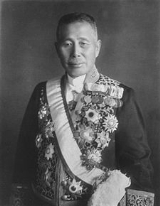
Tanaka Giichi

Encyclopedia
Baron
was a general in the Imperial Japanese Army
, politician, and the 26th Prime Minister of Japan
from 20 April 1927 to 2 July 1929.
family in Hagi
, Nagato Province
(modern day Yamaguchi Prefecture
), Japan. He graduated from the Imperial Japanese Army Academy and the 8th class of the Army War College
in 1892, and served in the First Sino-Japanese War
.
After the end of the war, he was sent as a military attaché
to Moscow and Petrograd, and was in Russia
at the same time as Takeo Hirose
of the Imperial Japanese Navy
, with whom he became close friends.Tanaka was fluent in the Russian language
, which he learned while attending mass every Sunday at a Russian Orthodox church, which enabled him to practice his Russian at church social events, although it is uncertain if he ever actually converted to Christianity.
Later in the Russo-Japanese War
, he served as aide to General Kodama Gentarō in Manchuria
. In 1906, Tanaka helped draft a defense plan which was so highly regarded by the Imperial Japanese Army General Staff and General Yamagata Aritomo
that it was adopted by as basic policy until World War I
. He was also awarded the Order of the Golden Kite
(3rd class) in April 1906.
In 1911, Tanaka was promoted to major general
, and was made director of the Military Affairs Bureau at the Army Ministry, where he recommended an increase in the strength of the standing army by two additionalinfantry
divisions. He was awarded the Order of the Sacred Treasure
(1st class) in September 1918.
Promoted to full general in 1920, he served as War Minister
under Prime Minister
s Hara Takashi
(1918–21) and the 2nd Yamamoto
administrations (1923–24), during which time he backed the Siberian Intervention
. He was awarded the Order of the Rising Sun
(1st class) in September 1920.
After retiring from the army, he was invited to accept the post of party president of the Rikken Seiyukai
political party in 1925, and was made a member of the House of Peers
. He was later elevated to the title of danshaku (Baron
) under the kazoku
peerage system. Tanaka had been scheduled to be promoted to the rank of Field Marshal
at the time of his retirement. However, when news reached the ears of the Army Ministry of a 3 million Yen bonus that Tanaka received on agreeing to join the Rikken Seiyukai, the promotion was denied.
on 20 April 1927, during the Shōwa financial crisis, serving simultaneously as the Foreign Affairs Minister
. He later added the posts of Home Minister
(4 May 1928 to 23 May 1928), and Colonial Affairs Minister
(10 June 1929 to 2 July 1929) to his portfolio.
On the domestic front, Tanaka attempted to suppress leftists, Communists and suspected Communist sympathizers through widespread arrests (the 15 March incident of 1928, and the 19 April incident of 1929).
In foreign affairs, he continued the aggressive interventionist policies he began as a military officer in China, Manchuria and Mongolia
. On three separate occasions in 1927–1928 he sent troops to intervene militarily in China to block Chang Kai-shek’s Northern Expedition to unify China under Kuomingtang rule, in what became known as the Jinan Incident
.
Tanaka came into office even as forces were already beginning to converge that would draw Japan into World War II
. In 1928, however, the machinations of the ultranationalist secret societies and the Kwantung Army resulted in a crisis: the assassination of the Manchurian warlord Zhang Zuolin
and the failed attempt to seize Manchuria
. Tanaka himself was taken by surprise by the assassination plot, and argued that the officers responsible should be publicly court-martial
ed for homicide. The military establishment, from which Tanaka was by now estranged, insisted on covering up the facts of the incident, which remained an official secret. Bereft of support, and under mounting criticism in Diet
and even from Emperor Hirohito himself, Tanaka and his cabinet resigned en masse on 2 July 1929.
Tanaka was succeeded by Hamaguchi Osachi
, and died a few months later after his resignation. He was awarded the Order of the Paulownia Flowers
on his death. His grave is at the Tama Reien Cemetery in Fuchū, Tokyo
.
Imperialist Conquest Plan", which advocated the conquest of Manchuria, Mongolia, and eventually the whole of China. He was alleged to have presented the plan to the Emperor in 1927. Today, most Japanese and western historians regard the document as a forgery. In another viewpoint, a memorial published in the mid-1950s, a Japanese-born Taiwanese businessman Tsai Chih-Kan, claimed that he had personally copied the "Plan" from the Imperial Library on the night of 20 June 1928, in a covert action assisted by several of Japan's leading pre-war politicians and officers who were opposed to Tanaka. Per this account, many Chinese history textbooks consider the document as authentic.
|-
|-
|-
|-
|-
Baron
Baron is a title of nobility. The word baron comes from Old French baron, itself from Old High German and Latin baro meaning " man, warrior"; it merged with cognate Old English beorn meaning "nobleman"...
was a general in the Imperial Japanese Army
Imperial Japanese Army
-Foundation:During the Meiji Restoration, the military forces loyal to the Emperor were samurai drawn primarily from the loyalist feudal domains of Satsuma and Chōshū...
, politician, and the 26th Prime Minister of Japan
Prime Minister of Japan
The is the head of government of Japan. He is appointed by the Emperor of Japan after being designated by the Diet from among its members, and must enjoy the confidence of the House of Representatives to remain in office...
from 20 April 1927 to 2 July 1929.
Early life and military career
Tanaka was born to a samuraiSamurai
is the term for the military nobility of pre-industrial Japan. According to translator William Scott Wilson: "In Chinese, the character 侍 was originally a verb meaning to wait upon or accompany a person in the upper ranks of society, and this is also true of the original term in Japanese, saburau...
family in Hagi
Hagi, Yamaguchi
is a city located in Yamaguchi, Japan and was incorporated as a city on July 1, 1932. Formerly part of Abu District.On March 6, 2005, the former city of Hagi merged with the towns of Susa and Tamagawa, and the villages of Asahi, Fukue, Kawakami and Mutsumi to form the new city of Hagi.Iwami Airport...
, Nagato Province
Nagato Province
, often called , was a province of Japan. It was at the extreme western end of Honshū, in the area that is today Yamaguchi Prefecture. Nagato bordered on Iwami and Suō Provinces....
(modern day Yamaguchi Prefecture
Yamaguchi Prefecture
is a prefecture of Japan in the Chūgoku region on Honshū island. The capital is the city of Yamaguchi, in the center of the prefecture. The largest city, however, is Shimonoseki.- History :...
), Japan. He graduated from the Imperial Japanese Army Academy and the 8th class of the Army War College
Army War College (Japan)
The ; Short form: of the Empire of Japan was founded in 1882 in Minato, Tokyo to modernize and Westernize the Imperial Japanese Army. Much of the empire's elite including prime ministers during the period of Japanese militarism were graduates of the college....
in 1892, and served in the First Sino-Japanese War
First Sino-Japanese War
The First Sino-Japanese War was fought between Qing Dynasty China and Meiji Japan, primarily over control of Korea...
.
After the end of the war, he was sent as a military attaché
Military attaché
A military attaché is a military expert who is attached to a diplomatic mission . This post is normally filled by a high-ranking military officer who retains the commission while serving in an embassy...
to Moscow and Petrograd, and was in Russia
Russia
Russia or , officially known as both Russia and the Russian Federation , is a country in northern Eurasia. It is a federal semi-presidential republic, comprising 83 federal subjects...
at the same time as Takeo Hirose
Takeo Hirose
, was an officer in the Imperial Japanese Navy. His selfless sacrifice during the Russo-Japanese War elevated him to the status of a deified national hero....
of the Imperial Japanese Navy
Imperial Japanese Navy
The Imperial Japanese Navy was the navy of the Empire of Japan from 1869 until 1947, when it was dissolved following Japan's constitutional renunciation of the use of force as a means of settling international disputes...
, with whom he became close friends.Tanaka was fluent in the Russian language
Russian language
Russian is a Slavic language used primarily in Russia, Belarus, Uzbekistan, Kazakhstan, Tajikistan and Kyrgyzstan. It is an unofficial but widely spoken language in Ukraine, Moldova, Latvia, Turkmenistan and Estonia and, to a lesser extent, the other countries that were once constituent republics...
, which he learned while attending mass every Sunday at a Russian Orthodox church, which enabled him to practice his Russian at church social events, although it is uncertain if he ever actually converted to Christianity.
Later in the Russo-Japanese War
Russo-Japanese War
The Russo-Japanese War was "the first great war of the 20th century." It grew out of rival imperial ambitions of the Russian Empire and Japanese Empire over Manchuria and Korea...
, he served as aide to General Kodama Gentarō in Manchuria
Manchuria
Manchuria is a historical name given to a large geographic region in northeast Asia. Depending on the definition of its extent, Manchuria usually falls entirely within the People's Republic of China, or is sometimes divided between China and Russia. The region is commonly referred to as Northeast...
. In 1906, Tanaka helped draft a defense plan which was so highly regarded by the Imperial Japanese Army General Staff and General Yamagata Aritomo
Yamagata Aritomo
Field Marshal Prince , also known as Yamagata Kyōsuke, was a field marshal in the Imperial Japanese Army and twice Prime Minister of Japan. He is considered one of the architects of the military and political foundations of early modern Japan. Yamagata Aritomo can be seen as the father of Japanese...
that it was adopted by as basic policy until World War I
World War I
World War I , which was predominantly called the World War or the Great War from its occurrence until 1939, and the First World War or World War I thereafter, was a major war centred in Europe that began on 28 July 1914 and lasted until 11 November 1918...
. He was also awarded the Order of the Golden Kite
Order of the Golden Kite
The ' was an order of the Empire of Japan, established on 12 February 1890 by Emperor Meiji "in commemoration of Jimmu Tennō, the Romulus of Japan."-Background:...
(3rd class) in April 1906.
In 1911, Tanaka was promoted to major general
Major General
Major general or major-general is a military rank used in many countries. It is derived from the older rank of sergeant major general. A major general is a high-ranking officer, normally subordinate to the rank of lieutenant general and senior to the ranks of brigadier and brigadier general...
, and was made director of the Military Affairs Bureau at the Army Ministry, where he recommended an increase in the strength of the standing army by two additionalinfantry
Infantry
Infantrymen are soldiers who are specifically trained for the role of fighting on foot to engage the enemy face to face and have historically borne the brunt of the casualties of combat in wars. As the oldest branch of combat arms, they are the backbone of armies...
divisions. He was awarded the Order of the Sacred Treasure
Order of the Sacred Treasure
The is a Japanese Order, established on January 4, 1888 by Emperor Meiji of Japan as the Order of Meiji. It is awarded in eight classes . It is generally awarded for long and/or meritorious service and considered to be the lowest of the Japanese orders of merit...
(1st class) in September 1918.
Promoted to full general in 1920, he served as War Minister
Ministry of War of Japan
The , more popularly known as the Ministry of War of Japan, was cabinet-level ministry in the Empire of Japan charged with the administrative affairs of the Imperial Japanese Army...
under Prime Minister
Prime Minister of Japan
The is the head of government of Japan. He is appointed by the Emperor of Japan after being designated by the Diet from among its members, and must enjoy the confidence of the House of Representatives to remain in office...
s Hara Takashi
Hara Takashi
was a Japanese politician and the 19th Prime Minister of Japan from 29 September 1918 to 4 November 1921. He was also called Hara Kei informally. He was the first commoner appointed to the office of prime minister of Japan...
(1918–21) and the 2nd Yamamoto
Yamamoto Gonnohyoe
, also called Gonnohyōe, was an admiral in the Imperial Japanese Navy and the 16th and 22nd Prime Minister of Japan.-Early life:...
administrations (1923–24), during which time he backed the Siberian Intervention
Siberian Intervention
The ', or the Siberian Expedition, of 1918–1922 was the dispatch of troops of the Entente powers to the Russian Maritime Provinces as part of a larger effort by the western powers and Japan to support White Russian forces against the Bolshevik Red Army during the Russian Civil War...
. He was awarded the Order of the Rising Sun
Order of the Rising Sun
The is a Japanese order, established in 1875 by Emperor Meiji of Japan. The Order was the first national decoration awarded by the Japanese Government, created on April 10, 1875 by decree of the Council of State. The badge features rays of sunlight from the rising sun...
(1st class) in September 1920.
After retiring from the army, he was invited to accept the post of party president of the Rikken Seiyukai
Rikken Seiyukai
The was one of the main political parties in the pre-war Empire of Japan. It was also known simply as the ‘Seiyūkai'Founded on September 15, 1900 by Itō Hirobumi , the Seiyūkai was a pro-government alliance of bureaucrats and former members of the Kenseitō. The Seiyūkai was the most powerful...
political party in 1925, and was made a member of the House of Peers
House of Peers (Japan)
The ' was the upper house of the Imperial Diet as mandated under the Constitution of the Empire of Japan ....
. He was later elevated to the title of danshaku (Baron
Baron
Baron is a title of nobility. The word baron comes from Old French baron, itself from Old High German and Latin baro meaning " man, warrior"; it merged with cognate Old English beorn meaning "nobleman"...
) under the kazoku
Kazoku
The was the hereditary peerage of the Empire of Japan that existed between 1869 and 1947.-Origins:Following the Meiji Restoration of 1868, the ancient court nobility of Kyoto regained some of its lost status...
peerage system. Tanaka had been scheduled to be promoted to the rank of Field Marshal
Field Marshal (Japan)
was the highest title in the prewar Imperial Japanese Military.The term gensui, which was used for both the Imperial Japanese Army and the Imperial Japanese Navy, was at first a rank held by Saigō Takamori as the Commander of the Armies in 1872...
at the time of his retirement. However, when news reached the ears of the Army Ministry of a 3 million Yen bonus that Tanaka received on agreeing to join the Rikken Seiyukai, the promotion was denied.
As Prime Minister
Tanaka became Prime Minister of JapanPrime Minister of Japan
The is the head of government of Japan. He is appointed by the Emperor of Japan after being designated by the Diet from among its members, and must enjoy the confidence of the House of Representatives to remain in office...
on 20 April 1927, during the Shōwa financial crisis, serving simultaneously as the Foreign Affairs Minister
Minister for Foreign Affairs (Japan)
The of Japan is the Cabinet member responsible for Japanese foreign policy and the chief executive of the Ministry of Foreign Affairs.Since the end of the American occupation of Japan, the position has been one of the most powerful in the Cabinet, as Japan's economic interests have long relied on...
. He later added the posts of Home Minister
Home Ministry (Japan)
The ' was a Cabinet-level ministry established under the Meiji Constitution that managed the internal affairs of Empire of Japan from 1873-1947...
(4 May 1928 to 23 May 1928), and Colonial Affairs Minister
Ministry of Colonial Affairs
The was a cabinet-level ministry in the government of the Empire of Japan from 1923-1942.-History:The original Ministry of Colonial Affairs was the short-lived Hokkaidō Colonization Office, established in the early Meiji period by Prime Minister Kuroda Kiyotaka to protect Japan's sparely populated...
(10 June 1929 to 2 July 1929) to his portfolio.
On the domestic front, Tanaka attempted to suppress leftists, Communists and suspected Communist sympathizers through widespread arrests (the 15 March incident of 1928, and the 19 April incident of 1929).
In foreign affairs, he continued the aggressive interventionist policies he began as a military officer in China, Manchuria and Mongolia
Mongolia
Mongolia is a landlocked country in East and Central Asia. It is bordered by Russia to the north and China to the south, east and west. Although Mongolia does not share a border with Kazakhstan, its western-most point is only from Kazakhstan's eastern tip. Ulan Bator, the capital and largest...
. On three separate occasions in 1927–1928 he sent troops to intervene militarily in China to block Chang Kai-shek’s Northern Expedition to unify China under Kuomingtang rule, in what became known as the Jinan Incident
Jinan Incident
The Jinan Incident or May 3rd Tragedy , was an armed conflict between the Japanese Army allied with Northern Chinese warlords against the Kuomintang's southern army in Jinan, the capital of Shandong in 1928 during the Kuomintang's Northern Expedition.-Background:During the Northern Expedition,...
.
Tanaka came into office even as forces were already beginning to converge that would draw Japan into World War II
World War II
World War II, or the Second World War , was a global conflict lasting from 1939 to 1945, involving most of the world's nations—including all of the great powers—eventually forming two opposing military alliances: the Allies and the Axis...
. In 1928, however, the machinations of the ultranationalist secret societies and the Kwantung Army resulted in a crisis: the assassination of the Manchurian warlord Zhang Zuolin
Zhang Zuolin
Zhang Zuolin was the warlord of Manchuria from 1916 to 1928 . He successfully invaded China proper in October 1924 in the Second Zhili-Fengtian War. He gained control of Peking, including China's internationally recognized government, in April 1926...
and the failed attempt to seize Manchuria
Manchuria
Manchuria is a historical name given to a large geographic region in northeast Asia. Depending on the definition of its extent, Manchuria usually falls entirely within the People's Republic of China, or is sometimes divided between China and Russia. The region is commonly referred to as Northeast...
. Tanaka himself was taken by surprise by the assassination plot, and argued that the officers responsible should be publicly court-martial
Court-martial
A court-martial is a military court. A court-martial is empowered to determine the guilt of members of the armed forces subject to military law, and, if the defendant is found guilty, to decide upon punishment.Most militaries maintain a court-martial system to try cases in which a breach of...
ed for homicide. The military establishment, from which Tanaka was by now estranged, insisted on covering up the facts of the incident, which remained an official secret. Bereft of support, and under mounting criticism in Diet
Diet of Japan
The is Japan's bicameral legislature. It is composed of a lower house, called the House of Representatives, and an upper house, called the House of Councillors. Both houses of the Diet are directly elected under a parallel voting system. In addition to passing laws, the Diet is formally...
and even from Emperor Hirohito himself, Tanaka and his cabinet resigned en masse on 2 July 1929.
Tanaka was succeeded by Hamaguchi Osachi
Hamaguchi Osachi
was a Japanese politician and the 27th Prime Minister of Japan from 2 July 1929 to 14 April 1931. He was called the "Lion prime minister" due to his physical features.-Early life:...
, and died a few months later after his resignation. He was awarded the Order of the Paulownia Flowers
Order of the Paulownia Flowers
The ' is an order presented by the Japanese Government. Established in 1888 during the Meiji Restoration as the highest award in the Order of the Rising Sun; however, since 2003 it has been an Order in its own right...
on his death. His grave is at the Tama Reien Cemetery in Fuchū, Tokyo
Fuchu, Tokyo
is a city located in western Tokyo Metropolis, Japan. As of 2010, the city has an estimated population of 255,394 and a population density of 8,700 persons per km². The total area was 29.34 km²...
.
The Tanaka Memorial
In 1929, China accused Tanaka of having authored the "Tanaka MemorialTanaka Memorial
The is an alleged Japanese strategic planning document from 1927, in which Prime Minister Baron Tanaka Giichi laid out for the Emperor Hirohito a strategy to take over the world...
Imperialist Conquest Plan", which advocated the conquest of Manchuria, Mongolia, and eventually the whole of China. He was alleged to have presented the plan to the Emperor in 1927. Today, most Japanese and western historians regard the document as a forgery. In another viewpoint, a memorial published in the mid-1950s, a Japanese-born Taiwanese businessman Tsai Chih-Kan, claimed that he had personally copied the "Plan" from the Imperial Library on the night of 20 June 1928, in a covert action assisted by several of Japan's leading pre-war politicians and officers who were opposed to Tanaka. Per this account, many Chinese history textbooks consider the document as authentic.
Awards and Decorations
- Order of the Golden KiteOrder of the Golden KiteThe ' was an order of the Empire of Japan, established on 12 February 1890 by Emperor Meiji "in commemoration of Jimmu Tennō, the Romulus of Japan."-Background:...
, 3rd class - Grand Cordon of the Order of the Rising SunOrder of the Rising SunThe is a Japanese order, established in 1875 by Emperor Meiji of Japan. The Order was the first national decoration awarded by the Japanese Government, created on April 10, 1875 by decree of the Council of State. The badge features rays of sunlight from the rising sun...
- Grand Cordon of the Order of the Sacred TreasureOrder of the Sacred TreasureThe is a Japanese Order, established on January 4, 1888 by Emperor Meiji of Japan as the Order of Meiji. It is awarded in eight classes . It is generally awarded for long and/or meritorious service and considered to be the lowest of the Japanese orders of merit...
- Knight Grand Cross of the Order of the British EmpireOrder of the British EmpireThe Most Excellent Order of the British Empire is an order of chivalry established on 4 June 1917 by George V of the United Kingdom. The Order comprises five classes in civil and military divisions...
- Knight Commander of the Order of St Michael and St GeorgeOrder of St Michael and St GeorgeThe Most Distinguished Order of Saint Michael and Saint George is an order of chivalry founded on 28 April 1818 by George, Prince Regent, later George IV of the United Kingdom, while he was acting as Prince Regent for his father, George III....
- Order of the Striped Tiger, 1st Class
External links
- Biography at infoplease.com
- Columbia Encyclopedia entry at bartleby.com
- Official lifespan at kantei.go.jp
|-
|-
|-
|-
|-