


Tamanend

Encyclopedia
Tamanend or Tammany or Tammamend, the "affable", (c. 1628–1698) was a chief of one of the clans that made up the Lenni-Lenape
nation in the Delaware Valley
at the time Philadelphia was established. Tamanend is best known as a lover of peace and friendship who played a prominent role in the establishment of peaceful relations among the Native American
tribes and the English settlers who established Pennsylvania
, led by William Penn
.
Tamanend reputedly took part in a meeting between the leaders of the Lenni-Lenape nation, and the leaders of the Pennsylvania colony held under a large elm tree at Shakamaxon
in the early 1680s. There, Tamanend is reported to have announced that the Lenni-Lenape and the English colonists would "live in peace as long as the waters run in the rivers and creeks and as long as the stars and moon endure." These words have been memorialized on the statue of Tamanend that stands in Philadelphia today.
It is believed that Tamanend died in 1698. Over the next century, many folk legends surrounded Tamanend and his fame assumed mythical proportions among the people of Philadelphia, who began to call him "King Tammany," "Saint Tammany," and the "Patron Saint of America." The people of Philadelphia also organized a Tammany society and an annual Tammany festival. These traditions soon spread across America. The reason for Tammany's popular status can be attributed to the need that patriotic colonists had to express a distinct "American" identity, in place of their former European nationalities. Tammany, an American Indian, provided an apt symbol for patriotic Americans to identify with.
Because of Philadelphia's political significance during the founding of the United States of America, Tammany soon became a national symbol throughout much of the newly formed country.
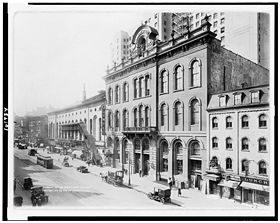 In 1772, the original Tammany Society was formed in Philadelphia (it was originally called the "Sons of King Tammany" but was later renamed the "Sons of St. Tammany"). Soon, Tammany societies began to appear from Georgia to Rhode Island to the Ohio River. The most famous of these was New York City's Society of St. Tammany, which grew into a major political machine
known as "Tammany Hall
." A white marble statue of Tamanend adorned the façade
of the building on East 14th Street that housed Tammany Hall.
traditions of Europe. The festivals also continued many of the features of the traditional May Day celebrations. For example, the Saint Tammany Day celebrated on May 1, 1771, in Annapolis had a may pole decorated with ribbons. People danced in Native American style to music while holding a ribbon and moving in a circle around the pole.
On May 1, 1777, John Adams
wrote of the Tammany festival in Philadelphia during the American Revolutionary War
. Adams, who was in Philadelphia attending the Second Continental Congress
as a delegate from Massachusetts, wrote a letter home to his wife, Abigail Adams
, which said:
"This is King Tammany's Day. Tammany was an Indian King, of this past of the Continent, when Mr. Penn first came here. His court was in this town. He was friendly to Mr. Penn and very serviceable to him. He lived here among the first settlers for some time and until old age. ... The people here have sainted him and keep his day" (Lyman H. Butterfield, ed., Adams Family Correspondence; Cambridge: Harvard University Press, 1963-1973, II, pp. 229-230).
On May 1, 1778, General George Washington
and the Continental Army
held a Tammany festival while camped at Valley Forge
. The "men spent the day in mirth and jollity...in honor of King Tammany" (Military Journal of George Ewing, 1928).
After the end of the Revolutionary War, Tammany celebrations spread throughout America, as far away as Savannah, Georgia. Wherever a Tammany Society had been established, the society would promote a local Tammany festival. Many calendars of the time listed "Saint Tammany's Festival" on May 1.
Tammany celebrations were such important events that, in 1785, George Washington appeared at the Tammany festival in Richmond, Virginia with Virginia governor Patrick Henry
. In 1787, New York City first began to have a Tammany festival.
s were introduced in the United States Congress
(Senate Concurrent Resolution 39 and House Concurrent Resolution 123) that sought to establish "St. Tammany Day" on May 1 as a national day of recognition
. The bills were referred for review to the Subcommittee on Civil Service and Agency Organization, which is a subcommittee of the House Committee on Government Reform
. As of December 2006, the Subcommittee has yet to take any action on the bill.
's tremendously popular "Tammany: The Indian Chief" premiered on Broadway
. It was the first major opera libretto
written in the United States that had an American theme and it was the earliest drama about American Indians. The opera premiered at the John Street Theatre, New York, on 3rd March 1794 and featured the English actress and 'grande dame' of American theatre, Charlotte Melmoth
. Melmoth refused to speak the opera's epilogue, as she disapproved of its patriotic sentiments, leading to the New York Journal calling on the public to boycott the play as long as Melmoth was still in the cast.
In 1826, Tammany appeared (as "Tamenund") at the conclusion of The Last of the Mohicans
, a novel which was extremely popular in the antebellum United States. The novel was written by James Fenimore Cooper
(one of the first popular American novelists) and was part of the Leatherstocking Tales
(which had a significant impact on both American literary culture and the emerging nation's identity).
A statue of a Native American, marked Tamanend, is shown in the lobby outside Tammany Hall
in the film Gangs of New York
.
Lenape
The Lenape are an Algonquian group of Native Americans of the Northeastern Woodlands. They are also called Delaware Indians. As a result of the American Revolutionary War and later Indian removals from the eastern United States, today the main groups live in Canada, where they are enrolled in the...
nation in the Delaware Valley
Delaware Valley
The Delaware Valley is a term used to refer to the valley where the Delaware River flows, along with the surrounding communities. This includes the metropolitan area centered on the city of Philadelphia. Such educational institutions as Delaware Valley Regional High School in Alexandria Township...
at the time Philadelphia was established. Tamanend is best known as a lover of peace and friendship who played a prominent role in the establishment of peaceful relations among the Native American
Native Americans in the United States
Native Americans in the United States are the indigenous peoples in North America within the boundaries of the present-day continental United States, parts of Alaska, and the island state of Hawaii. They are composed of numerous, distinct tribes, states, and ethnic groups, many of which survive as...
tribes and the English settlers who established Pennsylvania
Pennsylvania
The Commonwealth of Pennsylvania is a U.S. state that is located in the Northeastern and Mid-Atlantic regions of the United States. The state borders Delaware and Maryland to the south, West Virginia to the southwest, Ohio to the west, New York and Ontario, Canada, to the north, and New Jersey to...
, led by William Penn
William Penn
William Penn was an English real estate entrepreneur, philosopher, and founder of the Province of Pennsylvania, the English North American colony and the future Commonwealth of Pennsylvania. He was an early champion of democracy and religious freedom, notable for his good relations and successful...
.
Tamanend reputedly took part in a meeting between the leaders of the Lenni-Lenape nation, and the leaders of the Pennsylvania colony held under a large elm tree at Shakamaxon
Shackamaxon
Shackamaxon or Shakamaxon was a historic village along the Delaware River inhabited by Delaware Indians in North America. It was located within what are now the borders of the city of Philadelphia, Pennsylvania, United States....
in the early 1680s. There, Tamanend is reported to have announced that the Lenni-Lenape and the English colonists would "live in peace as long as the waters run in the rivers and creeks and as long as the stars and moon endure." These words have been memorialized on the statue of Tamanend that stands in Philadelphia today.
It is believed that Tamanend died in 1698. Over the next century, many folk legends surrounded Tamanend and his fame assumed mythical proportions among the people of Philadelphia, who began to call him "King Tammany," "Saint Tammany," and the "Patron Saint of America." The people of Philadelphia also organized a Tammany society and an annual Tammany festival. These traditions soon spread across America. The reason for Tammany's popular status can be attributed to the need that patriotic colonists had to express a distinct "American" identity, in place of their former European nationalities. Tammany, an American Indian, provided an apt symbol for patriotic Americans to identify with.
Because of Philadelphia's political significance during the founding of the United States of America, Tammany soon became a national symbol throughout much of the newly formed country.
Tammany Societies
Political machine
A political machine is a political organization in which an authoritative boss or small group commands the support of a corps of supporters and businesses , who receive rewards for their efforts...
known as "Tammany Hall
Tammany Hall
Tammany Hall, also known as the Society of St. Tammany, the Sons of St. Tammany, or the Columbian Order, was a New York political organization founded in 1786 and incorporated on May 12, 1789 as the Tammany Society...
." A white marble statue of Tamanend adorned the façade
Facade
A facade or façade is generally one exterior side of a building, usually, but not always, the front. The word comes from the French language, literally meaning "frontage" or "face"....
of the building on East 14th Street that housed Tammany Hall.
Tammany Festivals
By the early 1770s, annual Tammany Festivals occurred in Philadelphia and Annapolis. The festivals were held on May 1, replacing the May DayMay Day
May Day on May 1 is an ancient northern hemisphere spring festival and usually a public holiday; it is also a traditional spring holiday in many cultures....
traditions of Europe. The festivals also continued many of the features of the traditional May Day celebrations. For example, the Saint Tammany Day celebrated on May 1, 1771, in Annapolis had a may pole decorated with ribbons. People danced in Native American style to music while holding a ribbon and moving in a circle around the pole.
On May 1, 1777, John Adams
John Adams
John Adams was an American lawyer, statesman, diplomat and political theorist. A leading champion of independence in 1776, he was the second President of the United States...
wrote of the Tammany festival in Philadelphia during the American Revolutionary War
American Revolutionary War
The American Revolutionary War , the American War of Independence, or simply the Revolutionary War, began as a war between the Kingdom of Great Britain and thirteen British colonies in North America, and ended in a global war between several European great powers.The war was the result of the...
. Adams, who was in Philadelphia attending the Second Continental Congress
Second Continental Congress
The Second Continental Congress was a convention of delegates from the Thirteen Colonies that started meeting on May 10, 1775, in Philadelphia, Pennsylvania, soon after warfare in the American Revolutionary War had begun. It succeeded the First Continental Congress, which met briefly during 1774,...
as a delegate from Massachusetts, wrote a letter home to his wife, Abigail Adams
Abigail Adams
Abigail Adams was the wife of John Adams, who was the second President of the United States, and the mother of John Quincy Adams, the sixth...
, which said:
"This is King Tammany's Day. Tammany was an Indian King, of this past of the Continent, when Mr. Penn first came here. His court was in this town. He was friendly to Mr. Penn and very serviceable to him. He lived here among the first settlers for some time and until old age. ... The people here have sainted him and keep his day" (Lyman H. Butterfield, ed., Adams Family Correspondence; Cambridge: Harvard University Press, 1963-1973, II, pp. 229-230).
On May 1, 1778, General George Washington
George Washington
George Washington was the dominant military and political leader of the new United States of America from 1775 to 1799. He led the American victory over Great Britain in the American Revolutionary War as commander-in-chief of the Continental Army from 1775 to 1783, and presided over the writing of...
and the Continental Army
Continental Army
The Continental Army was formed after the outbreak of the American Revolutionary War by the colonies that became the United States of America. Established by a resolution of the Continental Congress on June 14, 1775, it was created to coordinate the military efforts of the Thirteen Colonies in...
held a Tammany festival while camped at Valley Forge
Valley Forge
Valley Forge in Pennsylvania was the site of the military camp of the American Continental Army over the winter of 1777–1778 in the American Revolutionary War.-History:...
. The "men spent the day in mirth and jollity...in honor of King Tammany" (Military Journal of George Ewing, 1928).
After the end of the Revolutionary War, Tammany celebrations spread throughout America, as far away as Savannah, Georgia. Wherever a Tammany Society had been established, the society would promote a local Tammany festival. Many calendars of the time listed "Saint Tammany's Festival" on May 1.
Tammany celebrations were such important events that, in 1785, George Washington appeared at the Tammany festival in Richmond, Virginia with Virginia governor Patrick Henry
Patrick Henry
Patrick Henry was an orator and politician who led the movement for independence in Virginia in the 1770s. A Founding Father, he served as the first and sixth post-colonial Governor of Virginia from 1776 to 1779 and subsequently, from 1784 to 1786...
. In 1787, New York City first began to have a Tammany festival.
Developments since 2003
In 2003, two identical concurrent resolutionConcurrent resolution
A concurrent resolution is a resolution adopted by both houses of a bicameral legislature that lacks the force of law and does not require the approval of the chief executive.-United States Congress:...
s were introduced in the United States Congress
United States Congress
The United States Congress is the bicameral legislature of the federal government of the United States, consisting of the Senate and the House of Representatives. The Congress meets in the United States Capitol in Washington, D.C....
(Senate Concurrent Resolution 39 and House Concurrent Resolution 123) that sought to establish "St. Tammany Day" on May 1 as a national day of recognition
Public holidays of the United States
The United States does not have national holidays in the sense of days on which all employees in the U.S. receive a day free from work and all business is halted. The U.S. federal government can only recognize national holidays that pertain to its own employees; it is at the discretion of each...
. The bills were referred for review to the Subcommittee on Civil Service and Agency Organization, which is a subcommittee of the House Committee on Government Reform
United States House Committee on Government Reform
The Committee on Oversight and Government Reform is a United States House of Representatives committee that has existed in varying forms since 1816....
. As of December 2006, the Subcommittee has yet to take any action on the bill.
Other Tammany appearances in popular culture
In 1794, Ann Julia HattonAnn Hatton
Ann Julia Hatton , was a popular novelist in Britain in the early 19th century.-Biography:...
's tremendously popular "Tammany: The Indian Chief" premiered on Broadway
Broadway theatre
Broadway theatre, commonly called simply Broadway, refers to theatrical performances presented in one of the 40 professional theatres with 500 or more seats located in the Theatre District centered along Broadway, and in Lincoln Center, in Manhattan in New York City...
. It was the first major opera libretto
Libretto
A libretto is the text used in an extended musical work such as an opera, operetta, masque, oratorio, cantata, or musical. The term "libretto" is also sometimes used to refer to the text of major liturgical works, such as mass, requiem, and sacred cantata, or even the story line of a...
written in the United States that had an American theme and it was the earliest drama about American Indians. The opera premiered at the John Street Theatre, New York, on 3rd March 1794 and featured the English actress and 'grande dame' of American theatre, Charlotte Melmoth
Charlotte Melmoth
Mrs Charlotte Melmoth was an 18th-century English actress, the estranged 'wife' of British actor/writer Samuel Jackson Pratt , and known as "The Grande Dame of Tragedy on the Early American Stage" After a mildly-successful stage career in Britain and Ireland she emigrated to America in 1793 and...
. Melmoth refused to speak the opera's epilogue, as she disapproved of its patriotic sentiments, leading to the New York Journal calling on the public to boycott the play as long as Melmoth was still in the cast.
In 1826, Tammany appeared (as "Tamenund") at the conclusion of The Last of the Mohicans
The Last of the Mohicans
The Last of the Mohicans: A Narrative of 1757 is a historical novel by James Fenimore Cooper, first published in February 1826. It is the second book of the Leatherstocking Tales pentalogy and the best known...
, a novel which was extremely popular in the antebellum United States. The novel was written by James Fenimore Cooper
James Fenimore Cooper
James Fenimore Cooper was a prolific and popular American writer of the early 19th century. He is best remembered as a novelist who wrote numerous sea-stories and the historical novels known as the Leatherstocking Tales, featuring frontiersman Natty Bumppo...
(one of the first popular American novelists) and was part of the Leatherstocking Tales
Leatherstocking Tales
The Leatherstocking Tales is a series of novels by American writer James Fenimore Cooper, each featuring the main hero Natty Bumppo, known by European settlers as "Leatherstocking," 'The Pathfinder", and "the trapper" and by the Native Americans as "Deerslayer," "La Longue Carabine" and...
(which had a significant impact on both American literary culture and the emerging nation's identity).
A statue of a Native American, marked Tamanend, is shown in the lobby outside Tammany Hall
Tammany Hall
Tammany Hall, also known as the Society of St. Tammany, the Sons of St. Tammany, or the Columbian Order, was a New York political organization founded in 1786 and incorporated on May 12, 1789 as the Tammany Society...
in the film Gangs of New York
Gangs of New York
Gangs of New York is a 2002 historical film set in the mid-19th century in the Five Points district of New York City. It was directed by Martin Scorsese and written by Jay Cocks, Steven Zaillian, and Kenneth Lonergan. The film was inspired by Herbert Asbury's 1928 nonfiction book, The Gangs of New...
.
Statues, monuments, and other mentions of Tamanend/Tammany
- Philadelphia has a statue of Tamanend located at the intersection of historic Market StreetMarket Street (Philadelphia)Market Street, originally known as High Street, is a major east–west street in Philadelphia, Pennsylvania. For the majority of its length, it serves as Pennsylvania Route 3....
with Front Street. The statue is located between Old CityOld City, Philadelphia, PennsylvaniaOld City is a neighborhood in Center City, Philadelphia, Pennsylvania, United States, in the area near e Delaware River where William Penn and the Quakers first settled...
and Penn's LandingPenn's LandingPenn's Landing is the waterfront area of the Center City along the Delaware River section of Philadelphia, Pennsylvania, United States. It is so named because the founder of Pennsylvania, William Penn, docked near here in 1682, along the now paved over Dock Creek, after landing first in New...
, the riverfront area. The plaque notes that "Tamanend was considered the patron saint of America by the colonists prior to American Independence."
- The prominence on Kittatinny Mountain on the northeast (New Jersey) side of Delaware Water GapDelaware Water GapThe Delaware Water Gap is on the border of New Jersey and Pennsylvania where the Delaware River cuts through a large ridge of the Appalachian Mountains...
is named Mount TammanyMount TammanyMount Tammany is the southernmost peak of the Kittatinny Mountains in Warren County, New Jersey. It is tall, and forms the east side of the Delaware Water Gap. Across the Gap is Mount Minsi, on the Pennsylvania side of the river. The mountain is named after the Lenni Lenape chief Tamanend. It lies...
.
- The Gettysburg BattlefieldGettysburg BattlefieldThe Gettysburg Battlefield is the area of the July 1–3, 1863, military engagements of the Battle of Gettysburg within and around the borough of Gettysburg, Pennsylvania. Locations of military engagements extend from the 4 acre site of the first shot & at on the west of the borough, to East...
has a statue of Tamanend on a monument to the Tammany Regiment that fought at Gettysburg. During the Civil War, the Tammany Regiment was the nickname of the New York 42nd Infantry.
- The famous "Tecumseh Statue" at the United States Naval AcademyUnited States Naval AcademyThe United States Naval Academy is a four-year coeducational federal service academy located in Annapolis, Maryland, United States...
faces Tecumseh Court (in front of Bancroft HallBancroft HallBancroft Hall at the United States Naval Academy in Annapolis, Maryland, is the largest single dormitory in the world. Bancroft Hall, named after former Secretary of the Navy George Bancroft, is home for the entire brigade of 4,000 midshipmen, and contains some 1,700 rooms, of corridors, and of...
) where the Brigade of Midshipmen forms the daily Noon Meal Formation. The "Tecumseh Statue" is a bronze replica of the figurehead of the USS DelawareUSS Delaware (1820)The third USS Delaware of the United States Navy was a 74-gun ship of the line, named for the state of Delaware.She was laid down at Norfolk Navy Yard in August 1817 and launched on 21 October 1820...
. This bust, one of the most famous relics on the campus, is commonly known as TecumsehTecumsehTecumseh was a Native American leader of the Shawnee and a large tribal confederacy which opposed the United States during Tecumseh's War and the War of 1812...
. However, when it adorned the American man-of-war, it commemorated not Tecumseh but Tamanend. In times past, the bronze replica was considered a good-luck "mascot" for the midshipmen, who threw pennies at it and offered left-handed salutes whenever they wanted a 'favor', such as a sports win over West Point, or spiritual help for examinations. Today it is used as a morale booster during football weeks and on special occasions when "Tecumseh" is painted in themes to include super heroes, action heroes, humorous figures, a leprechaun (before Saint Patrick's Day) and a naval officer (during Commissioning Week).
- St. Tammany ParishSt. Tammany Parish, LouisianaSt. Tammany Parish is a parish located in the U.S. state of Louisiana, in the New Orleans–Metairie–Kenner Metropolitan Statistical Area. The parish seat is Covington....
is one of nine Louisiana parishes (counties) named for "saints" and the sole one whose eponym is not a "saint" as recognized by the Roman Catholic Church.