

Taiho Code

Encyclopedia
The was an administrative reorganization enacted in 701
in Japan
, at the end of the Asuka period
. It was historically one of the . It was compiled at the direction of Prince Osakabe
, Fujiwara no Fuhito
and Awata no Mahito. The work was begun at the request of Emperor Mommu
and, like many other developments in the country at the time, it was largely an adaptation of the governmental system of China
's Tang Dynasty
.
The establishment of the Taihō Code was one of the first events to include Confucianism
as a significant element in the Japanese code of ethics and government. The Code was revised during the Nara period
to accommodate certain Japanese traditions and practical necessities of administration. The revised edition was named the . Major work on the Yōrō Code was completed in 718. However, for some elements of the Code, Chinese logic and morals were taken to extremes.
The Taihō Code contained only two major departures from the Tang model. First, government positions and class status were based on birth, as had always been the Japanese tradition, not talent, as was the Chinese way. Second, the Japanese rejected the Chinese concept of the "Mandate of Heaven
," asserting that the Emperor's
power comes from his imperial descent, not from his righteousness or fairness as a ruler.
This code is said to be based on the , enacted in 651 the Chinese (Emperor Yonghui
).
The Jingi-kan, or Department of Worship, was responsible for annual festivals and official court ceremonies such as coronations, as well as the upkeep of shrines, the discipline of shrine wardens, and the recording and observation of oracles and divinations. It is important to note that the department, though it governed all the Shintō
shrines in the country, had no connection with Buddhism.
The Daijō-kan, or Department of State, handled all secular matters and was headed by the Great Council of State, which was presided over by the Daijō Daijin (太政大臣, Chancellor). The Ministers of the Left and Right (Sadaijin
左大臣 and Udaijin
右大臣 respectively), Controllers of the Left and Right (Sadaiben 左大弁 and Udaiben 右大弁), four Great Councillors (Dainagon 大納言) and three Minor Councillors (Shōnagon 少納言) made up the Council, and were responsible to the Daijō-daijin. The eight government Ministries were, in turn, responsible to the Controllers and Ministers of the Left and Right.
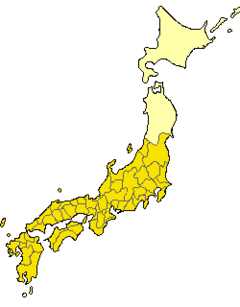 The country was divided into provinces called kuni (国), and the central government appointed administrative governors, kokushi (国司), divided into four levels (the Shitōkan), kami, suke, jo and sakan to each province. The provinces were further divided into districts
called gun (郡) or kōri, which were administered by locally appointed officials called gunji (郡司). These local officials were primarily responsible for keeping the peace, collecting taxes, recruiting labor for the corvée
, and for keeping registers of population and land allotment. Within the districts' further subdivisions, local organization varied greatly, but often resembled the arrangement of a township of fifty or so homes led by a headman.
The number of provinces was not fixed, however. As new land was developed, new provinces came into being. At the time of the Code's enactment, there were sixty-six provinces comprising 592 districts.
in Japan was adopted by both the kingdoms of the Korean peninsula and Japan at the same time.
According to Shoku Nihongi
, The participation member of Taihō Code was the 18 Japanese aristocrats and one Chinese
scholar (薩弘恪 Satsu Koukaku) Chinese scholar Satsu played an important role. He participated in the edit of Nihon Shoki
, and often received the reward from the Japanese emperor.
Any examinations of the earliest known texts become exercises in historiography
-- for example:
Although essential as a starting point, any list of serial events will reveal only part of the unfolding story - for example:
701
Year 701 was a common year starting on Saturday of the Julian calendar. The denomination 701 for this year has been used since the early medieval period, when the Anno Domini calendar era became the prevalent method in Europe for naming years.- Europe :* Wittiza succeeds his grandfather Ergica as...
in Japan
Japan
Japan is an island nation in East Asia. Located in the Pacific Ocean, it lies to the east of the Sea of Japan, China, North Korea, South Korea and Russia, stretching from the Sea of Okhotsk in the north to the East China Sea and Taiwan in the south...
, at the end of the Asuka period
Asuka period
The , was a period in the history of Japan lasting from 538 to 710 , although its beginning could be said to overlap with the preceding Kofun period...
. It was historically one of the . It was compiled at the direction of Prince Osakabe
Prince Osakabe
Prince Osakabe was a Japanese imperial prince who helped write the Taihō Code, alongside Fujiwara no Fuhito...
, Fujiwara no Fuhito
Fujiwara no Fuhito
Fujiwara no Fuhito was a powerful member of the imperial court of Japan during the Asuka and Nara periods...
and Awata no Mahito. The work was begun at the request of Emperor Mommu
Emperor Mommu
was the 42nd emperor of Japan, according to the traditional order of succession.Mommu's reign spanned the years from 697 through 707.-Traditional narrative:Before his ascension to the Chrysanthemum Throne, his personal name was Karu-shinnō....
and, like many other developments in the country at the time, it was largely an adaptation of the governmental system of China
China
Chinese civilization may refer to:* China for more general discussion of the country.* Chinese culture* Greater China, the transnational community of ethnic Chinese.* History of China* Sinosphere, the area historically affected by Chinese culture...
's Tang Dynasty
Tang Dynasty
The Tang Dynasty was an imperial dynasty of China preceded by the Sui Dynasty and followed by the Five Dynasties and Ten Kingdoms Period. It was founded by the Li family, who seized power during the decline and collapse of the Sui Empire...
.
The establishment of the Taihō Code was one of the first events to include Confucianism
Confucianism
Confucianism is a Chinese ethical and philosophical system developed from the teachings of the Chinese philosopher Confucius . Confucianism originated as an "ethical-sociopolitical teaching" during the Spring and Autumn Period, but later developed metaphysical and cosmological elements in the Han...
as a significant element in the Japanese code of ethics and government. The Code was revised during the Nara period
Nara period
The of the history of Japan covers the years from AD 710 to 794. Empress Gemmei established the capital of Heijō-kyō . Except for 5 years , when the capital was briefly moved again, it remained the capital of Japanese civilization until Emperor Kammu established a new capital, Nagaoka-kyō, in 784...
to accommodate certain Japanese traditions and practical necessities of administration. The revised edition was named the . Major work on the Yōrō Code was completed in 718. However, for some elements of the Code, Chinese logic and morals were taken to extremes.
The Taihō Code contained only two major departures from the Tang model. First, government positions and class status were based on birth, as had always been the Japanese tradition, not talent, as was the Chinese way. Second, the Japanese rejected the Chinese concept of the "Mandate of Heaven
Mandate of Heaven
The Mandate of Heaven is a traditional Chinese philosophical concept concerning the legitimacy of rulers. It is similar to the European concept of the divine right of kings, in that both sought to legitimaze rule from divine approval; however, unlike the divine right of kings, the Mandate of...
," asserting that the Emperor's
Emperor of Japan
The Emperor of Japan is, according to the 1947 Constitution of Japan, "the symbol of the state and of the unity of the people." He is a ceremonial figurehead under a form of constitutional monarchy and is head of the Japanese Imperial Family with functions as head of state. He is also the highest...
power comes from his imperial descent, not from his righteousness or fairness as a ruler.
This code is said to be based on the , enacted in 651 the Chinese (Emperor Yonghui
Emperor Gaozong of Tang
Emperor Gaozong of Tang , personal name Li Zhi , was the third emperor of the Tang Dynasty in China, ruling from 649 to 683...
).
Governmental organization
The Taihō Code established two branches of government: the and the . The Jingi-kan was the higher branch, taking precedence over the Daijō-kan and handled all spiritual, religious, or ritualistic matters. The Daijō-kan handled all secular and administrative matters.The Jingi-kan, or Department of Worship, was responsible for annual festivals and official court ceremonies such as coronations, as well as the upkeep of shrines, the discipline of shrine wardens, and the recording and observation of oracles and divinations. It is important to note that the department, though it governed all the Shintō
Shinto
or Shintoism, also kami-no-michi, is the indigenous spirituality of Japan and the Japanese people. It is a set of practices, to be carried out diligently, to establish a connection between present day Japan and its ancient past. Shinto practices were first recorded and codified in the written...
shrines in the country, had no connection with Buddhism.
The Daijō-kan, or Department of State, handled all secular matters and was headed by the Great Council of State, which was presided over by the Daijō Daijin (太政大臣, Chancellor). The Ministers of the Left and Right (Sadaijin
Sadaijin
, most commonly translated as "Minister of the Left", was a government position in Japan in the late Nara and Heian periods. The position was consolidated in the Taihō Code of 702. The Asuka Kiyomihara Code of 689 marks the initial appearance of the Sadaijin in the context of a central...
左大臣 and Udaijin
Udaijin
Udaijin , most commonly translated as the "Minister of the Right", was a government position in Japan in the late Nara and Heian periods. The position was consolidated in the Taihō Code of 702. The Asuka Kiyomihara Code of 689 marks the initial appearance of the Udaijin in the context of a central...
右大臣 respectively), Controllers of the Left and Right (Sadaiben 左大弁 and Udaiben 右大弁), four Great Councillors (Dainagon 大納言) and three Minor Councillors (Shōnagon 少納言) made up the Council, and were responsible to the Daijō-daijin. The eight government Ministries were, in turn, responsible to the Controllers and Ministers of the Left and Right.
Provincial organization and administration
Districts of Japan
The was most recently used as an administrative unit in Japan between 1878 and 1921 and is roughly equivalent to the county of the United States, ranking at the level below prefecture and above city, town or village. As of 2008, cities belong directly to prefectures and are independent from...
called gun (郡) or kōri, which were administered by locally appointed officials called gunji (郡司). These local officials were primarily responsible for keeping the peace, collecting taxes, recruiting labor for the corvée
Corvée
Corvée is unfree labour, often unpaid, that is required of people of lower social standing and imposed on them by the state or a superior . The corvée was the earliest and most widespread form of taxation, which can be traced back to the beginning of civilization...
, and for keeping registers of population and land allotment. Within the districts' further subdivisions, local organization varied greatly, but often resembled the arrangement of a township of fifty or so homes led by a headman.
The number of provinces was not fixed, however. As new land was developed, new provinces came into being. At the time of the Code's enactment, there were sixty-six provinces comprising 592 districts.
Chinese influence
The Chinese system known as ritsuryōRitsuryo
is the historical law system based on the philosophies of Confucianism and Chinese Legalism in Japan. The political system in accord to Ritsuryō is called "Ritsuryō-sei"...
in Japan was adopted by both the kingdoms of the Korean peninsula and Japan at the same time.
According to Shoku Nihongi
Shoku Nihongi
The is an imperially commissioned Japanese history text. Completed in 797, it is the second of the Six National Histories, coming directly after the Nihon Shoki and followed by Nihon Kōki. Fujiwara no Tsugutada and Sugano no Mamichi served as the primary editors...
, The participation member of Taihō Code was the 18 Japanese aristocrats and one Chinese
China
Chinese civilization may refer to:* China for more general discussion of the country.* Chinese culture* Greater China, the transnational community of ethnic Chinese.* History of China* Sinosphere, the area historically affected by Chinese culture...
scholar (薩弘恪 Satsu Koukaku) Chinese scholar Satsu played an important role. He participated in the edit of Nihon Shoki
Nihon Shoki
The , sometimes translated as The Chronicles of Japan, is the second oldest book of classical Japanese history. It is more elaborate and detailed than the Kojiki, the oldest, and has proven to be an important tool for historians and archaeologists as it includes the most complete extant historical...
, and often received the reward from the Japanese emperor.
Chronology
Current understanding of the conditions which preceded the Taihō reforms remains replete with unanswerable questions, but there is much which can be inferred—for example:-
- "The Reform of 645 was much more abrupt and radical than the similar change of 1868. In the former, the nation at large was morely [sic] passive, for a few statesmen accomplished the sweeping transformation. In 1868, although the Imperial throne was the inspiration of the movement, the actual work was participated [sic] by a considerable section of the nation. Moreover, the Japanese of the nineteenth century were more prepared, politically, socially, and intellectually, for their new life, than were those of the seventh for theirs. To say nothing of the training of the feudal regime which the former had received, they had been incomparably better trained mentally than their forefathers of 645, for there had been among them an intellectual revival, and some of them had sharpened their appetite for knowledge by studying Dutch books.
Any examinations of the earliest known texts become exercises in historiography
Historiography
Historiography refers either to the study of the history and methodology of history as a discipline, or to a body of historical work on a specialized topic...
-- for example:
-
- "Something must be said respecting the form in which the [Taihō] Code has come down to us. It exists only in the edition of 833, which contains, besides the text of 701, the official commentaries compiled in 718 and 833. The dates are not noted, and hence it will be an important question how much was the original law of 701. The work is written in three different types which interlace one another in each article, the first being the largest, the second smaller, and the third in the form of double-lined gloss. Of these, the first forms the main text, while the other two are comments on it. Of these, the first forms the main text, while the other two are comments on it. Of the latter, again, the second type occupies a far smaller portion of the commentary than the third. We establish that the third type was written after and the other two before 809, for an edict of that year cites passages from the latter two, but does not refer to the corresponding portion of the former which, if it had then existed, could not from its nature have escaped reference. This evidence would seem tantamount to saying that the third type represents the commentary of 833, for no other comment was made between 809 and 833 which has been accepted in the work of the latter year."
Although essential as a starting point, any list of serial events will reveal only part of the unfolding story - for example:
- 645645Year 645 was a common year starting on Saturday of the Julian calendar. The denomination 645 for this year has been used since the early medieval period, when the Anno Domini calendar era became the prevalent method in Europe for naming years.- Byzantine Empire :* The Byzantines recapture...
, 6th month: Emperor KōtokuEmperor Kotokuwas the 36th emperor of Japan, according to the traditional order of succession.The years of his reign lasted from 645 through 654.-Traditional narrative:Before Kōtoku ascension to the Chrysanthemum Throne, his personal name was or...
enthroned.- The three ministers appointed.
- The naming of the first year-period, TaikaTaika (era)was a during the reign of Kōtoku. The Taika era immediately preceded the Hakuchi era. This period spanned the years from August 645 through February 650.-Change of era:...
.
- 645645Year 645 was a common year starting on Saturday of the Julian calendar. The denomination 645 for this year has been used since the early medieval period, when the Anno Domini calendar era became the prevalent method in Europe for naming years.- Byzantine Empire :* The Byzantines recapture...
, 8th month:- The eastern governors are appointed and instructions given to them.
- Appeals of the people from their group-heads to the government and Emperor granted.
- Status of the free and the unfree defined.
- The Buddhist church organized, protected and controlled.
- 645645Year 645 was a common year starting on Saturday of the Julian calendar. The denomination 645 for this year has been used since the early medieval period, when the Anno Domini calendar era became the prevalent method in Europe for naming years.- Byzantine Empire :* The Byzantines recapture...
, 9th month:- The revolt and fall of Prince Furubito; an opposition party eliminated.
- Arms of the country collected.
- The powerful men forbidden to engross land.
- 646646Year 646 was a common year starting on Sunday of the Julian calendar. The denomination 646 for this year has been used since the early medieval period, when the Anno Domini calendar era became the prevalent method in Europe for naming years.- Byzantine Empire :* Alexandria is recaptured by the...
, 1st month:- The Decree of the Reform, abolishing miyake, tomo and the private estates, establishing salaries for the officers, defining the central region and the smaller administrative units, and regulating land-allotment and taxation.
- Armories ordered to be built in the kuni and kiri.
- 646646Year 646 was a common year starting on Sunday of the Julian calendar. The denomination 646 for this year has been used since the early medieval period, when the Anno Domini calendar era became the prevalent method in Europe for naming years.- Byzantine Empire :* Alexandria is recaptured by the...
, 3rd month:- The mita and miyake confiscated.
- Abuses of burial and marriage and some popular evil customs corrected.
- 646646Year 646 was a common year starting on Sunday of the Julian calendar. The denomination 646 for this year has been used since the early medieval period, when the Anno Domini calendar era became the prevalent method in Europe for naming years.- Byzantine Empire :* Alexandria is recaptured by the...
, 8th month: Intention of establishing a new order of rank and office announced. - 647647Year 647 was a common year starting on Monday of the Julian calendar. The denomination 647 for this year has been used since the early medieval period, when the Anno Domini calendar era became the prevalent method in Europe for naming years.- Asia :* A stone tower astronomical observatory named...
, 1st month: Intention of establishing a new order of rank and office announced. - 647647Year 647 was a common year starting on Monday of the Julian calendar. The denomination 647 for this year has been used since the early medieval period, when the Anno Domini calendar era became the prevalent method in Europe for naming years.- Asia :* A stone tower astronomical observatory named...
, 10th month: Thirteen cap-ranks established. - 649649Year 649 was a common year starting on Thursday of the Julian calendar. The denomination 649 for this year has been used since the early medieval period, when the Anno Domini calendar era became the prevalent method in Europe for naming years.- Asia :* Arabs conquer Cyprus* Soga no Kurayamada no...
, 2nd month: Nineteen cap-ranks established.- Eight departments and numerous offices established.
- 652652Year 652 was a leap year starting on Sunday of the Julian calendar. The denomination 652 for this year has been used since the early medieval period, when the Anno Domini calendar era became the prevalent method in Europe for naming years.- Africa :* Second Battle of Dongola between Makuria and...
, 4th month: The allotment of land completed, and the census made. Villages organized in units of five houses.
See also
- RitsuryoRitsuryois the historical law system based on the philosophies of Confucianism and Chinese Legalism in Japan. The political system in accord to Ritsuryō is called "Ritsuryō-sei"...
- Yōrō CodeYoro CodeThe was one iteration of several codes or governing rules compiled in early Nara period in Classical Japan. Major work on the Yōrō Code was completed in 718....
- Ōmi CodeOmi CodeThe are a collection of governing rules compiled in 668AD, hence being the first collection of Ritsuryō laws in classical Japan. These laws were compiled by Fujiwara no Kamatari under the order of Emperor Tenji....
- Asuka Kiyomihara CodeAsuka Kiyomihara CodeThe refers to a collection of governing rules compiled and promulgated in 689, one of the first, if not the first collection of Ritsuryō laws in classical Japan...
- Historiographical Institute of the University of Tokyo
- KōkyūKokyuThe is a traditional Japanese string instrument, the only one played with a bow. Although it was introduced to Japan from China along with the shamisen, its material, shape, and sound are unique to Japan...