

Taborite

Encyclopedia
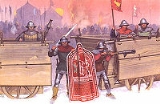
The Taborites were members of a religious community considered heretical by the Catholic Church. The Taborites were centered on the Bohemia
n city of Tábor
during the Hussite Wars
in the 15th century. The religious reform movement in Bohemia splintered into various religious sects. Beginning with the most radical, the various sects that existed were the: Adamites
, Taborites, Orebites
, Sirotčí
("Orphans"), Utraquists and Praguers. Because the revolution's impetus came from the burning of Jan Hus
, for the purpose of simplicity, many writers have put most of these sects under one umbrella term calling them the "Hussite
s".
Economically supported by Tabor's control of local gold
mines, the citizens joined local peasants to develop a communist-like society. Taborites announced the Millennium
of Christ
and declared there would be no more servants and masters. They promised people would return to a state of pristine innocence
.
Taborite theology
represented one of the most radical departures from that of the hierarchical medieval church. They rejected the outer veneer of the corrupted church and insisted on the normativeness of biblical authority. Even though Taborite theologians were versed in scholastic theology
, they were among the first intellectuals to break free from centuries-old scholastic methods.
The Taborites were particularly zealous in their religious practices and, like other such sects, some believed it was their duty to slay all heretics, i.e., non-Taborites.
Some of the most outstanding Taborite theologians were Mikuláš Biskupec of Pelhřimov
and Prokop Veliký
(who died in the Battle of Lipany
). The early radical theological ideas of Taborites were represented by Petr Kanis and Martin Huska.
Tabor's army was led by Jan Žižka
, the Bohemia
n general who commanded his rag-tag army in defense of Bohemia against the crusading Imperial Army under Emperor Sigismund. Žižka did not believe that all heretics should be slain and often showed clemency to those he defeated. After one battle when his army disobeyed him and killed many prisoners, Žižka ordered the army to pray for forgiveness. This experience partly inspired him to write a famous military code of conduct - "Žižkův vojenský řád" - a document partly inspired by the biblical book of Deuteronomy. Žižka eventually left Tabor because that community became too radical for his beliefs and took over the leadership of the more moderate Orebites in Hradec Králové
. Due to the numerous crusades, the Taborites and Orebites often set aside their religious differences and cooperated militarily to defeat crusades launched against Bohemia.
Once the external threat was removed by Hussite victories, the various Hussite factions turned on each other. Finally, the power of the Taborites was broken, after twenty years, with the Battle of Lipany
on May 30, 1434. 13,000 of the 18,000-strong army were killed. In 1437 they signed a treaty with Czech king Sigismund
.
Even though the Taborites ceased to play an important political role, their theological thinking strongly influenced the foundation and rise of the Unity of the Brethren
(Unitas Fratrum
) in 1457 today in English called the Moravian Church.
Bohemia
Bohemia is a historical region in central Europe, occupying the western two-thirds of the traditional Czech Lands. It is located in the contemporary Czech Republic with its capital in Prague...
n city of Tábor
Tábor
Tábor is a city of the Czech Republic, in the South Bohemian Region. It is named after Mount Tabor, which is believed by many to be the place of the Transfiguration of Christ; however, the name became popular and nowadays translates to "camp" or "encampment" in the Czech language.The town was...
during the Hussite Wars
Hussite Wars
The Hussite Wars, also called the Bohemian Wars involved the military actions against and amongst the followers of Jan Hus in Bohemia in the period 1419 to circa 1434. The Hussite Wars were notable for the extensive use of early hand-held gunpowder weapons such as hand cannons...
in the 15th century. The religious reform movement in Bohemia splintered into various religious sects. Beginning with the most radical, the various sects that existed were the: Adamites
Adamites
The Adamites, or Adamians, were adherents of an Early Christian sect that flourished in North Africa in the 2nd, 3rd and 4th centuries, but knew later revivals.-Ancient Adamites:...
, Taborites, Orebites
Orebites
Orebites were followers of the Hussites in Eastern Bohemia. The founders took part in the procession on the Mount Oreb near Třebechovice pod Orebem. Later most of the noble supporters belonged to the East Bohemian church known as the Bohemian Brethren. The ideological founder of the Orebites...
, Sirotčí
Sirotčí
Sirotčí , was a radical wing of the followers of Hussites. The association, founded in 1423 consisted mostly of city nobles, who joined with Jan Zizka and joined the East Bohemian Hussites, the so-called Orebites. From 1428, they were led by the priest Andreas Prokop...
("Orphans"), Utraquists and Praguers. Because the revolution's impetus came from the burning of Jan Hus
Jan Hus
Jan Hus , often referred to in English as John Hus or John Huss, was a Czech priest, philosopher, reformer, and master at Charles University in Prague...
, for the purpose of simplicity, many writers have put most of these sects under one umbrella term calling them the "Hussite
Hussite
The Hussites were a Christian movement following the teachings of Czech reformer Jan Hus , who became one of the forerunners of the Protestant Reformation...
s".
Economically supported by Tabor's control of local gold
Gold
Gold is a chemical element with the symbol Au and an atomic number of 79. Gold is a dense, soft, shiny, malleable and ductile metal. Pure gold has a bright yellow color and luster traditionally considered attractive, which it maintains without oxidizing in air or water. Chemically, gold is a...
mines, the citizens joined local peasants to develop a communist-like society. Taborites announced the Millennium
Millennium
A millennium is a period of time equal to one thousand years —from the Latin phrase , thousand, and , year—often but not necessarily related numerically to a particular dating system....
of Christ
Christ
Christ is the English term for the Greek meaning "the anointed one". It is a translation of the Hebrew , usually transliterated into English as Messiah or Mashiach...
and declared there would be no more servants and masters. They promised people would return to a state of pristine innocence
Innocence
Innocence is a term used to indicate a lack of guilt, with respect to any kind of crime, sin, or wrongdoing. In a legal context, innocence refers to the lack of legal guilt of an individual, with respect to a crime.-Symbolism:...
.
Taborite theology
Theology
Theology is the systematic and rational study of religion and its influences and of the nature of religious truths, or the learned profession acquired by completing specialized training in religious studies, usually at a university or school of divinity or seminary.-Definition:Augustine of Hippo...
represented one of the most radical departures from that of the hierarchical medieval church. They rejected the outer veneer of the corrupted church and insisted on the normativeness of biblical authority. Even though Taborite theologians were versed in scholastic theology
Scholasticism
Scholasticism is a method of critical thought which dominated teaching by the academics of medieval universities in Europe from about 1100–1500, and a program of employing that method in articulating and defending orthodoxy in an increasingly pluralistic context...
, they were among the first intellectuals to break free from centuries-old scholastic methods.
The Taborites were particularly zealous in their religious practices and, like other such sects, some believed it was their duty to slay all heretics, i.e., non-Taborites.
Some of the most outstanding Taborite theologians were Mikuláš Biskupec of Pelhřimov
Pelhrimov
- Basic facts :Pelhřimov is located approximately half-way between Prague and Brno. It is known as “the Gateway to the Highlands“ because of its location in the westernmost tip of the Czech-Moravian Highlands. The altitude above sea level at the foot of the tower of the Church of St...
and Prokop Veliký
Prokop the Great
Prokop or Prokop the Great was one of the most prominent Hussite generals of the Hussite Wars...
(who died in the Battle of Lipany
Battle of Lipany
The Battle of Lipany or Lipan, also called the Battle of Česky Brod, was fought at Lipany 40 km east of Prague on 30 May 1434 and virtually ended the Hussite Wars...
). The early radical theological ideas of Taborites were represented by Petr Kanis and Martin Huska.
Tabor's army was led by Jan Žižka
Jan Žižka
Jan Žižka z Trocnova a Kalicha , Czech general and Hussite leader, follower of Jan Hus, was born at small village Trocnov in Bohemia, into a gentried family. He was nicknamed "One-eyed Žižka"...
, the Bohemia
Bohemia
Bohemia is a historical region in central Europe, occupying the western two-thirds of the traditional Czech Lands. It is located in the contemporary Czech Republic with its capital in Prague...
n general who commanded his rag-tag army in defense of Bohemia against the crusading Imperial Army under Emperor Sigismund. Žižka did not believe that all heretics should be slain and often showed clemency to those he defeated. After one battle when his army disobeyed him and killed many prisoners, Žižka ordered the army to pray for forgiveness. This experience partly inspired him to write a famous military code of conduct - "Žižkův vojenský řád" - a document partly inspired by the biblical book of Deuteronomy. Žižka eventually left Tabor because that community became too radical for his beliefs and took over the leadership of the more moderate Orebites in Hradec Králové
Hradec Králové
Hradec Králové is a city of the Czech Republic, in the Hradec Králové Region of Bohemia. The city's economy is based on food-processing technology, photochemical, and electronics manufacture. Traditional industries include musical instrument manufacturing – the best known being PETROF pianos...
. Due to the numerous crusades, the Taborites and Orebites often set aside their religious differences and cooperated militarily to defeat crusades launched against Bohemia.
Once the external threat was removed by Hussite victories, the various Hussite factions turned on each other. Finally, the power of the Taborites was broken, after twenty years, with the Battle of Lipany
Battle of Lipany
The Battle of Lipany or Lipan, also called the Battle of Česky Brod, was fought at Lipany 40 km east of Prague on 30 May 1434 and virtually ended the Hussite Wars...
on May 30, 1434. 13,000 of the 18,000-strong army were killed. In 1437 they signed a treaty with Czech king Sigismund
Sigismund, Holy Roman Emperor
Sigismund of Luxemburg KG was King of Hungary, of Croatia from 1387 to 1437, of Bohemia from 1419, and Holy Roman Emperor for four years from 1433 until 1437, the last Emperor of the House of Luxemburg. He was also King of Italy from 1431, and of Germany from 1411...
.
Even though the Taborites ceased to play an important political role, their theological thinking strongly influenced the foundation and rise of the Unity of the Brethren
Unity of the Brethren
The Unity of the Brethren is a Christian denomination whose roots are in the pre-reformation work of priest and philosopher Jan Hus, who was martyred in 1415.-History in Bohemia:...
(Unitas Fratrum
Unitas Fratrum
This article is about the coordinating body of the Moravian Church worldwide. For the Christian denomination based in Texas see Unity of the Brethren....
) in 1457 today in English called the Moravian Church.
External links
- Joan of Arc's Letter to the Hussites (23 March 1430) — In 1430, Joan of ArcJoan of ArcSaint Joan of Arc, nicknamed "The Maid of Orléans" , is a national heroine of France and a Roman Catholic saint. A peasant girl born in eastern France who claimed divine guidance, she led the French army to several important victories during the Hundred Years' War, which paved the way for the...
dictated a letter threatening to lead a crusading army against the Hussites unless they returned to "the Catholic Faith and the original Light". This link contains a translation of the letter plus notes and commentary. - The Hussite Wars
- The Bohemian War (1420–1434)
- "The Hussite Wars (1419–36)", Stephen Turnbull, Osprey Publishing (ISBN 1-84176-665-8)
See also
- Hussite WarsHussite WarsThe Hussite Wars, also called the Bohemian Wars involved the military actions against and amongst the followers of Jan Hus in Bohemia in the period 1419 to circa 1434. The Hussite Wars were notable for the extensive use of early hand-held gunpowder weapons such as hand cannons...
- Wars of ReligionEuropean wars of religionThe European wars of religion were a series of wars waged in Europe from ca. 1524 to 1648, following the onset of the Protestant Reformation in Western and Northern Europe...
- BohemiaBohemiaBohemia is a historical region in central Europe, occupying the western two-thirds of the traditional Czech Lands. It is located in the contemporary Czech Republic with its capital in Prague...
- List of Holy Roman Emperors
- Jan HusJan HusJan Hus , often referred to in English as John Hus or John Huss, was a Czech priest, philosopher, reformer, and master at Charles University in Prague...