

Syncom

Encyclopedia
Syncom started as a 1961 NASA
program for active geosynchronous communication satellites, all of which were developed and manufactured by Hughes Space and Communications. Syncom 2, launched in 1963, was the world's first geosynchronous communications satellite.
In the 1980s, the series was continued as Syncom IV with some much larger satellites, also manufactured by Hughes. They were leased to the United States military under the Leasat program.
, California
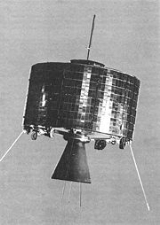
. All three satellites were cylindrical in shape, with a diameter of about 71 centimetres (28 in) and a height of about 39 centimetres (15.4 in). Pre-launch fueled masses were 68 kilograms (149.9 lb), and orbital masses were 39 kilograms (86 lb) with a 25 kilograms (55.1 lb) payload. They were capable of emitted signals on two transponders at just 2 W
. Thus, Syncom satellites were only capable of carrying a single two-way telephone conversation, or 16 Teletype connections. As of June 25, 2009, all three satellites are still in orbit.
communications satellite. It was launched on February 14, 1963 with the Delta B
#16 launch vehicle
from Cape Canaveral
, but was lost on the way to geosynchronous orbit due to an electronics failure. Seconds after the apogee kick motor for circularizing the orbit was fired, the spacecraft fell silent. Later telescopic observations verified the satellite was in an orbit with a period of almost 24 hours at a 33° inclination.
communication satellite. Its orbit was inclined
rather than geostationary. The satellite was launched by NASA on July 26, 1963 with the Delta B
#20 launch vehicle from Cape Canaveral. The satellite successfully kept station at the altitude calculated by Herman Potočnik Noordung
in the 1920s.
During the first year of Syncom 2 operations, NASA conducted voice, teletype, and facsimile tests, as well as 110 public demonstrations to show the capabilities of this satellite and invite feedback. In August 1963, President John F. Kennedy
in Washington, D.C., telephoned Nigerian Prime Minister Abubakar Balewa aboard USNS Kingsport docked in Lagos
Harbor; the first live two-way call between heads of government by satellite. The Kingsport acted as a control station and uplink station.
Syncom 2 also relayed a number of test television transmissions from Ft. Dix, N.J. to a ground station in Andover, Maine beginning on Sept. 29, 1963; the first successful TV transmission through a geosynchronous satellite. It was low-quality video with no audio.
communication satellite, launched on August 19, 1964 with the Delta D
#25 launch vehicle from Cape Canaveral. The satellite, in orbit near the International Date Line
, had the addition of a wideband channel for television and was used to telecast the 1964 Summer Olympics
in Tokyo
to the United States
. Although Syncom 3 is some times credited with the first television program to cross the Pacific Ocean
, the Relay 1 satellite first broadcast television from the United States to Japan on November 22, 1963.
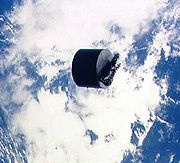 The five satellites of the 1980s Leasat (Leased Satellite) program (Leasat F1 through Leasat F5) were alternatively named Syncom IV-1 to Syncom IV-5. These satellites were considerably larger than Syncoms 1 to 3, weighing 1.3 tonne
s each (over 7 tonnes with launch fuel). At 4.26 metres (14 ft), the satellites were the first to be designed for launch from the Space Shuttle
payload bay.
Hughes was contracted to provide a worldwide communications system based on four satellites, one over the continental United States (CONUS), and one each over the Atlantic
, Pacific
, and Indian
oceans. Five satellites were ordered, with one as a replacement. Also part of the contract were the associated control systems and ground stations.
Leasat F1's launch was cancelled just prior to lift-off and F2 became the first into orbit on August 30, 1984 aboard Discovery
on shuttle mission STS-41-D
. F1 was launched successfully on November 8, 1984 aboard STS-51-A
followed on April 12, 1985 by Leasat F3 on STS-51-D
. F3's launch was declared a failure when the satellite failed to start its manoeuvre to geostationary orbit once released from Discovery
. On August 27, 1985 Discovery was again used to launch Leasat F4, and during the same mission (STS-51-I
) captured and repaired F3. F3 successfully fired its perigee motor and obtained a geostationary orbit, however F4 would later fail and was declared a loss.
The fifth and last Leasat (F5), which was built as a spare, was successfully launched by Columbia
mission STS-32
on January 9, 1990.
The last Leasat was retired February 1998.
NASA
The National Aeronautics and Space Administration is the agency of the United States government that is responsible for the nation's civilian space program and for aeronautics and aerospace research...
program for active geosynchronous communication satellites, all of which were developed and manufactured by Hughes Space and Communications. Syncom 2, launched in 1963, was the world's first geosynchronous communications satellite.
In the 1980s, the series was continued as Syncom IV with some much larger satellites, also manufactured by Hughes. They were leased to the United States military under the Leasat program.
Common features
The three early Syncom satellites were experimental spacecraft built by Hughes Aircraft Company's facility in Culver CityCulver City, California
Culver City is a city in western Los Angeles County, California. As of the 2010 census, the city had a population of 38,883, up from 38,816 at the 2000 census. It is mostly surrounded by the city of Los Angeles, but also shares a border with unincorporated areas of Los Angeles County. Culver...
, California
California
California is a state located on the West Coast of the United States. It is by far the most populous U.S. state, and the third-largest by land area...
. All three satellites were cylindrical in shape, with a diameter of about 71 centimetres (28 in) and a height of about 39 centimetres (15.4 in). Pre-launch fueled masses were 68 kilograms (149.9 lb), and orbital masses were 39 kilograms (86 lb) with a 25 kilograms (55.1 lb) payload. They were capable of emitted signals on two transponders at just 2 W
Watt
The watt is a derived unit of power in the International System of Units , named after the Scottish engineer James Watt . The unit, defined as one joule per second, measures the rate of energy conversion.-Definition:...
. Thus, Syncom satellites were only capable of carrying a single two-way telephone conversation, or 16 Teletype connections. As of June 25, 2009, all three satellites are still in orbit.
Syncom 1
Syncom 1 was to be the first geosynchronousGeosynchronous orbit
A geosynchronous orbit is an orbit around the Earth with an orbital period that matches the Earth's sidereal rotation period...
communications satellite. It was launched on February 14, 1963 with the Delta B
Delta rocket
Delta is a versatile family of expendable launch systems that has provided space launch capability in the United States since 1960. There have been more than 300 Delta rockets launched, with a 95 percent success rate. Two Delta launch systems – Delta II and Delta IV – are in active use...
#16 launch vehicle
Expendable launch system
An expendable launch system is a launch system that uses an expendable launch vehicle to carry a payload into space. The vehicles used in expendable launch systems are designed to be used only once , and their components are not recovered for re-use after launch...
from Cape Canaveral
Cape Canaveral
Cape Canaveral, from the Spanish Cabo Cañaveral, is a headland in Brevard County, Florida, United States, near the center of the state's Atlantic coast. Known as Cape Kennedy from 1963 to 1973, it lies east of Merritt Island, separated from it by the Banana River.It is part of a region known as the...
, but was lost on the way to geosynchronous orbit due to an electronics failure. Seconds after the apogee kick motor for circularizing the orbit was fired, the spacecraft fell silent. Later telescopic observations verified the satellite was in an orbit with a period of almost 24 hours at a 33° inclination.
Syncom 2
Syncom 2 was the first geosynchronousGeosynchronous orbit
A geosynchronous orbit is an orbit around the Earth with an orbital period that matches the Earth's sidereal rotation period...
communication satellite. Its orbit was inclined
Inclined orbit
A satellite is said to occupy an inclined orbit around the Earth if the orbit exhibits an angle other than zero degrees with the equatorial plane. This angle is called the orbit's inclination...
rather than geostationary. The satellite was launched by NASA on July 26, 1963 with the Delta B
Delta rocket
Delta is a versatile family of expendable launch systems that has provided space launch capability in the United States since 1960. There have been more than 300 Delta rockets launched, with a 95 percent success rate. Two Delta launch systems – Delta II and Delta IV – are in active use...
#20 launch vehicle from Cape Canaveral. The satellite successfully kept station at the altitude calculated by Herman Potočnik Noordung
Herman Potocnik
Herman Potočnik was an Austro-Hungarian rocket engineer and pioneer of cosmonautics . He is chiefly remembered for his work addressing the long-term human habitation of space.- Early life :Potočnik was born in Pola, southern Istria, Austria-Hungary...
in the 1920s.
During the first year of Syncom 2 operations, NASA conducted voice, teletype, and facsimile tests, as well as 110 public demonstrations to show the capabilities of this satellite and invite feedback. In August 1963, President John F. Kennedy
John F. Kennedy
John Fitzgerald "Jack" Kennedy , often referred to by his initials JFK, was the 35th President of the United States, serving from 1961 until his assassination in 1963....
in Washington, D.C., telephoned Nigerian Prime Minister Abubakar Balewa aboard USNS Kingsport docked in Lagos
Lagos
Lagos is a port and the most populous conurbation in Nigeria. With a population of 7,937,932, it is currently the third most populous city in Africa after Cairo and Kinshasa, and currently estimated to be the second fastest growing city in Africa...
Harbor; the first live two-way call between heads of government by satellite. The Kingsport acted as a control station and uplink station.
Syncom 2 also relayed a number of test television transmissions from Ft. Dix, N.J. to a ground station in Andover, Maine beginning on Sept. 29, 1963; the first successful TV transmission through a geosynchronous satellite. It was low-quality video with no audio.
Syncom 3
Syncom 3 was the first geostationaryGeostationary orbit
A geostationary orbit is a geosynchronous orbit directly above the Earth's equator , with a period equal to the Earth's rotational period and an orbital eccentricity of approximately zero. An object in a geostationary orbit appears motionless, at a fixed position in the sky, to ground observers...
communication satellite, launched on August 19, 1964 with the Delta D
Delta rocket
Delta is a versatile family of expendable launch systems that has provided space launch capability in the United States since 1960. There have been more than 300 Delta rockets launched, with a 95 percent success rate. Two Delta launch systems – Delta II and Delta IV – are in active use...
#25 launch vehicle from Cape Canaveral. The satellite, in orbit near the International Date Line
International Date Line
The International Date Line is a generally north-south imaginary line on the surface of the Earth, passing through the middle of the Pacific Ocean, that designates the place where each calendar day begins...
, had the addition of a wideband channel for television and was used to telecast the 1964 Summer Olympics
1964 Summer Olympics
The 1964 Summer Olympics, officially known as the Games of the XVIII Olympiad, was an international multi-sport event held in Tokyo, Japan in 1964. Tokyo had been awarded with the organization of the 1940 Summer Olympics, but this honor was subsequently passed to Helsinki because of Japan's...
in Tokyo
Tokyo
, ; officially , is one of the 47 prefectures of Japan. Tokyo is the capital of Japan, the center of the Greater Tokyo Area, and the largest metropolitan area of Japan. It is the seat of the Japanese government and the Imperial Palace, and the home of the Japanese Imperial Family...
to the United States
United States
The United States of America is a federal constitutional republic comprising fifty states and a federal district...
. Although Syncom 3 is some times credited with the first television program to cross the Pacific Ocean
Pacific Ocean
The Pacific Ocean is the largest of the Earth's oceanic divisions. It extends from the Arctic in the north to the Southern Ocean in the south, bounded by Asia and Australia in the west, and the Americas in the east.At 165.2 million square kilometres in area, this largest division of the World...
, the Relay 1 satellite first broadcast television from the United States to Japan on November 22, 1963.
Syncom IV (Leasat)
Tonne
The tonne, known as the metric ton in the US , often put pleonastically as "metric tonne" to avoid confusion with ton, is a metric system unit of mass equal to 1000 kilograms. The tonne is not an International System of Units unit, but is accepted for use with the SI...
s each (over 7 tonnes with launch fuel). At 4.26 metres (14 ft), the satellites were the first to be designed for launch from the Space Shuttle
Space Shuttle
The Space Shuttle was a manned orbital rocket and spacecraft system operated by NASA on 135 missions from 1981 to 2011. The system combined rocket launch, orbital spacecraft, and re-entry spaceplane with modular add-ons...
payload bay.
Hughes was contracted to provide a worldwide communications system based on four satellites, one over the continental United States (CONUS), and one each over the Atlantic
Atlantic Ocean
The Atlantic Ocean is the second-largest of the world's oceanic divisions. With a total area of about , it covers approximately 20% of the Earth's surface and about 26% of its water surface area...
, Pacific
Pacific Ocean
The Pacific Ocean is the largest of the Earth's oceanic divisions. It extends from the Arctic in the north to the Southern Ocean in the south, bounded by Asia and Australia in the west, and the Americas in the east.At 165.2 million square kilometres in area, this largest division of the World...
, and Indian
Indian Ocean
The Indian Ocean is the third largest of the world's oceanic divisions, covering approximately 20% of the water on the Earth's surface. It is bounded on the north by the Indian Subcontinent and Arabian Peninsula ; on the west by eastern Africa; on the east by Indochina, the Sunda Islands, and...
oceans. Five satellites were ordered, with one as a replacement. Also part of the contract were the associated control systems and ground stations.
Leasat F1's launch was cancelled just prior to lift-off and F2 became the first into orbit on August 30, 1984 aboard Discovery
Space Shuttle Discovery
Space Shuttle Discovery is one of the retired orbiters of the Space Shuttle program of NASA, the space agency of the United States, and was operational from its maiden flight, STS-41-D on August 30, 1984, until its final landing during STS-133 on March 9, 2011...
on shuttle mission STS-41-D
STS-41-D
STS-41-D was the first flight of NASA's Space Shuttle orbiter Discovery. It was the 12th mission of the Space Shuttle program, and was launched from Kennedy Space Center, Florida, on 30 August 1984...
. F1 was launched successfully on November 8, 1984 aboard STS-51-A
STS-51-A
STS-51-A was the second flight of Space Shuttle Discovery, and the 14th flight of NASA's Space Shuttle program. The mission launched from Kennedy Space Center on 8 November 1984, and landed just under eight days later on 16 November....
followed on April 12, 1985 by Leasat F3 on STS-51-D
STS-51-D
STS-51-D was the sixteenth flight of NASA's Space Shuttle program, and the fourth flight of Space Shuttle Discovery. The launch of STS-51-D from Kennedy Space Center , Florida, on 12 April 1985 was delayed by 55 minutes, after a boat strayed into the restricted Solid Rocket Booster recovery zone...
. F3's launch was declared a failure when the satellite failed to start its manoeuvre to geostationary orbit once released from Discovery
Space Shuttle Discovery
Space Shuttle Discovery is one of the retired orbiters of the Space Shuttle program of NASA, the space agency of the United States, and was operational from its maiden flight, STS-41-D on August 30, 1984, until its final landing during STS-133 on March 9, 2011...
. On August 27, 1985 Discovery was again used to launch Leasat F4, and during the same mission (STS-51-I
STS-51-I
STS-51-I was the twentieth mission of NASA's Space Shuttle program and the sixth flight of Space Shuttle Discovery. During the mission, Discovery deployed three communications satellites into orbit...
) captured and repaired F3. F3 successfully fired its perigee motor and obtained a geostationary orbit, however F4 would later fail and was declared a loss.
The fifth and last Leasat (F5), which was built as a spare, was successfully launched by Columbia
Space Shuttle Columbia
Space Shuttle Columbia was the first spaceworthy Space Shuttle in NASA's orbital fleet. First launched on the STS-1 mission, the first of the Space Shuttle program, it completed 27 missions before being destroyed during re-entry on February 1, 2003 near the end of its 28th, STS-107. All seven crew...
mission STS-32
STS-32
STS-32 was the 33rd mission of NASA's Space Shuttle program, and the 9th launch of Space Shuttle Columbia. Launching on 9 January 1990, it marked the first time since STS-61-C that Pad A at Kennedy Space Center's Complex 39 was used for a launch; it also marked the first use of Mobile Launcher...
on January 9, 1990.
The last Leasat was retired February 1998.
| Date | Name | ID International Designator The International Designator, also known as COSPAR designation, and in the United States as NSSDC ID, is an international naming convention for satellites... |
Launch vehicle |
|---|---|---|---|
| 1963-02-14 | Syncom 1 | 1963-004A | Thor Delta B |
| 1963-07-26 | Syncom 2 | 1963-031A | Thor Delta B |
| 1964-08-19 | Syncom 3 | 1964-047A | Thor Delta D |
| 1984-08-31 | Leasat F1 | 1984-093C | Discovery Space Shuttle Discovery Space Shuttle Discovery is one of the retired orbiters of the Space Shuttle program of NASA, the space agency of the United States, and was operational from its maiden flight, STS-41-D on August 30, 1984, until its final landing during STS-133 on March 9, 2011... , STS-41-D STS-41-D STS-41-D was the first flight of NASA's Space Shuttle orbiter Discovery. It was the 12th mission of the Space Shuttle program, and was launched from Kennedy Space Center, Florida, on 30 August 1984... |
| 1984-11-10 | Leasat F2 | 1984-113C | Discovery Space Shuttle Discovery Space Shuttle Discovery is one of the retired orbiters of the Space Shuttle program of NASA, the space agency of the United States, and was operational from its maiden flight, STS-41-D on August 30, 1984, until its final landing during STS-133 on March 9, 2011... , STS-51-A STS-51-A STS-51-A was the second flight of Space Shuttle Discovery, and the 14th flight of NASA's Space Shuttle program. The mission launched from Kennedy Space Center on 8 November 1984, and landed just under eight days later on 16 November.... |
| 1985-04-12 | Leasat F3 | 1985-028C | Discovery Space Shuttle Discovery Space Shuttle Discovery is one of the retired orbiters of the Space Shuttle program of NASA, the space agency of the United States, and was operational from its maiden flight, STS-41-D on August 30, 1984, until its final landing during STS-133 on March 9, 2011... , STS-51-D STS-51-D STS-51-D was the sixteenth flight of NASA's Space Shuttle program, and the fourth flight of Space Shuttle Discovery. The launch of STS-51-D from Kennedy Space Center , Florida, on 12 April 1985 was delayed by 55 minutes, after a boat strayed into the restricted Solid Rocket Booster recovery zone... |
| 1985-08-29 | Leasat F4 | 1985-076D | Discovery Space Shuttle Discovery Space Shuttle Discovery is one of the retired orbiters of the Space Shuttle program of NASA, the space agency of the United States, and was operational from its maiden flight, STS-41-D on August 30, 1984, until its final landing during STS-133 on March 9, 2011... , STS-51-I STS-51-I STS-51-I was the twentieth mission of NASA's Space Shuttle program and the sixth flight of Space Shuttle Discovery. During the mission, Discovery deployed three communications satellites into orbit... |
| 1990-01-09 | Leasat F5 | 1990-002B | Columbia Space Shuttle Columbia Space Shuttle Columbia was the first spaceworthy Space Shuttle in NASA's orbital fleet. First launched on the STS-1 mission, the first of the Space Shuttle program, it completed 27 missions before being destroyed during re-entry on February 1, 2003 near the end of its 28th, STS-107. All seven crew... , STS-32 STS-32 STS-32 was the 33rd mission of NASA's Space Shuttle program, and the 9th launch of Space Shuttle Columbia. Launching on 9 January 1990, it marked the first time since STS-61-C that Pad A at Kennedy Space Center's Complex 39 was used for a launch; it also marked the first use of Mobile Launcher... |
External links
- "The Stay-Putnik", a March 1963 Popular Science article on Syncom 1
- Boeing: Detailed Leasat information
- Boeing: Detailed Syncom information
- Daniel R. Glover's page about NASA Experimental Communications Satellites
- NASA Goddard Space Flight centre descriptions:
- Gunter's Space Page:
