
Home      Discussion      Topics      Dictionary      Almanac
Signup       Login
Synchroscope

Synchroscope

Overview
In AC
Alternating current
In alternating current the movement of electric charge periodically reverses direction. An electric charge would for instance move forward, then backward, then forward, then backward, over and over again...

 electrical
Electricity
Electricity is a general term that encompasses a variety of phenomena resulting from the presence and flow of electric charge...

 power systems, a synchroscope is a device that indicates the degree to which two systems (generators
Electrical generator
In electricity generation, an electrical generator is a device that converts mechanical energy to electrical energy. The reverse conversion of electrical energy into mechanical energy is done by a motor; motors and generators have many similarities...

 or power networks) are synchronized
Synchronization
Synchronization or synchronisation is timekeeping which requires the coordination of events to operate a system in unison. The familiar conductor of an orchestra serves to keep the orchestra in time....

 with each other.

For two electrical systems to be considered synchronized, both systems must be operating at the same frequency
Frequency
Frequency is the number of occurrences of a repeating event per unit time. It is also referred to as temporal frequency.The period is the duration of one cycle in a repeating event, so the period is the reciprocal of the frequency....

, and the phase angle
Phase angle
In the context of vectors and phasors, the term phase angle refers to the angular component of the polar coordinate representation. The notation   for a vector with magnitude A and phase angle θ, is called angle notation....

 between the systems must be zero. Synchroscopes measure and display the frequency difference and phase angle between two power systems.

It is not possible to connect two AC power systems unless the systems are synchronized.


Since it is necessary to synchronize AC power systems before connecting them, synchroscopes are used in any power plant that connects to an outside power grid and also in isolated plants containing more than one generator, as each generator must be synchronized with the others before being connected to the plant bus
Electrical bus
An electrical bus , derived from busbar, is a common electrical connection between multiple electrical devices....

.

When the operator of an electric generator wishes to connect a generator to the grid, they will first start the generator spinning at a rate approximately equal to the line frequency
Utility frequency
The line frequency or mains frequency is the frequency at which alternating current is transmitted from a power plant to the end user. In most parts of the world this is 50 Hz, although in the Americas it is typically 60 Hz...

 of the grid with which they plan to connect.
Discussion
Ask a question about 'Synchroscope'
Start a new discussion about 'Synchroscope'
Answer questions from other users
Full Discussion Forum
 
Encyclopedia
In AC
Alternating current
In alternating current the movement of electric charge periodically reverses direction. An electric charge would for instance move forward, then backward, then forward, then backward, over and over again...

 electrical
Electricity
Electricity is a general term that encompasses a variety of phenomena resulting from the presence and flow of electric charge...

 power systems, a synchroscope is a device that indicates the degree to which two systems (generators
Electrical generator
In electricity generation, an electrical generator is a device that converts mechanical energy to electrical energy. The reverse conversion of electrical energy into mechanical energy is done by a motor; motors and generators have many similarities...

 or power networks) are synchronized
Synchronization
Synchronization or synchronisation is timekeeping which requires the coordination of events to operate a system in unison. The familiar conductor of an orchestra serves to keep the orchestra in time....

 with each other.

For two electrical systems to be considered synchronized, both systems must be operating at the same frequency
Frequency
Frequency is the number of occurrences of a repeating event per unit time. It is also referred to as temporal frequency.The period is the duration of one cycle in a repeating event, so the period is the reciprocal of the frequency....

, and the phase angle
Phase angle
In the context of vectors and phasors, the term phase angle refers to the angular component of the polar coordinate representation. The notation   for a vector with magnitude A and phase angle θ, is called angle notation....

 between the systems must be zero. Synchroscopes measure and display the frequency difference and phase angle between two power systems.

It is not possible to connect two AC power systems unless the systems are synchronized.

Use in Power Plants


Since it is necessary to synchronize AC power systems before connecting them, synchroscopes are used in any power plant that connects to an outside power grid and also in isolated plants containing more than one generator, as each generator must be synchronized with the others before being connected to the plant bus
Electrical bus
An electrical bus , derived from busbar, is a common electrical connection between multiple electrical devices....

.

When the operator of an electric generator wishes to connect a generator to the grid, they will first start the generator spinning at a rate approximately equal to the line frequency
Utility frequency
The line frequency or mains frequency is the frequency at which alternating current is transmitted from a power plant to the end user. In most parts of the world this is 50 Hz, although in the Americas it is typically 60 Hz...

 of the grid with which they plan to connect. The voltage of the generator is then matched with the grid by adjusting the field/armature current (when line voltages are unequal when they are connected, a heavy current will flow as each line will attempt to equalize each other, causing damage in the process) then the synchroscope is connected to the power grid and to the generator being started.

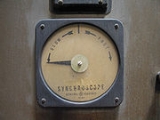
If the generator is turning at a lower frequency than the grid, the synchroscope needle will rotate in the direction (usually counterclockwise) marked "slow" or "lag" on the dial to indicate that the generator is running slower than, or lagging behind, the grid. If the generator is running faster than the grid, the needle will rotate in the opposite direction, marked "fast" or "lead". Next, the plant operator will adjust the speed of the generator until it is running at precisely the same speed (frequency) as the grid. As the frequency of the generator nears that of the grid, the synchroscope needle will slow down and when the frequencies match, the needle will stop moving.

At this point, there is one more task to perform before the generator can be connected to the grid. Although the generator and the grid are now operating at the same frequency, they are not necessarily at the same position in the rotational cycle as each other. If two electrical networks operating at two different phase angle
Phase angle
In the context of vectors and phasors, the term phase angle refers to the angular component of the polar coordinate representation. The notation   for a vector with magnitude A and phase angle θ, is called angle notation....

s were to be connected to each other, a fault
Fault
Fault may refer to:*Fault , planar rock fractures which show evidence of relative movement*Fault , an abnormal condition or defect at the component, equipment, or sub-system level which may lead to a failure...

 similar to a short circuit
Short circuit
A short circuit in an electrical circuit is one that allows a current to travel along a different path from the one originally intended....

 would occur and most likely destroy the generator and damage the grid.

The position (as opposed to movement) of the needle on a synchroscope indicates the current phase angle between the two systems. The angle between the systems is zero when the synchroscope needle is pointing directly to the line in between the "slow" and "fast" markings on the dial. (In the picture example in this article, the zero-phase-angle position is straight upwards, at the twelve o'clock position.)

If the needle reads "fast," then the plant's generator should be slowed down by a very small amount and the needle will turn counterclockwise (toward the zero mark). Alternatively, if the needle reads "slow," then the plant operator will speed the generator up slightly, and the needle will turn clockwise. Slightly before the needle reaches the zero mark, the plant operator will return the generator to the grid frequency in order to stop the needle when it reaches the zero mark. When the needle is at zero and is not moving, the two systems are synchronized.

Once the two systems are synchronized, they can be safely connected.

Depending on the application and the circuit design, the breaker is closed at approximately 5 minutes to noon, while traveling slowly in the fast direction, to allow the incoming generator to come onto the grid as a source. The purpose of this action is to prevent the possibility of the oncoming generator paralleling onto the grid as a load. This has the potential to have the generator operate as a motor which can cause damage to the generator and the prime mover
Prime mover (locomotive)
In locomotives, the prime mover is the source of power for propulsion. The term is generally used when discussing any locomotive powered by an internal combustion engine....

.