

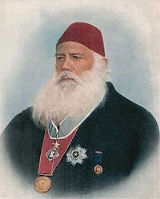
Syed Ahmed Khan

Encyclopedia
Javad-ud Daula, Arif Jang, Sir Syed
Ahmed Khan, KCSI
(also Sayyid Ahmad Khan) (October 17, 1817 – March 27, 1898), commonly known as Sir Syed, was an Indian
educator and politician
, and an Islam
ic reformer and modernist. Sir Syed pioneered modern education for the Muslim community in India
by founding the Muhammedan Anglo-Oriental College, which later developed into the Aligarh Muslim University
. His work gave rise to a new generation of Muslim intellectuals and politicians who composed the Aligarh movement
to secure the political future of Muslims of India.
In 1842, Emperor Bahadur Shah Zafar II
revived upon Syed Ahmad Khan the title of Javad-ud Daulah, conferred upon Syed Ahmad’s grandfather Syed Hadi by Emperor Shah Alam II in about the middle of the 18th century. The Emperor added to it the additional title of Arif Jang. The conferment of these titles was symbolic of Syed Ahmad Khan’s incorporation into the nobility of Delhi.
Born into Muslim nobility, Sir Syed earned a reputation as a distinguished scholar while working as a jurist for the British East India Company
. During the Indian Rebellion of 1857
he remained loyal to the British and was noted for his actions in saving European lives. After the rebellion he penned the booklet Asbab-e-Baghawat-e-Hind (The Causes of the Indian Mutiny) — a daring critique, at the time, of British
policies that he blamed for causing the revolt. Believing that the future of Muslims was threatened by the rigidity of their orthodox outlook, Sir Syed began promoting Western-style scientific education by founding modern schools and journals and organising Muslim intellectuals. Towards this goal, Sir Syed founded the Muhammedan Anglo-Oriental College in 1875 with the aim of promoting social and economic development of Indian Muslims.
One of the most influential Muslim politicians of his time, Sir Syed was suspicious of the Indian independence movement
and called upon Muslims to loyally serve the British Raj
. He denounced nationalist organisations such as the Indian National Congress
, instead forming organisations to promote Muslim unity and pro-British attitudes and activities. Sir Syed promoted the adoption of Urdu as the lingua franca
of all Indian Muslims, and mentored a rising generation of Muslim politicians and intellectuals. Although hailed as a great Muslim leader and social reformer, Sir Syed remains the subject of controversy for his views on Hindu
-Muslim issues.
 Syed Ahmed Khan was born in Delhi
, then the capital of the Mughal Empire
. He was an Indian educator and politician
, and an Islamic reformer and modernist. His family is said to have migrated from Herat
(now in Afghanistan
) in the time of emperor Akbar, although by other accounts his family descended from Arabia. Many generations of his family had since been highly connected with the Mughal administration. His maternal grandfather Khwaja Fariduddin served as wazir
in the court of Akbar Shah II
. His paternal grandfather Syed Hadi held a mansab, a high-ranking administrative position and honorary name of Jawwad Ali Khan in the court of Alamgir II
. Sir Syed's father Mir Muhammad Muttaqi was personally close to Akbar Shah II and served as his personal adviser. However, Sir Syed was born at a time when rebellious governors, regional insurrections and the British colonialism had diminished the extent and power of the Mughal state, reducing its monarch to a figurehead
status. With his elder brother Syed Muhammad Khan, Sir Syed was raised in a large house in a wealthy area of the city. They were raised in strict accordance with Mughal noble traditions and exposed to politics. Their mother Azis-un-Nisa played a formative role in Sir Syed's life, raising him with rigid discipline with a strong emphasis on education. Sir Syed was taught to read and understand the Qur'an by a female tutor, which was unusual at the time. He received an education traditional to Muslim nobility in Delhi. Under the charge of Hamiduddin, Sir Syed was trained in Persian
, Arabic
, Urdu and religious subjects. He read the works of Muslim scholars and writers such as Sahbai, Rumi
and Ghalib
. Other tutors instructed him in mathematics
, astronomy
and Islamic jurisprudence. Sir Syed was also adept at swimming, wrestling
and other sports. He took an active part in the Mughal court's cultural activities. His elder brother founded the city's first printing press in the Urdu language along with the journal Sayyad-ul-Akbar. Sir Syed pursued the study of medicine
for several years, but did not complete the prescribed course of study. Until the death of his father in 1838, Sir Syed had lived a life customary for an affluent young Muslim noble. Upon his father's death, he inherited the titles of his grandfather and father and was awarded the title of Arif Jung by the emperor Bahadur Shah Zafar. Financial difficulties put an end to Sir Syed's formal education, although he continued to study in private, using books on a variety of subjects. Sir Syed assumed editorship of his brother's journal and rejected offers of employment from the Mughal court.
. He opposed ignorance, superstitions and evil customs prevalent in the Muslim society. He firmly believed that the Muslim society would not progress without the acquisition of western education and science.
Having recognized the steady decline in Mughal political power, Sir Syed entered the British East India Company's civil service
. He was appointed serestadar at the courts of law in Agra
, responsible for record-keeping and managing court affairs. In 1840, he was promoted to the title of munshi
. In 1858, he was appointed to a high-ranking post at the court in Muradabad, where he began working on his most famous literary work.
Acquainted with high-ranking British officials, Sir Syed obtained close knowledge about British colonial politics during his service at the courts. At the outbreak of the Indian rebellion
, on May 10, 1857, Sir Syed was serving as the chief assessment officer at the court in Bijnor
. Northern India became the scene of the most intense fighting. The conflict had left large numbers of civilians dead. Erstwhile centres of Muslim power such as Delhi, Agra, Lucknow
and Kanpur were severely affected. Sir Syed was personally affected by the violence and the ending of the Mughal dynasty amongst many other long-standing kingdoms. Sir Syed and many other Muslims took this as a defeat of Muslim society. He lost several close relatives who died in the violence. Although he succeeded in rescuing his mother from the turmoil, she died in Meerut, owing to the privations she had experienced.
Maulana Altaf Hussain Hali wrote in the biography of Sir Syed that:"As soon as Sir Syed reached Muradabad, he began to write the pamphlet entitled The Causes of the Indian Revolt( asbab-e-baghawat-e-hind ),in which he did his best to clear the people of India, and especially the Muslims, of the charge of Mutiny. In spite of the obvious danger, he made a courageous and thorough report of the accusations people were making against the Government and refused the theory which the British had invented to explain the causes of the Mutiny.
When the work was finished, without waiting for an English translation, Sir Sayyid sent the Urdu version to be printed at the Mufassilat Gazette Press in Agra. Within a few weeks, he received 500 copies back from the printers. His friend warned him not to send the pamphlet to Parliament or to the Government of India.Rae Shankar Das,a great friend of Sir Syed, begged him to burn the books rather than put his life in danger. Sir Syed replied that he was bringing these matters to the attention of the British for the good of his own people, of his country, and of the Government itself. He said that if he came to any harm while doing something that would greatly benefit the rulers and the subjects of India alike, he would gladly suffer whatever befell him. When Rae Shankar Das saw that Sir Syed's mind was made up and nothing could be done to change it, he wept and remained silent. After performing a supplementary prayer and asking God's blessing, Sir Syed sent almost all the 500 copies of his pamphlet to England, one to the Government, and kept the rest himself.
When the Government of India had the book translated and presented before the Council, Lord Canning, the Governor-General, and Sir Barthold Frere both accepted it as a sincere and friendly report. The Foreign Secretary Mr Sale Beadon,however, severely attacked it, calling it 'an extremely seditious pamphlet'. He wanted a proper inquiry into the matter and said that the author, unless he could give a satisfactory explanation, should be harshly dealt with. Since no other member of the Council agreed with his opinion, his attack did no harm.
Later, Sir Syed was invited to attend Lord Canning's Durbar in Farrukhabad, and happened to meet the Foreign Secretary there. He told Sir Syed that he was displeased with the pamphlet and added that if he had really had the Government's interests at heart, he would not have made his opinion known in this way throughout the country, but would have communicated it directly to the Government. Sir Syed replied that he had only had five hundred copies printed, the majority of which he had sent to England, while one had been given to the Government of India, and the remaining copies were still in his possession. Furthermore, he had the receipt to prove it. He was aware, he added, that the view of the rulers had been distorted by the stress and anxieties of the times, which made it difficult to put even the most straightforward problem in its right perspective. It was for this reason that he had not communicated his thoughts publicly. He promised that for every copy that could be found circulating in India he would personally pay one thousand rupees. At first, the Foreign Secretary was not convinced, and asked Sir Syed over and over again if he was sure that no other copy had been distributed in India. Sir Syed reassured him on this matter, and the Foreign Secretary never mentioned it again. Later he became one of Sir Syed's strongest supporters.
Many official translations were made of the Urdu text of The Causes of the Indian Revolt. The one undertaken by the India Office formed the subject of many discussions and debates. The pamphlet was also translated by the Government of India and several members of parliament, but no version was offered to the public. A translation which has been started by a Government official was finished by Sir Sayyid's great friend, Colonel G. F. I. Graham, and finally published in 1873."
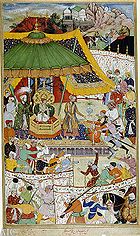 1855, he finished his highly scholarly, very well researched and illustrated edition of Abul Fazl’s Ai’n-e Akbari, itself an extraordinarily difficult book. Having finished the work to his satisfaction, and believing that Mirza Asadullah Khan Ghalib
was a person who would appreciate his labours, Syed Ahmad approached the great Ghalib to write a taqriz (in the convention of the times, a laudatory foreword) for it. Ghalib obliged, but what he did produce was a short Persian poem castigating the Ai’n-e Akbari, and by implication, the imperial, sumptuous, literate and learned Mughal culture of which it was a product. The least that could be said against it was that the book had little value even as an antique document. Ghalib practically reprimanded Syed Ahmad Khan for wasting his talents and time on dead things. Worse, he praised sky-high the “sahibs of England” who at that time held all the keys to all the a’ins in this world.
This poem is often referred to but has never translated in English. Shamsur Rahman Faruqi wrote an English translation. The translation is accurate if lacking the felicity of the original:
Good news my friends, this ancient book’s door
Is now open, because of the Syed’s grace and fortune, 1
The eye began to see, the arm found strength
That which was wrapped in ancient clothes,
now put on a new dress. 2
And this idea of his, to establish its text and edit the A’in
Puts to shame his exalted capability and potential, 3
He put his heart to a task and pleased himself
And made himself an auspicious, free servant. 4
One who isn’t capable of admiring his quality
Would no doubt praise him for this task, 5
For such a task, of which this book is the basis
Only an hypocrite can offer praise. 6
I, who am the enemy of pretence
And have a sense of my own truthfulness, 7
If I don’t give him praise for this task
It’s proper that I find occasion to praise. 8
I have nothing to say to the perverse
None know what I know of arts and letters, 9
In the whole world, this merchandise has no buyer.
What profit could my Master hope from it? 10
It should be said, it’s an excellent inventory
So what’s there to see that’s worth seeing? 11
And if you talk with me of Laws and Rules
Open your eyes, and in this ancient halting-place 12
Look at the Sahibs of England.
Look at the style and practice of these, 13
See what Laws and Rules they have made for all to see
What none ever saw, they have produced. 14
Science and skills grew at the hands of these skilled ones
Their efforts overtook the efforts of the forebears. 15
This is the people that owns the right to Laws and Rules
None knows to rule a land better than they, 16
Justice and Wisdom they’ve made as one
They have given hundreds of laws to India. 17
The fire that one brought out of stone
How well these skilled ones bring out from straw! 18
What spell have they struck on water
That a vapour drives the boat in water! 19
Sometimes the vapour takes the boat down the sea
Sometimes the vapour brings down the sky to the plains. 20
Vapour makes the sky-wheel go round and round
Vapour is now like bullocks, or horses. 21
Vapour makes the ship speed
Making wind and wave redundant. 22
Their instruments make music without the bow
They make words fly high like birds: 23
Oh don’t you see that these wise people
Get news from thousands of miles in a couple of breaths? 24
They inject fire into air
And the air glows like embers, 25
Go to London, for in that shining garden
The city is bright in the night, without candles. 26
Look at the businesses of the knowledgeable ones:
In every discipline, a hundred innovators! 27
Before the Laws and Rules that the times now have
All others have become things of yesteryears, 28
Wise and sensitive and prudent one, does your book
Have such good and elegant Laws? 29
When one sees such a treasure house of gems
Why should one glean corn from that other harvest? 30
Well, if you speak of its style, it’s good
No, it’s much better than all else that you seek 31
But every good always has a better too
If there’s a head, there’s also a crown for it. 32
Don’t regard that Generous Source as niggardly
It’s a Date-Palm which drops sweet light, like dates. 33
Worshipping the Dead is not an auspicious thing
And wouldn’t you too think that it’s
no more than just words? 34
The Rule of silence pleases my heart, Ghalib
You spoke well doubtless, not speaking is well too. 35
Here in this world your creed is to worship all the
Prophet’s children,
Go past praising, your Law asks you to pray: 36
For Syed Ahmad Khan-e Arif Jang
Who is made up entirely of wisdom and splendour 37
Let there be from God all that he might wish for
Let an auspicious star lead all his affairs. 38
The poem was unexpected, but it came at the time when Syed Ahmad Khan’s thought and feelings themselves were inclining toward change. Ghalib seemed to be acutely aware of a European[English]-sponsored change in world polity, especially Indian polity. Syed Ahmad might well have been piqued at Ghalib’s admonitions, but he would also have realized that Ghalib’s reading of the situation, though not nuanced enough, was basically accurate. Syed Ahmad Khan
may also have felt that he, being better informed about the English and the outside world, should have himself seen the change that now seemed to be just round the corner. Sir Syed Ahmad Khan never again wrote a word in praise of the Ai’n-e Akbari and in fact gave up taking active interest in history and archaeology, and became a social reformer.
to educational issues), mainly in Urdu, where he wrote, at least, 6000 pages. His career as an author began when he published a series of treatises in Urdu on religious subjects in 1842. He published the book A'thar-as-sanadid (Great Monuments) documenting antiquities of Delhi dating from the medieval era. This work earned him the reputation of a cultured scholar. In 1842, he completed the Jila-ul-Qulub bi Zikr-il Mahbub and the Tuhfa-i-Hasan, along with the Tahsil fi jar-i-Saqil in 1844. These works focused on religious and cultural subjects. In 1852, he published the two works Namiqa dar bayan masala tasawwur-i-Shaikh and Silsilat ul-Mulk. He released the second edition of A'thar-as-sanadid in 1854. He also penned a commentary on the Bible
— the first by a Muslim — in which he argued that Islam was the closest religion to Christianity
, with a common lineage from Abrahamic religions. His other writings such as Loyal Muhammadans of India, Tabyin-ul-Kalam and A Series of Essays on the Life of Muhammad
and Subjects Subsidiary Therein helped to create cordial relations between the British authorities and the Muslim community.
Throughout his life Syed Ahmad found time for literary and Scholarly pursuits. The range of his literary and Scholarly interests was very wide: history, politics, archaeology, journalism, literature, religion and science. The scope of his major writings is indeed amazing, majority are listed as follows:
amongst Indian Muslims. Committed to working for the upliftment of Muslims, Sir Syed founded a modern madrassa in Muradabad in 1859; this was one of the first religious schools to impart scientific education. Sir Syed also worked on social causes, helping to organise relief for the famine-struck people of the North-West Frontier Province
in 1860. He established another modern school in Ghazipur
in 1863.
Upon his transfer to Aligarh in 1864, Sir Syed began working wholeheartedly as an educator. He founded the Scientific Society of Aligarh
, the first scientific association of its kind in India. Modelling it after the Royal Society
and the Royal Asiatic Society
, Sir Syed assembled Muslim scholars from different parts of the country. The Society held annual conferences, disbursed funds for educational causes and regularly published a journal on scientific subjects in English
and Urdu. Sir Syed felt that the socio-economic future of Muslims was threatened by their orthodox aversions to modern science and technology. He published many writings promoting liberal, rational interpretations of In face of pressure from religious Muslims, Sir Syed avoided discussing religious subjects in his writings, focusing instead on promoting education.
On the pre-colonial system he said "The rule of the former emperors and rajas was neither in accordance with the Hindu nor the Mohammadan religion. It was based on nothing but tyranny and oppression; the law of might was that of right; the voice of the people was not listened to"
(Bipan Chandra: India's struggle for independence)
of 1867 saw the emergence of Sir Syed as a political leader of the Muslim community. He became a leading Muslim voice opposing the adoption of Hindi
as a second official language of the United Provinces
(now Uttar Pradesh
). Sir Syed perceived Urdu as the lingua franca of Muslims. Having been developed by Muslim rulers of India, Urdu was used as a secondary language to Persian, the official language of the Mughal court. Since the decline of the Mughal dynasty, Sir Syed promoted the use of Urdu through his own writings. Under Sir Syed, the Scientific Society translated Western works only into Urdu. The schools established by Sir Syed imparted education in the Urdu medium. The demand for Hindi, led largely by Hindus, was to Sir Syed an erosion of the centuries-old Muslim cultural domination of India. Testifying before the British-appointed education commission, Sir Syed controversially exclaimed that "Urdu was the language of gentry
and Hindi that of the vulgar." His remarks provoked a hostile response from Hindu leaders, who unified across the nation to demand the recognition of Hindi.
The success of the Hindi movement led Sir Syed to further advocate Urdu as the symbol of Muslim heritage and as the language of all Indian Muslims. His educational and political work grew increasingly centred around and exclusively for Muslim interests. He also sought to persuade the British to give Urdu extensive official use and patronage. His colleagues such as Mohsin-ul-Mulk
and Maulvi Abdul Haq
developed organisations such as the Urdu Defence Association
and the Anjuman Taraqqi-i-Urdu
, committed to the perpetuation of Urdu. All these colleagues led efforts that resulted in the adoption of Urdu as the official language of the Hyderabad State
and as the medium of instruction in the Osmania University
. To Muslims in northern and western India, Urdu had become an integral part of political and cultural identity. However, the division over the use of Hindi or Urdu further provoked communal conflict between Muslims and Hindus in India.
On April 1, 1869 he went, along with his son Syed Mahmood
, to England
, where he was awarded the Order of the Star of India
from the British government on August 6. Travelling across England, he visited its colleges and was inspired by the culture of learning established after the Renaissance
. Sir Syed returned to India in the following year determined to build a "Muslim Cambridge." Upon his return, he organised the "Committee for the Better Diffusion and Advancement of Learning among Muhammadans
" (Muslims) on December 26, 1870. Sir Syed described his vision of the institution he proposed to establish in an article written sometime in 1872 and re-printed in the Aligarh Institute Gazette of April 5, 1911:
By 1873, the committee under Sir Syed issued proposals for the construction of a college in Aligarh. He began publishing the journal Tahzib al-Akhlaq (Social Reformer) to spread awareness and knowledge on modern subjects and promote reforms in Muslim society. Sir Syed worked to promote reinterpretation of Muslim ideology in order to reconcile tradition with Western education. He argued in several books on Islam that the Qur'an rested on an appreciation of reason and natural law, making scientific inquiry important to being a good Muslim. Sir Syed established a modern school in Aligarh and, obtaining support from wealthy Muslims and the British, laid the foundation stone of the Muhammadan Anglo-Oriental College on May 24, 1875. He retired from his career as a jurist the following year, concentrating entirely on developing the college and on religious reform. Sir Syed's pioneering work received support from the British. Although intensely criticised by orthodox religious leaders hostile to modern influences, Sir Syed's new institution attracted a large student body, mainly drawn from the Muslim gentry and middle classes. The curriculum at the college involved scientific and Western subjects, as well as Oriental subjects and religious education. The first chancellor
was Sultan Shah Jahan Begum
, a prominent Muslim noblewoman, and Sir Syed invited an Englishman, Theodore Beck
, to serve as the first college principal. The college was originally affiliated with Calcutta University but was transferred to the Allahabad University
in 1885. Near the turn of the 20th century, it began publishing its own magazine and established a law school. In 1920, the college was transformed into a university.
in Aligarh, which promoted his vision of modern education and political unity for Muslims. His works made him the most prominent Muslim politician in 19th century India, often influencing the attitude of Muslims on various national issues. He supported the efforts of Indian political leaders Surendranath Banerjea
and Dadabhai Naoroji
to obtain representation for Indians in the government and civil services. In 1883, he founded the Muhammadan Civil Service Fund Association to encourage and support the entry of Muslim graduates into the Indian Civil Service (ICS).
While fearful of the loss of Muslim political power owing to the community's backwardness, Sir Syed was also averse to the prospect of democratic self-government, which would give control of government to the Hindu-majority population:
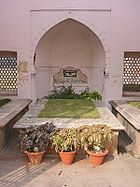
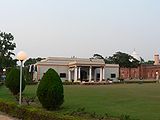 Sir Syed Ahmed Khan lived the last two decades of his life in Aligarh, regarded widely as the mentor of 19th- and 20th century Muslim intellectuals and politicians. He remained the most influential Muslim politician in India, with his opinions guiding the convictions of a large majority of Muslims. Battling illnesses and old age, Sir Syed died on March 27, 1898. He was buried besides Sir Syed Masjid
inside the campus of the Aligarh university. His funeral was attended by thousands of students, Muslim leaders and British officials. Sir Syed is widely commemorated across South Asia as a great Muslim reformer and visionary.
At the same time, Sir Syed sought to politically ally Muslims to the British government. An avowed loyalist of the British Empire
, Sir Syed was nominated as a member of the Civil Service Commission in 1887 by Lord Dufferin
. In 1888, he established the United Patriotic Association
at Aligarh to promote political co-operation with the British and Muslim participation in the government. Syed Ahmed Khan was knight
ed by the British government in 1888 and in the following year he received an LL.D. honoris causa from the Edinburgh University.
The university he founded remains one of India's most prominent institutions. Prominent alumni of Aligarh include Muslim political leaders Maulana Mohammad Ali
, Abdur Rab Nishtar
, Maulana Shaukat Ali
and Maulvi Abdul Haq
, who is hailed in Pakistan
as Baba-e-Urdu (Father of Urdu). The first two Prime Ministers of Pakistan
, Liaquat Ali Khan
and Khawaja Nazimuddin
, as well as the late Indian President Dr. Zakir Hussain
, are amongst Aligarh's most famous graduates. In India, Sir Syed is commemorated as a pioneer who worked for the socio-political upliftment of Indian Muslims, Sir Syed is also hailed as a founding father of Pakistan for his role in developing a Muslim political class independent of Hindu-majority organisations. The Sir Syed University of Engineering and Technology
was established in honour of Sir Syed in Karachi
and is a leading technical institution in Pakistan. Furthermore, Sir Syed Government Girls College
in Karachi
, Pakistan
is also named in the honour of Sir Syed Ahmed Khan.
Today he has family living in Denmark, India, Pakistan and UK.
 Supporters of Sir Syed contend that his political vision gave an independent political expression to the Muslim community, which aided its goal of securing political power in India. His philosophy guided the creation of the All India Muslim League in 1906, as a political party separate from the Congress. Sir Syed's ideas inspired both the liberal, pro-British politicians of the Muslim League and the religious ideologues of the Khilafat
struggle. The Muslim League remained at odds with the Congress and continued to advocate the boycott of the Indian independence movement. In the 1940s, the student body of Aligarh committed itself to the establishment of Pakistan and contributed in large measure to the activities of the Muslim League. Sir Syed's patronage of Urdu led to its widespread use amongst Indian Muslim communities and following the Partition of India
its adoption as the official language of Pakistan, even though Bengali
and Punjabi
were more prevalent at the time.
Sayyid
Sayyid is an honorific title, it denotes males accepted as descendants of the Islamic prophet Muhammad through his grandsons, Hasan ibn Ali and Husain ibn Ali, sons of the prophet's daughter Fatima Zahra and his son-in-law Ali ibn Abi Talib.Daughters of sayyids are given the titles Sayyida,...
Ahmed Khan, KCSI
Order of the Star of India
The Most Exalted Order of the Star of India is an order of chivalry founded by Queen Victoria in 1861. The Order includes members of three classes:# Knight Grand Commander # Knight Commander # Companion...
(also Sayyid Ahmad Khan) (October 17, 1817 – March 27, 1898), commonly known as Sir Syed, was an Indian
British Raj
British Raj was the British rule in the Indian subcontinent between 1858 and 1947; The term can also refer to the period of dominion...
educator and politician
Politics of India
The politics of India takes place within the framework of a federal constitutional republic, in which the President of India is head of state and the Prime Minister of India is the head of government. Executive power is exercised by the President and is independent of the legislature...
, and an Islam
Islam
Islam . The most common are and . : Arabic pronunciation varies regionally. The first vowel ranges from ~~. The second vowel ranges from ~~~...
ic reformer and modernist. Sir Syed pioneered modern education for the Muslim community in India
Islam in India
Islam is the second-most practiced religion in the Republic of India after Hinduism, with more than 13.4% of the country's population ....
by founding the Muhammedan Anglo-Oriental College, which later developed into the Aligarh Muslim University
Aligarh Muslim University
Aligarh Muslim University ,is a residential academic university, established in 1875 by Sir Syed Ahmed Khan as Mohammedan Angelo-Oriental College and later granted the status of Central University by an Act of the Indian Parliament in 1920...
. His work gave rise to a new generation of Muslim intellectuals and politicians who composed the Aligarh movement
Aligarh Movement
Aligarh Movement was the movement led by Sir Syed Ahmed Khan, to educate the Muslims of the South Asia after the defeat of the rebels in the Indian rebellion of 1857. It had enormous success and had a profound impact on the future of the subcontinent...
to secure the political future of Muslims of India.
In 1842, Emperor Bahadur Shah Zafar II
Bahadur Shah II
His Royal Highness Abu Zafar Sirajuddin Muhammad Bahadur Shah Zafar , also known as Bahadur Shah or Bahadur Shah II was the last of the Mughal emperors in India, as well as the last ruler of the Timurid Dynasty.He was the son of Akbar Shah II and Lalbai, who was a Hindu Rajput...
revived upon Syed Ahmad Khan the title of Javad-ud Daulah, conferred upon Syed Ahmad’s grandfather Syed Hadi by Emperor Shah Alam II in about the middle of the 18th century. The Emperor added to it the additional title of Arif Jang. The conferment of these titles was symbolic of Syed Ahmad Khan’s incorporation into the nobility of Delhi.
Born into Muslim nobility, Sir Syed earned a reputation as a distinguished scholar while working as a jurist for the British East India Company
British East India Company
The East India Company was an early English joint-stock company that was formed initially for pursuing trade with the East Indies, but that ended up trading mainly with the Indian subcontinent and China...
. During the Indian Rebellion of 1857
Indian Rebellion of 1857
The Indian Rebellion of 1857 began as a mutiny of sepoys of the British East India Company's army on 10 May 1857, in the town of Meerut, and soon escalated into other mutinies and civilian rebellions largely in the upper Gangetic plain and central India, with the major hostilities confined to...
he remained loyal to the British and was noted for his actions in saving European lives. After the rebellion he penned the booklet Asbab-e-Baghawat-e-Hind (The Causes of the Indian Mutiny) — a daring critique, at the time, of British
British Raj
British Raj was the British rule in the Indian subcontinent between 1858 and 1947; The term can also refer to the period of dominion...
policies that he blamed for causing the revolt. Believing that the future of Muslims was threatened by the rigidity of their orthodox outlook, Sir Syed began promoting Western-style scientific education by founding modern schools and journals and organising Muslim intellectuals. Towards this goal, Sir Syed founded the Muhammedan Anglo-Oriental College in 1875 with the aim of promoting social and economic development of Indian Muslims.
One of the most influential Muslim politicians of his time, Sir Syed was suspicious of the Indian independence movement
Indian independence movement
The term Indian independence movement encompasses a wide area of political organisations, philosophies, and movements which had the common aim of ending first British East India Company rule, and then British imperial authority, in parts of South Asia...
and called upon Muslims to loyally serve the British Raj
British Raj
British Raj was the British rule in the Indian subcontinent between 1858 and 1947; The term can also refer to the period of dominion...
. He denounced nationalist organisations such as the Indian National Congress
Indian National Congress
The Indian National Congress is one of the two major political parties in India, the other being the Bharatiya Janata Party. It is the largest and one of the oldest democratic political parties in the world. The party's modern liberal platform is largely considered center-left in the Indian...
, instead forming organisations to promote Muslim unity and pro-British attitudes and activities. Sir Syed promoted the adoption of Urdu as the lingua franca
Lingua franca
A lingua franca is a language systematically used to make communication possible between people not sharing a mother tongue, in particular when it is a third language, distinct from both mother tongues.-Characteristics:"Lingua franca" is a functionally defined term, independent of the linguistic...
of all Indian Muslims, and mentored a rising generation of Muslim politicians and intellectuals. Although hailed as a great Muslim leader and social reformer, Sir Syed remains the subject of controversy for his views on Hindu
Hinduism
Hinduism is the predominant and indigenous religious tradition of the Indian Subcontinent. Hinduism is known to its followers as , amongst many other expressions...
-Muslim issues.
Early life
Delhi
Delhi , officially National Capital Territory of Delhi , is the largest metropolis by area and the second-largest by population in India, next to Mumbai. It is the eighth largest metropolis in the world by population with 16,753,265 inhabitants in the Territory at the 2011 Census...
, then the capital of the Mughal Empire
Mughal Empire
The Mughal Empire , or Mogul Empire in traditional English usage, was an imperial power from the Indian Subcontinent. The Mughal emperors were descendants of the Timurids...
. He was an Indian educator and politician
Politician
A politician, political leader, or political figure is an individual who is involved in influencing public policy and decision making...
, and an Islamic reformer and modernist. His family is said to have migrated from Herat
Herat
Herāt is the capital of Herat province in Afghanistan. It is the third largest city of Afghanistan, with a population of about 397,456 as of 2006. It is situated in the valley of the Hari River, which flows from the mountains of central Afghanistan to the Karakum Desert in Turkmenistan...
(now in Afghanistan
Afghanistan
Afghanistan , officially the Islamic Republic of Afghanistan, is a landlocked country located in the centre of Asia, forming South Asia, Central Asia and the Middle East. With a population of about 29 million, it has an area of , making it the 42nd most populous and 41st largest nation in the world...
) in the time of emperor Akbar, although by other accounts his family descended from Arabia. Many generations of his family had since been highly connected with the Mughal administration. His maternal grandfather Khwaja Fariduddin served as wazir
Vizier
A vizier or in Arabic script ; ; sometimes spelled vazir, vizir, vasir, wazir, vesir, or vezir) is a high-ranking political advisor or minister in a Muslim government....
in the court of Akbar Shah II
Akbar Shah II
Akbar Shah II , also known as Mirza Akbar, was the second-to-last of the Mughal emperors of India. He held the title from 1806 to 1837. He was the second son of Shah Alam II and the father of Bahadur Shah Zafar II....
. His paternal grandfather Syed Hadi held a mansab, a high-ranking administrative position and honorary name of Jawwad Ali Khan in the court of Alamgir II
Alamgir II
Aziz-ud-din Alamgir II was the Mughal Emperor of India from 3 June 1754 to 29 November 1759. He was the son of Jahandar Shah....
. Sir Syed's father Mir Muhammad Muttaqi was personally close to Akbar Shah II and served as his personal adviser. However, Sir Syed was born at a time when rebellious governors, regional insurrections and the British colonialism had diminished the extent and power of the Mughal state, reducing its monarch to a figurehead
Figurehead
A figurehead is a carved wooden decoration found at the prow of ships largely made between the 16th and 19th century.-History:Although earlier ships had often had some form of bow ornamentation A figurehead is a carved wooden decoration found at the prow of ships largely made between the 16th and...
status. With his elder brother Syed Muhammad Khan, Sir Syed was raised in a large house in a wealthy area of the city. They were raised in strict accordance with Mughal noble traditions and exposed to politics. Their mother Azis-un-Nisa played a formative role in Sir Syed's life, raising him with rigid discipline with a strong emphasis on education. Sir Syed was taught to read and understand the Qur'an by a female tutor, which was unusual at the time. He received an education traditional to Muslim nobility in Delhi. Under the charge of Hamiduddin, Sir Syed was trained in Persian
Persian language
Persian is an Iranian language within the Indo-Iranian branch of the Indo-European languages. It is primarily spoken in Iran, Afghanistan, Tajikistan and countries which historically came under Persian influence...
, Arabic
Arabic language
Arabic is a name applied to the descendants of the Classical Arabic language of the 6th century AD, used most prominently in the Quran, the Islamic Holy Book...
, Urdu and religious subjects. He read the works of Muslim scholars and writers such as Sahbai, Rumi
Jalal ad-Din Muhammad Rumi
Jalāl ad-Dīn Muḥammad Balkhī , also known as Jalāl ad-Dīn Muḥammad Rūmī and popularly known as Mevlānā in Turkey and Mawlānā in Iran and Afghanistan but known to the English-speaking world simply as Rumi was a 13th-century Persian Muslim poet, jurist, theologian, and Sufi mystic...
and Ghalib
Mirza Ghalib
Dabir-ul-Mulk, Najm-ud-Daula Mirza Asadullah Baig Khan , pen-name Ghalib and Asad , was a classical Urdu and Persian poet from India during British colonial rule...
. Other tutors instructed him in mathematics
Mathematics
Mathematics is the study of quantity, space, structure, and change. Mathematicians seek out patterns and formulate new conjectures. Mathematicians resolve the truth or falsity of conjectures by mathematical proofs, which are arguments sufficient to convince other mathematicians of their validity...
, astronomy
Islamic astronomy
Islamic astronomy or Arabic astronomy comprises the astronomical developments made in the Islamic world, particularly during the Islamic Golden Age , and mostly written in the Arabic language. These developments mostly took place in the Middle East, Central Asia, Al-Andalus, and North Africa, and...
and Islamic jurisprudence. Sir Syed was also adept at swimming, wrestling
Wrestling
Wrestling is a form of grappling type techniques such as clinch fighting, throws and takedowns, joint locks, pins and other grappling holds. A wrestling bout is a physical competition, between two competitors or sparring partners, who attempt to gain and maintain a superior position...
and other sports. He took an active part in the Mughal court's cultural activities. His elder brother founded the city's first printing press in the Urdu language along with the journal Sayyad-ul-Akbar. Sir Syed pursued the study of medicine
Medicine
Medicine is the science and art of healing. It encompasses a variety of health care practices evolved to maintain and restore health by the prevention and treatment of illness....
for several years, but did not complete the prescribed course of study. Until the death of his father in 1838, Sir Syed had lived a life customary for an affluent young Muslim noble. Upon his father's death, he inherited the titles of his grandfather and father and was awarded the title of Arif Jung by the emperor Bahadur Shah Zafar. Financial difficulties put an end to Sir Syed's formal education, although he continued to study in private, using books on a variety of subjects. Sir Syed assumed editorship of his brother's journal and rejected offers of employment from the Mughal court.
Career
Social reforms in the Muslim society were initiated by Abdul Latif. He founded “The Mohammedan Literary Society" in Bengal. Sir Syed Ahmed Khan established the Mohammedan Anglo-Oriental college. Later, this institution came to be known as the Aligarh Muslim UniversityAligarh Muslim University
Aligarh Muslim University ,is a residential academic university, established in 1875 by Sir Syed Ahmed Khan as Mohammedan Angelo-Oriental College and later granted the status of Central University by an Act of the Indian Parliament in 1920...
. He opposed ignorance, superstitions and evil customs prevalent in the Muslim society. He firmly believed that the Muslim society would not progress without the acquisition of western education and science.
Having recognized the steady decline in Mughal political power, Sir Syed entered the British East India Company's civil service
Civil service
The term civil service has two distinct meanings:* A branch of governmental service in which individuals are employed on the basis of professional merit as proven by competitive examinations....
. He was appointed serestadar at the courts of law in Agra
Agra
Agra a.k.a. Akbarabad is a city on the banks of the river Yamuna in the northern state of Uttar Pradesh, India, west of state capital, Lucknow and south from national capital New Delhi. With a population of 1,686,976 , it is one of the most populous cities in Uttar Pradesh and the 19th most...
, responsible for record-keeping and managing court affairs. In 1840, he was promoted to the title of munshi
Munshi
Munshi was the Hindi-Urdu name of a contractor, writer or secretary, used in Mughal Empire and later British India of the native language teachers or secretaries employed by Europeans....
. In 1858, he was appointed to a high-ranking post at the court in Muradabad, where he began working on his most famous literary work.
Acquainted with high-ranking British officials, Sir Syed obtained close knowledge about British colonial politics during his service at the courts. At the outbreak of the Indian rebellion
Indian Rebellion of 1857
The Indian Rebellion of 1857 began as a mutiny of sepoys of the British East India Company's army on 10 May 1857, in the town of Meerut, and soon escalated into other mutinies and civilian rebellions largely in the upper Gangetic plain and central India, with the major hostilities confined to...
, on May 10, 1857, Sir Syed was serving as the chief assessment officer at the court in Bijnor
Bijnor
Bijnor variously spelt as Bijnaur and Bijnour, is a city and a municipal board in Bijnor district in the state of Uttar Pradesh, India...
. Northern India became the scene of the most intense fighting. The conflict had left large numbers of civilians dead. Erstwhile centres of Muslim power such as Delhi, Agra, Lucknow
Lucknow
Lucknow is the capital city of Uttar Pradesh in India. Lucknow is the administrative headquarters of Lucknow District and Lucknow Division....
and Kanpur were severely affected. Sir Syed was personally affected by the violence and the ending of the Mughal dynasty amongst many other long-standing kingdoms. Sir Syed and many other Muslims took this as a defeat of Muslim society. He lost several close relatives who died in the violence. Although he succeeded in rescuing his mother from the turmoil, she died in Meerut, owing to the privations she had experienced.
The Causes of the Indian Revolt
In 1859 Sir Syed Published the booklet Asbab-e-Baghawat-e-Hind,(The Causes of the Indian Revolt), in which he studied the causes of the Indian revolt.In this, his most famous work, he rejected the common notion that the conspiracy was planned by Muslim élites, who were insecure at the diminishing influence of Muslim monarchs.He blamed the British East India Company for its aggressive expansion as well as the ignorance of British politicians regarding Indian culture.Sir Syed advised the British to appoint Muslims to assist in administrationMaulana Altaf Hussain Hali wrote in the biography of Sir Syed that:"As soon as Sir Syed reached Muradabad, he began to write the pamphlet entitled The Causes of the Indian Revolt( asbab-e-baghawat-e-hind ),in which he did his best to clear the people of India, and especially the Muslims, of the charge of Mutiny. In spite of the obvious danger, he made a courageous and thorough report of the accusations people were making against the Government and refused the theory which the British had invented to explain the causes of the Mutiny.
When the work was finished, without waiting for an English translation, Sir Sayyid sent the Urdu version to be printed at the Mufassilat Gazette Press in Agra. Within a few weeks, he received 500 copies back from the printers. His friend warned him not to send the pamphlet to Parliament or to the Government of India.Rae Shankar Das,a great friend of Sir Syed, begged him to burn the books rather than put his life in danger. Sir Syed replied that he was bringing these matters to the attention of the British for the good of his own people, of his country, and of the Government itself. He said that if he came to any harm while doing something that would greatly benefit the rulers and the subjects of India alike, he would gladly suffer whatever befell him. When Rae Shankar Das saw that Sir Syed's mind was made up and nothing could be done to change it, he wept and remained silent. After performing a supplementary prayer and asking God's blessing, Sir Syed sent almost all the 500 copies of his pamphlet to England, one to the Government, and kept the rest himself.
When the Government of India had the book translated and presented before the Council, Lord Canning, the Governor-General, and Sir Barthold Frere both accepted it as a sincere and friendly report. The Foreign Secretary Mr Sale Beadon,however, severely attacked it, calling it 'an extremely seditious pamphlet'. He wanted a proper inquiry into the matter and said that the author, unless he could give a satisfactory explanation, should be harshly dealt with. Since no other member of the Council agreed with his opinion, his attack did no harm.
Later, Sir Syed was invited to attend Lord Canning's Durbar in Farrukhabad, and happened to meet the Foreign Secretary there. He told Sir Syed that he was displeased with the pamphlet and added that if he had really had the Government's interests at heart, he would not have made his opinion known in this way throughout the country, but would have communicated it directly to the Government. Sir Syed replied that he had only had five hundred copies printed, the majority of which he had sent to England, while one had been given to the Government of India, and the remaining copies were still in his possession. Furthermore, he had the receipt to prove it. He was aware, he added, that the view of the rulers had been distorted by the stress and anxieties of the times, which made it difficult to put even the most straightforward problem in its right perspective. It was for this reason that he had not communicated his thoughts publicly. He promised that for every copy that could be found circulating in India he would personally pay one thousand rupees. At first, the Foreign Secretary was not convinced, and asked Sir Syed over and over again if he was sure that no other copy had been distributed in India. Sir Syed reassured him on this matter, and the Foreign Secretary never mentioned it again. Later he became one of Sir Syed's strongest supporters.
Many official translations were made of the Urdu text of The Causes of the Indian Revolt. The one undertaken by the India Office formed the subject of many discussions and debates. The pamphlet was also translated by the Government of India and several members of parliament, but no version was offered to the public. A translation which has been started by a Government official was finished by Sir Sayyid's great friend, Colonel G. F. I. Graham, and finally published in 1873."
Sir Syed and Mirza Ghalib
Mirza Ghalib
Dabir-ul-Mulk, Najm-ud-Daula Mirza Asadullah Baig Khan , pen-name Ghalib and Asad , was a classical Urdu and Persian poet from India during British colonial rule...
was a person who would appreciate his labours, Syed Ahmad approached the great Ghalib to write a taqriz (in the convention of the times, a laudatory foreword) for it. Ghalib obliged, but what he did produce was a short Persian poem castigating the Ai’n-e Akbari, and by implication, the imperial, sumptuous, literate and learned Mughal culture of which it was a product. The least that could be said against it was that the book had little value even as an antique document. Ghalib practically reprimanded Syed Ahmad Khan for wasting his talents and time on dead things. Worse, he praised sky-high the “sahibs of England” who at that time held all the keys to all the a’ins in this world.
This poem is often referred to but has never translated in English. Shamsur Rahman Faruqi wrote an English translation. The translation is accurate if lacking the felicity of the original:
Good news my friends, this ancient book’s door
Is now open, because of the Syed’s grace and fortune, 1
The eye began to see, the arm found strength
That which was wrapped in ancient clothes,
now put on a new dress. 2
And this idea of his, to establish its text and edit the A’in
Puts to shame his exalted capability and potential, 3
He put his heart to a task and pleased himself
And made himself an auspicious, free servant. 4
One who isn’t capable of admiring his quality
Would no doubt praise him for this task, 5
For such a task, of which this book is the basis
Only an hypocrite can offer praise. 6
I, who am the enemy of pretence
And have a sense of my own truthfulness, 7
If I don’t give him praise for this task
It’s proper that I find occasion to praise. 8
I have nothing to say to the perverse
None know what I know of arts and letters, 9
In the whole world, this merchandise has no buyer.
What profit could my Master hope from it? 10
It should be said, it’s an excellent inventory
So what’s there to see that’s worth seeing? 11
And if you talk with me of Laws and Rules
Open your eyes, and in this ancient halting-place 12
Look at the Sahibs of England.
Look at the style and practice of these, 13
See what Laws and Rules they have made for all to see
What none ever saw, they have produced. 14
Science and skills grew at the hands of these skilled ones
Their efforts overtook the efforts of the forebears. 15
This is the people that owns the right to Laws and Rules
None knows to rule a land better than they, 16
Justice and Wisdom they’ve made as one
They have given hundreds of laws to India. 17
The fire that one brought out of stone
How well these skilled ones bring out from straw! 18
What spell have they struck on water
That a vapour drives the boat in water! 19
Sometimes the vapour takes the boat down the sea
Sometimes the vapour brings down the sky to the plains. 20
Vapour makes the sky-wheel go round and round
Vapour is now like bullocks, or horses. 21
Vapour makes the ship speed
Making wind and wave redundant. 22
Their instruments make music without the bow
They make words fly high like birds: 23
Oh don’t you see that these wise people
Get news from thousands of miles in a couple of breaths? 24
They inject fire into air
And the air glows like embers, 25
Go to London, for in that shining garden
The city is bright in the night, without candles. 26
Look at the businesses of the knowledgeable ones:
In every discipline, a hundred innovators! 27
Before the Laws and Rules that the times now have
All others have become things of yesteryears, 28
Wise and sensitive and prudent one, does your book
Have such good and elegant Laws? 29
When one sees such a treasure house of gems
Why should one glean corn from that other harvest? 30
Well, if you speak of its style, it’s good
No, it’s much better than all else that you seek 31
But every good always has a better too
If there’s a head, there’s also a crown for it. 32
Don’t regard that Generous Source as niggardly
It’s a Date-Palm which drops sweet light, like dates. 33
Worshipping the Dead is not an auspicious thing
And wouldn’t you too think that it’s
no more than just words? 34
The Rule of silence pleases my heart, Ghalib
You spoke well doubtless, not speaking is well too. 35
Here in this world your creed is to worship all the
Prophet’s children,
Go past praising, your Law asks you to pray: 36
For Syed Ahmad Khan-e Arif Jang
Who is made up entirely of wisdom and splendour 37
Let there be from God all that he might wish for
Let an auspicious star lead all his affairs. 38
The poem was unexpected, but it came at the time when Syed Ahmad Khan’s thought and feelings themselves were inclining toward change. Ghalib seemed to be acutely aware of a European[English]-sponsored change in world polity, especially Indian polity. Syed Ahmad might well have been piqued at Ghalib’s admonitions, but he would also have realized that Ghalib’s reading of the situation, though not nuanced enough, was basically accurate. Syed Ahmad Khan
may also have felt that he, being better informed about the English and the outside world, should have himself seen the change that now seemed to be just round the corner. Sir Syed Ahmad Khan never again wrote a word in praise of the Ai’n-e Akbari and in fact gave up taking active interest in history and archaeology, and became a social reformer.
Scholarly works
While continuing to work as a jurist, Sir Syed began focusing on writing, from the age of 23 (in 1840), on various subjects (from mechanicsMechanics
Mechanics is the branch of physics concerned with the behavior of physical bodies when subjected to forces or displacements, and the subsequent effects of the bodies on their environment....
to educational issues), mainly in Urdu, where he wrote, at least, 6000 pages. His career as an author began when he published a series of treatises in Urdu on religious subjects in 1842. He published the book A'thar-as-sanadid (Great Monuments) documenting antiquities of Delhi dating from the medieval era. This work earned him the reputation of a cultured scholar. In 1842, he completed the Jila-ul-Qulub bi Zikr-il Mahbub and the Tuhfa-i-Hasan, along with the Tahsil fi jar-i-Saqil in 1844. These works focused on religious and cultural subjects. In 1852, he published the two works Namiqa dar bayan masala tasawwur-i-Shaikh and Silsilat ul-Mulk. He released the second edition of A'thar-as-sanadid in 1854. He also penned a commentary on the Bible
Bible
The Bible refers to any one of the collections of the primary religious texts of Judaism and Christianity. There is no common version of the Bible, as the individual books , their contents and their order vary among denominations...
— the first by a Muslim — in which he argued that Islam was the closest religion to Christianity
Christianity
Christianity is a monotheistic religion based on the life and teachings of Jesus as presented in canonical gospels and other New Testament writings...
, with a common lineage from Abrahamic religions. His other writings such as Loyal Muhammadans of India, Tabyin-ul-Kalam and A Series of Essays on the Life of Muhammad
Muhammad
Muhammad |ligature]] at U+FDF4 ;Arabic pronunciation varies regionally; the first vowel ranges from ~~; the second and the last vowel: ~~~. There are dialects which have no stress. In Egypt, it is pronounced not in religious contexts...
and Subjects Subsidiary Therein helped to create cordial relations between the British authorities and the Muslim community.
Throughout his life Syed Ahmad found time for literary and Scholarly pursuits. The range of his literary and Scholarly interests was very wide: history, politics, archaeology, journalism, literature, religion and science. The scope of his major writings is indeed amazing, majority are listed as follows:
Legal works
- 1. Act No. 10 (Stamp Act) 1862.
- 2. Act No. 14 (Limitation) Act 1859-1864.
- 3. Act No. 16 (Regarding registration of documents) - Allygurh, 1864.
Religious works
- 4. Ahkam Tu'am Ahl-Kitab, Kanpur, 1868.
- 5. Al-Du'a Wa'l Istajaba, Agra, 1892.
- 6. Al-Nazar Fi Ba'z Masa'il Imam Al-Ghazzali, Agra.
- 7. Izalat ul-Chain as Zi'al Qarnain, Agra, 1889.
- 8. Zila al-Qulub ba Zikr al-Mahbub, Delhi, 1843.
- 9. Khulq al-Insan ala ma fi al-Quran, Agra, 1892.
- 10. Kimiya-i-Sa'dat, 2 fasl, 1883.
- 11. Mazumm ba nisbat tanazzul ulum-i-diniya wa Arabiya wa falsafa-i-Yunaniya, Agra, 1857.
- 12. Namiqa fi Bayan Mas'ala Tasawwur al-Shaikh, Aligarh, 1883.
- 13. Rah-i-Sunnat dar rad-i-bid'at, Aligarh, 1883.
- 14. Risala Ibtal-i-Ghulami, Agra, 1893.
- 15. Risala ho wal Mojud, 1880.
- 16. Risala Tahqiq Lafzi-i-Nassara, 1860.
- 17. Tabyin-ul-Kalam fi Tafsir-al-turat-wa'l Injil ala Mullat-al-Islam (The Mohomedan Commentary on the Holy Bible).
- 18. Tafsir-ul-Qura'n
- Vol. I Aligarh, 1880,
- Vol. II Aligarh, 1882, Agra, 1903.
- Vol. III Aligarh, 1885
- Vol. IV Aligarh, 1888
- Vol. V Aligarh, 1892.
- Vol. VI Aligarh, 1895
- Vol. VII Agra, 1904.
- 19. Tafsir al-Jinn Wa'l Jan ala ma fi al-Qur'an, Rahmani Press, Lahore, 1893, Agra, 1891.
- 20. Tafsir-a-Samawat, Agra.
- 21. Tahrir fi Usul al-Tafsir, Agra, 1892.
- 22. Tarjama fawa'id al-afkar fi amal al-farjar, Delhi 1846.
- 23. Tarqim fi qisa ashab al-kahf wal-Raqim, Agra, 1889.
- 24. Tasfiyad al'Aquid (Being the correspondence between Syed Ahmad Khan and Maulana Muhammad Qasim of Deobund).
- 25. He promote western and eastern education.
Historical works
- 25. A'in-e-Akbari (Edition with Illustration), Delhi.
- 26. Asar-us-Sanadid (i) Syed-ul-Akhbar, 1847, (II) Mata-i-Sultani, 1852.
- 27. Description des monument de Delhi in 1852, D'a Pre Le Texte Hindostani De Saiyid Ahmad Khan (tr. by M. Garcin De Tassy), Paris, 1861.
- 28. Jam-i-Jum, Akbarabad, 1940.
- 29. Silsilat-ul-Muluk, Ashraf ul Mataba', Delhi, 1852.
- 30. Tarikh-i-Firoz Shahi (Edition), Asiatic Society, Calcutta, 1862.
- 31. Tuzuk-i-Jahangiri (edition Aligarh, 1864).
Biographical works
- 32. Al-Khutbat al-Ahmadiya fi'l Arab wa'I Sirat al-Muhammadiya : Aligarh, 1900, English translation, London, 1869-70.
- 33. Sirat-i-Faridiya, Agra, 1896.
- 34. Tuhfa-i-Hasan, Aligarh, 1883.
Political works
- 35. Asbab-i-Bhaghwat-i-Hind, Urdu 1858 and English edition, Banaras.
- 36. Lecture Indian National Congress Madras Par, Kanpur, 1887.
- 37. Lectures on the Act XVI of 1864, delivered on the 4th Dec., 1864 for the Scientific Society, Allygurh, 1864.
- 38. Musalmanon ki qismat ka faisla (taqarir-e-Syed Ahmad Khan wa Syed Mehdi Ali Khan etc.) Agra, 1894.
- 39. On Hunter's :Our Indian Mussulmans' London, 1872.
- 40. Present State of Indian Politics (Consisting of lectures and Speeches) Allahabad, 1888.
- 41. Sarkashi Zilla Binjor, Agra 1858.
Lectures
- 42. Iltimas be Khidmat Sakinan-i-Hindustan dar bad tarraqi ta' lim ahl-i.Hind, Ghazipore, 1863.
- 43. Lecture dar bab targhib wa tahris talim itfal-i-Musalmanan, in 1895, Agra 1896.
- 44. Lecture Madrasaat ul-Ulum Aligarh Key Tarikhi halat aur jadid Waqi'at Par, Agra. 1889.
- 45. Lecture Ijlas Dahum Muhammadan Educational Conference, Agra, 1896.
- 46. Lecture Muta'liq Ijlas Yazdahum Muhammadan Educational Conference, Agra, 1896.
- 47. Majmu'a Resolution Haye dah sala (Resolutions passed by the Muhammadan Anglo-Oriental Educational Conference from 1886 to 1895) ed. by Sir Syed Ahmad, Agra, 1896.
- 48. Report Salana (Annual Report of the Boarding House of Madrasat-ul-Ulum 1879-1880).
Collected works
- 49. Khutut-i-Sir Syed, ed Ross Masud, 1924.
- 50. Majuma Lecture Kaye Sir Syed ed. Munshi Sirajuddin, Sadhora 1892.
- 51. Maqalat-i-Sir-Syed ed. by 'Abdullah Khvesgri, Aligarh, 1952.
- 52. Maqalat-i-Sir Syed, ed. By Muhammad Ismail, Lahore,
- 53. Makatib-i-Sir Syed, Mustaq Husain, Delhi, 1960.
- 54. Maktubat-i-Sir Syed, Muhammad Ismail Panipati, Lahore, 1959.
- 55. Makummal Majumua Lectures wa speeches. ed. Malik Fazaluddin, Lahore, 1900.
- 56. Muktubat al-Khullan ed. Mohd. Usman Maqbul, Aligarh 1915.
- 57. Tasanif-i-Ahmadiya (Collection of Syed Ahmad Khan's works on religions topics) in 8 parts.
Miscellaneous
- 58. On the Use of the Sector (Urdu), Syed-ul-Akbar, 1846.
- 59. Qaul-i-Matin dar Ibtal-i-Harkat i Zamin, Delhi, 1848.
- 60. Tashil fi Jar-a-Saqil, Agra, 1844.
- 61. Ik Nadan Khuda Parast aur Dana dunyadar Ki Kahani, Badaon, 1910.
- 62. Kalamat-ul-Haqq, Aligarh
Journals, Reports Proceedings, Etc.
- 1. Tehzeeb-ul-Ikhlaq.
- 2. Aligarh Institute GazetteAligarh Institute GazetteAligarh Institute Gazette was a journal edited and published by Sir Syed Ahmed Khan. It was introduced first in Aligarh Institute by Sir Syed Ahmed Khan. It was published until death of Syed Ahmed Khan ....
. - 3. Proceedings of the Muhammadans Educational Conference.
- 4. An Account of the Loyal Muhammadans of India, Parts I, II, III, Moufussel Press, Meerut, 1860.
- 5. Proceedings of the Scientific Society.
- 6. Bye-Laws of the Scientific Society.
- 7. Addresses and speeches relating to the Muhammedan Anglo-Oriental College in Aligarh (1875–1898) ed. Nawab Mohsin-ul-Mulk, Aligarh, 1898.
Muslim reformer
Through the 1850s, Syed Ahmed Khan began developing a strongest passion for education. While pursuing studies of different subjects including European [jurisprudence], Sir Syed began to realise the advantages of Western-style education, which was being offered at newly established colleges across India. Despite being a devout Muslim, Sir Syed criticised the influence of traditional dogma and religious orthodoxy, which had made most Indian Muslims suspicious of British influences. Sir Syed began feeling increasingly concerned for the future of Muslim communities. A scion of Mughal nobility, Sir Syed had been reared in the finest traditions of Muslim élite culture and was aware of the steady decline of Muslim political power across India. The animosity between the British and Muslims before and after the rebellion (Independence War) of 1857 threatened to marginalise Muslim communities across India for many generations. Sir Syed intensified his work to promote co-operation with British authorities, promoting loyalty to the EmpireBritish Empire
The British Empire comprised the dominions, colonies, protectorates, mandates and other territories ruled or administered by the United Kingdom. It originated with the overseas colonies and trading posts established by England in the late 16th and early 17th centuries. At its height, it was the...
amongst Indian Muslims. Committed to working for the upliftment of Muslims, Sir Syed founded a modern madrassa in Muradabad in 1859; this was one of the first religious schools to impart scientific education. Sir Syed also worked on social causes, helping to organise relief for the famine-struck people of the North-West Frontier Province
North-West Frontier Province
Khyber Pakhtunkhwa , formerly known as the North-West Frontier Province and various other names, is one of the four provinces of Pakistan, located in the north-west of the country...
in 1860. He established another modern school in Ghazipur
Ghazipur
Ghazipur , or Ghazipur City, previously spelt Ghazeepore, is a city/town and a municipal corporation and headquarter of Ghazipur district in the state of Uttar Pradesh, India. It is the administrative headquarters of Ghazipur Division and Sub-division...
in 1863.
Upon his transfer to Aligarh in 1864, Sir Syed began working wholeheartedly as an educator. He founded the Scientific Society of Aligarh
Scientific Society of Aligarh
The Scientific Society of Aligarh was an organisation founded by Syed Ahmed Khan, who also founded the Aligarh Muslim University. The Scientific Society sought to promote liberal, modern education and Western scientific knowledge in the Muslim community in India.-External links:*...
, the first scientific association of its kind in India. Modelling it after the Royal Society
Royal Society
The Royal Society of London for Improving Natural Knowledge, known simply as the Royal Society, is a learned society for science, and is possibly the oldest such society in existence. Founded in November 1660, it was granted a Royal Charter by King Charles II as the "Royal Society of London"...
and the Royal Asiatic Society
Royal Asiatic Society
The Royal Asiatic Society of Great Britain and Ireland was established, according to its Royal Charter of 11 August 1824, to further "the investigation of subjects connected with and for the encouragement of science, literature and the arts in relation to Asia." From its incorporation the Society...
, Sir Syed assembled Muslim scholars from different parts of the country. The Society held annual conferences, disbursed funds for educational causes and regularly published a journal on scientific subjects in English
English language
English is a West Germanic language that arose in the Anglo-Saxon kingdoms of England and spread into what was to become south-east Scotland under the influence of the Anglian medieval kingdom of Northumbria...
and Urdu. Sir Syed felt that the socio-economic future of Muslims was threatened by their orthodox aversions to modern science and technology. He published many writings promoting liberal, rational interpretations of In face of pressure from religious Muslims, Sir Syed avoided discussing religious subjects in his writings, focusing instead on promoting education.
On the pre-colonial system he said "The rule of the former emperors and rajas was neither in accordance with the Hindu nor the Mohammadan religion. It was based on nothing but tyranny and oppression; the law of might was that of right; the voice of the people was not listened to"
(Bipan Chandra: India's struggle for independence)
Advocacy of Urdu
The onset of the Hindi-Urdu controversyHindi-Urdu controversy
The Hindi–Urdu controversy is an ongoing dispute—dating back to the 19th century—regarding the establishment of a single standard language in certain areas of north and northwestern India; while the debate was officially settled by government order in 1950, some resistance remains...
of 1867 saw the emergence of Sir Syed as a political leader of the Muslim community. He became a leading Muslim voice opposing the adoption of Hindi
Hindi
Standard Hindi, or more precisely Modern Standard Hindi, also known as Manak Hindi , High Hindi, Nagari Hindi, and Literary Hindi, is a standardized and sanskritized register of the Hindustani language derived from the Khariboli dialect of Delhi...
as a second official language of the United Provinces
United Provinces of Agra and Oudh
The United Provinces of Agra and Oudh was a province of India under the British Raj, which existed from 1902 to 1947; the official name was shortened by the Government of India Act 1935 to United Provinces, by which the province had been commonly known, and by which name it was also a province of...
(now Uttar Pradesh
Uttar Pradesh
Uttar Pradesh abbreviation U.P. , is a state located in the northern part of India. With a population of over 200 million people, it is India's most populous state, as well as the world's most populous sub-national entity...
). Sir Syed perceived Urdu as the lingua franca of Muslims. Having been developed by Muslim rulers of India, Urdu was used as a secondary language to Persian, the official language of the Mughal court. Since the decline of the Mughal dynasty, Sir Syed promoted the use of Urdu through his own writings. Under Sir Syed, the Scientific Society translated Western works only into Urdu. The schools established by Sir Syed imparted education in the Urdu medium. The demand for Hindi, led largely by Hindus, was to Sir Syed an erosion of the centuries-old Muslim cultural domination of India. Testifying before the British-appointed education commission, Sir Syed controversially exclaimed that "Urdu was the language of gentry
Gentry
Gentry denotes "well-born and well-bred people" of high social class, especially in the past....
and Hindi that of the vulgar." His remarks provoked a hostile response from Hindu leaders, who unified across the nation to demand the recognition of Hindi.
The success of the Hindi movement led Sir Syed to further advocate Urdu as the symbol of Muslim heritage and as the language of all Indian Muslims. His educational and political work grew increasingly centred around and exclusively for Muslim interests. He also sought to persuade the British to give Urdu extensive official use and patronage. His colleagues such as Mohsin-ul-Mulk
Mohsin-ul-Mulk
Nawab Mohsin-ul-Mulk, Munir Nawaz Jang, Syed Mehdi Ali was a prominent Indian Muslim politician...
and Maulvi Abdul Haq
Maulvi Abdul Haq
Maulvi Abdul Haq was a scholar and linguist, who is also regarded as Baba-e-Urdu . He was a champion of the Urdu language and the demand for it to be made the national language of Pakistan.-Early life:...
developed organisations such as the Urdu Defence Association
Urdu Defence Association
The Urdu Defence Association was an organisation developed by Mohsin-ul-Mulk, starting in 1900, for the advocacy of Urdu as the lingua franca of the Muslim community of India...
and the Anjuman Taraqqi-i-Urdu
Anjuman Taraqqi-i-Urdu
Anjuman Taraqqi-e-Urdu is an organisation founded by Maulvi Abdul Haq in 1903 in Aligarh for the promotion of Urdu language, Urdu literature and Indian Muslim cultural heritage. The organisation publishes many journals and books, and supports research and creative work in Urdu linguistics and...
, committed to the perpetuation of Urdu. All these colleagues led efforts that resulted in the adoption of Urdu as the official language of the Hyderabad State
Hyderabad State
-After Indian independence :When India gained independence in 1947 and Pakistan came into existence in 1947, the British left the local rulers of the princely states the choice of whether to join one of the new dominions or to remain independent...
and as the medium of instruction in the Osmania University
Osmania University
Osmania University , , since 1918, is a public university located in Hyderabad, Andhra Pradesh, India. It was established and named after the last Nizam of Hyderabad, Mir Osman Ali Khan. It is one of the oldest modern universities in India. It is the first Indian University to have Urdu and...
. To Muslims in northern and western India, Urdu had become an integral part of political and cultural identity. However, the division over the use of Hindi or Urdu further provoked communal conflict between Muslims and Hindus in India.
On April 1, 1869 he went, along with his son Syed Mahmood
Syed Mahmood
Justice Syed Mahmood was Puisne Judge of the High Court, North-Western Provinces from 1887 to 1893, after having served in the High Court in a temporary capacity as officiating judge on four previous periods since 1882...
, to England
England
England is a country that is part of the United Kingdom. It shares land borders with Scotland to the north and Wales to the west; the Irish Sea is to the north west, the Celtic Sea to the south west, with the North Sea to the east and the English Channel to the south separating it from continental...
, where he was awarded the Order of the Star of India
Order of the Star of India
The Most Exalted Order of the Star of India is an order of chivalry founded by Queen Victoria in 1861. The Order includes members of three classes:# Knight Grand Commander # Knight Commander # Companion...
from the British government on August 6. Travelling across England, he visited its colleges and was inspired by the culture of learning established after the Renaissance
Renaissance
The Renaissance was a cultural movement that spanned roughly the 14th to the 17th century, beginning in Italy in the Late Middle Ages and later spreading to the rest of Europe. The term is also used more loosely to refer to the historical era, but since the changes of the Renaissance were not...
. Sir Syed returned to India in the following year determined to build a "Muslim Cambridge." Upon his return, he organised the "Committee for the Better Diffusion and Advancement of Learning among Muhammadans
Muslim
A Muslim, also spelled Moslem, is an adherent of Islam, a monotheistic, Abrahamic religion based on the Quran, which Muslims consider the verbatim word of God as revealed to prophet Muhammad. "Muslim" is the Arabic term for "submitter" .Muslims believe that God is one and incomparable...
" (Muslims) on December 26, 1870. Sir Syed described his vision of the institution he proposed to establish in an article written sometime in 1872 and re-printed in the Aligarh Institute Gazette of April 5, 1911:
I may appear to be dreaming and talking like Shaikh Chilli, but we aim to turn this MAO College into a University similar to that of OxfordUniversity of OxfordThe University of Oxford is a university located in Oxford, United Kingdom. It is the second-oldest surviving university in the world and the oldest in the English-speaking world. Although its exact date of foundation is unclear, there is evidence of teaching as far back as 1096...
or Cambridge. Like the churches of Oxford and Cambridge, there will be mosqueMosqueA mosque is a place of worship for followers of Islam. The word is likely to have entered the English language through French , from Portuguese , from Spanish , and from Berber , ultimately originating in — . The Arabic word masjid literally means a place of prostration...
s attached to each College… The College will have a dispensary with a Doctor and a compounder, besides a UnaniUnaniUnani-tibb or Unani Medicine also spelled Yunani Medicine means "Greek Medicine", and is a form of traditional medicine widely practiced in South Asia...
HakimHakim (title)' and ' are two Arabic titles derived from the same triliteral ḤKM "appoint, choose, judge". Compare the Hebrew title hakham.-Hakīm :...
. It will be mandatory on boys in residence to join the congregational prayers (namaz) at all the five times. Students of other religions will be exempted from this religious observance. Muslim students will have a uniform consisting of a black alpaca, half-sleeved chugha and a red FezFez (clothing)The fez , or tarboosh is a felt hat either in the shape of a red truncated cone or in the shape of a short cylinder made of kilim fabric. Both usually have tassels...
cap… Bad and abusive words which boys generally pick up and get used to, will be strictly prohibited. Even such a word as a "liar" will be treated as an abuse to be prohibited. They will have food either on tables of European styleTable mannersTable manners are the rules of etiquette used while eating, which may also include the appropriate use of utensils. Different cultures observe different rules for table manners...
or on chaukis in the manner of the Arabs… Smoking of cigarette or huqqaHookahA hookah A hookah(Gujarati હૂકાહ) A hookah(Gujarati હૂકાહ) (Hindustani: हुक़्क़ा (Devanagari, (Nastaleeq) huqqah) also known as a waterpipe or narghile, is a single or multi-stemmed (often glass-based) instrument for smoking in which the smoke is cooled by water. The tobacco smoked is referred to...
and the chewing of betelBetelThe Betel is the leaf of a vine belonging to the Piperaceae family, which includes pepper and Kava. It is valued both as a mild stimulant and for its medicinal properties...
s shall be strictly prohibited. No corporal punishmentCorporal punishmentCorporal punishment is a form of physical punishment that involves the deliberate infliction of pain as retribution for an offence, or for the purpose of disciplining or reforming a wrongdoer, or to deter attitudes or behaviour deemed unacceptable...
or any such punishment as is likely to injure a student's self-respect will be permissible… It will be strictly enforced that Shia and SunniSunni IslamSunni Islam is the largest branch of Islam. Sunni Muslims are referred to in Arabic as ʾAhl ūs-Sunnah wa āl-Ǧamāʿah or ʾAhl ūs-Sunnah for short; in English, they are known as Sunni Muslims, Sunnis or Sunnites....
boys shall not discuss their religious differences in the College or in the boarding house. At present it is like a day dream. I pray to God that this dream may come true."
By 1873, the committee under Sir Syed issued proposals for the construction of a college in Aligarh. He began publishing the journal Tahzib al-Akhlaq (Social Reformer) to spread awareness and knowledge on modern subjects and promote reforms in Muslim society. Sir Syed worked to promote reinterpretation of Muslim ideology in order to reconcile tradition with Western education. He argued in several books on Islam that the Qur'an rested on an appreciation of reason and natural law, making scientific inquiry important to being a good Muslim. Sir Syed established a modern school in Aligarh and, obtaining support from wealthy Muslims and the British, laid the foundation stone of the Muhammadan Anglo-Oriental College on May 24, 1875. He retired from his career as a jurist the following year, concentrating entirely on developing the college and on religious reform. Sir Syed's pioneering work received support from the British. Although intensely criticised by orthodox religious leaders hostile to modern influences, Sir Syed's new institution attracted a large student body, mainly drawn from the Muslim gentry and middle classes. The curriculum at the college involved scientific and Western subjects, as well as Oriental subjects and religious education. The first chancellor
Chancellor
Chancellor is the title of various official positions in the governments of many nations. The original chancellors were the Cancellarii of Roman courts of justice—ushers who sat at the cancelli or lattice work screens of a basilica or law court, which separated the judge and counsel from the...
was Sultan Shah Jahan Begum
Sultan Shah Jahan, Begum of Bhopal
Sultan Shahjahan Begum GCSI CI KIH was the Begum of Bhopal for two times: 1844–60, and secondly during 1868–1901....
, a prominent Muslim noblewoman, and Sir Syed invited an Englishman, Theodore Beck
Theodore Beck
Theodore Beck was a British educationalist working for the British Raj in India, who was invited by Sir Syed Ahmed Khan to serve as the first principal of the Muhammadan Anglo-Oriental College in Aligarh, which would later evolve into the Aligarh Muslim University.Beck was educated at the...
, to serve as the first college principal. The college was originally affiliated with Calcutta University but was transferred to the Allahabad University
Allahabad University
Allahabad University , is a premier Central University located in Allahabad, Uttar Pradesh, India. Its origins lie in the Muir Central College, named after Lt...
in 1885. Near the turn of the 20th century, it began publishing its own magazine and established a law school. In 1920, the college was transformed into a university.
Political career
In 1878, Sir Syed was nominated to the Viceroy's Legislative Council. He testified before the education commission to promote the establishment of more colleges and schools across India. In the same year, Sir Syed founded the Muhammadan Association to promote political co-operation amongst Indian Muslims from different parts of the country. In 1886, he organised the All India Muhammadan Educational ConferenceAll India Muhammadan Educational Conference
The All India Muhammadan Educational Conference was an organisation promoting modern, liberal education for the Muslim community in India. It was founded by Syed Ahmed Khan, also the founder of the Aligarh Muslim University...
in Aligarh, which promoted his vision of modern education and political unity for Muslims. His works made him the most prominent Muslim politician in 19th century India, often influencing the attitude of Muslims on various national issues. He supported the efforts of Indian political leaders Surendranath Banerjea
Surendranath Banerjea
Sir Surendranath Banerjee was one of the earliest Indian political leaders during the British Raj. He founded the Indian National Association, one of the earliest Indian political organizations, and later became a senior leader of the Indian National Congress...
and Dadabhai Naoroji
Dadabhai Naoroji
Dadabhai Naoroji , known as the Grand Old Man of India, was a Parsi intellectual, educator, cotton trader, and an early Indian political leader. His book Poverty and Un-British Rule in India brought attention to the draining of India's wealth into Britain...
to obtain representation for Indians in the government and civil services. In 1883, he founded the Muhammadan Civil Service Fund Association to encourage and support the entry of Muslim graduates into the Indian Civil Service (ICS).
While fearful of the loss of Muslim political power owing to the community's backwardness, Sir Syed was also averse to the prospect of democratic self-government, which would give control of government to the Hindu-majority population:
"At this time our nation is in a bad state in regards education and wealth, but God has given us the light of religion and the Quran is present for our guidance, which has ordained them and us to be friends. Now God has made them rulers over us. Therefore we should cultivate friendship with them, and should adopt that method by which their rule may remain permanent and firm in India, and may not pass into the hands of the BengalisBengali peopleThe Bengali people are an ethnic community native to the historic region of Bengal in South Asia. They speak Bengali , which is an Indo-Aryan language of the eastern Indian subcontinent, evolved from the Magadhi Prakrit and Sanskrit languages. In their native language, they are referred to as বাঙালী...
… If we join the political movement of the Bengalis our nation will reap a loss, for we do not want to become subjects of the Hindus instead of the subjects of the "people of the BookPeople of the BookPeople of the Book is a term used to designate non-Muslim adherents to faiths which have a revealed scripture called, in Arabic, Al-Kitab . The three types of adherents to faiths that the Qur'an mentions as people of the book are the Jews, Sabians and Christians.In Islam, the Muslim scripture, the...
…"
Legacy
Sir Syed Masjid
Sir Syed Masjid is located in the heart of Aligarh Muslim University campus. Standing against the university's cricket ground, it poses a striking view for the onlookers. It is located inside Sir Syed Hall. The tomb of Sir Syed Ahmed Khan is also enclosed within the walls of the mosque...
inside the campus of the Aligarh university. His funeral was attended by thousands of students, Muslim leaders and British officials. Sir Syed is widely commemorated across South Asia as a great Muslim reformer and visionary.
At the same time, Sir Syed sought to politically ally Muslims to the British government. An avowed loyalist of the British Empire
British Empire
The British Empire comprised the dominions, colonies, protectorates, mandates and other territories ruled or administered by the United Kingdom. It originated with the overseas colonies and trading posts established by England in the late 16th and early 17th centuries. At its height, it was the...
, Sir Syed was nominated as a member of the Civil Service Commission in 1887 by Lord Dufferin
Frederick Hamilton-Temple-Blackwood, 1st Marquess of Dufferin and Ava
Frederick Hamilton-Temple-Blackwood, 1st Marquess of Dufferin and Ava, KP, GCB, GCSI, GCMG, GCIE, PC was a British public servant and prominent member of Victorian society...
. In 1888, he established the United Patriotic Association
United Patriotic Association
The United Patriotic Association was a political organisation founded by Sir Syed Ahmed Khan, the founder of the Aligarh Muslim University. Opposed to the Indian National Congress, the group aimed to develop close ties between the Muslim community and the British Raj....
at Aligarh to promote political co-operation with the British and Muslim participation in the government. Syed Ahmed Khan was knight
Knight
A knight was a member of a class of lower nobility in the High Middle Ages.By the Late Middle Ages, the rank had become associated with the ideals of chivalry, a code of conduct for the perfect courtly Christian warrior....
ed by the British government in 1888 and in the following year he received an LL.D. honoris causa from the Edinburgh University.
The university he founded remains one of India's most prominent institutions. Prominent alumni of Aligarh include Muslim political leaders Maulana Mohammad Ali
Maulana Mohammad Ali
Maulana Mohammad Ali Jouhar was an Indian Muslim leader, activist, scholar, journalist and poet, and was among the leading figures of the Khilafat Movement....
, Abdur Rab Nishtar
Abdur Rab Nishtar
Sardar Abdur Rab Nishtar was a Muslim League stalwart, Pakistan movement activist and later Pakistani politician.-Education:...
, Maulana Shaukat Ali
Maulana Shaukat Ali
Maulana Shaukat Ali was an Indian Muslim nationalist and leader of the Khilafat movement. He was the brother of Maulana Mohammad Ali.-Early life:...
and Maulvi Abdul Haq
Maulvi Abdul Haq
Maulvi Abdul Haq was a scholar and linguist, who is also regarded as Baba-e-Urdu . He was a champion of the Urdu language and the demand for it to be made the national language of Pakistan.-Early life:...
, who is hailed in Pakistan
Pakistan
Pakistan , officially the Islamic Republic of Pakistan is a sovereign state in South Asia. It has a coastline along the Arabian Sea and the Gulf of Oman in the south and is bordered by Afghanistan and Iran in the west, India in the east and China in the far northeast. In the north, Tajikistan...
as Baba-e-Urdu (Father of Urdu). The first two Prime Ministers of Pakistan
Prime Minister of Pakistan
The Prime Minister of Pakistan , is the Head of Government of Pakistan who is designated to exercise as the country's Chief Executive. By the Constitution of Pakistan, Pakistan has the parliamentary democratic system of government...
, Liaquat Ali Khan
Liaquat Ali Khan
For other people with the same or similar name, see Liaqat Ali Nawabzada Liaquat Ali Khan was a Pakistani statesman who became the first Prime Minister of Pakistan, Defence minister and Commonwealth, Kashmir Affairs...
and Khawaja Nazimuddin
Khawaja Nazimuddin
Hajji Sir Khawaja Nazimuddin, KCIE , was the second Governor-General of Pakistan, and later the second Prime Minister of Pakistan as well.-Early life:...
, as well as the late Indian President Dr. Zakir Hussain
Zakir Hussain (politician)
Dr. Zakir Hussain , was the third President of India from 13 May 1967 until his death on 3 May 1969. He was the first elected Muslim president of India....
, are amongst Aligarh's most famous graduates. In India, Sir Syed is commemorated as a pioneer who worked for the socio-political upliftment of Indian Muslims, Sir Syed is also hailed as a founding father of Pakistan for his role in developing a Muslim political class independent of Hindu-majority organisations. The Sir Syed University of Engineering and Technology
Sir Syed University of Engineering and Technology
Sir Syed University of Engineering and Technology, or SSUET, is a private sector engineering university located in Karachi, Pakistan. It was named after the 19th-century Muslim education reformer Sir Syed Ahmad Khan. Sir Syed University of Engineering and Technology was founded by the current...
was established in honour of Sir Syed in Karachi
Karachi
Karachi is the largest city, main seaport and the main financial centre of Pakistan, as well as the capital of the province of Sindh. The city has an estimated population of 13 to 15 million, while the total metropolitan area has a population of over 18 million...
and is a leading technical institution in Pakistan. Furthermore, Sir Syed Government Girls College
Sir Syed Government Girls College
Sir Syed Government Girls College is located in Nazimabad at Karachi, Sindh, Pakistan. Sir Syed Girls College is adjacent to 1st Chowrangi, Altaf Ali Barelvi Road, Nazimabad, Karachi and is under the supervision of Government of Sindh.-History:...
in Karachi
Karachi
Karachi is the largest city, main seaport and the main financial centre of Pakistan, as well as the capital of the province of Sindh. The city has an estimated population of 13 to 15 million, while the total metropolitan area has a population of over 18 million...
, Pakistan
Pakistan
Pakistan , officially the Islamic Republic of Pakistan is a sovereign state in South Asia. It has a coastline along the Arabian Sea and the Gulf of Oman in the south and is bordered by Afghanistan and Iran in the west, India in the east and China in the far northeast. In the north, Tajikistan...
is also named in the honour of Sir Syed Ahmed Khan.
Today he has family living in Denmark, India, Pakistan and UK.
Conclusion
Khilafat Movement
The Khilafat movement was a pan-Islamic, political campaign launched by Muslims in British India to influence the British government and to protect the Ottoman Empire during the aftermath of World War I...
struggle. The Muslim League remained at odds with the Congress and continued to advocate the boycott of the Indian independence movement. In the 1940s, the student body of Aligarh committed itself to the establishment of Pakistan and contributed in large measure to the activities of the Muslim League. Sir Syed's patronage of Urdu led to its widespread use amongst Indian Muslim communities and following the Partition of India
Partition of India
The Partition of India was the partition of British India on the basis of religious demographics that led to the creation of the sovereign states of the Dominion of Pakistan and the Union of India on 14 and 15...
its adoption as the official language of Pakistan, even though Bengali
Bengali language
Bengali or Bangla is an eastern Indo-Aryan language. It is native to the region of eastern South Asia known as Bengal, which comprises present day Bangladesh, the Indian state of West Bengal, and parts of the Indian states of Tripura and Assam. It is written with the Bengali script...
and Punjabi
Punjabi language
Punjabi is an Indo-Aryan language spoken by inhabitants of the historical Punjab region . For Sikhs, the Punjabi language stands as the official language in which all ceremonies take place. In Pakistan, Punjabi is the most widely spoken language...
were more prevalent at the time.
Further reading
- The Glowing Legend of Sir Syed – A Centennial Tribute (1998), Ed. Syed Ziaur RahmanSyed Ziaur RahmanDr Syed Ziaur Rahman is a faculty member in the discipline of Pharmacology and Chair of the Advisory Council , International Association of Medical Colleges.-Biography:...
, Non-Resident Students’ Centre, Aligarh Muslim University (Aligarh) - Prof. Iftikhar Alam Khan. Sir Syed aur Faney Tameer (Aligarh)
- Prof. Iftikhar Alam Khan. Muslim University ki Kahani, Imarton ki zubani (Aligarh)
- Prof. Iftikhar Alam Khan. Sir Syed aur Scientific Society (Aligarh)
- Prof. Iftikhar Alam Khan. Sir Syed tahreek ka siyasi aur samaji pas manzar (Aligarh)
- Prof. Iftikhar Alam Khan. Sir Syed House ke Mah Wasal (Aligarh)
- Prof. Iftikhar Alam Khan. Sir Syed Daroon e Khana (Aligarh)
- Graham, George Farquhar Irving. The Life and Work of Sir Syed Ahmed Khan (KarachiKarachiKarachi is the largest city, main seaport and the main financial centre of Pakistan, as well as the capital of the province of Sindh. The city has an estimated population of 13 to 15 million, while the total metropolitan area has a population of over 18 million...
: Oxford University PressOxford University PressOxford University Press is the largest university press in the world. It is a department of the University of Oxford and is governed by a group of 15 academics appointed by the Vice-Chancellor known as the Delegates of the Press. They are headed by the Secretary to the Delegates, who serves as...
, 1974) - Encyclopedia of World Biography — Syed Ahmed Khan, 2nd ed. 17 Vols. (Gale Research) as Baba-e-Urdu (Father of Urdu). The first two Prime Ministers of PakistanPrime Minister of PakistanThe Prime Minister of Pakistan , is the Head of Government of Pakistan who is designated to exercise as the country's Chief Executive. By the Constitution of Pakistan, Pakistan has the parliamentary democratic system of government...
, Liaquat Ali KhanLiaquat Ali KhanFor other people with the same or similar name, see Liaqat Ali Nawabzada Liaquat Ali Khan was a Pakistani statesman who became the first Prime Minister of Pakistan, Defence minister and Commonwealth, Kashmir Affairs...
and Khawaja NazimuddinKhawaja NazimuddinHajji Sir Khawaja Nazimuddin, KCIE , was the second Governor-General of Pakistan, and later the second Prime Minister of Pakistan as well.-Early life:...
, as well as the late Indian President Dr. Zakir HussainZakir Hussain (politician)Dr. Zakir Hussain , was the third President of India from 13 May 1967 until his death on 3 May 1969. He was the first elected Muslim president of India....
, are amongst Aligarh's most famous graduates. In India, Sir Syed is commemorated as a pioneer who worked for the socio-political upliftment of Indian Muslims, though his views on Hindu-Muslim issues are a subject of controversy. Sir Syed is also hailed as a founding father of Pakistan for his role in developing a Muslim political class independent of Hindu-majority organisations. The Sir Syed University of Engineering and TechnologySir Syed University of Engineering and TechnologySir Syed University of Engineering and Technology, or SSUET, is a private sector engineering university located in Karachi, Pakistan. It was named after the 19th-century Muslim education reformer Sir Syed Ahmad Khan. Sir Syed University of Engineering and Technology was founded by the current...
was established in honour of Sir Syed in KarachiKarachiKarachi is the largest city, main seaport and the main financial centre of Pakistan, as well as the capital of the province of Sindh. The city has an estimated population of 13 to 15 million, while the total metropolitan area has a population of over 18 million...
and is a leading technical institution in Pakistan. Furthermore, Sir Syed Government Girls CollegeSir Syed Government Girls CollegeSir Syed Government Girls College is located in Nazimabad at Karachi, Sindh, Pakistan. Sir Syed Girls College is adjacent to 1st Chowrangi, Altaf Ali Barelvi Road, Nazimabad, Karachi and is under the supervision of Government of Sindh.-History:...
in KarachiKarachiKarachi is the largest city, main seaport and the main financial centre of Pakistan, as well as the capital of the province of Sindh. The city has an estimated population of 13 to 15 million, while the total metropolitan area has a population of over 18 million...
, PakistanPakistanPakistan , officially the Islamic Republic of Pakistan is a sovereign state in South Asia. It has a coastline along the Arabian Sea and the Gulf of Oman in the south and is bordered by Afghanistan and Iran in the west, India in the east and China in the far northeast. In the north, Tajikistan...
is also named in the honour of Sir Syed Ahmed Khan.