

Syd Shores

Encyclopedia
Sydney Shores was an American
comic book
artist
known for his work on Captain America
both during the 1940s, in what fans and historians call the Golden Age of comic books
, and during the 1960s Silver Age of comic books
.
's Pratt Institute
, where he met his wife-to-be, Selma. After working seven years at his uncle's whiskey bottling plant until it closed down in 1940, he became an assistant at the quirkily named Harry "A" Chesler's studio, under comics artists Mac Raboy
and Phil Sturm. "For months I was just a joe-boy, watching and learning and helping wherever I could. I studied Mac Raboy for hours on end — he was slow and meticulous about everything, doing maybe only a single panel of artwork a day, but it was truly beautiful work. After four months I tried my own hand at work, doing a seven-page piece called 'The Terror'. I was proud of it then, of course, but in looking back it really was a terror!"
"The Terror" still held enough promise that it saw print in Mystic Comics
#5 (March 1941) from Timely Comics
, the 1940s precursor of Marvel Comics
, and went on to make other appearances. Timely editor
Joe Simon
hired Shores as the fledgling company's third employee.

, embellishing some of the earliest pencil work of industry legend Jack Kirby
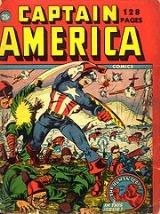
, including the covers of the Simon & Kirby-created Captain America Comics #5, 7 and 9 in 1941. After the Simon & Kirby team moved on following Captain America Comics #10 (Jan. 1942), Shores and Al Avison
became regular pencilers of the hit title, with one generally inking over the other, both working with writer Stan Lee
. At that point, Shores received a promotion, he recalled in 1973, "When Simon and Kirby left in 1942 Stan did all the writing and was given the position of editorial director, while I was the art director, although I got called 'associate editor' in the books that were put out around then." Shores took over as regular penciller on Captain America Comics, inked by Vince Alascia
, while Avison did his World War II
military service
. Decades later, Shores would return to ink Kirby's Captain America during the 1960s Silver Age of Comic Books
.
Shores also inked two of Kirby's Golden Age Vision stories, in Marvel Mystery Comics
#21-22 (July-Aug. 1941); and the cover and splash page of Young Allies
#1 (July 1941). Shores said, "Jack Kirby influenced my sense of dramatics. Jack Kirby influences everybody in comics, though: Before I got really started in the field it was Alex Raymond
and Hal Foster, they were my gods back then, but Kirby was the most immediate influence." Shores penciled stories of the Vision and the Patriot in Marvel Mystery Comics, Major Liberty in USA Comics, and the Captain America portions of the All-Winners Squad
stories in the (unhyphenated) All Winners Comics #19 and 21 (Fall and Winter 1946; there was no issue #20).
Shores was inducted into the U.S. Army
in early 1944, seeing action as part of General Patton's Third Army in France
and Germany
, and receiving a Purple Heart
for being wounded in France on 16 December 1944. After four months at a convalescent hospital in Warwick
, England
, he was reassigned to an engineering
outfit and became part of the occupation forces in Germany.
Comic-book artist Gene Colan
recalled in 1999,
. Future Comic Book Hall of Famer Gene Colan
, a Marvel mainstay from 1946 on, described Shores during this time as "a very quiet man. He would come in with a kind of very slow walk, with a cup of morning coffee in one of these spiral cups and a cigarette in the other. Big smoker. He would say hello to everybody very quietly, and sit down. He'd been in the war in Germany
, and sometimes I'd try to feel him out about it. He never wanted to talk about it. Very quiet fellow, but a sweet, sweet guy, and very helpful; very unassuming".
At postwar Timely and at the company's 1950s successor, Atlas Comics
, Shores was among the artists on the company's superhero
stars the Human Torch and the Sub-Mariner, the Western
titles The Black Rider
and Kid Colt, Outlaw
, the jungle series Jann of the Jungle
and Jungle Action
, the war comics Battle Action and Battle Brady, and many others including Blonde Phantom
.
Going freelance in 1948, when virtually all of Timely's staff positions were eliminated, Shores drew for Atlas, Avon, and Orbit Publications
. With Mort Lawrence
, who succeeded Bill Everett
on The Sub-Mariner, and Norman Steinberg, another Atlas artist, Shores co-founded a comic-art studio in 1952, first in Hempstead
, Long Island
, and later in nearby Freeport
. But with Steinberg's death in the mid-1950s and Lawrence's decision to leave the field, Shores returned to individual freelancing, adding magazine
illustration to his repertoire. He said in a 1970 interview that, "In 1957, there was a recession in the comic book industry and I was forced to look elsewhere for work. I entered the magazine illustration field. I did illustrations for the men's adventure
-type magazines until 1967. After things picked up again in the comic field I hastened back again to my first love, comics!"
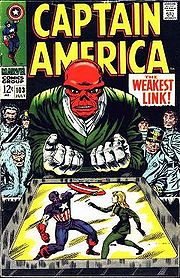 In the 1960s, Shores found a new audience at Marvel Comics, where he once again Jack Kirby
on Captain America
when the character once more received a full-length title, Captain America. Shores inked the premiere issue (#100, April 1968, continuing the numbering from Tales of Suspense
, a split book shared with Iron Man
) and continued through seven of the first 10. He also inked a run of Gene Colan
's Daredevil
, as well Colan's backup feature "The Watcher
" in Silver Surfer
#1 & #6 (Aug. 1968 & June 1969); Dick Ayers
' and Don Heck
's Captain Savage and His Leatherneck Raiders
/ Capt. Savage and His Battlefield Raiders, and a variety of other titles.
In a rare return to penciling at Marvel, Shores drew and self-inked the anthological horror stories "The Face of Fear" in Chamber of Darkness
#2 (Dec. 1969), "Time Out" in Tower of Shadows
#5 (May 1970), "Master and Slave" in Creatures on the Loose #12 (July 1971), "In the Shadow of Tragg — He Who Walks Beneath the Earth" in Monsters on the Prowl #13 (Oct. 1971), and "Terror of the Pterodactyl" in #15 (February 1972), as well as Gerry Conway
's adaptation of Harlan Ellison
's "Delusions for a Dragon Slayer" in Chamber of Chills
#1 (Nov. 1972). Additionally, Shores penciled and occasionally self-inked several Western stories, including the premiere of the feature "Tales of Fort Rango" in Western Gunfighters #1 (August 1970); The Gunhawks #1-2 & 4-5 (Oct.-Dec.1972, April–June 1973); and the Native American
hero Red Wolf
in Marvel Spotlight
#1 (Nov.1971) and Red Wolf #1-8 (May 1972 - July 1973). Shores also penciled the Skywald Publications
Western The Bravados #1 (Aug. 1971).
He likewise penciled a handful of black-and-white horror
-comics magazine
stories, such as "Blood Thirst!" in Major Publications
' Web Of Horror #1 (Dec. 1969) and "Strangers!" in #3 (April 1970); and for Warren Publishing
, "Army of the Walking Dead" in Creepy #35 (Sept. 1970) and "King Keller" in #37 (Jan. 1971).
Despite this seeming steady stream of work, fellow Golden Age and Silver Age artist Joe Giella
recalled that, "Syd later became a taxi cab driver; that was so sad. I happened to see him while I was on jury duty back in the early ' 70s, and he told me he was driving a cab because he couldn't find work".
Some of Shores' last comics work was inking Tom Sutton and Jim Mooney on, respectively Marvel's Ghost Rider
#1-2 (Sept.-Oct. 1973). A trouper to the end, he finished penciling two-thirds of the eight-page story "Voodoo War" for Marvel's black-and-white horror-comics magazine Tales of the Zombie #5 (May 1974) before dying of a heart seizure at age 59. Dick Ayers penciled the remainder of writer Tony Isabella
's anthological horror tale.
reprints of 1940s Timely Comics
stories, listed chronologically from date of earliest original publication:
United States
The United States of America is a federal constitutional republic comprising fifty states and a federal district...
comic book
Comic book
A comic book or comicbook is a magazine made up of comics, narrative artwork in the form of separate panels that represent individual scenes, often accompanied by dialog as well as including...
artist
Artist
An artist is a person engaged in one or more of any of a broad spectrum of activities related to creating art, practicing the arts and/or demonstrating an art. The common usage in both everyday speech and academic discourse is a practitioner in the visual arts only...
known for his work on Captain America
Captain America
Captain America is a fictional character, a superhero that appears in comic books published by Marvel Comics. The character first appeared in Captain America Comics #1 , from Marvel Comics' 1940s predecessor, Timely Comics, and was created by Joe Simon and Jack Kirby...
both during the 1940s, in what fans and historians call the Golden Age of comic books
Golden Age of Comic Books
The Golden Age of Comic Books was a period in the history of American comic books, generally thought of as lasting from the late 1930s until the late 1940s or early 1950s...
, and during the 1960s Silver Age of comic books
Silver Age of Comic Books
The Silver Age of Comic Books was a period of artistic advancement and commercial success in mainstream American comic books, predominantly those in the superhero genre. Following the Golden Age of Comic Books and an interregnum in the early to mid-1950s, the Silver Age is considered to cover the...
.
Early life and career
Syd Shores was educated at BrooklynBrooklyn
Brooklyn is the most populous of New York City's five boroughs, with nearly 2.6 million residents, and the second-largest in area. Since 1896, Brooklyn has had the same boundaries as Kings County, which is now the most populous county in New York State and the second-most densely populated...
's Pratt Institute
Pratt Institute
Pratt Institute is a private art college in New York City located in Brooklyn, New York, with satellite campuses in Manhattan and Utica. Pratt is one of the leading undergraduate art schools in the United States and offers programs in Architecture, Graphic Design, History of Art and Design,...
, where he met his wife-to-be, Selma. After working seven years at his uncle's whiskey bottling plant until it closed down in 1940, he became an assistant at the quirkily named Harry "A" Chesler's studio, under comics artists Mac Raboy
Mac Raboy
Emmanuel "Mac" Raboy was an American cartoonist whose comic books and strips remain collectibles more than 40 years after his death. He was known for his work on Fawcett Comics' Captain Marvel Jr...
and Phil Sturm. "For months I was just a joe-boy, watching and learning and helping wherever I could. I studied Mac Raboy for hours on end — he was slow and meticulous about everything, doing maybe only a single panel of artwork a day, but it was truly beautiful work. After four months I tried my own hand at work, doing a seven-page piece called 'The Terror'. I was proud of it then, of course, but in looking back it really was a terror!"
"The Terror" still held enough promise that it saw print in Mystic Comics
Mystic Comics
Mystic Comics is the name of four comic book series published by the company that would eventually become Marvel Comics. The first two series were superhero anthologies published by Marvel's 1930-1940s predecessor, Timely Comics, during what fans and historians call the Golden Age of comic books...
#5 (March 1941) from Timely Comics
Timely Comics
Timely Comics, an imprint of Timely Publications, was the earliest comic book arm of American publisher Martin Goodman, and the entity that would evolve by the 1960s to become Marvel Comics....
, the 1940s precursor of Marvel Comics
Marvel Comics
Marvel Worldwide, Inc., commonly referred to as Marvel Comics and formerly Marvel Publishing, Inc. and Marvel Comics Group, is an American company that publishes comic books and related media...
, and went on to make other appearances. Timely editor
Editing
Editing is the process of selecting and preparing written, visual, audible, and film media used to convey information through the processes of correction, condensation, organization, and other modifications performed with an intention of producing a correct, consistent, accurate, and complete...
Joe Simon
Joe Simon
Joseph Henry "Joe" Simon is an American comic book writer, artist, editor, and publisher. Simon created or co-created many important characters in the 1930s-1940s Golden Age of Comic Books and served as the first editor of Timely Comics, the company that would evolve into Marvel Comics.With his...
hired Shores as the fledgling company's third employee.
Golden Age of comics
Shores initially worked as an inkerInker
The inker is one of the two line artists in a traditional comic book or graphic novel. After a pencilled drawing is given to the inker, the inker uses black ink to produce refined outlines over the pencil lines...
, embellishing some of the earliest pencil work of industry legend Jack Kirby
Jack Kirby
Jack Kirby , born Jacob Kurtzberg, was an American comic book artist, writer and editor regarded by historians and fans as one of the major innovators and most influential creators in the comic book medium....
, including the covers of the Simon & Kirby-created Captain America Comics #5, 7 and 9 in 1941. After the Simon & Kirby team moved on following Captain America Comics #10 (Jan. 1942), Shores and Al Avison
Al Avison
Alfred Avison is an American comic book artist known for his work on the Marvel Comics characters Captain America and the Whizzer during the 1930-1940s period known to fans and historians as the Golden Age of comic books....
became regular pencilers of the hit title, with one generally inking over the other, both working with writer Stan Lee
Stan Lee
Stan Lee is an American comic book writer, editor, actor, producer, publisher, television personality, and the former president and chairman of Marvel Comics....
. At that point, Shores received a promotion, he recalled in 1973, "When Simon and Kirby left in 1942 Stan did all the writing and was given the position of editorial director, while I was the art director, although I got called 'associate editor' in the books that were put out around then." Shores took over as regular penciller on Captain America Comics, inked by Vince Alascia
Vince Alascia
Vincent Alascia , also known as Nicholas Alascia, was an American comic book artist known for his work on Captain America during the Golden Age of comics, and for his 23-year run as inker on a single creative team, with penciler Charles Nicholas Wojtkowski and writer Joe Gill at Charlton Comics...
, while Avison did his World War II
World War II
World War II, or the Second World War , was a global conflict lasting from 1939 to 1945, involving most of the world's nations—including all of the great powers—eventually forming two opposing military alliances: the Allies and the Axis...
military service
Military service
Military service, in its simplest sense, is service by an individual or group in an army or other militia, whether as a chosen job or as a result of an involuntary draft . Some nations require a specific amount of military service from every citizen...
. Decades later, Shores would return to ink Kirby's Captain America during the 1960s Silver Age of Comic Books
Silver Age of Comic Books
The Silver Age of Comic Books was a period of artistic advancement and commercial success in mainstream American comic books, predominantly those in the superhero genre. Following the Golden Age of Comic Books and an interregnum in the early to mid-1950s, the Silver Age is considered to cover the...
.
Shores also inked two of Kirby's Golden Age Vision stories, in Marvel Mystery Comics
Marvel Mystery Comics
Marvel Mystery Comics is an American comic book series published during the 1930s-1940s period known to fans and historians as the Golden Age of Comic Books...
#21-22 (July-Aug. 1941); and the cover and splash page of Young Allies
Young Allies
Young Allies is the name of three superhero teams in the .-Golden Age:The Golden Age's Young Allies were a gang of kids who fought the Axis...
#1 (July 1941). Shores said, "Jack Kirby influenced my sense of dramatics. Jack Kirby influences everybody in comics, though: Before I got really started in the field it was Alex Raymond
Alex Raymond
Alexander Gillespie "Alex" Raymond was an American cartoonist, best known for creating Flash Gordon for King Features in 1934...
and Hal Foster, they were my gods back then, but Kirby was the most immediate influence." Shores penciled stories of the Vision and the Patriot in Marvel Mystery Comics, Major Liberty in USA Comics, and the Captain America portions of the All-Winners Squad
All-Winners Squad
The All-Winners Squad is a fictional superhero team in the Marvel Comics universe. The company's first such team, it first appeared in All Winners Comics #19 , published by Marvel predecessor Timely Comics during the period fans and historians call the Golden Age of Comic Books.While the comic-book...
stories in the (unhyphenated) All Winners Comics #19 and 21 (Fall and Winter 1946; there was no issue #20).
Shores was inducted into the U.S. Army
United States Army
The United States Army is the main branch of the United States Armed Forces responsible for land-based military operations. It is the largest and oldest established branch of the U.S. military, and is one of seven U.S. uniformed services...
in early 1944, seeing action as part of General Patton's Third Army in France
France
The French Republic , The French Republic , The French Republic , (commonly known as France , is a unitary semi-presidential republic in Western Europe with several overseas territories and islands located on other continents and in the Indian, Pacific, and Atlantic oceans. Metropolitan France...
and Germany
Germany
Germany , officially the Federal Republic of Germany , is a federal parliamentary republic in Europe. The country consists of 16 states while the capital and largest city is Berlin. Germany covers an area of 357,021 km2 and has a largely temperate seasonal climate...
, and receiving a Purple Heart
Purple Heart
The Purple Heart is a United States military decoration awarded in the name of the President to those who have been wounded or killed while serving on or after April 5, 1917 with the U.S. military. The National Purple Heart Hall of Honor is located in New Windsor, New York...
for being wounded in France on 16 December 1944. After four months at a convalescent hospital in Warwick
Warwick
Warwick is the county town of Warwickshire, England. The town lies upon the River Avon, south of Coventry and just west of Leamington Spa and Whitnash with which it is conjoined. As of the 2001 United Kingdom census, it had a population of 23,350...
, England
England
England is a country that is part of the United Kingdom. It shares land borders with Scotland to the north and Wales to the west; the Irish Sea is to the north west, the Celtic Sea to the south west, with the North Sea to the east and the English Channel to the south separating it from continental...
, he was reassigned to an engineering
Engineering
Engineering is the discipline, art, skill and profession of acquiring and applying scientific, mathematical, economic, social, and practical knowledge, in order to design and build structures, machines, devices, systems, materials and processes that safely realize improvements to the lives of...
outfit and became part of the occupation forces in Germany.
Comic-book artist Gene Colan
Gene Colan
Eugene Jules "Gene" Colan was an American comic book artist best known for his work for Marvel Comics, where his signature titles include the superhero series, Daredevil, the cult-hit satiric series Howard the Duck, and The Tomb of Dracula, considered one of comics' classic horror series...
recalled in 1999,
Post-war career
After his military discharge in January 1946, Shores returned to Timely as art directorArt director
The art director is a person who supervise the creative process of a design.The term 'art director' is a blanket title for a variety of similar job functions in advertising, publishing, film and television, the Internet, and video games....
. Future Comic Book Hall of Famer Gene Colan
Gene Colan
Eugene Jules "Gene" Colan was an American comic book artist best known for his work for Marvel Comics, where his signature titles include the superhero series, Daredevil, the cult-hit satiric series Howard the Duck, and The Tomb of Dracula, considered one of comics' classic horror series...
, a Marvel mainstay from 1946 on, described Shores during this time as "a very quiet man. He would come in with a kind of very slow walk, with a cup of morning coffee in one of these spiral cups and a cigarette in the other. Big smoker. He would say hello to everybody very quietly, and sit down. He'd been in the war in Germany
Germany
Germany , officially the Federal Republic of Germany , is a federal parliamentary republic in Europe. The country consists of 16 states while the capital and largest city is Berlin. Germany covers an area of 357,021 km2 and has a largely temperate seasonal climate...
, and sometimes I'd try to feel him out about it. He never wanted to talk about it. Very quiet fellow, but a sweet, sweet guy, and very helpful; very unassuming".
At postwar Timely and at the company's 1950s successor, Atlas Comics
Atlas Comics (1950s)
Atlas Comics is the term used to describe the 1950s comic book publishing company that would evolve into Marvel Comics. Magazine and paperback novel publisher Martin Goodman, whose business strategy involved having a multitude of corporate entities, used Atlas as the umbrella name for his comic...
, Shores was among the artists on the company's superhero
Superhero
A superhero is a type of stock character, possessing "extraordinary or superhuman powers", dedicated to protecting the public. Since the debut of the prototypical superhero Superman in 1938, stories of superheroes — ranging from brief episodic adventures to continuing years-long sagas —...
stars the Human Torch and the Sub-Mariner, the Western
Western comics
Western comics is a comics genre usually depicting the American Old West frontier and typically set during the late nineteenth century...
titles The Black Rider
Black Rider
Black Rider may refer to:* The Third Horseman of the Four Horsemen of the Apocalypse* Black Rider , a Marvel Comics Western character* The Black Rider, a 1990 stage musical by Tom Waits, Robert Wilson and William S...
and Kid Colt, Outlaw
Kid Colt
Kid Colt is the name of two fictional characters in comic books published by Marvel Comics. The first is a cowboy whose adventures have taken place in numerous western themed comic book series published by Marvel...
, the jungle series Jann of the Jungle
Jann of the Jungle
Jann of the Jungle is a fictional comic book jungle girl protagonist created by writer Don Rico and artist Jay Scott Pike in the anthology title Jungle Tales #1 , published by Marvel Comics' 1950s predecessor, Atlas Comics....
and Jungle Action
Jungle Action
Jungle Action is the name of two comic book series published by Marvel Comics and its 1950s precursor, Atlas Comics. The latter-day version is the first series starring the Black Panther, the first Black superhero in mainstream comics, created by the writer/artist team of Stan Lee and Jack Kirby in...
, the war comics Battle Action and Battle Brady, and many others including Blonde Phantom
Blonde Phantom
The Blonde Phantom is a fictional masked crime fighter in comic books published by Marvel Comics. Created by writer-editor Stan Lee and artist Syd Shores for Marvel predecessor Timely Comics, she first appeared in All Select Comics #11 , during the 1940s period fans and historians call the Golden...
.
Going freelance in 1948, when virtually all of Timely's staff positions were eliminated, Shores drew for Atlas, Avon, and Orbit Publications
Orbit Publications
Orbit Publications was a publishing house operated by Rae Herman known for its comic books of the 1940s and 1950s "Golden Age of Comic Books"...
. With Mort Lawrence
Mort Lawrence
Morton "Mort" Lawrence is an American comic book artist and penciller. He is best known for his work on Atlas Comics' Young Men series which reintroduced Captain America and Bucky as communist hunting super-heroes....
, who succeeded Bill Everett
Bill Everett
William Blake "Bill" Everett, also known as William Blake and Everett Blake was a comic book writer-artist best known for creating Namor the Sub-Mariner and co-creating Daredevil for Marvel Comics...
on The Sub-Mariner, and Norman Steinberg, another Atlas artist, Shores co-founded a comic-art studio in 1952, first in Hempstead
Hempstead (village), New York
Hempstead is a village located in the town of Hempstead, Nassau County, New York, United States. The population was 53,891 at the 2010 census.Hofstra University is located on the border between Hempstead and Uniondale.-Foundation:...
, Long Island
Long Island
Long Island is an island located in the southeast part of the U.S. state of New York, just east of Manhattan. Stretching northeast into the Atlantic Ocean, Long Island contains four counties, two of which are boroughs of New York City , and two of which are mainly suburban...
, and later in nearby Freeport
Freeport, New York
Freeport is a village in the town of Hempstead, Nassau County, New York, USA, on the South Shore of Long Island. The population was 42,860 at the 2010 census. A settlement since the 1640s, it was once an oystering community and later a resort popular with the New York City theater community...
. But with Steinberg's death in the mid-1950s and Lawrence's decision to leave the field, Shores returned to individual freelancing, adding magazine
Magazine
Magazines, periodicals, glossies or serials are publications, generally published on a regular schedule, containing a variety of articles. They are generally financed by advertising, by a purchase price, by pre-paid magazine subscriptions, or all three...
illustration to his repertoire. He said in a 1970 interview that, "In 1957, there was a recession in the comic book industry and I was forced to look elsewhere for work. I entered the magazine illustration field. I did illustrations for the men's adventure
Men's adventure
Men's adventure is a genre of magazines that had its heyday in the 1950s and 1960s. Catering to a male audience, these magazines featured glamour photography and lurid tales of adventure that typically featured wartime feats of daring, exotic travel or conflict with wild animals.These magazines are...
-type magazines until 1967. After things picked up again in the comic field I hastened back again to my first love, comics!"
Silver Age of Comics
Jack Kirby
Jack Kirby , born Jacob Kurtzberg, was an American comic book artist, writer and editor regarded by historians and fans as one of the major innovators and most influential creators in the comic book medium....
on Captain America
Captain America
Captain America is a fictional character, a superhero that appears in comic books published by Marvel Comics. The character first appeared in Captain America Comics #1 , from Marvel Comics' 1940s predecessor, Timely Comics, and was created by Joe Simon and Jack Kirby...
when the character once more received a full-length title, Captain America. Shores inked the premiere issue (#100, April 1968, continuing the numbering from Tales of Suspense
Tales of Suspense
Tales of Suspense is the name of an American comic book series and two one-shot comics published by Marvel Comics. The first, which ran from 1959 to 1968, began as a science-fiction anthology that served as a showcase for such artists as Jack Kirby, Steve Ditko, and Don Heck, then featured...
, a split book shared with Iron Man
Iron Man
Iron Man is a fictional character, a superhero in the . The character was created by writer-editor Stan Lee, developed by scripter Larry Lieber, and designed by artists Don Heck and Jack Kirby, first appearing in Tales of Suspense #39 .A billionaire playboy, industrialist and ingenious engineer,...
) and continued through seven of the first 10. He also inked a run of Gene Colan
Gene Colan
Eugene Jules "Gene" Colan was an American comic book artist best known for his work for Marvel Comics, where his signature titles include the superhero series, Daredevil, the cult-hit satiric series Howard the Duck, and The Tomb of Dracula, considered one of comics' classic horror series...
's Daredevil
Daredevil (Marvel Comics)
Daredevil is a fictional character, a superhero in comic books published by Marvel Comics. The character was created by writer-editor Stan Lee and artist Bill Everett, with an unspecified amount of input from Jack Kirby, and first appeared in Daredevil #1 .Living in the Hell's Kitchen neighborhood...
, as well Colan's backup feature "The Watcher
Watcher (comics)
The Watchers are a fictional race of extraterrestrials that appear in comic books published by Marvel Comics. Created by Stan Lee and Jack Kirby, the first Watcher - named Uatu - appears in Fantastic Four #13 .-Fictional history:...
" in Silver Surfer
Silver Surfer
The Silver Surfer is a Marvel Comics superhero created by Jack Kirby. The character first appears in Fantastic Four #48 , the first of a three-issue arc that fans call "The Galactus Trilogy"....
#1 & #6 (Aug. 1968 & June 1969); Dick Ayers
Dick Ayers
Richard "Dick" Ayers is an American comic book artist and cartoonist best known for his work as one of Jack Kirby's inkers during the late-1950s and 1960s period known as the Silver Age of Comics, including on some of the earliest issues of Marvel Comics' The Fantastic Four, and as the signature...
' and Don Heck
Don Heck
Don Heck was an American comic book artist best known for co-creating the Marvel Comics character Iron Man, and for his long run penciling the Marvel superhero-team series The Avengers during the 1960s Silver Age of comic books.-Early life and career:Born in the Jamaica neighborhood of Queens, New...
's Captain Savage and His Leatherneck Raiders
Leatherneck Raiders
The Leatherneck Raiders are a fictional World War II unit in comic books published by Marvel Comics. Created by Gary Friedrich and Dick Ayers, they were a specially trained tactical commando squad...
/ Capt. Savage and His Battlefield Raiders, and a variety of other titles.
In a rare return to penciling at Marvel, Shores drew and self-inked the anthological horror stories "The Face of Fear" in Chamber of Darkness
Chamber of Darkness
Chamber of Darkness was a horror/fantasy anthology comic book published bi-monthly by Marvel Comics that under this and a subsequent name ran from 1969-1974...
#2 (Dec. 1969), "Time Out" in Tower of Shadows
Tower of Shadows
Tower of Shadows was a horror/fantasy anthology comic book published by Marvel Comics under this and a subsequent name from 1969-1975. It featured work by such notable creators as writer-artists Neal Adams, Jim Steranko, Johnny Craig, and Wally Wood, writer-editor Stan Lee, and artists including...
#5 (May 1970), "Master and Slave" in Creatures on the Loose #12 (July 1971), "In the Shadow of Tragg — He Who Walks Beneath the Earth" in Monsters on the Prowl #13 (Oct. 1971), and "Terror of the Pterodactyl" in #15 (February 1972), as well as Gerry Conway
Gerry Conway
Gerard F. "Gerry" Conway is an American writer of comic books and television shows. He is known for co-creating the Marvel Comics vigilante The Punisher and scripting the death of the character Gwen Stacy during his long run on The Amazing Spider-Man...
's adaptation of Harlan Ellison
Harlan Ellison
Harlan Jay Ellison is an American writer. His principal genre is speculative fiction.His published works include over 1,700 short stories, novellas, screenplays, teleplays, essays, a wide range of criticism covering literature, film, television, and print media...
's "Delusions for a Dragon Slayer" in Chamber of Chills
Chamber of Chills
Chamber of Chills is the name of two anthology horror comic books, one published by Harvey Publications in the early 1950s, the other by Marvel Comics in the 1970s.-Harvey Publications:...
#1 (Nov. 1972). Additionally, Shores penciled and occasionally self-inked several Western stories, including the premiere of the feature "Tales of Fort Rango" in Western Gunfighters #1 (August 1970); The Gunhawks #1-2 & 4-5 (Oct.-Dec.1972, April–June 1973); and the Native American
Native Americans in the United States
Native Americans in the United States are the indigenous peoples in North America within the boundaries of the present-day continental United States, parts of Alaska, and the island state of Hawaii. They are composed of numerous, distinct tribes, states, and ethnic groups, many of which survive as...
hero Red Wolf
Red Wolf (comics)
Red Wolf is the name of a number of fictional characters in Marvel Comics' shared universe, the Marvel Universe.-Johnny Wakeley:Johnny Wakeley was the adopted name of a Cheyenne man who was raised from childhood by a white couple in the late 19th century. His adoptive parents were killed by Native...
in Marvel Spotlight
Marvel Spotlight
Marvel Spotlight is the name of several comic book series published by Marvel Comics as a try-out book for new characters. The first series ran for 33 issues from November 1971 to April 1977...
#1 (Nov.1971) and Red Wolf #1-8 (May 1972 - July 1973). Shores also penciled the Skywald Publications
Skywald Publications
Skywald Publications is a 1970s publisher of black-and-white comics magazines, primarily the horror anthologies Nightmare, Psycho, and Scream. It also published a small line of comic books and other magazines....
Western The Bravados #1 (Aug. 1971).
He likewise penciled a handful of black-and-white horror
Horror fiction
Horror fiction also Horror fantasy is a philosophy of literature, which is intended to, or has the capacity to frighten its readers, inducing feelings of horror and terror. It creates an eerie atmosphere. Horror can be either supernatural or non-supernatural...
-comics magazine
Magazine
Magazines, periodicals, glossies or serials are publications, generally published on a regular schedule, containing a variety of articles. They are generally financed by advertising, by a purchase price, by pre-paid magazine subscriptions, or all three...
stories, such as "Blood Thirst!" in Major Publications
Major Publications
Major Publications, also known was Major Magazines, was a publisher specializing in comic magazines, most notably the satirical magazine Cracked, the most durable imitator of Mad magazine. Founded by Robert C...
' Web Of Horror #1 (Dec. 1969) and "Strangers!" in #3 (April 1970); and for Warren Publishing
Warren Publishing
Warren Publishing was an American magazine company founded by James Warren, who published his first magazines in 1957 and continued in the business for decades...
, "Army of the Walking Dead" in Creepy #35 (Sept. 1970) and "King Keller" in #37 (Jan. 1971).
Despite this seeming steady stream of work, fellow Golden Age and Silver Age artist Joe Giella
Joe Giella
Joe Giella is an American comic book artist best known as a DC Comics inker during the late 1950s and 1960s period historians and fans call the Silver Age of comic books.-Early life and career:...
recalled that, "Syd later became a taxi cab driver; that was so sad. I happened to see him while I was on jury duty back in the early ' 70s, and he told me he was driving a cab because he couldn't find work".
Some of Shores' last comics work was inking Tom Sutton and Jim Mooney on, respectively Marvel's Ghost Rider
Ghost Rider (comics)
Ghost Rider is the name of several fictional supernatural antiheroes appearing in comic books published by Marvel Comics. Marvel had previously used the name for a Western character whose name was later changed to Night Rider and subsequently to Phantom Rider.The first supernatural Ghost Rider is...
#1-2 (Sept.-Oct. 1973). A trouper to the end, he finished penciling two-thirds of the eight-page story "Voodoo War" for Marvel's black-and-white horror-comics magazine Tales of the Zombie #5 (May 1974) before dying of a heart seizure at age 59. Dick Ayers penciled the remainder of writer Tony Isabella
Tony Isabella
Tony Isabella is an American comic book writer, editor, artist and critic, known as the creator and writer of Marvel Comics' Black Goliath, DC Comics' first major African American superhero, Black Lightning, and as a columnist and critic for the Comics Buyer's Guide.-Marvel Comics:Before he joined...
's anthological horror tale.
Legacy
The survey "The 20 Greatest Inkers of American Comic Books" placed Shores at #11, saying he ""evidenced a unique and singular inking style, one perhaps only vaguely approximated by the great Bill Everett. Both had bold but rough-hewn lines and illustrative, photorealistic brushwork which gave the pages a beautiful, organic look. . . ."Shores Golden Age reprints
Marvel ComicsMarvel Comics
Marvel Worldwide, Inc., commonly referred to as Marvel Comics and formerly Marvel Publishing, Inc. and Marvel Comics Group, is an American company that publishes comic books and related media...
reprints of 1940s Timely Comics
Timely Comics
Timely Comics, an imprint of Timely Publications, was the earliest comic book arm of American publisher Martin Goodman, and the entity that would evolve by the 1960s to become Marvel Comics....
stories, listed chronologically from date of earliest original publication:
- Captain AmericaCaptain AmericaCaptain America is a fictional character, a superhero that appears in comic books published by Marvel Comics. The character first appeared in Captain America Comics #1 , from Marvel Comics' 1940s predecessor, Timely Comics, and was created by Joe Simon and Jack Kirby...
: The Classic Years (1998) ISBN 0-7851-0660-X
-
- Covers, Captain America Comics #2, 5-7 (April, August–October 1941)
- Captain America: The Classic Years, Vol. 2 (2000) ISBN 0-7851-0743-6
- Captain America Comics #7 (Oct. 1941)
- "Captain America and the Red Skull"
- "Death Loads the Bases"
- "Horror Plays the Scales"
- The Golden Age of Marvel Comics (1997) ISBN 0-7851-0564-6
- Captain America Comics #22 (Jan. 1943): "The Cobra Ring of Death"
- Fantasy Masterpieces #10 (Aug. 1967) and Timely Presents: All-Winners (hyphen sic) #1 (Dec. 1999)
- All Winners ComicsAll-Winners SquadThe All-Winners Squad is a fictional superhero team in the Marvel Comics universe. The company's first such team, it first appeared in All Winners Comics #19 , published by Marvel predecessor Timely Comics during the period fans and historians call the Golden Age of Comic Books.While the comic-book...
#19 (Fall 1946)- Marvel Super-HeroesMarvel Super-Heroes (comics)Marvel Super-Heroes is the name of several comic book series and specials published by Marvel Comics.-Marvel Super-Heroes Special:The first was the one-shot Marvel Super-Heroes Special #1 , reprinting Daredevil #1 and The Avengers #2 Marvel Super-Heroes is the name of several comic book series and...
#17-18 (Nov. 1968 - January 1969)
- Marvel Super-Heroes
- All Winners Comics #21 (Winter 1946)
- Covers, Captain America Comics #2, 5-7 (April, August–October 1941)
External links
- The Unofficial Handbook of Marvel Comics Creators
- Archive of The Syd Shores Timely Gallery, LiveForEverett.com, n.d. Original page.
- Nevins, JessJess NevinsJohn J. Nevins, MA/MS, is an American author and librarian, born 30 July 1966 and raised in Boston, Massachusetts. He is the author of the World Fantasy Award-nominated Encyclopedia of Fantastic Victoriana , and other works on Victoriana and pulp fiction...
. "The Timely Comics Story". WebCitation archive. - Stiles, Steve. "The Star-Spangled Avenger: Timely Declares War Against The Axis", SteveStiles.com, n.d. WebCitation archive.
- Vassallo, Michael J. "A Timely Talk with Allen Bellman", Comicartville.com, 2005. WebCitation archive.