

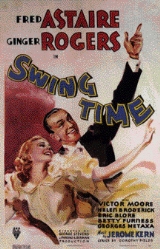
Swing Time

Encyclopedia
Swing Time is a 1936 RKO musical comedy film
set mainly in New York City
and stars Fred Astaire
, Ginger Rogers
, Helen Broderick
, Victor Moore
, Eric Blore
and Georges Metaxa, with music by Jerome Kern
and lyrics by Dorothy Fields
. The film was directed by George Stevens
.
Swing Time is considered by Croce
, Mueller
and Hyam to be Astaire and Rogers' best dance musical, featuring four dance routines that are each regarded as masterpieces of their kind. "Never Gonna Dance" is often singled out as the partnership's and collaborator Hermes Pan
's most profound achievement in filmed dance, while "The Way You Look Tonight
" won the Academy Award for Best Original Song
and went on to become Astaire's most successful hit record, scoring first place in the U.S. charts in 1936. Kern's score, the second of three he composed specially for Astaire, contains three of his most memorable songs.
But while it is considered to be one of Astaire and Rogers' greatest films, the film's plot has been criticized as has the performance of Metaxa. More praised is the acting and dancing performance of Ginger Rogers. Rogers herself credited much of the film's success to Stevens: "He gave us a certain quality, I think, that made it stand out above the others." Swing Time also marked the beginning of a decline in popularity of the Astaire-Rogers partnership among the general public, with box office receipts falling faster than usual, after a successful opening. Nevertheless, the film was a sizable hit, costing $886,000 while grossing over $2,600,000 worldwide and showing a net profit of $830,000. Still, the partnership never again quite regained the creative heights scaled in this and previous films.
In 1999, Swing Time was one of Entertainment Weekly
's top 100 films. In 2004, it was selected for preservation in the United States National Film Registry
by the Library of Congress
as being "culturally, historically, or aesthetically significant". In the new AFI's 100 Years... 100 Movies (10th Anniversary Edition) it has been added at #90.
) is a gambler and dancer. He is set to marry Margaret (Betty Furness
), but his friends hold him up so that he is late to the wedding. Margret's father phones to call off the wedding, but Lucky doesn't get that message. His friends bet him that he won't be getting married and he agrees to the bet. Margret's father tells Lucky that he must earn $25,000 in order to demonstrate his good intentions.
He and his friend "Pop" Cardetti (Victor Moore
) try to buy train tickets, but his friends take his money - because he lost the bet. So they hitch the first freight train to New York. Broke, they wander around the city. Lucky meets Penny (Ginger Rogers
), a dance school instructor, when he asks for change for a quarter. It's his lucky quarter and Pop feels bad that Lucky lost it. They attempt to get it back, but Penny is in no mood to deal with them. When she drops her things, Pop sneaks the quarter out of her purse, and she thinks Lucky did it.
They follow Penny to her work. In order to apologize, he needs to take a lesson from her. She's still furious at him. After a disastrous lesson, Penny tells him to "save his money" since he will never learn to dance. Her boss, Mr. Gordon (Eric Blore
), overhears her comment and fires her. Lucky dances with Penny to "prove" how much she's taught him. Not only does he give Penny her job back, Mr. Gordon sets up an audition with the owner of a local venue.
They check into the same hotel where Penny is staying. Lucky does not have a tuxedo to wear to the audition. He tries to get a tuxedo off a drunk man, but he ends up loses his own clothes instead. They miss the audition and Penny gets mad at Lucky all over again. Lucky arranges another audition. He and Pop picket in front of Penny's door until she gives in and forgives him.
But they cannot audition because the club has lost their band leader, Ricardo Romero (Georges Metaxa), to a casino. They go to Club Raymond where Lucky gambles to win enough to get Ricky back. Meanwhile, Ricky declares his feelings for Penny. Lucky is about to win enough to marry Margaret, but his takes his last bet off in time... proving he is no longer interested in her, but in Penny, instead. The club owner bets him double or nothing and they gamble for Ricky's contract. Pop cheats and Lucky wins the contract.
Lucky and Penny dance at the club. They are dancing together all the time, but Lucky does not trust himself around Penny because he feels guilty about not telling her about Margaret. He's avoiding her, which Penny notices, so she and her friend Mabel Anderson (Helen Broderick
) conspire to get Lucky and Pop out to the country. Pop lets slip the information about Lucky and Margaret.
Despite her best efforts, the two begin a romance, even as Ricky continues to woo Penny. When Margaret shows up, Lucky tries to avoid her, but, too late, Penny finds out. She agrees to marry Ricky. Margaret calls off her engagement to Lucky before he can. Lucky successfully stops Penny's wedding. And the two end up together, much to everyone's delight.
. These releases feature a commentary by John Mueller
, author of Astaire Dancing - The Musical Films.
, who control the rights to the RKO Astaire-Rogers pictures in Europe. These releases feature an introduction by Astaire's daughter, Ava Astaire McKenzie.
Comedy film
Comedy film is a genre of film in which the main emphasis is on humour. They are designed to elicit laughter from the audience. Comedies are mostly light-hearted dramas and are made to amuse and entertain the audiences...
set mainly in New York City
New York City
New York is the most populous city in the United States and the center of the New York Metropolitan Area, one of the most populous metropolitan areas in the world. New York exerts a significant impact upon global commerce, finance, media, art, fashion, research, technology, education, and...
and stars Fred Astaire
Fred Astaire
Fred Astaire was an American film and Broadway stage dancer, choreographer, singer and actor. His stage and subsequent film career spanned a total of 76 years, during which he made 31 musical films. He was named the fifth Greatest Male Star of All Time by the American Film Institute...
, Ginger Rogers
Ginger Rogers
Ginger Rogers was an American actress, dancer, and singer who appeared in film, and on stage, radio, and television throughout much of the 20th century....
, Helen Broderick
Helen Broderick
Helen Broderick was an American film and stage actress known for her comic roles, especially as a wisecracking sidekick.-Career:...
, Victor Moore
Victor Moore
Victor Frederick Moore was an American actor of stage and screen, as well as a comedian, writer, and director.-Personal life:...
, Eric Blore
Eric Blore
Eric Blore was an English comic actor. Blore was born in Finchley , England.Aged eighteeen, he worked as an insurance agent for two years. He gained theatre experience while touring Australia. Originally enlisting into the Artists Rifles he was commissioned in the South Wales Borderers in World...
and Georges Metaxa, with music by Jerome Kern
Jerome Kern
Jerome David Kern was an American composer of musical theatre and popular music. One of the most important American theatre composers of the early 20th century, he wrote more than 700 songs, used in over 100 stage works, including such classics as "Ol' Man River", "Can't Help Lovin' Dat Man", "A...
and lyrics by Dorothy Fields
Dorothy Fields
Dorothy Fields was an American librettist and lyricist.She wrote over 400 songs for Broadway musicals and films...
. The film was directed by George Stevens
George Stevens
George Stevens was an American film director, producer, screenwriter and cinematographer.Among his most notable films were Diary of Anne Frank , nominated for Best Director, Giant , winner of Oscar for Best Director, Shane , Oscar nominated, and A Place in the Sun , winner of Oscar for Best...
.
Swing Time is considered by Croce
Arlene Croce
Arlene Croce founded Ballet Review magazine in 1965. She was a dance critic for The New Yorker magazine from 1973 to 1998. Prior to her long career as a dance writer, she also wrote film criticism for Film Culture and other magazines. The keynote of her criticism can be grasped from her ability to...
, Mueller
John Mueller
John E. Mueller is a political scientist in the field of international relations as well as a scholar of the history of dance. He is recognized for his ideas concerning "the banality of ethnic war" and the theory that major world conflicts are quickly becoming obsolete.-Career:He received his A.B...
and Hyam to be Astaire and Rogers' best dance musical, featuring four dance routines that are each regarded as masterpieces of their kind. "Never Gonna Dance" is often singled out as the partnership's and collaborator Hermes Pan
Hermes Pan (choreographer)
Hermes Pan was an American dancer and choreographer, principally celebrated as Fred Astaire's choreographic collaborator on the famous 1930s movie musicals starring Astaire and Ginger Rogers.-Early life:...
's most profound achievement in filmed dance, while "The Way You Look Tonight
The Way You Look Tonight
"The Way You Look Tonight" is a song featured in the film Swing Time, originally performed by Fred Astaire. It won the Academy Award for Best Original Song in 1936. The song was sung to Ginger Rogers as Penelope "Penny" Carroll by Astaire's character of John "Lucky" Garnett while Penny was busy...
" won the Academy Award for Best Original Song
Academy Award for Best Original Song
The Academy Award for Best Original Song is one of the awards given annually to people working in the motion picture industry by the Academy of Motion Picture Arts and Sciences . It is presented to the songwriters who have composed the best original song written specifically for a film...
and went on to become Astaire's most successful hit record, scoring first place in the U.S. charts in 1936. Kern's score, the second of three he composed specially for Astaire, contains three of his most memorable songs.
But while it is considered to be one of Astaire and Rogers' greatest films, the film's plot has been criticized as has the performance of Metaxa. More praised is the acting and dancing performance of Ginger Rogers. Rogers herself credited much of the film's success to Stevens: "He gave us a certain quality, I think, that made it stand out above the others." Swing Time also marked the beginning of a decline in popularity of the Astaire-Rogers partnership among the general public, with box office receipts falling faster than usual, after a successful opening. Nevertheless, the film was a sizable hit, costing $886,000 while grossing over $2,600,000 worldwide and showing a net profit of $830,000. Still, the partnership never again quite regained the creative heights scaled in this and previous films.
In 1999, Swing Time was one of Entertainment Weekly
Entertainment Weekly
Entertainment Weekly is an American magazine, published by the Time division of Time Warner, that covers film, television, music, broadway theatre, books and popular culture...
's top 100 films. In 2004, it was selected for preservation in the United States National Film Registry
National Film Registry
The National Film Registry is the United States National Film Preservation Board's selection of films for preservation in the Library of Congress. The Board, established by the National Film Preservation Act of 1988, was reauthorized by acts of Congress in 1992, 1996, 2005, and again in October 2008...
by the Library of Congress
Library of Congress
The Library of Congress is the research library of the United States Congress, de facto national library of the United States, and the oldest federal cultural institution in the United States. Located in three buildings in Washington, D.C., it is the largest library in the world by shelf space and...
as being "culturally, historically, or aesthetically significant". In the new AFI's 100 Years... 100 Movies (10th Anniversary Edition) it has been added at #90.
Synopsis
John "Lucky" Garnett (Fred AstaireFred Astaire
Fred Astaire was an American film and Broadway stage dancer, choreographer, singer and actor. His stage and subsequent film career spanned a total of 76 years, during which he made 31 musical films. He was named the fifth Greatest Male Star of All Time by the American Film Institute...
) is a gambler and dancer. He is set to marry Margaret (Betty Furness
Betty Furness
Elizabeth Mary Furness was an American actress, consumer advocate and current affairs commentator.-Early years:...
), but his friends hold him up so that he is late to the wedding. Margret's father phones to call off the wedding, but Lucky doesn't get that message. His friends bet him that he won't be getting married and he agrees to the bet. Margret's father tells Lucky that he must earn $25,000 in order to demonstrate his good intentions.
He and his friend "Pop" Cardetti (Victor Moore
Victor Moore
Victor Frederick Moore was an American actor of stage and screen, as well as a comedian, writer, and director.-Personal life:...
) try to buy train tickets, but his friends take his money - because he lost the bet. So they hitch the first freight train to New York. Broke, they wander around the city. Lucky meets Penny (Ginger Rogers
Ginger Rogers
Ginger Rogers was an American actress, dancer, and singer who appeared in film, and on stage, radio, and television throughout much of the 20th century....
), a dance school instructor, when he asks for change for a quarter. It's his lucky quarter and Pop feels bad that Lucky lost it. They attempt to get it back, but Penny is in no mood to deal with them. When she drops her things, Pop sneaks the quarter out of her purse, and she thinks Lucky did it.
They follow Penny to her work. In order to apologize, he needs to take a lesson from her. She's still furious at him. After a disastrous lesson, Penny tells him to "save his money" since he will never learn to dance. Her boss, Mr. Gordon (Eric Blore
Eric Blore
Eric Blore was an English comic actor. Blore was born in Finchley , England.Aged eighteeen, he worked as an insurance agent for two years. He gained theatre experience while touring Australia. Originally enlisting into the Artists Rifles he was commissioned in the South Wales Borderers in World...
), overhears her comment and fires her. Lucky dances with Penny to "prove" how much she's taught him. Not only does he give Penny her job back, Mr. Gordon sets up an audition with the owner of a local venue.
They check into the same hotel where Penny is staying. Lucky does not have a tuxedo to wear to the audition. He tries to get a tuxedo off a drunk man, but he ends up loses his own clothes instead. They miss the audition and Penny gets mad at Lucky all over again. Lucky arranges another audition. He and Pop picket in front of Penny's door until she gives in and forgives him.
But they cannot audition because the club has lost their band leader, Ricardo Romero (Georges Metaxa), to a casino. They go to Club Raymond where Lucky gambles to win enough to get Ricky back. Meanwhile, Ricky declares his feelings for Penny. Lucky is about to win enough to marry Margaret, but his takes his last bet off in time... proving he is no longer interested in her, but in Penny, instead. The club owner bets him double or nothing and they gamble for Ricky's contract. Pop cheats and Lucky wins the contract.
Lucky and Penny dance at the club. They are dancing together all the time, but Lucky does not trust himself around Penny because he feels guilty about not telling her about Margaret. He's avoiding her, which Penny notices, so she and her friend Mabel Anderson (Helen Broderick
Helen Broderick
Helen Broderick was an American film and stage actress known for her comic roles, especially as a wisecracking sidekick.-Career:...
) conspire to get Lucky and Pop out to the country. Pop lets slip the information about Lucky and Margaret.
Despite her best efforts, the two begin a romance, even as Ricky continues to woo Penny. When Margaret shows up, Lucky tries to avoid her, but, too late, Penny finds out. She agrees to marry Ricky. Margaret calls off her engagement to Lucky before he can. Lucky successfully stops Penny's wedding. And the two end up together, much to everyone's delight.
Cast
- Fred AstaireFred AstaireFred Astaire was an American film and Broadway stage dancer, choreographer, singer and actor. His stage and subsequent film career spanned a total of 76 years, during which he made 31 musical films. He was named the fifth Greatest Male Star of All Time by the American Film Institute...
as John "Lucky" Garnett - Ginger RogersGinger RogersGinger Rogers was an American actress, dancer, and singer who appeared in film, and on stage, radio, and television throughout much of the 20th century....
as Penelope "Penny" Carrol - Victor MooreVictor MooreVictor Frederick Moore was an American actor of stage and screen, as well as a comedian, writer, and director.-Personal life:...
as Edwin "Pop" Cardetti - Helen BroderickHelen BroderickHelen Broderick was an American film and stage actress known for her comic roles, especially as a wisecracking sidekick.-Career:...
as Mabel Anderson - Betty FurnessBetty FurnessElizabeth Mary Furness was an American actress, consumer advocate and current affairs commentator.-Early years:...
as Margaret Watson - Georges Metaxa as Ricardo Romero
- Landers Stevens (George Stevens' father) as Judge Watson
Key songs/dance routines
Astaire introduces two new elements into his approach to filmed song and dance, both of which represent the abandonment of theatrical staging conventions. First is the use of space, horizontally in "A Fine Romance" and vertically in "Never Gonna Dance", and second is the introduction of trick photography in "Bojangles of Harlem". Partnered hopping steps/spins and the satire of self-conscious elegance feature prominently in the choreography, in which Astaire was assisted by Hermes Pan.- "Pick Yourself UpPick Yourself Up"Pick Yourself Up" is a popular song composed in 1936 by Jerome Kern, with lyrics by Dorothy Fields. It has a verse and chorus, as well as a third section, though the third section is often omitted in recordings...
": The first of Kern's standards is a charming polkaPolkaThe polka is a Central European dance and also a genre of dance music familiar throughout Europe and the Americas. It originated in the middle of the 19th century in Bohemia...
first sung and then danced to by Astaire and Rogers. One of their most joyous and exuberant numbers is also a technical tour-de-force with the basic polka embellished by syncopated rhythms and overlayed with tap decoration. In particular, Rogers recaptures the spontaneity and commitment that she first displayed in the "I'll Be Hard to HandleI'll Be Hard to Handle"I'll Be Hard to Handle" is a 1932 song composed by Jerome Kern, with lyrics written by Bernard Dougall.It was written for the Broadway musical Roberta , where it was introduced by Lyda Roberti....
" number from RobertaRoberta (1935 film)Roberta is a 1935 musical film by RKO starring Irene Dunne, Fred Astaire, Ginger Rogers, and Randolph Scott. It was an adaptation of a 1933 Broadway theatre musical of the same name, which in turn was based on the novel Gowns by Roberta by Alice Duer Miller...
(1935). - "The Way You Look TonightThe Way You Look Tonight"The Way You Look Tonight" is a song featured in the film Swing Time, originally performed by Fred Astaire. It won the Academy Award for Best Original Song in 1936. The song was sung to Ginger Rogers as Penelope "Penny" Carroll by Astaire's character of John "Lucky" Garnett while Penny was busy...
": Kern's classic Oscar-winning foxtrotFoxtrot (Dance)The foxtrot is a smooth progressive dance characterized by long, continuous flowing movements across the dance floor. It is danced to big band music, and the feeling is one of elegance and sophistication...
is sung by Astaire, seated at a piano, while Ginger is busy washing her hair in a side room. Here, Astaire conveys a sunny yet nostalgic romanticism but later, when the music is danced to as part of "Never Gonna Dance", the pair will create a mood of sombre poignancy. As evidence of its enduring appeal, this song is regularly featured in modern cinema and television: as in Chinatown (1974), or My Best Friend's WeddingMy Best Friend's WeddingMy Best Friend's Wedding is a 1997 romantic comedy film directed by P. J. Hogan. It stars Julia Roberts, Cameron Diaz, Dermot Mulroney, Rupert Everett, and Philip Bosco.The film received mostly positive reviews from critics...
(1997), and it played a prominent role as the key linking element in the final episode of Star Trek: Deep Space NineStar Trek: Deep Space NineStar Trek: Deep Space Nine is a science fiction television series set in the Star Trek universe...
. - "Waltz in Swing Time": Described by one critic as "the finest piece of pure dance music ever written for Astaire", this is the most virtuosic partnered romantic duet Astaire ever committed to film. Kern - always reluctant to compose in the Swing style - provided some themes to Robert Russell BennettRobert Russell BennettRobert Russell Bennett was an American composer and arranger, best known for his orchestration of many well-known Broadway and Hollywood musicals by other composers such as Irving Berlin, George Gershwin, Jerome Kern, Cole Porter, and Richard Rodgers. In 1957 and 2008, Bennett received Tony Awards...
who, with the assistance of Astaire's rehearsal pianist Hal BorneHal BorneHal Borne was an American popular song composer, orchestra leader, music arranger and musical director, who studied music at the University of Illinois...
, produced the final score. The dance is a nostalgic celebration of love, in the form of a syncopated waltz with tap overlays - a concept Astaire later reworked in the similarly impressive "Belle of New York" segment of the "Currier and Ives" routine from The Belle of New YorkThe Belle of New YorkThe Belle of New York is a 1952 Hollywood musical comedy film set in New York circa 1900 and stars Fred Astaire, Vera-Ellen, Alice Pearce, Marjorie Main and Keenan Wynn, with music by Harry Warren and lyrics by Johnny Mercer...
(1952). In the midst of this most complex of routines, Astaire and Rogers find time to gently poke fun at notions of elegance, in a delicate reminder of a similar episode in "Pick Yourself Up". - "A Fine RomanceA Fine Romance (song)"A Fine Romance" is a popular song composed by Jerome Kern with lyrics by Dorothy Fields, published in 1936.The song was written for the musical film, Swing Time, where it was co-introduced by Fred Astaire and Ginger Rogers...
": Kern's third standard, a quickstepQuickstepThe quickstep is a light-hearted member of the standard ballroom dances. The movement of the dance is fast and powerfully flowing and sprinkled with syncopations. The upbeat melodies that quickstep is danced to make it suitable for both formal and informal events...
to Field's bittersweet lyrics, is sung alternately by Rogers and Astaire, with Rogers providing an object lesson in acting while a bowler-hatted Astaire appears at times to be impersonating Stan LaurelStan LaurelArthur Stanley "Stan" Jefferson , better known as Stan Laurel, was an English comic actor, writer and film director, famous as the first half of the comedy team Laurel and Hardy. His film acting career stretched between 1917 and 1951 and included a starring role in the Academy Award winning film...
. Never a man to discard a favourite piece of fine clothing, Astaire wears the same coat in the opening scene of Holiday InnHoliday Inn (film)Holiday Inn is a 1942 American musical film starring Bing Crosby and Fred Astaire, with music by Irving Berlin. The film has twelve songs written expressly for the film, the most notable being "White Christmas"...
(1941), and never a man to waste a chord sequence, Jerome Kern uses the same sequence for "The Way you Look Tonight" and "A Fine Romance". - "Bojangles of Harlem": Once again, Kern, Bennett and Borne combined their talents to produce a jaunty instrumental piece ideally suited to Astaire, who here - while overtly paying tribute to Bill RobinsonBill RobinsonBill “Bojangles” Robinson was an American tap dancer and actor of stage and film. Audiences enjoyed his understated style, which eschewed the frenetic manner of the jitterbug in favor of cool and reserve; rarely did he use his upper body, relying instead on busy, inventive feet, and an expressive...
- actually broadens his tribute to African-American tap dancers by dancing in the style of Astaire's one-time teacher John W. BubblesJohn W. BubblesJohn William Sublett , known by his stage name John W. Bubbles, was an American vaudeville performer, dancer, singer and entertainer.-Life and career:...
, and dressing in the style of the character Sportin' Life, whom Bubbles played the year before in Gershwin's Porgy and BessPorgy and BessPorgy and Bess is an opera, first performed in 1935, with music by George Gershwin, libretto by DuBose Heyward, and lyrics by Ira Gershwin and DuBose Heyward. It was based on DuBose Heyward's novel Porgy and subsequent play of the same title, which he co-wrote with his wife Dorothy Heyward...
. Dorothy Fields recounts how Astaire managed to inspire the reluctant Kern by visiting his home and singing while dancing on and around his furniture. It is the only number in which Astaire - again bowler-hatted - appears in blackfaceBlackfaceBlackface is a form of theatrical makeup used in minstrel shows, and later vaudeville, in which performers create a stereotyped caricature of a black person. The practice gained popularity during the 19th century and contributed to the proliferation of stereotypes such as the "happy-go-lucky darky...
. The idea of using trick photography to show Astaire dancing with three of his shadows was invented by Hermes Pan, who also choreographed the opening chorus, after which Astaire dances a short opening solo which features poses mimicking, perhaps satirising, Al JolsonAl JolsonAl Jolson was an American singer, comedian and actor. In his heyday, he was dubbed "The World's Greatest Entertainer"....
- all of which was captured by Stevens in one take. There follows a two-minute solo of Astaire dancing with his shadows which took three days to shoot. Astaire's choreography exercises every limb and makes extensive use of hand-clappers. This routine earned Hermes Pan an Academy AwardAcademy AwardsAn Academy Award, also known as an Oscar, is an accolade bestowed by the American Academy of Motion Picture Arts and Sciences to recognize excellence of professionals in the film industry, including directors, actors, and writers...
nomination for Best Dance Direction. - "Never Gonna DanceNever Gonna Dance (song)"Never Gonna Dance" is a song performed by Fred Astaire and danced with Ginger Rogers in their movie Swing Time. The words were by Dorothy Fields and the music was by Jerome Kern....
": After Astaire sings Field's memorable closing line: "la belle, la perfectly swell romance" of Kern's haunting ballad, they begin the acknowledgement phase of the dance - possibly their greatest - replete with a poignant nostalgia for their now-doomed affair, where music changes to "The Way You Look Tonight" and they dance slowly in a manner reminiscent of the opening part of "Let's Face The Music And Dance" from Follow the FleetFollow the FleetFollow the Fleet is a 1936 Hollywood musical comedy film with a nautical theme and stars Fred Astaire, Ginger Rogers, Randolph Scott, Harriet Hilliard, and Astrid Allwyn, with music and lyrics by Irving Berlin. Lucille Ball and Betty Grable also appear, in small supporting roles...
. At the end of this episode, Astaire adopts a crestfallen, helpless pose. They now begin the denial phase, and again the music changes and speeds up, this time to the "Waltz In Swing Time" while the dancers separate to twirl their way up their respective staircases, escaping to the platform at the top of the Silver Sandal Set - one of the most beautiful Art DecoArt DecoArt deco , or deco, is an eclectic artistic and design style that began in Paris in the 1920s and flourished internationally throughout the 1930s, into the World War II era. The style influenced all areas of design, including architecture and interior design, industrial design, fashion and...
-influenced Hollywood Moderne creations of Carroll ClarkCarroll ClarkCarroll Clark was an American art director. He was nominated for seven Academy Awards in the category Best Art Direction. He worked on 173 films between 1927 and 1968...
and John Harkrider. Here the music switches again to a frantic, fast-paced, recapitulation of "Never Gonna Dance" as the pair dance a last, desperate, and virtuosic routine before Ginger flees and Astaire repeats his pose of dejection, in a final acceptance of the affair's end. This final routine was shot forty-seven times in one day before Astaire was satisfied, with Rogers' feet left bruised and bleeding by the time they finished.
Contemporary reviews
- American Dancer, November 1936: "Astaire's dancing can no longer be classified as mere tap, because it is such a perfect blend of tap, modern and ballet, with a generous share of Astaire's personality and good humor...Rogers is vastly improved...but she cannot, as yet, vie with Astaire's amazing agility, superb grace and sophisticated charm. With Astaire one feels, with each succeeding picture, that surely his dancing has reached perfection and marks the end of invention of new steps: and yet he seems to go forward with ease and apparent nonchalence."
- Dance MagazineDance MagazineDance Magazine is an "influential" American trade publication for dance, currently published by the Macfadden Communications Group. It was first published in June 1927 as The American Dancer. William Como was its editor-in-chief from 1970 to his death in 1989. Wendy Perron became its editor-in...
, November 1936, Joseph Arnold Kaye: "Much has been written about Fred Astaire and Ginger Rogers in Swing Time except, perhaps, one thing: Astaire and Rogers are the picture; everything else seems to have been put in to fill the time between swings. Dance routines are fresh and interesting, dance is superb. When Hollywood will learn to make a dance picture as good as the dancing, we cannot even guess." - VarietyVariety (magazine)Variety is an American weekly entertainment-trade magazine founded in New York City, New York, in 1905 by Sime Silverman. With the rise of the importance of the motion-picture industry, Daily Variety, a daily edition based in Los Angeles, California, was founded by Silverman in 1933. In 1998, the...
, 2 September 1936, Abel: "Perhaps a shade under previous par, but it's another box-office and personal winner from the Fred Astaire-Ginger Rogers combo...Film's 103 minutes running time could have been pared to advantage but Swing Time will swing 'em past the wickets in above-average tempo."
Region 1
Since 2005, a digitally restored version of Swing Time is available separately and as part of The Astaire & Rogers Collection, Vol.1 from Warner Home VideoWarner Home Video
Warner Home Video is the home video unit of Warner Bros. Entertainment, Inc., itself part of Time Warner. It was founded in 1978 as WCI Home Video . The company launched in the United States with twenty films on VHS and Betamax videocassettes in late 1979...
. These releases feature a commentary by John Mueller
John Mueller
John E. Mueller is a political scientist in the field of international relations as well as a scholar of the history of dance. He is recognized for his ideas concerning "the banality of ethnic war" and the theory that major world conflicts are quickly becoming obsolete.-Career:He received his A.B...
, author of Astaire Dancing - The Musical Films.
Region 2
Since 2003, a digitally restored version of Swing Time (not the same as the US restoration) is available separately, and as part of The Fred and Ginger Collection, Vol. 1 from Universal StudiosUniversal Studios
Universal Pictures , a subsidiary of NBCUniversal, is one of the six major movie studios....
, who control the rights to the RKO Astaire-Rogers pictures in Europe. These releases feature an introduction by Astaire's daughter, Ava Astaire McKenzie.