

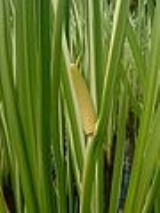
Sweet Flag

Encyclopedia
Acorus calamus, commonly known as Sweet Flag or Calamus and erroneously as "rush
" or "sedge
s", is a plant from the Acoraceae family, in the genus Acorus
. It is a tall perennial
wetland
monocot with scented leaves and more strongly scented rhizome
s. Parts of the plant have been used medicinally and its scent has been used to make fragrances.
Likely indigenous to India
or Arabia, Acorus calamus is now found across Europe, in southern Russia, northern Asia Minor, southern Siberia, China, Indonesia, Japan, Burma, Sri Lanka, Australia, as well as southern Canada and the northern United States where it may be confused with diploid Acorus americanus
.
distinction between the Acorus species is made by the number of prominent leaf veins. Acorus calamus has a single prominent midvein and then on both sides slightly raised secondary veins (with a diameter less than half the midvein) and many fine tertiary veins. This makes it clearly distinct from Acorus americanus
.
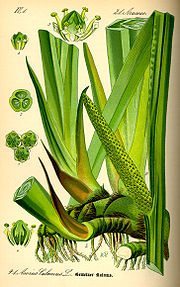
The leaves are between 0.7 and 1.7 cm wide, with average of 1 cm. The sympodial
leaf of Acorus calamus is somewhat shorter than the vegetative leaves. The margin is curly-edged or undulate. The spadix
, at the time of expansion, can reach a length between 4.9 and 8.9 cm (longer than A. americanus). The flowers are longer too, between 3 and 4 mm. Acorus calamus is infertile and shows an abortive ovary
with a shriveled appearance.
Acorus americanus was formerly classified as Acorus calamus var. americanus.
It differs in being a fertile diploid (2n = 24)], whereas most of the A. calamus of Europe and Asia is a sterile triploid species, that only spreads asexually. Diploid plants in northern Asia may be part of A. americanus. Also as a diploid it does not produce b-asarone.
One subspecies, Acorus calamus var. angustatus Besser
, Synonyms: Acorus asiaticus, Acorus cochinchinensis, Acorus latifolius, Acorus rumphianus, Acorus spurius, Acorus triqueter, Acorus tatarinowii, Acorus terrestris, Orontium cochinchinense, Acorus calamus var. spurius, Acorus gramineus var. crassispadix.
Four varieties of Acorus calamus strains exist in nature; diploid, triploid, tetraploid and hexaploid.
Diploids do not produce the procarcinogenic β-asarone. Diploids are known to grow naturally in Eastern Asia (Mongolia and Central Siberian Plateau) and North America. The triploid cytotype probably originated in the Himalayan region, as a hybrid between the diploid and tetraploid cytotypes. The North American Calamus is known as Acorus Calamus var. Americanus or more recently as simply Acorus Americanus. Like the diploid strains of calamus in parts of the Himalayas, Mongolia, and C Siberia, the North American diploid strain does not contain the procarcinogenic β-asarone. Research has consistently demonstrated that “β-asarone was not detectable in the North American spontaneous diploid Acorus [Calamus var. Americanus]”.
In reality β-asarone is not actually a carcinogen but it is a procarcinogen that is neither hepatotoxic nor directly hepatocarcinogenic. It must first undergo metabolic l'-hydroxylation in the liver before achieving toxicity. Cyrochrome P450 in the hepatocytes is responsible for secreting the hydrolyzing enzymes that convert β-asarone into genotoxic epoxide structure. We are told that even with activation of these metabolites, the carcinogenic potency is very low due to the rapid breakdown of epoxide residues with hydrolase which leaves these compounds inert (Luo, 1992). Additionally, the major metabolite of β-asarone is 2,4,5-trimethoxyninnamic acid, a derivative which is not a carcinogen (Hasheminejad & Caldwell, 1999). Again, we are still cautioned about ingesting any calamus derivatives outside of the diploid strain.
industry. In Britain the plant was also cut for use as a sweet smelling floor covering for the packed earth floors of medieval dwellings and churches, and stacks of rushes have been used as the centrepiece of rushbearing
ceremonies for many hundreds of years. It has also been used as a thatching material
for English cottages.
In antiquity in the Orient and Egypt, the rhizome
was thought to be a powerful aphrodisiac
. In Europe Acorus calamus was often added to wine, and the root is also one of the possible ingredients of absinthe
. Among the northern Native Americans, it is used both medicinally and as a stimulant
. It is believed by some that calamus is a hallucinogen. This urban legend
is based solely on two pages of a book written by Hoffer and Osmund entitled The Hallucinogens. The information on these two pages came from anecdotal reports from two individuals (a husband and wife) who reported that they had ingested calamus on a few occasions. None of the components in calamus are converted to TMA
(trimethoxyamphetamine) in the human organism. To date there is no solid evidence of any hallucinogenic substances in calamus. Acorus calamus shows neuroprotective effect against stroke and chemically induced neurodegeneration in rat. Specifically, it has protective effect against acrylamide induced neurotoxicity
.
The essence from the rhizome is used as a flavor for pipe tobacco. When eaten in crystallized form, it is called "German ginger". It's also used in bitters.
Teton-Dakota warriors chewed the root to a paste, which they rubbed on their faces. It was thought to prevent excitement and fear when facing an enemy.
The Potawatomi
people powdered the dried root and placed this up the nose to cure catarrh
.
, laxative
, diuretic
, and carminative
properties. It is used in Ayurveda
to counter the side effects of all hallucinogens. Sweet Flag is one of the most widely and frequently used herbal medicines amongst the Chipewyan people.
Both roots and leaves of A. calamus have shown antioxidant
, antimicrobial and insecticidal activities.
Acorus calamus may prove to be an effective control measure against cattle tick, Rhipicephalus (Boophilus) microplus
.
.
Other phytochemicals include:
Diploids do not contain beta-asarone (β-asarone). A recent study showed that beta-asarone
isolated from Acorus calamus oil inhibits adipogenesis in 3T3-L1 cells
and thus reduces lipid accumulation in fat cells.
, son of the river-god Maeander, who loved the youth Karpos
, of Zephyrus (the West Wind) and Chloris
(Spring). When Karpos drowned in a swimming race, Kalamos also drowned and was transformed into a reed, whose rustling in the wind was interpreted as a sigh of lamentation.
The plant was a favorite of Henry David Thoreau
(who called it "sweet flag"), and also of Walt Whitman
, who added a section called the "Calamus
" poems, to the third edition of Leaves of Grass
(1860). In the poems the calamus is used as a symbol of love, lust, and affection.
The name Sweet Flag refers to its sweet scent (it has been used as a strewing herb
) and the wavy edges of the leaves which are supposed to resemble a fluttering flag.
s of the Latin
word calamus (meaning "cane") are found in both Greek
(kalamos
, meaning "reed") and Sanskrit
(kalama, meaning "reed" and "pen" as well as a sort of rice) — strong evidence that the word is older than all three languages and exists in their parent language, Proto-Indo European. The Arabic
word qalam (meaning "pen") is likely to have been borrowed from one of these languages in antiquity, or directly from Indo-European itself.
From the Latin root "calamus", a number of modern English words arise:
Juncaceae
Juncaceae, the rush family, are a monocotyledonous family of flowering plants. There are eight genera and about 400 species. Members of the Juncaceae are slow-growing, rhizomatous, herbaceous plants, and they may superficially resemble grasses. They often grow on infertile soils in a wide range...
" or "sedge
Sedge
- Plants :* Acorus calamus, sweet flag, a plant in the Acoraceae family* Any of the plants in the family Cyperaceae- Animals :* A collective noun for several species of birds, including bitterns, cranes and herons* Sedge-fly, caddisfly- Other uses :...
s", is a plant from the Acoraceae family, in the genus Acorus
Acorus
Acorus is a genus of monocot flowering plants. This genus was once placed within the family Araceae , but more recent classifications place it in its own family Acoraceae and order Acorales, of which it is the sole genus of the oldest surviving line of monocots. The exact relationship of Acorus to...
. It is a tall perennial
Perennial plant
A perennial plant or simply perennial is a plant that lives for more than two years. The term is often used to differentiate a plant from shorter lived annuals and biennials. The term is sometimes misused by commercial gardeners or horticulturalists to describe only herbaceous perennials...
wetland
Wetland
A wetland is an area of land whose soil is saturated with water either permanently or seasonally. Wetlands are categorised by their characteristic vegetation, which is adapted to these unique soil conditions....
monocot with scented leaves and more strongly scented rhizome
Rhizome
In botany and dendrology, a rhizome is a characteristically horizontal stem of a plant that is usually found underground, often sending out roots and shoots from its nodes...
s. Parts of the plant have been used medicinally and its scent has been used to make fragrances.
Likely indigenous to India
India
India , officially the Republic of India , is a country in South Asia. It is the seventh-largest country by geographical area, the second-most populous country with over 1.2 billion people, and the most populous democracy in the world...
or Arabia, Acorus calamus is now found across Europe, in southern Russia, northern Asia Minor, southern Siberia, China, Indonesia, Japan, Burma, Sri Lanka, Australia, as well as southern Canada and the northern United States where it may be confused with diploid Acorus americanus
Acorus americanus
Acorus americanus, the American Sweet Flag, is an emergent wetland plant native to the northern United States and Canada. This perennial plant has bright green blade-shaped leaves that arising directly from the rhizomes and sheath into each other at the base. Additionally the blades have 2-6 raised...
.
Botanical information
The morphologicalMorphology (biology)
In biology, morphology is a branch of bioscience dealing with the study of the form and structure of organisms and their specific structural features....
distinction between the Acorus species is made by the number of prominent leaf veins. Acorus calamus has a single prominent midvein and then on both sides slightly raised secondary veins (with a diameter less than half the midvein) and many fine tertiary veins. This makes it clearly distinct from Acorus americanus
Acorus americanus
Acorus americanus, the American Sweet Flag, is an emergent wetland plant native to the northern United States and Canada. This perennial plant has bright green blade-shaped leaves that arising directly from the rhizomes and sheath into each other at the base. Additionally the blades have 2-6 raised...
.
The leaves are between 0.7 and 1.7 cm wide, with average of 1 cm. The sympodial
Sympodial
Sympodial means "with conjoined feet", and in biology is often used to refer to the outward morphology or mode of growth of organisms.-In botany:...
leaf of Acorus calamus is somewhat shorter than the vegetative leaves. The margin is curly-edged or undulate. The spadix
Spadix
In botany, a spadix is a type of spike inflorescence having small flowers borne on a fleshy stem. Spadix are typical of the Family Araceae known as arums or aroids...
, at the time of expansion, can reach a length between 4.9 and 8.9 cm (longer than A. americanus). The flowers are longer too, between 3 and 4 mm. Acorus calamus is infertile and shows an abortive ovary
Ovary (plants)
In the flowering plants, an ovary is a part of the female reproductive organ of the flower or gynoecium. Specifically, it is the part of the pistil which holds the ovule and is located above or below or at the point of connection with the base of the petals and sepals...
with a shriveled appearance.
Acorus americanus was formerly classified as Acorus calamus var. americanus.
It differs in being a fertile diploid (2n = 24)], whereas most of the A. calamus of Europe and Asia is a sterile triploid species, that only spreads asexually. Diploid plants in northern Asia may be part of A. americanus. Also as a diploid it does not produce b-asarone.
One subspecies, Acorus calamus var. angustatus Besser
Besser
Besser is the surname of:* Chaskel Besser , Rabbi from Manhattan* Joe Besser , American comedian* Les Besser, founder of Compact Software, the first RF and microwave EDA company...
, Synonyms: Acorus asiaticus, Acorus cochinchinensis, Acorus latifolius, Acorus rumphianus, Acorus spurius, Acorus triqueter, Acorus tatarinowii, Acorus terrestris, Orontium cochinchinense, Acorus calamus var. spurius, Acorus gramineus var. crassispadix.
Regulations
'"A. calamus and products derived from A. calamus (such as its oil) were banned in 1968 as food additives and medicines by the United States Food and Drug Administration. This ban was the result of lab studies that involved supplementing the diets of lab animals over a prolonged period of time with massive doses of isolated chemicals (β-asarone) from the Indian Jammu strain of calamus. The animals developed tumors, and the plant was labeled procarcinogenic. Wichtl says “It is not clear whether the observed carcinogenic effects in rats are relevant to the human organism.” However, most sources advise caution in ingesting strains other than the diploid strain.Four varieties of Acorus calamus strains exist in nature; diploid, triploid, tetraploid and hexaploid.
Diploids do not produce the procarcinogenic β-asarone. Diploids are known to grow naturally in Eastern Asia (Mongolia and Central Siberian Plateau) and North America. The triploid cytotype probably originated in the Himalayan region, as a hybrid between the diploid and tetraploid cytotypes. The North American Calamus is known as Acorus Calamus var. Americanus or more recently as simply Acorus Americanus. Like the diploid strains of calamus in parts of the Himalayas, Mongolia, and C Siberia, the North American diploid strain does not contain the procarcinogenic β-asarone. Research has consistently demonstrated that “β-asarone was not detectable in the North American spontaneous diploid Acorus [Calamus var. Americanus]”.
In reality β-asarone is not actually a carcinogen but it is a procarcinogen that is neither hepatotoxic nor directly hepatocarcinogenic. It must first undergo metabolic l'-hydroxylation in the liver before achieving toxicity. Cyrochrome P450 in the hepatocytes is responsible for secreting the hydrolyzing enzymes that convert β-asarone into genotoxic epoxide structure. We are told that even with activation of these metabolites, the carcinogenic potency is very low due to the rapid breakdown of epoxide residues with hydrolase which leaves these compounds inert (Luo, 1992). Additionally, the major metabolite of β-asarone is 2,4,5-trimethoxyninnamic acid, a derivative which is not a carcinogen (Hasheminejad & Caldwell, 1999). Again, we are still cautioned about ingesting any calamus derivatives outside of the diploid strain.
Uses
Calamus has been an item of trade in many cultures for thousands of years. Calamus has been used medicinally for a wide variety of ailments, and its smell makes calamus essential oil valued in the perfumePerfume
Perfume is a mixture of fragrant essential oils and/or aroma compounds, fixatives, and solvents used to give the human body, animals, objects, and living spaces "a pleasant scent"...
industry. In Britain the plant was also cut for use as a sweet smelling floor covering for the packed earth floors of medieval dwellings and churches, and stacks of rushes have been used as the centrepiece of rushbearing
Rushbearing
Rushbearing is an old English ecclesiastical festival in which rushes are collected and carried to be strewn on the floor of the parish church. The tradition dates back to the time when most buildings had earthen floors and rushes were used as a form of renewable floor covering for cleanliness and...
ceremonies for many hundreds of years. It has also been used as a thatching material
Thatching
Thatching is the craft of building a roof with dry vegetation such as straw, water reed, sedge , rushes, or heather, layering the vegetation so as to shed water away from the inner roof. It is a very old roofing method and has been used in both tropical and temperate climates...
for English cottages.
In antiquity in the Orient and Egypt, the rhizome
Rhizome
In botany and dendrology, a rhizome is a characteristically horizontal stem of a plant that is usually found underground, often sending out roots and shoots from its nodes...
was thought to be a powerful aphrodisiac
Aphrodisiac
An aphrodisiac is a substance that increases sexual desire. The name comes from Aphrodite, the Greek goddess of sexuality and love. Throughout history, many foods, drinks, and behaviors have had a reputation for making sex more attainable and/or pleasurable...
. In Europe Acorus calamus was often added to wine, and the root is also one of the possible ingredients of absinthe
Absinthe
Absinthe is historically described as a distilled, highly alcoholic beverage. It is an anise-flavoured spirit derived from herbs, including the flowers and leaves of the herb Artemisia absinthium, commonly referred to as "grande wormwood", together with green anise and sweet fennel...
. Among the northern Native Americans, it is used both medicinally and as a stimulant
Stimulant
Stimulants are psychoactive drugs which induce temporary improvements in either mental or physical function or both. Examples of these kinds of effects may include enhanced alertness, wakefulness, and locomotion, among others...
. It is believed by some that calamus is a hallucinogen. This urban legend
Urban legend
An urban legend, urban myth, urban tale, or contemporary legend, is a form of modern folklore consisting of stories that may or may not have been believed by their tellers to be true...
is based solely on two pages of a book written by Hoffer and Osmund entitled The Hallucinogens. The information on these two pages came from anecdotal reports from two individuals (a husband and wife) who reported that they had ingested calamus on a few occasions. None of the components in calamus are converted to TMA
Trimethoxyamphetamine
TMAs, also known as trimethoxyamphetamines, are a family of isomeric psychedelic hallucinogenic drugs. There exist six different TMAs that differ only in the position of the three methoxy groups: TMA, TMA-2, TMA-3, TMA-4, TMA-5, and TMA-6. The TMAs are analogs of the phenethylamine cactus alkaloid...
(trimethoxyamphetamine) in the human organism. To date there is no solid evidence of any hallucinogenic substances in calamus. Acorus calamus shows neuroprotective effect against stroke and chemically induced neurodegeneration in rat. Specifically, it has protective effect against acrylamide induced neurotoxicity
Neurotoxicity
Neurotoxicity occurs when the exposure to natural or artificial toxic substances, which are called neurotoxins, alters the normal activity of the nervous system in such a way as to cause damage to nervous tissue. This can eventually disrupt or even kill neurons, key cells that transmit and process...
.
The essence from the rhizome is used as a flavor for pipe tobacco. When eaten in crystallized form, it is called "German ginger". It's also used in bitters.
Cultural uses
For the Penobscot people this was a very important root. One story goes that a sickness was plaguing the people. A muskrat spirit came to a man in dream, telling him that he (the muskrat) was a root and where to find him. The man awoke, found the root, and made a medicine which cured the people. In Penobscot homes, pieces of the dried root were strung together and hung up for preservation. Steaming it throughout the home was thought to "kill" sickness. While traveling, a piece of root was kept and chewed to ward off illness.Teton-Dakota warriors chewed the root to a paste, which they rubbed on their faces. It was thought to prevent excitement and fear when facing an enemy.
The Potawatomi
Potawatomi
The Potawatomi are a Native American people of the upper Mississippi River region. They traditionally speak the Potawatomi language, a member of the Algonquian family. In the Potawatomi language, they generally call themselves Bodéwadmi, a name that means "keepers of the fire" and that was applied...
people powdered the dried root and placed this up the nose to cure catarrh
Catarrh
Catarrh is a disorder of inflammation of the mucous membranes in one of the airways or cavities of the body. It can result in a thick exudate of mucus and white blood cells caused by the swelling of the mucous membranes in the head in response to an infection...
.
Herbal medicine
Sweet flag has a very long history of medicinal use in Chinese and Indian herbal traditions. It is widely employed in modern herbal medicine as its sedativeSedative
A sedative or tranquilizer is a substance that induces sedation by reducing irritability or excitement....
, laxative
Laxative
Laxatives are foods, compounds, or drugs taken to induce bowel movements or to loosen the stool, most often taken to treat constipation. Certain stimulant, lubricant, and saline laxatives are used to evacuate the colon for rectal and/or bowel examinations, and may be supplemented by enemas under...
, diuretic
Diuretic
A diuretic provides a means of forced diuresis which elevates the rate of urination. There are several categories of diuretics. All diuretics increase the excretion of water from bodies, although each class does so in a distinct way.- Medical uses :...
, and carminative
Carminative
A carminative, also known as carminativum , is a herb or preparation that either prevents formation of gas in the gastrointestinal tract or facilitates the expulsion of said gas, thereby combating flatulence...
properties. It is used in Ayurveda
Ayurveda
Ayurveda or ayurvedic medicine is a system of traditional medicine native to India and a form of alternative medicine. In Sanskrit, words , meaning "longevity", and , meaning "knowledge" or "science". The earliest literature on Indian medical practice appeared during the Vedic period in India,...
to counter the side effects of all hallucinogens. Sweet Flag is one of the most widely and frequently used herbal medicines amongst the Chipewyan people.
Both roots and leaves of A. calamus have shown antioxidant
Antioxidant
An antioxidant is a molecule capable of inhibiting the oxidation of other molecules. Oxidation is a chemical reaction that transfers electrons or hydrogen from a substance to an oxidizing agent. Oxidation reactions can produce free radicals. In turn, these radicals can start chain reactions. When...
, antimicrobial and insecticidal activities.
Acorus calamus may prove to be an effective control measure against cattle tick, Rhipicephalus (Boophilus) microplus
Rhipicephalus microplus
Rhipicephalus microplus is an economically important tick that parasitises a variety of livestock species; it is known as the cattle tick or southern cattle tick. It has been recorded on "cattle, buffalo, horses, donkeys, goats, sheep, deer, pigs, dogs and some wild animals"...
.
Chemistry
Both triploid and tetraploid A. calamus contain alpha-asaroneAsarone
Asarone, which includes alpha and beta types, is an ether found in certain plants such as acorus and asarum. As a volatile fragrance oil, it is used in killing plant fungal pests and bacteria...
.
Other phytochemicals include:
- Beta-asaroneAsaroneAsarone, which includes alpha and beta types, is an ether found in certain plants such as acorus and asarum. As a volatile fragrance oil, it is used in killing plant fungal pests and bacteria...
, - eugenolEugenolEugenol is a phenylpropene, an allyl chain-substituted guaiacol. Eugenol is a member of the phenylpropanoids class of chemical compounds. It is a clear to pale yellow oily liquid extracted from certain essential oils especially from clove oil, nutmeg, cinnamon, basil and bay leaf. It is slightly...
Diploids do not contain beta-asarone (β-asarone). A recent study showed that beta-asarone
Asarone
Asarone, which includes alpha and beta types, is an ether found in certain plants such as acorus and asarum. As a volatile fragrance oil, it is used in killing plant fungal pests and bacteria...
isolated from Acorus calamus oil inhibits adipogenesis in 3T3-L1 cells
3T3-L1
3T3-L1 is a cell line derived from 3T3 cells that is used in biological research on adipose tissue. 3T3-L1 cells have a fibroblast-like morphology, but, under appropriate conditions, the cells differentiate into an adipocyte-like phenotype....
and thus reduces lipid accumulation in fat cells.
Cultural symbolism
The calamus has long been a symbol of love. The name is associated with a Greek myth: KalamosKalamos
Kalamos is an ancient Greek word meaning reed or reed pen. The basis for this meaning is the story of the Greek mythological figure Kalamos, son of Maiandros .-Greek mythology:...
, son of the river-god Maeander, who loved the youth Karpos
Karpos
This article is about the Greek mythological character, for the unit within the city of Skopje, go to Karpoš Municipality.In Greek mythology, Karpos , was a youth renowned for his beauty...
, of Zephyrus (the West Wind) and Chloris
Chloris
thumb|250px|right| "As she talks, her lips breathe spring roses:I was Chloris, who am now called Flora." [[Ovid]]There are many stories in Greek mythology about figures named Chloris...
(Spring). When Karpos drowned in a swimming race, Kalamos also drowned and was transformed into a reed, whose rustling in the wind was interpreted as a sigh of lamentation.
The plant was a favorite of Henry David Thoreau
Henry David Thoreau
Henry David Thoreau was an American author, poet, philosopher, abolitionist, naturalist, tax resister, development critic, surveyor, historian, and leading transcendentalist...
(who called it "sweet flag"), and also of Walt Whitman
Walt Whitman
Walter "Walt" Whitman was an American poet, essayist and journalist. A humanist, he was a part of the transition between transcendentalism and realism, incorporating both views in his works. Whitman is among the most influential poets in the American canon, often called the father of free verse...
, who added a section called the "Calamus
Calamus (poem)
The "Calamus" poems are a cluster of poems in Leaves of Grass by Walt Whitman. These poems celebrate and promote "the manly love of comrades"...
" poems, to the third edition of Leaves of Grass
Leaves of Grass
Leaves of Grass is a poetry collection by the American poet Walt Whitman . Though the first edition was published in 1855, Whitman spent his entire life writing Leaves of Grass, revising it in several editions until his death...
(1860). In the poems the calamus is used as a symbol of love, lust, and affection.
The name Sweet Flag refers to its sweet scent (it has been used as a strewing herb
Strewing herb
Strewing herbs are certain kinds of plants that are scattered over the floors of dwelling places and other buildings. Such plants usually have fragrant or astringent smells, and many also serve as insecticides or disinfectants...
) and the wavy edges of the leaves which are supposed to resemble a fluttering flag.
Etymology of calamus
CognateCognate
In linguistics, cognates are words that have a common etymological origin. This learned term derives from the Latin cognatus . Cognates within the same language are called doublets. Strictly speaking, loanwords from another language are usually not meant by the term, e.g...
s of the Latin
Latin
Latin is an Italic language originally spoken in Latium and Ancient Rome. It, along with most European languages, is a descendant of the ancient Proto-Indo-European language. Although it is considered a dead language, a number of scholars and members of the Christian clergy speak it fluently, and...
word calamus (meaning "cane") are found in both Greek
Greek language
Greek is an independent branch of the Indo-European family of languages. Native to the southern Balkans, it has the longest documented history of any Indo-European language, spanning 34 centuries of written records. Its writing system has been the Greek alphabet for the majority of its history;...
(kalamos
Kalamos
Kalamos is an ancient Greek word meaning reed or reed pen. The basis for this meaning is the story of the Greek mythological figure Kalamos, son of Maiandros .-Greek mythology:...
, meaning "reed") and Sanskrit
Sanskrit
Sanskrit , is a historical Indo-Aryan language and the primary liturgical language of Hinduism, Jainism and Buddhism.Buddhism: besides Pali, see Buddhist Hybrid Sanskrit Today, it is listed as one of the 22 scheduled languages of India and is an official language of the state of Uttarakhand...
(kalama, meaning "reed" and "pen" as well as a sort of rice) — strong evidence that the word is older than all three languages and exists in their parent language, Proto-Indo European. The Arabic
Arabic language
Arabic is a name applied to the descendants of the Classical Arabic language of the 6th century AD, used most prominently in the Quran, the Islamic Holy Book...
word qalam (meaning "pen") is likely to have been borrowed from one of these languages in antiquity, or directly from Indo-European itself.
From the Latin root "calamus", a number of modern English words arise:
- calamari, meaning "squid", via the LatinLatinLatin is an Italic language originally spoken in Latium and Ancient Rome. It, along with most European languages, is a descendant of the ancient Proto-Indo-European language. Although it is considered a dead language, a number of scholars and members of the Christian clergy speak it fluently, and...
calamarium, "ink horn" or "pen case", as reeds were then used as writing implements; - calumetCalumet (pipe)A Calumet is a ceremonial smoking pipe used by some Native American Nations. Traditionally it has been smoked to seal a covenant or treaty, or to offer prayers in a religious ceremony.- Etymology :...
, another name for the Native AmericanNative Americans in the United StatesNative Americans in the United States are the indigenous peoples in North America within the boundaries of the present-day continental United States, parts of Alaska, and the island state of Hawaii. They are composed of numerous, distinct tribes, states, and ethnic groups, many of which survive as...
peace pipe, which was often made from a hollow reed; - shawmShawmThe shawm was a medieval and Renaissance musical instrument of the woodwind family made in Europe from the 12th century until the 17th century. It was developed from the oriental zurna and is the predecessor of the modern oboe. The body of the shawm was usually turned from a single piece of wood,...
, a medieval oboeOboeThe oboe is a double reed musical instrument of the woodwind family. In English, prior to 1770, the instrument was called "hautbois" , "hoboy", or "French hoboy". The spelling "oboe" was adopted into English ca...
-like instrument (whose sound is produced by a vibrating reed mouthpiece); - chalumeau register, the lower notes of a clarinetClarinetThe clarinet is a musical instrument of woodwind type. The name derives from adding the suffix -et to the Italian word clarino , as the first clarinets had a strident tone similar to that of a trumpet. The instrument has an approximately cylindrical bore, and uses a single reed...
's range (another reed instrument).
External links
- Proper Use of Acorus Calamus
- Family Araceae in L. Watson and M.J. Dallwitz (1992 onwards). The families of flowering plants: descriptions, illustrations, identification, information retrieval. http://delta-intkey.com
- Calamus Acorus Calamus Online Herb Guide Contains a detailed monograph on Acorus calamus, A. americanus (Vacha; Calamus; Sweet Flag), as well as a discussion of health benefits and usage in clinical practice. Available online at http://www.toddcaldecott.com/index.php/herbs/learning-herbs/339-vacha