


Swabian German

Encyclopedia
Swabian is one of the Alemannic
dialects of High German
. It is spoken in Swabia
, a region which covers much of Germany's southwestern state Baden-Württemberg
, including its capital Stuttgart
, the rural area known as the Swabian Alb
, and Bavaria
. Swabian is also spoken by part of the Danube Swabian minorities in Hungary
, former Yugoslavia
, Romania
, and the former Soviet Union
.
Swabian is difficult to understand for speakers of Standard German
. It contains vocabulary that differs altogether from Standard German. For example, jam in Standard German is Marmelade while in Swabian it is Gsälz.
In many regions the Swabian dialect is spoken with a unique intonation
that is also present when Swabian native speakers talk in Standard German.
The voiced plosives, the post-alveolar fricative, and the frequent use of diminutives based on "l" suffixes gives the dialect a very "soft" or "mild" feel, that is often felt to be in sharp contrast to the harder varieties of German spoken in the North.
dialect, which in turn is one of the two types of Upper German
dialects (the other being Bavarian
). The ISO 639-3
language code for Swabian is swg.
 The Swabian dialect is composed of numerous sub-dialects, each of which has its own variations. These sub-dialects can be categorized by the difference in the formation of the past participle of 'sein' (to be) into gwä and gsi. The Gsi group is nearer to other Alemannic dialects
, such as Swiss German
. It can be divided into South-East Swabian, West Swabian and Central Swabian.
Chamber of Commerce
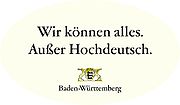
was highly praised for its advertising campaign with the slogan "Wir können alles. Außer Hochdeutsch." which means "We can [do] anything. Except [speak] Standard German." The campaign was clever in boosting Swabian pride for their dialect and industrial achievements. This is a light-hearted allusion to the fact that Baden-Württemberg is one of the principal centres for innovation in Germany and also for its distinctive dialects.
Alemannic German
Alemannic is a group of dialects of the Upper German branch of the Germanic language family. It is spoken by approximately ten million people in six countries: Switzerland, Germany, Austria, Liechtenstein, France and Italy...
dialects of High German
High German languages
The High German languages or the High German dialects are any of the varieties of standard German, Luxembourgish and Yiddish, as well as the local German dialects spoken in central and southern Germany, Austria, Liechtenstein, Switzerland, Luxembourg and in neighboring portions of Belgium and the...
. It is spoken in Swabia
Swabia
Swabia is a cultural, historic and linguistic region in southwestern Germany.-Geography:Like many cultural regions of Europe, Swabia's borders are not clearly defined...
, a region which covers much of Germany's southwestern state Baden-Württemberg
Baden-Württemberg
Baden-Württemberg is one of the 16 states of Germany. Baden-Württemberg is in the southwestern part of the country to the east of the Upper Rhine, and is the third largest in both area and population of Germany's sixteen states, with an area of and 10.7 million inhabitants...
, including its capital Stuttgart
Stuttgart
Stuttgart is the capital of the state of Baden-Württemberg in southern Germany. The sixth-largest city in Germany, Stuttgart has a population of 600,038 while the metropolitan area has a population of 5.3 million ....
, the rural area known as the Swabian Alb
Swabian Alb
The Swabian Alps or Swabian Jura is a low mountain range in Baden-Württemberg, Germany, extending 220 km from southwest to northeast and 40 to 70 km in width. It is named after the region of Swabia....
, and Bavaria
Bavaria
Bavaria, formally the Free State of Bavaria is a state of Germany, located in the southeast of Germany. With an area of , it is the largest state by area, forming almost 20% of the total land area of Germany...
. Swabian is also spoken by part of the Danube Swabian minorities in Hungary
Hungary
Hungary , officially the Republic of Hungary , is a landlocked country in Central Europe. It is situated in the Carpathian Basin and is bordered by Slovakia to the north, Ukraine and Romania to the east, Serbia and Croatia to the south, Slovenia to the southwest and Austria to the west. The...
, former Yugoslavia
Yugoslavia
Yugoslavia refers to three political entities that existed successively on the western part of the Balkans during most of the 20th century....
, Romania
Romania
Romania is a country located at the crossroads of Central and Southeastern Europe, on the Lower Danube, within and outside the Carpathian arch, bordering on the Black Sea...
, and the former Soviet Union
Soviet Union
The Soviet Union , officially the Union of Soviet Socialist Republics , was a constitutionally socialist state that existed in Eurasia between 1922 and 1991....
.
Description and character
The dialect ranges from a 'standard' Swabian, spoken in Stuttgart, to slightly differing and 'thicker' forms found in smaller towns in the countryside. Older people can often tell the exact village a person comes from merely by hearing their accent.Swabian is difficult to understand for speakers of Standard German
Standard German
Standard German is the standard variety of the German language used as a written language, in formal contexts, and for communication between different dialect areas...
. It contains vocabulary that differs altogether from Standard German. For example, jam in Standard German is Marmelade while in Swabian it is Gsälz.
Linguistic
Some characteristics in comparison to Standard German:- The Middle High GermanMiddle High GermanMiddle High German , abbreviated MHG , is the term used for the period in the history of the German language between 1050 and 1350. It is preceded by Old High German and followed by Early New High German...
monophthongMonophthongA monophthong is a pure vowel sound, one whose articulation at both beginning and end is relatively fixed, and which does not glide up or down towards a new position of articulation....
s î and û have become [e͡i] and [o͡u], not [a͡ɪ] and [a͡ʊ]. - The ending "-et" is used for verbs in the first person plural. (For example, "we go" is mir ganget instead of Standard German's wir gehen.)
- As in other Alemannic dialects, the pronunciation of "s" before "t" and "p" is [ʃ] (For example, Fest ("party"), is pronounced as Fescht.)
- All plosives are pronounced in a voicedVOICEDVirtual Organization for Innovative Conceptual Engineering Design is a virtual organization that promotes innovation in engineering design. This project is the collaborative work of researchers at five universities across the United States, and is funded by the National Science Foundation...
fashion, removing the distinction between the consonants 'b' and 'p' as well as 'd' and 't', which is made in Standard German. - The diminutive ending "-le" for singular and (in some regions) "-la" for plural is used. (For example, Haus may become Häusle, Bisschen may become Bissle; Spätzle becomes Spätzla.)
- Articles (der, die and das) are often pronounced as "dr", "d" and "s". ( "s Haus" instead of "das Haus")
In many regions the Swabian dialect is spoken with a unique intonation
Intonation
Intonation may refer to:*Intonation , the variation of tone used when speaking*Intonation , a musician's realization of pitch accuracy, or the pitch accuracy of a musical instrument*Intonation Music Festival, held in Chicago...
that is also present when Swabian native speakers talk in Standard German.
The voiced plosives, the post-alveolar fricative, and the frequent use of diminutives based on "l" suffixes gives the dialect a very "soft" or "mild" feel, that is often felt to be in sharp contrast to the harder varieties of German spoken in the North.
Classification and variation
Swabian is categorized as an AlemannicAlemannic German
Alemannic is a group of dialects of the Upper German branch of the Germanic language family. It is spoken by approximately ten million people in six countries: Switzerland, Germany, Austria, Liechtenstein, France and Italy...
dialect, which in turn is one of the two types of Upper German
Upper German
Upper German is a family of High German dialects spoken primarily in southern Germany, Austria, Switzerland and Northern Italy.-Family tree:Upper German can be generally classified as Alemannic or Austro-Bavarian...
dialects (the other being Bavarian
Austro-Bavarian
Bavarian , also Austro-Bavarian, is a major group of Upper German varieties spoken in the south east of the German language area.-History and origin:...
). The ISO 639-3
ISO 639-3
ISO 639-3:2007, Codes for the representation of names of languages — Part 3: Alpha-3 code for comprehensive coverage of languages, is an international standard for language codes in the ISO 639 series. The standard describes three‐letter codes for identifying languages. It extends the ISO 639-2...
language code for Swabian is swg.
Alemannic German
Alemannic is a group of dialects of the Upper German branch of the Germanic language family. It is spoken by approximately ten million people in six countries: Switzerland, Germany, Austria, Liechtenstein, France and Italy...
, such as Swiss German
Swiss German
Swiss German is any of the Alemannic dialects spoken in Switzerland and in some Alpine communities in Northern Italy. Occasionally, the Alemannic dialects spoken in other countries are grouped together with Swiss German as well, especially the dialects of Liechtenstein and Austrian Vorarlberg...
. It can be divided into South-East Swabian, West Swabian and Central Swabian.
Recognition in mass media
The Baden-WürttembergBaden-Württemberg
Baden-Württemberg is one of the 16 states of Germany. Baden-Württemberg is in the southwestern part of the country to the east of the Upper Rhine, and is the third largest in both area and population of Germany's sixteen states, with an area of and 10.7 million inhabitants...
Chamber of Commerce
Chamber of commerce
A chamber of commerce is a form of business network, e.g., a local organization of businesses whose goal is to further the interests of businesses. Business owners in towns and cities form these local societies to advocate on behalf of the business community...
was highly praised for its advertising campaign with the slogan "Wir können alles. Außer Hochdeutsch." which means "We can [do] anything. Except [speak] Standard German." The campaign was clever in boosting Swabian pride for their dialect and industrial achievements. This is a light-hearted allusion to the fact that Baden-Württemberg is one of the principal centres for innovation in Germany and also for its distinctive dialects.
Swabian dialect writers
- Sebastian SailerSebastian SailerSebastian Sailer , born Johann Valentin Sailer, was a German Premonstratensian Baroque preacher and writer...
(1714–1777) - August Lämmle (de)
- Josef Eberle (as Sebastian Blau) (de)
- Peter Schlack (born 1943) (de)