
All Topics  
Surfboard

 
Surfboard

   Email Print
   Bookmark   Link


Surfboard


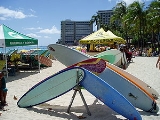
Surfboards are elongated platforms used in the sport of surfing
Surfing

Surfing refers to a person or boat riding down a wave and thereby gathering speed from the downward movement. Most commonly, the term is used for a surface water sports in which the person surfing is carried along the face of a breaking ocean surface wave standing on a surfboard....
. They are relatively light, but strong enough to support an individual standing on them while riding a breaking wave
Ocean surface wave

In fluid dynamics wind waves, or more precisely wind generated waves, are surface waves that occur on the free surface of oceans, seas, lakes, rivers and canals ? or even on small puddles and ponds....
. They were invented in Hawaii
Hawaii

File:Pahoehoe and Aa flows at Hawaii.jpgThe State of Hawaii is a U.S. state in the United States, located on an archipelago in the central Pacific Ocean southwest of the continental United States, southeast of Japan, and northeast of Australia....
, where they were known as Papa he‘e nalu in the Hawaiian language
Hawaiian language

The Hawaiian language is an Austronesian languages that takes its name from Hawaii , the largest island in the tropical North Pacific archipelago where it developed....
, usually made of wood
Wood

Wood is an organic material; in the strict sense wood is produced as secondary xylem in the stems of woody plants, notably trees but also shrubs, etc....
 from local trees, such as koa, and were often over in length and extremely heavy. Major advances over the years include the addition of one or more fins
FINS

FINS is a network protocol used by Omron programmable logic controller, over different physical networks like Ethernet, Controller Link, DeviceNet and RS-232C....
 on the bottom rear of the board to improve directional stability
Directional stability

Directional stability is the tendency of a moving body to align itself with the direction of motion.With the exception of spacecraft, vehicles generally have a recognisable front and rear and are designed so that the front points more or less in the direction of motion....
, and numerous improvements in materials and shape.

Modern surfboards are made of polyurethane
Polyurethane

A polyurethane, commonly abbreviated PU, is any polymer consisting of a chain of organic chemistry units joined by carbamate links. Polyurethane polymers are formed by reacting a monomer containing at least two isocyanate functional groups with another monomer containing at least two alcohol groups in the presence of a catalyst....
 or polystyrene
Polystyrene

Polystyrene , sometimes abbreviated PS, is an Aromaticity polymer made from the aromatic monomer styrene, a liquid hydrocarbon that is commercially manufactured from petroleum by the chemical industry....
 foam covered with layers of fiberglass
Fiberglass

Fiberglass, , is material made from extremely fine fibers of glass. It is used as a reinforcing agent for many polymer products; the resulting composite material, properly known as fiber-reinforced polymer or glass-reinforced plastic , is called "fiberglass" in popular usage....
, cloth and polyester
Polyester

Polyester is a category of polymers which contain the ester functional group in their main chain. Although there are many polyesters, the term "polyester" as a specific material most commonly refers to polyethylene terephthalate ....
 or epoxy resin.


Discussion
Ask a question about 'Surfboard'
Start a new discussion about 'Surfboard'
Answer questions from other users
Full Discussion Forum


Recent Posts


Encyclopedia


Surfboards are elongated platforms used in the sport of surfing
Surfing

Surfing refers to a person or boat riding down a wave and thereby gathering speed from the downward movement. Most commonly, the term is used for a surface water sports in which the person surfing is carried along the face of a breaking ocean surface wave standing on a surfboard....
. They are relatively light, but strong enough to support an individual standing on them while riding a breaking wave
Ocean surface wave

In fluid dynamics wind waves, or more precisely wind generated waves, are surface waves that occur on the free surface of oceans, seas, lakes, rivers and canals ? or even on small puddles and ponds....
. They were invented in Hawaii
Hawaii

File:Pahoehoe and Aa flows at Hawaii.jpgThe State of Hawaii is a U.S. state in the United States, located on an archipelago in the central Pacific Ocean southwest of the continental United States, southeast of Japan, and northeast of Australia....
, where they were known as Papa he‘e nalu in the Hawaiian language
Hawaiian language

The Hawaiian language is an Austronesian languages that takes its name from Hawaii , the largest island in the tropical North Pacific archipelago where it developed....
, usually made of wood
Wood

Wood is an organic material; in the strict sense wood is produced as secondary xylem in the stems of woody plants, notably trees but also shrubs, etc....
 from local trees, such as koa, and were often over in length and extremely heavy. Major advances over the years include the addition of one or more fins
FINS

FINS is a network protocol used by Omron programmable logic controller, over different physical networks like Ethernet, Controller Link, DeviceNet and RS-232C....
 on the bottom rear of the board to improve directional stability
Directional stability

Directional stability is the tendency of a moving body to align itself with the direction of motion.With the exception of spacecraft, vehicles generally have a recognisable front and rear and are designed so that the front points more or less in the direction of motion....
, and numerous improvements in materials and shape.

Modern surfboards are made of polyurethane
Polyurethane

A polyurethane, commonly abbreviated PU, is any polymer consisting of a chain of organic chemistry units joined by carbamate links. Polyurethane polymers are formed by reacting a monomer containing at least two isocyanate functional groups with another monomer containing at least two alcohol groups in the presence of a catalyst....
 or polystyrene
Polystyrene

Polystyrene , sometimes abbreviated PS, is an Aromaticity polymer made from the aromatic monomer styrene, a liquid hydrocarbon that is commercially manufactured from petroleum by the chemical industry....
 foam covered with layers of fiberglass
Fiberglass

Fiberglass, , is material made from extremely fine fibers of glass. It is used as a reinforcing agent for many polymer products; the resulting composite material, properly known as fiber-reinforced polymer or glass-reinforced plastic , is called "fiberglass" in popular usage....
, cloth and polyester
Polyester

Polyester is a category of polymers which contain the ester functional group in their main chain. Although there are many polyesters, the term "polyester" as a specific material most commonly refers to polyethylene terephthalate ....
 or epoxy resin. The end result is a light and strong surfboard that is buoyant and maneuverable. Recent developments in surfboard technology have included the use of carbon fiber.

Most modern surfboards can be divided into two main categories: longboards and shortboards. Longboards, as the name suggests, are longer (often or more), and are also thicker and wider, with a more rounded nose than a shortboard. Shortboards are shorter , thinner, and have a more pointed nose. They are not as wide as longboards and are typically more maneuverable. Other variants include guns, longboard guns, olos, fun-boards, fish, eggs, bonzers, quads, tow-boards, and hydrofoils. In order to discuss board design, it is helpful to have basic knowledge of the vocabulary used to reference each part of the board.

Construction

Surfboards are usually constructed using polyurethane foam. They are made stronger with one or more small pieces of wood, called a stringer, going down the middle of the board. The foam is molded into a "blank", in the rough shape of a surfboard. Once the blanks have been made they are given to shapers. Shapers then cut, plane, and sand the board to its specifications. Finally, the board is covered in one or more layers of fiberglass cloth and resin. It is during this stage that the fins, or boxes for removable fins, are put on and the leash plug is installed. Another method of making boards is using epoxy resin and polystyrene foam, instead of polyester resin and polyurethane foam. In recent years, surfboards made out of balsa and a polystyrene core are becoming more popular. Even solid balsa surfboards are available.

Although boards are usually shaped by hand, the use of machines to shape them has become more popular over the years. Modern technology has made its way into surfboard production as well. Vacuum forming and modern sandwich construction techniques borrowed from other industries have become more common in the industry. Many surfers have switched to riding sandwich-construction, epoxy boards. These boards have become especially popular with beginner surfers as they provide a cheaper entry level surfboard.

Variations

Balsa boards
The history of using balsa as a material for surfboard making goes back to the Hawaiians but really hits off in the late 1930s. Being light and strong, balsa wood was long considered a perfect material for surfboards. However, shapers could not use this fragile wood to make entire surfboards until after WW2 when fiberglass was invented.
The advantages of balsa wood boards is that they are a lot lighter, more buoyant and therefore easier to handle. These boards did have some disadvantages, however, because they were not as sturdy as the solid redwood. They are currently favoured by surfers and collectors because they are more durable than a regular surfboard, environmentally friendly and have a beautiful look.
Egg
Modern hybrid boards are usually 6 feet to 8 feet 6 inches (1.8–2.3 m) in length with a more rounded profile and tail shape. Surfed in smaller waves with any fin set up. They are more about having fun than high performance or tricks. They can be easier to ride for beginning surfers and generally perform well in surfing conditions where the more traditional long and short boards might not.
Fish
Radically short stubby board under in length developed from kneeboards in the 1960s by Steve Lis. Other prominent Fish shapers include Skip Frye
Skip Frye

Skip Frye is a surfer, board shaper, and environmental activist....
, Steve Brom, Larry Mabil, and Rich Pavel. Primarily a twin fin set up with a swallow tail shape and popular in smaller waves. Resurgence in popularity in early 2000s created by legendary surfer Tom Curren
Tom Curren

Tom Curren is an USA surfing. He was born to father Pat and mother Jeanine. His brother Joe is also a professional surfer and popular photographer and he also has a sister, Anna....
. Note, any type of board (such as shortboard or mini-longboard) can have a fish tail, and these are commonly referred to as a "fish", but they lack the other properties of a traditional, or "retro", fish as listed here.
Fun Board
The funboard combines elements of both shortboards and longboards and are generally midsized, usually . The funboard's design allows waves to be caught more easily than a shortboard, yet with a shape that makes it more maneuverable than a longboard; hence it is a popular type of surfboard, especially among beginners, or those transitioning from longboarding to the more difficult shortboarding.
This makes it the best design in most people's view due to the combination of the speed of a longboard and the maneuverability of a shortboard.
Gun
Big wave boards of length . Thin, needle-like template with single or thruster fin set up. It usually looks like a shortboard but at a longboard size. Used at such big waves spots as Waimea Bay and Mavericks
Mavericks (location)

Maverick's or Mavericks is a world-famous, but for some a notorious and deadly, surfing location in Northern California. It is located approximately one-half mile from shore in Pillar Point Harbor just north of Half Moon Bay, California at the village of Princeton-by-the-Sea, California....
.
Hollow wooden surfboards
A switch back to using wood after the foam revolution in the 1950's, hollow wooden surfboards are made of wood and epoxy
Epoxy

In chemistry, epoxy or polyepoxide is a thermosetting epoxide polymer that cures when mixed with a catalyst agent or hardener. Most common epoxy resins are produced from a reaction between epichlorohydrin and bisphenol-A....
. They specifically have no foam in their construction. (boards made with foam and wood are commonly known as compsands or veneer boards) Various construction methods are used to hollow the inside of the surfboard and lighten the weight of the completed board. Generally a hollow wood surfboard is 30% to 300% heavier than a standard foam and resin surfboard. The main inspiration apart from beauty, is to turn to a more environmentally friendly method which uses fast growing plantation wood such as Paulownia
Paulownia

Paulownia is a genus of between 6?17 species of plants in the monogeneric family Paulowniaceae, related to and sometimes included in the Scrophulariaceae....
, Cedar
Cedar

Cedar is a genus of coniferous trees in the plant family Pinaceae. They are most closely related to the Firs , sharing a very similar cone structure....
, Spruce
Spruce

A spruce is a tree of the genus Picea, a genus of about 35 species of coniferous evergreen trees in the Family Pinaceae, found in the northern temperate and boreal regions of the earth....
, Redwood
Redwood

'Redwood' may refer to* Family Cupressaceae ** Sequoia sempervirens - Sequoia** Sequoiadendron giganteum - Giant Sequoia or Sierra Redwood...
, and of course Balsa.
The Paul Jensen method descended from the 1930's Tom Blake paddleboarding
Paddleboarding

Paddleboarding is a Surface water sports in which the participant is propelled by a swimming motion usually on a long surfboard close to the shore....
 method which favors a central stringer, with individually shaped transverse ribs, covered with a skin and lastly, rails which are then shaped. Some dispute over Paul Jensen's boards being real wooden surfboards as he uses cork on the rails, thus making his method a hollow hybrid board. A modern interpretation of Tom Blakes work is the perimeter stringer method used by some manufacturers utilizing laminated rails as stringers, which are connected with a series of plywood ribs. This skeleton is subsequently sheathed with 5mm thick wood strips, forming a fast hollow board with better flex properties.
The parallel profile system developed by Roy Stewart is developed from cold molded (double diagonal) boat building and uses at least four layers laminated over a male mold into a curved blank, including enough wood for rails, which are then shaped.
The chambering method as used by follows a system whereby planks of paulownia are selected and the rocker of the board is cut into each. The planks are then chambered to reduce weight and then bonded together to form a hollow, or "chambered" blank which is then shaped .
Longboard
The longboard is primarily a single finned surfboard with large rounded nose and length of . Noseriders are a class of longboards which enable the rider to walk to the tip and nose ride
Nose ride

Noseriding is the art of standing on the front of a surfboard.Tipriding is a subset of noseriding where the [surfer] wraps 5 or ten toes around the tip of the board whilst surfing in the curl of the wave....
. Also called a "Mal", which is a shortened version of Malibu, one of, if not the most popular longboard wave.
Longboards (also known as Malibu boards) range long, or taller than the rider in overall length. Its advantage is its substantial buoyancy and planing surface, which enables most surfers using it to ride waves generally deemed too small to propel a shortboard, as well as anything else. Longboards are universally common among both beginners and skilled surfers alike. The main reason why longboards are more suitable for beginners is because of the board's size and frequency of catching waves. In the proper conditions, a skilled surfer can ride a wave standing on the nose of a longboard, and put his toes over the nose's edge. By literally putting his "toes on the nose" the surfer can "hang ten".
Classic Longboards
Longboards are the original, and very first variety of board used in standup surfing. Ever since the sixth-century the ancient Hawaii
Ancient Hawaii

Ancient Hawaii refers to the period of Hawaiian history preceding the unification of the Kingdom of Hawaii by Kamehameha the Great in 1810. Included in this period was the first contact made by Captain James Cook in 1778....
ans have used solid wooden boards when practicing their ancient art of he'e nalu. Surfing was brought to the Hawaiian Islands by Polynesians and has since become popular worldwide. The ancient boards were carved and fashioned out of solid wood, reaching lengths of long and weighing as much as . Both men and women, royalty and commoners surfed. But the longest of boards (the Olo) was reserved for royalty. (See Legendary Surfers Volume 1 by Malcolm Gualt-Williams.) During the 19th century, some extreme western missionaries actively discouraged surfing, viewing it as sinful. Surfing almost died out completely. In recent times replicas have been made of Olo's and alaia's by experienced surfers and shapers wishing to explore the roots of the sport.
By the early 20th century, only a handful of people surfed, mostly at Waikiki. But there, it started to grow again. Beginning in 1912, Duke Kahanamoku
Duke Kahanamoku

File:Duke Kahanamoku 1920.jpgDuke Paoa Kahinu Mokoe Hulikohola Kahanamoku , is generally regarded as the person who popularized the modern sport of surfing....
, a Hawaiian Olympic swimmer in the early 1900s, brought surfing to mainland United States
United States

The United States of America is a Federal government constitutional republic comprising U.S. state and a federal district. The country is situated mostly in central North America, where its Contiguous United States and Washington, D.C., the Capital districts and territories, lie between the Pacific Ocean and Atlantic Oceans, Borders of the U...
 and Australia
Australia

Australia, officially the Commonwealth of Australia, is a country in the southern hemisphere comprising the Australia of the world's smallest continent, the major island of Tasmania, and numerous list of islands of Australia in the Indian Ocean and Pacific Oceans....
. Because of this, Duke is considered the "Father of Modern Surfing". From that point on, surfing became an integral part of the California
California

California is a U.S. state on the West Coast of the United States of the United States, along the Pacific Ocean. It is bordered by Oregon to the north, Nevada to the east, Arizona to the southeast, and to the south the Mexico state of Baja California....
 beach lifestyle. In Malibu
Malibu, California

Malibu is an incorporated city in western Los Angeles County, California, United States. As of the 2000 census, the city population is 12,575....
 (in Los Angeles
Los Ángeles

Los ?ngeles is the Capital of the Biob?o Province, in the municipality of the same name, in Regions of Chile VIII , in the center-south of Chile....
 county), the beach was so popular amongst the early surfers that it lent its name to the type of longboard, the Malibu Surfboard. In the 1920s boards made of plywood
Plywood

Sorry, no overview for this topic
 or planking called Hollowboards came into use. These were typically in length and very light. During the 1950s, the surf trend took off dramatically as it obtained a substantial amount of popularity as a sport. The design and material of longboards in the 1950s changed from using solid wood, to balsa
Balsa

Balsa is a large, fast-growing tree that can grow up to 30m ]] tall, native to tropical South America north to southern Mexico. It is evergreen, or dry-season deciduous if the dry season is long, with large weakly palmately lobed leaves....
 wood. The length of the boards still remained the same at an average of 10.5 feet, and had then become widely produced.
It was not until the late 50's and early 60's when the surfboard design had closely evolved into today's modern longboard. The introduction of polyurethane
Polyurethane

A polyurethane, commonly abbreviated PU, is any polymer consisting of a chain of organic chemistry units joined by carbamate links. Polyurethane polymers are formed by reacting a monomer containing at least two isocyanate functional groups with another monomer containing at least two alcohol groups in the presence of a catalyst....
 foam and fiberglass
Fiberglass

Fiberglass, , is material made from extremely fine fibers of glass. It is used as a reinforcing agent for many polymer products; the resulting composite material, properly known as fiber-reinforced polymer or glass-reinforced plastic , is called "fiberglass" in popular usage....
 became the technological leap in design. In the 1960s, the longboard continued to remain popular as its material changed from balsa wood to fiberglass and polyurethane foam. In the 1960's, the introduction of the shortboard, averaging , allowed surfers to make tighter turns, quicker maneuvers, and achieve faster speeds, thus radically changing the way people surfed. This "shortboard revolution" nearly made longboards obsolete for all practical purposes. But in the early 1990's, the longboard returned, integrating a number of the design features invented during the shortboard revolution. Surfers rediscovered the grace and poise – the "glide" – of the longboard, and the fun of classic maneuvers that are not possible on a shortboard. In some circles the battle between longboards and shortboards continues. But many surfers live by a philosophy of finding the joy of surfing a mix of boards and surfing styles to suit the waves of the day.
Modern Longboards
The modern longboard has undergone many changes since its earlier models in the past. Today's longboard is much lighter than its predecessors. Its polyurethane foam and fiberglass design allows less drag on waves. Today's longboards are typically long, although some ride boards up to in length. Additionally, there is a revival of stand-up paddle-based surfing with boards up to in length (for stability). The classic single-fin longboard retains much of its classic design including a single fin, weight, and considerable buoyancy. A longboard with a single fin allows the board to pivot turn in order to remain in the curl of the wave. Due to recent advances in technology, the longboard has expanded its family into different variations of the classic longboard.
Tri-Fin
An updated version of the classic longboard, the Tri-fin longboard is featured with three fins underneath the tail rather than the traditional single fin. The Tri-fin's additional two fins on the board allows riders better turning capabilities as well as greater thrust than classic longboards did back in the 1950s. The tri-fin's design incorporates the glide of a longboard and the performance of a shortboard into a single layout.
The Gun
A newer, more recent addition to the longboard family is the modern longboard gun, also known as "the big wave board". The longboard gun's teardrop-shaped layout pierces through the water when on large waves. Stretching from in length, the longboard gun incorporates the features of a professional shortboard into a longboard's structure. Its hybrid structure also allows surfers better paddling capabilities before catching a wave. One new manufacturer of a traditional Wooden "Gun" is "Empress Surfboards" who now makes a fully chambered Gun from "Paulownia Wood" aka "Empress Wood".
The 2+1
The 2+1 longboard is the most versatile board of the longboard family, offering greater maneuverability. Sometimes referred as a "single-fin with training wheels", the 2+1's fins actually takes the features of the classic longboard and the Tri-fin. The fins of the 2+1 takes the rigid stability of a classic longboard, and fuses with the strength and drive of a Tri-fin.
The Malibu
Named after Malibu, California
Malibu, California

Malibu is an incorporated city in western Los Angeles County, California, United States. As of the 2000 census, the city population is 12,575....
, this longboard shape has spread its genes into all aspects of surfing
Surfing

Surfing refers to a person or boat riding down a wave and thereby gathering speed from the downward movement. Most commonly, the term is used for a surface water sports in which the person surfing is carried along the face of a breaking ocean surface wave standing on a surfboard....
 culture
Culture

Culture is difficult to define. For example, in 1952, Alfred Kroeber and Clyde Kluckhohn compiled a list of 164 definitions of "culture" in Culture: A Critical Review of Concepts and Definitions....
. Typically from long, these boards are what most surfers started on and what they come back to later on in life. The classic shape has been ridden and praised by experienced surfers for its maneuverability and performance. Classic tricks that can be performed on a Malibu are "Hang Fives" and "Hang tens" whereby the surfer walks to the nose of the board and hangs 5 or 10 toes over the nose.
Olo
Originally reserved for royalty due to its size and weight, these wooden boards can exceed lengths of and reach weights up to .
Quad
Quads are quick down the line but lose drive through turns. The quad is making quite a comeback over the last year, showing up everywhere from Mavs guns to small wave fishes. CJ Hobgood won the 2007 Surfbout on a Quad at lowers.
Shortboard
Since the late 1960s (when Gordon Clark found the optimum formulation of urethane foam), many of the surfboards in common use have been of the shortboard variety between five (five'o) and seven feet in length, with a pointed nose and a rounded or squarish tail, typically with three skegs (fins) but sometimes with two or as many as five. Surfers generally find a shortboard very quick to maneuver compared with other types of surfboards, but because of a lack of flotation due to the smaller size, harder to catch waves with, often requiring steeper, larger and more powerful waves and very late takeoffs, where the surfer catches the wave at the critical moment before it breaks.
A bonzer is a variety of surfboard created by the Campbell Brothers with three or five fins with double concave channels. The channels create a venturi effect
Venturi effect

The Venturi effect is the reduction in fluid pressure that results when a fluid flows through a constricted section of pipe. The fluid velocity must increase through the constriction to satisfy the Derivation of the Navier?Stokes equations#Conservation of mass, while its pressure must decrease due to conservation of energy: the gain in kin...
 which guides the water off of the surface of the board through a narrowed passage.


Parts

Sufer Carrying Surfboard Along the Beach
Bottom
The surface of the board that rests on the water.
Concave
Modern surfboards often contain multiple contours on the bottom of the board called Concave. These concaves have different uses and vary among different types of surfboards. Most concaves on the modern shortboard begin about twelve inches (300 mm) back from the nose of the board on the bottom and then carry out through the middle to the tail of the surfboard. The purpose of concave is to direct water through the fins of the surfboard. Surfboard shapers can experiment with concaves to create different drive and response characteristics on each individual surfboard.
Deck
The surface of the board that the surfer stands on. Surfwax is applied to this surface.
Fins
The surfboard fin is a stabilizing strut fixed to the rear of the surfboard to prevent it from sliding sideways. In the early days, surfers would stabilize the board by hanging the toes of their back foot over the edge of the board and would steer by putting their foot in the water. The innovation of a skeg
Skeg

A skeg is a sternward extension of the keel of boats and ships which have a rudder mounted on the centre line. The term also applies to the lowest point on an Outboard motor or the outdrive of an sterndrive....
 in 1936 —by either or both of Woody "Spider" Brown
Woody Brown (surfer and catamaran inventor)

Woody 'Spider' Brown was a surfer and designer notable for introducing modern surfing to America and for the invention of the modern catamaran....
 or Tom Blake— revolutionized surfing, allowing surfers to direct the board's momentum and providing more balance whilst turning.
The template of the modern surfboard fin was developed by George Greenough
George Greenough

George Greenough is an innovative surfer and cinematographer from Santa Barbara, California who now resides in Byron Bay in N.S.W Australia. He was born to a wealthy family but despised its trappings and spent most of his time in the ocean....
 in the 1960s. The single fin changed little until the late 70's, when a second was added and popularised by Australian Mark Richards
Mark Richards

Mark Richards may refer to*Mark Richards , Australian surfing champion*Mark Richards , US congressman from Vermont...
. The new twin fin set up allowed much more flowing carves to be performed. Mark Richards dominated the world competitive scene from 1979 to 1983. In 1981 another Australian was developing another set up which would again change the face of surfing. His name was Simon Anderson
Simon Anderson

Simon Anderson is an Australian surfer and surfboard shaper, noted for creating the Thruster design of three equal-sized fins on a surfboard, a design now used on practically every shortboard made....
 and by attaching a third fin, positioned centrally behind the twin fins, he created the thruster set up. Today, most surfboards still use the same arrangement with its popularity arising from the combined ability for carving turns and providing control and drive.
In the early 90's removable fin systems were developed and embraced. One of the most popular such fin systems is the FCS system
FCS system

The FCS system is a fin system on surfboards that allows the interchanging of surfboard fins. FCS systems can have a five-fin setup, known as C5, as well as tri-fin designs....
, or Fin Control System. FCS is a more standardized system that allows fins to be easily removed or replaced, utilising set screw
Set screw

A set screw, is a type of screw generally used to secure an object within another object. It is generally fully threaded. A blind screw will generally not have an external head and will be inserted into its location by means of an internal Hex, Allen , slot, Torx, star or Phillips key or driver....
s to hold the fins in place. These systems provided surfers with the ability to alter the riding characteristics of a surfboard, by changing the size and shape of fins used. This innovation opened the market to a range of fin designs, including single foiled fins, concave inside surfaces, and curved fins. Another variation of fin was later designed in the time frame known as the soul fin, a sleek bendable attachment.
Tunnel fins
Tunnel fins

The Tunnel fin is used on surfboards especially heavy longboards and longboard guns. The weight and length of these boards make it easier to control the fore and aft angle of the tunnel....
 were invented in the 60's by Richard Deese, and were found on longboards by multiple manufacturers of that era, including Dewey Weber. Bob Bolen aka 'the Greek' patented the Turbo Tunnel in the late 1990s. Since the mid 90's half tunnel fins have been used, mainly on very long hollow wooden surfboards such as those made in New Zealand by Roy Stewart.
Bullet Fins were invented in the 2005 by Ron Pettibone to increase surfboard hull planing and rail-to-rail transition speed. The patent-pending fins are based on 50 years of hydrodynamic research on the bulbous bow hull design. Just as with the bow of a ship, the traditional surfboard fin creates a wave as it displaces the water in its path. The resulting turbulence places drag on the surfboard. The bulb of the Bullet Fin reduces this drag by creating a new (primary) fin wave in front of the original (secondary) wave. This new bulb wave is designed to be nearly 180 degrees out of phase with the original fin wave to subtract its turbulence thus reducing fin drag.
Winged fins are another type of surfboard fin, the genesis of which was America's Cup sailboat design. The Starfin was designed in the 1980s by the America's Cup yacht designer, Ben Lexcen
Ben Lexcen

Ben Lexcen Order of Australia was an Australian yachtsman and marine architect. He is famous for the winged keel design applied to Australia II which, in 1983, became the first non-United States yacht to win the prestigious America's Cup in 132 years....
, who had designed the winged keel
Winged keel

A winged keel is a sailboat keel, usually of high aspect ratio , that uses a nearly horizontal foil , the "wing", at the bottom to provide additional performance....
 for the America's Cup boat, Australia II. The small thruster-sized fin, the RedTip 3D is manufactured by FCS.
Fins with winglets -- tiny wings -- are part of the Wavegrinder fin invented in 2005. See patent. The purpose of winglets, as in airplane design, is to increase lift (horizontal turning force in the case of surfboard fins) while reducing drag, by reducing the fin-tip vortex.
Leash
A surfboard leash is the cord
Cord

Cord may refer to* String or rope* Cord , a trimming made of multiple strands of yarn twisted together* The spinal cord* Cord Automobile, a former American car marque founded by Errett Lobban Cord...
 that attaches a surfboard to the surfer. It prevents the surfboard from being swept away by wave
Ocean surface wave

In fluid dynamics wind waves, or more precisely wind generated waves, are surface waves that occur on the free surface of oceans, seas, lakes, rivers and canals ? or even on small puddles and ponds....
s and stops runaway surfboards from hitting other surfers and swimmers. Modern leashes comprise a urethane
Urethane

Urethane can refer to*Carbamates, compounds with the functional group RONHR'*ethyl carbamate, the trivial name of which is urethane*polyurethane in colloquial usage...
 cord
Rope

A rope is a length of fibers, twisted or braided together to improve strength for pulling and connecting. It has tensile strength but is too flexible to provide compressive strength ....
 where one end has a band with a velcro
Velcro

Velcro is a brand name of fabric hook-and-loop fasteners. It consists of two layers: a "hook" side, which is a piece of fabric covered with tiny hooks, and a "loop" side, which is covered with even smaller and "hairier" loops....
 strap attached to the surfer's trailing foot, and the opposite has a velcro strap attached to the tail end of the surfboard.
Prior to leashes introduction in 1971, surfers who fell off their boards had to swim to retrieve them with runaway boards being an inconvenience to the surfer and a danger to other surfers. Santa Cruz
Santa Cruz, California

Santa Cruz is the county seat and largest city of Santa Cruz County, California, California in the United States of America. As of the United States Census, 2000, Santa Cruz had a total population of 54,593....
 resident Pat O'Neill, son of surfer Jack O'Neill (inventor of the O'Neill Wetsuit), is credited with inventing
Invention

An invention is the creation of a new configuration, composition of matter, device, or process. Some inventions are based on pre-existing models or ideas....
 the surf leash. His initial designs consisted of surgical
Surgery

Surgery is a medical specialty that uses operative manual and instrumental techniques on a patient to investigate and/or treat a pathological condition such as disease or injury, to help improve bodily function or appearance, or sometimes for some other reason....
 cord attached to a board with a suction cup
Suction cup

File:Suction-lifter-one-cup.jpgA suction cup is a device, usually made of rubber or plastic, that sticks to smooth, pore surfaces. They are usually used to attach objects together with the use of suction....
. At the 1971 Malibu
Malibu, California

Malibu is an incorporated city in western Los Angeles County, California, United States. As of the 2000 census, the city population is 12,575....
 international surfing competition, Pat offered leashes to his competitors in the event. Consequently he was disqualified from the event for wearing his leash, dubbed a kook cord by those at the event however over the next year, the leash became a ubiquitous tool in the surfing world.
Pat's father, Jack O'Neill, lost his left eye in a surf leash accident
Accident

An accident is a specific, identifiable, unexpected, unusual and unintended external action which occurs in a particular time and place, without apparent or deliberate cause but with marked effects....
 as the surgical tubing used in the early designs allowed the leash to overstretch
Deformation

In materials science, deformation is a change in the shape or size of an object due to an applied force . This can be a result of tensile strength forces, compressive strength forces, Simple shear, bending or torsion ....
, causing the surfboard to fly back towards the surfer. Subsequent cords were made with less elastic materials such as bungee cord
Bungee cord

A bungee cord is an elastomer cord composed of one or more elastic strands forming a core, covered in a woven sheath usually of nylon or cotton....
s.
Leashes are still the source of some contention in surfing today as, although they are now accepted as mandatory equipment for shortboarders, many longboarders refuse to wear them, claiming it interferes with their ability to walk up and down the board. At crowded surf spots with large waves, it is argued that the freedom not wearing a leash gives is secondary to the safety of others.
Leash Cup
An indentation in the deck of the board close to the tail that contains a small bar that a short cord can be girth hitched to for attaching a leash.
Nose
The front tip of the board. This can be pointed or rounded.
Rail
The edges of the board. A rounded rail is called "soft", while a more squared off rail is called "hard", and rails that are in between are considered 50/50.
Rocker
This refers to how much curve the bottom of the board has from nose to tail. Increasing the rocker helps improve a boards performance when it is used in and around tighter curves on the wave face while flattening the curves of the board help it to handle better on flatter sections of water.
Stringer
A thin piece of wood running from nose to tail that increases the strength of the board. Boards have different amount of stringers and some have no stringers.
Tail
The shape of the tail affects how a board responds. Tail shapes vary from square, pin, squash, swallow, diamond, and so on—each one in turn having its own family of smaller variants.


See also

  • Surf culture
    Surf culture

    Surf culture includes the people, language, fashion and life surrounding the sport of modern surfing.The culture began early in the 20th century, spread quickly during the 1950s and 1960s, and continues to evolve....
  • Wind surfing


External links