
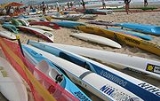
A
surf ski is a long, narrow, lightweight
kayakA kayak is a small human-powered boat. It typically has a covered deck, and a cockpit covered by a spraydeck also known as a skirt. The kayak was used by the native Ainu, Aleut and Eskimo hunters in sub-Arctic regions of northeastern Asia, North America and Greenland. It historically was, and...
with an open (sit-on-top) cockpit, usually with a foot pedal controlled
rudderA rudder is a device used to steer a ship, boat, submarine, hovercraft, aircraft,or other conveyance that moves through a fluid . On an aircraft the rudder is used primarily to counter adverse yaw and p-factor and is not the primary control used to turn the airplane...
.
Typically 5-6.5m (16½-21ft) long and only 40-50 cm (16-20") wide, surf skis are extremely fast when paddled on flat water (only an Olympic K1 or K2 kayak is faster) and the fastest paddled craft available over a long distance on ocean swells. They track well but are less maneuverable and have less transverse primary and secondary stability than shorter, wider craft.
A
surf ski is a long, narrow, lightweight
kayakA kayak is a small human-powered boat. It typically has a covered deck, and a cockpit covered by a spraydeck also known as a skirt. The kayak was used by the native Ainu, Aleut and Eskimo hunters in sub-Arctic regions of northeastern Asia, North America and Greenland. It historically was, and...
with an open (sit-on-top) cockpit, usually with a foot pedal controlled
rudderA rudder is a device used to steer a ship, boat, submarine, hovercraft, aircraft,or other conveyance that moves through a fluid . On an aircraft the rudder is used primarily to counter adverse yaw and p-factor and is not the primary control used to turn the airplane...
.
Characteristics
Typically 5-6.5m (16½-21ft) long and only 40-50 cm (16-20") wide, surf skis are extremely fast when paddled on flat water (only an Olympic K1 or K2 kayak is faster) and the fastest paddled craft available over a long distance on ocean swells. They track well but are less maneuverable and have less transverse primary and secondary stability than shorter, wider craft. Despite its typical instability, a surf ski (with an experienced paddler) is a very effective craft for paddling in big surf. Its narrowness and length helps it cut or punch through large broken waves. Double bladed
paddleA paddle is a tool used for pushing against liquids, either as a form of propulsion in a boat or as an implement for mixing.-Materials and designs:...
s are used, often with highly contoured wing blades for extra efficiency.
A
waveskiWaveski Surfing is a dynamic sport combining the paddle power of a kayak with the manoeuvrability and performance of a surfboard.A Waveski resembles a thick surfboard, with a seat, fins, footstraps, and seatbelt, enabling the rider to 'eskimo roll' if overturned...
is a type of short surf ski similar to a surf board, used primarily in surf play. It is usually less than 3m (10ft) long, typically with a wide planing type bottom and with one to three fixed skegs, or fins.
Current use
Surf skis are used worldwide for surf lifesaving, surf kayaking and for training and competition on flat-water or ocean (downwind) racing. They are most popular in warmer coastal regions such as Australia, California, Hawaii, and South Africa, as paddling a surf ski inevitably involves contact with the water. In cooler waters, paddlers often choose to wear a
wetsuitA Wetsuit is a garment, usually made of neoprene, which is worn by divers, windsurfers, canoeists, and others engaged in water sports, providing thermal insulation, abrasion resistance and buoyancy. The insulation properties depend on bubbles of gas enclosed within the material, which reduce its...
.
Construction and design
Some cheaper, heavier surf skis are made from polyethylene. Light weight surf skis are made of composite layers of epoxy or polyester resin-bonded cloth: fibreglass,
kevlarKevlar is the registered trademark for a light, strong para-aramid synthetic fiber, related to other aramids such as Nomex and Technora.Developed at DuPont in 1965 by Stephanie Kwolek it was first commercially used in the early 1970s as a replacement for steel in racing tires...
, carbon fibre or a mixture. To cut weight, the number of layers of the material and the amount of resin may be minimised to just that necessary for structural integrity or increased for extra strength and durability in heavy surf.
Early surf skis were constructed in the same way as early surfboards, being laminated from light wood and sometimes covered with fabric. In the 1960s, the first foam surfboards and surf skis were carved from a single block of expanded polystyrene foam, strengthened with wooden stringers and covered with a thin layer of fibreglass. As the demand for surf skis grew in the 1970s, this custom method of production proved too costly and moulds were made from the most successful surf skis so that moulded craft could be made more cost effectively out of glass-fibre. At the same time, there was a divergence in ski design, one type becoming known as the lifesaving specification surf ski (spec ski) and the other being the long distance or ocean racing surf ski.
Ocean racing surf skis differ from spec skis in that they are longer, have sharply pointed bows and under stern rudders. The front of the modern lifesaving type surf ski is often flared to prevent nose diving on returning to shore when surfing down large steep waves. Ocean racing surf skis are also usually longer than long distance racing kayaks; they have more longitudinal curvature (rocker); they typically have less transverse primary and secondary stability but more longitudinal stability because the paddler is seated more towards the centre of the craft to enhance wave riding ability. An ocean racing surf ski must have enough volume in the bow to provide buoyancy when punching through surf, a long waterline to make use of ocean swells, a sleek, narrow shape to reduce water resistance, as well as enough stability to make paddling in rough conditions feasible.
Competition
The spec ski is used in surf lifesaving competitions all over the world including
AustraliaAustralia , officially the Commonwealth of Australia, is a country in the Southern Hemisphere comprising the continental mainland , the island of Tasmania, and numerous smaller islands in the Indian and Pacific Oceans...
,
CanadaCanada is a country occupying most of northern North America, extending from the Atlantic Ocean in the east to the Pacific Ocean in the west and northward into the Arctic Ocean...
,
New ZealandNew Zealand is an island country in the south-western Pacific Ocean comprising two main landmasses , and numerous smaller islands, most notably Stewart Island/Rakiura and the Chatham Islands. The indigenous Māori named New Zealand Aotearoa, commonly translated as The Land of the Long White Cloud...
,
South AfricaThe Republic of South Africa is a country located at the southern tip of Africa, with a coastline on the Atlantic and Indian Oceans. To the north lie Namibia, Botswana and Zimbabwe, to the east are Mozambique and Swaziland, while Lesotho is an independent country surrounded by South Africa.Modern...
, the USA and in Europe. Since its introduction, surf ski racing has been managed by the
International Life Saving FederationThe International Life Saving Federation is an organisation for drowning prevention, water safety, lifesaving and lifesaving sport.- Definition :...
. The standard ILS surf ski race is about 700m, from a start in the water, out around a series of
buoyA buoy is a floating device that can have many different purposes. It can be anchored or allowed to drift. The word, of Old French or Middle Dutch origin, is now most commonly in UK English, although some orthoepists have traditionally prescribed the pronunciation...
s and back to the beach.
Events include:
- Surf ski
- Surf race
- Paddle board
- Ski relay
- Taplin Relay
- Oceanman (new name since ILS Rulebook 2007, in history it is Ironman)
It was not long before people began going further afield in these new, extremely seaworthy craft, and ocean racing began to emerge. The earliest races were the Scottburgh to Brighton in
South AfricaThe Republic of South Africa is a country located at the southern tip of Africa, with a coastline on the Atlantic and Indian Oceans. To the north lie Namibia, Botswana and Zimbabwe, to the east are Mozambique and Swaziland, while Lesotho is an independent country surrounded by South Africa.Modern...
, a 46 km event first held in 1958; the Port Elizabeth to East London in South Africa, a 240 km event held every two years since 1972; and the most famous of them all, the
MolokaiMolokai or Molokai ) is an island in the Hawaiian archipelago. It is 38 by 10 miles in size with a land area of 260.0 square miles , making it the fifth largest of the main Hawaiian Islands and the 27th largest island in the United States...
race in
HawaiiHawaii is the newest of the 50 U.S. states, and is the only state made up entirely of islands. It is located on an archipelago in the central Pacific Ocean, southwest of the continental United States, southeast of Japan, and northeast of Australia. The state was admitted to the Union on August...
, a 60 km event first held in 1976. There are also two major surf ski races held in South Africa and Dubai, the Southern Shamaal and the Dubai Shamaal, the newest surf ski race.
More recently, there has been a huge growth in ocean surf ski racing in mainland USA, Australia, New Zealand and other Pacific countries. There has been a move in many of these active surf ski racing countries to transfer the ocean events to the
International Canoe FederationThe International Canoe Federation is the umbrella organization of all national canoe organizations worldwide. It is headquartered in Lausanne, Switzerland, and administers all aspects of canoe sport worldwide...
s as the Lifesaving Federations often do not have the resources to manage long distance races with up to 500 competitors.
As well as ocean racing, surf skis are becoming increasingly popular as a versatile racing craft for open class races that take place in sheltered bays, lakes and rivers. One advantage of the surf ski over the traditional kayak is that if the conditions tip the paddler into the water, a "wet entry" is possible by simply climbing back onto the boat and continuing paddling without first having to drain the boat of water.
Venues include:
Thurso EastThurso East is Scotland's prime surfing venue on the north coast of Scotland.Thurso East is located at the mouth of the River Thurso, overlooked by the remains of Thurso castle. The reef is made of layers of Caithness flagstone .Thurso East is a fast reef break and has hosted many international...
in the UK.
History
Harry McLaren and his brother Jack used an early version of the surf ski in 1912 for use around the family's oyster beds on Lake Innes, near
Port Macquarie, New South WalesPort Macquarie is a large town on the mid-North Coast of New South Wales, Australia, located about 390 km north of Sydney, and 570 km south of Brisbane. The town is located on the coast, at the mouth of the Hastings River...
, Australia, and the brothers used them in the surf on Port Macquarie's beaches. The board was propelled in a sitting position with two small hand blades, which was probably not a highly efficient method to negotiate the surf. The deck is flat with a bung plug at the rear and a nose ring with a leash, possibly originally required for mooring. The rails are square and there is pronounced rocker. The boards' obvious buoyancy indicates hollow construction, with thin boards of cedar fixed longtitudinally down the board.
Surf skis were later used by lifesavers to rescue drowning swimmers. Until the 1960s, surf boats -- lightweight rowing boats with a crew of five -- were responsible for the rescue work in and behind the surf line. These boats were expensive and require a huge amount of skill to be used effectively. It was soon realised that a double surf ski could do almost everything that a surf boat could do, and in 1946 the importance of surf skis was noted by the surf lifesaving associations and they were included in lifesaving competitions and championships. Riders could stand up on them to surf them back to shore. These early surf skis were very wide and bear little resemblance to their modern counterparts. Surf skis were quickly introduced into surf lifesaving as a competition event. Over time they became narrower to maximise speed.
In 1984, waveski surfing became established as an offshoot of surf skiing with the formation of the World Waveski Surfing Association.
External links