

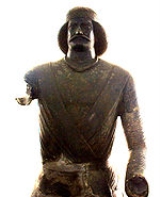
Surena

Encyclopedia
Surena or Suren may refer to either a noble family of Parthia
also known as the House of Suren, or to a renowned 1st century BC General Surena who was a member of that family.
From Ammianus Marcellinus
and other historiographers of late antiquity, it appears that 'Surena' was also a title of office. "The highest dignity in the kingdom, next to the Crown, was that of Surena, or 'Field-Marshal', and this position was hereditary in a particular family."
'Surena' remains popular as a name in Iran
. 'Surena' is the Greek and Latin form of Sûrên or Sūrēn. As 'Suren', the name remains common in Armenia
. 'Suren' means "the heroic one, Avestan sūra (strong, exalted)."
For at least the second half of the Arsacid era (which extends from 247 BC to AD 224), the Surena family had the privilege to crown the Parthian kings. Following the 3rd century AD defeat of the Arsacids and the subsequent rise of the Sassanids, the Surenas then switched sides and began to serve the Persians, at whose court they were identified as one of the so-called "Parthian clans
." The last attested scion of the family was a military commander active in northern Chine during the 9th century.
It is "probable" that the Surenas were landowners in Sakastan
, that is, in the region between Arachosia
and Drangiana
in present-day southwestern Afghanistan
, where they expelled the aboriginal Saka
s who then migrated to the Punjab
. The Surenas appear to have governed Sistan
(which derives its name from 'Sakastan' and was once a much larger region than the present day province) as their personal fiefdom
.
"Ernst Herzfeld maintained that the dynasty of [the Indo-Parthian emperor] Gondophares
represented the House of Suren." Other notable members of the family include the 1st century BC cavalry commander General Surena (see below) and a 6th century AD governor (satrap
) of Armenia
who attempted to reestablish Zoroastrianism
in that province.
) and Massis, was a famed commander of cavalry during the reign of the Arsacid dynast Orodes II (r. 57–38 BC).
In Life of Crassus
21, written c. 225 years after the commander's time, Plutarch
described Surena as "an extremely distinguished man. In wealth, birth, and in the honor paid to him, he ranked next after the king; in courage and ability he was the foremost Parthian of his time; and in stature and personal beauty he had no equal." Also according to Plutarch, there were "many slaves" in his army, suggesting the general had great wealth.
Plutarch also described him as "the tallest and finest looking man himself, but the delicacy of his looks and effeminacy of his dress did not promise so much manhood as he really was master of; or his face was painted, and his hair parted after the fashion of the Medes."
In 54 BC, Surena commanded troops of Orodes II at the battle for the city of Seleucia
. Surena distinguished himself in this battle for dynastic succession (Orodes II had previously been deposed by Mithridates III
) and was instrumental in the reinstatement of Orodes upon the Arsacid throne.
In 53 BC, the Romans advanced on the western Arsacid vassalaries. In response, Orodes II sent his cavalry units under Surena to combat them. The two armies subsequently met at Battle of Carrhae
(at Harrân in present-day Turkey
), where the superior equipment and clever tactics of the Parthians to lure the Romans out into the middle of the desert enabled them to defeat the numerically superior Romans.
Although this feat of arms took a severe toll on the Roman troops (Plutarch speaks of 20,000 dead and 10,000 prisoners), and "produced a mighty echo amongst the peoples of the East," it did not cause "any decisive shift in the balance of power," that is, the Arsacid victory did not gain them territory. For Surena, "it soon cost him his life. Probably fearing that he would constitute a threat to himself, King Orodes II had him executed."
"In some ways, the position of [Surena] in the historical tradition is curiously parallel to that of Rustam
in the[ Shahnameh
] ." "Yet despite the predominance of Rustam in the epic tradition, it has never been possible to find him a convincingly historical niche."
The last composition of the 17th century French dramatist Pierre Corneille
, a tragedy titled Suréna, is roughly based on the story of General Surena.
Parthia
Parthia is a region of north-eastern Iran, best known for having been the political and cultural base of the Arsacid dynasty, rulers of the Parthian Empire....
also known as the House of Suren, or to a renowned 1st century BC General Surena who was a member of that family.
From Ammianus Marcellinus
Ammianus Marcellinus
Ammianus Marcellinus was a fourth-century Roman historian. He wrote the penultimate major historical account surviving from Antiquity...
and other historiographers of late antiquity, it appears that 'Surena' was also a title of office. "The highest dignity in the kingdom, next to the Crown, was that of Surena, or 'Field-Marshal', and this position was hereditary in a particular family."
'Surena' remains popular as a name in Iran
Iran
Iran , officially the Islamic Republic of Iran , is a country in Southern and Western Asia. The name "Iran" has been in use natively since the Sassanian era and came into use internationally in 1935, before which the country was known to the Western world as Persia...
. 'Surena' is the Greek and Latin form of Sûrên or Sūrēn. As 'Suren', the name remains common in Armenia
Armenia
Armenia , officially the Republic of Armenia , is a landlocked mountainous country in the Caucasus region of Eurasia...
. 'Suren' means "the heroic one, Avestan sūra (strong, exalted)."
House of Suren
The Surenas or "House of Suren" are one of two Parthian noble families explicitly mentioned by name in sources dateable to the Arsacid period.For at least the second half of the Arsacid era (which extends from 247 BC to AD 224), the Surena family had the privilege to crown the Parthian kings. Following the 3rd century AD defeat of the Arsacids and the subsequent rise of the Sassanids, the Surenas then switched sides and began to serve the Persians, at whose court they were identified as one of the so-called "Parthian clans
Seven Parthian clans
The Seven Parthian clans or Seven Houses were seven purportedly "Parthian" feudal aristocracies allied with the Sassanid court.Only two of the seven - the House of Suren and the House of Karen - are actually attested in sources dateable to the Arsacid period...
." The last attested scion of the family was a military commander active in northern Chine during the 9th century.
It is "probable" that the Surenas were landowners in Sakastan
Sakastan
Sakastan or Sakaistan or Sakasthan is a term indicating certain regions of the South Asia where the Scythians or Sakas settled around 100 BC. Sakastan region includes southern Afghanistan; Punjab, Khyber Pakhtunkhwa, and Sindh provinces of Pakistan; also includes Gujarat, Rajasthan, Haryana and...
, that is, in the region between Arachosia
Arachosia
Arachosia is the Latinized form of the Greek name of an Achaemenid and Seleucid governorate in the eastern part of their respective empires, around modern-day southern Afghanistan. The Greek term "Arachosia" corresponds to the Iranian land of Harauti which was between Kandahar in Afghanistan and...
and Drangiana
Drangiana
Drangiana or Zarangiana was a historical region of the Achaemenid Empire. This region comprises territory around lake Hâmûn, wetlands in endorheic Sīstān basin on the Irano-Afghan-Pakistan border, and its primary watershed Helmand river in nowadays southwestern Afghanistan and the "Nok Kondi" of...
in present-day southwestern Afghanistan
Afghanistan
Afghanistan , officially the Islamic Republic of Afghanistan, is a landlocked country located in the centre of Asia, forming South Asia, Central Asia and the Middle East. With a population of about 29 million, it has an area of , making it the 42nd most populous and 41st largest nation in the world...
, where they expelled the aboriginal Saka
Saka
The Saka were a Scythian tribe or group of tribes....
s who then migrated to the Punjab
Punjab region
The Punjab , also spelled Panjab |water]]s"), is a geographical region straddling the border between Pakistan and India which includes Punjab province in Pakistan and the states of the Punjab, Haryana, Himachal Pradesh, Chandigarh and some northern parts of the National Capital Territory of Delhi...
. The Surenas appear to have governed Sistan
Sistan
Sīstān is a border region in eastern Iran , southwestern Afghanistan and northern tip of Southwestern Pakistan .-Etymology:...
(which derives its name from 'Sakastan' and was once a much larger region than the present day province) as their personal fiefdom
Fiefdom
A fee was the central element of feudalism and consisted of heritable lands granted under one of several varieties of feudal tenure by an overlord to a vassal who held it in fealty in return for a form of feudal allegiance and service, usually given by the...
.
"Ernst Herzfeld maintained that the dynasty of [the Indo-Parthian emperor] Gondophares
Gondophares
Gondophares I a Seistani representative of the house of Suren as well as founder and first king of the Indo-Parthian Kingdom. He seems to have ruled c...
represented the House of Suren." Other notable members of the family include the 1st century BC cavalry commander General Surena (see below) and a 6th century AD governor (satrap
Satrap
Satrap was the name given to the governors of the provinces of the ancient Median and Achaemenid Empires and in several of their successors, such as the Sassanid Empire and the Hellenistic empires....
) of Armenia
Armenia
Armenia , officially the Republic of Armenia , is a landlocked mountainous country in the Caucasus region of Eurasia...
who attempted to reestablish Zoroastrianism
Zoroastrianism
Zoroastrianism is a religion and philosophy based on the teachings of prophet Zoroaster and was formerly among the world's largest religions. It was probably founded some time before the 6th century BCE in Greater Iran.In Zoroastrianism, the Creator Ahura Mazda is all good, and no evil...
in that province.
General Surena
General Surena (84–52 BC), son of Arakhsh (Arash in PersianPersian language
Persian is an Iranian language within the Indo-Iranian branch of the Indo-European languages. It is primarily spoken in Iran, Afghanistan, Tajikistan and countries which historically came under Persian influence...
) and Massis, was a famed commander of cavalry during the reign of the Arsacid dynast Orodes II (r. 57–38 BC).
In Life of Crassus
Parallel Lives
Plutarch's Lives of the Noble Greeks and Romans, commonly called Parallel Lives or Plutarch's Lives, is a series of biographies of famous men, arranged in tandem to illuminate their common moral virtues or failings, written in the late 1st century...
21, written c. 225 years after the commander's time, Plutarch
Plutarch
Plutarch then named, on his becoming a Roman citizen, Lucius Mestrius Plutarchus , c. 46 – 120 AD, was a Greek historian, biographer, essayist, and Middle Platonist known primarily for his Parallel Lives and Moralia...
described Surena as "an extremely distinguished man. In wealth, birth, and in the honor paid to him, he ranked next after the king; in courage and ability he was the foremost Parthian of his time; and in stature and personal beauty he had no equal." Also according to Plutarch, there were "many slaves" in his army, suggesting the general had great wealth.
Plutarch also described him as "the tallest and finest looking man himself, but the delicacy of his looks and effeminacy of his dress did not promise so much manhood as he really was master of; or his face was painted, and his hair parted after the fashion of the Medes."
In 54 BC, Surena commanded troops of Orodes II at the battle for the city of Seleucia
Seleucia
Seleucia was the first capital of the Seleucid Empire, and one of the great cities of antiquity standing in Mesopotamia, on the Tigris River.Seleucia may refer to:...
. Surena distinguished himself in this battle for dynastic succession (Orodes II had previously been deposed by Mithridates III
Mithridates III of Parthia
King Mithridates III of Parthia ruled the Parthian Empire c. 57–54 BC. With the assistance of his brother Orodes he murdered his father Phraates III. He was made king of Media and waged war against his brother, but was soon deposed on account of his cruelty. He took refuge with Aulus Gabinius, the...
) and was instrumental in the reinstatement of Orodes upon the Arsacid throne.
In 53 BC, the Romans advanced on the western Arsacid vassalaries. In response, Orodes II sent his cavalry units under Surena to combat them. The two armies subsequently met at Battle of Carrhae
Battle of Carrhae
The Battle of Carrhae, fought in 53 BC near the town of Carrhae, was a major battle between the Parthian Empire and the Roman Republic. The Parthian Spahbod Surena decisively defeated a Roman invasion force led by Marcus Licinius Crassus...
(at Harrân in present-day Turkey
Turkey
Turkey , known officially as the Republic of Turkey , is a Eurasian country located in Western Asia and in East Thrace in Southeastern Europe...
), where the superior equipment and clever tactics of the Parthians to lure the Romans out into the middle of the desert enabled them to defeat the numerically superior Romans.
Although this feat of arms took a severe toll on the Roman troops (Plutarch speaks of 20,000 dead and 10,000 prisoners), and "produced a mighty echo amongst the peoples of the East," it did not cause "any decisive shift in the balance of power," that is, the Arsacid victory did not gain them territory. For Surena, "it soon cost him his life. Probably fearing that he would constitute a threat to himself, King Orodes II had him executed."
"In some ways, the position of [Surena] in the historical tradition is curiously parallel to that of Rustam
Rostam
Rostam is the national hero of Greater Iran from Zabulistan in Persian mythology and son of Zal and Rudaba. In some ways, the position of Rostam in the historical tradition is parallel to that of Surena, the hero of the Carrhae. His figure was endowed with many features of the historical...
in the
Shahnameh
The Shahnameh or Shah-nama is a long epic poem written by the Persian poet Ferdowsi between c.977 and 1010 AD and is the national epic of Iran and related societies...
The last composition of the 17th century French dramatist Pierre Corneille
Pierre Corneille
Pierre Corneille was a French tragedian who was one of the three great seventeenth-century French dramatists, along with Molière and Racine...
, a tragedy titled Suréna, is roughly based on the story of General Surena.