
All Topics  
Sulu Archipelago


   Email Print
   Bookmark   Link


Sulu Archipelago


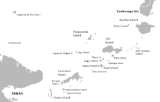
Sulu Archipelago is an island chain in the southwest Philippines
Philippines

The Philippines, officially known as the Republic of the Philippines, is a country in Southeast Asia with Manila as its capital city. It comprises 7,107 islands in the western Pacific Ocean....
. It is considered to be part of Moroland by the local independence movement. With the centers in Maimbung and Jolo
Jolo, Sulu

Jolo is located on Jolo Island. Jolo is a 2nd class Philippine municipality in the Philippine province of Sulu province, Philippines. Jolo is the capital municipality of the Sulu province....
, the whole of this archipelago, Palawan and coastal regions of the Zamboanga Peninsula
Zamboanga Peninsula

Zamboanga Peninsula is both a peninsula and an Regions of the Philippines in the Philippines. Designated as Region IX, the region consists of three Provinces of the Philippines, namely, Zamboanga del Norte, Zamboanga del Sur, and Zamboanga Sibugay, and the chartered and Independent city of Zamboanga City at the south-eastern tip, with Pagadia...
 and North Borneo used to be part of the thalassocratic
Thalassocracy

The term thalassocracy refers to a state with primarily maritime realms?an empire at sea, such as the Phoenician network of merchant cities....
 Sultanate of Sulu and North Borneo. It is home to the indigenous Tausug
Tausug

File:PhetandingKoBayanan.jpgThis article is about the people name Tausug. For their language, see Tausug language.The 'Tausug' or 'Suluk people' are an ethnic group of the Philippines and Malaysia....
, various Samal
Samal

Samal may refer to:*cultures**The Languages of the Philippines of the Sulu Archipelago in island Southeast Asia**The ethnic groups that speak this language ...
 (Sama
Sama

Sama may refer to:* A verse from the Samaveda, one of the Vedas* Sama , a part of Harstad city in northern Norway* Sama, Asturias, a parish in the municipality of Langreo in northern Spain...
) groups, including the semi-nomadic Badjaw
Bajau

The Bajau, are an Indigenous peoples of Asia ethnic group of Malaysia and the southern Philippines. Although native to the southern Philippines, due to escalated conflicts in the Sulu Archipelago in the southern part of the country, many of the Bajau had migrated to neighboring Malaysia over the course of 50 years, where currently they are t...
, land-based Sama, the closely related Yakan
Yakan

The Yakan are one of the 13 Moro groups in the Philippines. They mainly reside in Basilan.The Yakans are the traditional settlers of Basilan Island in the Southern Philippines, situated to the west of Zamboanga in Mindanao....
, and Jama Mapun peoples.


Discussion
Ask a question about 'Sulu Archipelago'
Start a new discussion about 'Sulu Archipelago'
Answer questions from other users
Full Discussion Forum


Encyclopedia


Sulu Archipelago is an island chain in the southwest Philippines
Philippines

The Philippines, officially known as the Republic of the Philippines, is a country in Southeast Asia with Manila as its capital city. It comprises 7,107 islands in the western Pacific Ocean....
. It is considered to be part of Moroland by the local independence movement. With the centers in Maimbung and Jolo
Jolo, Sulu

Jolo is located on Jolo Island. Jolo is a 2nd class Philippine municipality in the Philippine province of Sulu province, Philippines. Jolo is the capital municipality of the Sulu province....
, the whole of this archipelago, Palawan and coastal regions of the Zamboanga Peninsula
Zamboanga Peninsula

Zamboanga Peninsula is both a peninsula and an Regions of the Philippines in the Philippines. Designated as Region IX, the region consists of three Provinces of the Philippines, namely, Zamboanga del Norte, Zamboanga del Sur, and Zamboanga Sibugay, and the chartered and Independent city of Zamboanga City at the south-eastern tip, with Pagadia...
 and North Borneo used to be part of the thalassocratic
Thalassocracy

The term thalassocracy refers to a state with primarily maritime realms?an empire at sea, such as the Phoenician network of merchant cities....
 Sultanate of Sulu and North Borneo. It is home to the indigenous Tausug
Tausug

File:PhetandingKoBayanan.jpgThis article is about the people name Tausug. For their language, see Tausug language.The 'Tausug' or 'Suluk people' are an ethnic group of the Philippines and Malaysia....
, various Samal
Samal

Samal may refer to:*cultures**The Languages of the Philippines of the Sulu Archipelago in island Southeast Asia**The ethnic groups that speak this language ...
 (Sama
Sama

Sama may refer to:* A verse from the Samaveda, one of the Vedas* Sama , a part of Harstad city in northern Norway* Sama, Asturias, a parish in the municipality of Langreo in northern Spain...
) groups, including the semi-nomadic Badjaw
Bajau

The Bajau, are an Indigenous peoples of Asia ethnic group of Malaysia and the southern Philippines. Although native to the southern Philippines, due to escalated conflicts in the Sulu Archipelago in the southern part of the country, many of the Bajau had migrated to neighboring Malaysia over the course of 50 years, where currently they are t...
, land-based Sama, the closely related Yakan
Yakan

The Yakan are one of the 13 Moro groups in the Philippines. They mainly reside in Basilan.The Yakans are the traditional settlers of Basilan Island in the Southern Philippines, situated to the west of Zamboanga in Mindanao....
, and Jama Mapun peoples. The Tausug language
Tausug language

Tausug is a Visayan languages spoken in Sulu province in the Philippines, Malaysia and Indonesia by the Tausug people....
 is spoken widely as both a first and second language throughout the archipelago. The Yakan language is spoken mainly in Basilan
Basilan

'Basilan' is an island Provinces of the Philippines of the Philippines most of which is located within the Autonomous Region in Muslim Mindanao , except its capital, Isabela City, which is administered as part of the Zamboanga Peninsula Region....
 Island. Numerous dialects of Sinama are spoken throughout the archipelago, from the Tawi-Tawi
Tawi-Tawi

Tawi-Tawi is an island Provinces of the Philippines of the Philippines located in the Autonomous Region in Muslim Mindanao . The capital of Tawi-Tawi is Bongao....
 Island group, to the Mapun island group (Mapun), to the coast of Mindanao and beyond.

The island chain is one of two partial land bridges to Borneo
Borneo

Borneo is the List of islands by area and is located at the centre of Maritime Southeast Asia. Administratively, this island is divided between Indonesia, Malaysia and Brunei....
 and is an important migration route for birds. Excavations in Bolobok Cave (Sanga-Sanga Island, Tawi-Tawi Province) shows human settlement around 2,000 years before the birth of Christ. So far, it is a definitive source of the beginning of artistic development in the country.

History


Spain’s hold on Mindanao was tenuous, especially the south and the archipelagos of Sulu and Balangingi, where power was under the control of Royal Sultanate of Sulu. Although as early as the 16th century, expeditions against the sultanate were launched, and the independent sovereigns was made to recognize Spanish sovereignty by paying a regular tribute of pearls, the effective occupation of Jolo by Spaniards did not take place until after 1876. From the 16th century onwards there were all in all 16 military campaigns against Jolo, five resulting in occupation and all except the last were short-lived. For more than three centuries, the Spaniards had held Jolo for a short period of a three decade

From its first encounters with Jolo, Spain was met with stiff resistance from a highly organized people under the Sulu sultanate, which was established in 1457 by a Johore-born Arab adventurer, Shari’ful Hashem Syed Abu Bak’r, arrived in Sulu from Melaka in 1450. The sultanate had strong ties with Borneo, which by the 15th century was influenced by Islam.

Although Miguel Lopez de Legazpi had successfully established a colony in Cebu in May 1565, the initial push of the Spanish conquista was northwards. It was not until June 1578 that Gov. Gen Francisco de Sande dispatched captain Esteban Rodriguez de Figueroa, together with Jesuit priest Juan del Campo and Coadjutor Gaspar Gomez to Jolo. The result was not occupation but a negotiated compromise where the Sulu sultan paid a regular tribute in pearls. The following year, Figueroa was awarded the sole right to colonize Mindanao. In 1587 during a campaign against the Borneo launched by Sande, Figueroa attacked and burnt Jolo. The Spaniards left Jolo after a few days, probably they had no intentions of occupation, but were merely securing their rear on their way to conquer Borneo. Spanish hostilities had secured the Joloanos resolve to resist Spanish intrusions. In response to attacks, raids were conducted against the settlements and reducciones organized by Spain. In 1593, the first permanent Catholic mission was established in Zamboanga, and three years later, Spain launched another attack on Jolo but was repelled by Rajah Bongsu. In November of that year, the Spanish government sent Juan Ronquillo to in Tampakan to thwart the raiders but by the following year, the Spaniards had repositioned themselves in Caldera Bay (Recodo), Zamboanga. In 1598 another expedition launched against Jolo was successfully repelled by the Joloanos.

In late 1600, Capitan Juan Gallinato with a contingent of 200 attacked Jolo but they were decimated. By 1601, after three months’ heavy fighting Spanish force retreated unable to capture Jolo. In 1628, a raiding force of 200 Spanish officers and 1,600 soldiers was organized against Jolo to break the back of the slave raiders, however, the large expedition failed to take Jolo. Again on 17 March 1630, a large Spanish contingent of 2,500 men, attacked Jolo with 2,500 troops but to no avail. When the commander Lorenzo de Olazo was wounded, the contingent retreated.

On 4 January 1638 de Corcuera again led an expedition of 80 ships and 2,000 troops to Jolo but Sultan Wasit launched a successful defense. However, an epidemic within Sultan Wasit’s kuta so he and his chieftains sought refuge in Dungun Tawi-Tawi. The Spaniards freely occupied Jolo, where a small garrison was left to control the area. The Spanish contingent was annihilated by frequent raids launched by Sultan Wasit; by 1645 the garrison was completely wiped out. This was the first time Jolo had been occupied by the Spaniards for an appreciable length of time.

From 1663 to 1718, an interregnum of peace reigned because Spanish troops were ordered to abandon Zamboanga and all the garrisons south and regroup in Manila to prepare for the impending attack of Koxinga, which never materialized.

Hostilities resumed in the 18th century and this was triggered by the decision in 1718 by Gov. Gen Juan Antonio dela Torre Bustamante to reconstruct Real Fuerza de San José in Bagumbayan, Zamboanga. The fort completed in 1719 was renamed Real Fuerza del Pilar de Zaragosa (Fort Pilar is its popular name today). The rebuilt fort was inaugurated on 16 April by Don Fernando Bustillos Bustamante Rueda, senior maestro de campo of Zamboanga. Three years later in 1722, the Spaniards were launching another expedition against Jolo. Lead by Andres Garcia, the expedition failed miserably. In 1731, General Ignacio Iriberri lead a force of 1000 to Jolo and captured it after a lengthy siege. But the Spaniards left after a few days.

In 1755, contingent of 1,900 men led by captains Simeon Valdez and Pedro Gastambide was sent to Jolo to avenge for the raids by Sultan Muiz ud-Din. But were roundly defeated. In 1775, after Moro raid on Zamboanga, Capitan Vargas led a punitive expedition against Jolo but was repulsed.

The second half of the 18th century saw a new player in the Sulu Zone. After occupying Manila from 1762-64, during the Thirty years war between Spain and England, the British withdrew south. There they established trading alliances between the Sulu Sultanate and the British East India Company. Spanish attacks on Jolo were now directed at weakening British trading interests in the south. In 1784, Aguilar conducted a series of unsuccessful assaults against Jolo and in 1796, Spanish Admiral Jose Alava was sent from Madrid with a powerful naval fleet to stop slave-raiding attacks coming from the Sulu Sea. British presence was signaled when in 1798, Fort Pilar in Zamboanga was bombarded by the British navy, which had established a base in Sulu. In 1803, the Lord Arthur Wellesley, governor-general of India, ordered Robert J. Fraquhar to transfer trading and military operations to Balambangan island in Borneo. By 1895, the British had withdrawn its military from Sulu.

In 1815 saw the end of the galleon trade with Mexico as the wars of independence in the Americas was brewing. In 1821, administration of the Philippines fell directly under Madrid after Mexico had become independent. The Madrid government sought to end the “Moro threat.” In 1824, the Marina Sutil, a light and maneuverable armada under Capitan Alonso Morgado encountered the slave raiders in the Sulu Sea.

In 1844, Gov. Gen. Narciso Claveria led yet another expedition against Jolo and in 1848 Claveria with powerful gunboats Magallanes, El Cano, and Reina de Castilla brought from Europe supervised the attack on Balangingi stronghold in Tungkil. The raid resulted in the capture of many Sama Balangingi and the exile of many to the tobacco fields of Cagayan Valley. However, the leader of the Sama, Paglima Taupan, was not captured. With the fall of the Balangingi, a powerful ally of the Sulu Sultanate was decimated, this started the downturn of the sultanate’s maritime sea power. In 1850, Gov.Gen. Juan Urbiztondo continued with Claveria’s campaign and successfully annihilated of the remaining Balangingi strongholds at Tungkil. However, a raid on Jolo that same year was a failure. On 28 February 1851, Urbiztondo launched another campaign against Jolo, destroying the whole town by fire and confiscating 112 pieces of artillery. But the Spanish troops withdrew after their successful assault.

In 1876, the Spanish launched a massive campaign to occupy Jolo. Spurred by the need to curb slave raiding once and for all and worried about the presence of other Western powers in the south (the British had established trading centers in Jolo by the 19th century and the French were offering to purchase Basilan Island from the cash strapped government in Madrid), the Spanish made a final bid to consolidate their rule in this southern frontier. On 21 February of that year, the Spaniards assembled the largest contingent against Jolo, consisting of 9,000 soldiers, in 11 transports, 11 gunboats, and 11 steamboats. Headed by Admiral Jose Malcampo captured Jolo and established a Spanish settlement with Capt. Pascual Cervera appointed to set up a garrison and serve as military governor; He served from March 1876 to December1876 followed by Brig.Gen. Jose Paulin (December 1876-April 1877), Col Carlos Martinez (Sept 1877-Feb 1880), Col. Rafael de Rivera (1880-1881), Col. Isidro G. Soto (1881-1882), Col. Eduardo Bremon, (1882), Col. Julian Parrrado (1882-1884), Col. Francisco Castilla (1884-1886), Col. Juan Arolas (1886-18930, Col. Caesar Mattos (1893), Gen. Venancio Hernandez (1893-1896) and Col. Luis Huerta (1896-1899).

The Spaniards were never secure in Jolo so by 1878 they had fortified Jolo with a perimeter wall and tower gates, built inner forts called Puerta Blockaus, Puerta España, and Puerta Alfonso XII; and two outer fortifications named Princesa de Asturias and Torre de la Reina. Troops , including a cavalry with its own lieutenant commander, were garrisoned within the protective confine of the walls. From Jolo, in 1880 Col. Rafael Gonzales de Rivera who was appointed the governor dispatched the 6th Regiment to Siasi and Bongao islands. The Spaniards were not secure in their stronghold because it would be sporadically attacked. On 22 July 1883, it is reported that three unnamed juramentado succeeded in penetrating the Jolo town plaza and killed three Spaniards.; The word “Ajuramentado” was coined by Spanish colonel Juan Arolas after witnessing several such acts while serving duty in Jolo garrison.

1898 was a fateful year for the Philippines because this spelled a change in colonial rulers. On 25 February Dewey, received secret cable instructions from Theodore Roosevelt, Assistant Secretary to the Navy, to sail for Manila. On 23 April, Gov. Gen. Basilio Augustin y Davila announced the defeat of Spanish troops in the Battle of San Juan against the revolucionarios and the presence of Commodore George Dewey, commander of the U.S. Asiatic Squadron, who was sailing from Honking toward the Philippines. On 1 May, Dewey defeated the Spanish Admiral Patricio Montojo y Parasan at the Battle of Manila Bay and secured Manila. For his success, the US Congress promoted Dewey is promoted to Rear Admiral on May 10. Sensing that the Americans were going to renege on their promise to recognize the independence of the Philippines, on 12 June, Gen. Emilio Aguinaldo declared Philippine independence in Kawit, Cavite. However, the United States was doing its own negotiations with Spain. On 21 November U.S. peace commissioners presented Spain with an ultimatum to sign the Treaty of Paris ceding the Philippines to the United States in exchange for 20 million dollars. On 10 December the treaty was signed between the United States and Spain. The Philippines was now a US colony. On 21 December, US Pres. William McKinley promulgated the policy of benevolent assimilation and ten day later, he instructed the War Department to establish military government over the Philippines. On 4 January of the following year, Gen. Otis who was assigned to the Philippines proclaimed that the islands were under the sovereignty and complete control of the United States of America. Jolo was now in American hands.

The fortifications of Jolo remained in good state during the American occupation, when its walls, gates and the buildings within it were photographed. These early 20th cent images of Jolo show a well-ordered and planned community, neatly laid out in a grid of streets and blocks — characteristics of Spanish urbanism applied with the rigidity characteristic of the military. The World War years did not see much destruction on the fabric of the fortification walls. A map drawn by the US Navy in 1944, at the end of the World War, shows that much of the walls were still standing. It is in the post war years that the walls degraded. Jolo suffered major destruction due to bombardment and fire during the military operations in Jolo in 1973. There are no records of how much of the existing walls were destroyed during this time. Presently, short stretches of a degraded perimeter wall still exist but takes some doing to find because they are covered by houses of buildings or degraded to less than a meter in height.

See also

  • Basilan
    Basilan

    'Basilan' is an island Provinces of the Philippines of the Philippines most of which is located within the Autonomous Region in Muslim Mindanao , except its capital, Isabela City, which is administered as part of the Zamboanga Peninsula Region....
  • Tawi-Tawi
    Tawi-Tawi

    Tawi-Tawi is an island Provinces of the Philippines of the Philippines located in the Autonomous Region in Muslim Mindanao . The capital of Tawi-Tawi is Bongao....
  • Sulu
    Sulu

    Sulu is an island Provinces of the Philippines of the Philippines located in the Autonomous Region in Muslim Mindanao . Its capital is Jolo, Sulu and occupies the middle group of islands of the Sulu Archipelago, between Basilan and Tawi-Tawi....
  • Banguingui
    Banguingui

    Banguingui, also known as Sama Banguingui, Sama Bangingi?, Bangingi, and Samal Banguingui, is a distinct ethno-linguistic group dispersed throughout the Sulu Archipelago and southern and western coastal regions of the Zamboanga Peninsula in Mindanao....
  • Operation Enduring Freedom - Philippines
    Operation Enduring Freedom - Philippines

    Operation Enduring Freedom - Philippines is part of Operation Enduring Freedom and the United States Global War on Terrorism. About 500 U.S. military personnel are advising and assisting the Armed Forces of the Philippines in the Southern Philippines....